

Introduction
The comparison of Peptide vs Antibody Oligonucleotide Conjugates has become an important topic in the development of modern oligonucleotide therapeutics. Antisense oligonucleotides, siRNA molecules, and other nucleic acid drugs offer powerful ways to regulate gene expression. However, one of the biggest barriers to their success is efficient delivery to the right cells and tissues. Without proper delivery systems, these molecules may struggle to cross biological membranes or reach target tissues in sufficient concentrations. Even when they reach the desired tissue, entering the cell and escaping intracellular barriers can still limit their therapeutic effect. Because of this, scientists have focused heavily on developing delivery platforms that improve cellular uptake and biodistribution.
For organizations looking to accelerate early-stage discovery through tailored molecular design: Explore Custom Synthesis for Drug Discovery
One widely explored strategy involves attaching oligonucleotides to biologically active carrier molecules. Two major approaches include Peptide-Oligonucleotide Conjugates (POCs) and Antibody-Oligonucleotide Conjugates (AOCs). Both systems aim to enhance delivery performance while preserving the biological activity of the nucleic acid payload.
Although these platforms share a similar goal, they differ significantly in structure, delivery mechanisms, pharmacokinetics, and manufacturing complexity. These differences can strongly influence how well each strategy works in different therapeutic settings. Rather than providing only a general overview, this article explores the major design considerations involved in choosing between Peptide vs Antibody Oligonucleotide Conjugates. The discussion highlights their strengths, limitations, and practical applications in modern oligonucleotide drug development.
Share via:
Peptide vs Antibody Oligonucleotide Conjugates: Key Structural Differences
One of the most important differences in the comparison of Peptide vs Antibody Oligonucleotide Conjugates is their molecular structure and size. These structural properties influence how each conjugate behaves in biological environments, including circulation time, tissue penetration, and cellular uptake.
Peptide conjugates are built using short synthetic peptide sequences that are chemically attached to an oligonucleotide payload. Because peptides are relatively small molecules, the resulting conjugates are compact and flexible. This smaller structure often allows them to move through tissues more easily and interact with cellular membranes.
Antibody-based conjugates use full-length monoclonal antibodies as targeting carriers. Antibodies are large proteins that contain highly specific antigen-binding domains. When oligonucleotides are attached to these antibodies, the conjugates combine antibody targeting precision with the gene-modulating abilities of nucleic acid therapeutics.
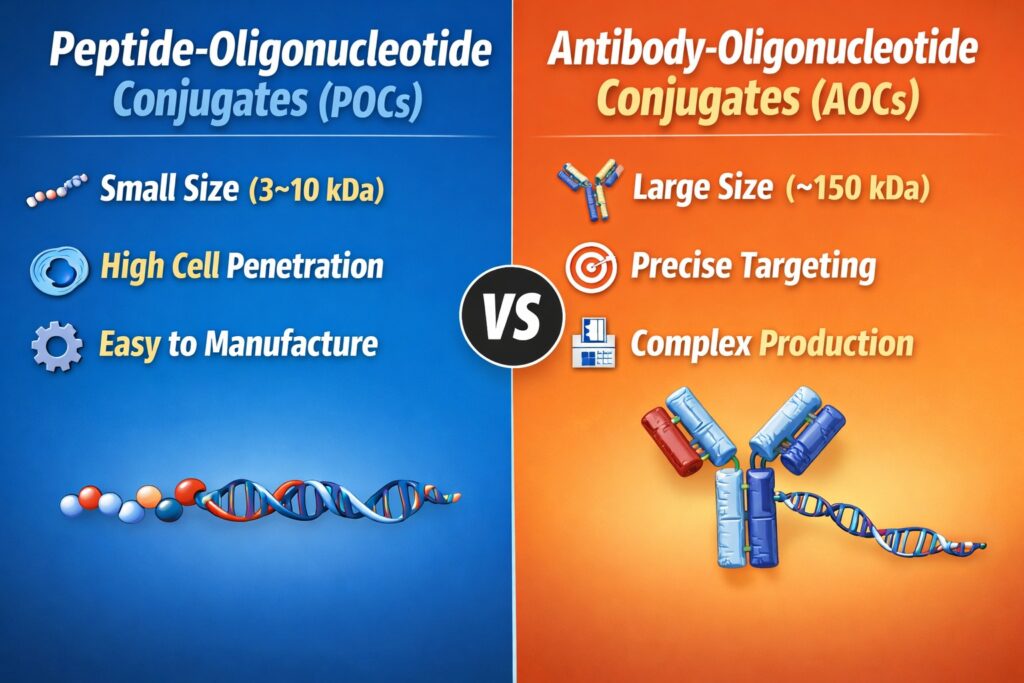
The difference in molecular size is significant. Peptides are typically only a few kilodaltons in size, while antibodies have molecular weights of around 150 kDa. This size gap influences many aspects of biological behavior, including tissue penetration, circulation time, and receptor interactions.
Understanding these structural differences is essential when designing oligonucleotide therapeutics. Researchers must evaluate how molecular architecture affects stability, delivery efficiency, and therapeutic performance in specific disease environments.
To understand the specific structural types and variations available for therapeutic design: Learn About Types of Peptide Oligonucleotide Conjugates
Peptide-Oligonucleotide Conjugates (POCs)
Peptide-Oligonucleotide Conjugates are composed of several functional components that work together to enhance nucleic acid delivery. In most cases, an antisense oligonucleotide or siRNA molecule is linked to a short peptide sequence through a chemical linker.
The peptide portion of the conjugate acts as a carrier that helps the nucleic acid reach and enter target cells. Depending on the design, the peptide can improve cellular uptake, enhance stability, or provide receptor-specific targeting.
Researchers can select peptide sequences with specific biological functions. Some peptides promote membrane interaction and cellular internalization, while others bind to receptors expressed on certain tissues. This flexibility allows POCs to be customized for a wide range of therapeutic applications.
For comprehensive support in the development and production of these molecular hybrids: Access Peptide Oligonucleotide Conjugation Services
Cell-penetrating peptides (CPPs) are among the most commonly used peptides in POCs. Examples include TAT and penetratin, which are known for their ability to cross cellular membranes. These peptides can significantly improve the intracellular delivery of attached therapeutic molecules.
Other peptides may be designed to stabilize the oligonucleotide or enhance its retention inside the cell. These modifications help ensure that the therapeutic payload remains intact long enough to interact with its intended genetic target.
Because peptide sequences are relatively short, most POCs have a molecular weight between 3 and 10 kDa. This compact structure contributes to faster tissue penetration and efficient distribution throughout biological systems.
Antibody-Oligonucleotide Conjugates (AOCs)
Antibody-Oligonucleotide Conjugates represent a different strategy for nucleic acid delivery. In these systems, oligonucleotide molecules are attached to monoclonal antibodies that serve as targeting vehicles.
AOCs typically consist of three major components: a monoclonal antibody, an oligonucleotide payload such as antisense RNA or siRNA, and a linker that connects the two molecules. The linker must be stable enough to survive circulation while still allowing the therapeutic payload to function inside target cells.
Structurally, AOCs resemble antibody-drug conjugates (ADCs), which are commonly used in oncology. However, instead of delivering cytotoxic drugs, AOCs carry nucleic acid therapeutics capable of regulating gene expression.
One of the strongest advantages of antibody-based delivery is targeting precision. Antibodies can bind to specific antigens with extremely high affinity. This allows the conjugate to deliver oligonucleotides selectively to cells that express the targeted receptor.
Because of this property, AOCs are often explored in diseases where defined cell populations need to be targeted. This includes cancer, muscle disorders, and other conditions where specific receptors are highly expressed.
Antibody-mediated targeting can also trigger receptor-mediated internalization, allowing the conjugate to enter cells through natural biological pathways.
If you are looking for a specialized partner to handle the research and development of these complex molecules: Partner with a Peptide Oligonucleotide Conjugates CRO
Peptide vs Antibody Oligonucleotide Conjugates in Cellular Uptake Efficiency
Cellular uptake is one of the most important factors affecting the success of oligonucleotide therapeutics. When comparing Peptide vs Antibody Oligonucleotide Conjugates, peptide-based systems often show stronger intracellular delivery.
Because peptides can interact directly with cellular membranes, POCs can facilitate the transport of nucleic acids across biological barriers. Their smaller size and flexible structure allow them to approach cell membranes more easily than larger biomolecules.
Many peptides used in these conjugates are specifically engineered to promote membrane interaction and internalization. This feature is critical for therapies that depend on reaching intracellular targets.
Antibody-based systems rely primarily on receptor binding followed by internalization through endocytosis. While this approach provides excellent targeting specificity, uptake efficiency may depend on receptor density and cellular internalization rates.
To dive deeper into the biological pathways these molecules use to enter cells: Review the POC Mechanism of Action
POC Uptake Mechanisms
Peptide-Oligonucleotide Conjugates use several biological pathways to enter cells. One common mechanism is receptor-triggered endocytosis, where the peptide interacts with membrane receptors that initiate cellular uptake.
Another mechanism involves direct membrane translocation. Some cell-penetrating peptides can cross lipid bilayers without traditional receptor-mediated pathways. This allows the oligonucleotide cargo to enter cells more directly.
Endosomal escape is also a key factor. After internalization, therapeutic molecules may become trapped in endosomes. Certain peptides are designed to disrupt endosomal membranes and release the oligonucleotide into the cytoplasm.
These mechanisms make peptide-based systems highly effective for delivering antisense oligonucleotides into difficult cell types, including muscle cells and neurons.
AOC Uptake Mechanisms
Antibody-Oligonucleotide Conjugates rely primarily on receptor-mediated internalization. The antibody binds to a specific antigen on the cell surface, which triggers endocytosis of the receptor-antibody complex.
This mechanism allows AOCs to deliver nucleic acid therapeutics specifically to cells that express the targeted receptor. As a result, off-target delivery to other tissues is reduced.
Several receptors are commonly used in antibody targeting strategies. Examples include CD71 (transferrin receptor), ASGPR in liver cells, and tumor-associated antigens in cancer therapy.
However, uptake efficiency depends heavily on receptor density and internalization behavior. If a target receptor is expressed at low levels, fewer conjugates may enter the cell.
Peptide vs Antibody Oligonucleotide Conjugates: Pharmacokinetics and Biodistribution
The pharmacokinetic profiles of Peptide vs Antibody Oligonucleotide Conjugates differ significantly due to their molecular size and biological properties.
POCs typically distribute quickly into tissues because their smaller size allows them to pass through biological barriers more easily. This rapid distribution can help therapeutic molecules reach intracellular targets faster.
Antibody-based conjugates tend to remain in circulation for longer periods. Their structural stability and interactions with Fc receptors help extend their half-life in the bloodstream.
These differences influence dosing strategies, tissue exposure, and therapeutic effectiveness.
For detailed insights into how these conjugates move through and are eliminated from the body: Read About POC Pharmacokinetics
POC Pharmacokinetics
Peptide-Oligonucleotide Conjugates often show rapid tissue penetration and distribution. Their small size enables them to diffuse efficiently through capillary walls and extracellular matrices.
This property is particularly beneficial when therapeutic targets are located deep within tissues. Reduced steric hindrance allows the conjugates to interact more freely with cellular membranes.
However, small molecular size can also lead to faster renal clearance. POCs may be filtered by the kidneys and removed from circulation more quickly than larger molecules.
Despite this limitation, their strong intracellular delivery capabilities often compensate for shorter circulation times.
AOC Pharmacokinetics
Antibody-Oligonucleotide Conjugates typically exhibit long systemic half-lives similar to monoclonal antibody therapeutics.
This extended circulation is mainly due to Fc-mediated recycling through neonatal Fc receptors (FcRn). These receptors protect antibodies from degradation and return them to the bloodstream.
Longer circulation times allow sustained exposure of target tissues to the therapeutic conjugate. This can improve treatment effectiveness and reduce dosing frequency.
However, the large size of antibody molecules can limit their ability to penetrate dense or poorly vascularized tissues.
Peptide vs Antibody Oligonucleotide Conjugates in Targeting Specificity
Targeting specificity is another important factor in the comparison of Peptide vs Antibody Oligonucleotide Conjugates.
Antibody-based systems provide extremely precise targeting because antibodies bind to antigens with very high affinity. This allows therapeutic payloads to be directed toward specific cell populations.
Peptide-based systems generally offer broader tissue penetration and efficient cellular entry. Although their targeting may be less specific than antibodies, their flexibility allows them to interact with multiple biological pathways.
The optimal choice often depends on whether precise targeting or widespread intracellular delivery is more important for the therapy.
Targeting Strengths of AOCs
Antibody-Oligonucleotide Conjugates benefit from the natural targeting ability of monoclonal antibodies. These proteins are engineered to recognize specific antigens with very high affinity.
This selectivity allows researchers to deliver nucleic acid therapeutics directly to cells expressing the target receptor. Such precision is particularly valuable in cancer therapies.
Antibody targeting is also used in tissue-specific gene modulation and precision medicine applications.
Targeting Strengths of POCs
Peptide-based targeting relies on interactions between peptide ligands and cellular receptors or biological environments.
Some peptides are engineered to recognize receptors expressed in particular tissues. Others function as cell-penetrating peptides that facilitate entry into many types of cells.
Although peptide affinity is usually lower than antibody affinity, their small size allows deeper tissue penetration and broader distribution.
Manufacturing Complexity: Peptide vs Antibody Oligonucleotide Conjugates
Manufacturing considerations play a major role when selecting between Peptide vs Antibody Oligonucleotide Conjugates.
Peptide-based systems generally involve simpler and more scalable production processes. Both peptides and oligonucleotides can be synthesized using well-established chemical methods.
Antibody-based systems require more complex workflows, including cell culture production, purification steps, and controlled conjugation chemistry.
These differences significantly influence development cost and production timelines.
POC Manufacturing Advantages
Peptides can be produced using solid-phase peptide synthesis, a reliable and widely used technique. This process allows precise control over amino acid sequence and chemical modifications.
Oligonucleotides are also synthesized using automated solid-phase methods. After both components are produced, they can be linked using straightforward conjugation chemistry.
Because these steps are highly automated, POCs can often be manufactured faster and at lower cost.
To learn more about the specific chemical strategies used to join these components: Explore POC Linker Chemistry
AOC Manufacturing Challenges
Producing Antibody-Oligonucleotide Conjugates involves several technically demanding steps.
Monoclonal antibodies must first be generated using mammalian expression systems. These processes require specialized facilities and strict quality control.
After purification, the oligonucleotide must be attached using controlled conjugation chemistry. Maintaining consistent drug-to-antibody ratios is essential for product stability and performance.
For expert guidance on meeting regulatory and quality standards during production: View CMC Services for Peptide Oligonucleotide Conjugates
Table: Peptide vs Antibody Oligonucleotide Conjugates
| Feature | Peptide-Oligonucleotide Conjugates | Antibody-Oligonucleotide Conjugates |
|---|---|---|
| Molecular size | Small (3–10 kDa) | Large (~150 kDa) |
| Cellular uptake | High intracellular penetration | Receptor-mediated internalization |
| Targeting specificity | Moderate | Very high |
| Tissue penetration | Excellent | Limited in dense tissues |
| Circulation half-life | Shorter | Longer |
| Manufacturing complexity | Low–moderate | High |
| Development cost | Lower | Higher |
| Clinical targeting | Broad tissue applications | Highly specific receptor targeting |
This comparison highlights the major differences between Peptide vs Antibody Oligonucleotide Conjugates from both biological and engineering perspectives.
Application-Driven Selection: When to Use POCs vs AOCs
Selecting the right delivery platform depends heavily on the therapeutic goal and biological context.
Researchers must evaluate factors such as tissue accessibility, receptor expression, and pharmacokinetic requirements when deciding between Peptide vs Antibody Oligonucleotide Conjugates.
POCs Are Preferred When
Peptide-Oligonucleotide Conjugates are often chosen when efficient intracellular delivery is essential. Their ability to penetrate tissues and enter cells makes them suitable for therapies targeting gene expression inside cells.
They are also useful when therapeutic targets are located within dense tissues that are difficult for large molecules to access.
Because POCs are easier to manufacture and modify, they are commonly used during early drug development and optimization.
AOCs Are Preferred When
Antibody-Oligonucleotide Conjugates are preferred when precise targeting of specific cell populations is required.
Their antibody component allows selective binding to receptors expressed on certain tissues, enabling highly focused delivery.
They are commonly explored in oncology, muscle-specific therapies, and precision gene-silencing strategies.
Emerging Research Trends in Peptide vs Antibody Oligonucleotide Conjugates
Recent advances in oligonucleotide delivery are exploring hybrid approaches that combine features of both peptide and antibody platforms.
Some new systems incorporate peptide sequences into antibody-based constructs. In these designs, antibodies provide targeting while peptides improve cellular penetration and endosomal escape.
Researchers are also developing multivalent peptide targeting strategies that increase binding strength and uptake efficiency.
These innovations aim to improve intracellular delivery, targeting precision, and therapeutic performance.
Conclusion
The comparison of Peptide vs Antibody Oligonucleotide Conjugates highlights two powerful strategies for improving the delivery of nucleic acid therapeutics.
Peptide-based conjugates offer strong cellular penetration, rapid tissue distribution, and simpler manufacturing processes. Their small size allows efficient intracellular delivery, making them valuable for therapies that require direct interaction with genetic targets.
Antibody-based conjugates provide exceptional targeting precision and long circulation times. Their ability to recognize specific cell-surface antigens enables highly selective therapeutic delivery.
Ultimately, the choice between Peptide vs Antibody Oligonucleotide Conjugates depends on therapeutic objectives, target tissue characteristics, and pharmacokinetic requirements. A clear understanding of these factors helps researchers design more effective nucleic acid therapies.
To ensure the safety and efficacy of your final therapeutic product: Inquire About QC Testing for Peptide Oligonucleotide Conjugates
For research collaborations or analytical support related to oligonucleotide conjugates, you can contact the team here: Contact us
Frequently Asked Questions (FAQs)
Several factors influence the selection of a conjugation platform, including the targeting strategy, tissue accessibility, pharmacokinetics, and therapeutic mechanism. Peptide conjugates are usually selected when strong intracellular delivery and tissue penetration are needed. Antibody conjugates are preferred when precise receptor-specific targeting and longer circulation time are important.
In many situations, yes. Peptide-oligonucleotide conjugates often show better cellular uptake because many peptides function as cell-penetrating molecules. These peptides help therapeutic oligonucleotides cross cell membranes and reach the cytoplasm. This improves the ability of antisense or siRNA molecules to interact with their genetic targets.
Antibodies naturally bind to target antigens with extremely high affinity and selectivity. When oligonucleotides are attached to antibodies, the conjugates can deliver nucleic acid therapeutics specifically to cells expressing that receptor. This targeted approach improves therapeutic precision and helps reduce unwanted effects in non-target tissues.
Major challenges include complex manufacturing processes, maintaining consistent drug-to-antibody ratios, and ensuring stability of the oligonucleotide payload. Achieving efficient intracellular release after receptor-mediated uptake is another key development challenge. These factors require careful optimization during research and production.
Linkers play a critical role in connecting the oligonucleotide payload to the carrier molecule. A well-designed linker ensures stability during circulation while allowing the therapeutic payload to function inside the target cell. Proper linker selection can greatly influence the effectiveness and safety of the conjugate.
Reference:
- Dugal-Tessier, J., Thirumalairajan, S., & Jain, N. (2021). Antibody-oligonucleotide conjugates: A twist to antibody-drug conjugates. Journal of Clinical Medicine, 10(4), 838. https://doi.org/10.3390/jcm10040838
- Dovgan, I., Koniev, O., Kolodych, S., & Wagner, A. (2019). Antibody–oligonucleotide conjugates as therapeutic, imaging, and detection agents. Bioconjugate Chemistry, 30(10), 2483–2501. https://doi.org/10.1021/acs.bioconjchem.9b00306
- Williams, B. A. R., & Chaput, J. C. (2010). Synthesis of peptide–oligonucleotide conjugates using a heterobifunctional crosslinker. Current Protocols in Nucleic Acid Chemistry, 42(1), 4.41.1–4.41.13. https://doi.org/10.1002/0471142700.nc0441s42
- Malinowska, A. L., Huynh, H. L., & Bose, S. (2024). Peptide–oligonucleotide conjugation: Chemistry and therapeutic applications. Current Issues in Molecular Biology, 46(10), 11031–11047. https://doi.org/10.3390/cimb46100655
Get In Touch With Us
About The Author


