


Introduction
Pharmacodynamic Biomarkers in Biosimilar Development provide precise, quantitative measurements of a biological drug’s pharmacological activity and target engagement, enabling the evaluation of biosimilarity without relying exclusively on comparative clinical efficacy trials. The use of sensitive pharmacodynamic (PD) markers allows developers to assess functional equivalence at the physiological or cellular level. These markers offer greater statistical sensitivity for detecting potential differences between a proposed biosimilar and its reference product.
Under the regulatory frameworks established by the U.S. Food and Drug Administration (FDA) and the European Medicines Agency (EMA), biosimilar approval follows a stepwise “Totality of Evidence” approach. This framework prioritizes comprehensive structural, analytical, and functional characterization, followed by clinical pharmacokinetic (PK) and pharmacodynamic (PD) similarity assessments. Comparative clinical efficacy trials (CES) involving patient populations may have limited sensitivity to minor product differences because of heterogeneous patient cohorts, variations in underlying disease conditions, concomitant immunosuppressive medications, and subjective clinical endpoints. In contrast, clinical pharmacology studies that measure sensitive PD biomarkers under well-controlled conditions, such as studies involving healthy volunteers, provide greater quantitative resolution for identifying potential differences in potency, active concentration, or target-binding affinity.
Modern regulatory frameworks, including the U.S. Biologics Price Competition and Innovation Act (BPCIA) and the FDA’s Biosimilars Action Plan, support the expanded application of PD markers. Demonstrating PD similarity instead of relying on comparative efficacy endpoint studies can streamline clinical trial designs, reduce development expenditures, and accelerate patient access to essential biological therapies without compromising standards for safety, purity, and potency.
Share via:
Quick Summary:
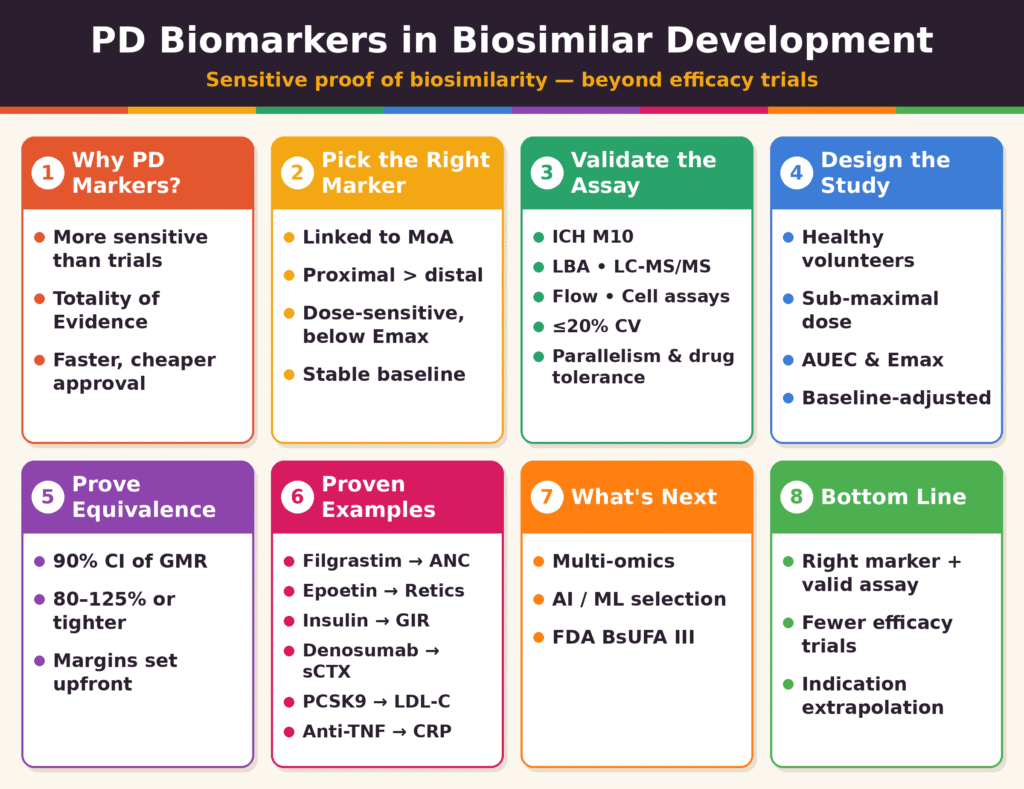
- Why PD biomarkers: They measure a biologic’s pharmacological activity precisely. They detect differences between a biosimilar and its reference product more sensitively than comparative efficacy trials, and they fit the FDA/EMA “Totality of Evidence” approach.
- Selecting the marker: A good marker is directly linked to the drug’s mechanism of action, and proximal markers are preferred. It should show dose sensitivity below the saturating dose (Emax), a stable baseline with low variability, and a wide enough dynamic range.
- Assay validation: Assays follow ICH M10 and run on platforms such as LBA, LC-MS/MS, flow cytometry, and cell-based bioassays. Precision should be within 20% CV (25% at LLOQ). Drug tolerance, parallelism, and matrix selectivity also need to be shown, with the endogenous baseline levels taken into account.
- Study design: Studies usually enrol healthy volunteers and use sub-maximal doses so differences are not hidden at Emax. The main endpoints are AUEC, Emax, and TEmax, adjusted for baseline by subtraction, baseline-adjusted integration, or ANCOVA.
- Equivalence criteria: The 90% CI of the geometric mean ratio must fall within margins set before the study. The usual range is 80–125%, but tighter margins may be needed depending on how variable the biomarker is.
- Regulatory precedents: PD markers have supported approvals for filgrastim (ANC), epoetin (reticulocytes), insulin glargine (GIR), denosumab (sCTX), PCSK9 inhibitors (LDL-C), and anti-TNF antibodies (CRP). They also help justify extrapolating approval to other indications.
- Future directions: Multi-omics profiling, AI/ML-driven marker selection, and FDA BsUFA III research are expanding PD-based approaches. This may reduce the need for comparative efficacy trials and make development faster and cheaper.
Selection Criteria for Pharmacodynamic Biomarkers in Biosimilar Development
Selecting appropriate Pharmacodynamic Biomarkers in Biosimilar Development requires establishing a direct relationship with the drug’s mechanism of action, demonstrating exposure-response sensitivity within non-saturating dose ranges, and ensuring low baseline physiological variability. These selection criteria help ensure that the biomarker accurately reflects receptor engagement and target activation while retaining the dynamic range needed to identify subtle functional differences between the biosimilar and the reference biologic.
Mechanism of Action Linkage and Target Engagement
A candidate PD marker must directly reflect the biologic’s primary mechanism of action (MoA) or a closely associated downstream biological cascade. Proximal biomarkers measure immediate drug-target interactions, such as target receptor occupancy (RO) or Target-Mediated Drug Disposition (TMDD) kinetics. Distal biomarkers measure downstream physiological changes resulting from target activation, including enzyme suppression, cytokine modulation, or cellular proliferation. Proximal markers are generally preferred for bioequivalence evaluations because they reduce the influence of confounding physiological factors that may introduce variability into downstream biological pathways.
To understand how structural and functional attributes contribute to biosimilarity assessments, explore critical quality attributes in biosimilars.
Exposure-Response Relationship and Dose Sensitivity
The selected PD biomarker must demonstrate a clear exposure-response relationship across the clinical concentration range. To identify potential differences in active drug concentration or functional potency, the PD response should be evaluated along the steep, approximately linear portion of the dose-response curve. Administering supratherapeutic or saturating doses at which the maximum response (Emax) is achieved can conceal functional differences between molecules. This occurs because target saturation may produce similar output levels despite subtle differences in binding affinity or potency.
Signal-to-Noise Ratio and Baseline Variability
Candidate biomarkers must demonstrate a high signal-to-noise ratio relative to normal physiological fluctuations. Substantial baseline variability in endogenous biomarker levels can obscure drug-induced effects and reduce statistical power. Ideally, selected biomarkers should exhibit stable baseline concentrations, low intra-subject variability, and predictable return-to-baseline kinetics following drug clearance. These characteristics improve the reliability of PD measurements and help distinguish drug-related changes from normal biological variation.
Key Selection Parameters for Pharmacodynamic Biomarkers
| Selection Parameter | Biological Requirement | Analytical and Regulatory Significance |
|---|---|---|
| MoA Directness | Proximal target engagement or a close association with the biological cascade. | Ensures that observed PD effects are directly attributable to drug activity, supporting indication extrapolation. |
| Dose Sensitivity | Responsiveness to dose changes within non-saturating dose ranges. | Maximizes statistical sensitivity for detecting minor differences in active concentration or potency. |
| Baseline Stability | Low endogenous variation or predictable circadian patterns. | Reduces required sample sizes and improves statistical precision. |
| Dynamic Range | A measurable response window between baseline (E0) and maximum effect (Emax). | Facilitates precise mathematical modeling of the Area Under the Effect Curve (AUEC). |
| Assay Feasibility | Compatibility with standardized bioanalytical platforms. | Supports reproducible quantification across multicenter clinical study timelines. |
Bioanalytical Method Validation for Pharmacodynamic Biomarkers in Biosimilar Development
Bioanalytical method validation for Pharmacodynamic Biomarkers in Biosimilar Development requires the establishment of stringent criteria for accuracy, precision, drug tolerance, parallelism, and matrix selectivity in accordance with ICH M10 guidelines and applicable FDA and EMA bioanalytical standards. Because PD biomarkers are often endogenous molecules naturally present in biological matrices, validation protocols must account for baseline concentrations and potential matrix interference caused by circulating drug substances or anti-drug antibodies (ADAs).
Analytical Platforms for Biomarker Quantification
Selecting an appropriate analytical platform depends on the molecular structure, concentration within the biological matrix, and functional role of the biomarker target. Several analytical techniques are routinely used to quantify PD biomarkers in biosimilar development.
Ligand-Binding Assays (LBA): Platforms such as Enzyme-Linked Immunosorbent Assay (ELISA), Electrochemiluminescence (ECLIA), and automated microfluidic systems, including Gyrolab, are commonly used to measure soluble protein biomarkers, cytokines, and circulating receptors. LBAs offer high analytical sensitivity but require careful evaluation of potential interference caused by target-mediated drug interactions.
Liquid Chromatography-Tandem Mass Spectrometry (LC-MS/MS): This technique is particularly suitable for quantifying small peptide fragments, lipids, steroids, and metabolic intermediates, including ceramide species, cortisol, and bone turnover markers such as sCTX. LC-MS/MS provides high specificity, a broad dynamic range, and multiplexing capabilities without depending on antibody-capture reagents.
Flow Cytometry: Flow cytometry is essential for evaluating cell-surface target engagement, receptor occupancy, and cellular mobilization endpoints. Examples include CD34+ progenitor cell counts and leukocyte subsets. This technique enables the characterization of cellular responses associated with biological drug activity.
Cell-Based Bioassays: Cell-based bioassays are used when neutralizing capability, reporter gene transcription, or cellular proliferation must be quantified to assess functional biological activity. These assays provide information about the biological effects of a drug under defined experimental conditions.
For a broader view of the analytical techniques used to evaluate structural and functional similarities between biological products, see the biosimilar characterization services available for comprehensive analytical assessment.
Key Bioanalytical Validation Parameters
Validation of endogenous biomarker assays differs from conventional pharmacokinetic (PK) bioanalysis because background analytes are naturally present in biological matrices, even when no analyte has been added through spiking. Consequently, validation strategies must account for endogenous concentrations and their potential effects on assay performance.
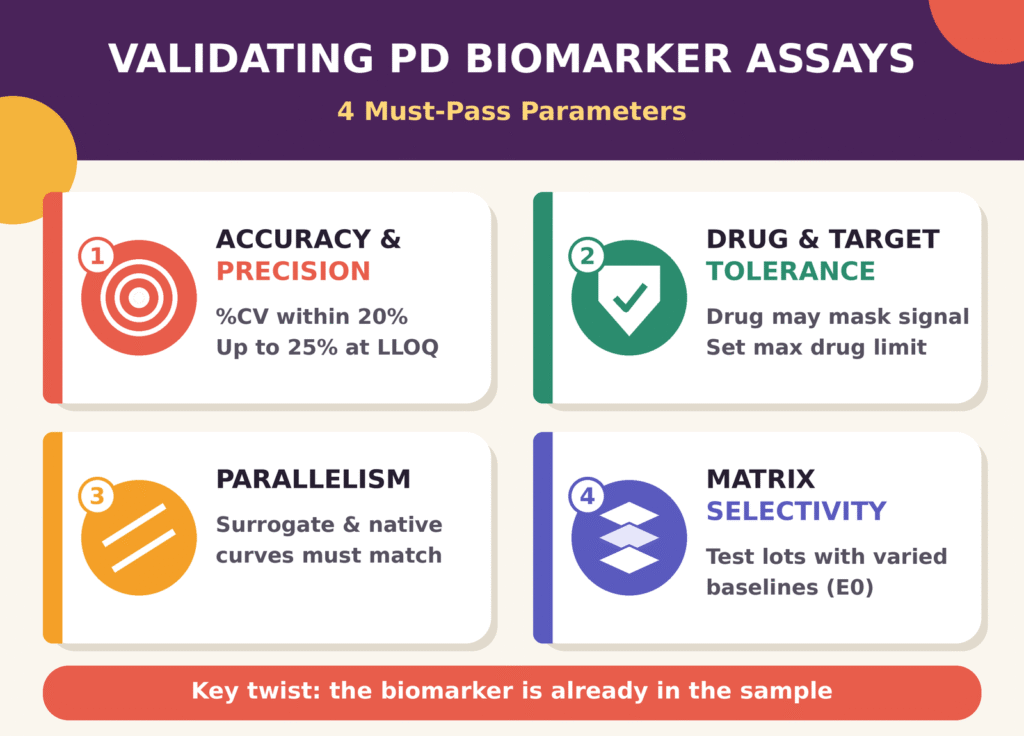
Accuracy and Precision: Bioanalytical validation criteria generally require inter-batch and intra-batch precision, expressed as the coefficient of variation (%CV), to remain within 20% for standard molecular assays. A wider limit of 25% may apply at the lower limit of quantitation (LLOQ) and to certain cell-based functional assays, depending on the applicable validation framework and assay requirements.
Drug and Target Tolerance: High circulating concentrations of the biosimilar or reference drug may bind to the target biomarker and block capture or detection epitopes in immunoassay formats. Validation protocols must therefore establish the maximum drug concentration at which biomarker quantification remains reliable and unaffected by clinically relevant interference.
Parallelism and Dilutional Linearity: Parallelism assessments determine whether calibrator curves prepared in surrogate matrices behave comparably to curves generated by diluting native endogenous biomarker analytes in the target biological matrix. Demonstrating parallelism supports the validity of quantitative measurements across different sample concentrations.
Matrix Selectivity and Endogenous Baseline Handling: Matrix selectivity assessments evaluate analyte recovery across individual matrix lots containing different baseline biomarker concentrations (E0). These assessments help determine whether endogenous variability introduces matrix-related bias that could compromise the accuracy and comparability of biomarker measurements.
Clinical Study Design and Statistical Evaluation of Pharmacodynamic Biomarkers in Biosimilar Development
Clinical evaluation of Pharmacodynamic Biomarkers in Biosimilar Development generally relies on single-dose or multiple-dose clinical pharmacology studies, often conducted in healthy volunteers, with predefined bioequivalence statistical margins for primary PD endpoints. Integrating intensive PK and PD sampling schedules enables the simultaneous modeling of exposure-response relationships and the characterization of drug disposition. This combined approach provides a quantitative basis for comparing the pharmacological behavior of a proposed biosimilar with that of its reference product.
Study Population and Sub-Maximal Dosing Strategies
Healthy volunteer cohorts are generally preferred for clinical PD bioequivalence trials because they present fewer clinical confounding factors than diseased patient populations. Healthy subjects typically have intact physiological pathways, stable organ function, relatively consistent baseline biomarker concentrations, and no concomitant immunomodulatory therapies. These characteristics can improve the precision of PD measurements and facilitate the detection of differences attributable to the study treatments.
Selecting the appropriate clinical dose is equally important for maintaining study sensitivity. Clinical pharmacology protocols should use sub-maximal, sensitive doses positioned along the ascending portion of the dose-response relationship. Administering standard therapeutic doses that produce the maximum physiological effect (Emax) can create an analytical plateau, concealing potential differences in target affinity or functional potency between the proposed biosimilar and the reference biologic. Dose selection must therefore preserve a measurable response range in which meaningful differences between the products can be detected.
Primary Endpoints and Mathematical Baseline Adjustments
Primary pharmacodynamic parameters are derived from the effect-time curve following drug administration. These parameters quantify the magnitude, duration, and timing of the biological response and provide a framework for comparing the PD profiles of the biosimilar and reference product.
Area Under the Effect-Time Curve (AUEC): This parameter quantifies the total integrated pharmacodynamic effect over a specified time interval, such as AUEC0-t, or extrapolated over an extended period until baseline recovery, such as AUEC0-∞. It provides an overall measure of the magnitude and duration of the observed pharmacodynamic response.
Maximum Observed Effect (Emax): This parameter represents the peak pharmacodynamic change relative to the pre-dose baseline value. It helps characterize the maximum biological response produced by the administered drug.
Time to Maximum Effect (TEmax): This parameter indicates the time required to reach the peak pharmacodynamic response. It provides information about the timing of the drug’s maximum observed biological effect.
Because endogenous biomarkers have naturally occurring baseline levels before treatment, baseline adjustment strategies are necessary to isolate drug-induced pharmacodynamic changes. Common approaches include the following:
Direct Baseline Subtraction: The pre-dose baseline value (E0) is subtracted from each post-dose response measurement (Et − E0) before calculating AUEC. This method helps distinguish treatment-related changes from the biomarker’s initial physiological level.
Baseline-Adjusted AUEC Integration: Trapezoidal integration is applied to response curves above or below baseline levels to calculate the net pharmacodynamic exposure. This approach quantifies the cumulative treatment-associated effect while accounting for the initial biomarker concentration.
Covariate-Adjusted Analysis of Variance (ANCOVA): Pre-dose baseline concentrations are incorporated as continuous covariates in linear statistical models to adjust geometric mean ratios. This method helps account for baseline differences between treatment groups and can improve the precision of treatment comparisons.
Statistical Acceptance Criteria and Equivalence Margins
Pharmacodynamic bioequivalence is generally established when the 90% Confidence Interval (CI) for the geometric mean ratio of the biosimilar to the reference product falls entirely within predefined equivalence boundaries for the primary PD parameters, such as AUEC and Emax. The acceptance criteria should be specified before the study begins and justified according to the biomarker’s biological characteristics, variability, and intended regulatory application.
Although the conventional bioequivalence interval of 80.00% to 125.00% is widely used in regulatory assessments, it should not automatically be applied to every PD endpoint. Tighter, clinically justified boundaries, such as 96.8% to 103.2% for certain hematological markers, may be appropriate depending on the biomarker’s biological variability and clinical dynamic range. The selected equivalence margins must be supported by scientific and statistical justification and should reflect the ability of the study to identify clinically meaningful differences between the proposed biosimilar and the reference product.
A well-designed comparability strategy connects clinical pharmacology findings with evidence from analytical characterization and functional testing. Review the principles of biosimilar comparability studies to understand how multiple evidence streams contribute to the overall similarity assessment.
Regulatory Frameworks and Industry Precedents for Pharmacodynamic Biomarkers in Biosimilar Development
Regulatory frameworks established by the FDA, EMA, and Health Canada recognize the role of Pharmacodynamic Biomarkers in Biosimilar Development in supporting indication extrapolation and potentially waiving comparative clinical efficacy trials when sufficient evidence of PK/PD similarity is available. Regulatory experience across several therapeutic biological drug classes demonstrates that comprehensive PK/PD similarity packages can contribute substantial evidence of comparable clinical performance when considered alongside analytical, structural, functional, and other relevant findings.
Therapeutic Classes and Applications of PD Biomarkers
| Therapeutic Drug Class | Reference Biologics | Validated PD Biomarkers | Bioanalytical Platform | Regulatory Impact and Application |
|---|---|---|---|---|
| G-CSF Analogues | Filgrastim / Pegfilgrastim | Absolute Neutrophil Count (ANC), CD34+ Cell Count | Automated Hematology Analyzer / Flow Cytometry | Supported biosimilarity assessments and indication extrapolation; reduced reliance on Phase III trials in applicable development programs. |
| Erythropoietin Analogues | Epoetin alfa | Reticulocyte Count, Total Hemoglobin | Automated Hematology Analyzer | Supported the evaluation of PD equivalence using applicable statistical acceptance criteria, including the 80%–125% interval where justified. |
| Long-Acting Insulins | Insulin glargine | Glucose Infusion Rate (GIR) | Automated Euglycemic Clamp Technique | Supported PD bioequivalence assessments and the design of interchangeability studies. |
| Bone Resorption Inhibitors | Denosumab | Serum C-Terminal Telopeptide (sCTX), RANKL | LC-MS/MS / ECLIA Immunoassay | Supported the assessment of osteoclast suppression as part of bioequivalence evaluation. |
| PCSK9 Inhibitors | Alirocumab / Evolocumab | LDL-Cholesterol (LDL-C), Free PCSK9 Levels | Clinical Chemistry / ECLIA Immunoassay | Used in dose-response evaluations to investigate exposure-response relationships and support equivalence assessments. |
| Anti-TNF Monoclonal Antibodies | Infliximab / Adalimumab | Serum CRP, Erythrocyte Sedimentation Rate, IL-6 | High-Sensitivity Immunoassay Panels | Contributed to totality-of-evidence assessments supporting multi-indication extrapolation. |
For biological products with complex molecular structures, a complete analytical evidence package can help establish the foundation for regulatory review. See the end-to-end biosimilar analytical package for regulatory submissions for further information.
Indication Extrapolation Mechanics
Indication extrapolation is the regulatory process through which a biosimilar approved for one clinically evaluated indication may receive marketing authorization for additional indications approved for the reference product without requiring separate comparative clinical efficacy studies for every indication. Demonstrating PD bioequivalence can provide a mechanistic basis for supporting such extrapolation when considered alongside the complete body of scientific evidence.
When a reference product acts through the same receptor targets and pharmacological pathways across multiple disease states, evidence of PK/PD similarity may support the assessment of comparable biological activity across the relevant indications. For example, tumor necrosis factor-alpha (TNF-α) suppression is relevant to rheumatoid arthritis, plaque psoriasis, and Crohn’s disease. Establishing PK/PD similarity in healthy subjects or an appropriate patient population can contribute to the scientific justification for extrapolation across the reference product’s approved indications. However, extrapolation also requires consideration of the mechanism of action, pharmacokinetics, immunogenicity, safety, and other indication-specific scientific factors.
Emerging Technologies and Future Directions in Pharmacodynamic Biomarkers in Biosimilar Development
Emerging technologies in multi-omics profiling, machine learning, and applied regulatory science are expanding the use of Pharmacodynamic Biomarkers in Biosimilar Development, particularly for complex biological products that lack established single-protein biomarkers. These advances enable multidimensional characterization of drug activity across cellular pathways and may improve the detection of subtle functional differences between a proposed biosimilar and its reference product.
Multi-Omics Profiling Platforms
High-throughput multi-omics techniques can capture broad physiological responses following the administration of biotherapeutic products. By examining different molecular layers, these technologies provide complementary information about biological activity and downstream pathway modulation.
Proteomics: Mass spectrometry platforms quantify changes across systemic plasma protein networks, helping identify secondary response markers and characterize changes associated with drug exposure or target activation. These measurements can reveal biological responses that may not be adequately captured by a single conventional biomarker.
To explore how protein-level measurements support the characterization of biological products, read about the proteomics approach for biosimilars.
Transcriptomics: RNA sequencing (RNA-seq) of peripheral blood mononuclear cells (PBMCs) maps gene expression profiles triggered by target activation. This approach can characterize cell-signaling cascades and identify transcriptional changes associated with the pharmacological activity of biological therapies.
Metabolomics: High-resolution LC-MS profiling tracks changes in downstream lipid, amino acid, and carbohydrate metabolites to assess metabolic pathway modulation. These measurements may help identify treatment-associated biochemical changes and provide additional evidence of biological response.
AI and Machine Learning in Biomarker Selection
Artificial intelligence (AI) and machine learning (ML) algorithms can analyze large multi-omics datasets to identify combinations of biomarkers that predict biological activity or clinical response. By evaluating multiple molecular features simultaneously, these methods may identify patterns that remain undetected through conventional single-marker analyses.
Machine learning models can also investigate relationships between structural critical quality attributes (CQAs), such as afucosylation and advanced glycosylation profiles, and downstream multi-omic PD fingerprints. These associations may support the early-stage prediction of functional bioequivalence and help prioritize relevant biomarkers for further analytical and clinical evaluation. However, predictive models require appropriate training data, independent validation, and demonstrated analytical and biological relevance before they can support regulatory conclusions.
Modernization of Regulatory Pathways
Under the Biosimilar User Fee Amendments (BsUFA III) regulatory science pilot program, the U.S. FDA’s Division of Applied Regulatory Science (DARS) is conducting clinical pharmacology research to support the development of standardized methodologies for novel PD biomarkers. Investigations involving candidates across different drug classes, including IL-5 inhibitors, PCSK9 inhibitors, and interferon therapies, are helping advance approaches for baseline adjustment, dose-response modeling, and dynamic range validation.
These initiatives aim to improve the consistency, sensitivity, and interpretability of PD assessments in biosimilar development. As analytical technologies and regulatory science continue to advance, comprehensive analytical characterization combined with clinical PK/PD bioequivalence packages may reduce the need for comparative clinical efficacy studies in appropriate development programs. The extent of such reductions will depend on the product-specific evidence, the suitability of the selected biomarkers, and the applicable regulatory requirements.
Conclusion
Pharmacodynamic Biomarkers in Biosimilar Development provide an efficient and scientifically rigorous foundation for evaluating clinical biosimilarity and supporting regulatory approval across global markets. By combining mechanism-linked biomarker selection, validated bioanalytical assays in accordance with ICH M10 standards, and appropriately designed sub-maximal clinical studies, biopharmaceutical developers can assess functional equivalence while potentially reducing development timelines and costs.
A successful PD strategy requires careful consideration of biomarker specificity, exposure-response sensitivity, baseline variability, analytical performance, and statistical acceptance criteria. When these elements are integrated with comprehensive structural, analytical, functional, and pharmacokinetic evidence, PD biomarkers can strengthen the scientific justification for biosimilar approval and indication extrapolation.
For expert bioanalytical method validation, biomarker quantification, and analytical comparability services tailored to biosimilar development programs, visit ResolveMass Contact Us.
Frequently Asked Questions (FAQs)
Pharmacodynamic biomarkers can improve the efficiency of biosimilar development by providing sensitive measurements of drug activity in controlled clinical pharmacology studies. They help identify differences in biological responses that may not be apparent through conventional clinical endpoints. When supported by comprehensive analytical and pharmacokinetic evidence, PD findings may justify reducing or waiving comparative clinical efficacy trials, subject to regulatory requirements.
Proximal PD biomarkers measure biological events closely associated with the initial interaction between a drug and its target, such as target receptor occupancy. Distal PD biomarkers assess subsequent biological effects, including cytokine suppression, enzyme inhibition, or changes in cellular proliferation. Proximal markers may provide a more direct assessment of target engagement, whereas distal markers help characterize downstream physiological responses.
Healthy volunteers often provide a more controlled study population because they generally have fewer disease-related complications and less variability from concomitant medications. Their relatively stable physiological conditions can improve the consistency of baseline biomarker measurements and increase statistical sensitivity. However, healthy volunteers are suitable only when the drug’s safety profile, mechanism of action, and study objectives support their inclusion.
The selection of a bioanalytical platform depends on the biomarker’s molecular characteristics, concentration, and biological function. Ligand-Binding Assays (LBA), including ELISA, ECLIA, and Gyrolab, are commonly used for soluble proteins and cytokines, while LC-MS/MS measures peptides and metabolic intermediates. Flow Cytometry supports the analysis of cellular markers and receptor occupancy, whereas cell-based bioassays evaluate functional biological activity.
ICH M10 provides a framework for validating bioanalytical methods, particularly those used to measure drug concentrations in biological matrices, with relevant principles informing suitable assay-validation strategies. Important considerations include accuracy, precision, selectivity, and the evaluation of matrix effects. For endogenous PD biomarkers, additional assessments may be necessary to address baseline concentrations, assay parallelism, and interference from circulating therapeutic proteins or other matrix components.
PD biomarkers can help demonstrate that a proposed biosimilar produces biological effects consistent with those of its reference product through relevant pharmacological pathways. When combined with analytical characterization, PK similarity, safety, and immunogenicity assessments, these findings may support the scientific justification for extending approval to additional indications. Extrapolation also requires consideration of indication-specific mechanisms of action and other relevant clinical and scientific evidence.
Multi-omics platforms combine information from proteomics, transcriptomics, and metabolomics to characterize biological responses across multiple molecular pathways. This integrated analysis can identify biomarker combinations that reveal drug-related effects not captured by individual markers. In biosimilar development, these approaches may help evaluate complex biological products and discover additional indicators of functional similarity, although their suitability requires appropriate analytical and biological validation.
Reference:
- Strauss, D. G., Wang, Y.-M., Florian, J., & Zineh, I. (2023). Pharmacodynamic biomarkers evidentiary considerations for biosimilar development and approval. Clinical Pharmacology & Therapeutics, 113(1), 55–61. https://doi.org/10.
- U.S. Food and Drug Administration. (n.d.). Audio transcript: The role of pharmacodynamic biomarkers in biosimilar drug development. https://www.fda.gov/drugs/cder-small-business-industry-assistance-sbia/audio-transcript-role-pharmacodynamic-biomarkers-biosimilar-drug-development
- Wang, Y.-M. (2023). Pharmacodynamic (PD) biomarkers for biosimilar development & approval [PowerPoint presentation]. U.S. Food and Drug Administration. https://www.fda.gov/media/173867/download
- U.S. Food and Drug Administration. (2016, December). Clinical pharmacology data to support a demonstration of biosimilarity to a reference product: Guidance for industry. https://www.fda.gov/regulatory-information/search-fda-guidance-documents/clinical-pharmacology-data-support-demonstration-biosimilarity-reference-product
- European Medicines Agency. (n.d.). Multidisciplinary guidelines: Biosimilar. https://www.ema.europa.eu/en/human-regulatory-overview/research-development/scientific-guidelines/multidisciplinary-guidelines/multidisciplinary-guidelines-biosimilar
- U.S. Food and Drug Administration. (2016, December). Clinical pharmacology data to support a demonstration of biosimilarity to a reference product: Guidance for industry. https://www.fda.gov/media/88622/download
- U.S. Food and Drug Administration. (2024, March). Clinical pharmacology considerations for antibody-drug conjugates: Guidance for industry. U.S. Department of Health and Human Services. https://www.fda.gov/media/155997/download
Get In Touch With Us
About The Author