

Introduction:
PLGA Molecular Weight and End-Group Chemistry together determine how quickly a PLGA matrix hydrolyzes and how a drug moves out of it. Molecular weight sets how many ester bonds must be cleaved before the matrix erodes, and end-group chemistry (acid-terminated or ester-capped) sets how hydrophilic the polymer is and how much autocatalysis occurs inside it.
At ResolveMass Laboratories Inc., a Canadian analytical CRO/CDMO, we characterize PLGA polymers and PLGA-based drug products, including microspheres, implants, and nanoparticles, using mass spectrometry, chromatography, and spectroscopy. A recurring lesson from this work is that two PLGA lots with the same nominal L:G ratio can release a drug very differently if their molecular weight distribution or end-group state differs. This article explains the science, the practical implications, and how to control both variables.
Summary:
- PLGA Molecular Weight and End-Group Chemistry are two of the most influential variables controlling how fast poly(lactic-co-glycolic acid) degrades and how a drug is released.
- Lower molecular weight PLGA hydrolyzes faster, so drug release is quicker. Higher molecular weight PLGA degrades more slowly and extends release.
- Acid-terminated (free carboxyl) PLGA degrades faster than ester-capped (end-capped) PLGA of similar molecular weight.
- Ester-capped PLGA is generally more hydrophobic, which tends to slow water uptake, reduce burst release, and prolong release duration.
- Molecular weight and end-group effects interact with lactide:glycolide (L:G) ratio, particle size, drug properties, and polymer crystallinity.
- Batch-to-batch variation in either parameter can change release profiles. Orthogonal analytical characterization (GPC/SEC, NMR, titration, DSC) is essential.
- Regulators expect both attributes to be controlled and justified in submissions for PLGA-based products.
1: How Does PLGA Molecular Weight Affect Degradation?
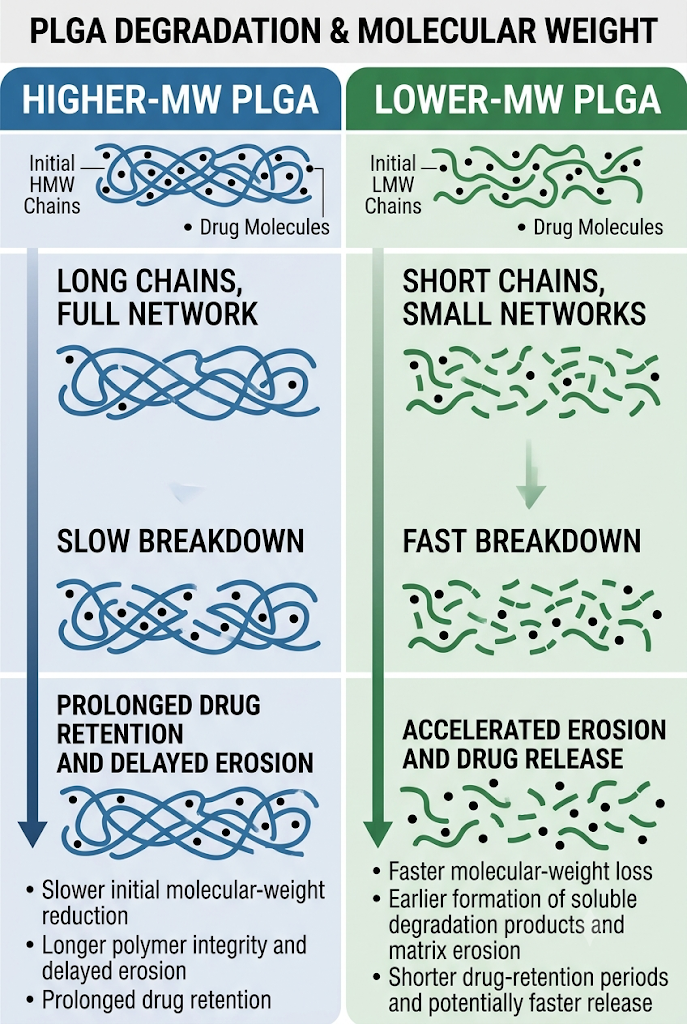
Higher-molecular-weight PLGA generally needs more hydrolytic chain scission before significant loss of molecular weight and structural integrity, while lower-molecular-weight PLGA reaches critical molecular-weight reduction more quickly.
PLGA degrades primarily by hydrolysis of ester bonds in the backbone. A simplified progression is:
Water penetration → ester-bond hydrolysis → chain scission → molecular-weight reduction → oligomer formation → polymer erosion → drug release
The starting molecular weight determines where a formulation begins on this pathway.
Higher-Molecular-Weight PLGA
Longer chains can contribute to:
- Slower initial molecular-weight reduction
- Longer polymer integrity and delayed erosion
- Prolonged drug retention and potentially slower overall release
Higher molecular weight is not an absolute predictor of slow release. Water penetration, porosity, drug solubility, autocatalysis, and particle dimensions can all modify the profile.
Lower-Molecular-Weight PLGA
Shorter chains may reach the range associated with substantial degradation sooner, which can mean:
- Faster molecular-weight loss
- Earlier formation of soluble degradation products and matrix erosion
- Shorter drug-retention periods and potentially faster release
This matters most for long-acting formulations where the polymer must keep its structure for weeks or months.
2: How Does PLGA End-Group Chemistry Affect Degradation?
The terminal functional group affects PLGA hydrophilicity and its interaction with water, making end-group chemistry an important determinant of hydrolysis and drug release.
The two common types are carboxylic acid-terminated PLGA and ester-terminated (end-capped) PLGA. This small structural difference can influence the behavior of the whole delivery system.
Acid-Terminated PLGA
Acid-terminated PLGA generally has greater hydrophilic character, which can contribute to:
- Greater interaction with water and water uptake
- Enhanced hydrolytic activity and faster molecular-weight reduction
- Changes in the internal microenvironment
Terminal carboxylic acids can also contribute to an acidic environment as degradation progresses. This may affect both polymer degradation and the stability of sensitive drug molecules.
Ester-Terminated PLGA
Ester-capped PLGA has fewer free acidic terminal groups and can show lower water affinity, which can mean:
- Reduced water accessibility
- Slower hydrolytic degradation under comparable conditions
- Longer polymer integrity and potentially prolonged release
Comparing acid-terminated and ester-terminated PLGA at similar molecular weights is a useful way to isolate the contribution of end-group chemistry.
| Feature | Acid-Terminated PLGA | Ester-Terminated PLGA |
|---|---|---|
| Terminal group | Free carboxylic acid | Capped (ester) |
| Hydrophilicity | Higher | Lower |
| Water uptake | Typically faster | Typically slower |
| Degradation rate | Often faster | Often slower |
| Internal acidity | May build up faster | Generally lower free-acid functionality |
3: PLGA Molecular Weight and End-Group Chemistry: How Do They Work Together?
PLGA Molecular Weight and End-Group Chemistry should be evaluated together because molecular weight sets the starting chain length, while end groups influence how the polymer interacts with water and its degradation environment.
| Polymer characteristic | Typical influence on PLGA behavior |
|---|---|
| Higher molecular weight | Generally slower progression toward substantial molecular-weight loss |
| Lower molecular weight | Generally faster progression toward low-molecular-weight degradation products |
| Acid-terminated | Greater hydrophilic character; may accelerate water interaction and degradation |
| Ester-terminated | Lower free-acid functionality; may support slower degradation |
| Narrow PDI | More uniform polymer population |
| Broad PDI | Wider range of chain lengths; potentially more complex degradation |
For example, a low-molecular-weight acid-terminated grade will typically degrade much faster than a high-molecular-weight ester-capped grade. These are general trends rather than universal rules, and actual release depends on the complete formulation system. Our related article on PLGA molecular weight and drug release explores how processing can shift molecular weight further.
4: Why Does PLGA Degradation Not Always Equal Drug Release?
Polymer degradation and drug release are related but not identical: a formulation can lose molecular weight before much drug is released, while others release significantly through diffusion before extensive erosion.
Release can occur through:
- Diffusion
- Polymer swelling and water penetration
- Polymer degradation
- Polymer erosion
- A combination of diffusion and degradation
A small water-soluble drug in a porous microsphere may diffuse out relatively quickly. A hydrophobic drug strongly associated with the matrix may stay entrapped until substantial degradation occurs. Measuring polymer molecular weight alone is therefore not enough to predict release.
5: What Other Factors Control PLGA Degradation and Drug Release?
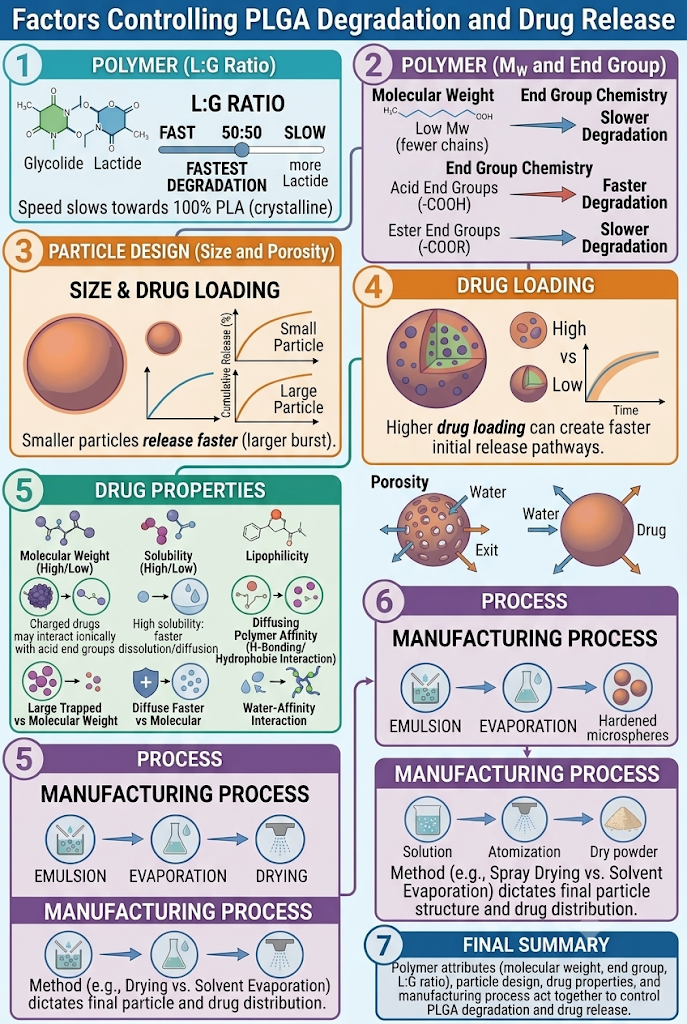
Beyond PLGA Molecular Weight and End-Group Chemistry, L:G ratio, particle size, porosity, drug properties, drug loading, and manufacturing process can substantially modify degradation and release.
| Factor | How it affects release |
|---|---|
| Lactide:glycolide ratio | Changes polymer hydrophobicity, water interaction, and degradation behavior |
| Particle size | Smaller particles have higher surface-area-to-volume ratio, affecting water penetration, surface erosion, burst, and duration |
| Porosity | Creates pathways for water entry and drug exit; higher porosity can increase initial release |
| Drug properties | Molecular weight, solubility, lipophilicity, ionization, stability, and polymer affinity all matter |
| Drug loading | Can alter morphology and internal pore formation, changing initial and later release kinetics |
| Manufacturing process | Affects morphology, residual solvent, drug distribution, polymer molecular weight, porosity, and encapsulation efficiency |
Two formulations using nominally identical PLGA grades may not release identically if their processes differ. See our comparison of spray drying vs solvent evaporation for how method choice shapes particle properties.
6: How Can SEC/GPC Measure the Effect of PLGA Molecular Weight?
SEC/GPC directly measures PLGA molecular-weight changes by tracking Mn, Mw, and polydispersity before and after degradation or formulation studies.
| Parameter | What it indicates |
|---|---|
| Mn | Number-average molecular weight |
| Mw | Weight-average molecular weight |
| PDI (Mw/Mn) | Breadth of molecular-weight distribution |
| Distribution profile | Changes in polymer-chain populations |
| Retention time | Shifts in polymer distribution |
A useful strategy samples at multiple time points: initial → early release → intermediate → late release → endpoint. Tracking the decline in molecular weight helps establish whether release is driven mainly by diffusion, polymer degradation, or both.
7: Which Analytical Techniques Should Be Used to Characterize PLGA Degradation?
A robust PLGA characterization program combines molecular-weight, thermal, chemical, morphological, and release measurements instead of relying on one technique.
| Technique | What it contributes |
|---|---|
| SEC/GPC | Mn, Mw, PDI, molecular-weight distribution |
| DSC | Glass-transition behavior and thermal changes linked to degradation or formulation |
| FTIR | Functional-group and structural changes |
| NMR | Polymer composition, L:G characteristics, end-group information, chemical changes |
| SEM | Particle morphology, surface structure, pores, changes during degradation |
| Residual-monomer analysis | Polymer purity and process residuals |
| In vitro release testing | Direct drug release over time; links polymer changes to performance |
8: How Should PLGA Molecular Weight and End-Group Chemistry Be Evaluated in a Development Study?
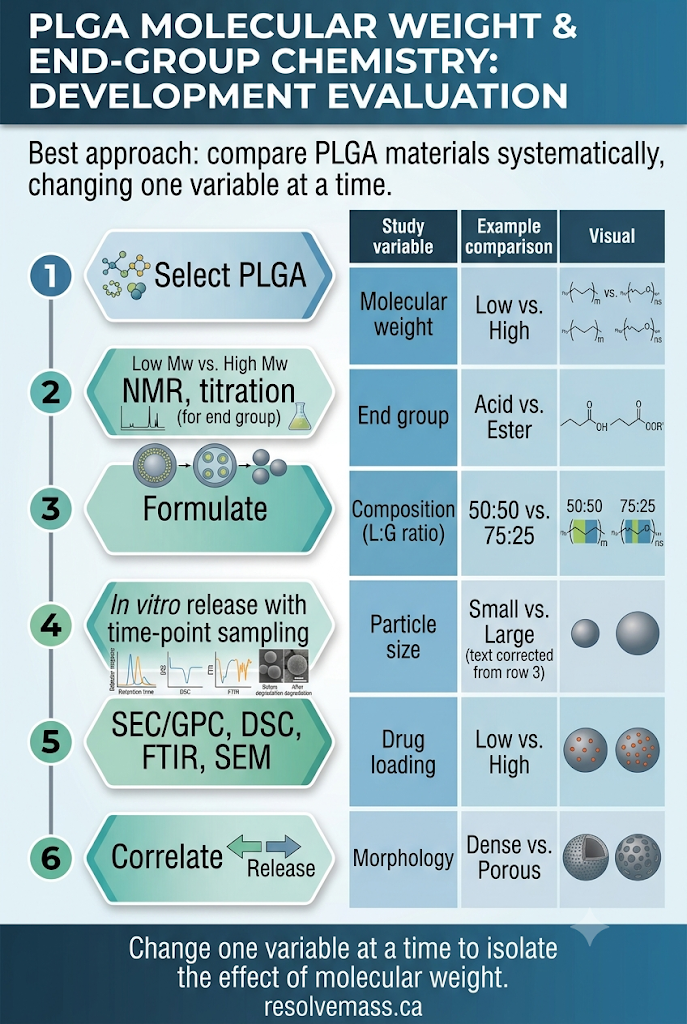
The most informative approach is to compare PLGA materials systematically while holding other formulation variables constant.
A practical workflow:
- PLGA selection
- Molecular-weight and end-group characterization
- Formulation development and initial characterization
- In vitro release with time-point sampling
- SEC/GPC plus morphology, thermal, and chemical analysis
- Correlation of polymer changes with release
| Study variable | Example comparison |
|---|---|
| Molecular weight | Low vs. medium vs. high |
| End group | Acid-terminated vs. ester-terminated |
| Composition | Different L:G ratios |
| Particle size | Smaller vs. larger |
| Drug loading | Low vs. high |
| Morphology | Low vs. high porosity |
This design makes it easier to separate the effect of molecular weight from other variables. Teams working on grade selection for clinical supply should also review requirements for GMP-grade PLGA for Phase II/III clinical supply.
9: Why Is Molecular-Weight Change Important for Long-Acting PLGA Formulations?
For long-acting formulations, monitoring molecular-weight reduction shows whether the polymer keeps its release-controlling properties over the target duration.
This is particularly important for injectable microspheres, depot formulations, biodegradable implants, and nanoparticle systems. A product intended to release over weeks or months should not be judged only by its initial release profile. Monitoring the polymer throughout the release period helps answer:
- How quickly does molecular weight decrease, and does that correlate with accelerated release?
- Does the end group influence a particular release phase?
- Is there an initial burst?
- When does substantial erosion occur, and does morphology change?
- Are degradation products affecting drug stability?
For product-level examples, see our resources on PLGA long-acting injectable formulation and PLA and PLGA veterinary long-acting injectables. When moving toward larger batches, scaling PLGA microsphere manufacturing introduces further molecular-weight and morphology considerations.
How Can ResolveMass Support PLGA Analytical Characterization?
ResolveMass Laboratories Inc. supports PLGA development by combining molecular-weight analysis with complementary physicochemical and degradation-focused methods designed around your specific question.
Our scientists build the strategy around your formulation and development goal rather than a single test. Potential areas include:
- SEC/GPC molecular-weight determination (Mn, Mw, PDI)
- Molecular-weight comparison before and after stress or degradation
- DSC, FTIR, and NMR characterization
- Morphological assessment and residual-monomer evaluation
- Drug-release sample analysis and polymer degradation studies
- Comparative evaluation of PLGA grades
- Investigation of formulation-related changes and unexpected release behavior
A scientifically defensible package connects polymer attributes → degradation behavior → formulation properties → release performance.
Conclusion:
PLGA Molecular Weight and End-Group Chemistry are fundamental attributes that influence degradation rate and drug release, but they must be interpreted together with composition, particle characteristics, drug properties, morphology, processing, and the release environment.
Higher molecular weight generally supports longer chain integrity, while lower molecular weight allows faster progression toward substantial degradation. Acid-terminated PLGA typically interacts more readily with water than comparable ester-terminated material, potentially accelerating hydrolysis. Yet release cannot be predicted from these two attributes alone. SEC/GPC, DSC, FTIR, NMR, SEM, and in vitro release testing together provide the mechanistic link between polymer degradation and drug release.
For microspheres, nanoparticles, implants, and long-acting injectables, a systematic understanding of PLGA Molecular Weight and End-Group Chemistry supports rational polymer selection, formulation optimization, and troubleshooting.
Frequently Asked Questions:
Acid-terminated PLGA generally has greater hydrophilic character and can interact more readily with water than comparable ester-terminated PLGA. This can contribute to faster hydrolytic degradation, although the magnitude of the effect depends on the complete formulation.
Yes. The same nominal PLGA grade can behave differently depending on particle size, porosity, drug loading, manufacturing process, residual solvent, drug–polymer interactions, storage conditions, and other formulation variables.
Long-acting formulations depend on controlled polymer degradation and drug release over an extended period. Monitoring molecular-weight changes and other polymer attributes can help determine whether the formulation is following its intended degradation and release mechanism.
Acid-terminated PLGA generally has greater hydrophilic character and can interact more readily with water than comparable ester-terminated PLGA. This can contribute to faster hydrolytic degradation, although the magnitude of the effect depends on the complete formulation.
Reference
- Mittal G, Sahana DK, Bhardwaj V, Kumar MR. Estradiol loaded PLGA nanoparticles for oral administration: effect of polymer molecular weight and copolymer composition on release behavior in vitro and in vivo. Journal of controlled release. 2007 May 14;119(1):77-85.https://www.sciencedirect.com/science/article/pii/S0168365907000661
- Singh S, Singha P. Effect of modifications in poly (lactide-co-glycolide)(PLGA) on drug release and degradation characteristics: A mini review. Current Drug Delivery. 2021 Dec 1;18(10):1378-90.https://www.benthamdirect.com/content/journals/cdd/10.2174/1567201818666210510165938
- Saha S, Lin X, Zhou L, Xue A, Gosselin E, Chothe PP, Darji M, Lu X, Yang W. Evaluation of the impact of the polymer end groups and molecular weight on in vitro and in vivo performances of PLGA based in situ forming implants for ketoprofen. Journal of Pharmaceutical Sciences. 2025 Jan 1;114(1):424-33.https://www.sciencedirect.com/science/article/pii/S0022354924004490
- Huang CL, Kumar S, Tan JJ, Boey FY, Venkatraman SS, Steele TW, Loo JS. Modulating drug release from poly (lactic-co-glycolic acid) thin films through terminal end-groups and molecular weight. Polymer degradation and stability. 2013 Feb 1;98(2):619-26.https://www.sciencedirect.com/science/article/pii/S0141391012004430
- Wang J, Helder L, Shao J, Jansen JA, Yang M, Yang F. Encapsulation and release of doxycycline from electrospray-generated PLGA microspheres: Effect of polymer end groups. International journal of pharmaceutics. 2019 Jun 10;564:1-9.https://www.sciencedirect.com/science/article/pii/S0378517319302856
About the Author


