

Introduction
Evaluating Process Equipment-Related Leachables (PERLs) under 21 CFR 211.65 is an essential compliance requirement for pharmaceutical and biopharmaceutical manufacturers aiming to prevent chemical contamination during manufacturing and processing operations. Title 21 of the Code of Federal Regulations, Section 211.65(a), requires equipment surfaces in contact with components, in-process materials, or drug products to be non-reactive, non-additive, and non-absorptive in ways that alter the safety, identity, strength, quality, or purity of the drug product beyond established requirements. As biomanufacturing increasingly transitions from traditional stainless steel infrastructure to single-use systems (SUS), including bioprocess containers, silicone transfer tubing, depth filters, and chromatography columns, the risk of chemical additives and polymer degradation products migrating into process streams becomes significantly greater.
Polymer formulations contain volatile, semi-volatile, and non-volatile additives, including antioxidants, plasticizers, slip agents, vulcanization catalysts, and unreacted oligomers, that may migrate into in-process fluids. Regulatory agencies, including the U.S. Food and Drug Administration (FDA) and the European Medicines Agency (EMA), have intensified their scrutiny of how process equipment contact surfaces influence the quality of the final drug substance (DS) and drug product (DP). Rather than treating equipment contact as an isolated material selection decision, modern compliance practices require a quantitative, science-based Quality Risk Management (QRM) framework. Aligning 21 CFR 211.65 compliance with relevant United States Pharmacopeia (USP) chapters, BioPhorum Operations Group (BPOG) best practices, and the draft ICH Q3E guideline supports a systematic approach to assessing, quantifying, and controlling potential impurities throughout the drug manufacturing lifecycle.
Explore the fundamentals of extractables and leachables in biopharmaceutical manufacturing to understand how material selection and chemical migration can influence product quality.
Share via:
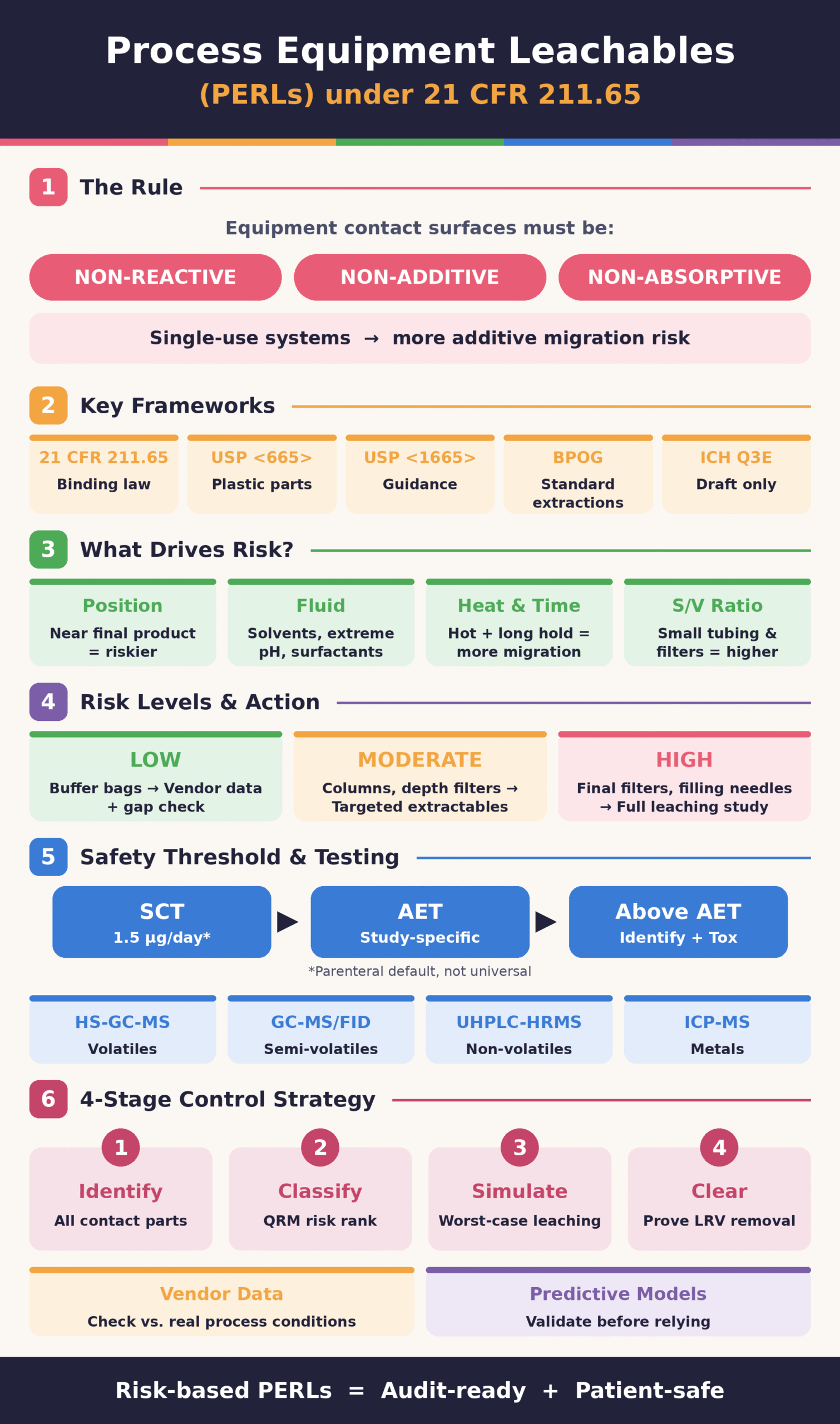
Quick Summary:
- Regulatory basis: 21 CFR 211.65(a) requires equipment contact surfaces to be non-reactive, non-additive and non-absorptive, so they don’t alter a drug’s safety, identity, strength, quality or purity.
- Why it matters now: The shift from stainless steel to single-use systems increases the risk that polymer additives migrate into process fluids. These include antioxidants, plasticizers, slip agents and oligomers.
- Supporting standards: USP <665> and <1665>, BPOG best practices and the draft ICH Q3E guideline support compliance through material characterization and risk assessment. ICH Q3E is still a draft as of October 2026.
- Risk factors: Leachable risk depends on several factors:
- how close a component sits to the final product
- how aggressive the process fluid is (solvents, extreme pH, surfactants)
- temperature and contact time
- the surface-area-to-volume ratio
- Safety thresholds: A study-specific Analytical Evaluation Threshold (AET), derived from a Safety Concern Threshold such as 1.5 µg/day for applicable parenterals, sets the sensitivity for screening. Compounds at or above the AET need identification and toxicological assessment.
- Analytical toolkit: Complementary techniques cover different compound types:
- HS-GC-MS for volatiles
- GC-MS/FID for semi-volatiles
- UHPLC-HRMS for non-volatiles
- ICP-MS for elemental impurities
- Control strategy: A four-stage workflow runs from identifying components, to classifying risk, to simulated leaching studies, to proving downstream clearance with Log Reduction Values. Vendor data gap analysis and validated predictive modeling support it, producing audit-ready documentation that protects patients.
Regulatory Imperatives: 21 CFR 211.65 and Harmonized Standards for Process Equipment-Related Leachables (PERLs)
Regulatory compliance with 21 CFR 211.65 is supported by aligning equipment contact evaluations with USP General Chapter <665>, which addresses plastic components and systems used in pharmaceutical and biopharmaceutical manufacturing, and its informational companion chapter, USP <1665>. These chapters provide relevant approaches for evaluating process-contact materials and their potential contribution to extractables and leachables. While 21 CFR 211.65 provides the foundational legal requirements for equipment compatibility in the United States, applicable compendial standards and industry guidance support the technical characterization and risk assessment needed to demonstrate appropriate material suitability during current Good Manufacturing Practice (cGMP) inspections.
Review the key considerations for USP extractables and leachables requirements to support a scientifically justified approach to material characterization and regulatory compliance.
USP <665> addresses the characterization of plastic components and systems used in pharmaceutical manufacturing and biopharmaceutical production. USP <1665> provides additional informational guidance on characterizing and qualifying these components. Industry consortium frameworks, particularly the BPOG extractables and leachables guidelines, provide standardized testing conditions using model solvents to establish baseline extractables profiles for materials.
ICH Q3E is being developed to harmonize international expectations for extractables and leachables assessment through a lifecycle-based approach. The draft guideline addresses the assessment and control of leachable impurities associated with manufacturing components, packaging, and drug delivery systems. As of October 2026, ICH Q3E remains a draft guideline rather than a finalized, implemented harmonized guideline. Its recommendations should therefore be distinguished from enforceable statutory requirements and applicable official compendial standards.
| Regulatory / Standard Framework | Regulatory Authority / Body | Primary Scope and Application | Legal or Guidance Status | Key Assessment Focus for Equipment |
|---|---|---|---|---|
| 21 CFR 211.65(a) | U.S. FDA | cGMP requirements for equipment construction and design used in pharmaceutical manufacturing. | Binding regulation | Requires contact surfaces to be non-reactive, non-additive, and non-absorptive in ways that adversely affect drug product quality. |
| USP <665> | United States Pharmacopeia | Plastic components and systems used to manufacture pharmaceutical drug products and biopharmaceutical drug substances and products. | Official compendial chapter; applicability depends on relevant regulatory requirements and compendial provisions. | Characterization and assessment of plastic process-contact components and systems. |
| USP <1665> | United States Pharmacopeia | Characterization and qualification of plastic components and systems used in pharmaceutical and biopharmaceutical manufacturing. | Informational chapter | Risk assessment, material characterization, and qualification approaches for manufacturing components. |
| BPOG Best Practice Guide | BioPhorum Operations Group | Single-use systems used in biopharmaceutical manufacturing. | Industry best-practice framework | Standardized multi-solvent extraction conditions and risk-based assessment of extractables. |
| ICH Q3E | International Council for Harmonisation | Assessment and control of extractables and leachables throughout the pharmaceutical product lifecycle. | Draft international guideline; not yet finalized as of October 2026. | Lifecycle-based, risk-driven management of leachable impurities and patient exposure. |
Risk-Based Assessment Framework for Process Equipment-Related Leachables (PERLs)
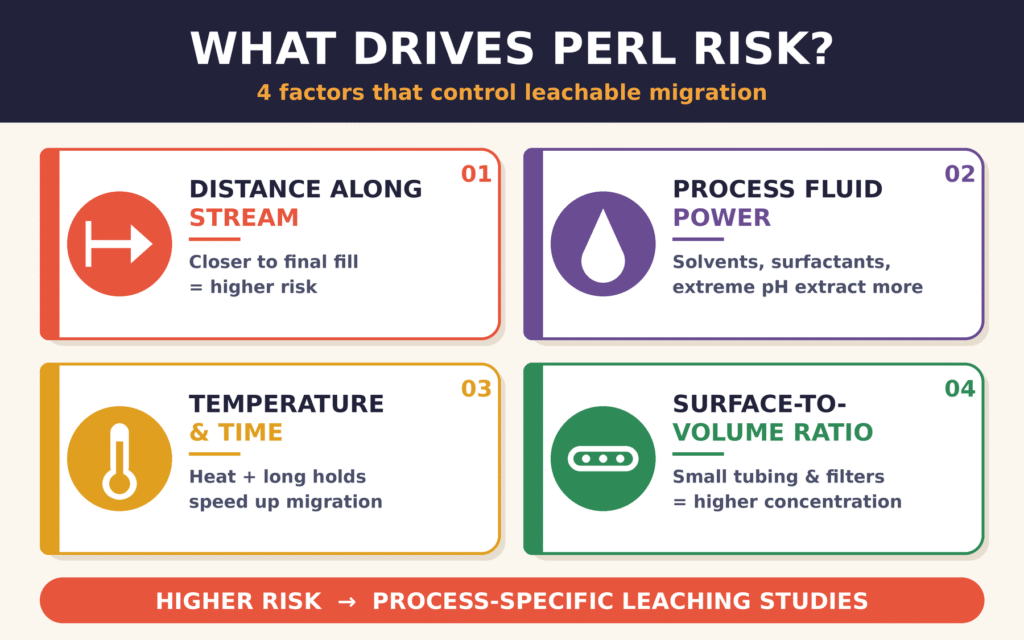
A risk-based assessment framework for Process Equipment-Related Leachables (PERLs) classifies manufacturing components according to Process Fluid Interaction (PFI), operating temperature, contact duration, surface-area-to-volume (S/V) ratio, and Distance Along Production Stream (DAS). Assessing these parameters helps pharmaceutical manufacturers determine whether baseline extractables data supplied by equipment vendors is adequate or whether additional process-specific simulated leaching studies are necessary.
The potential for chemical compounds to migrate from polymeric or elastomeric equipment components into a process stream depends on several distinct physical and chemical parameters.
Distance Along Production Stream (DAS)
Components positioned closer to the final drug substance or drug product filling and finishing stages generally present a higher potential risk than those used during early upstream processing. Downstream unit operations, such as final sterile filtration, ultrafiltration/diafiltration (UF/DF) retentate loops, and filling needles, may have no subsequent purification steps capable of removing migrated chemical impurities. In contrast, upstream components, such as cell culture media preparation bags, may present a lower risk because downstream dilution and removal processes, including harvesting, chromatography, and diafiltration, can reduce the concentration of migrated compounds. However, actual risk depends on the specific process configuration and the physicochemical properties of each leachable.
Process Fluid Interaction (PFI) and Solvation Power
The chemical composition of a process fluid determines its ability to extract compounds from polymer matrices. Highly aqueous solutions at neutral pH may have limited solvation power for certain hydrophobic polymer additives. However, process fluids containing organic modifiers, such as ethanol or isopropanol gradients used in chromatography, extreme acidic or basic pH conditions, surfactants such as Polysorbate 20 or Polysorbate 80, or lipid formulations may exhibit greater extraction capacity. These conditions can substantially increase the migration of organic compounds from equipment materials into the process stream.
Learn how solvents are selected for extractables studies to better understand solvent compatibility and its influence on the recovery of potential extractable compounds.
Exposure Temperature and Contact Duration
Diffusion kinetics depend on thermal energy and exposure time. High-temperature processing, including heat sterilization and warm holding steps between 37°C and 60°C, can accelerate the migration of low-molecular-weight plasticizers and degradation products into process fluids. Similarly, prolonged contact periods, such as multi-day holding steps in intermediate storage bags, can allow semi-volatile and non-volatile leachables to accumulate. The magnitude of migration depends on the material formulation, temperature, fluid composition, and the duration of exposure.
Surface-Area-to-Volume (S/V) Ratio
The geometric ratio between the equipment surface area in contact with the process fluid and the fluid volume influences the potential concentration of leachables. The ratio is expressed as:
S/V = Acontact / Vfluid
Where:
- Acontact = Surface area of the equipment in contact with the process fluid.
- Vfluid = Volume of the process fluid in contact with the equipment.
Small-diameter tubing, complex filter membrane matrices, and small-volume mixing vessels typically have higher S/V ratios. Consequently, they may produce higher concentrations of migrated compounds per milliliter of process fluid than large-scale storage containers with capacities of 2,000 liters. The actual concentration also depends on material composition, migration kinetics, and operating conditions.
| Risk Level | Representative Manufacturing Components | Typical Operational Parameters | Recommended Characterization Strategy |
|---|---|---|---|
| Low Risk | Buffer preparation bags, early-stage harvest transfer tubing, and raw material storage containers. | Ambient or cold temperatures, aqueous solutions, short contact duration (less than 60 minutes), and substantial downstream clearance capacity. | Review vendor-provided extractables data, perform a documented gap analysis, and justify the adequacy of existing evidence. |
| Moderate Risk | Intermediate chromatography columns, inline sensors, intermediate holding bags, and depth filters. | Moderate holding times (1–24 hours), mild organic solvent or surfactant content, and moderate downstream clearance capability. | Perform a risk-justified extractables evaluation and compare vendor data with actual process fluid parameters. |
| High Risk | Final sterile filters, filling needles, final UF/DF assemblies, and drug product filling lines. | Late-stage downstream processing with limited or no subsequent clearance capacity, prolonged contact (more than 24 hours), high S/V ratios, and contact with formulated drug products. | Consider comprehensive simulated leaching studies, appropriate analytical method qualification or validation, and AET-based identification and toxicological assessment where applicable. |
Toxicological Risk Assessment and Analytical Evaluation Threshold (AET) Calculations
Toxicological risk assessment helps translate patient safety considerations into an Analytical Evaluation Threshold (AET), which establishes the analytical sensitivity needed to screen for potential leachables. Establishing a scientifically justified AET helps ensure that laboratory analytical platforms can detect unknown organic compounds at concentrations relevant to the applicable safety assessment.
The Safety Concern Threshold (SCT) is a threshold concept used in certain extractables and leachables assessment frameworks to establish an exposure level below which compounds may be considered to present negligible toxicological concern under specified conditions. A default SCT of 1.5 µg/day has been used in certain Product Quality Research Institute (PQRI) recommendations for applicable parenteral drug products. However, this value should not be treated as a universal safety limit for all process equipment-related leachables. The appropriate threshold depends on the product, route of administration, patient exposure, compound characteristics, and applicable scientific and regulatory framework.
To translate an absolute daily exposure threshold into an analytical concentration limit, a study-specific AET calculation may be required. The following expression illustrates one possible relationship between the variables involved; it must not be applied without confirming that its assumptions, units, and scaling factors are appropriate for the specific study.
AET = (SCT / MDD) × (Vbatch / Vcontact) × (1 / UF)
Where:
- SCT = Safety Concern Threshold (µg/day), where scientifically applicable.
- MDD = Maximum Daily Dose of the final drug product administered to the patient, expressed on a basis consistent with the concentration units being calculated.
- Vbatch = Total volume of the drug product batch produced by the process stream (mL).
- Vcontact = Total volume of process fluid that contacts the specific equipment component (mL).
- UF = Analytical uncertainty factor, used where appropriate to account for uncertainty in analytical response factors, particularly when surrogate standards are used to estimate concentrations of unidentified compounds.
Important calculation note: The expression above is illustrative and is not a universally applicable AET equation. The relationship between patient exposure, batch concentration, component contact volume, and analytical uncertainty must be established using the selected methodology. In particular, MDD must be defined consistently as a daily dose volume or mass, and the volume-ratio term must be justified for the process configuration. Verify the equation and all units against the applicable guidance and validated study design before using the result to establish analytical reporting thresholds.
Compounds detected at or above the calculated AET during laboratory screening should undergo appropriate structural identification, quantification, and toxicological evaluation. The analytical strategy should use complementary platforms selected according to the volatility, polarity, molecular weight, and elemental composition of the compounds being investigated.
Explore the role of the Analytical Evaluation Threshold in extractables and leachables studies to understand how reporting thresholds guide compound identification and risk assessment.
Headspace Gas Chromatography-Mass Spectrometry (HS-GC-MS)
HS-GC-MS is used to identify volatile organic compounds (VOCs), including residual polymerization solvents, low-molecular-weight volatile compounds, and certain volatile degradation products that may migrate from equipment materials into process fluids.
Gas Chromatography-Mass Spectrometry / Flame Ionization Detection (GC-MS/FID)
GC-MS is used to identify and characterize suitable volatile and semi-volatile organic compounds, including certain plasticizers, antioxidants such as Irganox 1010 and Irgafos 168, and slip agents such as erucamide, depending on their chromatographic behavior and thermal stability. Flame ionization detection (FID) can provide complementary quantitative information for suitable organic compounds. The two detectors have different analytical functions and should not be treated as interchangeable.
Compare GC-MS and LC-MS in extractables and leachables testing to understand how complementary analytical techniques support the characterization of different chemical compounds.
Ultra-High Performance Liquid Chromatography-High Resolution Mass Spectrometry (UHPLC-HRMS / Orbitrap)
UHPLC-HRMS, including Orbitrap-based platforms, is useful for profiling non-volatile organic compounds, polar additives, surfactant degradation products, and synthetic oligomers. High-resolution accurate-mass measurements and appropriate fragmentation experiments support compound identification and characterization. Quantitative conclusions require suitable calibration approaches and consideration of compound-specific analytical response factors.
Inductively Coupled Plasma-Mass Spectrometry (ICP-MS)
ICP-MS is used to quantify inorganic elemental impurities and trace metals, including zinc, aluminum, and other elements that may originate from equipment materials, manufacturing processes, or elastomeric additives. Elemental results should be interpreted using appropriate risk assessment criteria, including relevant ICH Q3D principles where applicable. Elemental analysis does not, by itself, establish the identity of the original chemical species or the source of an element.
Discover how ICP-MS supports extractables and leachables testing when investigating trace metals and inorganic elemental impurities.
Implementation Methodology and Control Strategies for Process Equipment-Related Leachables (PERLs)
Implementing an effective control strategy for Process Equipment-Related Leachables (PERLs) requires a structured, multistage workflow that includes contact surface categorization, risk modeling, analytical leaching simulations, and evaluation of downstream purification clearance. Incorporating systematic clearance assessments during process development helps demonstrate compliance with 21 CFR 211.65 and may reduce the need for redundant testing of every upstream disposable component when scientifically justified.
Stage 1: Product-Contact Component Identification and Documentation
The implementation process begins with an audit of all product-contact components throughout the manufacturing line. These components may include single-use systems, metallic contact vessels, elastomeric gaskets, transfer tubing, filter assemblies, and process sensors. Equipment metallurgy, polymeric material formulations, and component construction are evaluated against available vendor-provided extractables documentation, material specifications, and relevant safety data sheets to establish baseline material profiles.
Stage 2: Quality Risk Management and Component Classification
Quality Risk Management (QRM) principles are applied to assess each component according to Distance Along Production Stream (DAS), Process Fluid Interaction (PFI), operating temperature, holding time, and surface-area-to-volume ratio. The assessment should also consider material composition, process configuration, available extractables data, and the potential for leachables to reach the final drug substance or drug product. Components classified as moderate or high risk are prioritized for further analytical characterization based on the documented risk assessment.
Stage 3: Simulated Leaching Studies and Analytical Characterization
Simulated leaching studies are conducted using process-representative solvents under scientifically justified worst-case conditions for temperature and contact duration. The resulting extracts are analyzed using appropriate combinations of HS-GC-MS, GC-MS, UHPLC-HRMS, and ICP-MS to identify and quantify chemical entities. Analytical methods, detection limits, quantification limits, and reporting thresholds should be appropriate to the compounds and safety questions being evaluated.
Compounds detected at or above the applicable AET are assessed for identification, quantification, and toxicological relevance. Depending on the study objectives and analytical methodology, additional characterization may also be necessary for compounds below the AET if other evidence indicates a potential safety concern.
Stage 4: Downstream Purification Clearance Evaluation
The clearance capabilities of downstream purification processes are formally evaluated where they may reduce exposure to identified migrants. Unit operations such as protein A affinity chromatography, anion-exchange chromatography, and ultrafiltration/diafiltration (UF/DF) may contribute to the removal of specific compounds, but their clearance performance depends on the chemical properties of each migrant and the operating conditions.
Demonstrating that a process achieves substantial Log Reduction Values (LRVs) for identified migrants can support a conclusion that upstream leachables are reduced before final drug substance isolation. Clearance should be supported by appropriate experimental data, scientifically justified surrogate selection where necessary, and toxicological assessment of the residual exposure. Removal should not be assumed solely because a purification operation is present in the manufacturing process.
Supplier Extractables Data Gap Analysis
An essential part of Stages 1 and 2 is conducting a supplier extractables data gap analysis. Pharmaceutical manufacturers retain responsibility for ensuring that equipment materials are suitable for their intended use under applicable regulatory requirements. Although equipment vendors may provide standardized extractables data, manufacturers must assess whether the extraction solvents, contact conditions, analytical coverage, and reporting thresholds adequately represent the actual manufacturing process.
For example, extraction studies involving 50% ethanol or acidic and basic aqueous media may provide useful information about material composition and extractable compounds. However, the adequacy of those conditions must be evaluated against the actual process fluid pH, organic solvent concentration, surfactant content, temperature, and contact duration. If the actual operating conditions are more aggressive than the vendor’s test conditions, supplementary simulation studies or other appropriate investigations may be necessary.
Predictive Modeling and Complex Single-Use Assemblies
Complex single-use assemblies can contain dozens of interconnected components, making comprehensive physical testing of every possible configuration challenging. In these situations, predictive simulation tools and scaled extractables profiling software can support scientifically justified estimates of compound migration. Such approaches can help prioritize testing, compare materials, and evaluate potential risks. However, their suitability must be established through appropriate validation, supporting evidence, and documented assessment of model assumptions and limitations.
Review case studies on extractables and leachables testing to learn how analytical investigations and risk-based evaluations can support practical decision-making.
Conclusion
Implementing a comprehensive, risk-based assessment of Process Equipment-Related Leachables (PERLs) supports compliance with 21 CFR 211.65 while protecting drug substance quality and patient safety throughout the manufacturing lifecycle. Integrating USP <665> and <1665> approaches, supplier extractables data review, appropriately justified AET-driven analytical screening, toxicological evaluation, and downstream clearance studies enables pharmaceutical manufacturers to develop scientifically defensible, audit-ready documentation while reducing the risk of contamination-related findings and costly operational delays.
For support with extractables and leachables testing services in Canada, explore laboratory capabilities for analytical characterization and risk-based evaluation of pharmaceutical manufacturing components.
For specialized analytical testing, extractables profiling, toxicological evaluations, and regulatory strategy support, consult the scientific team through the ResolveMass Contact Page.
Frequently Asked Questions
Section 21 CFR 211.65 requires product-contact equipment surfaces to be non-reactive, non-additive, and non-absorptive in ways that could adversely affect drug product quality. Manufacturers must ensure that disposable bags, tubing, filters, and other single-use components are suitable for their intended applications and do not introduce chemical substances that compromise the safety, identity, strength, quality, or purity of the drug product.
The Safety Concern Threshold (SCT) establishes a toxicological screening benchmark for assessing potential exposure to leachable compounds. For applicable parenteral products, a value of 1.5 µg/day may be used as a default threshold under the relevant assessment framework. This value can help establish the Analytical Evaluation Threshold (AET), which determines the analytical sensitivity required to identify compounds that may warrant further evaluation.
Identifying unknown Process Equipment-Related Leachables (PERLs) generally requires complementary analytical techniques that detect compounds with different chemical properties. Headspace GC-MS is used for volatile organic compounds, GC-MS/FID for semi-volatile compounds, UHPLC-HRMS for non-volatile organic substances, and ICP-MS for elemental impurities and trace metals. The final analytical strategy should reflect the material composition, process conditions, and potential contamination risks.
Distance Along Production Stream (DAS) helps determine how much opportunity remains to remove migrated compounds before the drug reaches the final manufacturing stage. Components located near final sterile filtration or filling operations may present greater risks because fewer downstream purification steps remain available. Components used earlier in manufacturing may have lower risks when subsequent operations effectively remove or reduce the concentration of leachables.
Vendor-provided USP extractables data can support regulatory submissions when its relevance to the intended manufacturing process has been scientifically established. Manufacturers should conduct a formal gap analysis comparing the vendor’s extraction solvents, temperatures, contact durations, and reporting thresholds with actual process conditions and the applicable AET. Additional studies may be necessary if the available data do not adequately represent the intended use of the equipment.
Surfactants such as Polysorbate 20 and Polysorbate 80 can increase the ability of process fluids to solubilize certain hydrophobic compounds released from polymeric materials. This may increase the migration of additives, including some antioxidants and slip agents, into the manufacturing process stream. The extent of leaching depends on the surfactant concentration, polymer composition, temperature, and duration of contact.
Downstream purification operations can reduce the concentration of upstream leachables through mechanisms such as separation, removal, and dilution. Techniques including chromatography and ultrafiltration/diafiltration (UF/DF) can be evaluated to determine their effectiveness in reducing specific chemical contaminants. Measured Log Reduction Values (LRVs), supported by suitable analytical data, help demonstrate clearance and establish whether residual concentrations meet applicable safety limits.
ICH Q3E aims to harmonize the assessment and control of extractables and leachables through a science-based, risk-oriented approach across the drug product lifecycle. Its framework supports consistent evaluation of potential impurities originating from manufacturing equipment, packaging materials, and delivery systems. Applying these principles can help manufacturers develop scientifically justified regulatory submissions that address the expectations of authorities such as the FDA, EMA, and PMDA, subject to the guideline’s applicable status and regional implementation.
Reference:
- United States Pharmacopeia. (n.d.). Extractables and leachables. https://www.usp.org/impurities/extractables-and-leachables
- Evaluation of extractables from product-contact surfaces. (n.d.). ResearchGate. https://www.researchgate.net/publication/290869009_Evaluation_of_extractables_from_product-contact_surfaces
- Extractables/Leachables in Single-Use Systems: Moving from Compliance to Competitive Advantage. (n.d.). ResearchGate. https://www.researchgate.net/publication/408305654_Extract-ables_Leach-ables_in_Single-Use_Sys-tems_Mov-ing_from_Com-pli-ance_to_Com-pet-it-ive_Advant-age
Get In Touch With Us
About The Author