
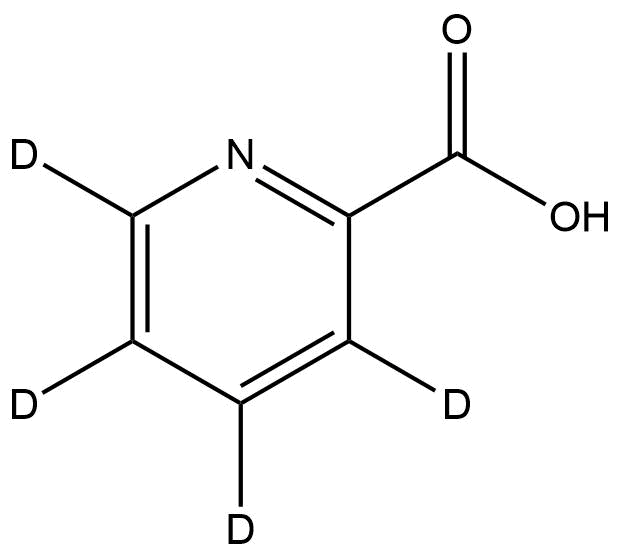
OVERVIEW of 2-Picolinic-d4 acid | CAS 284487-61-2
2-Picolinic-d4 Acid | CAS 284487-61-2 is a deuterium-labeled derivative of picolinic acid, a pyridine-based organic acid widely used in coordination chemistry, biochemical research, and metal-binding mechanistic studies. By incorporating four deuterium atoms into the aromatic ring, this labeled analogue provides a distinct isotopic signature that makes it exceptionally suited for mass spectrometry, tracer studies, metabolic pathway elucidation, and quantitative analytical applications.
The compound retains the native chemical behavior of picolinic acid, including its strong chelating ability toward metal ions, its acidity profile, and its compatibility with aqueous and organic solvents. Because the deuterium atoms do not significantly alter the molecular functionality, 2-Picolinic-d4 Acid behaves nearly identically to its non-labeled counterpart, ensuring seamless substitution in experiments requiring isotopically enriched standards.
In modern analytical sciences, stable isotope-labeled materials have become indispensable tools for method development, internal standardization, and compound tracing. 2-Picolinic-d4 Acid fulfills these requirements through exceptional isotopic purity, chemical stability, and robust performance across LC-MS, GC-MS, and NMR platforms.
CHEMICAL INFORMATION
-
Chemical Name: 2-Picolinic-d4 Acid
-
CAS Number: 284487-61-2
-
Molecular Formula: C6HD4NO2
-
Isotopic Enrichment: ≥ 98% D
-
Chemical Class: Deuterated pyridine carboxylic acid
-
Molecular Weight: 127.14 g/mol
The selective incorporation of deuterium into the pyridine ring ensures the molecule maintains the same pKa behavior, chelating strength, and chromatographic characteristics as unlabeled picolinic acid.
STRUCTURAL & ANALYTICAL PROPERTIES
2-Picolinic-d4 Acid retains the essential functional features of picolinic acid, including:
-
Pyridine nitrogen that strongly coordinates with metals
-
Carboxylate group providing bidentate chelation
-
High solubility in polar solvents such as methanol, water, and acetonitrile
-
Thermal and chemical stability suitable for LC-MS and GC-MS sample prep
-
Robust ionization in both positive and negative electrospray modes
The presence of four deuterium atoms produces a predictable +4 Da mass shift, allowing clear separation between the labeled and unlabeled analyte in mass spectra. This makes the compound ideal for quantitative assays requiring an internal standard that behaves identically during extraction, separation, and detection.
Additionally, the strong metal-binding characteristics of picolinic acid are preserved in the d4 version, allowing it to be used in mechanistic coordination studies without altering the reactivity of target metals or complexes.
APPLICATIONS of 2-Picolinic-d4 acid | CAS 284487-61-2
Stable Isotope Internal Standard for LC-MS Analysis
2-Picolinic-d4 Acid is frequently used as an internal standard in mass spectrometry due to:
-
Nearly identical chromatographic retention as the native compound
-
Highly reproducible ionization
-
Ability to correct matrix effects
-
Enhanced quantitative precision in calibration curves
It is particularly useful in studies where endogenous picolinic acid or related metabolites must be measured accurately.
Metabolomics & Biochemical Pathway Tracing
In biological systems, picolinic acid is associated with the kynurenine pathway of tryptophan metabolism. The deuterated analogue enables researchers to:
-
Trace conversion pathways
-
Measure metabolic flux
-
Identify intermediates and side metabolites
-
Distinguish between endogenous and exogenous contributions
Coordination Chemistry & Metal Binding Studies
Picolinic acid is a widely studied ligand due to its:
-
Bidentate chelation behavior
-
Ability to form stable complexes with transition metals
-
Utility in catalysis and supramolecular chemistry
The d4-labeled variant allows for NMR tracing, reaction mechanistic studies, and kinetic evaluations without altering the coordination chemistry.
Environmental, Food, and Industrial Analytical Testing
Picolinic acid derivatives appear in environmental samples, microbial processes, and industrial chemical transformations. 2-Picolinic-d4 Acid is ideal for:
-
Method validation
-
Spiked recoveries
-
Inter-laboratory assay harmonization
-
Calibration curve development for regulatory testing
ADVANTAGES OF USING 2-Picolinic-d4 acid | CAS 284487-61-2
-
Distinct isotopic mass shift (+4 Da) for clean spectral separation
-
Excellent chemical and isotopic stability
-
Ideal for use as an internal standard in quantitative assays
-
No significant alteration of chemical reactivity or ligand behavior
-
Compatible with LC-MS, GC-MS, and NMR workflows
-
Enhances accuracy, reproducibility, and data confidence
CONCLUSION
2-Picolinic-d4 Acid (CAS 284487-61-2) is a highly reliable and chemically robust stable isotope-labeled compound designed for advanced analytical, biochemical, and coordination chemistry applications. Its four deuterium atoms allow precise mass differentiation without altering the molecule’s natural behavior, making it ideal for quantitative LC-MS/MS workflows, metabolic tracing, chelation studies, and method validation. With strong solubility, predictable ionization, and excellent isotopic enrichment, 2-Picolinic-d4 Acid remains an essential reference material for researchers working in pharmaceutical analysis, metabolomics, coordination chemistry, and environmental science.
Learn more about,
Deuterated Polymers: A Cornerstone Guide to Synthesis, Applications, and Future Trends
Availability of All the Deuterated Chemicals at ResolveMass Laboratories Inc.
ResolveMass Laboratories: Leading Deuterated Chemical Synthesis Company in the United States.
Deuterated Internal Standards for LC-MS: Selection & Custom Synthesis
How to Choose the Right Deuterated Labelled Chemical Synthesis Company in Canada
How to Choose the Right Deuterium Labelled Compounds Supplier for Your Lab
Deuterium-Labelled Compounds — Synthesis, Applications & Ordering
Custom Synthesis of Deuterated Chemicals
Reviews
There are no reviews yet.