
OVERVIEW
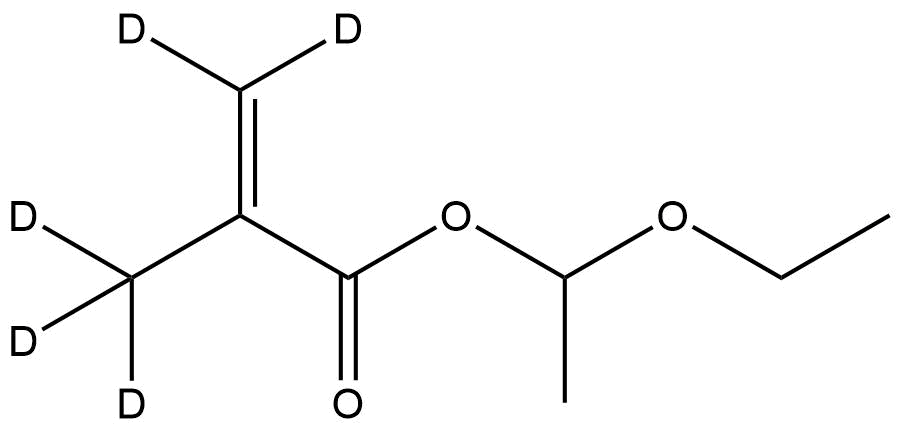
Deuterated 1-Ethoxyethyl Methacrylate-d5 (EEEMA-d5) is a stable isotope–labeled methacrylate monomer engineered for advanced analytical, polymerization, and mechanistic research applications. With five deuterium atoms incorporated into the ethoxyethyl group, this specialized monomer provides a consistent mass shift ideal for NMR, LC–MS, GC–MS, metabolic tracing, and polymer characterization studies.
For pharmaceutical, material science, biomedical engineering, and nuclear magnetic resonance laboratories, EEEMA-d5 offers superior spectral clarity and enhanced analytical reliability when studying polymerization kinetics, degradation pathways, or copolymer architectures. The deuterated backbone minimizes interference, enabling scientists to detect subtle molecular changes that would be masked using non-labeled monomers.
ResolveMass Laboratories Inc. supplies high-purity, research-grade EEEMA-d5 tailored for reproducible polymer synthesis, structural elucidation, and method development.
CHEMICAL INFORMATION
-
Chemical Name: 1-Ethoxyethyl Methacrylate-d5
-
Synonyms: EEEMA-d5, Deuterated 1-ethoxyethyl methacrylate, Isotopically labeled methacrylate-d5
-
Molecular Formula: C₈H₉D₅O₃
-
Isotopic Enrichment: ≥ 98% D
-
Functional Groups: Methacrylate ester, protected alcohol moiety
-
Form: Clear to slightly yellow liquid
-
Reactivity: Readily polymerizable under free-radical and controlled radical conditions (RAFT, ATRP, NMP)
The replacement of five protium atoms with deuterium significantly enhances the monomer’s utility in high-precision spectroscopic and mechanistic investigations. Deuterium’s lower vibrational frequency and distinct mass signature result in well-resolved peaks in NMR and mass spectrometry workflows, improving signal differentiation and analytical certainty.
KEY FEATURES
-
High isotopic purity for reliable MS/NMR tracing
-
Excellent stability under controlled storage conditions
-
Compatible with diverse polymerization systems
-
Predictable incorporation into copolymers without altering polymerization kinetics significantly
-
Enables quantifiable mass-shift tracking in multi-component formulations
-
Supports advanced research on polymer degradation, diffusion, and crosslink behavior
APPLICATIONS of Deuterated 1-Ethoxyethyl methacrylate-d5
1. Polymer Synthesis and Mechanistic Studies
EEEMA-d5 serves as a powerful monomer for studying polymer chain growth, end-group behavior, and copolymer distribution. Deuterium labeling allows researchers to selectively monitor monomer incorporation and segmental mobility using NMR or MS. This is critical for:
-
Determining polymerization kinetics
-
Tracking block copolymer formation
-
Understanding crosslinking mechanisms
-
Investigating microstructure evolution in stimuli-responsive materials
Its methacrylate core ensures compatibility with RAFT, ATRP, and free-radical polymerization, making it flexible for material development.
2. LC–MS / GC–MS Internal Standards
Due to its well-defined mass shift, EEEMA-d5 is widely used as an internal standard in quantitative mass spectrometry, especially in:
-
Residual monomer analysis
-
Impurity profiling
-
Polymer degradation studies
-
Stability monitoring
Deuteration enables selective detection and quantification without interference from native methacrylate signals.
3. NMR Spectroscopy and Structural Elucidation
In NMR studies, deuterium labeling helps suppress proton signals and enhances interpretation of complex spectra. Researchers use EEEMA-d5 to study:
-
Polymer segmental dynamics
-
Conversion and reactivity ratios
-
Degradation and hydrolysis pathways
-
Spatial distribution of monomers within copolymers
This makes it valuable for academic, pharmaceutical, and materials development laboratories focusing on structural precision.
4. Degradation and Metabolic Tracing
For biomedical polymer systems—such as drug-delivery hydrogels or degradable implants—deuterated monomers play a vital role in tracking:
-
Hydrolytic degradation
-
Enzymatic breakdown
-
Release kinetics of embedded molecules
-
Migration, diffusion, or excretion pathways
The mass-shifted fragments of EEEMA-d5 are easily identified, providing clear insight into degradation mechanisms.
BENEFITS FOR SCIENTISTS AND FORMULATION TEAMS
-
Enhanced spectral clarity: Deuterium reduces overlapping signals in NMR and MS.
-
Improved quantification accuracy: Acts as an ideal internal standard for polymer and monomer analysis.
-
Higher reliability in mechanistic studies: Reveals detailed polymerization behavior that standard monomers cannot.
-
Versatile for materials engineering: Suitable for coatings, adhesives, biomedical polymers, and stimuli-responsive materials.
-
Supports regulatory-ready analytical methods: Useful for validated LC-MS workflows and QC method development.
WHY CHOOSE RESOLVEMASS LABORATORIES INC.
ResolveMass Laboratories Inc. is committed to providing high-purity, rigorously characterized isotopically labeled monomers designed for demanding research. With deep expertise in polymer chemistry, analytical sciences, and specialty materials, we support:
-
Custom deuterated compounds
-
High-purity methacrylate monomers
-
Polymer characterization standards
-
Technical guidance for method development and formulation design
Our testing infrastructure and quality systems ensure every batch meets the expectations of advanced scientific and industrial laboratories.
Learn more through,
Deuterated Polymers: A Cornerstone Guide to Synthesis, Applications, and Future Trends
Availability of All the Deuterated Chemicals at ResolveMass Laboratories Inc.
ResolveMass Laboratories: Leading Deuterated Chemical Synthesis Company in the United States.
Deuterated Internal Standards for LC-MS: Selection & Custom Synthesis
How to Choose the Right Deuterated Labelled Chemical Synthesis Company in Canada
How to Choose the Right Deuterium Labelled Compounds Supplier for Your Lab
Deuterium-Labelled Compounds — Synthesis, Applications & Ordering
Custom Synthesis of Deuterated Chemicals
Reviews
There are no reviews yet.