
OVERVIEW
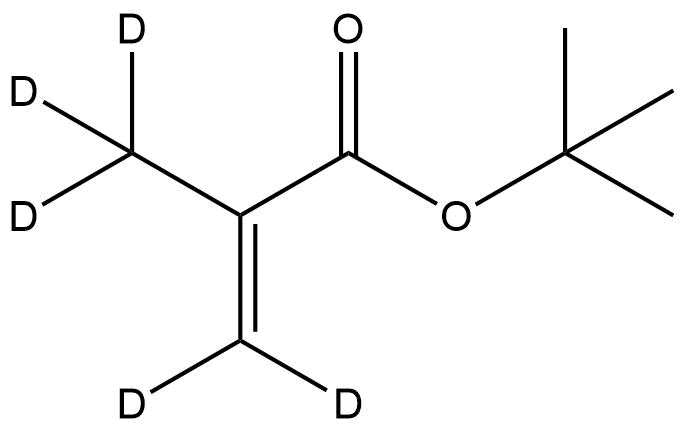
Deuterated tert-Butyl methacrylate-d5 | CAS 585-07-9 is a stable-isotope-labeled monomer in which the tert-butyl group is fully deuterated, providing five deuterium atoms for enhanced analytical traceability, improved resolution in spectroscopic analysis, and specialized applications in polymer science. This compound is particularly valued in research settings where deuterium incorporation is essential for kinetic studies, advanced characterization, NMR structural verification, reaction mechanism elucidation, and polymer chain-tracking experiments.
At ResolveMass Laboratories Inc., Deuterated tert-Butyl methacrylate-d5 is offered as a high-purity, research-grade monomer designed for precision applications in academic, industrial, and pharmaceutical R&D environments. Its combination of chemical stability, synthetic compatibility, and isotopic enrichment makes it a versatile building block for cutting-edge material science and analytical chemistry workflows.
CHEMICAL INFORMATION
Chemical Name: Deuterated tert-Butyl methacrylate-d5
CAS Number: 585-07-9
Molecular Formula: C8H3D5O2
Molecular Weight: 147.23 g/mol
Structure Classification: Deuterium-labeled methacrylate ester
Isotopic Labeling: 5 deuterium atoms located on the tert-butyl group
This monomer maintains the classical methacrylate vinyl functionality, allowing it to behave chemically similar to the non-deuterated tert-butyl methacrylate in polymerization reactions, while enabling isotopically distinguishable tracking during analysis.
KEY PROPERTIES
Deuterated tert-Butyl methacrylate-d5 exhibits a series of characteristics that make it uniquely suited for analytical and polymer research:
-
High Deuterium Enrichment: Ensures strong isotopic signatures for NMR, MS, and kinetic experiments.
-
Excellent Stability: The tert-butyl moiety provides steric protection, resulting in stable storage and predictable reactivity.
-
Polymerizable Vinyl Group: Supports free-radical, controlled radical, ATRP, RAFT, and living polymerization techniques.
-
Spectroscopically Distinct: Deuterium substitution reduces proton coupling and enhances signal resolution.
-
Compatibility with Copolymer Systems: Can be incorporated into hydrophobic, amphiphilic, or functional block copolymers for advanced materials research.
ANALYTICAL APPLICATIONS of Deuterated tert-Butyl methacrylate-d5 | CAS 585-07-9
Deuterated tert-Butyl methacrylate-d5 is widely used as an analytical tool in:
1. Nuclear Magnetic Resonance (NMR) Spectroscopy
Deuterium provides clean spectral windows by eliminating interfering proton signals. It is commonly used for:
-
Polymer microstructure analysis
-
Copolymer composition quantification
-
Reaction monitoring
-
Structural assignment and impurity profiling
2. Mass Spectrometry (MS) and LC-MS Method Development
The +5 Da shift from deuterium incorporation allows researchers to differentiate between labeled and unlabeled monomers, aiding in:
-
Reaction mechanism studies
-
Kinetic isotope effect measurements
-
Quantitative MS standard development
-
Metabolic labeling (in materials or chemical biology research)
3. Isotopic Internal Standards
Ideal for calibration of analytical methods when evaluating methacrylate monomers or intermediates.
POLYMER SCIENCE APPLICATIONS
Because the deuteration does not significantly alter the reactivity of the vinyl functional group, tBMA-d5 behaves similarly to tert-butyl methacrylate in polymerization systems. This makes it a powerful tool for polymer researchers working on:
1. Chain-Growth Polymerization Studies
Useful for tracking chain propagation and termination when combined with:
-
Free-radical polymerization
-
RAFT polymerization
-
ATRP polymerization
-
Ionic polymerization routes
2. Block Copolymer Development
tBMA-d5 can be integrated into block copolymers for:
-
Morphology studies (SAXS, SANS)
-
Diffusion studies
-
Segmental motion analysis
-
Deuterium-enhanced neutron scattering
3. Polymer Degradation and Kinetic Studies
Deuterium incorporation enables separation of product fragments in analytical workflows, making it easier to study degradation pathways, hydrolysis behavior, and chain scission events.
4. Thin-Film and Coating Research
The hydrophobic tert-butyl structure supports applications in:
-
Protective coatings
-
Surface modification
-
Functional polymer film characterization
-
Self-assembled structures
BENEFITS FOR MATERIAL AND ANALYTICAL RESEARCH
-
Improved spectral clarity and reduced noise in NMR
-
Strong isotopic signal for MS tracking
-
Suitable for mechanistic polymer chemistry studies
-
Enables modeling of polymer dynamics using neutron scattering
-
Supports high-precision method development
-
Essential for kinetic isotope effect determination in diverse reaction systems
WHY CHOOSE RESOLVEMASS LABORATORIES INC.
ResolveMass Laboratories Inc. specializes in high-purity deuterated monomers and isotopically labeled compounds tailored for pharmaceutical, academic, and industrial R&D. Our products are selected for reproducibility, analytical consistency, and maximum scientific utility. Each batch undergoes rigorous quality control to support advanced spectroscopy, polymer development, and materials science.
If you need customized isotopic ratios, specialized derivatives, or technical support for integrating deuterated methacrylates into your workflow, our scientific team is here to help.
Learn more through,
Deuterated Polymers: A Cornerstone Guide to Synthesis, Applications, and Future Trends
Availability of All the Deuterated Chemicals at ResolveMass Laboratories Inc.
ResolveMass Laboratories: Leading Deuterated Chemical Synthesis Company in the United States.
Deuterated Internal Standards for LC-MS: Selection & Custom Synthesis
How to Choose the Right Deuterated Labelled Chemical Synthesis Company in Canada
How to Choose the Right Deuterium Labelled Compounds Supplier for Your Lab
Deuterium-Labelled Compounds — Synthesis, Applications & Ordering
Custom Synthesis of Deuterated Chemicals

Reviews
There are no reviews yet.