

Introduction:
Quantification Methods in E&L Testing play a crucial role in determining the safety of pharmaceutical products, medical devices, and packaging systems. As discussed in modern approaches to Extractables and Leachables in pharmaceutical products, accurate quantification is one of the most critical requirements for regulatory approval.
One of the most important aspects of Extractables and Leachables (E&L) studies is the accurate measurement of leachable compounds, especially when dealing with unknown impurities or compounds without certified standards. Regulatory frameworks such as the ICH Q3E guideline for extractables and leachables clearly emphasize the importance of reliable quantification in risk-based safety assessments.
In this article, we explain Quantifying Leachables: Relative vs Absolute Quantification, how each method works, when to use them, and what regulatory agencies expect. This guide is written based on real-world analytical experience and industry practices followed in advanced E&L laboratories.
Share via:
Summary:
- Quantification Methods in E&L Testing are critical for regulatory submissions and product safety.
- Relative quantification is useful in early-stage screening when reference standards are not available.
- Absolute quantification is required for accurate reporting and regulatory compliance.
- Choosing the correct quantification method depends on study phase, regulatory expectations, and analytical technique.
- This article explains when to use each method and how laboratories implement them in real-world E&L studies.
1: What Are Quantification Methods in E&L Testing?
Quantification Methods in E&L Testing are analytical strategies used to measure how much of a leachable compound migrates from packaging materials, container-closure systems, or medical device components into a pharmaceutical product.
These methods play a key role in E&L risk assessment, because regulatory authorities require both identification and accurate concentration data before approving pharmaceutical products.
In other words, these methods help determine the exact or estimated concentration of leachables, which is essential for toxicological risk assessment and regulatory compliance.
In simple terms:
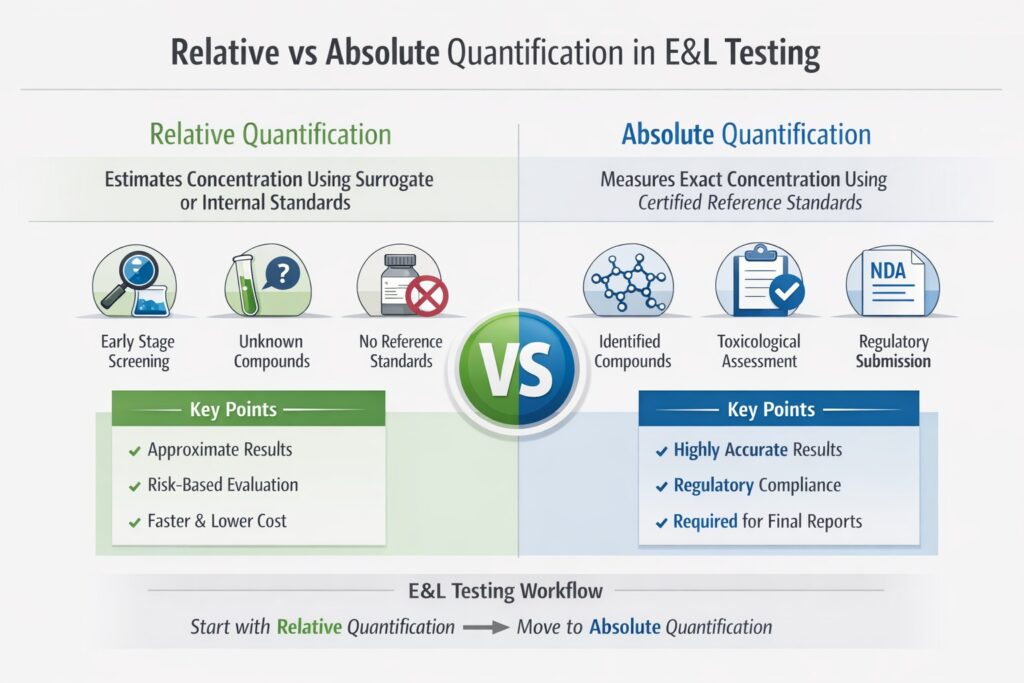
- Relative quantification estimates the concentration of a compound using response factors or surrogate standards when a reference standard is not available.
- Absolute quantification measures the exact concentration using a certified reference standard of the same compound.
Both approaches are essential Quantification Methods in E&L Testing, especially when performing a complete Extractables and Leachables study.
2: Why Is Quantification Important in E&L Studies?
Quantification Methods in E&L Testing are important because regulatory authorities do not only require identification of leachables — they require clear proof that the detected levels are safe for patients. Simply identifying a compound is not sufficient unless its concentration is accurately measured.
Regulatory authorities do not only require identification of leachables — they require proof that the detected levels are safe. This is especially important for companies preparing E&L testing for NDA and ANDA submissions.
Quantification plays a critical role in ensuring product safety, regulatory compliance, and successful submissions.
Quantification helps in:
- Toxicological risk assessment to determine whether a leachable poses any health risk
- Determination of safety thresholds, especially the Analytical Evaluation Threshold (AET)
- Regulatory submissions such as ANDA and NDA where accurate data is mandatory
- Monitoring product stability throughout shelf life
- Evaluating container-closure compatibility and packaging safety
- Supporting extractables and leachables risk assessments
- Compliance with USP extractables and leachables requirements
Without proper quantification, even if a leachable compound is successfully identified, it cannot be scientifically justified from a safety perspective. This is why Quantification Methods in E&L Testing are considered one of the most critical steps in any E&L study.
3: Relative vs Absolute Quantification – What Is the Difference?
In Quantification Methods in E&L Testing, the difference between relative and absolute quantification mainly depends on how the concentration of a leachable compound is calculated. Both methods are widely used, but they serve different purposes depending on the stage of the study and regulatory requirements.
The difference between relative and absolute quantification lies in how the concentration of a leachable compound is calculated. This concept is especially important when comparing regulatory expectations in different regions such as E&L testing USA vs Europe.
Relative Quantification
Relative quantification estimates concentration using a surrogate compound or internal standard. It is commonly used during the early stages of simulated vs exaggerated extraction studies when reference standards are not available.
Relative quantification is typically used when:
- Reference standards are not available
- The leachable compound is unknown
- The study is in the early development stage
- Screening of multiple compounds is required
- Risk-based evaluation is the primary goal
Key characteristics of relative quantification:
- The response factor is assumed rather than experimentally confirmed
- The concentration obtained is approximate
- It is suitable for preliminary risk assessment
- It helps prioritize which compounds need further investigation
Absolute Quantification
Absolute quantification determines the exact concentration of a leachable compound using a certified reference standard of the same compound. This method is required when accurate and regulatory-ready data is needed.
Absolute quantification is required when:
- The leachable compound has been fully identified
- Toxicological risk assessment must be performed
- Data will be submitted to regulatory agencies (such as ANDA or NDA submissions)
- The compound concentration is close to safety limits
- Accurate and defensible reporting is mandatory
Key advantages of absolute quantification:
- Highly accurate concentration values
- Better reproducibility and reliability
- Strong regulatory acceptance
- Scientifically justified results suitable for final reports
4: Quantification Methods in E&L Testing – When Should You Use Relative Quantification?
In Quantification Methods in E&L Testing, relative quantification should be used during the early stages of an E&L study when the primary objective is screening and risk evaluation rather than regulatory reporting. It allows laboratories to estimate the concentration of multiple leachables quickly, especially when certified reference standards are not available.
Relative quantification should be used during the early stages of an E&L study when the goal is screening rather than regulatory reporting. It is often used alongside E&L sample preparation best practices to quickly identify risk levels.
You should use relative quantification when:
- The leachable compound has not yet been identified
- You are performing simulated extraction studies
- The goal is to identify potential risk levels
- Certified reference standards are not available
- The project is still in early product development
- A large number of compounds need to be screened quickly
Why it is used first in most E&L studies
In practical workflows, laboratories typically begin with relative quantification because it helps prioritize critical compounds without increasing cost and project timelines. Once compounds that are close to safety limits are identified, the study then moves to absolute quantification for accurate and regulatory-ready results.
This is why relative quantification is considered the first step in Quantification Methods in E&L Testing before moving to absolute quantification in later stages.
5: Quantification Methods in E&L Testing – When Should You Use Absolute Quantification?
In Quantification Methods in E&L Testing, absolute quantification must be used whenever accurate, regulatory-ready data is required. Once a leachable compound has been identified and its concentration needs to be scientifically justified, relative quantification is no longer sufficient.
Absolute quantification must be used when accurate and regulatory-ready data is required. This is particularly important for companies planning market authorization in the United States.
You should use absolute quantification when:
- The leachable compound has been fully identified
- Toxicological qualification or risk assessment is required
- You are preparing an ANDA or NDA submission
- The concentration is close to safety limits
- The compound has regulatory or toxicological significance
- Accurate reporting is required for final study reports
Why regulatory authorities require it
Regulatory agencies expect absolute quantification for any leachable compound that exceeds or is close to the Analytical Evaluation Threshold (AET). This is because safety decisions cannot be made using estimated values — they must be based on scientifically validated concentration data.
For this reason, absolute quantification is considered one of the most critical Quantification Methods in E&L Testing, especially during the final stages of pharmaceutical development and regulatory submission.
6: Comparison Table: Relative vs Absolute Quantification
The table below clearly explains the difference between relative and absolute approaches in Quantification Methods in E&L Testing and when each method should be used.
| Parameter | Relative Quantification | Absolute Quantification |
|---|---|---|
| Accuracy | Moderate | Very High |
| Reference Standard Required | No | Yes |
| Regulatory Acceptance | Limited | Fully Accepted |
| Use in Early Screening | Yes | No |
| Use in Final Reports | Rarely used | Yes |
| Suitable for Unknown Compounds | Yes | No |
| Time Required | Faster | Slower |
| Cost | Lower | Higher |
This comparison clearly shows why both approaches are essential Quantification Methods in E&L Testing. Relative quantification helps in early-stage screening and risk-based evaluation, while absolute quantification is required for accurate reporting and regulatory submissions.
7: Analytical Techniques Used for Quantifying Leachables
In Quantification Methods in E&L Testing, the accuracy of quantification depends strongly on the analytical technique used. Different types of leachables require different analytical methods, and each technique supports both relative and absolute quantification depending on the stage of the study.
Quantification accuracy depends heavily on the analytical technique used. Modern laboratories performing Extractables and Leachables testing in the United States typically rely on the following techniques:
Below are the most commonly used analytical techniques in E&L studies.
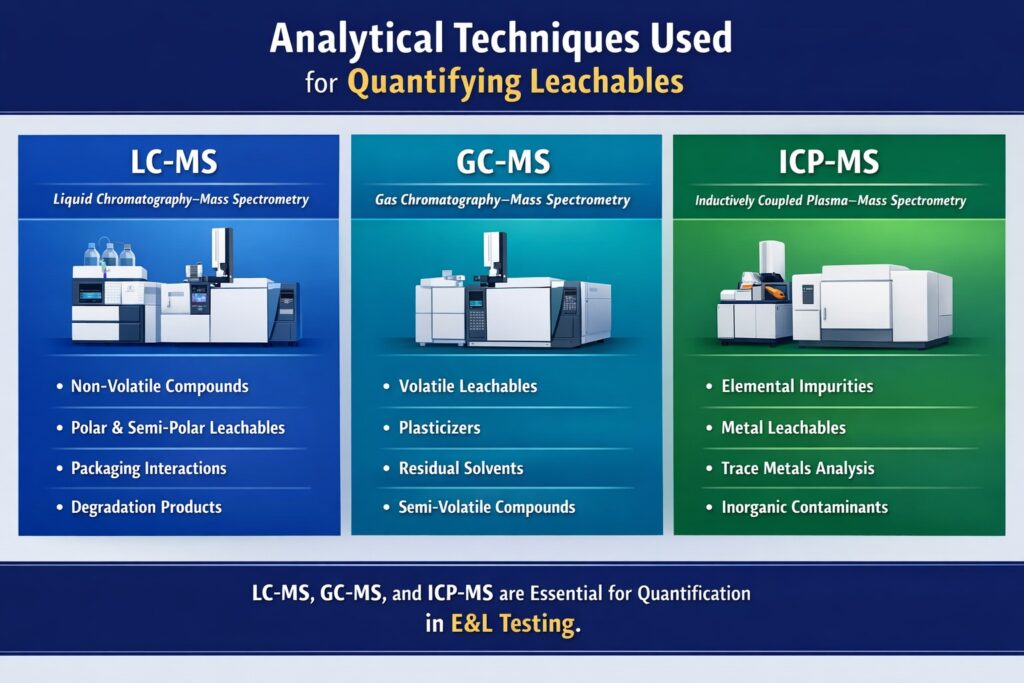
1. LC-MS (Liquid Chromatography–Mass Spectrometry)
LC-MS is widely used for quantifying non-volatile and polar leachables that cannot be analyzed using gas chromatography. It is one of the most important techniques in modern extractables and leachables testing.
LC-MS is commonly used for:
- Non-volatile leachable compounds
- Polar and semi-polar compounds
- Pharmaceutical packaging interactions
- Additives, degradation products, and unknown leachables
- Compounds that require high sensitivity detection
LC-MS supports both relative quantification (for screening) and absolute quantification (for regulatory reporting).
2. GC-MS (Gas Chromatography–Mass Spectrometry)
GC-MS is used for volatile and semi-volatile leachables, especially those commonly found in polymer-based packaging materials.
GC-MS is commonly used for:
- Volatile leachables
- Semi-volatile organic compounds (SVOCs)
- Plasticizers and polymer additives
- Residual solvents
- Organic extractables from container-closure systems
Like LC-MS, GC-MS can be used for both relative and absolute quantification depending on whether reference standards are available.
3. ICP-MS
ICP-MS is primarily used for the quantification of elemental impurities and metal leachables in pharmaceutical products and packaging systems.
ICP-MS is commonly used for:
- Elemental impurities
- Metal leachables
- Trace-level metal detection
- Container closure compatibility studies
- Compliance with elemental impurity guidelines
These techniques are also widely used in specialized applications such as E&L testing for inhalation and nasal drug products and Extractables and leachables in biologics.
8: How Analytical Evaluation Threshold (AET) Impacts Quantification Methods in E&L Testing
In Quantification Methods in E&L Testing, the Analytical Evaluation Threshold (AET) plays a critical role in deciding whether relative quantification is sufficient or absolute quantification is required. The AET is the level above which a leachable compound must be evaluated for potential toxicological risk.
The Analytical Evaluation Threshold (AET) plays a major role in deciding whether relative or absolute quantification is sufficient. This concept is especially important in advanced risk-based approaches such as Extractables and Leachables in biopharma and carcinogenicity-focused E&L testing.
In simple terms, the AET helps laboratories decide how accurate the quantification needs to be.
If the estimated concentration (from relative quantification):
- Is far below the AET → Relative quantification is generally acceptable
- Is close to the AET → Absolute quantification becomes necessary
- Exceeds the AET → Toxicological risk assessment is mandatory
Why the AET is so important in E&L studies
The purpose of the AET is not just to detect leachables, but to focus scientific effort on compounds that could impact patient safety. This is why laboratories often begin with relative quantification and then move to absolute quantification only for critical compounds.
For this reason, experienced laboratories do not rely on a single approach. Instead, they strategically combine both approaches as part of advanced Quantification Methods in E&L Testing to ensure accurate, regulatory-ready, and risk-based results.
9: Real-World Example: Relative vs Absolute Quantification in an E&L Study
In Quantification Methods in E&L Testing, laboratories rarely rely on only one quantification approach. Instead, a combination of relative and absolute quantification is used strategically to generate accurate and regulatory-ready data. The example below explains how this works in a real-world E&L study.
In real-world projects, laboratories rarely rely on only one quantification method. Instead, they combine both methods strategically — especially when outsourcing complex projects to a specialized E&L testing laboratory in the United States.
Step 1: Initial screening using relative quantification
During a simulated extraction study:
- 15 unknown peaks were detected using LC-MS
- Relative quantification was performed using a surrogate standard
- 12 compounds were found to be well below the AET
- 3 compounds were detected close to the AET limit
At this stage, relative quantification helped quickly identify which compounds required further investigation without delaying the study.
Step 2: Confirmation using absolute quantification
For the 3 compounds that were close to the safety threshold:
- Structural identification was performed using advanced analytical techniques
- Certified reference standards were procured
- Absolute quantification was carried out using validated calibration methods
This ensured that the reported concentration values were accurate and suitable for regulatory review.
Final outcome of the study
- Only one compound required toxicological evaluation
- The remaining compounds were confirmed to be below safety limits
- The product was successfully approved without repeating the E&L study
- Time, cost, and regulatory delays were avoided
This example clearly shows how both approaches work together in real-world Quantification Methods in E&L Testing, especially in regulatory-focused laboratories where both scientific accuracy and submission readiness are critical.
10: Challenges in Quantifying Leachables
In Quantification Methods in E&L Testing, quantifying leachables is often more complex than simple analytical measurement. Even when compounds are detected successfully, several technical and regulatory challenges can affect the accuracy and reliability of the results.
Below are some of the most common challenges faced in E&L studies.
Common challenges in quantifying leachables:
- Lack of reference standards for newly identified or unknown leachable compounds
- Low-level detection limits, especially when compounds are present at trace levels
- Matrix interference from the drug product or extraction solvent
- Unknown compounds that require identification before accurate quantification
- Complex packaging materials that can release multiple extractables simultaneously
- Strict regulatory expectations for accurate, reproducible, and scientifically justified data
Why expertise is critical
Because of these challenges, quantification in E&L studies is not just a routine analytical task. It requires strong expertise in analytical chemistry, advanced instrumentation (such as LC-MS and GC-MS), and a deep understanding of regulatory requirements.
This is why experienced laboratories play a crucial role in ensuring accurate results in Quantification Methods in E&L Testing, especially for regulatory submissions and high-risk pharmaceutical products.
11: Why Expertise Matters in Quantification Methods in E&L Testing
In Quantification Methods in E&L Testing, accurate results depend not only on analytical instruments but also on the expertise of the scientists performing the study. Quantification of leachables is not just a mathematical calculation — it requires scientific judgment, regulatory understanding, and real-world analytical experience.
Quantification is not just a mathematical calculation — it requires deep scientific expertise, especially when working on advanced therapies such as emerging biologics and advanced therapies.
Experienced laboratories also help reduce delays and improve submission success rates, which is why many companies rely on ResolveMass Extractables and Leachables testing services.
To generate reliable and regulatory-ready data, the laboratory must combine advanced analytical capability with strong technical knowledge.
Quantification in E&L testing requires:
- Strong understanding of analytical chemistry, especially chromatographic and mass spectrometry techniques
- Knowledge of global regulatory guidelines related to extractables and leachables
- Hands-on experience with LC-MS and GC-MS methods for low-level quantification
- Toxicological awareness to understand the safety impact of detected compounds
- Risk-based scientific decision making when choosing between relative and absolute quantification
- Experience with complex packaging and pharmaceutical matrices
Why specialized expertise makes a difference
Laboratories that specialize in extractables and leachables testing can significantly reduce project timelines, avoid unnecessary re-testing, and ensure that the final reports are accurate, defensible, and ready for regulatory submission.
This is why technical expertise plays a critical role in successful Quantification Methods in E&L Testing, especially for pharmaceutical companies preparing for regulatory approval.
12: Best Practices for Quantifying Leachables
In Quantification Methods in E&L Testing, following the right strategy is essential to generate accurate, reproducible, and regulatory-ready results. A structured approach helps laboratories avoid re-testing, reduce project timelines, and ensure reliable data for toxicological risk assessment.
Below are some of the most important best practices used in successful E&L studies.
Best practices for accurate quantification:
- Start with relative quantification for initial screening to quickly estimate concentrations of multiple leachables
- Identify compounds that are close to the AET and prioritize them for further investigation
- Use absolute quantification for critical compounds that may impact product safety
- Validate calibration curves properly to ensure accuracy and reproducibility
- Use internal standards wherever possible to improve quantification reliability
- Document analytical methods clearly for regulatory submissions
- Align the quantification strategy with regulatory expectations from the beginning of the study
These best practices are becoming increasingly important as the future of extractables and leachables testing evolves toward more complex pharmaceutical products.
Why these best practices matter
Following these practices ensures that the data generated in Quantification Methods in E&L Testing is scientifically justified, accurate, and acceptable to regulatory authorities. It also helps pharmaceutical companies make faster and more confident decisions during product development.
Conclusion:
Quantification Methods in E&L Testing are essential for ensuring pharmaceutical product safety and regulatory compliance. Relative quantification is ideal for early screening and risk-based evaluation, while absolute quantification is necessary for final reporting and regulatory submissions.
Understanding Quantifying Leachables: Relative vs Absolute Quantification helps pharmaceutical companies avoid unnecessary delays, reduce testing costs, and ensure successful approvals. A strategic combination of both methods, supported by analytical expertise and regulatory knowledge, delivers the most reliable and efficient E&L testing results.
Frequently Asked Questions:
Quantification Methods in E&L Testing are analytical approaches used to measure the concentration of leachable compounds that migrate from packaging materials, container-closure systems, or medical devices into pharmaceutical products. These methods are essential for toxicological risk assessment and regulatory submissions.
Relative quantification estimates the concentration using response factors or surrogate standards, while absolute quantification measures the exact concentration using a certified reference standard. Relative quantification is mainly used for early screening, whereas absolute quantification is required for regulatory reporting.
Relative quantification should be used during the early stages of extractables and leachables studies when the compounds are unknown, reference standards are not available, and the goal is screening or risk evaluation rather than final regulatory submission.
Absolute quantification is required when the leachable compound has been identified, toxicological qualification is necessary, or the data will be submitted to regulatory authorities such as in ANDA or NDA submissions.
Quantification is important because regulatory agencies require not only identification of leachables but also proof that the detected levels are safe. Accurate quantification supports toxicological risk assessment, AET determination, and regulatory compliance.
Reference
- Rozio MG, Angelini D, Carrara S. Uncertainty factors and relative response factors: correcting detection and quantitation bias in extractables and leachables studies. Analytical and Bioanalytical Chemistry. 2025 Aug;417(19):4331-49.https://link.springer.com/article/10.1007/s00216-025-05946-5
- Jenke D. Identification and quantitation classifications for extractables and leachables. PDA Journal of Pharmaceutical Science and Technology. 2020 Mar 1;74(2):275-85.https://www.researchgate.net/profile/Dennis-Jenke/publication/335215943_Identification_and_Quantitation_Classifications_for_Extractables_and_Leachables/links/5eedec75a6fdcc73be8d93fa/Identification-and-Quantitation-Classifications-for-Extractables-and-Leachables.pdf
- Jordi MA, Rowland K, Liu W, Cao X, Zong J, Ren Y, Liang Z, Zhou X, Louis M, Lerner K. Reducing relative response factor variation using a multidetector approach for extractables and leachables (E&L) analysis to mitigate the need for uncertainty factors. Journal of pharmaceutical and biomedical analysis. 2020 Jul 15;186:113334.https://www.sciencedirect.com/science/article/pii/S0731708520304283
- Sica VP, Krivos KL, Kiehl DE, Pulliam CJ, Henry ID, Baker TR. The role of mass spectrometry and related techniques in the analysis of extractable and leachable chemicals. Mass Spectrometry Reviews. 2020 Mar;39(1-2):212-26.https://analyticalsciencejournals.onlinelibrary.wiley.com/doi/abs/10.1002/mas.21591
- Jenke D. Identification, analysis and safety assessment of leachables and extractables. TrAC Trends in Analytical Chemistry. 2018 Apr 1;101:56-65.https://www.sciencedirect.com/science/article/pii/S0165993617303321
About the Author


