

Introduction:
Rapid Bioanalytical Method Development has become a critical requirement in modern drug development, especially during Phase II studies where timelines tighten and data expectations increase. Sponsors advancing programs through discovery and clinical stages increasingly rely on specialized bioanalytical services and bioanalytical services in drug development to maintain momentum without compromising data integrity.
ResolveMass Laboratories Inc., a specialized bioanalytical CRO, recently supported a Phase II clinical program where traditional timelines were no longer acceptable. By applying a structured yet flexible Rapid Bioanalytical Method Development framework—rooted in proven bioanalytical method development and bioanalytical method validation expertise—ResolveMass reduced overall method development time by 30% while maintaining regulatory alignment.
Summary:
- ResolveMass Laboratories Inc. achieved a 30% reduction in method development timelines during a Phase II clinical program
- The success was driven by Rapid Bioanalytical Method Development strategies aligned with regulated bioanalytical services
- Early risk assessment, platform-based workflows, and LC–MS/MS expertise were central to the outcome
- The approach improved data quality, regulatory confidence, and sponsor decision-making speed
1: Understanding the Phase II Bioanalytical Challenge
What was the core challenge in this Phase II study?
The central challenge was developing a validated bioanalytical method rapidly enough to support aggressive Phase II timelines, while ensuring long-term robustness suitable for clinical bioanalytical services and eventual IND and NDA submissions.
Why Phase II Bioanalysis Is Particularly Demanding
Phase II clinical studies introduce a unique combination of scientific and operational complexity, including:
- Higher Sample Volumes Than Phase I
Phase II studies demand scalable workflows supported by high-throughput bioanalysis and reliable bioanalytical laboratory services. - Narrow Therapeutic Windows
Precise bioanalytical quantification at low concentration levels is essential for safe dose optimization. - Multiple Study Amendments
Protocol changes often require method flexibility without compromising validation integrity.
Programs may involve small-molecule vs large-molecule bioanalysis, biologics, or even cell and gene therapy bioanalysis. - Increased Regulatory Scrutiny
Phase II data directly informs risk–benefit decisions, making bioanalytical data integrity non-negotiable.
In this study, the sponsor required rapid method readiness to prevent delays in patient dosing and to enable timely interim pharmacokinetic analysis, making speed and reliability equally non-negotiable.
2: Why Conventional Method Development Was Not Enough
Why do traditional workflows slow Phase II programs?
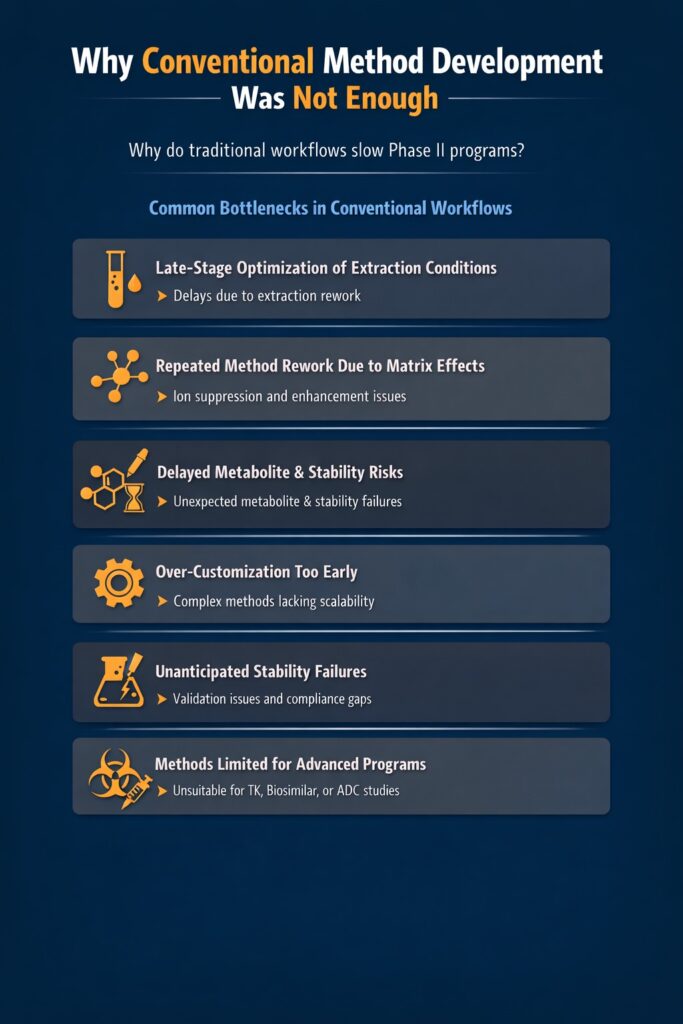
Traditional bioanalytical method development relies on a linear, step-by-step workflow that prioritizes completeness over speed. While scientifically sound, this approach is poorly suited for Phase II programs where timelines are compressed and rapid decision-making is essential.
Common Bottlenecks in Conventional Workflows
- Late-Stage Optimization of Extraction Conditions
Extraction challenges are often discovered only after significant method development time has already been invested. - Repeated Method Rework Due to Matrix Effects
Inadequate early matrix evaluation leads to ion suppression or enhancement issues that require redevelopment. - Delayed Identification of Metabolite and Stability Risks
Metabolite interference or stability failures may surface late, disrupting validation and ongoing biomarker bioanalytical services or PK studies. - Over-Customization Too Early in Development
Excessive fine-tuning before understanding long-term study needs increases complexity without added value. - Unanticipated bioanalytical stability testing failures
- Rework caused by known challenges in bioanalytical method development
- Methods unsuitable for toxicokinetic bioanalysis or biosimilar programs
Recognizing these limitations, ResolveMass adopted a fundamentally different mindset—one centered on Rapid Bioanalytical Method Development from the very first development step, enabling faster timelines without compromising data quality or regulatory confidence.
3: ResolveMass’ Rapid Bioanalytical Method Development Strategy
ResolveMass applied a platform-driven, risk-based model grounded in its bioanalytical services overview and CRO-scale operational experience.
How did ResolveMass approach Rapid Bioanalytical Method Development differently?
ResolveMass applied a platform-driven, risk-based approach designed specifically for Phase II demands.
Key Principles Applied
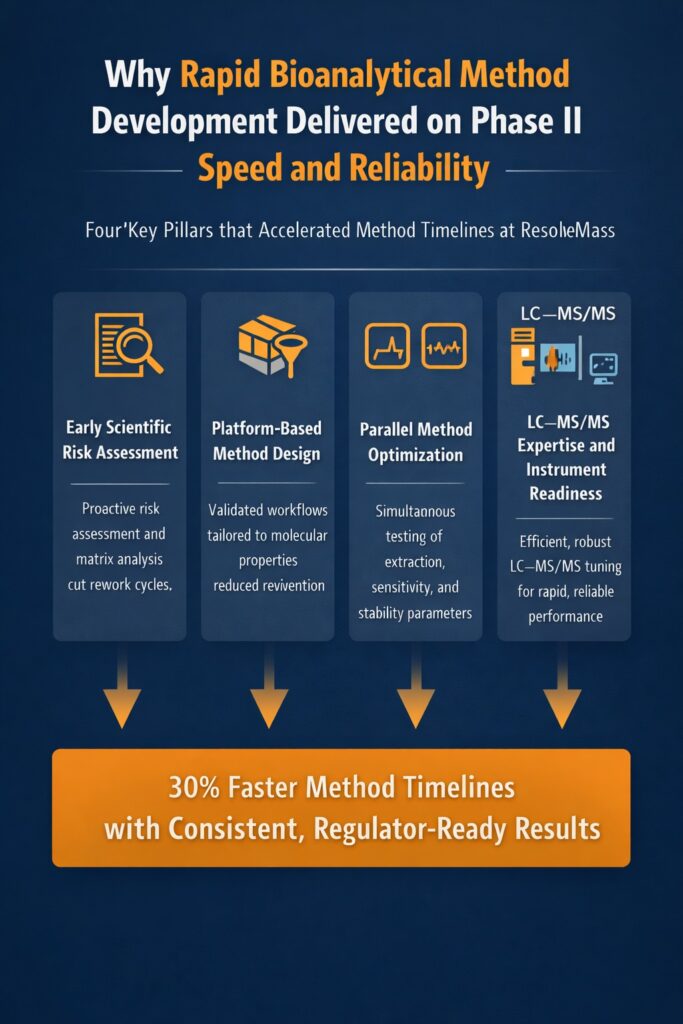
- Early scientific risk assessment
- Platform methods tailored, not reinvented
- Parallel optimization instead of sequential testing
- LC–MS/MS readiness aligned with validation requirements
This strategy is especially effective for outsourced bioanalysis for drug development and bioanalytical outsourcing for pharma.
Step 1: Early Risk Assessment and Matrix Intelligence
Why was early risk assessment critical?
Early risk assessment was essential because it allowed potential bioanalytical challenges to be identified and mitigated before method development began. ResolveMass focused on understanding matrix complexity, analyte stability, and clinically relevant concentration ranges to prevent downstream method rework.
Actions Taken During Early Risk Assessment
- Review of Preclinical and Phase I Bioanalytical Data
Existing data were analyzed to anticipate sensitivity requirements, matrix behavior, and analytical variability. - Assessment of Species-to-Human Matrix Differences
Cross-matrix comparisons helped predict extraction efficiency and matrix effects specific to human samples. - Prediction of Ion Suppression and Enhancement Zones
Historical LC–MS/MS data were used to identify potential ionization risks early in the chromatographic process. - Evaluation of Stability Under Real Storage Conditions
Stability risks related to freeze–thaw cycles, bench-top handling, and autosampler conditions were assessed upfront.
By addressing these risks early, ResolveMass minimized redevelopment cycles and laid a strong foundation for Rapid Bioanalytical Method Development with consistent, regulator-ready performance.
ResolveMass evaluated matrix complexity, stability, and ionization behavior early—leveraging experience in LC–MS/MS bioanalysis of xenobiotics and biologically complex matrices.
This proactive approach reduced rework and supported GLP bioanalytical services readiness.
Step 2: Platform-Based Method Design
How did platform methods accelerate development?
Platform-based method design accelerated Rapid Bioanalytical Method Development by eliminating unnecessary reinvention. Instead of building methods from the ground up, ResolveMass leveraged validated LC–MS/MS platform workflows and strategically adapted them to the specific physicochemical properties of the molecule.
Benefits of Platform-Based LC–MS/MS Methods
- Faster Chromatographic Selection
Pre-established column chemistries and mobile phase systems enabled rapid identification of suitable chromatographic conditions. - Pre-Optimized Mass Spectrometry Parameters
Existing ion source and acquisition settings provided a reliable starting point, reducing extensive tuning cycles. - Reduced Trial-and-Error During Extraction Development
Platform extraction strategies minimized experimental iterations while maintaining recovery and cleanliness. - Built-In Regulatory Alignment
Platform workflows were already designed to meet FDA and EMA bioanalytical expectations, ensuring validation readiness.
This platform-driven approach is a cornerstone of Rapid Bioanalytical Method Development at ResolveMass, delivering speed, consistency, and long-term method robustness.
Rather than reinventing workflows, ResolveMass adapted validated platform methods spanning:
- LC–MS/MS bioanalytical services
- LC–MS for large molecules
- LC–MS bioanalysis for oligonucleotides
- Antibody–drug conjugate bioanalytical services
This ensured rapid progression from development to bioanalytical method development and validation.
Step 3: Parallel Optimization Instead of Sequential Testing
Parallel evaluation of extraction, selectivity, sensitivity, and stability allowed ResolveMass to maintain speed without compromising compliance—an approach increasingly adopted in advanced bioanalytical strategies for complex drug modalities.
What role did parallel optimization play?
Parallel optimization was a major driver of time savings in Rapid Bioanalytical Method Development. Instead of optimizing one method parameter at a time, ResolveMass evaluated multiple critical parameters simultaneously, allowing informed decisions to be made earlier in the development process.
Parallel Activities That Accelerated Development
- Extraction Recovery and Matrix Effect Assessment
Recovery efficiency and matrix effects were evaluated together to ensure optimal extraction performance without introducing ion suppression or enhancement. - Sensitivity Optimization Alongside Selectivity Evaluation
Lower limits of quantification were refined while confirming selectivity across relevant biological matrices, reducing the need for re-optimization. - Stability Assessments During Method Refinement
Short-term and process stability studies were conducted in parallel with method optimization to confirm analyte integrity under real analytical conditions.
By integrating these activities, ResolveMass significantly shortened the development cycle while maintaining method robustness, reproducibility, and regulatory readiness.
Step 4: LC–MS/MS Expertise and Instrument Readiness
Why did instrumentation expertise matter?
Instrumentation expertise was critical because Rapid Bioanalytical Method Development depends on how efficiently LC–MS/MS systems are configured, optimized, and stabilized. At ResolveMass, scientists bring deep, hands-on experience with advanced LC–MS/MS platforms, allowing rapid troubleshooting and precise fine-tuning without repeated trial cycles.
Deep instrument knowledge and readiness minimized downtime and supported reproducible performance—critical for PK and TK bioanalytical CRO services and biosimilar studies.
Key Advantages of ResolveMass’ LC–MS/MS Expertise
- Faster Ionization Mode Selection
Early, experience-driven decisions on ionization polarity and source conditions reduced unnecessary optimization experiments. - Efficient MRM Transition Optimization
Targeted transition development ensured high sensitivity and selectivity while minimizing background noise and matrix interference. - Stable and Reproducible Signal Performance
Consistent instrument tuning delivered reliable signal response across analytical batches and study phases. - Reduced Downtime Between Development Iterations
Proactive instrument readiness and expert troubleshooting minimized delays, keeping development timelines on track.
This expert-level command of LC–MS/MS instrumentation is often the unseen factor that enables Rapid Bioanalytical Method Development to deliver both speed and long-term analytical robustness.
4: Results: 30% Reduction in Method Development Time
What measurable impact did ResolveMass achieve?
| Metric | Conventional Timeline | ResolveMass Timeline |
|---|---|---|
| Method Development | ~10 weeks | ~7 weeks |
| Rework Cycles | Multiple | Minimal |
| Validation Readiness | Delayed | On schedule |
| Study Support | Reactive | Proactive |
The 30% time reduction directly enabled the sponsor to:
- Maintain patient dosing schedules
- Access PK data earlier
- Make faster dose-escalation decisions
The approach is particularly valuable for virtual biotech and biotech startups seeking cost-effective bioanalytical services.
5: Regulatory Confidence and Data Integrity
How was regulatory confidence maintained?
Regulatory confidence was preserved by ensuring that speed never compromised compliance. From the earliest stages, ResolveMass aligned Rapid Bioanalytical Method Development with FDA and EMA bioanalytical guidance, designing methods that were validation-ready rather than optimized only for short-term study needs.
Key Compliance Factors That Ensured Data Integrity
- Validation-Ready Method Design
Methods were developed with full validation requirements in mind, minimizing the need for redevelopment or corrective actions later in the program. - Clear and Defensible Documentation
All development decisions were scientifically justified and documented, creating a transparent audit trail suitable for regulatory review. - Robust Selectivity and Sensitivity Data
Extensive evaluation across relevant biological matrices ensured reliable quantification at clinically meaningful concentrations. - Comprehensive Stability Evidence
Stability studies reflected real-world sample handling, storage, and analysis conditions to support ongoing clinical use.
This disciplined approach reinforced trust between ResolveMass, the sponsor, and regulatory reviewers while delivering reliable, regulator-ready data at accelerated timelines.
6: Why Rapid Bioanalytical Method Development Works at ResolveMass
What makes ResolveMass different?
Rapid Bioanalytical Method Development works at ResolveMass because it is grounded in real clinical experience, not trial-and-error shortcuts. Every method is designed with downstream validation, regulatory expectations, and long-term study support in mind from the very beginning.
Key Differentiators That Drive Success
- Experienced Bioanalytical Scientists
ResolveMass teams are led by scientists with hands-on Phase II and Phase III bioanalytical experience, ensuring practical decision-making under real clinical timelines. - Proven Platform-Based Workflows
Established LC–MS/MS platform methods allow faster optimization while maintaining sensitivity, selectivity, and robustness across studies. - CRO-Scale Flexibility with Scientific Depth
ResolveMass combines the agility of a specialized CRO with the technical expertise required for complex bioanalytical challenges. - Transparent Sponsor Communication
Continuous, science-driven communication minimizes rework, aligns expectations, and keeps programs moving forward without surprises. Transparent sponsor communication and managing bioanalytical CRO projects experience - Strategic bioanalytical outsourcing
This integrated approach ensures Rapid Bioanalytical Method Development delivers speed, regulatory confidence, and reliable long-term method performance for clinical programs.
Sponsors also benefit from insights into bioanalytical CRO vs in-house decision-making.
7: Business Impact for Sponsors
What does this mean for drug developers?
- For sponsors, the impact includes:
- Faster timelines
- Reduced cost (bioanalytical testing services cost transparency)
- Lower regulatory risk
- Scalable support through bioanalytical CRO outsourcing
Rapid Bioanalytical Method Development is no longer optional — it is a competitive advantage.
Conclusion:
Rapid Bioanalytical Method Development enabled ResolveMass Laboratories Inc. to reduce method development time by 30% during a demanding Phase II program. By integrating platform-based workflows, early risk assessment, and deep LC–MS/MS expertise, ResolveMass delivered speed without sacrificing data quality or regulatory trust.
For sponsors navigating tight Phase II timelines, partnering with a CRO that truly understands why bioanalysis is important—and how to execute it efficiently—can be the difference between delay and momentum.
Frequently Asked Questions :
The four phases of drug development are:
a. Discovery & Preclinical
-Target identification, lead optimization
-In vitro and animal studies to assess safety and activity
b. Clinical Development
-Phase I: Safety, tolerability, PK (20–100 subjects)
-Phase II: Efficacy, dose-ranging (100–300 patients)
-Phase III: Confirmatory efficacy and safety (1,000+ patients)
c. Regulatory Review
-Submission of NDA/BLA
-Regulatory assessment by FDA, EMA, etc.
d. Post-Marketing (Phase IV)
-Long-term safety, real-world effectiveness, pharmacovigilance
ICH guidelines (Q1A(R2), Q1B) do not specify a strict numerical limit, but industry and regulatory consensus recommends:
-Target degradation: 5–20%
-Maximum acceptable: Up to 30% in exceptional cases
The goal is to:
-Demonstrate stability-indicating power
-Generate meaningful degradation products without destroying the molecule
On average:
-10–15 years from discovery to approval
Typical breakdown:
-Discovery & preclinical: 3–6 years
-Clinical development: 6–8 years
-Regulatory review: 1–2 years
-Accelerated pathways (e.g., orphan drugs, oncology) may shorten timelines.
The Rule of 3 defines ideal properties for fragments used in fragment-based drug discovery (FBDD):
-Molecular weight ≤ 300 Da
-cLogP ≤ 3
-Hydrogen bond donors ≤ 3
-Hydrogen bond acceptors ≤ 3
-Rotatable bonds ≤ 3
These properties ensure fragments are small, soluble, and suitable for optimization.
Phase II evaluates whether a drug works in patients with the target disease.
Key objectives:
-Demonstrate preliminary efficacy
-Optimize dose and dosing regimen
-Further assess short-term safety
-Generate PK/PD relationships
Phase II is often the most critical decision point in drug development.
The average success rate of Phase III trials is:
-50–65%, depending on therapeutic area
Examples:
-Oncology: ~40–50%
-Cardiovascular: ~60%
-Infectious diseases: ~70%
Failure at Phase III is costly due to large patient populations and high trial expenses.
Clinical trials fail primarily due to:
-Lack of efficacy (most common)
-Unacceptable safety or toxicity
-Poor target selection or biology
-Inadequate biomarkers or endpoints
-Suboptimal dose selection
-PK variability or bioavailability issues
-Operational or trial design flaws
Many failures trace back to insufficient translational science between preclinical and clinical phases.
Reference
- High Resolution Mass Spectrometry.https://pubs.acs.org/doi/full/10.1021/ac203191t
- Resolvins D1, D2, and Other Mediators of Self-Limited Resolution of Inflammation in Human Blood following n-3 Fatty Acid Supplementation .https://academic.oup.com/clinchem/article-abstract/58/10/1476/5620877
- Phase II: Managing the Remedial Phase in Aggregate Litigation .https://papers.ssrn.com/sol3/papers.cfm?abstract_id=5669850
- Measuring proteins with greater speed and resolution while reducing sample size.https://www.nature.com/articles/s41598-017-09051-1
About the Author


