

Introduction
Regulatory Requirements for GLP-1 Peptide Characterization are critical for ensuring that peptide-based therapies are safe, effective, and consistent in quality. Unlike small molecule drugs, GLP-1 analogs such as liraglutide and semaglutide are more complex and sensitive to changes in their environment and manufacturing process. Because of this, they require deeper analytical evaluation and closer regulatory attention.
Peptide drugs can change over time due to chemical or physical instability during production and storage. These changes may affect how the drug performs in the body, which makes careful monitoring essential. Even small variations can have a noticeable impact on therapeutic outcomes, so strong analytical controls are necessary.
Explore our specialized solutions for complex molecules: Comprehensive Peptide Characterization Services
This article explains the Regulatory Requirements for GLP-1 Peptide Characterization, focusing on global expectations and how companies can align their analytical strategies accordingly. It also highlights why combining scientific understanding with regulatory compliance is essential. A well-planned analytical approach plays a key role in achieving successful product approval.
Share via:
🔍 Summary
- Regulatory Requirements for GLP-1 Peptide Characterization are primarily governed by ICH guidelines (Q6B, Q5C, Q2(R2), Q1A) and regional agencies (FDA, EMA).
- Analytical characterization must define identity, purity, potency, and impurity profile using orthogonal techniques.
- Impurity profiling (oxidation, deamidation, aggregation) is a critical regulatory expectation for GLP-1 analogs.
- Method validation and lifecycle management are mandatory under ICH Q2(R2).
- Stability-indicating methods aligned with ICH Q5C and Q1A are required for peptide degradation pathways.
- Regulatory agencies expect structure-function correlation, especially for modified GLP-1 analogs.
- Comparability studies are essential for process changes and biosimilar/follow-on GLP-1 drugs.
- Advanced tools like LC-MS/MS, HRMS, peptide mapping, and bioassays are standard regulatory expectations.
What Do Regulatory Agencies Require for GLP-1 Peptide Characterization?
Regulatory agencies expect a complete evaluation of structural, physicochemical, and biological properties using validated analytical methods. This ensures that both the drug substance and finished product meet defined quality standards. All data submitted must be reliable, reproducible, and scientifically justified.
For GLP-1 peptides, organizations such as the FDA and EMA rely on ICH guidelines to standardize requirements. These frameworks provide a clear path for characterization, validation, and stability testing. Following these guidelines helps companies meet expectations across multiple global markets.
Ensure your submission meets all federal standards: FDA Peptide Sameness Study Requirements
Key Regulatory Guidelines
| Guideline | Scope for GLP-1 Characterization |
|---|---|
| ICH Q6B | Specifications for biologics (identity, purity, impurities) |
| ICH Q2(R2) | Analytical method validation |
| ICH Q5C | Stability testing for biotechnological products |
| ICH Q1A | Stability protocols |
| ICH S6 | Nonclinical safety (linked to characterization) |
According to Colalto (2024), regulatory expectations for peptide drugs continue to grow due to their structural complexity and impurity challenges. This means companies must go beyond basic testing and demonstrate a deeper understanding of the molecule. As peptide therapies advance, regulatory requirements will also become more detailed.
Regulatory Requirements for GLP-1 Peptide Characterization: Identity & Structural Confirmation
Clear and accurate identity confirmation is a core part of Regulatory Requirements for GLP-1 Peptide Characterization. Regulators require strong evidence that the molecule being developed is exactly what it is claimed to be. This must be supported by multiple analytical techniques to avoid any uncertainty.
The primary structure, including the amino acid sequence, must be confirmed in detail. Any chemical modifications, whether intentional or accidental, must also be identified and explained. These modifications can influence how the drug behaves in the body, including its stability and activity.
In some cases, higher-order structure analysis may also be needed. Even small structural changes can affect how the peptide binds to its target receptor. Therefore, structural analysis must be thorough, accurate, and supported by reliable data.
Verify your primary sequence with precision: Expert Peptide Sequencing and Mapping for Sameness Studies
Required Analytical Techniques
- High-resolution mass spectrometry (HRMS)
- Peptide mapping (enzymatic digestion + LC-MS)
- Amino acid analysis
- NMR (in specific cases)
Research shows that peptide mapping combined with LC-MS is one of the most reliable approaches for confirming GLP-1 structure (Patel & Patel, 2024). It provides detailed sequence information and helps detect even minor variations. This makes it an essential tool in regulatory submissions.
Deep dive into molecular structure using advanced resonance: NMR Analysis for Peptides and Proteins
Regulatory Requirements for GLP-1 Peptide Characterization: Impurity Profiling
Impurity profiling is one of the most important aspects of Regulatory Requirements for GLP-1 Peptide Characterization. Even very small amounts of impurities can impact drug safety and effectiveness. Because of this, regulators require detailed identification and measurement of all impurities.
GLP-1 peptides are especially sensitive to degradation during manufacturing and storage. Changes such as oxidation, deamidation, aggregation, and truncation can occur over time. These changes must be carefully tracked and controlled to maintain product quality.
Understanding how and why these impurities form is also essential. This helps in designing better manufacturing processes and improving product stability. Without proper impurity control, regulatory approval can become difficult.
Regulatory Expectations
- Identification and quantification of process-related impurities
- Identification of product-related impurities and degradation products
- Establishment of acceptance criteria (ICH Q6B)
Utilize state-of-the-art MS technology for profiling: LC-MS Characterization of GLP-1 Peptides
Colalto (2024) emphasizes that advanced analytical tools are required because peptide impurities are often very similar to the main product. Techniques like LC-MS provide the resolution needed to distinguish them clearly. This level of detail is necessary for regulatory compliance.
Regulatory Requirements for GLP-1 Peptide Characterization: Analytical Method Validation
All analytical methods must be validated according to ICH Q2(R2) guidelines. This ensures that the methods are reliable and suitable for their intended use. Validation is a fundamental requirement for regulatory approval and ongoing quality control.
Key validation parameters include specificity, accuracy, precision, and robustness. These ensure that the method produces consistent and correct results under different conditions. Without proper validation, analytical results cannot be trusted.
Other important parameters such as linearity, range, and detection limits must also be established. These define how well the method performs across different concentrations. Proper validation supports confident decision-making during product development.
Partner with experts for compliant method development: Analytical Method Development and Validation Services
For example, validated RP-HPLC methods used for liraglutide impurity analysis have demonstrated compliance with regulatory expectations (Konduru et al., 2024). These methods are essential for routine testing and long-term monitoring.
Stability Requirements in Regulatory Requirements for GLP-1 Peptide Characterization
Stability testing is a key component of Regulatory Requirements for GLP-1 Peptide Characterization. These studies show how the peptide behaves over time under different environmental conditions. They are essential for determining shelf life and proper storage conditions.
GLP-1 peptides are sensitive to temperature, pH, and oxidative stress. These factors can accelerate degradation and affect product performance. Therefore, stability studies must be carefully designed and executed.
Predict your product’s shelf-life and degradation pathways: Forced Degradation Studies for Peptides
Forced degradation studies help identify potential breakdown pathways. These studies also support the development of stability-indicating methods. Together, they provide a complete picture of product stability.
Regulatory Expectations
- Forced degradation studies
- Stability-indicating analytical methods
- Long-term and accelerated stability studies (ICH Q1A, Q5C)
Research by Krieg (2021) confirms that identifying degradation products is necessary for regulatory approval. This ensures that all risks are properly understood and controlled throughout the product lifecycle.
Bioanalytical and Potency Testing Requirements
Potency testing must reflect the biological activity of the GLP-1 peptide. This ensures that the drug works as expected in the body. Regulators place strong importance on assays that directly measure biological function.
Cell-based assays that measure cAMP response are commonly used for GLP-1 receptor agonists. These assays provide direct evidence of receptor activation. In some cases, receptor binding studies are also required.
There must be a clear link between structure and function. Any change in the molecule should be evaluated for its impact on activity. This helps ensure that product quality remains consistent.
Validation of bioassays is also required to confirm accuracy and reproducibility. Poorly designed assays can lead to incorrect conclusions. Therefore, careful selection and validation are essential.
Comparability Requirements for GLP-1 Peptide Drugs
Comparability studies are required whenever there are changes in the manufacturing process. These studies ensure that the product remains consistent before and after the change. This is especially important for peptide drugs due to their sensitivity.
Even small process changes can affect the final product. This makes comparability studies critical for maintaining quality. Regulators expect detailed analytical comparisons to support any changes.
Comparability is also essential for biosimilars. These products must show high similarity to a reference drug. Analytical data plays a central role in demonstrating this similarity.
Regulatory Expectations
- Analytical comparability (physicochemical + biological)
- Impurity profile comparison
- Stability comparison
Hach et al. (2024) highlight that manufacturing changes can significantly impact GLP-1 peptide quality. This reinforces the need for strong analytical evaluation.
Navigate the complexities of ANDA submissions: Peptide Sameness Study for ANDA Approval
Advanced Analytical Techniques Required by Regulators
Regulators expect the use of modern analytical technologies for peptide characterization. Traditional methods alone are not enough for complex molecules like GLP-1 peptides. Advanced tools provide better sensitivity and accuracy.
Core Techniques
- LC-MS/MS and HRMS
- UPLC for impurity profiling
- Circular dichroism (CD)
- Capillary electrophoresis (CE)
- Size exclusion chromatography (SEC)
These techniques allow detailed analysis of structure, purity, and aggregation. They also help detect low-level impurities that could impact safety. Using multiple techniques improves confidence in the results.
Why Multiple Techniques?
No single method can fully characterize peptide drugs. A combination of techniques provides a more complete understanding. This approach aligns with regulatory expectations for strong and reliable data.
Key Challenges in Meeting Regulatory Requirements
One major challenge is controlling peptide heterogeneity and degradation. Peptides can exist in multiple forms, making analysis more complex. This increases the need for advanced analytical methods.
Detecting low-level impurities is another challenge. These impurities are often very similar to the main product. High-resolution techniques are required to identify them accurately.
Setting appropriate specifications can also be difficult. Variability in synthesis and processing must be tightly controlled. This requires both scientific expertise and strong analytical systems.
Yaseen et al. (2025) note that structural modifications in GLP-1 analogs increase analytical complexity. While these changes improve drug performance, they also make characterization more challenging.
Streamline your development with an experienced partner:Leading CRO for GLP-1 Peptide Characterization
Best Practices to Meet Regulatory Requirements for GLP-1 Peptide Characterization
A science-based and proactive approach is essential for meeting Regulatory Requirements for GLP-1 Peptide Characterization. Early planning helps reduce risks and avoid delays. Analytical strategies should be integrated from the start of development.
Using multiple analytical methods improves reliability and ensures full characterization. This aligns well with regulatory expectations. It also provides stronger support for submissions.
Developing stability-indicating methods early helps identify potential issues. This allows for better decision-making during formulation and storage. Early insights can save time later in development.
Quality by Design (QbD) is another important approach. It focuses on understanding how processes affect product quality. This leads to more consistent and reliable outcomes.
Maintaining data integrity and traceability is also critical. Regulators carefully review data quality. Any gaps or inconsistencies can create compliance risks.
Conclusion
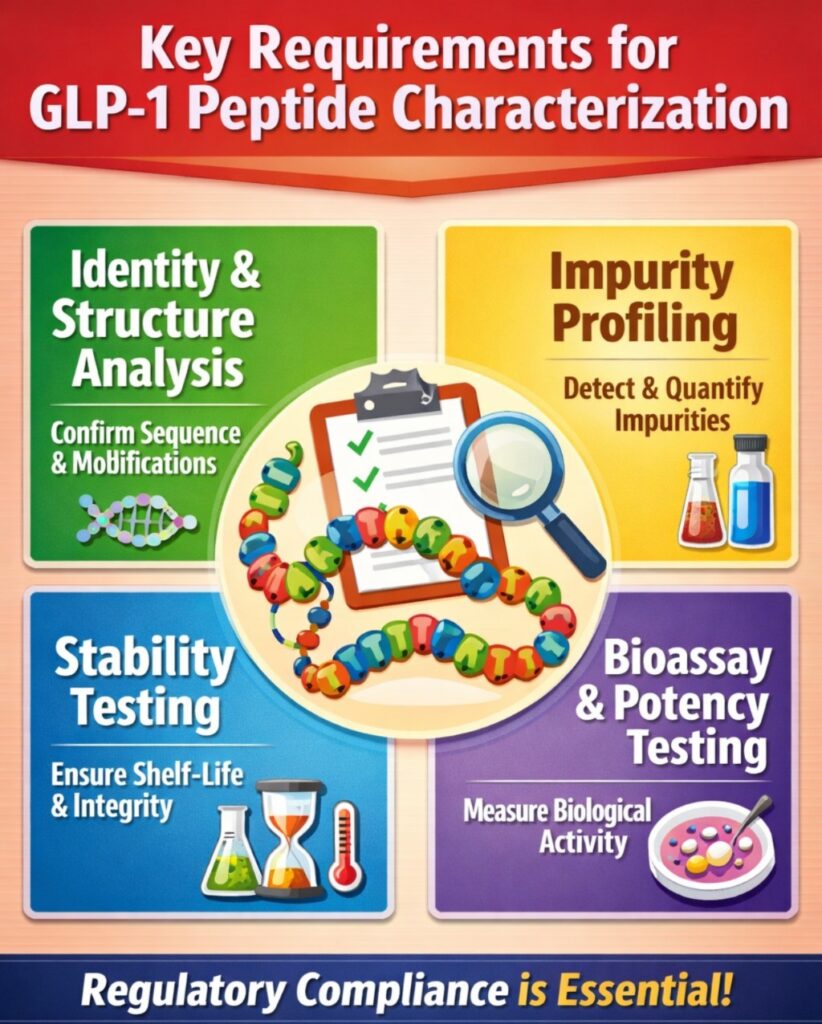
Regulatory Requirements for GLP-1 Peptide Characterization demand a detailed and multi-layered analytical approach. This includes structural analysis, impurity profiling, stability studies, and validated bioassays. Each of these elements plays an important role in ensuring product quality.
As GLP-1 therapies continue to grow, regulatory expectations are becoming more advanced. Agencies now expect deeper insights and the use of modern analytical tools. This trend will continue as peptide technologies evolve.
Companies that invest in strong analytical strategies are more likely to succeed. They can achieve faster approvals and maintain consistent quality. In a competitive market, robust characterization is a clear advantage.
📞 Contact Us
For expert support in GLP-1 peptide analytical characterization and regulatory compliance:
Frequently Asked Questions (FAQs)
The key regulatory guidelines include ICH Q6B, Q2(R2), Q5C, and Q1A. These documents define how to set specifications, validate analytical methods, and perform stability studies. Together, they create a structured approach for ensuring quality and compliance. Following these guidelines helps meet global regulatory expectations.
Impurity profiling is important because even very small impurities can affect drug safety and performance. GLP-1 peptides are complex, and their impurities are often similar in structure to the main compound. This makes detection and control more challenging. Careful profiling ensures consistent quality and reduces risk to patients.
Analytical validation follows ICH Q2(R2) guidelines and confirms that methods are reliable and accurate. Key parameters include specificity, precision, accuracy, and robustness. Additional checks like linearity and detection limits are also required. This process ensures that test results can be trusted throughout the product lifecycle.
GLP-1 peptides must undergo forced degradation, accelerated, and long-term stability studies. These studies help determine how the drug behaves under different environmental conditions. They also establish shelf life and proper storage requirements. Stability testing is essential for regulatory approval and product safety.
Bioassays are used to measure the biological activity of the peptide drug. They confirm that the molecule produces the expected effect in line with its mechanism of action. This helps link structure to function. Reliable bioassays are critical for demonstrating drug effectiveness.
Comparability studies are required when there are changes in the manufacturing process or formulation. They ensure that the product remains consistent before and after the change. This is especially important for sensitive molecules like peptides. Regulators rely on these studies to confirm product equivalence.
Regulators strongly support the use of advanced analytical tools for peptide characterization. These techniques provide higher sensitivity and better resolution than traditional methods. They help detect small changes that could affect product quality. Their use improves confidence in regulatory submissions.
Reference:
- Müller, T. D., Finan, B., Bloom, S. R., D’Alessio, D., Drucker, D. J., Flatt, P. R., Fritsche, A., Gribble, F., Grill, H. J., Habener, J. F., Holst, J. J., Langhans, W., Meier, J. J., Nauck, M. A., Perez-Tilve, D., Pocai, A., Reimann, F., Sandoval, D. A., Schwartz, T. W., … Tschöp, M. H. (2019). Glucagon-like peptide 1 (GLP-1). Molecular Metabolism, 30, 72–130. https://doi.org/10.1016/j.molmet.2019.09.010
- Manandhar, B., & Ahn, J.-M. (2015). Glucagon-like peptide-1 (GLP-1) analogs: Recent advances, new possibilities, and therapeutic implications. Journal of Medicinal Chemistry, 58(3), 1020–1037. https://doi.org/10.1021/jm500810s
- Drucker, D. J. (2018). Discovery, characterization, and clinical development of the glucagon-like peptides. Molecular Metabolism, 14, 80–99. https://doi.org/10.1016/j.molmet.2018.01.001
Get In Touch With Us
About The Author


