

Introduction:
Regulatory Support for generic drugs US and Canada CDMO services play a crucial role in helping pharmaceutical companies successfully develop and register generic drugs. Generic drug development requires strict compliance with regulatory frameworks established by the U.S. Food and Drug Administration (FDA) in the United States and Health Canada in Canada.
To obtain market authorization, companies must submit Abbreviated New Drug Applications (ANDA) in the U.S. and Abbreviated New Drug Submissions (ANDS) in Canada. These submissions require extensive analytical data, bioequivalence evidence, impurity profiles, stability studies, and validated analytical methods.
Because these regulatory requirements are highly technical and time-consuming, pharmaceutical companies often partner with specialized CDMOs such as providers of CDMO for generic drug development in Canada services. These organizations provide Regulatory Support for generic drugs US and Canada CDMO services that streamline development, ensure compliance, and accelerate approvals.
Share via:
Summary:
- Generic drug developers must comply with strict regulatory pathways in both the United States and Canada.
- In the U.S., companies submit an Abbreviated New Drug Application (ANDA) to the U.S. Food and Drug Administration (FDA).
- In Canada, generic drugs are approved through an Abbreviated New Drug Submission (ANDS) to Health Canada.
- Regulatory Support for generic drugs US and Canada CDMO services help companies prepare regulatory documentation, analytical validation, and bioanalytical data.
- Contract Development and Manufacturing Organizations (CDMOs) support stability studies, impurity profiling, bioanalysis, and method validation required for regulatory filings.
- Regulatory expertise significantly reduces submission delays and improves approval success rates.
- Companies often rely on experienced CDMOs to manage regulatory complexities across both markets.
1: Regulatory Pathways for Generic Drugs in the United States and Canada
Overview of Approval Pathways
The approval pathways for generic drugs in the United States and Canada follow similar scientific principles but differ in regulatory procedures and documentation requirements.
Companies evaluating development strategies often compare development models such as CDMO vs CRO for generic drug development to determine the most efficient regulatory pathway.
United States – ANDA Pathway
In the United States, generic drugs are approved through the Abbreviated New Drug Application (ANDA) submitted to the U.S. Food and Drug Administration.
The ANDA pathway demonstrates that a generic drug is equivalent to a reference listed drug (RLD) in:
- Active pharmaceutical ingredient (API)
- Dosage form
- Strength
- Route of administration
- Bioequivalence
Key requirements include:
- Bioequivalence studies
- Analytical method validation
- Impurity and degradation profiling
- Stability testing
- Manufacturing process documentation
- Quality control data
Canada – ANDS Pathway
In Canada, generic drugs are approved via an Abbreviated New Drug Submission (ANDS) to Health Canada.
The ANDS process also focuses on demonstrating equivalence with a Canadian Reference Product (CRP).
Key requirements include:
- Bioequivalence data
- Chemistry and manufacturing information
- Stability studies
- Analytical validation data
- Product monograph documentation
Companies developing generics in Canada often rely on generic pharmaceutical CDMO Canada partners for regulatory and analytical support.
2: Key Differences Between ANDA and ANDS Requirements
While both pathways aim to demonstrate equivalence with reference drugs, certain regulatory aspects differ.
| Requirement | United States (ANDA) | Canada (ANDS) |
|---|---|---|
| Regulatory Authority | FDA | Health Canada |
| Reference Drug | Reference Listed Drug (RLD) | Canadian Reference Product (CRP) |
| Submission Type | ANDA | ANDS |
| Bioequivalence | Mandatory | Mandatory |
| Stability Data | Required | Required |
| Manufacturing Compliance | cGMP | GMP |
| Labeling Requirements | U.S. labeling format | Canadian Product Monograph |
Because of these differences, companies benefit significantly from Regulatory Support for generic drugs US and Canada CDMO providers with cross-border regulatory expertise.
3: Major Regulatory Requirements for Generic Drug Development
Analytical Method Development
Analytical method development is essential for demonstrating product quality and equivalence.
Specialized providers offering analytical method development for generic drugs and analytical development for generic drugs Canada help ensure regulatory compliance.
Key analytical requirements include:
- Method development for API and finished products
- Impurity and degradation analysis
- Forced degradation studies
- Method validation according to regulatory guidelines
- Stability-indicating methods
These validated analytical methods are critical components of ANDA and ANDS submissions.
Bioanalytical and Bioequivalence Studies
Bioequivalence studies demonstrate that the generic drug performs the same as the reference drug in the human body.
A strong bioanalytical strategy for drug development is essential for generating reliable pharmacokinetic data.
Key components include:
- Pharmacokinetic analysis
- Bioanalytical method validation
- Plasma drug concentration measurement
- Statistical comparison of PK parameters
Advanced mass spectrometry experts in drug development support high-precision analysis required for regulatory submissions.
Many companies also rely on specialized bioanalysis in Canada laboratories for these studies.
4: Regulatory Support for Generic Drugs US and Canada CDMO: Impurity and Nitrosamine Risk Assessment
Regulators require detailed impurity analysis to ensure drug safety.
Important studies include:
- Impurity profiling
- Nitrosamine risk assessment
- Trace-level impurity quantification
- Stability degradation analysis
These assessments ensure that the generic drug meets global safety standards and regulatory limits.
For complex molecules, services such as peptide characterization in drug development and peptide testing service are often required to fully evaluate product purity and structure.
5: Regulatory Support for Generic Drugs US and Canada CDMO: Stability Studies
Stability studies demonstrate the shelf life and storage conditions of generic drugs.
Regulatory stability requirements include:
- Long-term stability testing
- Accelerated stability testing
- Stress testing under multiple conditions
- Stability-indicating analytical methods
These studies provide evidence that the product maintains quality, safety, and efficacy throughout its shelf life.
During development, companies may also perform reverse engineering for development of generic drugs to understand the reference product formulation and stability characteristics.
6: How CDMOs Support ANDA and ANDS Regulatory Submissions
Successful Abbreviated New Drug Application (ANDA) submissions to the U.S. Food and Drug Administration and Abbreviated New Drug Submission (ANDS) filings to Health Canada require extensive scientific data, regulatory documentation, and validated analytical results. Contract Development and Manufacturing Organizations (CDMOs) play a critical role in supporting pharmaceutical companies throughout this process by providing technical expertise, regulatory strategy, and integrated analytical capabilities.
Companies frequently work with CDMO for generic projects in Canada partners to support these complex regulatory processes.
Below are the key ways CDMOs support ANDA and ANDS regulatory submissions.
Regulatory Documentation
Preparing regulatory submissions requires highly structured technical documentation that meets the expectations of both the U.S. Food and Drug Administration and Health Canada.
CDMOs assist pharmaceutical companies by developing and compiling essential regulatory documentation required for approval.
Key documentation support includes:
- Development of Chemistry, Manufacturing, and Controls (CMC) sections
- Preparation of analytical method validation reports
- Compilation of bioanalytical and bioequivalence study reports
- Support for regulatory deficiency responses and agency queries
- Ensuring compliance with FDA and Health Canada regulatory guidelines
Because regulatory submissions contain thousands of pages of technical data, experienced CDMOs ensure that documentation is scientifically accurate, complete, and aligned with regulatory expectations. This significantly reduces the risk of submission delays or requests for additional information.
Integrated Analytical and Bioanalytical Services
One of the major advantages of working with a CDMO is access to integrated analytical and bioanalytical development services, which are essential for generating the data required for ANDA and ANDS submissions.
These services support both drug product characterization and regulatory compliance.
Common analytical services provided by CDMOs include:
- Analytical method development for APIs and finished drug products
- Method validation in accordance with regulatory guidelines
- Bioanalysis using LC-MS/MS technology for pharmacokinetic studies
- Stability testing under ICH conditions
- Peptide and complex molecule testing
- Impurity profiling and degradation studies
Many companies also benefit from outsourced chemistry in drug discovery services to accelerate early development.
By offering these capabilities within a single organization, CDMOs streamline the development process and eliminate the need for multiple vendors. This integrated approach helps reduce development timelines and simplifies regulatory coordination for pharmaceutical companies.
Risk Mitigation and Regulatory Strategy
A critical aspect of regulatory success is identifying and addressing potential issues before the submission stage. CDMOs with regulatory expertise help companies develop proactive strategies that minimize regulatory risks.
Regulatory strategy support typically includes:
- Conducting regulatory gap assessments to identify missing data
- Developing pre-submission regulatory strategies
- Assisting with reference product selection for bioequivalence studies
- Designing bioequivalence study protocols
- Managing impurity risk assessments and stability strategies
These strategic activities help ensure that the submission package is complete and aligned with regulatory expectations from the start.
As a result, pharmaceutical companies benefit from:
- Higher regulatory submission success rates
- Faster approval timelines
- Reduced risk of costly re-studies or additional testing
Companies planning large development programs also benefit from outsourcing generic drug development Canada partnerships.
With the growing complexity of global regulatory frameworks, experienced CDMOs provide the scientific and regulatory expertise necessary to navigate both U.S. and Canadian generic drug approval pathways efficiently.

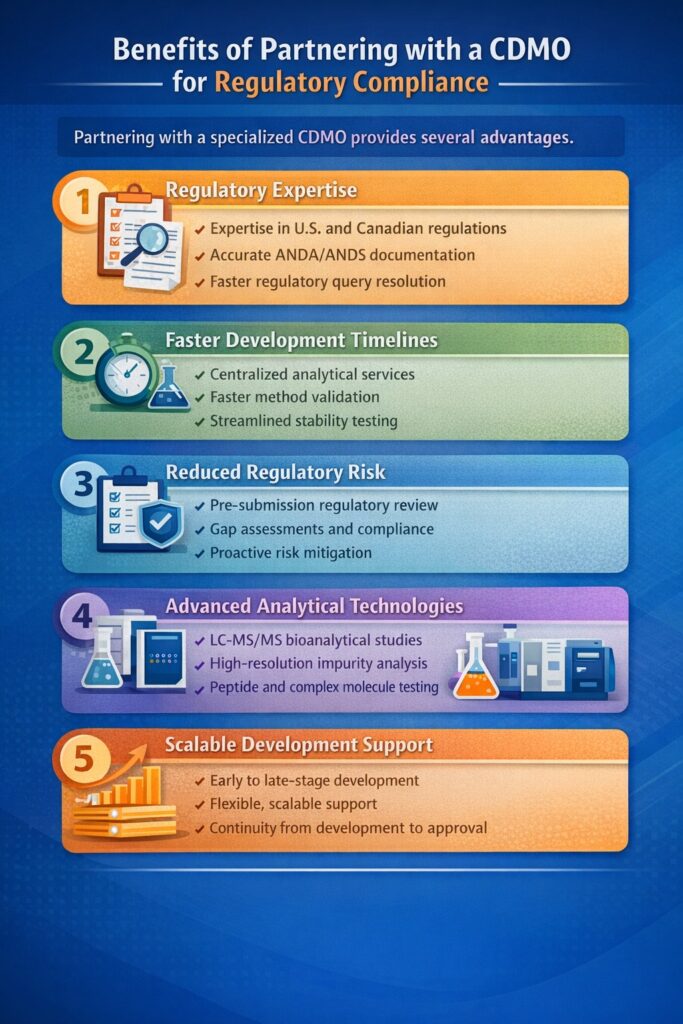
7: Benefits of Partnering with a CDMO for Regulatory Compliance
Partnering with a specialized CDMO provides significant advantages for pharmaceutical companies developing generic drugs for both the United States and Canadian markets. Organizations offering Regulatory Support for generic drugs US and Canada CDMO services help ensure that development programs meet the expectations of the U.S. Food and Drug Administration and Health Canada while improving efficiency and reducing regulatory risk.
Below are the key benefits of working with an experienced CDMO partner.
Key Benefits
1. Regulatory Expertise
Experienced CDMOs have deep knowledge of regulatory frameworks governing generic drug approvals in both the United States and Canada. Their teams understand the technical and documentation requirements for Abbreviated New Drug Applications (ANDA) and Abbreviated New Drug Submissions (ANDS).
This expertise helps ensure:
- Accurate regulatory documentation
- Compliance with FDA and Health Canada guidelines
- Proper preparation of CMC sections and analytical reports
- Faster resolution of regulatory queries
With strong regulatory guidance, companies can navigate complex approval pathways with greater confidence.
2. Faster Development Timelines
Generic drug development often involves multiple scientific and regulatory activities that must be coordinated carefully. CDMOs offering integrated services can significantly accelerate development timelines.
Benefits include:
- Centralized analytical and bioanalytical services
- Faster method development and validation
- Streamlined stability and impurity testing
- Reduced coordination between multiple vendors
By consolidating these services within one organization, pharmaceutical companies can move more efficiently from development to regulatory submission.
3. Reduced Regulatory Risk
Regulatory delays can significantly impact product launch timelines and development costs. CDMOs help mitigate these risks by ensuring that all studies, documentation, and analytical methods meet regulatory expectations.
Key risk mitigation strategies include:
- Regulatory gap assessments
- Pre-submission regulatory review
- Compliance with international quality standards
- Early identification of potential regulatory issues
This proactive approach helps prevent submission deficiencies and reduces the likelihood of costly rework.
4. Advanced Analytical Technologies
Modern generic drug development relies heavily on advanced analytical instrumentation and scientific expertise. Leading CDMOs utilize cutting-edge technologies to support regulatory submissions.
Examples include:
- LC-MS/MS for bioanalytical studies
- High-resolution mass spectrometry for impurity analysis
- Stability-indicating analytical methods
- Advanced peptide and complex molecule characterization
These technologies enable highly sensitive and accurate data generation required for regulatory approval.
5. Scalable Development Support
Another important benefit of partnering with a CDMO is the ability to scale development support across the entire drug development lifecycle.
CDMOs typically provide services across multiple stages, including:
- Early-stage analytical development
- Bioanalytical testing and method validation
- Stability studies and impurity analysis
- Regulatory submission support
This scalability allows pharmaceutical companies to maintain continuity from early development through regulatory approval.
Overall, partnering with an experienced CDMO enables pharmaceutical companies to manage regulatory complexity more effectively while accelerating generic drug development and improving the likelihood of successful approvals in both the U.S. and Canadian markets.
8: Best Practices for Successful ANDA and ANDS Submissions
Companies planning generic drug development should follow these best practices:
- Begin regulatory strategy early in development
- Use validated analytical methods
- Perform thorough impurity and degradation studies
- Design robust bioequivalence studies
- Partner with experienced regulatory and analytical experts
- Ensure accurate and complete submission documentation
These practices help prevent regulatory delays and improve approval success.
Conclusion:
Developing generic drugs for the United States and Canada requires strict adherence to regulatory frameworks established by the U.S. Food and Drug Administration and Health Canada. Companies must successfully complete ANDA and ANDS submissions by providing comprehensive analytical data, bioequivalence evidence, stability studies, and validated methods.
Because these requirements are complex, pharmaceutical companies often rely on Regulatory Support for generic drugs US and Canada CDMO partners to guide development and regulatory submissions. Experienced CDMOs provide integrated analytical, bioanalytical, and regulatory expertise that ensures compliance, reduces development risks, and accelerates approvals.
With the right regulatory support strategy, generic drug developers can efficiently navigate the approval pathways in both markets and bring high-quality medicines to patients faster.
Frequently Asked Questions:
An Abbreviated New Drug Application (ANDA) is the regulatory pathway used in the United States to obtain approval for generic drugs. Companies must demonstrate that their product is bioequivalent to a reference listed drug and meets all quality, safety, and manufacturing requirements set by the U.S. Food and Drug Administration.
An Abbreviated New Drug Submission (ANDS) is the regulatory application used in Canada for approving generic drugs. The submission demonstrates that the generic product is equivalent to a Canadian Reference Product and complies with regulatory requirements set by Health Canada.
CDMOs typically provide a wide range of services supporting ANDA and ANDS submissions, including:
-Analytical method development and validation
-Bioanalytical testing and bioequivalence studies
-Stability testing and impurity profiling
-Chemistry, Manufacturing and Controls (CMC) documentation
-Regulatory strategy and submission preparation
These services ensure that all required data are generated according to regulatory guidelines.
Bioanalysis is essential for measuring drug concentrations in biological samples during bioequivalence studies. Advanced techniques such as LC-MS/MS are used to generate pharmacokinetic data that demonstrate the generic drug performs the same as the reference product.
Typical analytical studies required for regulatory submissions include:
-Impurity profiling
-Degradation and forced degradation studies
-Stability testing under ICH conditions
-Analytical method validation
-Nitrosamine risk assessment
These studies ensure the safety, quality, and stability of the generic drug product.
Reference
- Reed F. Beall , Lorian Hardcastle , Fiona Clement , Aidan Hollis. How will recent trade agreements that extend market protections for brand-name prescription pharmaceuticals impact expenditures and generic access in Canada?https://www.sciencedirect.com/science/article/abs/pii/S0168851019302258
- Regulation of Pharmaceuticals in Canada.https://papers.ssrn.com/sol3/papers.cfm?abstract_id=958929
- Steven G. Morgan , Paige A. Thomson , Jamie R. Daw , Melissa K. Friesen. Canadian policy makers’ views on pharmaceutical reimbursement contracts involving confidential discounts from drug manufacturers.https://www.sciencedirect.com/science/article/pii/S0168851013001607
- Pharmaceutical security for Canada. https://www.cmaj.ca/content/194/32/E1113.short
- Managing pharmaceutical expenditure: an overview and options for Canada.https://utoronto.scholaris.ca/items/7d8b1541-4818-45b5-b5c5-4baad8195dce
About the Author


