

Introduction
Pharmaceutical companies often receive regulatory questions about nitrosamine impurities during submissions, variations, or post-approval reviews. When this happens, organizations must Respond to Nitrosamine Regulatory Query with a clear and scientifically supported risk assessment that demonstrates product safety and regulatory compliance.
Regulatory authorities expect companies to evaluate possible sources of nitrosamine formation, review manufacturing processes and raw materials, and confirm that analytical methods can detect impurities at very low levels. Agencies such as the FDA, EMA, Health Canada, and WHO require manufacturers to follow structured risk assessment approaches aligned with guidance like ICH M7.
Ensure compliance with the latest standards: Nitrosamine Analysis Services
This article explains how companies can effectively Respond to Nitrosamine Regulatory Query by presenting strong scientific evidence, clear documentation, and well-defined control strategies that meet global regulatory expectations.
Share via:
Quick Summary
- Respond to Nitrosamine Regulatory Query effectively by providing structured scientific evidence, root-cause analysis, and validated analytical data.
- Regulatory agencies expect clear justification of risk assessment methodology, including alignment with ICH M7, FDA, EMA, and Health Canada nitrosamine guidance.
- A strong response should include manufacturing risk evaluation, nitrosamine formation pathways, control strategies, and analytical validation data.
- Acceptable intake limits (AI), carcinogenic potency categorization (CPC), and impurity quantification must be explained clearly.
- Supporting documentation such as risk assessment reports, batch testing results, supplier data, and CAPA plans strengthens credibility.
- Structuring responses with tables, data summaries, and regulatory references helps reviewers quickly assess compliance.
- Companies that proactively demonstrate risk mitigation and lifecycle monitoring significantly improve regulatory acceptance.
- A scientifically grounded response not only resolves queries but also builds long-term regulatory trust.
Why Regulators Issue Queries During Nitrosamine Risk Assessment
Regulatory queries often arise when submitted documentation does not clearly prove that the risk of nitrosamine formation has been fully evaluated and controlled. When companies Respond to Nitrosamine Regulatory Query, regulators expect clear scientific explanations and supporting data.
Authorities carefully review regulatory submissions to confirm that manufacturers have evaluated all possible sources of nitrosamine formation. If important details such as manufacturing steps, analytical validation results, or toxicological justifications are missing, regulators may request additional clarification.
Another common reason for queries is the absence of a clear explanation about how potential nitrosamine formation pathways were identified. Regulators want companies to describe the chemistry involved and explain how manufacturing conditions may affect impurity formation.
Stay updated on regulatory shifts: Impact of ICH M7R2 Updates on Nitrosamine Risk Assessment
Common triggers include:
- Incomplete risk assessment methodology
- Insufficient explanation of nitrosamine formation pathways
- Lack of validated analytical testing data
- Absence of justification for acceptable intake (AI) limits
- Inadequate control strategies or mitigation plans
Regulators expect pharmaceutical manufacturers to follow a science-based approach to impurity control. This approach should align with ICH M7 guidelines and regional nitrosamine guidance documents.
Studies reviewing regulatory responses after the 2018 nitrosamine contamination crisis show that agencies now examine manufacturing processes much more closely. They review raw materials, reagent quality, and excipient interactions to identify potential contamination risks. (Yerram et al., 2025)
This increased regulatory scrutiny highlights the importance of providing detailed explanations and solid scientific evidence when responding to regulatory questions.
Key Elements Required to Respond to Nitrosamine Regulatory Query
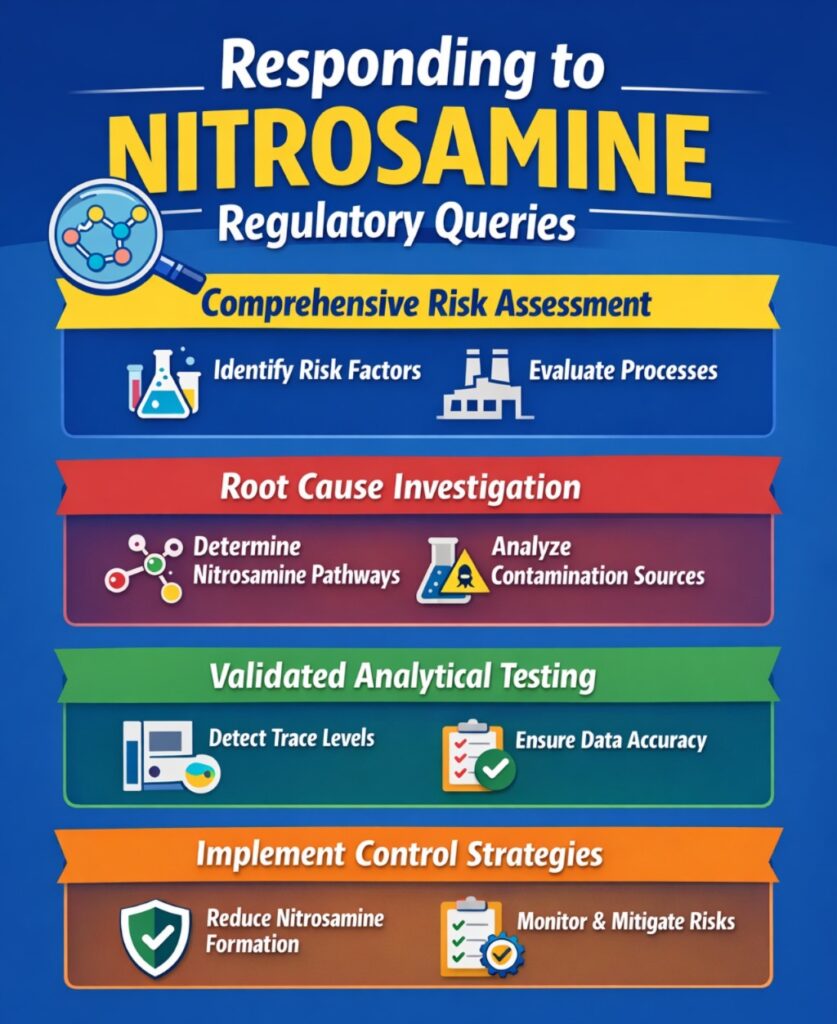
The most effective way to Respond to Nitrosamine Regulatory Query is to organize the response around well-documented scientific evidence. Regulators prefer responses that follow a logical structure and clearly connect risk assessment results with analytical data and mitigation strategies.
Providing a systematic explanation allows reviewers to understand how the investigation was conducted and how conclusions were supported by data. A well-organized response also reduces confusion and demonstrates that the company has performed a comprehensive scientific evaluation.
Most regulatory responses should begin with a clear description of the risk assessment framework used to evaluate possible nitrosamine formation. This framework should consider both process-related and material-related risk factors.
1. Comprehensive Risk Assessment Framework
A regulatory submission should first explain the methodology used to evaluate nitrosamine risk. This section should describe the scientific approach and evaluation steps used during the investigation.
The risk assessment should clearly explain how chemical reactions were evaluated and how manufacturing conditions were reviewed. This allows regulators to confirm that all possible sources of impurity formation were considered.
This should include:
- Identification of secondary and tertiary amines
- Presence of nitrosating agents
- Evaluation of manufacturing conditions
- Potential interactions between APIs, reagents, solvents, and excipients
Companies should also describe how manufacturing steps were reviewed to identify conditions that may promote nitrosation reactions. Important factors include temperature, pH levels, and reagent compatibility.
Providing this information in a structured format improves readability and helps regulators quickly understand the scope of the evaluation.
Evaluate complex molecular risks: Isomeric Nitrosamines Analysis and Identification
Typical Risk Assessment Components
| Component | Description |
|---|---|
| Process Review | Evaluation of API synthesis and formulation steps |
| Raw Material Analysis | Screening for nitrites or amine-containing materials |
| Reaction Mechanisms | Identification of potential nitrosation pathways |
| Degradation Risk | Assessment of storage or packaging effects |
| Control Strategy | Preventive and monitoring measures |
Regulators expect the risk assessment to follow quality risk management principles described in ICH Q9 and ICH M7. These frameworks ensure that impurity risks are evaluated systematically and supported by scientific evidence.
2. Root Cause Investigation When You Respond to Nitrosamine Regulatory Query
When regulatory authorities raise questions about nitrosamines, companies must clearly explain the root cause or possible formation mechanism. A detailed investigation demonstrates that the company has carefully examined the issue.
The investigation should focus on identifying chemical or process factors that may contribute to nitrosamine formation. This includes evaluating reaction conditions, reagent quality, and possible contamination sources within the manufacturing process.
Typical root causes include:
- Nitrosation reactions between amines and nitrites
- Use of contaminated solvents or reagents
- Recycled solvents containing nitrosating species
- Degradation during high temperature or acidic conditions
Companies should review every manufacturing step to determine whether certain conditions could promote nitrosamine formation. Even small changes in process parameters may influence impurity generation.
A strong response should include:
- Chemical reaction pathway analysis
- Process step evaluation
- Literature-based scientific evidence
Including references from scientific literature strengthens the explanation and helps regulators understand the chemical reasoning behind the conclusions.
Research evaluating nitrosamine contamination across pharmaceutical products confirms that manufacturing conditions and reagent impurities are major contributors to nitrosamine formation. (Burns et al., 2023)
Analytical Evidence to Respond to Nitrosamine Regulatory Query
Regulators expect strong analytical evidence to support the conclusions presented in the risk assessment. Analytical data help confirm whether nitrosamines are present and whether impurity levels remain within acceptable regulatory limits.
Providing validated analytical methods ensures that impurity detection is accurate and reliable. Without proper analytical data, regulators may question whether the risk assessment findings are fully supported.
Validated Analytical Testing
To properly Respond to Nitrosamine Regulatory Query, companies should provide validated analytical methods capable of detecting trace levels of nitrosamines.
Analytical testing must demonstrate that the methods are sensitive, selective, and reproducible. These characteristics ensure that very small amounts of impurities can be accurately detected and measured.
Common techniques include:
- LC-MS/MS
- GC-MS
- High-resolution mass spectrometry
These advanced technologies allow laboratories to detect nitrosamines at extremely low levels, often in the parts-per-billion range.
Leverage advanced detection technology: HRMS for Nitrosamine Testing and Identification
Key Analytical Validation Parameters
| Parameter | Requirement |
|---|---|
| Limit of Detection | Must meet regulatory AI limits |
| Specificity | Ability to differentiate nitrosamines from matrix |
| Accuracy | Recovery studies |
| Precision | Repeatability and intermediate precision |
| Robustness | Performance under variable conditions |
Analytical methods capable of detecting genotoxic nitrosamines at trace levels are essential for regulatory approval. (Patel et al., 2023)
Reliable analytical validation reassures regulators that impurity testing is scientifically sound and supports the conclusions presented in the submission.
Achieve industry-leading sensitivity: Ultra-Low Limit of Quantitation (LOQ) in Nitrosamine Testing
Justifying Acceptable Intake (AI) Limits When You Respond to Nitrosamine Regulatory Query
One critical step when companies Respond to Nitrosamine Regulatory Query is explaining how acceptable intake (AI) limits were determined. These limits define the maximum impurity level that is considered safe based on toxicological evidence.
Regulators expect a clear explanation of the scientific methods used to calculate these limits. Transparent calculations allow reviewers to verify that the limits follow established toxicological principles.
Regulators generally expect limits based on:
- Carcinogenic potency data
- Structure-activity relationships
- CPC (Carcinogenic Potency Categorization)
Applicants should also explain how available toxicological information was used to estimate potential health risks.
Streamline your AI limit calculations: Nitrosamine CPCA Approach for NDSRIs
Typical AI Justification Workflow
- Identify the nitrosamine structure
- Compare with known carcinogenic nitrosamines
- Use read-across toxicological data
- Apply threshold of toxicological concern (TTC) when data is limited
This structured approach ensures that impurity limits are calculated using scientifically accepted methods.
Research on nitrosamine potency classification shows that structure-based categorization improves the accuracy of risk assessments. (Burns et al., 2023)
Providing a transparent explanation of AI calculations helps regulators confirm that impurity limits protect patient safety.
Control Strategies That Strengthen the Response to Nitrosamine Regulatory Query
When companies Respond to Nitrosamine Regulatory Query, regulators expect evidence that preventive measures are already implemented or planned.
Control strategies should focus on preventing nitrosamine formation, rather than only detecting impurities after they occur. Preventive process design is considered a more reliable long-term solution.
Effective control strategies include:
- Removal or replacement of nitrosating agents
- Optimization of reaction conditions
- Control of nitrite levels in excipients
- Implementation of supplier qualification programs
- Routine nitrosamine monitoring testing
Companies should also assess raw material quality and ensure suppliers follow strict impurity control standards. Supplier audits and material testing often form part of a comprehensive control program.
A study reviewing global regulatory practices found that risk-based process control strategies significantly reduce nitrosamine formation in pharmaceutical manufacturing. (Dirat et al., 2025)
These preventive measures help companies demonstrate strong process control and regulatory compliance.
Implement effective chemical mitigation: Secondary Amine Scavengers for Nitrosamine Mitigation
How to Structure the Response Document for Regulatory Review
A well-organized document makes it easier for regulators to evaluate the information provided. Logical structure and concise explanations improve clarity and reduce the possibility of misunderstandings.
The response should present technical information in a clear sequence so reviewers can easily follow the scientific reasoning behind the conclusions.
Recommended Response Structure to Respond to Nitrosamine Regulatory Query
- Executive summary
- Description of regulatory query
- Detailed risk assessment methodology
- Root cause investigation
- Analytical testing results
- Acceptable intake justification
- Control strategy and mitigation plan
- Supporting documentation and references
Each section should provide concise explanations supported by scientific data and regulatory guidance references.
Using tables, diagrams, and summarized data helps regulators quickly review the evidence and improves the overall clarity of the response.
Common Mistakes When Responding to Nitrosamine Regulatory Queries
Even technically strong risk assessments may fail to satisfy regulators if the response lacks clarity or completeness. Poorly structured responses often lead to additional regulatory questions and longer review timelines.
One common mistake is submitting generic risk assessments that are not tailored to the specific product or manufacturing process. Regulators expect product-specific analysis rather than broad theoretical explanations.
Another issue is incomplete analytical validation data. Without sufficient evidence supporting analytical methods, regulators may question the reliability of impurity testing results.
Common mistakes include:
- Submitting generic risk assessments without product-specific data
- Missing analytical validation details
- Inadequate toxicological justification
- Lack of manufacturing process transparency
- Failure to provide corrective and preventive actions (CAPA)
Responses that lack clear corrective actions may appear reactive instead of proactive. Regulators prefer submissions that demonstrate long-term risk prevention and monitoring strategies.
Optimize your submission strategy: Nitrosamine Risk Assessment for ANDA Submission
Best Practices to Respond to Nitrosamine Regulatory Query Successfully
Organizations that consistently handle regulatory queries effectively usually follow structured and proactive risk management practices. These practices help identify potential issues early and reduce regulatory concerns during submissions.
Maintaining a continuous nitrosamine monitoring program allows companies to detect impurity risks over time. This is particularly important when manufacturing processes, suppliers, or raw materials change.
Companies should also regularly review manufacturing processes to ensure that reaction conditions remain aligned with impurity control strategies.
Best practices include:
- Maintaining proactive nitrosamine monitoring programs
- Conducting periodic process reviews
- Implementing advanced analytical screening methods
- Clearly documenting risk management decisions
- Aligning responses with global regulatory guidance
Organizations that adopt these practices generally experience smoother regulatory reviews and fewer queries.
Regulatory studies suggest that companies with structured nitrosamine risk management frameworks often receive faster approvals and fewer follow-up questions. (Bhangale & Ayre, 2024)
Manage your product throughout its lifespan: Nitrosamine Lifecycle Management and Monitoring
Conclusion
Addressing regulatory concerns related to nitrosamines requires a structured, data-driven, and scientifically justified approach. To successfully Respond to Nitrosamine Regulatory Query, pharmaceutical companies must provide comprehensive risk assessments, validated analytical data, and clearly defined mitigation strategies.
Regulatory authorities expect companies to demonstrate a complete understanding of how nitrosamine risks are evaluated and controlled throughout the product lifecycle. Transparent explanations supported by scientific evidence help regulators verify that patient safety remains the highest priority.
A well-prepared regulatory response does more than resolve a specific question. It also demonstrates the organization’s long-term commitment to product quality and regulatory compliance.
By integrating structured risk assessments, validated analytical methods, and preventive control strategies, companies can confidently Respond to Nitrosamine Regulatory Query while maintaining regulatory trust and uninterrupted product supply.
Need Expert Support for Nitrosamine Risk Assessment?
If you require technical support to Respond to Nitrosamine Regulatory Query, expert guidance can help streamline the process and strengthen regulatory submissions. Specialists can assist with risk assessments, analytical validation, and regulatory documentation.
Contact the experts here: Contact us
FAQs: Respond to Nitrosamine Regulatory Query
To Respond to Nitrosamine Regulatory Query, companies usually need to provide a detailed risk assessment report, analytical method validation data, and a review of the manufacturing process. Regulators may also expect batch testing results, acceptable intake (AI) calculations, and CAPA documentation. These materials help demonstrate how the company evaluated and controlled the potential impurity risk.
A nitrosamine risk assessment should thoroughly examine all possible sources of impurity formation within the product and manufacturing process. This includes evaluating APIs, excipients, solvents, reagents, and processing conditions. The assessment should clearly explain the scientific reasoning used to identify risks and support the final conclusions.
When companies Respond to Nitrosamine Regulatory Query, they typically reference global regulatory guidance such as ICH M7, FDA nitrosamine guidance, EMA recommendations, and Health Canada guidance. These documents provide accepted frameworks for assessing and controlling genotoxic impurities. Citing them shows that the risk evaluation follows recognized international standards.
Regulatory authorities often request confirmatory testing of production batches when there is a potential risk of nitrosamine formation. Testing multiple batches helps determine whether the impurity is present and whether levels remain consistent across production. This information supports the conclusions presented in the risk assessment.
ICH M7 provides a structured approach for assessing and controlling mutagenic impurities in pharmaceutical products. It outlines risk assessment principles, acceptable intake calculations, and recommended control strategies. Even though nitrosamines have separate guidance documents, ICH M7 still supports the scientific evaluation of genotoxic risk.
Reference:
- U.S. Food and Drug Administration. (2023, August 4). Recommended acceptable intake limits for nitrosamine drug substance-related impurities (NDSRIs): Guidance for industry. https://www.fda.gov/regulatory-information/search-fda-guidance-documents/recommended-acceptable-intake-limits-nitrosamine-drug-substance-related-impurities
- Manchuri, K. M., Shaik, M. A., Gopireddy, V. S. R., Sultana, N., & Gogineni, S. (2024). Analytical methodologies to detect N-nitrosamine impurities in active pharmaceutical ingredients, drug products and other matrices. Chemical Research in Toxicology, 37(9), 1456–1483. https://doi.org/10.1021/acs.chemrestox.4c00234
- Tarafder, A., Vega, E., Beck, H. P., Mundal, D., Tilala, M., & Wang, S. (2025). Nitrosamine control: From risk assessment to analytical testing with emphasis on sample preparation and phase-appropriate method validation. Organic Process Research & Development. Advance online publication. https://doi.org/10.1021/acs.oprd.5c00158
Get In Touch With Us
About The Author


