
Introduction
Secondary and tertiary packaging leachables are volatile, semi-volatile, or mobile chemical substances that originate from non-contact outer packaging materials, including printing inks, adhesives, varnishes, corrugated shippers, and labels. These substances can migrate across semi-permeable primary containment systems and enter pharmaceutical formulations. Even without direct liquid contact, chemical constituents can cross physical barriers through vapor-phase outgassing, mechanical set-off during converting, and ambient diffusion processes. This cross-barrier migration challenges the traditional assumption that non-contact packaging materials do not pose a risk to drug product quality. Low-molecular-weight additives present in outer paperboard cartons and shipping containers can readily pass through primary polymeric containers, potentially causing chemical contamination, active pharmaceutical ingredient (API) degradation, and toxicological concerns.
Global regulatory authorities, including the U.S. Food and Drug Administration (FDA), European Medicines Agency (EMA), and Health Canada, require a risk-based assessment of the entire packaging system. When volatile organic compounds outgas from secondary labels or tertiary corrugated boxes, they accumulate in the secondary packaging headspace. This creates a chemical potential gradient that promotes cross-barrier diffusion. Advanced analytical testing conducted by specialized laboratories, such as ResolveMass Laboratories Inc., has demonstrated that non-contact leachables can exceed regulatory Analytical Evaluation Thresholds (AET). Such findings necessitate comprehensive chemical characterization, root-cause investigation, and toxicological safety assessments.
| Packaging Tier | Contact Status | Primary Components | Common Chemical Additives | Primary Migration Mechanism |
|---|---|---|---|---|
| Primary Packaging | Direct Contact | Glass vials, elastomeric stoppers, LDPE ampoules, PVC/polyolefin IV bags, blister cavity films. | Vulcanization agents, antioxidants (BHT), plasticizers (DEHP), lubricants (silicone oil). | Direct liquid-solid dissolution, extraction, and leaching. |
| Secondary Packaging | Non-Contact / Indirect | Printed folding cartons, aluminum foil overwraps, blister lidding, labels, secondary adhesives. | UV photoinitiators (Benzophenone, ITX), adhesive solvents, acrylic tackifiers, dye degradation products. | Gas-phase volatilization, permeation, and set-off transfer during converting. |
| Tertiary Packaging | Non-Contact | Corrugated shipping boxes, wooden pallets, shrink wrap, desiccant pouches, transit strapping. | Mineral oils (MOSH/MOAH), recycled pulp contaminants, flame retardants, slip agents. | Outgassing into bulk transit headspace and cross-barrier vapor absorption. |
Share via:
Quick Summary:
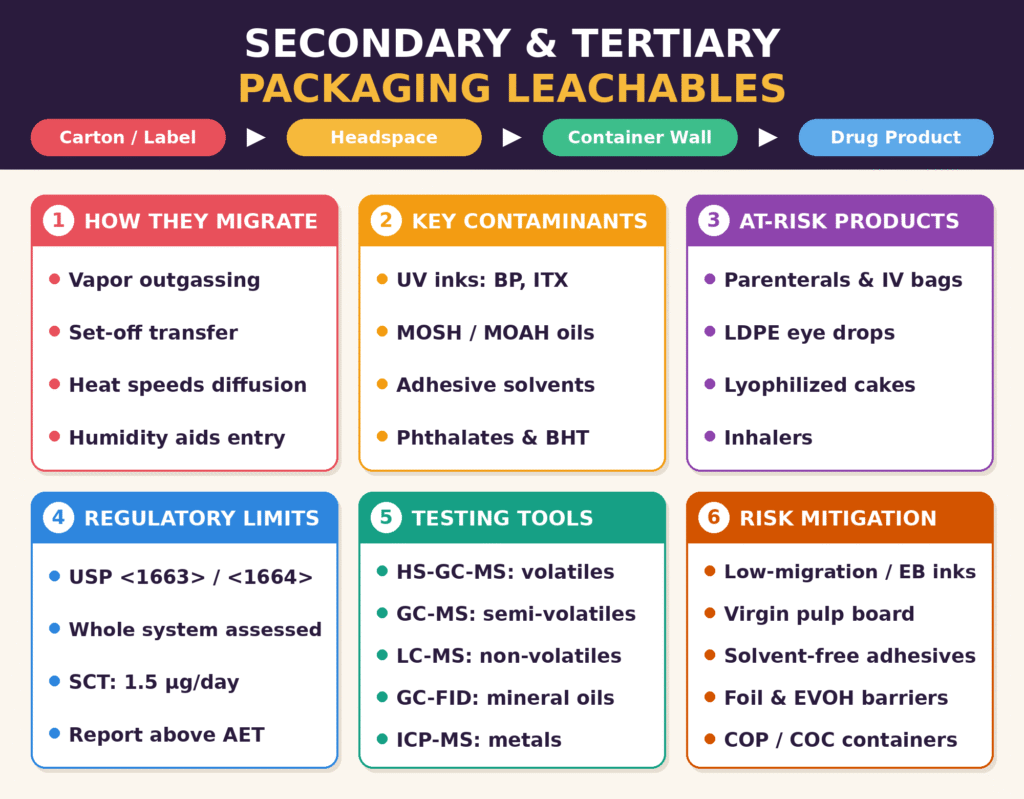
- What they are: Secondary and tertiary packaging leachables are chemicals from non-contact packaging, like carton inks, label adhesives and corrugated shippers. They can still get into the drug by passing through semi-permeable primary containers.
- How they migrate: There are three main routes. Chemicals outgas as vapor and permeate the container wall, transfer by set-off during printing and stacking, or diffuse faster at higher temperature and humidity.
- Key contaminants: These include UV ink photoinitiators (benzophenone, ITX) and MOSH/MOAH mineral oils from recycled board. Adhesive solvents, phthalates and BHT by-products also contribute.
- Products most at risk: Parenterals and IV bags, especially surfactant-containing biologics, are most exposed. LDPE eye drops, lyophilized cakes that adsorb vapors, and inhaled products are also at risk.
- Regulatory expectations: USP, FDA, EMA and Health Canada expect the whole packaging system to be assessed. Leachables are judged against a Safety Concern Threshold of 1.5 µg/day, and any compound above the Analytical Evaluation Threshold must be identified and evaluated.
- Testing approach: Headspace GC-MS covers volatiles, GC-MS covers semi-volatiles, and LC-HRAM-MS covers non-volatiles. GC-FID/HPLC-FLD measures mineral oils and ICP-MS measures metals.
- Risk mitigation: Use low-migration or EB-cured inks, virgin pulp board and solvent-free adhesives. Add barriers such as foil overpouches or EVOH/SiOx coatings, and switch from LDPE to COP/COC containers.
Migration Mechanisms of Secondary and Tertiary Packaging Leachables
The migration of secondary and tertiary packaging leachables primarily occurs through three distinct physical processes: vapor-phase outgassing followed by cross-barrier permeation, mechanical set-off transfer during converting, and thermally accelerated Arrhenius diffusion. These migration pathways allow low-molecular-weight additives present in external cardboard, labels, and shipping containers to enter primary packaging systems without requiring direct contact with the pharmaceutical formulation.
Vapor-Phase Outgassing and Permeation
Vapor-phase permeation is the principal mechanism through which volatile and semi-volatile organic compounds (VOCs and SVOCs) originating from non-contact packaging materials contaminate pharmaceutical formulations. Secondary printed cartons, varnishes, corrugated shipping containers, and labeling adhesives continuously release volatile molecules into the microenvironment of the package headspace. Semi-permeable primary containers, including Low-Density Polyethylene (LDPE), Polypropylene (PP), Polyvinyl Chloride (PVC), and thin elastomeric closures, function as selective membranes rather than completely impermeable chemical barriers.
Mass transport through the wall of a semi-permeable polymeric container is governed by Fick’s laws of diffusion in combination with Henry’s law of solubility. The overall mass flux (J) across the barrier film depends on the migrant’s solubility coefficient (S) within the polymer matrix, its diffusion coefficient (D), the concentration gradient (ΔC) across the barrier, and the thickness (x) of the primary container:
J = −D × (∂C/∂x)
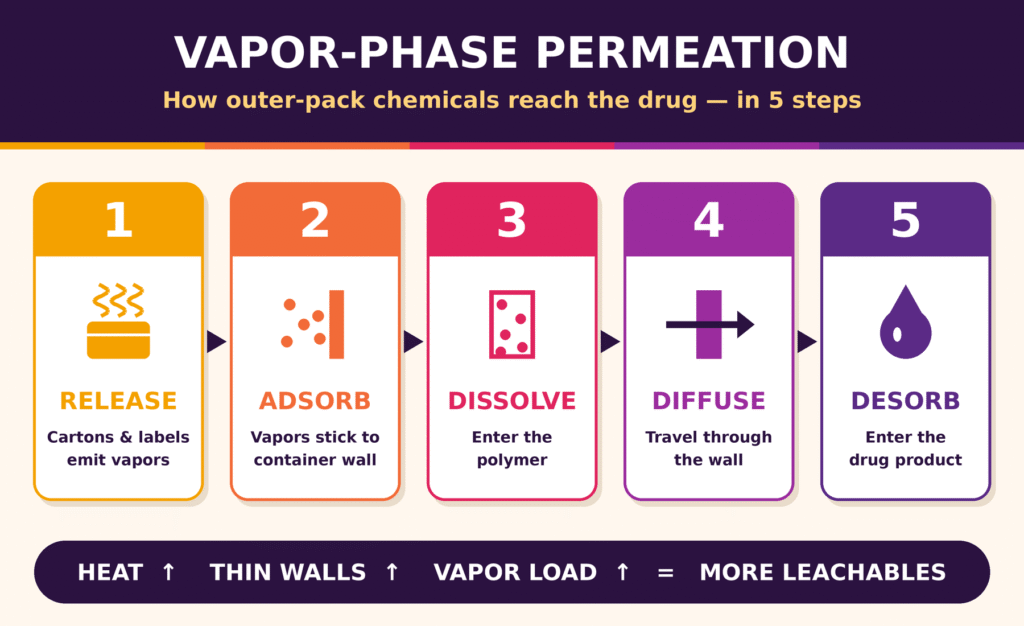
The overall migration process follows a multi-stage thermodynamic sequence:
- Organic compounds are released from secondary paperboard or tertiary corrugated packaging matrices into the internal secondary packaging headspace.
- The gas-phase migrant subsequently adsorbs onto the external surface of the primary polymeric container wall.
- The migrant dissolves into the bulk polymer matrix according to its thermodynamic partition coefficient.
- The molecule travels through the amorphous regions of the primary polymer wall along the concentration gradient.
- Finally, the migrant desorbs from the inner container wall and enters the liquid formulation or vial headspace.
Understand how chemical migrants can move through drug delivery device components and how appropriate testing helps identify potential contamination risks.
Explore extractables and leachables testing for autoinjectors
Set-Off Migration During Converting and Storage
Set-off migration refers to the physical transfer of chemical substances from a printed outer surface to an unprinted inner surface during roll-winding, stacking, or converting operations. During high-speed printing of secondary folding cartons, foil overwraps, and blister lidding materials, the printed outer surface is pressed against the unprinted contact surface under considerable pressure while the materials are stored on reels. Under these conditions, uncured printing inks, photoinitiators, lacquers, and residual solvents can transfer directly onto the opposite unprinted surface.
When these converted materials are subsequently shaped into secondary cartons or pouches, the contaminated inner surface faces the primary drug container. The transferred chemical compounds can then outgas across the narrow internal air gap. This process reduces the distance required for vapor transport and allows the migrants to penetrate the primary packaging wall more rapidly.
Arrhenius Diffusion Kinetics and Environmental Acceleration
The rate of chemical migration through semi-permeable primary containment systems increases exponentially with temperature, following Arrhenius kinetics. Higher temperatures supply additional thermal energy, increasing polymer free volume and the kinetic energy of migrating molecules. The temperature-dependent behavior of the diffusion coefficient (D) can be represented by the following equation:
D = D0 × exp(−Ea / (R × T))
Here, D0 represents the pre-exponential factor, Ea is the activation energy for diffusion, R denotes the universal gas constant, and T represents the absolute temperature. Accelerated stability conditions (40°C / 75% RH) can substantially increase cross-barrier diffusion rates, leading to faster leachable accumulation. Furthermore, elevated humidity can plasticize hydrophilic polymers, increasing the spacing between polymer chains and facilitating molecular transport into the drug product.
| Migration Mechanism | Primary Driving Force | Typical Migrant Compounds | Key Influencing Variables |
|---|---|---|---|
| Vapor-Phase Permeation | Headspace concentration gradient (ΔC) across the polymer. | Benzophenone, ITX, residual solvents, BHT. | Temperature, polymer free volume, vapor pressure. |
| Set-Off Transfer | Mechanical pressure during roll-winding or stacking. | Uncured ink resins, photoinitiators, slip additives. | Stacking pressure, ink cure efficiency, storage time. |
| Solvent-Mediated Extraction | Partition coefficient (Kp) into formulation co-solvents. | Phthalates, plasticizers, tackifying resins. | Surfactant concentration (Polysorbates), pH, lipid content. |
Volatile and Semi-Volatile Contaminants in Secondary and Tertiary Packaging Leachables
The major chemical classes associated with secondary and tertiary packaging leachables include ultraviolet (UV) ink photoinitiators, mineral oil saturated and aromatic hydrocarbons (MOSH/MOAH), ester plasticizers, and volatile adhesive residues. These low-molecular-weight compounds generally exhibit relatively high vapor pressures or elevated octanol-water partition coefficients (Kow). These properties promote their volatilization and subsequent partitioning across primary container walls.
Ultraviolet (UV) Cured Ink Photoinitiators
Photoinitiators are chemical additives incorporated into UV-curable inks and lacquers to initiate and accelerate polymerization when exposed to ultraviolet light during folding carton printing. Inadequate UV curing can leave residual, unreacted photoinitiators within the ink layer. Since many of these compounds have molecular weights below 300 Da, they can readily outgas and permeate semi-permeable primary packaging barriers.
- Benzophenone (C13H10O) and 4-Methylbenzophenone (C14H12O): Benzophenone is a mobile aromatic photoinitiator that can migrate from printed folding cartons through outgassing. It can penetrate plastic containers through gas-phase transport and partition into both aqueous and lipophilic formulations, potentially creating endocrine-disrupting hazards.
- 2-Isopropylthioxanthone (ITX, C16H14OS): ITX is a hydrophobic photoinitiator capable of migrating from printed secondary packaging through outgassing. Its lipophilic chemical structure promotes partitioning into lipid emulsions, parenteral formulations, and surfactant-stabilized biologics.
- Ethyl-4-(dimethylamino)benzoate (EDAB) and Amine Synergists: Amine co-initiators can produce volatile degradation products that modify formulation pH or interact directly with sensitive active pharmaceutical ingredients.
Mineral Oil Saturated Hydrocarbons (MOSH) and Mineral Oil Aromatic Hydrocarbons (MOAH)
Recycled paperboard used in secondary cartons and tertiary shipping containers can contain considerable quantities of mineral oil hydrocarbons originating from newsprint inks and industrial processing lubricants. These complex hydrocarbon mixtures are generally divided into two categories:
- Mineral Oil Saturated Hydrocarbons (MOSH): These compounds consist of open-chain paraffinic and cyclic naphthenic hydrocarbons (C10 to C50). MOSH fractions within the C10 to C25 range possess sufficient volatility to migrate through the gas phase at room temperature, potentially penetrating plastic ampoules and blister packs. Certain short-chain MOSH compounds can accumulate in human lymphoid tissue, the liver, and the spleen.
- Mineral Oil Aromatic Hydrocarbons (MOAH): These substances consist of alkylated polycyclic aromatic hydrocarbons. MOAH fractions containing three to seven fused aromatic rings are associated with genotoxic and carcinogenic concerns. Outgassing of MOAH from tertiary corrugated shipping containers during transportation can therefore create a significant contamination risk during long-term drug product storage.
Adhesives, Tackifiers, and Solvent Residues
Cold-seal and hot-melt adhesives used in carton side seams, shipping labels, and tamper-evident seals can release volatile organic chemicals into the packaging environment. Important migrants associated with synthetic adhesives include residual solvents such as toluene, ethyl acetate, and cyclohexane; phthalate plasticizers, including diisobutyl phthalate (DIBP) and dibutyl phthalate (DBP); tackifying rosin esters; and antioxidant degradation products, such as 2,6-di-tert-butyl-4-methylphenol (BHT) quinones.
Identify common causes of unexpected extractables and leachables findings and learn how to address analytical and material-related study failures.
Read about the root causes of failed extractables and leachables studies
Risk Profiles of Dosage Forms Exposed to Secondary and Tertiary Packaging Leachables
The susceptibility of pharmaceutical dosage forms to secondary and tertiary packaging leachables varies according to their physical state, vehicle lipophilicity, surface area-to-volume ratio, and route of administration. Formulations considered particularly vulnerable include parenterals containing surfactant co-solvents, Low-Density Polyethylene (LDPE) ophthalmic solutions, and highly porous lyophilized cakes.
Parenterals and Large-Volume Intravenous Solutions
Parenteral formulations administered through intravenous, intramuscular, or subcutaneous routes bypass the protective metabolic barriers of the gastrointestinal tract, making potential contamination a significant clinical safety concern. Large-volume parenterals (LVP) packaged in flexible polyolefin or PVC bags are frequently enclosed in secondary protective overpouches. Solvent residues, plasticizers, and printing ink photoinitiators originating from the outer printed pouch or label can permeate through the relatively thin primary bag wall and enter the sterile fluid.
Biologic products containing non-ionic surfactants, such as Polysorbate 20 or Polysorbate 80, are particularly susceptible to this type of contamination. Surfactant micelles reduce formulation surface tension and can encapsulate non-polar migrants, including photoinitiators and BHT. This behavior can increase the apparent solubility of these substances in the formulation and facilitate their migration across packaging barriers.
Ophthalmic Drug Products
Ophthalmic solutions are commonly packaged in Low-Density Polyethylene (LDPE) blow-fill-seal (BFS) bottles or dropper containers. Because LDPE has relatively low density and substantial polymer free volume, it exhibits considerable permeability to organic vapors. When LDPE ophthalmic bottles are stored inside printed secondary paperboard cartons or fitted with labels containing pressure-sensitive adhesives, volatile photoinitiators, such as Benzophenone, and adhesive tackifiers can outgas and migrate through the LDPE wall. These substances may subsequently dissolve in the sterile ophthalmic solution, creating potential risks of localized ocular toxicity.
Learn how packaging-related chemical migrants are evaluated in ophthalmic formulations through targeted extractables and leachables testing.
Explore extractables and leachables testing for ophthalmic drug products
Lyophilized Powders and Sterile Crystalline Solids
Solid dosage forms are generally considered less susceptible to leaching because they do not contain a liquid solvent. However, lyophilized (freeze-dried) cakes and sterile active pharmaceutical ingredient (API) powders represent important exceptions. Lyophilized cakes have a high specific surface area and extremely low moisture content, making them effective physical adsorbents for airborne organic vapors.
Volatile compounds released from secondary cartons or tertiary corrugated shipping boxes can diffuse into the vial headspace during prolonged storage. The dry lyophilized cake may then adsorb these volatile organic compounds directly onto its porous matrix. When the product is reconstituted with a liquid diluent before administration, the adsorbed leachables can dissolve into the liquid, introducing chemical impurities into the reconstituted solution.
| Dosage Form | Primary Barrier | Secondary/Tertiary Packaging Source | Key Migrant Classes | Clinical / Quality Impact |
|---|---|---|---|---|
| Small-Volume Parenterals (SVP) | Polyolefin BFS, LDPE vials. | Foil overwraps, secondary carton inks. | Photoinitiators (BP, ITX), adhesive solvents. | Immunogenicity, API degradation, direct systemic toxicity. |
| Large-Volume Parenterals (LVP) | Polyolefin or PVC IV bags. | Outer protective pouches, printed labels. | Phthalates (DIBP, DBP), cyclohexanone, BHT. | Patient exposure to endocrine disruptors during infusion. |
| Ophthalmic Drops | LDPE squeeze bottles. | Printed carton boxes, bottle labels. | Benzophenone, alkylphenols, monomeric residues. | Localized ocular tissue inflammation, loss of sterility. |
| Lyophilized Biologicals | Glass vials with elastomeric stoppers. | Secondary paperboard cartons, tertiary shippers. | Volatile rubber oligomers, MOSH/MOAH, photoinitiators. | Protein aggregation, oxidation, and immediate dissolution upon reconstitution. |
| Orally Inhaled Products (OINDP) | Metered-dose inhaler canisters, blisters. | Secondary foil pouches, actuator plastics. | Polycyclic aromatic hydrocarbons (PAHs), vulcanization agents. | Direct pulmonary deposition and airway sensitization. |
Regulatory Standards Governing Secondary and Tertiary Packaging Leachables
Global regulatory frameworks established by the USP, FDA, EMA, and Health Canada require comprehensive characterization of both contact and non-contact packaging components to establish the safety of the overall container closure system. Compendial standards emphasize controlled extraction studies, real-time leachable monitoring, and toxicological assessments against established threshold limits.
Enforceable and Informational USP Chapters
The United States Pharmacopeia establishes different regulatory expectations for enforceable compendial chapters (below 1000) and informational risk-management chapters (above 1000):
- USP Packaging and Storage Requirements: Establishes formal definitions and requirements for primary, secondary, and tertiary packaging components. It also outlines functional expectations for protecting pharmaceutical products against atmospheric ingress and chemical contamination.
- USP and Plastic Packaging Systems: Describe characterization requirements, resin testing procedures, and safety assessments for plastic materials used in pharmaceutical packaging systems.
- USP Polymeric Components Used in Manufacturing: Establishes extractables testing approaches for polymeric manufacturing equipment, single-use systems, and secondary process tubing.
- USP Assessment of Extractables Associated with Pharmaceutical Packaging/Delivery Systems: Provides methodologies for Controlled Extraction Studies (CES). These studies involve exposing packaging components to aggressive solvents under elevated thermal conditions to generate a comprehensive chemical profile of potential extractables.
- USP and Assessment of Drug Product Leachables: Describe analytical approaches for monitoring leachable migration into pharmaceutical formulations during real-time shelf-life stability studies. These frameworks require consideration of secondary packaging contributions whenever primary packaging materials exhibit semi-permeable characteristics.
Safety Concern Thresholds (SCT) and Analytical Evaluation Threshold (AET)
The Product Quality Research Institute (PQRI) and USP frameworks establish toxicological safety thresholds that determine the analytical reporting requirements for leachable compounds:
Safety Concern Threshold (SCT): The standardized SCT for organic leachables in parenteral and ophthalmic drug products is established at 1.5 µg/day for total daily intake. Compounds present below the SCT generally represent a lower level of toxicological concern, although specific high-potency mutagenic classes, such as N-nitrosamines and MOAH, require separate consideration.
Analytical Evaluation Threshold (AET): The AET represents the calculated concentration threshold at or above which an analytical chemist must report, identify, and toxicologically evaluate a leachable compound. Its calculation considers the SCT, maximum daily dose (MDD), total fill volume (V), and number of doses per container (Ndoses):
AET = (SCT / MDD) × (V / Dose Volume) × (1 / UF)
In this equation, UF represents an Uncertainty Factor, typically ranging from 1.0 to 2.0. This factor accounts for variations in analytical response factors across different chemical classes.
Understand how to calculate and scientifically justify the Analytical Evaluation Threshold for extractables and leachables studies.
Read the guide to AET for extractables and leachables studies
Analytical Methodologies for Profiling Secondary and Tertiary Packaging Leachables
Reliable characterization of secondary and tertiary packaging leachables requires high-resolution, hyphenated analytical techniques capable of detecting and identifying trace organic compounds at concentrations as low as parts-per-billion (ppb). Standard analytical workflows generally combine Headspace and Direct Injection Gas Chromatography-Mass Spectrometry (GC-MS) with Ultra-High Performance Liquid Chromatography-High Resolution Accurate Mass Spectrometry (UHPLC-HRAM-MS).
Gas Chromatography-Mass Spectrometry (GC-MS) Workflows
Gas chromatography is a primary analytical technique for separating and identifying volatile and semi-volatile migrants originating from secondary packaging inks, adhesives, and tertiary corrugated packaging materials. Common analytical approaches include:
- Headspace GC-MS (HS-GC-MS): This technique is used to identify and quantify volatile organic compounds (VOCs) released into the packaging headspace. HS-GC-MS is suitable for measuring residual printing solvents, including toluene, isopropyl alcohol, and ethyl acetate, as well as low-boiling monomeric residues and volatile adhesive fragments.
- Direct Injection GC-MS: This approach is used to examine semi-volatile organic compounds (SVOCs) extracted from secondary packaging components or detected in stability testing samples. Direct injection GC-MS can identify semi-volatile photoinitiators, such as Benzophenone and ITX, plasticizers, including phthalates, and antioxidant degradation products, such as BHT. Electron Ionization (EI), combined with NIST spectral database matching, supports the structural identification of these compounds.
Liquid Chromatography High-Resolution Accurate Mass Spectrometry (LC-HRAM-MS)
Non-volatile organic compounds (NVOCs), thermally labile photoinitiators, oligomeric additives, and complex secondary degradation products require Liquid Chromatography coupled with High-Resolution Accurate Mass Spectrometry. Commonly used platforms include Orbitrap and Quadrupole Time-of-Flight instruments.
LC-HRAM-MS systems deliver sub-parts-per-million (ppm) mass accuracy, supporting the precise determination of empirical molecular formulas (CxHyOzNw) for unidentified migrants. Subsequent tandem mass spectrometry fragmentation (MS/MS) provides additional structural information, allowing analytical scientists at ResolveMass Laboratories Inc. to investigate unknown chemical structures and distinguish secondary packaging migrants from active drug degradation pathways.
Sample preparation typically begins with controlled extraction or the isolation of stability testing samples, followed by parallel chromatographic separation. GC-MS is used to investigate volatile and semi-volatile compounds through headspace or direct injection techniques, whereas UHPLC-HRAM-MS separates and characterizes non-volatile chemical species. The resulting spectral signals are compared with NIST libraries and accurate mass databases to determine chemical structures. Identified compounds are then quantified against calculated AET limits to support comprehensive toxicological risk assessments.
Compare the capabilities of GC-MS and LC-MS and understand how each technique contributes to extractables and leachables investigations.
Explore GC-MS vs. LC-MS in extractables and leachables testing
Analytical Testing Matrix for Packaging Qualification
| Analytical Technique | Targeted Compound Class | Typical Secondary/Tertiary Migrants | Sensitivity / Detection Limit |
|---|---|---|---|
| Headspace GC-MS | Volatile Organic Compounds (VOCs). | Residual solvents, low-boiling adhesive volatiles. | Sub-ppm (µg/mL) range. |
| Direct Injection GC-MS | Semi-Volatile Organic Compounds (SVOCs). | Benzophenone, ITX, BHT, phthalates, fatty acids. | Trace ppb (ng/mL) range. |
| UHPLC-HRAM-MS/MS | Non-Volatile Organics, UV photoinitiators. | Dyes, lacquers, high-MW photoinitiators, rosin esters. | Sub-ppb (ng/mL) range. |
| GC-FID / HPLC-FLD | Mineral Oils (MOSH / MOAH). | Recycled paperboard hydrocarbons, newsprint inks. | Fractional ppm range. |
| ICP-MS | Elemental Impurities / Heavy Metals. | Metal foil catalysts, bleached paperboard residues. | Parts-per-trillion (ppt) range. |
Discover how ICP-MS supports the detection and quantification of trace elemental impurities in pharmaceutical packaging materials.
Learn about ICP-MS in extractables and leachables testing
Risk Mitigation Strategies for Secondary and Tertiary Packaging Systems
Successfully controlling risks associated with non-contact leachables requires a Quality by Design (QbD) strategy that combines low-outgassing packaging materials with highly effective functional barrier layers. Removing volatile ink photoinitiators and replacing permeable primary polymers with suitable low-permeability alternatives can significantly reduce or prevent cross-barrier migration before commercial distribution.
Low-Migration Packaging Materials
Risk reduction should begin during the initial selection of packaging materials by incorporating components designed to minimize chemical outgassing and migration.
- Low-Migration Inks and Polymeric Photoinitiators: Packaging specifications should prioritize low-migration ink formulations that replace monomeric photoinitiators with polymeric alternatives. Polymeric photoinitiators incorporate multiple photoactive functional groups into a high-molecular-weight polymer chain (>1000 Da). Their larger molecular structures reduce volatilization and cross-barrier diffusion. Electron-beam (EB) cured inks offer another effective approach because they undergo polymerization without requiring photoinitiators, thereby eliminating photoinitiator migration risks.
- Virgin Pulp Paperboard: Replacing recycled paperboard with virgin fiber board helps eliminate MOSH and MOAH mineral oil contaminants associated with recycled materials. This substitution reduces the possibility of mineral oil outgassing from secondary cartons during warehouse storage.
- Solvent-Free Adhesive Formulations: Substituting solvent-based adhesives with hot-melt polyolefins or water-borne acrylic adhesives helps prevent residual aromatic solvents from being released into the packaging environment. This approach reduces potential outgassing from secondary labels and carton seams.
Explore packaging material strategies designed to reduce the migration of potentially harmful chemical substances into pharmaceutical products.
Discover low-leachables packaging materials
Functional Barrier Integration
A functional barrier refers to a packaging layer designed to prevent extractable chemical substances from migrating across packaging materials and entering the drug formulation throughout its intended commercial shelf life.
- Aluminum Foil Overpouches: High-integrity aluminum foil laminates (>9 µm thickness) provide highly effective barrier protection against organic vapors, light, and moisture ingress. Their incorporation can substantially limit the migration of external contaminants into primary packaging.
- High-Barrier Co-Extrusions: Integrating Ethylene Vinyl Alcohol (EVOH), Silicon Oxide (SiOx), or Aluminum Oxide (Al2O3) barrier coatings into secondary plastic films can significantly reduce VOC permeation rates and improve overall packaging protection.
- Polymeric Barrier Substitution: Replacing highly permeable LDPE primary containers with lower-permeability alternatives, including Cyclic Olefin Polymers (COP) and Cyclic Olefin Copolymers (COC), can reduce the absorption of gas-phase leachables and limit their migration into pharmaceutical formulations.
Learn about the analytical performance characteristics and validation requirements necessary for reliable leachables testing.
Read about method validation for leachables testing
Conclusion
Managing secondary and tertiary packaging leachables is critical to preserving drug product safety, therapeutic potency, and regulatory submission readiness. Non-contact packaging components can introduce significant chemical contamination risks through gas-phase permeation, set-off transfer, and solvent-mediated diffusion. Therefore, comprehensive testing of the entire container closure system is necessary to identify and control potential sources of contamination.
By selecting low-migration packaging materials, incorporating effective functional barriers, and conducting rigorous testing in accordance with applicable USP and related regulatory requirements, pharmaceutical manufacturers can maintain container closure integrity throughout the commercial product lifecycle. Collaborating with specialized analytical testing laboratories further supports regulatory compliance, helps prevent costly filing delays, and protects patient health. Comprehensive extractables and leachables assessments also provide valuable information for identifying potential chemical interactions between packaging components and pharmaceutical formulations before products reach the market.
Explore specialized analytical laboratory support for comprehensive extractables and leachables investigations, from chemical characterization to regulatory compliance.
Discover extractables and leachables testing outsourcing services
To discuss your packaging system qualification and extractable/leachable testing requirements, contact the analytical team at ResolveMass Laboratories Inc. through their contact portal.
Frequently Asked Questions (FAQs)
Common photoinitiators associated with non-contact packaging leachables include Benzophenone (BP), 2-Isopropylthioxanthone (ITX), 4-Methylbenzophenone (4-MBP), and Ethyl-4-(dimethylamino)benzoate (EDAB). These substances may remain in printed paperboard cartons and aluminum blister coatings when UV curing is incomplete. Their chemical mobility allows them to migrate through suitable polymeric primary packaging barriers.
Low-Density Polyethylene (LDPE) has a relatively high free volume and considerable gas permeability, making it susceptible to the absorption of organic vapors. Unlike glass and aluminum, LDPE does not provide a completely impermeable barrier against volatile chemical compounds. Migrants can enter its polymer matrix and subsequently diffuse into the pharmaceutical formulation.
Set-off migration occurs when chemical substances from a printed packaging surface transfer onto an unprinted surface during roll-winding, sheet stacking, or storage. Uncured inks, photoinitiators, and lacquers are common compounds involved in this process. Once the packaging material is converted into cartons or blister packs, these transferred chemicals can release vapors and migrate toward the primary packaging system.
Mineral Oil Saturated Hydrocarbons (MOSH) and Mineral Oil Aromatic Hydrocarbons (MOAH) can originate from recycled paperboard and corrugated shipping containers containing printing ink residues. During storage and transportation, these substances may enter the surrounding headspace through outgassing. Their subsequent permeation through semi-permeable primary containers can result in contamination of liquid or solid pharmaceutical products.
Yes, lyophilized products and dry API powders can absorb volatile organic compounds released by secondary and tertiary packaging materials. Their porous structure and large specific surface area make them particularly susceptible to adsorption of airborne chemical contaminants within the vial headspace. During reconstitution, these adsorbed substances may dissolve into the liquid diluent, introducing unwanted impurities into the final injectable solution.
Several analytical techniques are used to identify and quantify chemical migrants originating from non-contact packaging materials. Headspace GC-MS is suitable for volatile compounds, while Direct Injection GC-MS helps characterize semi-volatile substances such as photoinitiators and plasticizers. UHPLC-HRAM-MS is used for non-volatile compounds, whereas Inductively Coupled Plasma Mass Spectrometry (ICP-MS) supports the detection of elemental impurities.
The assessment of packaging-related extractables and leachables is supported by various USP chapters, including USP and USP , along with relevant plastic packaging requirements under USP and USP . FDA Container Closure System guidelines and applicable ICH Q8/Q1E stability testing frameworks also provide important regulatory considerations. These requirements support systematic chemical characterization and safety evaluation of pharmaceutical packaging systems.
The Analytical Evaluation Threshold (AET) is derived from the Safety Concern Threshold (SCT) and adjusted according to the maximum daily dose, container fill volume, number of doses, and applicable analytical uncertainty factor. The calculation establishes the concentration above which a detected leachable requires further investigation. Compounds meeting or exceeding this threshold must undergo appropriate identification, characterization, and toxicological assessment.
Manufacturers can minimize contamination risks by selecting low-migration UV inks, polymeric photoinitiators, solvent-free adhesives, and virgin pulp paperboard instead of recycled materials. Incorporating aluminum foil overpouches and other high-barrier packaging materials can further restrict chemical migration. Comprehensive extractables and leachables (E&L) testing during packaging development and qualification helps identify potential contamination sources before commercial distribution.
Reference:
- Jung, T., Simat, T. J., Altkofer, W., & Fügel, D. (2013). Survey on the occurrence of photo-initiators and amine synergists in cartonboard packaging on the German market and their migration into the packaged foodstuffs. Food Additives & Contaminants: Part A, 30(11), 1993–2016. https://doi.org/10.1080/19440049.2013.837586
- Aznar, M., Domeño, C., Nerín, C., & Bosetti, O. (2015). Set-off of non volatile compounds from printing inks in food packaging materials and the role of lacquers to avoid migration. Dyes and Pigments, 114, 85–92. https://doi.org/10.1016/j.dyepig.2014.10.019
- Pastorelli, S., Sanches-Silva, A., Cruz, J. M., Simoneau, C., & Losada, P. P. (2008). Study of the migration of benzophenone from printed paperboard packages to cakes through different plastic films. European Food Research and Technology, 227(6), 1585–1590. https://doi.org/10.1007/s00217-008-0882-2
- Ramamoorthy, S., Chong, N. S., & Hotha, K. K. (2024). Strengthening extractable & leachable study submissions: Best practices to avoid regulatory deficiencies. American Journal of Analytical Chemistry, 15(12), 368–394. https://doi.org/10.4236/ajac.2024.1512025
- Health Canada. (2024). Quality (chemistry and manufacturing) guidance: New Drug Submissions (NDSs) and Abbreviated New Drug Submissions (ANDSs). Government of Canada. https://www.canada.ca/en/health-canada/services/drugs-health-products/drug-products/applications-submissions/guidance-documents/chemical-entity-products-quality/guidance-document-quality-chemistry-manufacturing-guidance-new-drug-submissions-ndss-abbreviated-new-drug-submissions.html
- International Council for Harmonisation of Technical Requirements for Pharmaceuticals for Human Use. (2025). ICH Q3E guideline for extractables and leachables (Draft version, Step 2). U.S. Food and Drug Administration. https://www.fda.gov/media/189890/download
- Shen, D.-X., Lian, H.-Z., Ding, T., Xu, J.-Z., & Shen, C.-Y. (2009). Determination of low-level ink photoinitiator residues in packaged milk by solid-phase extraction and LC-ESI/MS/MS using triple-quadrupole mass analyzer. Analytical and Bioanalytical Chemistry, 395(7), 2359–2370. https://doi.org/10.1007/s00216-009-3115-z
Get In Touch With Us
About The Author