

Introduction
Phosphorothioate diastereomers present significant challenges in oligonucleotide characterization. This is because replacing a non-bridging oxygen atom in the phosphodiester backbone with a sulfur atom creates a chiral phosphorus center, transforming a single nominal sequence into an exponentially complex mixture containing 2n stereoisomers. Understanding why stereochemistry complicates oligonucleotide characterization requires examining the structural and physical consequences of this substitution, which produces diastereomers with distinct physical, chemical, and biological properties. In synthetic antisense oligonucleotides (ASOs), small interfering RNAs (siRNAs), and single-guide RNAs (sgRNAs), this stereochemical variability directly influences duplex hybridization stability, resistance to enzymatic degradation, cellular uptake, and overall pharmacokinetic behavior.
In native phosphodiester (PO) oligonucleotides, the repeating sugar-phosphate backbone does not contain chiral centers at the phosphorus atom. Consequently, a given nucleotide sequence exists as a single defined molecular species. However, unmodified phosphodiester linkages are rapidly hydrolyzed by endogenous endo- and exonucleases present in biological matrices. Therefore, chemical modification of the backbone is necessary to improve therapeutic longevity. Replacing one non-bridging oxygen atom with a sulfur atom produces a phosphorothioate (PS) linkage. Although this modification preserves Watson-Crick base pairing and substantially improves metabolic stability, it introduces a stereogenic phosphorus atom (P*) at every modified position.
During standard, non-stereocontrolled solid-phase phosphoramidite synthesis, sulfurization produces an approximately equimolar mixture of Rp and Sp diastereomeric configurations at each modified linkage. As a result, an oligonucleotide containing n phosphorothioate linkages exists as a population of 2n distinct diastereomers. For fully modified therapeutic gapmers or guide RNAs containing 15 to 25 PS modifications, this can result in hundreds of thousands or even millions of co-existing stereoisomers. Such extensive isomeric complexity creates considerable analytical difficulties because conventional chromatography and mass spectrometry techniques often struggle to separate, identify, and quantify these isobaric species.
Explore specialized analytical approaches for confirming therapeutic sequences and identifying structural variations during characterization.
Learn more about sequence confirmation services for synthetic therapeutic peptides.
Share via:
Quick Summary:
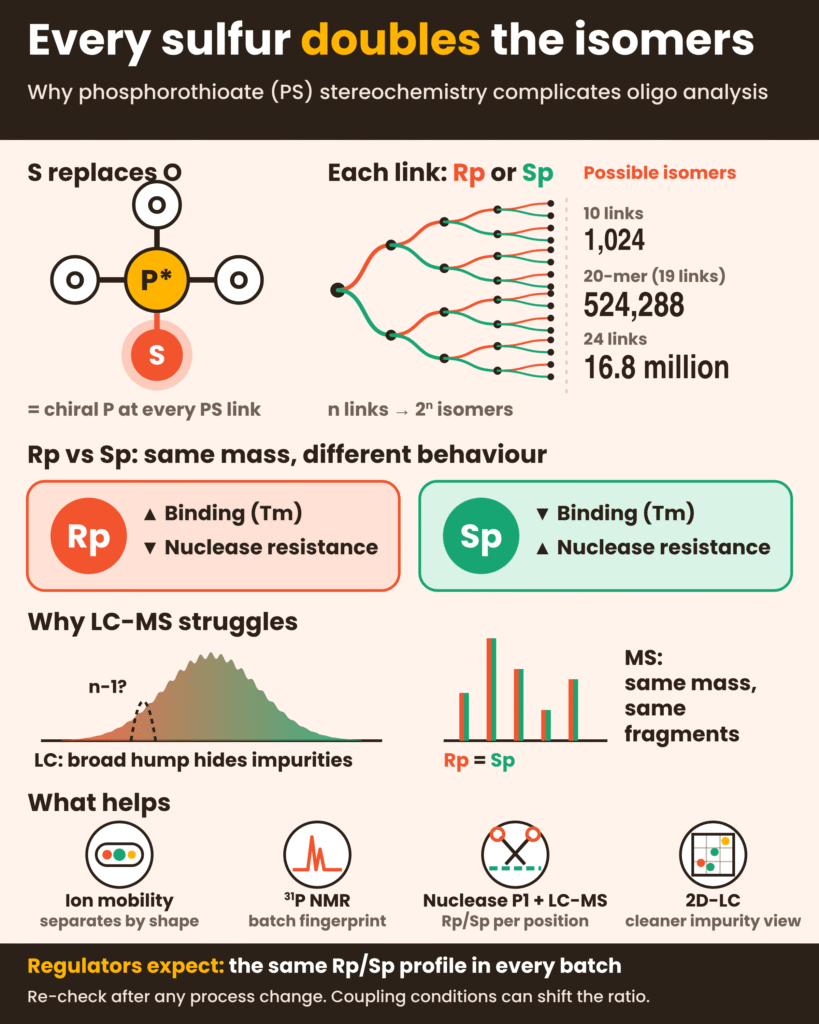
- The root cause: Swapping one non-bridging oxygen for sulfur (a phosphorothioate, or PS, linkage) protects oligonucleotides from nucleases. It also makes the phosphorus at every PS link chiral, so each link can be Rp or Sp.
- The scale of the problem: In standard (stereorandom) synthesis, n PS links give 2ⁿ diastereomers. A fully modified 20-mer (19 links) is a mixture of 524,288 isomers, and a 24-link guide RNA has about 16.8 million.
- Why it matters biologically: Rp and Sp behave differently. Rp linkages generally bind the target more tightly (higher Tm) but break down faster. Sp linkages bind more weakly but resist exonucleases. So the isomer mix can affect stability, potency and pharmacokinetics.
- Why LC is limited: In ion-pairing reversed-phase LC, the isomers elute as a broad “diastereomeric hump” instead of a sharp peak. This hump can hide impurities such as n-1/n-2 shortmers, depurinated species and PO exchange products.
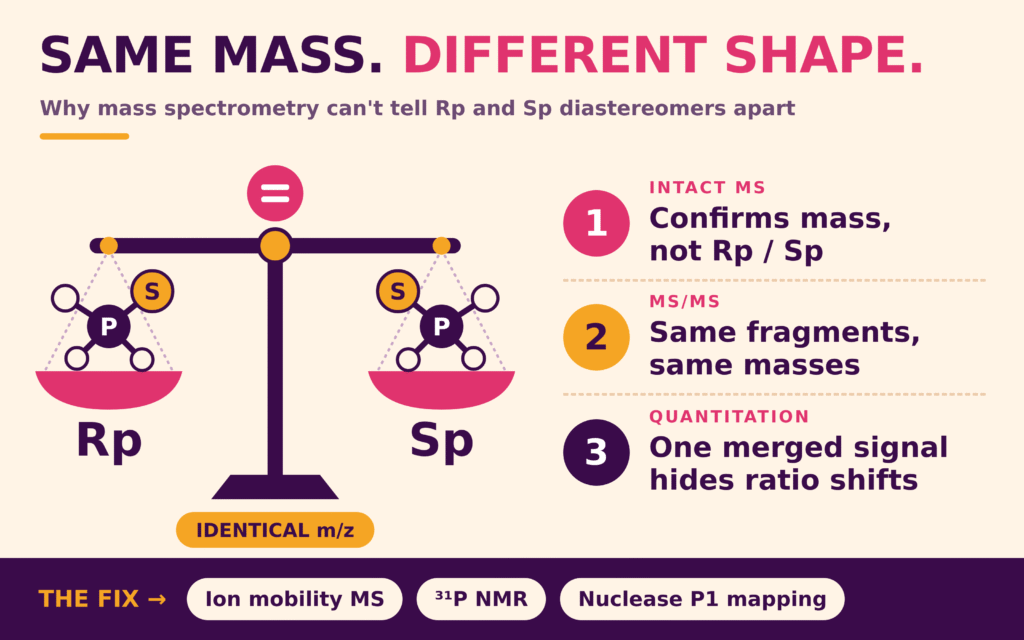
- Why MS is limited: All diastereomers have the same mass and the same MS/MS fragments. Mass spectrometry can confirm the sequence, but it can’t tell Rp from Sp or detect shifts in the stereochemical ratio.
- Tools that help: Several orthogonal methods fill the gap:
- Ion mobility MS (including cyclic IMS) separates isomers by gas-phase shape.
- ³¹P NMR (PS signals at about 55–60 ppm) gives a batch-level fingerprint.
- Nuclease P1 digestion followed by LC-MS maps Rp/Sp ratios at specific positions, because the enzyme cuts Sp linkages and spares Rp.
- 2D-LC (SAX × IP-RPLC) sharpens impurity profiling.
- Regulatory expectations: FDA and EMA expect consistent Rp/Sp profiles from batch to batch, and re-assessment after any process change (scale, reagent vendor, purification). Synthesis conditions such as the coupling activator, moisture, time and temperature can shift the ratio.
Structural Mechanisms: How Stereochemistry Complicates Oligonucleotide Characterization
The primary structural mechanism through which stereochemistry complicates oligonucleotide characterization involves the spatial reorientation of the sulfur atom. This produces Rp and Sp diastereomeric configurations with different steric accessibility, charge density, and hydration shells. Replacing oxygen with the larger sulfur atom modifies local electrostatic potentials and backbone solvation, resulting in distinct spatial arrangements among individual isomers.
The two configurations, Rp (rectus) and Sp (sinister), exhibit substantially different sulfur atom orientations relative to the ribose ring and nucleobase core. In the Rp configuration, the sulfur atom projects toward the major or minor groove solvent interface. This arrangement causes minimal disruption to the helical geometry and supports optimal Watson-Crick duplex hybridization. In contrast, the sulfur atom in the Sp configuration is oriented closer to the adjacent sugar-phosphate backbone, creating minor local structural distortions that slightly reduce thermal melting temperatures (Tm). However, this same steric arrangement makes Sp linkages particularly resistant to 3′- and 5′-exonucleases. Meanwhile, Rp linkages are generally more susceptible to exonucleolytic cleavage but are preferred by RNase H1 endonucleases during target RNA degradation.
| Property / Feature | Rp Diastereomer | Sp Diastereomer |
|---|---|---|
| Spatial Sulfur Orientation | Projects toward the major/minor groove solvent interface | Oriented closer to the sugar-phosphate backbone, creating steric proximity |
| Duplex Hybridization Stability (Tm) | Higher thermal stability (Tm) with minimal disruption to duplex formation | Slightly reduced thermal stability due to local backbone distortion |
| Exonuclease Resistance | Moderately susceptible to 3′- and 5′-exonucleolytic cleavage | Highly resistant to exonucleolytic degradation |
| Endonuclease Sensitivity | Susceptible to RNase H1 cleavage in central ASO gapmers | Resistant to endonuclease-mediated hydrolysis |
| Chromatographic Retention (IP-RPLC) | Elutes earlier due to lower exposed hydrophobic surface interactions | Elutes later due to altered hydrophobic interactions with the stationary phase |
The structural complexity increases exponentially with sequence length and the frequency of phosphorothioate modifications. As the number of phosphorothioate linkages (n) increases, the total number of unique diastereomers (Z) can be calculated using the following mathematical expression:
Z = 2n
| Linkage Count (n) | Representative Molecular Target | Total Diastereomer Count (Z = 2n) |
|---|---|---|
| 1 | Single-modified dinucleotide control | 2 |
| 2 | End-capped trinucleotide fragment | 4 |
| 5 | Partially modified siRNA terminal overhang | 32 |
| 10 | Short antisense gapmer wing structure | 1,024 |
| 19 | Fully modified 20-mer antisense oligonucleotide | 524,288 |
| 24 | Heavily modified therapeutic guide RNA (sgRNA) | 16,777,216 |
This exponential increase demonstrates why stereochemistry creates substantial challenges in oligonucleotide characterization. For a fully phosphorothioated 20-mer ASO, the drug substance contains more than 500,000 unique diastereomeric compounds rather than one chemically uniform entity. Each diastereomer has distinct spatial conformations, binding kinetics, and chromatographic retention characteristics. Consequently, individual analytical signals merge into broad chromatographic profiles that are difficult to resolve and interpret.
Discover how advanced spectroscopic approaches help investigate molecular structures and distinguish complex conformational characteristics.
Explore 2D NMR techniques for peptide characterization.
Analytical Challenges: Why Stereochemistry Complicates Oligonucleotide Characterization in LC-MS
Liquid chromatography and mass spectrometry characterization becomes particularly challenging in the presence of phosphorothioate stereochemistry. Thousands of co-eluting isobaric diastereomers can produce broad chromatographic bands while maintaining identical exact masses and MS/MS fragmentation spectra. Consequently, conventional liquid chromatography-mass spectrometry (LC-MS) platforms often struggle to achieve distinct separation without specialized analytical method optimization.
Ion-Pairing Reversed-Phase Liquid Chromatography Limitations
Ion-Pairing Reversed-Phase Liquid Chromatography (IP-RPLC) is widely used as the primary chromatographic technique for evaluating oligonucleotide purity. Volatile alkylamines, such as triethylamine (TEA) or hexylamine (HA), are combined with fluorinated alcohol modifiers, such as hexafluoroisopropanol (HFIP). These reagents mask the negatively charged backbone, facilitating retention on hydrophobic C18 stationary phases.
However, when fully modified phosphorothioate oligonucleotides are analyzed, IP-RPLC encounters several significant performance limitations:
Micro-resolution and Baseline Humps: Individual diastereomers exhibit subtle differences in hydrophobic surface exposure, allowing the column to partially separate hundreds or thousands of individual stereoisomers. Rather than producing a sharp and well-defined peak, the analyte typically elutes as a broad “diastereomeric hump” extending across several minutes. This makes it difficult to distinguish individual components and accurately evaluate the chromatographic profile.
Impurity Co-elution and Masking: The broad chromatographic envelope generated by the primary diastereomeric mixture can overlap with important synthesis-related impurities. These include failure sequences (n-1, n-2 shortmers), depurinated species, and phosphodiester back-exchange products. Such overlapping signals complicate impurity identification and may interfere with accurate purity assessment.
Method Development Trade-offs: Increasing the concentration of ion-pairing reagents or applying shallower gradients can improve separation selectivity between individual stereoisomers. However, these adjustments may also broaden the overall retention envelope, resulting in reduced signal-to-noise ratios and lower ionization efficiency in mass spectrometers. Therefore, analytical method development requires balancing chromatographic selectivity with detection performance.
Learn how multi-attribute monitoring can support comprehensive analytical assessment and the evaluation of important molecular quality attributes.
Explore multi-attribute monitoring (MAM) for peptide characterization.
Mass Spectrometry Isobaric Interference
High-Resolution Electrospray Ionization Mass Spectrometry (ESI-HRMS) enables accurate mass measurement and sequence confirmation. However, mass spectrometry fundamentally distinguishes ions according to their mass-to-charge ratios (m/z).
Since all 2n diastereomers generated from a single nucleotide sequence possess identical elemental formulas and monoisotopic masses, they are strictly isobaric. This creates several analytical limitations:
Intact MS Invisibility: Intact mass spectrometry cannot distinguish between an Rp or Sp configuration at any position along the oligonucleotide backbone. Although the instrument can confirm the molecular mass of the analyte, it cannot independently establish the stereochemical configuration of individual phosphorothioate linkages.
Identical Fragmentation Pathways: Tandem mass spectrometry (MS/MS), particularly when using collision-induced dissociation (CID), cleaves phosphodiester and phosphorothioate bonds along the backbone, producing c, y, a-B, and w fragment ion series. The resulting fragment ions remain isobaric regardless of whether the precursor linkages contained Rp or Sp stereocenters. Consequently, conventional fragmentation analysis cannot reliably distinguish these configurations.
Quantitation Bias: Mass spectrometry detectors measure the combined signal from all co-eluting diastereomeric ions entering the ion source simultaneously. This combined response makes it difficult to identify subtle variations in stereochemical ratios resulting from changes in synthetic process parameters. As a result, differences in the diastereomeric composition may remain undetected during routine analysis.
Understand how native mass spectrometry provides complementary information for investigating molecular characteristics and interactions in therapeutic molecules.
Learn more about native mass spectrometry for therapeutic peptide characterization.
Advanced Analytical Methodologies for Resolving Oligonucleotide Diastereomers
Advanced analytical methodologies address phosphorothioate diastereomer separation by utilizing gas-phase ion mobility cross-sections, phosphorus nuclear spin resonance, and stereospecific enzymatic hydrolysis. These techniques overcome several limitations associated with conventional LC-MS analysis. By providing complementary analytical information, these orthogonal approaches support more precise evaluation of intact diastereomeric distributions and linkage-specific stereochemical ratios.
High-Resolution Ion Mobility Mass Spectrometry (HRIM-MS) and Cyclic IMS
High-Resolution Ion Mobility Mass Spectrometry introduces an additional gas-phase separation dimension before mass analysis. During this process, ions travel through a gas-filled drift cell under an applied electric field. Their separation depends on overall molecular size, charge, and three-dimensional spatial orientation, which is evaluated through the Collisional Cross Section (CCS).
Recent developments in Cyclic Ion Mobility Spectrometry (cIMS) have enabled multiple passes through the gas-phase separation pathway, extending the available resolving power and helping distinguish previously unresolved isobaric diastereomers. HRIM-MS can separate distinct gas-phase conformers of phosphorothioate oligonucleotides up to 35-mers in length. This approach provides an additional separation mechanism without depending entirely on liquid chromatographic resolution.
Explore how hydrogen-deuterium exchange mass spectrometry can contribute to higher-order structural investigations of complex therapeutic molecules.
Learn about HDX-MS for higher-order structure confirmation.
Phosphorus-31 Nuclear Magnetic Resonance (31P NMR) Spectroscopy
Phosphorus-31 NMR spectroscopy provides a direct approach for investigating stereochemical environments surrounding the phosphorus center. Natural phosphodiester (PO) linkages generally produce resonance signals centered around 0 to -1 ppm. In comparison, phosphorothioate (PS) linkages exhibit downfield chemical shifts, with resonance signals appearing in the 55 to 60 ppm region.
When an oligonucleotide contains multiple PS modifications, the resonance signals within the 55–60 ppm region can broaden and overlap because of the different Rp and Sp chemical environments. By combining 31P NMR with chemometric algorithms, such as Principal Component Analysis (PCA), analytical laboratories can assess stereochemical comparability between manufacturing batches. This approach also helps identify relatively small changes in diastereomeric distributions across different production lots.
Discover how spectroscopic methods can provide additional information about molecular conformation and secondary structural characteristics.
Explore CD spectroscopy for peptide secondary structure characterization.
Enzymatic Hydrolysis and Digestion LC-MS Mapping
Since intact LC-MS analysis cannot spatially identify individual stereocenters, enzymatic cleavage techniques are used to divide the oligonucleotide backbone into smaller units that can be more effectively separated through chromatography.
Nuclease P1 (NP1) selectively hydrolyzes phosphodiester and phosphorothioate linkages but demonstrates considerable stereospecificity. It rapidly cleaves Sp linkages while leaving Rp linkages intact or hydrolyzing them at substantially slower rates. When a phosphorothioate oligonucleotide undergoes digestion with Nuclease P1, the process produces a predictable mixture of nucleosides, mononucleotides, and stereospecific dinucleotides.
The resulting digestion products can subsequently be analyzed using IP-RPLC-MS. This enables the identification and quantification of individual Rp/Sp ratios at specific sequence positions, providing more detailed information about the stereochemical composition of the oligonucleotide backbone.
Understand how specialized chiral analytical techniques help investigate stereochemical variations in therapeutic molecules.
Explore chiral analysis of therapeutic peptide APIs.
| Analytical Platform | Primary Separation Mechanism | Structural Capabilities | Method Limitations |
|---|---|---|---|
| IP-RPLC-MS | Hydrophobic interactions through alkylammonium ion-pairs | Resolves impurities, shortmers, and general purity profiles | Significant peak broadening; cannot resolve complex intact diastereomers |
| HRIM-MS / cIMS | Gas-phase collisional cross-section (CCS) differences | Separates intact isobaric stereoisomers in the gas phase | Requires specialized high-resolution instrumentation |
| 31P NMR Spectroscopy | Nuclear magnetic resonance of 31P nuclei | Direct quantification of overall Rp/Sp backbone ratios | Limited analytical sensitivity; requires high sample concentrations |
| Nuclease P1 LC-MS | Stereospecific enzymatic cleavage of PS bonds | Maps position-specific Rp/Sp ratios across the sequence | Destructive assay; incomplete digestion may introduce analytical bias |
| 2D LC-MS (SAX × IP-RPLC) | Orthogonal charge (SAX) and hydrophobic (IP-RPLC) separation | High-resolution impurity profiling of modified oligonucleotides | Complex method development and extended analytical run times |
Regulatory Guidance and Batch Consistency: Where Stereochemistry Complicates Oligonucleotide Characterization
Regulatory agencies, including the FDA and EMA, establish stringent characterization expectations for phosphorothioate oligonucleotides because even relatively small changes in Rp/Sp ratios may influence clinical safety and efficacy profiles. Since synthetic coupling activators can significantly affect Rp/Sp stereoselectivity during phosphoramidite coupling, regulatory submissions require validated analytical workflows to demonstrate stereochemical reproducibility and manufacturing consistency.
During solid-phase phosphoramidite synthesis, the selection of nucleophilic activators, such as 5-ethylthio-1H-tetrazole (ETT) or 4,5-dicyanoimidazole (DCI), directly influences the stereochemical outcome of sulfurization steps. Even minor variations in activator concentration, moisture content, coupling duration, or reaction temperature can affect the final Rp/Sp ratio across manufacturing batches.
Regulatory expectations for non-stereocontrolled (stereorandom) and stereopure oligonucleotide therapeutics require comprehensive characterization frameworks that address the following areas:
Batch-to-Batch Comparability: Manufacturers must demonstrate consistent Rp/Sp ratios across scale-up batches using complementary analytical methodologies. Techniques such as 31P NMR combined with enzymatic digestion LC-MS can provide orthogonal evidence of stereochemical consistency and help establish comparability between different manufacturing lots.
Impurity Profiling: Comprehensive characterization of critical quality attributes (CQAs) is necessary to identify and monitor potentially relevant impurities. These include stereospecific degradation products, phosphodiester exchange impurities, and shortmers. Proper impurity profiling helps ensure that variations in the manufacturing process do not compromise the quality or consistency of the final oligonucleotide drug substance.
Comparability After Process Changes: Any modification to the manufacturing process requires an appropriate assessment of its potential impact on the final product’s stereochemical profile. This includes changes in synthesis scale, reagent vendors, or purification parameters. Analytical evaluation helps determine whether such modifications influence the underlying stereochemical composition and whether the resulting drug substance remains comparable to previously manufactured batches.
Review the important analytical deliverables required for a comprehensive characterization package and quality assessment.
Explore the peptide characterization CRO deliverables checklist.
Conclusion
Understanding why stereochemistry complicates oligonucleotide characterization is essential for developing reliable quality control frameworks and meeting global regulatory expectations for therapeutic nucleic acids. The exponential formation of 2n isobaric diastereomers creates substantial limitations for conventional LC-MS resolution, making complementary analytical approaches increasingly important. Advanced techniques such as HRIM-MS, 31P NMR, and enzymatic digestion workflows provide additional characterization capabilities that help address these analytical challenges.
As therapeutic oligonucleotides continue to advance toward more sophisticated gapmers, stereopure constructs, and conjugated RNA platforms, analytical characterization strategies must evolve to accommodate their increasing structural complexity. Integrating high-resolution separation technologies with reliable spectroscopic techniques enables biopharmaceutical developers to maintain better control over diastereomeric purity. These complementary analytical approaches support consistent product quality, safety, and manufacturing reproducibility throughout early development and commercial lot release.
Explore the structural characterization approaches used to investigate peptide-oligonucleotide conjugates and their complex molecular architecture.
Learn more about structural characterization of peptide-oligonucleotide conjugates.
For technical inquiries, specialized analytical assistance, or custom mass spectrometry testing related to oligonucleotide characterization, contact the expert testing team through the ResolveMass Contact Page.
Frequently Asked Questions
The number of possible diastereomers increases exponentially with the number of phosphorothioate modifications, following the equation:
Z = 2n
where n represents the number of modified linkages. Each additional PS linkage doubles the number of possible stereochemical combinations. For example, an oligonucleotide containing 20 phosphorothioate linkages can theoretically generate 1,048,576 distinct diastereomers.
Phosphorothioate diastereomers have identical elemental compositions and molecular masses, making them difficult to differentiate using conventional mass spectrometry. Since electrospray ionization mass spectrometry (ESI-MS) primarily measures mass-to-charge (m/z) ratios, both configurations produce overlapping mass signals. They also generate similar fragmentation patterns during conventional collision-induced dissociation (CID), limiting stereochemical identification.
The Rp and Sp configurations can influence oligonucleotide hybridization, enzymatic stability, and biological activity differently. Their spatial arrangements affect duplex thermal stability and susceptibility to nuclease-mediated degradation. In antisense gapmers, stereochemical configuration can also influence RNase H1 activity, making the distribution of these linkages an important factor in therapeutic performance.
IP-RPLC separates oligonucleotides through differences in their interactions with the hydrophobic stationary phase. Alkylammonium ion-pairing reagents, such as triethylamine, are combined with fluorinated alcohol modifiers, such as HFIP, to facilitate the retention of negatively charged oligonucleotides. Subtle differences in the spatial arrangement and sulfur exposure of Rp and Sp configurations can influence their retention behavior and chromatographic separation.
Peak broadening occurs because fully phosphorothioated oligonucleotides contain numerous diastereomers with slightly different chromatographic retention characteristics. These closely eluting species undergo partial separation and overlap during column elution. Instead of producing a single sharp peak, their combined signals form a broad chromatographic envelope commonly described as a diastereomeric hump.
31P NMR spectroscopy helps characterize phosphorothioate modifications by detecting differences in the chemical environments surrounding phosphorus atoms. PS linkages generally produce signals in the 55–60 ppm region, whereas native phosphodiester linkages resonate around 0 to -1 ppm. Evaluating these signals helps laboratories assess backbone modification, overall stereochemical distributions, and consistency between manufacturing batches.
HRIM-MS provides an additional separation dimension by distinguishing ions according to their gas-phase Collisional Cross Section (CCS). During analysis, charged molecules travel through a gas-filled drift region under an applied electric field. Differences in molecular shape and three-dimensional conformations affect their movement through the gas, allowing certain isobaric diastereomers to be separated before mass detection.
Enzymatic digestion breaks phosphorothioate oligonucleotides into smaller fragments that can be examined using LC-MS. Nuclease P1 exhibits stereoselective activity, cleaving Sp linkages more rapidly than Rp linkages under suitable conditions. Studying the resulting digestion products helps researchers evaluate stereochemical distributions at individual backbone positions and obtain more detailed information about linkage-specific configurations.
The FDA and EMA expect oligonucleotide developers to establish appropriate characterization and quality control strategies for their therapeutic products. These assessments should address batch-to-batch consistency, impurity profiles, and potential changes in stereochemical distribution during manufacturing scale-up. Validated analytical methods are important for evaluating the impact of process modifications and demonstrating that the resulting product consistently meets its established quality specifications.
Reference:
- Chen, T., Tang, S., Fu, Y., Napolitano, J. G., & Zhang, K. (2022). Analytical techniques for characterizing diastereomers of phosphorothioated oligonucleotides. Journal of Chromatography A, 1678, Article 463349. https://doi.org/10.1016/j.chroma.2022.463349
- Larson, N. R., Tong, F., Li, Z., Zhang, Y., Xiao, L., Zhou, X., Immel-Brown, J. P., & Bou-Assaf, G. M. (2025). Assessment of stereochemical comparability in phosphorothioated oligonucleotides by CD, ³¹P NMR, and NP1 digestion coupled to LC-MS. Analytical Chemistry, 97(11), 6059–6066. https://doi.org/10.1021/acs.analchem.4c06140
- Ali, M., Manghrani, A., Szramowski, M., Abdel-Megied, A. M., Liang, L., Aberg, N. F., Yang, K., Chen, K., Wang, Y., Zhang, D., Fletcher, S., Brinson, R. G., & Jones, J. W. (2025). The use of multiple liquid chromatography methods augmented by phosphorus-31 nuclear magnetic resonance to characterize the diastereomer composition in synthetic oligonucleotides. Journal of Chromatography A, 1766, Article 466600. https://doi.org/10.1016/j.chroma.2025.466600
- Kanatsu, K., Takahashi, Y., Sakaguchi, T., Kim, D.-S., Murota, M., Shan, M., Fukami, K., Itano, W., Kikuta, K., Yoshimura, H., Kurokawa, T., Nagayama, Y., Ishikawa, R., Dairiki, R., Zhou, Z., Sanders, K., Stupalski, J., Yasui, S., Liu, D., … Choi, H.-W. (2024). Discovery and characterization of stereodefined PMO-gapmers targeting tau. Molecular Therapy – Nucleic Acids, 36(1), Article 102404. https://doi.org/10.1016/j.omtn.2024.102404
- Al Bardawil, S., Barthélémy, P., & Ferey, L. (2026). Advances in analysis of therapeutic oligonucleotides with chromatography coupled to mass spectrometry. Analytical Chemistry, 98(15), 10895–10912. https://doi.org/10.1021/acs.analchem.5c06656
Get In Touch With Us
About The Author