
Introduction:
Sterilization changes an extractables and leachables profile because heat, radiation, or reactive gas alters the polymers, additives, and residues that migrate out of a material. Understanding sterilization effects on extractables and leachables is essential for any device or drug product where a sterilization step sits between manufacturing and patient use.
A material that looks clean before sterilization can behave very differently after it. New degradation products can form, additives can be consumed, and process residues can appear. Regulators expect your E&L data to reflect the product as the patient receives it.
At ResolveMass Laboratories Inc., our Canadian analytical team supports pharmaceutical and medical device sponsors with E&L studies built on LC-MS, GC-MS, headspace GC-MS, and ICP-MS. This article explains, method by method, what changes and how to design studies that hold up to review.
Pharmaceutical packaging components, elastomeric closures, containers, tubing, filters, syringes, and device materials can all change chemically under heat, ionizing radiation, or reactive sterilizing gas. A material with an acceptable E&L profile before sterilization may therefore show a different profile afterward.
This matters most for sterile injectables, biologics, peptide injectables, prefilled syringes, polymer-based drug delivery systems, and combination products. For the wider framework, see our overview of extractables and leachables assessment and our guide to GMP extractables and leachables testing.
Summary:
- Sterilization changes the E&L profile. Steam, gamma, and EtO each add, remove, or transform compounds in medical devices, packaging, and drug-contact components.
- Autoclave (steam): heat and moisture drive hydrolysis, leaching of water-soluble additives, and can raise extractables from elastomers and some polymers.
- Gamma irradiation: ionizing radiation causes chain scission and cross-linking, producing new degradation products and depleting antioxidants and stabilizers.
- Ethylene oxide (EtO): leaves residual EtO and ethylene chlorohydrin (ECH) and can react with materials, so residuals must be tested alongside E&L.
- Test the sterilized state. Extractables studies on unsterilized material can miss compounds that appear only after sterilization.
- Plan early. Choosing the sterilization method before E&L study design avoids repeat studies and regulatory questions.
- Standards to follow: ISO 10993-18, ISO 10993-7 (EtO residuals), USP <1663>, and USP <1664>.
- Material compatibility: polymers, elastomers, adhesives, coatings, and packaging materials each respond differently to sterilization.
- Analytical toolkit: LC-MS/MS, GC-MS, GC-HRMS, headspace GC-MS, and ICP-MS, supported by FTIR, NMR, and SEC/GPC, identify sterilization-related changes.
- Updated EtO standard: ISO 10993-7:2026, the third edition published in April 2026, updates EO and ECH residual limits for applicable medical devices.
- Risk, not alarm: a higher extractables count does not automatically mean a material is unsafe; compound identity, dose, and exposure route decide the risk.
1: What Are the Sterilization Effects on Extractables and Leachables?
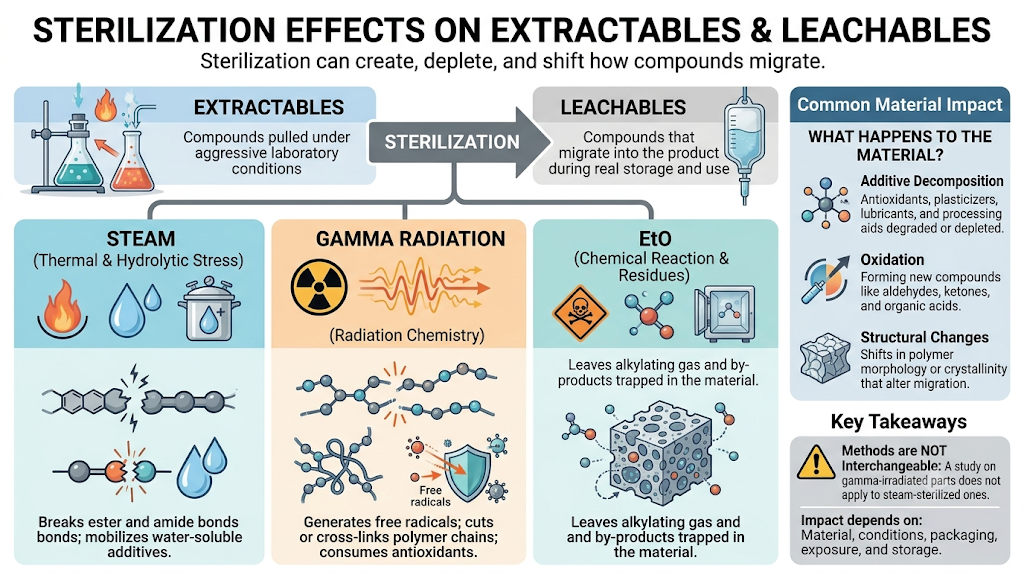
Sterilization can create new extractables, deplete existing ones, and shift how much of each compound migrates. Extractables are compounds pulled from a material under aggressive laboratory conditions; leachables are those that actually migrate into the product under real storage and use. Sterilization sits upstream of both.
Three mechanisms explain most of the change:
- Thermal and hydrolytic stress (steam) breaks ester and amide bonds and mobilizes water-soluble additives.
- Radiation chemistry (gamma) generates free radicals that cut or cross-link polymer chains and consume antioxidants.
- Chemical reaction and residues (EtO) leave alkylating gas and by-products trapped in the material.
Because each route is different, one sterilization method cannot be assumed to represent another. A study run on gamma-irradiated parts does not automatically cover steam-sterilized ones.
Sterilization can also decompose additives such as antioxidants, plasticizers, lubricants, and processing aids, and it can drive oxidation that forms aldehydes, ketones, and organic acids. Changes in polymer morphology or crystallinity may further alter how easily existing additives migrate. The extent of each effect depends on material composition, sterilization conditions, packaging configuration, exposure time, and later storage.
2: How Does Autoclave (Steam) Sterilization Change the E&L Profile?
Autoclaving typically increases hydrolysis-related and water-soluble extractables, while leaving radiation-type degradation products absent. Standard cycles of about 121 °C with saturated steam combine heat, pressure, and moisture, which suits materials that tolerate them.
What changes after steam sterilization
- Hydrolysis products: polyesters, polyamides, and polycarbonates can release monomers and oligomers.
- Additive migration: water-soluble salts, surfactants, and processing aids move more readily into the contact medium.
- Elastomer effects: rubber closures and gaskets can release curing-system residues and nitrosamine precursors under heat.
- Physical changes: swelling or crystallinity shifts can alter diffusion rates, which affects later leachables.
Validated cycles commonly use saturated steam at about 121 °C or 134 °C. The table below lists potential investigation targets; they will not necessarily appear in every sterilized material.
| Material or component | Potential chemical changes | Compounds to investigate |
|---|---|---|
| Polypropylene (PP) | Thermal oxidation, additive degradation | Antioxidants, oxidation products |
| Polyethylene (PE) | Oxidation, additive migration | Aldehydes, ketones, antioxidant-related compounds |
| Polycarbonate (PC) | Hydrothermal degradation | Phenolic and carbonate-related products |
| Polyesters | Hydrolysis of ester linkages | Oligomers, low-molecular-weight products |
| Elastomeric closures | Additive migration, formulation changes | Plasticizers, antioxidants, curing-related compounds |
| Adhesives and coatings | Thermal degradation | Organic degradation products, processing residues |
Repeated cycles matter. A material that tolerates one autoclave cycle may respond differently to several, so test the number of cycles in the product lifecycle. Closures used with freeze-dried products deserve the same scrutiny; see our page on extractables and leachables in lyophilized drug products.
Analytical focus
Aqueous and polar extraction solvents, LC-MS for non-volatile and semi-volatile species, and ICP-MS for elemental impurities are central here. Since nitrosamine risk is a concern for elastomeric components, our team also screens for nitrosamines and their precursors where the materials warrant it.
3: How Does Gamma Irradiation Change the E&L Profile?
Gamma irradiation generally creates new radiolysis products and depletes antioxidants, so the sterilized extractables profile differs from the unsterilized one. Typical sterilization doses fall in the range of 25 kGy or higher, and the energy is absorbed in the polymer itself, not only at the surface.
What changes after gamma sterilization
- Chain scission and cross-linking: polyolefins, PVC, and polycarbonate can form lower-molecular-weight fragments and volatile species.
- Additive depletion: phenolic antioxidants and phosphite stabilizers are consumed, producing transformation products such as quinones and phosphates.
- Oxidation products: aldehydes, ketones, carboxylic acids, and other oxygenated species increase, particularly when oxygen is present during irradiation.
- Ongoing change: some radical reactions continue after irradiation, so storage time before testing matters.
Gamma irradiation commonly uses a cobalt-60 source. A dose of 25 kGy is frequently used for medical devices, but it is not a universal requirement; the dose is validated for each product. Chain scission lowers molecular weight and creates mobile fragments, while cross-linking changes swelling and additive accessibility. Which one dominates depends on polymer chemistry, dose, oxygen availability, and formulation.
| Material | Potential radiation-related changes | E&L priorities |
|---|---|---|
| Polyethylene (PE) | Chain scission, cross-linking, oxidation | Aldehydes, ketones, organic acids |
| Polypropylene (PP) | Oxidative degradation, chain scission | Antioxidants, degradation products |
| PVC | Dehydrochlorination, additive degradation | Plasticizers, degradation products |
| Polyurethane (PU) | Chain scission, oxidation | Oligomers, degradation products |
| Silicone elastomers | Structural and additive changes | Siloxanes, low-molecular-weight species |
| Polyesters | Chain degradation | Oligomers, oxidation products |
Dose matters too. Compare non-irradiated samples with samples at the minimum and maximum justified doses, and add repeated irradiation if the product will see it. Because trapped radicals can keep reacting, include post-irradiation aging. Single-use bags and tubing are often gamma-sterilized; see our guide to single-use systems and GMP E&L testing.
Analytical focus
GC-MS and headspace GC-MS capture volatile and semi-volatile radiolysis products, while LC-MS profiles antioxidant degradants. Comparing irradiated and non-irradiated samples side by side is the most reliable way to identify which compounds are sterilization-derived.
4: How Does Ethylene Oxide (EtO) Sterilization Change the E&L Profile?
EtO adds a separate category of concern: residual sterilant and its reaction products, on top of any changes to the material itself. EtO is a reactive alkylating gas, so it penetrates porous packaging and can remain trapped in polymers after aeration.
What changes after EtO sterilization
- Residual EtO within the material, which can desorb into the product over time.
- Ethylene chlorohydrin (ECH) and ethylene glycol, formed when EtO reacts with chloride or water.
- Reaction with polymer additives: nucleophilic groups such as amines, hydroxyls, and thiols can be alkylated, creating new adducts.
- Humidity and temperature effects: typical cycles use elevated humidity, so some hydrolytic changes can also occur.
The amount of EtO a material retains depends on polymer composition and density, thickness and porosity, gas concentration, humidity, temperature, exposure time, aeration, and packaging configuration. Three compounds need particular attention:
| Compound | Potential source | Analytical significance |
|---|---|---|
| Ethylene oxide (EO) | Residual sterilizing agent | Requires residual EO determination |
| Ethylene chlorohydrin (ECH) | EO reacting with chlorine-containing materials | Requires specific residual assessment |
| Ethylene glycol (EG) | EO reacting with water | May need evaluation based on risk assessment |
Aeration is critical. Insufficient aeration can leave residuals above applicable limits, while poorly controlled aeration may affect material properties. Evaluate residuals right after sterilization, after validated aeration, at different thicknesses or configurations, and after storage.
Analytical focus
Residual EtO and ECH limits are governed by ISO 10993-7, and they are measured by dedicated headspace or extraction GC methods. These residual tests are separate from, and complementary to, a broad E&L screen. Our team recommends combining both so a single dataset covers material-derived and process-derived compounds.
ISO 10993-7:2026, the third edition published in April 2026, updates requirements for allowable EO and ECH residuals, measurement, and conformity assessment for applicable medical devices. It applies to relevant device exposure scenarios and should not automatically be treated as the acceptance standard for every pharmaceutical packaging or drug product application.
5: Autoclave vs. Gamma vs. EtO: Which Method Changes the E&L Profile Most?
No method is universally the worst; the impact depends on the material, so the best choice is the one your material tolerates with the smallest and best-characterized change. The table below summarizes the typical pattern.
| Factor | Autoclave (steam) | Gamma irradiation | Ethylene oxide (EtO) |
|---|---|---|---|
| Main mechanism | Heat, moisture, pressure | Ionizing radiation, free radicals | Alkylation, gas residues |
| Typical new compounds | Hydrolysis products, monomers, oligomers | Oxidation products, fragments, antioxidant degradants | Residual EtO, ECH, ethylene glycol, adducts |
| Additive impact | Water-soluble additives mobilized | Antioxidants and stabilizers consumed | Nucleophilic additives may be alkylated |
| Materials most affected | Polyesters, polyamides, elastomers | Polyolefins, PVC, polycarbonate | Porous or gas-absorbing polymers |
| Extra testing needed | Aqueous extracts, elemental impurities | Volatile and semi-volatile screening | ISO 10993-7 residuals plus E&L screen |
| Key analytical tools | LC-MS, ICP-MS | GC-MS, headspace GC-MS, LC-MS | Residual GC methods, GC-MS, LC-MS |
6: Which Analytical Techniques Identify Sterilization-Induced Extractables and Leachables?
No single technique covers every compound class, so a combination of chromatographic, spectroscopic, and physicochemical methods is used. Sterilization can create volatile, semi-volatile, non-volatile, and inorganic species, and the strategy should follow the material, expected chemistry, and patient exposure.
- GC-MS and GC-HRMS: volatile and semi-volatile organics, volatile degradation products, plasticizers, and additives. Accurate-mass data helps identify unknowns.
- LC-MS/MS and LC-HRMS: non-volatile and thermally unstable compounds such as antioxidant degradants, oligomers, and non-volatile additives, with targeted and non-targeted screening.
- Headspace GC-MS: volatile residues, including residual EtO, using validated procedures.
- ICP-MS: elemental impurities from metals, pigments, fillers, and inorganic additives.
| Complementary technique | Primary application |
|---|---|
| FTIR | Functional group changes, polymer degradation |
| NMR | Structure of unknown organic compounds |
| SEC/GPC | Molecular-weight distribution changes |
| DSC | Thermal transitions, material properties |
| SEM | Surface morphology, physical degradation |
7: How Should You Design an E&L Study Around Sterilization?
Design the study around the final sterilized product, and include both sterilized and unsterilized controls. This gives defensible evidence of which compounds the sterilization step introduces.
Practical steps
- Fix the sterilization method and cycle early, because changing it later can invalidate the E&L data.
- Extract sterilized and non-sterilized samples in parallel using solvents of varied polarity and pH.
- Use orthogonal techniques (LC-MS, GC-MS, headspace GC-MS, ICP-MS) for full coverage.
- Apply an analytical evaluation threshold (AET) so that identification effort is risk-based.
- Run a toxicological risk assessment on identified and unidentified compounds.
- Confirm with leachables studies under real storage conditions and shelf life.
Which standards and guidance apply?
The core references are ISO 10993-18 (chemical characterization of medical device materials), ISO 10993-7 (EtO sterilization residuals), USP <1663> (extractables from pharmaceutical packaging and delivery systems), and USP <1664> (leachables in drug products). Sponsors should also review current FDA and Health Canada expectations for their specific product category.
| Standard or guidance | Relevance |
|---|---|
| USP <1663> | Extractables from pharmaceutical packaging and delivery systems |
| USP <1664> | Drug product leachables assessment |
| ISO 10993-18 | Chemical characterization of device materials |
| ISO 10993-17 | Toxicological risk assessment of device constituents |
| ISO 10993-7:2026 | EO and ECH residual limits and measurement |
| ISO 11135 | EtO sterilization development, validation, routine control |
| ISO 11137 | Radiation sterilization development, validation, routine control |
USP <1663> and <1664> do not prescribe one universal procedure or acceptance limit, so each assessment must be tailored to the product. Keep documentation on material composition, sterilization specifications and validation, pre- and post-sterilization results, new or increased compounds, toxicological assessments, and compatibility conclusions. Always interpret expectations by product category and jurisdiction.
Common mistakes to avoid
- Testing only the raw, unsterilized polymer.
- Assuming one sterilization method represents another.
- Skipping the post-irradiation aging period.
- Treating EtO residual testing as a replacement for a full E&L screen.
- Ignoring repeated sterilization cycles on reusable or multi-cycle components.
- Using too few analytical techniques to cover volatile, non-volatile, organic, and inorganic compounds.
- Treating an extractable as proof of migration; a leachables study shows actual exposure.
How Does ResolveMass Support Sterilization-Related E&L Studies?
ResolveMass Laboratories Inc. supports pharmaceutical and biotechnology companies with analytical characterization of complex materials, packaging, and drug delivery systems. Our capabilities include LC-MS/MS, HRMS and LC-HRMS, GC-MS and GC-HRMS, ICP-MS, NMR, FTIR, and SEC/GPC.
These tools support pre- and post-sterilization extractables comparisons, elastomeric closure characterization, and leachables identification for polymer-based delivery systems. Related programs include E&L testing for generic injectable drugs, and for regulated work we design every GMP-compliant E&L study and GMP E&L testing around the specific material, sterilization process, and drug product.
Conclusion:
Sterilization is not a neutral step. Steam, gamma, and EtO each reshape the compounds that can migrate from your materials, so sterilization effects on extractables and leachables must be built into study design from the start. Testing the sterilized product, using orthogonal analytics, and following ISO 10993 and USP <1663>/<1664> principles gives you data that supports a confident regulatory submission.
Frequently Asked Questions:
Gamma irradiation can cause polymer chain scission, crosslinking, and oxidation. These changes may alter molecular weight, mechanical properties, and chemical composition, potentially generating new extractables such as aldehydes, ketones, organic acids, and polymer degradation products.
There is no universally best sterilization method for pharmaceutical packaging. Autoclaving is suitable for heat-resistant materials, gamma irradiation may be appropriate for radiation-compatible polymers, and EtO is useful for heat-sensitive materials. Selection should consider material compatibility, product stability, sterilization effectiveness, and E&L risks.
Pre- and post-sterilization E&L testing helps identify new chemical compounds, changes in existing extractables, and potential degradation products generated during sterilization. This comparison helps manufacturers evaluate material compatibility and determine whether additional leachables or toxicological assessments are necessary.
Gamma irradiation generates free radicals within polymer materials. These radicals can react with oxygen and other chemical species, resulting in oxidation, polymer degradation, and the formation of new chemical compounds. Radiation-induced products may include aldehydes, ketones, organic acids, and low-molecular-weight polymer fragments.
Aeration helps remove residual ethylene oxide and related volatile compounds from sterilized materials. Appropriate aeration conditions are important for controlling residual EO concentrations and supporting compliance with applicable safety requirements.
Yes. Repeated autoclave cycles can cause cumulative thermal and hydrolytic stress, potentially increasing polymer degradation, additive migration, and the formation of new extractables. Reusable medical devices and components should therefore be evaluated under conditions representative of their intended sterilization lifecycle.
Yes. Sterilization-induced polymer degradation, additive transformation, and changes in material properties may influence packaging performance and long-term chemical stability. Stability studies and appropriate E&L assessments can help determine whether sterilization affects packaging suitability throughout the intended shelf life.
Reference
- Sobańtka A, Weiner C. Extractables/Leachables from Single‐Use Equipment: Considerations from a (Bio) Pharmaceutical Manufacturer. Single‐Use Technology in Biopharmaceutical Manufacture. 2019 Aug 5:143-58.https://onlinelibrary.wiley.com/doi/abs/10.1002/9781119477891.ch11
- Curry W, Conway S, Goodfield C, Miller K, Mueller RL, Polini E. Reducing the risk of contamination of sterile parenteral products via ready-to-use closure components. AAPS PharmSciTech. 2010 Dec;11(4):1572-9.https://link.springer.com/article/10.1208/s12249-010-9531-8
- Sacha GA, Saffell-Clemmer W, Abram K, Akers MJ. Practical fundamentals of glass, rubber, and plastic sterile packaging systems. Pharmaceutical development and technology. 2010 Feb 1;15(1):6-34.https://www.tandfonline.com/doi/abs/10.3109/10837450903511178
- Eissa M. An Exploratory Review of Elastomeric Closures in Pharmaceutical Packaging: From Material Science to Regulatory Compliance. Journal of Engineering Advancements. 2026 Jul 9;7(02):65-72.https://www.researchgate.net/profile/Mostafa-Eissa/publication/408625569_An_Exploratory_Review_of_Elastomeric_Closures_in_Pharmaceutical_Packaging_From_Material_Science_to_Regulatory_Compliance/links/6a4f4f165ec6581029902683/An-Exploratory-Review-of-Elastomeric-Closures-in-Pharmaceutical-Packaging-From-Material-Science-to-Regulatory-Compliance.pdf
About the Author