
Introduction
The Oligonucleotide Capacity Challenge highlights the growing industrial mismatch between the rapidly increasing global therapeutic demand for small interfering RNA (siRNA) and antisense oligonucleotides (ASO) and the physical, environmental, and chemical limitations of conventional solid-phase manufacturing infrastructure. Historically, these manufacturing systems were developed to supply low-volume orphan drugs for rare genetic disorders. However, traditional platforms are not adequately equipped to produce the metric-ton annual volumes needed to support large-scale chronic disease indications. As late-stage clinical pipelines continue expanding into high-prevalence cardiovascular, metabolic, and central nervous system disorders, biopharmaceutical developers are approaching a significant drug substance supply bottleneck that could jeopardize commercialization schedules.
Bridging this widening gap between supply and demand requires extensive improvements across chemical synthesis, downstream purification, solvent recovery, and analytical control systems. Specialized analytical reference organizations, including ResolveMass Laboratories Inc., have an important role in facilitating this transition by establishing high-resolution liquid chromatography-mass spectrometry (LC-MS) characterization methods, real-time Process Analytical Technology (PAT) assays, and comprehensive failure sequence profiling protocols. These capabilities are essential for assessing and validating next-generation synthetic platforms. Understanding the progression of this manufacturing capacity deficit requires examining commercial market growth, solid-phase chemical limitations, facility engineering restrictions, and emerging synthesis technologies.
Explore the mechanism of action of peptide–oligonucleotide conjugates and their applications in targeted nucleic acid therapeutics.
Share via:
Quick Summary:
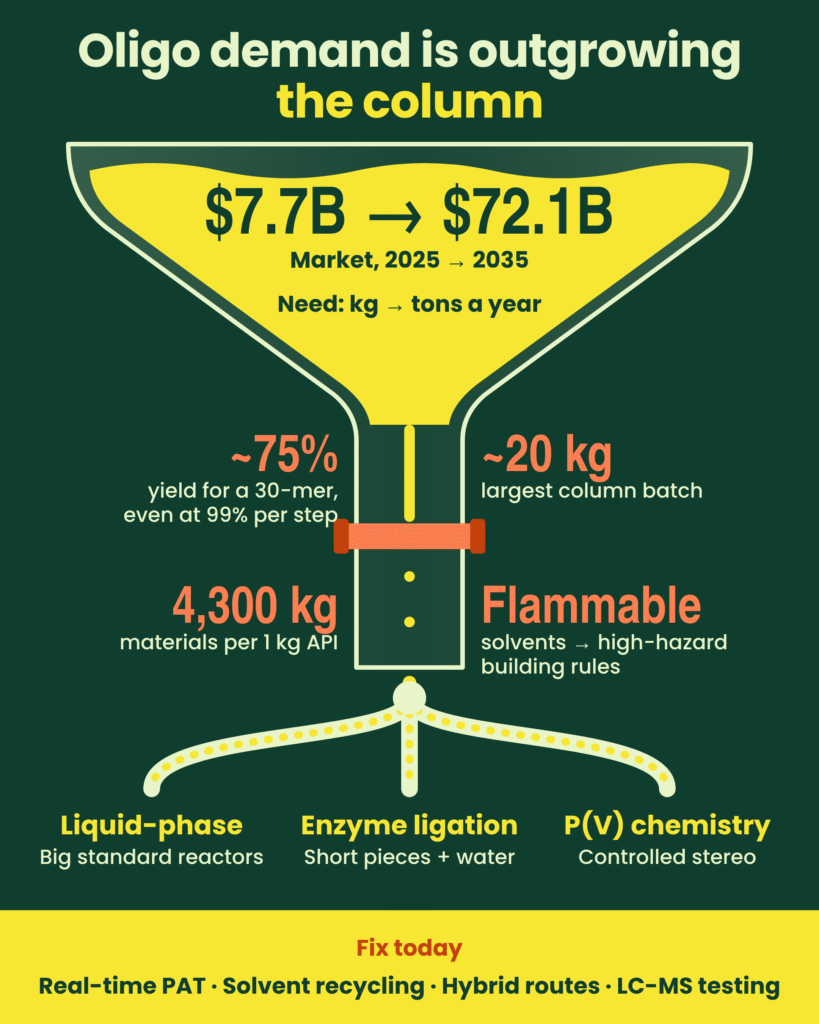
- The capacity gap: Oligonucleotide drugs (siRNA, ASO) are moving from rare diseases to common chronic diseases like high cholesterol, hypertension, MASH and Alzheimer’s. Annual drug substance needs are rising from kilograms to tons, and current manufacturing wasn’t built for that scale.
- Market growth: The oligonucleotide therapeutics market is projected to grow from USD 7.7 billion in 2025 to USD 72.1 billion by 2035. Leqvio’s twice-yearly dosing for high cholesterol shows how these drugs can reach mass-market patient populations.
- Limits of solid-phase synthesis (SPOS): Yield losses add up over repeated coupling cycles. Even at 99% per step, a 30-mer reaches only about 75% crude yield. The largest column batches top out around 2 mol (roughly 20 kg at most), and purification by preparative HPLC adds major cost and time.
- Environmental and facility burden: SPOS uses about 4,300 kg of materials per kg of API, mostly solvents like acetonitrile and toluene. Because these are flammable, scaling up triggers high-hazard building rules that make facility expansion slow and expensive.
- New manufacturing routes: Liquid-phase synthesis (LPOS) runs in standard large reactors. Chemoenzymatic ligation joins short fragments with enzymes in water, cutting solvent use and impurities. P(V) chemistry gives defined backbone stereochemistry but is still early-stage.
- Practical steps available now: Real-time process monitoring (PAT), process intensification, closed-loop solvent recycling, and hybrid chemical-plus-enzymatic workflows can ease bottlenecks today.
- The analytical role: Strong LC-MS characterization, impurity profiling and method validation are essential to qualify these new platforms during scale-up and technology transfer, and that is where specialized analytical labs like ResolveMass support the transition.
Market Dynamics Driving the Oligonucleotide Capacity Challenge
The Oligonucleotide Capacity Challenge is primarily fueled by a significant change in patient population requirements, shifting from relatively small groups of patients with rare diseases to millions of individuals requiring treatment for chronic conditions. This transition has substantially increased the annual demand for metric tons of active pharmaceutical ingredient (API). In the early stages of nucleic acid therapeutics commercialization, approved products generally targeted niche genetic disorders, with annual commercial API requirements ranging from several hundred grams to a few kilograms. However, the successful commercialization of twice-yearly siRNA maintenance therapies for hypercholesterolemia, including Inclisiran (Leqvio), which generated $1.198 billion in global sales in 2025, illustrates the growing potential of therapeutic oligonucleotides to serve much broader primary care populations.
The expansion of these therapies into high-prevalence indications, including hypertension, Alzheimer’s disease, and metabolic dysfunction-associated steatohepatitis (MASH), has significantly transformed the volume requirements of biopharmaceutical supply chains. A single chronic disease indication targeting millions of patients can require hundreds to thousands of kilograms of API annually. Such requirements place enormous pressure on existing global contract development and manufacturing organization (CDMO) infrastructure and its available production capacity.
Learn how peptide–oligonucleotide conjugates support targeted drug delivery in advanced therapeutic development.
The global oligonucleotide CDMO market demonstrates the scale of this increasing demand. According to Grand View Research, the market was estimated at USD 911.78 million in 2024 and is projected to reach USD 3.17 billion by 2033, growing at a CAGR of 14.98% from 2025 to 2033. At the same time, the global oligonucleotide therapeutics market, which includes ASO, siRNA, and aptamer products, was valued at USD 7.7 billion in 2025 and is projected to reach USD 72.1 billion by 2035, growing at a CAGR of 23.4%, according to Global Market Insights.
Market Dynamics and Supply Projections
| Market Parameter | Rare Disease Era Baseline | Mass-Market Chronic Era Target | Growth Metric and Significance |
|---|---|---|---|
| Annual API Volumetric Demand | 1 to 10 kilograms/year | 100 to 5,000+ kilograms/year | Requires multi-metric-ton operational manufacturing capacity |
| Primary Disease Focus | Ultra-rare genetic mutations | Cardiovascular, MASH, CNS, Renal | Expands treatment into large primary care patient populations |
| Global Oligo CDMO Market Value | USD 911.78 Million (2024) | USD 3.17 Billion (2033) | 14.98% CAGR (2025–2033) |
| Total ASO and siRNA Drug Market | USD 7.7 Billion (2025) | USD 72.1 Billion (2035) | 23.4% CAGR, supported by increasing pipeline maturity |
| Dominant Commercial Formats | Naked or LNP-formulated ASOs | GalNAc-conjugated siRNA/ASOs | Improved potency enables subcutaneous administration |
The inability of conventional manufacturing infrastructure to accommodate these increasing production volumes has resulted in a structural supply deficit. Biopharmaceutical sponsors are encountering longer CDMO lead times, rising raw material expenses, and greater regulatory scrutiny regarding process comparability and batch-to-batch consistency during manufacturing scale-up.
Technical and Chemical Bottlenecks in Solid-Phase Phosphoramidite Synthesis
Solid-Phase Phosphoramidite Synthesis (SPOS) faces significant limitations when applied to metric-ton manufacturing because cumulative stepwise yield losses, column bed-height and fluid-flow restrictions, and downstream chromatographic purification requirements substantially reduce overall batch throughput. SPOS was originally developed for research-scale production and early-stage clinical supply, typically involving batches of less than 100 mmol. Even today, the largest commercial flow-through column synthesizers operate at roughly 1 to 2 mol per batch, which corresponds to only single-digit to low-double-digit kilograms of oligonucleotide. SPOS uses repetitive four-step chemical cycles to extend nucleotide chains that are covalently attached to a solid resin support.
The conventional phosphoramidite synthesis cycle consists of the following four steps:
- Detritylation: Removal of the acid-labile 5′-DMT (4,4′-dimethoxytrityl) protecting group using dichloroacetic acid or trichloroacetic acid. This reaction exposes the terminal 5′-hydroxyl group, allowing the next nucleotide to be incorporated into the growing oligonucleotide chain.
- Activation and Coupling: Nucleophilic addition of the incoming 3′-phosphoramidite monomer to the available 5′-hydroxyl group in the presence of an azole activator, such as 5-ethylthio-1H-tetrazole. This step facilitates the formation of the phosphite linkage between successive nucleotide units.
- Capping: Acetylation of unreacted 5′-hydroxyl groups using acetic anhydride and N-methylimidazole. This reaction prevents unreacted nucleotide chains from participating in subsequent coupling cycles and producing unwanted shortmer impurities.
- Oxidation or Thiolation: Conversion of the unstable trivalent phosphite triester P(III) backbone linkage into a more stable pentavalent phosphate P(V) using iodine/water or an appropriate sulfurizing agent, such as xanthane hydride, when producing phosphorothioate backbones.
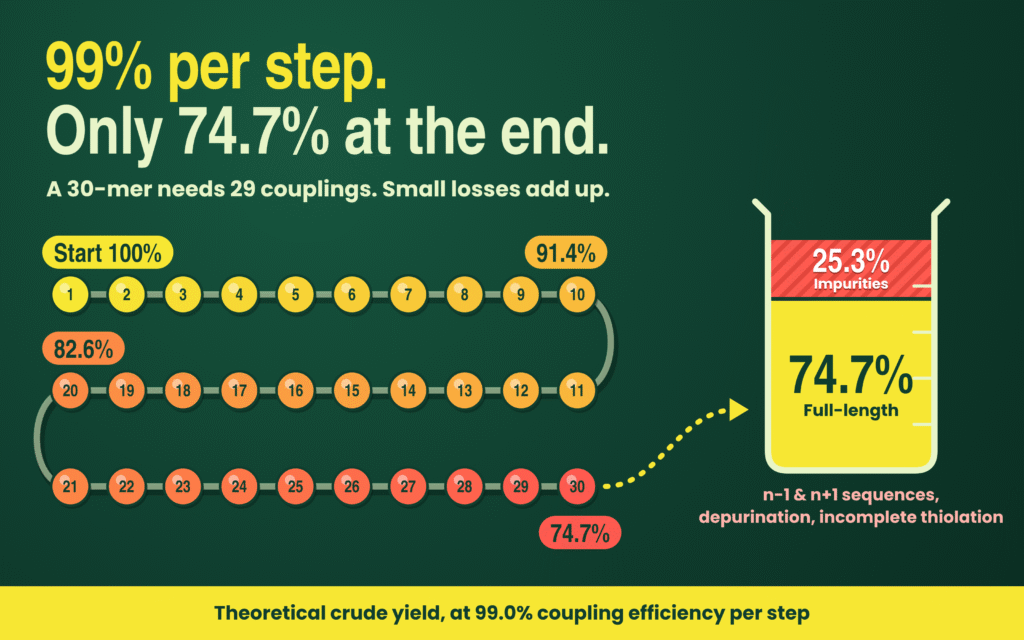
One of the most significant limitations of SPOS is the mathematical reduction in overall product yield resulting from multiple consecutive coupling reactions. Even when individual coupling steps achieve efficiencies of 99.0%, the cumulative theoretical yield of a conventional 30-mer oligonucleotide decreases to approximately 74.7% in the crude reaction mixture. The remaining 25.3% of the material comprises structurally related synthesis impurities, including truncated n-1 failure sequences, n+1 monomer insertions, depurinated sequences, and incomplete thiolation adducts.
Explore structural characterization of peptide–oligonucleotide conjugates and the analytical approaches used to evaluate complex therapeutic molecules.
Downstream purification introduces an additional and substantial manufacturing challenge. Separating full-length therapeutic oligonucleotide sequences from structurally similar impurities requires high-resolution preparative High-Performance Liquid Chromatography (HPLC), primarily through Anion-Exchange (AEX) or Ion-Pair Reversed-Phase (IP-RP) chromatography.
Downstream chromatographic purification and product isolation can account for as much as 50% of the total raw material consumption and operational expenditure. Furthermore, the collected chromatographic fractions generally contain highly diluted aqueous product streams. These streams must undergo additional processing, including energy-intensive tangential flow filtration (TFF), desalting, and extended freeze-drying (lyophilization) cycles. These additional operations increase processing time, delay batch turnaround, and ultimately limit the quantity of finished product that can be manufactured within a given period.
Learn how multi-attribute monitoring (MAM) supports peptide characterization and comprehensive analytical assessment.
Environmental and Facility Infrastructure Constraints of Scaled Synthesis
Expanding solid-phase oligonucleotide manufacturing to meet commercial demand creates considerable environmental waste and introduces substantial facility engineering challenges associated with hazardous organic solvent handling. Unlike small-molecule active pharmaceutical ingredients (APIs) or biopharmaceutical monoclonal antibodies, solid-phase oligonucleotide synthesis depends on exceptionally large quantities of reagents and washing solvents. These excess volumes are necessary to drive heterogeneous surface reactions toward completion and achieve the required coupling efficiency.
According to process benchmarks compiled by the American Chemical Society Green Chemistry Institute Pharmaceutical Roundtable (ACS GCIPR), conventional solid-phase oligonucleotide synthesis has an average Process Mass Intensity (PMI) of 4,299 kg of total material input for every kilogram of isolated API. Across commercial manufacturing operations, reported PMI values vary from 3,035 kg/kg to 7,023 kg/kg.
Hazardous organic solvents, primarily acetonitrile (ACN), toluene, pyridine, and dimethylformamide (DMF), contribute approximately 80% to 90% of the total material burden. An assessment using the Complete E-factor further demonstrates the environmental consequences of this manufacturing approach. Producing one metric ton of purified oligonucleotide drug substance can generate more than 4,000 metric tons of chemical waste.
The relevant calculations are expressed as follows:
Process Mass Intensity (PMI):
PMI = Total Mass of Input Materials Charged (including Solvents and Water) / Mass of Isolated API
Complete E-Factor:
Complete E-Factor = PMI – 1
Facility engineering requirements create another major obstacle to manufacturing expansion. Under internationally recognized structural and fire safety standards, including the International Building Code (IBC) and National Fire Protection Association (NFPA) codes, commonly used synthesis solvents such as acetonitrile and toluene are classified as Class 1B flammable liquids.
Manufacturing facilities that store or use Class IB flammable liquids above the Maximum Allowable Quantity (MAQ) per control area must be classified as High-Hazard Group H-2 or H-3 occupancies. Under IBC Table 307.1(1), the base MAQ for Class IB liquids is 120 gallons per control area for storage and closed-system use, and 30 gallons for open-system use. This limit can be doubled to 240 gallons in a building protected throughout by an automatic sprinkler system, and doubled again (up to 480 gallons) when the liquids are also stored in approved storage cabinets.
H-Space facility requirements introduce several significant architectural and operational restrictions:
- Perimeter Wall Requirements: In Group H-2 and H-3 occupancies, at least 25% of the perimeter of the occupancy must be an exterior wall. This requirement supports fire department access and safe operation; it is not an explosion-relief wall requirement. Rooms used for flammable liquid storage or closed-system use with a floor area of 1,000 square feet or less may be exempt when they comply with the fire code and NFPA 30. Where explosion hazards exist, separate explosion-control measures, such as deflagration venting or explosion prevention systems, are required under the International Fire Code.
- Ventilation, Containment, and Fire Protection: Facilities must provide mechanical exhaust ventilation, spill control and secondary containment, electrical equipment rated for classified hazardous locations, and automatic sprinkler protection designed for the specific hazard. Specialized systems such as foam-water sprinklers may be selected based on the hazard assessment, but they are not a universal code requirement.
- Control Area Limits: Facilities that remain below the MAQ must divide their solvent inventories among a limited number of fire-rated control areas, with the number of permitted control areas decreasing on upper floors. These restrictions prevent manufacturing facilities from expanding single-train production designs linearly without substantial additional land, infrastructure modifications, and capital investment.
Collectively, these environmental and structural limitations make the expansion of conventional SPOS manufacturing facilities increasingly difficult and economically challenging. Consequently, the biopharmaceutical industry is exploring continuous, environmentally sustainable, and non-column synthesis architectures that can support higher production volumes while reducing infrastructure requirements.
Next-Generation Manufacturing Solutions to Overcome the Oligonucleotide Capacity Challenge
To address the Oligonucleotide Capacity Challenge, the biopharmaceutical industry is increasingly investigating alternative manufacturing approaches, including Liquid-Phase Oligonucleotide Synthesis (LPOS), chemoenzymatic ligation, and phosphorus(V) stereocontrolled platforms. These emerging technologies aim to eliminate the physical limitations of packed-bed columns, improve material utilization, reduce manufacturing waste, and establish production systems capable of supporting high-volume commercial requirements.
Liquid-Phase Oligonucleotide Synthesis Platforms
Liquid-Phase Oligonucleotide Synthesis (LPOS) replaces conventional rigid solid-phase supports with soluble anchors. These include hydrophobic anchor tags, such as those used in Ajinomoto’s AJIPHASE technology, and soluble polymer supports such as polyethylene glycol (PEG), which can be recovered by precipitation or membrane separation. This modification allows chemical reactions to take place in a homogeneous liquid environment rather than on a fixed solid support.
By dissolving the anchor and growing the oligonucleotide chain directly within the reaction solvent, LPOS eliminates several limitations associated with conventional solid-phase columns. These include mass-transfer resistance, physical bed compression, and channeling phenomena, all of which can negatively affect reaction efficiency and manufacturing throughput.
Following each coupling cycle, unreacted phosphoramidites, activators, and reaction byproducts can be separated through controlled phase separation, liquid-liquid extraction, crystallization, or organic solvent nanofiltration (OSN). These separation techniques enable the removal of unwanted reaction components while retaining the growing oligonucleotide chain within the soluble anchor system.
Because LPOS reactions take place in homogeneous solutions, the technology can be scaled using conventional stainless-steel chemical synthesis reactors. This gives CDMOs an opportunity to move beyond column-based SPOS runs, which are generally limited to about 2 mol (typically a few kilograms and at most around 20 kilograms) per batch, toward much larger batch production using existing small-molecule chemical synthesis infrastructure.
Discover different peptide–oligonucleotide conjugate synthesis methods used to produce complex therapeutic constructs.
Chemoenzymatic Ligation and Aqueous Assembly
Chemoenzymatic synthesis combines the chemical production of short oligonucleotide fragments with enzyme-mediated assembly to overcome the limitations associated with long, sequential coupling reactions. Instead of producing an entire 21-mer to 30-mer oligonucleotide through 20 to 29 consecutive SPOS cycles, this approach initially generates shorter fragments, generally ranging from 5-mer to 10-mer, using SPOS or LPOS.
These short, high-purity oligonucleotide building blocks are subsequently assembled in an aqueous environment using ligase enzymes, such as engineered T4 DNA or RNA ligases, guided by a complementary template or splint strand. In siRNA manufacturing, the complementary strand of the duplex itself can serve as the template. Enzymatic ligation joins the fragments to produce the desired full-length therapeutic sequence.
Chemoenzymatic ligation offers several important manufacturing advantages:
- Yield Attrition Elimination: The accumulation of yield losses across numerous consecutive chemical coupling cycles is substantially reduced because chemical synthesis is restricted to shorter oligonucleotide fragments. This helps preserve overall product yield and improves manufacturing efficiency.
- Solvent Waste Reduction: Enzymatic ligation reactions are conducted in aqueous buffers rather than relying exclusively on large volumes of organic solvents. Because chemical synthesis is limited to short fragments, this approach can substantially reduce organic solvent consumption and overall process PMI compared with conventional linear SPOS, although the exact reduction depends on the process design.
- Purification Streamlining: Shorter failure fragments can be separated before the enzymatic ligation stage. Removing these impurities at an earlier manufacturing stage helps prevent the formation of full-length n-1 impurities, which otherwise complicate downstream HPLC purification and increase separation requirements.
Understand the role of linker chemistry in peptide–oligonucleotide conjugates in developing complex therapeutic molecules.
Stereocontrolled Phosphorus(V) Synthesis Architectures
Phosphorus(V) stereocontrolled synthesis platforms use chiral P(V) reagents, such as the limonene-derived phosphorus–sulfur incorporation (PSI) reagents, to set the configuration of each phosphorothioate stereocenter during coupling. Because the phosphorus is already in the pentavalent P(V) state, this approach bypasses conventional trivalent P(III) phosphoramidite chemistry and its separate oxidation or sulfurization step. (Chiral-auxiliary stereocontrol methods also exist, but these are generally based on P(III) chemistry.)
Traditional P(III) synthesis generates a random mixture of Rp and Sp configurations at each phosphorothioate linkage. A fully phosphorothioated 20-mer ASO, with 19 such linkages, can therefore exist as up to 2^19 (524,288) individual diastereomers, each potentially exhibiting different pharmacokinetic and pharmacological characteristics.
Traditional P(III) synthesis generates a random mixture of Rp and Sp configurations at each phosphorothioate linkage. A fully phosphorothioated 20-mer ASO, with 19 such linkages, can therefore exist as up to 2^19 (524,288) individual diastereomers, each potentially exhibiting different pharmacokinetic and pharmacological characteristics.
In contrast to P(III) phosphoramidites, P(V) reagents are bench-stable and enable stereospecific phosphorus coupling. Removing the separate oxidation or sulfurization step can simplify each synthesis cycle and may support future process intensification.
As a result, P(V) synthesis platforms offer the potential for improved coupling reproducibility, defined backbone stereochemistry, which can influence nuclease stability and pharmacological behaviour, and reduced reagent and solvent use. These platforms remain at an early stage of industrial development, but they are a promising manufacturing option for complex, extensively modified siRNA and ASO therapeutic candidates.
Explore NMR-based structural elucidation techniques for additional insights into advanced molecular characterization.
Comparative Analysis of Oligonucleotide Production Technologies
Comparing alternative oligonucleotide manufacturing technologies reveals considerable differences in their batch production capabilities, environmental impact, purification requirements, and technological maturity. Each synthesis approach offers distinct operational advantages and presents specific technical challenges that must be addressed before large-scale commercial implementation.
The following comparison demonstrates how emerging non-column and enzymatic manufacturing platforms can overcome several limitations associated with conventional solid-phase phosphoramidite chemistry.
| Technology Modality | Typical Batch Scale | Process Mass Intensity (PMI) | Primary Reaction Solvent Matrix | Infrastructure and Scalability Profile | Primary Technical and Process Constraints |
|---|---|---|---|---|---|
| Solid-Phase Synthesis (SPOS) | Up to ~2 mol per batch (a few kg to ~20 kg) | Average ~4,300 kg/kg API (range ~3,000–7,000) | Organic solvents (acetonitrile, toluene) | Mature commercial standard; scale limited by column bed height, flow and pump capacity | Cumulative yield attrition, high solvent use, chromatography-intensive purification |
| Liquid-Phase Synthesis (LPOS) | Potential for much larger batches in stirred-tank reactors | Reported lower than SPOS (process-dependent) | Homogeneous organic solution | High scalability; compatible with conventional batch chemical reactors | Soluble anchor cost and recovery, phase separation and precipitation optimization |
| Chemoenzymatic Ligation | Fragment-based; potential for ton-scale annual output | Substantially lower than SPOS (process-dependent) | Aqueous buffers (plus organic solvents for fragment synthesis) | Emerging; pilot to early commercial development | Enzyme cost and supply, ligation efficiency with heavily modified substrates, template requirements |
| Stereocontrolled P(V) Synthesis | Laboratory to early development scale | Not yet established at commercial scale | Organic solvents | Early-stage; potential for process intensification | Reagent cost, auxiliary recovery, sequence-dependent kinetics |
Learn about specification setting for peptide–oligonucleotide conjugates and its importance in maintaining consistent product quality.
Strategic Solutions for Mitigating the Oligonucleotide Capacity Challenge
Pharmaceutical developers and CDMOs can address immediate oligonucleotide manufacturing bottlenecks by implementing real-time analytical monitoring systems, transitioning toward continuous-flow reactors, establishing solvent recovery infrastructure, and developing strategic partnerships with specialized analytical testing organizations.
Several important strategies can support these objectives:
- Deploying Real-Time Process Analytical Technology (PAT): Integrating high-speed in-line UV-Vis spectroscopy, near-infrared (NIR) monitoring systems, and online LC-MS platforms enables manufacturers to monitor detritylation efficiency, coupling kinetics, and byproduct formation in real time. Early identification of process deviations allows manufacturers to implement corrective actions before minor issues develop into complete batch failures. This approach also helps reduce unnecessary off-specification processing runs and improves overall manufacturing consistency.
- Adopting Process Intensification Technologies: Conventional SPOS columns are already flow-through systems, so the main efficiency gains now come from process intensification. Examples include stirred-bed SPOS reactors that use higher-loading resins and fewer washing solvents, and continuous chromatography such as multicolumn countercurrent solvent gradient purification (MCSGP). These approaches can improve batch homogeneity, reduce solvent consumption and process mass intensity, and improve production efficiency while reducing the environmental burden of conventional synthesis.
- Establishing On-Site Closed-Loop Solvent Recovery Systems: Installing fractional distillation units and membrane-based solvent recovery technologies allows manufacturing facilities to reclaim more than 90% of acetonitrile and toluene from their waste streams. Recovering and reusing these solvents can substantially decrease process PMI, lower raw material expenditure, and help maintain on-site solvent inventories within applicable H-Space regulatory limits.
- Leveraging Convergent Hybrid Synthesis Workflows: Combining conventional linear SPOS or LPOS for the preparation of short, heavily modified oligonucleotide building blocks with chemoenzymatic aqueous ligation can improve overall manufacturing efficiency. This hybrid strategy helps maximize product yield, reduces the accumulation of synthesis-related impurities, and significantly simplifies downstream purification requirements.
- Partnering with Specialized Analytical Organizations: Collaborating with experienced reference testing laboratories, such as ResolveMass Laboratories Inc., supports reliable LC-MS characterization, comprehensive impurity identification, and efficient analytical method validation. These services are particularly important during technology transfer, process development, and manufacturing scale-up, where accurate characterization and consistent analytical performance are essential for maintaining product quality.
Explore physicochemical characterization services for therapeutic peptides and their role in comprehensive analytical evaluation.
Conclusion: Navigating the Oligonucleotide Capacity Challenge
Addressing the Oligonucleotide Capacity Challenge is critical to ensuring that next-generation siRNA and ASO therapeutics can reach patient populations worldwide. As therapeutic development programs increasingly target high-prevalence chronic diseases, depending entirely on conventional solid-phase phosphoramidite chemistry is becoming increasingly difficult from both operational and environmental perspectives. Biopharmaceutical manufacturers must therefore consider transitioning toward more scalable, environmentally sustainable, and non-column synthesis technologies, including liquid-phase synthesis and chemoenzymatic ligation, to establish reliable multi-metric-ton manufacturing and supply capabilities.
Successfully achieving this manufacturing transformation requires close coordination between process chemistry, environmental engineering, and advanced analytical testing. Integrating real-time Process Analytical Technology, improving solvent recovery efficiency, and collaborating with specialized analytical reference laboratories for comprehensive characterization can help the biopharmaceutical industry address existing production limitations. These improvements will be essential for strengthening manufacturing capacity, maintaining consistent product quality, and delivering innovative nucleic acid therapies to patients on a global scale.
For specialized analytical characterization, high-resolution LC-MS impurity profiling, and analytical method validation services supporting oligonucleotide process development and manufacturing scale-up, visit the ResolveMass Laboratories Inc. contact page:
Contact ResolveMass Laboratories Inc.
Frequently Asked Questions
Conventional SPOS encounters several technical limitations, including restricted column bed capacity, increasing fluid backpressure, and cumulative yield losses during repeated coupling reactions. Additionally, the synthesis process generates structurally similar impurities and failure sequences that are difficult to separate. These challenges increase downstream HPLC purification requirements and limit overall manufacturing throughput.
Process Mass Intensity (PMI) measures the total quantity of materials, including raw materials, solvents, and water, consumed to manufacture one kilogram of isolated drug substance. Oligonucleotide synthesis typically exhibits high PMI because conventional solid-phase processes require substantial quantities of organic solvents and chemical reagents. This extensive material consumption increases manufacturing expenses and contributes significantly to environmental waste generation.
Downstream purification requires preparative Anion-Exchange (AEX) and Ion-Pair Reversed-Phase (IP-RP) chromatography to separate full-length oligonucleotides from closely related synthesis impurities. These operations can consume up to 50% of the total process materials and generate highly diluted product fractions. Additional steps, including desalting, ultrafiltration, and freeze-drying (lyophilization), further increase processing time and restrict manufacturing throughput.
High-Hazard (H-Space) classifications apply to facilities handling flammable solvents, such as acetonitrile and toluene, beyond specified Maximum Allowable Quantities. Compliance requires specialized building designs incorporating explosion-relief structures, dedicated spill containment systems, advanced ventilation, and fire suppression infrastructure. These additional safety requirements increase construction expenses, complicate facility expansion, and extend manufacturing project timelines.
Chemoenzymatic ligation involves joining shorter, chemically synthesized oligonucleotide fragments through engineered RNA ligases or polymerases in aqueous buffer solutions. This approach reduces dependence on repeated linear coupling reactions, thereby minimizing cumulative yield losses. It also decreases the consumption of hazardous organic solvents and can lower Process Mass Intensity (PMI) by more than 50% compared with conventional SPOS.
Liquid-Phase Oligonucleotide Synthesis (LPOS) uses soluble anchors instead of conventional solid resin supports, allowing oligonucleotide chain extension to occur in a homogeneous liquid environment. This eliminates packed-column limitations, including bed compression, channeling, and mass-transfer resistance. Additionally, LPOS can utilize standard chemical synthesis reactors, offering greater flexibility for scaling production to multi-hundred-kilogram batches.
Phosphorus(V) stereocontrolled synthesis uses chiral catalysts or auxiliaries to regulate the stereochemical configuration of phosphorothioate linkages during synthesis. Unlike conventional trivalent P(III) phosphoramidite chemistry, which produces mixtures of stereoisomers, this approach enables more controlled backbone stereochemistry. The chemical stability of P(V) intermediates also supports continuous-flow processing, improves reaction reproducibility, and can enhance the consistency of therapeutic oligonucleotide products.
Process Analytical Technology (PAT) enables continuous monitoring of critical manufacturing parameters through integrated analytical systems, including online LC-MS, UV-Vis spectroscopy, and near-infrared sensors. These technologies help track coupling efficiency, detritylation rates, reaction kinetics, and impurity formation throughout synthesis. Identifying process deviations in real time allows manufacturers to make timely adjustments, minimize batch failures, and maintain consistent product quality during scale-up.
Specialized analytical laboratories provide advanced characterization services, including high-resolution LC-MS analysis, detailed impurity profiling, and analytical method validation. These capabilities help manufacturers establish product identity, evaluate impurity profiles, and demonstrate process comparability when transferring synthesis technologies to larger production facilities. Independent analytical testing also supports quality control and the generation of reliable data needed for regulatory submissions and compliance with applicable FDA and EMA requirements.
Reference:
- Andrews, B. I., Antia, F. D., Brueggemeier, S. B., Diorazio, L. J., Koenig, S. G., Kopach, M. E., Lee, H., Olbrich, M., & Watson, A. L. (2021). Sustainability challenges and opportunities in oligonucleotide manufacturing. The Journal of Organic Chemistry, 86(1), 49–61. https://doi.org/10.1021/acs.joc.0c02291
- Kekessie, I., Wegner, K., Martinez, I., Kopach, M. E., White, T. D., Tom, J. K., Kenworthy, M. N., Gallou, F., Lopez, J., Koenig, S. G., Payne, P. R., Eissler, S., Arumugam, B., Li, C., Mukherjee, S., Isidro-Llobet, A., Ludemann-Hombourger, O., Richardson, P., Kittelmann, J., … van den Bos, L. J. (2024). Process mass intensity (PMI): A holistic analysis of current peptide manufacturing processes informs sustainability in peptide synthesis. The Journal of Organic Chemistry, 89(7), 4261–4282. https://doi.org/10.1021/acs.joc.3c01494
- Stern, S., Wange, R. L., & Rogers, H. (2024). An evaluation of first-in-human studies for RNA oligonucleotides. Nucleic Acid Therapeutics, 34(6), 276–284. https://doi.org/10.1089/nat.2024.0036
- Zhang, Y., Chen, H., Hong, L., Wang, H., Li, B., Zhang, M., Li, J., Yang, L., & Liu, F. (2023). Inclisiran: A new generation of lipid-lowering siRNA therapeutic. Frontiers in Pharmacology, 14, 1260921. https://doi.org/10.3389/fphar.2023.1260921
- Obexer, R., Nassir, M., Moody, E. R., Baran, P. S., & Lovelock, S. L. (2024). Modern approaches to therapeutic oligonucleotide manufacturing. Science, 384(6692), eadl4015. https://doi.org/10.1126/science.adl4015
Get In Touch With Us
About The Author