


Introduction to Types of Peptide Oligonucleotide Conjugates
Types of Peptide Oligonucleotide Conjugates are specialized molecular structures where therapeutic oligonucleotides are chemically linked to peptides. This strategy is widely used in drug development to improve the delivery and biological activity of nucleic acid therapeutics. One of the biggest challenges in nucleic acid drug development is poor cellular uptake. Free oligonucleotides often have difficulty crossing biological membranes and may degrade before reaching their intended targets inside cells.
Peptide conjugation helps overcome these barriers by acting as a delivery system. The peptide component enables the therapeutic molecule to enter cells more efficiently and improves its ability to reach specific tissues.
Accelerate your drug development programs: Explore our Custom Synthesis for Drug Discovery
Different Types of Peptide Oligonucleotide Conjugates are designed depending on the biological function required from the peptide. Some peptides enhance membrane penetration, while others support tissue targeting, antimicrobial activity, or nuclear transport within cells. Understanding the various conjugate types is important for developing next-generation therapeutics. These technologies are now widely used in gene regulation, RNA modulation, and precision drug delivery strategies for complex diseases.
Expert solutions for complex molecules: Peptide-Oligonucleotide Conjugates (POCs) Synthesis Services
Share via:
Quick Summary
- Types of Peptide Oligonucleotide Conjugates used in therapeutics are primarily classified based on the type of peptide attached and the biological function it provides.
- The most clinically relevant categories include:
- Cell-Penetrating Peptide (CPP)–Oligonucleotide Conjugates
- Peptide Nucleic Acid (PNA)–Peptide Conjugates
- Receptor-Targeting Peptide–Oligonucleotide Conjugates
- Antimicrobial Peptide–Oligonucleotide Conjugates
- Nuclear Localization Signal (NLS) Peptide–Oligonucleotide Conjugates
- Multifunctional and Trifunctional Peptide–Oligonucleotide Conjugates
- These conjugates are widely explored in antisense therapy, RNA modulation, gene silencing, and targeted drug delivery.
- The choice of peptide determines cell uptake, tissue targeting, stability, and therapeutic efficiency.
- Modern therapeutic designs increasingly use CPP–PNA or CPP–PMO conjugates for improved intracellular delivery.
- Clinical development focuses on neuromuscular diseases, cancer, infectious diseases, and rare genetic disorders.
Classification of Types of Peptide Oligonucleotide Conjugates in Therapeutics
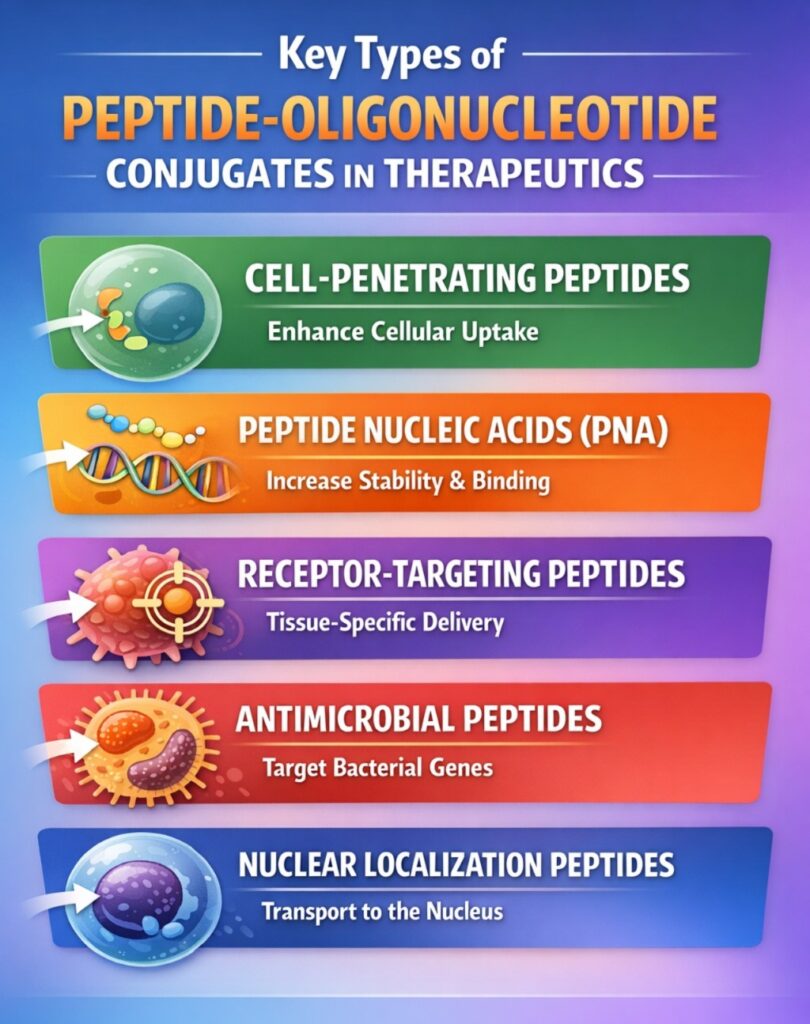
The Types of Peptide Oligonucleotide Conjugates used in therapeutic research are usually classified according to the biological function of the peptide and how it assists in drug delivery.
| Type of Conjugate | Key Function | Therapeutic Applications |
|---|---|---|
| Cell-penetrating peptide conjugates | Enhance cellular uptake | Antisense therapy, gene modulation |
| Peptide nucleic acid conjugates | Increase stability and binding | Genetic disorders, antimicrobial therapy |
| Receptor-targeting peptide conjugates | Tissue-specific delivery | Cancer therapeutics |
| Antimicrobial peptide conjugates | Target bacterial gene expression | Antibiotic-resistant infections |
| Nuclear localization peptide conjugates | Transport to nucleus | Splice correction, gene editing |
| Multifunctional peptide conjugates | Combine targeting and penetration | Advanced gene therapy |
Each of these categories addresses different biological challenges related to delivering nucleic acid drugs into cells.
By selecting appropriate peptides, researchers can optimize cellular internalization, tissue targeting, and intracellular transport. This improves the overall therapeutic efficiency of the drug.
Many modern delivery systems combine several peptide functions together. This has led to the development of multifunctional conjugates that perform multiple delivery tasks at the same time.
Partner with a specialized CRO: Leading Peptide Oligonucleotide Conjugates CRO Services
1. Cell-Penetrating Peptide (CPP)–Oligonucleotide Conjugates
Cell-penetrating peptide conjugates are among the most widely studied Types of Peptide Oligonucleotide Conjugates because they significantly improve the intracellular delivery of nucleic acid therapeutics.
CPPs are short peptides that can transport large biomolecules across cell membranes. They are usually cationic or amphipathic in nature, which allows them to interact effectively with lipid bilayers.
Their strong interaction with cell membranes enables therapeutic molecules to enter cells more efficiently compared with unmodified oligonucleotides.
These peptides often contain positively charged amino acids. These charges interact with negatively charged components of cell membranes, which helps promote membrane penetration or endocytosis.
Key Characteristics
- Strong interaction with negatively charged cell membranes
- Facilitation of endocytosis-based cellular uptake
- Improved intracellular delivery of antisense oligonucleotides
CPP conjugates can also improve pharmacokinetic properties by protecting oligonucleotides from enzymatic degradation in biological fluids. This protection can increase circulation time and enhance therapeutic effectiveness.
Common CPPs Used in Therapeutic Conjugates
- TAT peptide (HIV-derived)
- Penetratin
- Oligo-arginine peptides (R8, R9)
- Pep-3 peptide
These peptides have been extensively researched because of their ability to transport nucleic acids, proteins, and nanoparticles into cells.
Therapeutic Applications
- Duchenne muscular dystrophy splice-switching therapy
- RNA interference delivery
- Gene-silencing strategies
Research studies show that CPP–PNA conjugates significantly improve antisense activity and cellular uptake when compared with free oligonucleotides.
Understand the biology of delivery: Peptide Oligonucleotide Conjugates Mechanism of Action
2. Peptide Nucleic Acid (PNA)–Peptide Conjugates
PNA-based conjugates represent an important group among the Types of Peptide Oligonucleotide Conjugates because of their high molecular stability and strong binding affinity to nucleic acid targets.
Peptide nucleic acids are synthetic analogs of DNA. Instead of the typical sugar-phosphate backbone found in natural DNA, PNAs contain a peptide-like backbone.
This structural difference provides PNAs with several useful biochemical properties that make them valuable in therapeutic applications.
Key Properties
- Resistance to nuclease degradation
- High sequence specificity
- Strong hybridization with DNA or RNA targets
Because of these properties, PNAs are highly effective in antisense technologies and gene regulation research.
Why Peptide Conjugation is Necessary
Although PNAs bind strongly to nucleic acids, they have limited ability to cross cellular membranes on their own.
Peptide conjugation helps solve this problem by improving cellular uptake and intracellular distribution. With the help of delivery peptides, PNAs can reach their target molecules more efficiently.
Examples
- CPP–PNA conjugates
- Antimicrobial peptide–PNA conjugates
Therapeutic Focus Areas
- Genetic disease correction
- Antisense inhibition
- Bacterial gene silencing
These conjugates have shown strong promise in antisense antimicrobial therapies because they can target essential bacterial genes with high precision.
High-precision conjugation for research: Professional Peptide Oligonucleotide Conjugation Services
3. Receptor-Targeting Peptide–Oligonucleotide Conjugates
Receptor-targeting peptide conjugates are Types of Peptide Oligonucleotide Conjugates designed for tissue-specific delivery of nucleic acid drugs.
These peptides recognize and bind to receptors that are highly expressed on certain cell types or diseased tissues. After binding, the conjugate enters the cell through receptor-mediated endocytosis.
This targeted delivery approach increases drug concentration at the disease site and reduces exposure to healthy tissues.
Examples of Targeting Peptides
- RGD peptides (integrin targeting)
- Tumor-homing peptides
- Transferrin receptor peptides
These peptides are commonly used in cancer research because tumor cells often overexpress specific receptors.
Advantages
- Selective delivery to diseased tissues
- Reduced systemic toxicity
- Higher therapeutic concentration at the target site
Targeted delivery strategies also reduce off-target effects, which is an important factor in nucleic acid therapy.
Therapeutic Areas
- Cancer gene therapy
- Targeted antisense delivery
- Precision RNA therapeutics
Comprehensive analytical support: Learn more about POC Synthesis and Characterization
4. Antimicrobial Peptide–Oligonucleotide Conjugates
Antimicrobial peptide conjugates are specialized types of Peptide Oligonucleotide Conjugates designed to develop antisense antibiotics.
In this approach, the oligonucleotide component is designed to silence essential bacterial genes. At the same time, the antimicrobial peptide helps the conjugate enter bacterial cells.
This creates a dual-action strategy for treating bacterial infections.
Traditional antibiotics typically target bacterial proteins or metabolic pathways. In contrast, antisense oligonucleotides block gene expression at the mRNA level.
Mechanism
- Peptide enables penetration of the bacterial cell envelope
- Oligonucleotide binds target mRNA
- Protein translation is inhibited
This mechanism disrupts key cellular processes necessary for bacterial survival.
Advantages
- High specificity for bacterial genes
- Lower risk of resistance development
- Targeted inhibition of essential pathways
Because this therapy is sequence-specific, it can be designed to target particular bacterial strains without affecting beneficial microbes.
Ensure quality and regulatory compliance: CMC Services for Peptide Oligonucleotide Conjugates
5. Nuclear Localization Signal (NLS) Peptide–Oligonucleotide Conjugates
NLS-based conjugates are types of Peptide Oligonucleotide Conjugates designed to transport therapeutic oligonucleotides directly into the cell nucleus.
Many gene-modulating therapies require interaction with nuclear DNA or pre-mRNA molecules. Nuclear localization peptides help guide therapeutic molecules through nuclear pore complexes into the nucleus.
Without these targeting signals, oligonucleotides may remain in the cytoplasm and fail to reach their intended molecular targets.
Typical NLS Peptides
- SV40 large T-antigen NLS
- Importin-recognition motifs
These peptides interact with transport proteins that assist with nuclear import.
Therapeutic Uses
- Splice-switching oligonucleotides
- Gene-editing strategies
- Transcriptional regulation
By directing oligonucleotides into the nucleus, NLS peptides can significantly improve the efficiency of RNA splicing correction therapies.
Validate your therapeutic candidates: Expert Peptide Characterization Service
6. Multifunctional Peptide–Oligonucleotide Conjugates
Multifunctional constructs represent advanced types of Peptide Oligonucleotide Conjugates that combine multiple peptides or functional domains within a single molecular structure.
These systems are designed to overcome several biological barriers at the same time, such as cell entry, tissue targeting, and endosomal escape.
Combining different peptide functions allows researchers to build more advanced and efficient drug delivery systems.
These constructs may include:
- Cell-penetrating peptides
- Targeting peptides
- Endosomal escape peptides
Such combinations provide multiple delivery mechanisms within one conjugate molecule.
Maintain the highest purity standards: QC Testing for Peptide Oligonucleotide Conjugates
Example Architecture
| Component | Function |
|---|---|
| Targeting peptide | Directs conjugate to specific tissue |
| CPP peptide | Facilitates cell entry |
| Oligonucleotide | Therapeutic gene modulation |
Advantages
- Improved tissue targeting
- Higher intracellular delivery
- Better pharmacokinetic properties
Recent studies have demonstrated trifunctional peptide-oligonucleotide conjugates synthesized through native chemical ligation. This modular strategy allows researchers to assemble complex therapeutic molecules with precise functional control.
Key Design Considerations for Types of Peptide Oligonucleotide Conjugates
Selecting the appropriate Types of Peptide Oligonucleotide Conjugates requires careful optimization of several molecular design factors.
The goal is to balance stability, targeting ability, and delivery efficiency for the intended therapeutic application.
Important Design Factors
- Peptide charge and hydrophobicity
- Linker chemistry
- Oligonucleotide stability
- Target tissue specificity
- Endosomal escape efficiency
These factors influence how the conjugate behaves inside biological systems, including its distribution, stability, and cellular uptake.
Common Linker Strategies
- Disulfide linkers
- Amide bonds
- Click chemistry conjugation
- Native chemical ligation
Linker design is particularly important because it determines how the peptide and oligonucleotide interact and whether the therapeutic payload can be released under specific biological conditions.
Future Directions in Types of Peptide Oligonucleotide Conjugates
Research continues to expand the field of Types of Peptide Oligonucleotide Conjugates through new chemical and biological innovations.
Scientists are developing advanced delivery platforms that combine computational design, synthetic chemistry, and molecular biology.
Key Developments
- AI-guided peptide design
- Modular conjugation chemistries
- Targeted delivery systems
- Next-generation antisense antibiotics
These innovations aim to overcome major challenges such as endosomal trapping, off-target delivery, and systemic toxicity.
As these technologies continue to mature, peptide–oligonucleotide conjugates are expected to become an essential component of precision gene therapy and RNA-targeted medicine.
Conclusion
The Types of Peptide Oligonucleotide Conjugates used in therapeutics represent a rapidly growing class of molecular tools for gene modulation and nucleic acid drug delivery.
Each conjugate category—including cell-penetrating peptide conjugates, PNA-based constructs, receptor-targeting systems, antimicrobial conjugates, nuclear localization peptides, and multifunctional architectures—addresses specific biological challenges involved in nucleic acid therapeutics.
Advances in peptide engineering and oligonucleotide chemistry continue to expand the potential of these systems. Researchers can now design conjugates with improved stability, better targeting capability, and stronger intracellular delivery.
As scientific research progresses, the diversity of Types of Peptide Oligonucleotide Conjugates will continue to grow. These technologies are expected to play a major role in future antisense therapies, RNA-targeted medicines, and precision gene therapeutics.
Contact ResolveMass Laboratories Inc.
For specialized peptide-oligonucleotide conjugation services or research collaboration:
Frequently Asked Questions (FAQs)
Peptide-oligonucleotide conjugates improve the delivery, stability, and targeting ability of nucleic acid drugs. Free oligonucleotides often struggle to enter cells and may degrade quickly in biological environments. By attaching peptides, researchers can improve cellular uptake and help the drug reach the correct biological target.
Cell-penetrating peptide conjugates are among the most widely studied because they significantly improve intracellular delivery. These peptides help therapeutic oligonucleotides cross cell membranes and reach the cytoplasm or nucleus more effectively. As a result, they are frequently used in antisense and gene-silencing research.
CPP-PNA conjugates use cell-penetrating peptides to transport PNA molecules across cellular membranes. Once inside the cell, the PNA binds to complementary RNA or DNA sequences with high specificity. This interaction blocks gene expression through antisense mechanisms and can regulate disease-related genes.
PNA molecules provide strong sequence-specific binding and high resistance to enzymatic degradation. They are also more stable than many traditional nucleic acids. These properties make PNA-based conjugates valuable for gene regulation, antisense therapy, and antimicrobial research.
Receptor-targeting peptides guide the conjugate to specific tissues or cell types by binding to receptors on cell surfaces. This improves the selectivity of the therapy and helps deliver the drug to the intended disease site. As a result, it can reduce unwanted effects on healthy tissues.
Multifunctional conjugates combine several peptide domains and functional components within a single structure. They may include targeting peptides, cell-penetrating peptides, and endosomal escape elements. This multi-component design allows them to perform several delivery tasks at the same time.
Some key challenges include improving endosomal escape, optimizing pharmacokinetics, and ensuring precise tissue targeting. Researchers also need to minimize off-target effects and enhance intracellular delivery. Continuous advances in peptide engineering and chemical design are helping address these limitations.
Reference:
- Williams, B. A. R., Diehnelt, C. W., Belcher, P., Greving, M., Woodbury, N. W., Johnston, S. A., & Chaput, J. C. (2010). Synthesis of peptide–oligonucleotide conjugates using a heterobifunctional crosslinker. Bioconjugate Chemistry, 21(10), 1808–1816. https://doi.org/10.1021/bc1001137
- Arar, K., Aubertin, A. M., Roche, A. C., Monsigny, M., & Mayer, R. (1995). Synthesis and antiviral activity of peptide-oligonucleotide conjugates prepared by using Nα-(bromoacetyl) peptides. Bioconjugate Chemistry, 6(5), 573–577. https://doi.org/10.1021/bc00035a011
Get In Touch With Us
About The Author


