

Introduction:
This Unknown Impurity Identification ANDA Case Study explains how an unidentified impurity discovered during stability testing was successfully characterized and resolved before regulatory submission. Unknown impurities are among the most challenging analytical problems in ANDA development because regulatory agencies require complete identification, structural justification, and toxicological assessment before approval.
Companies working on complex generics often rely on a strong ResolveMass Laboratories Inc.-type analytical partner with deep experience in Bioanalytical Strategy in Drug Development and Mass Spectrometry Experts in Drug Development.
Many pharmaceutical companies encounter similar situations where a small unidentified peak appears during stability studies, forced degradation, or batch analysis. Without proper identification, the entire ANDA submission can be delayed or rejected. This case study demonstrates how a systematic analytical approach combined with advanced mass spectrometry expertise helps resolve such issues efficiently and reliably.
Share via:
Summary:
- Unknown impurities are one of the most common causes of delays in ANDA submissions.
- This Unknown Impurity Identification ANDA Case Study explains how a regulatory-focused analytical laboratory identifies, characterizes, and resolves an unknown impurity.
- Advanced techniques such as LC-MS/MS, HRMS, and structural interpretation play a key role in solving impurity challenges.
- A structured analytical strategy can reduce regulatory risk and prevent major submission delays.
- The case study highlights real-world experience in resolving complex impurity issues during generic drug development.
1: What Happens When an Unknown Impurity Appears During ANDA Development?
When an unknown impurity appears during ANDA development, the first and most critical step is to determine whether it is process-related, degradation-related, or formulation-related. Identifying the origin of the impurity is essential because it directly defines the analytical strategy, risk assessment approach, and regulatory response.
This is especially important for companies working on Analytical Method Development for Generic Drugs or Reverse Engineering for Development of Generic Drugs.
In most real-world ANDA projects, unknown impurities are typically detected under the following situations:
- Stability studies (long-term and accelerated stability conditions)
- Forced degradation studies during method development
- Scale-up batch manufacturing or pilot batches
- Analytical method transfer between laboratories
- Reformulation or manufacturing process optimization
- Excipient compatibility or packaging-related interactions
Once the impurity is detected, the next step is to evaluate whether the impurity level exceeds the identification thresholds defined by regulatory guidelines such as ICH Q3A/Q3B. If the impurity level is above the threshold, complete structural identification becomes mandatory before submission.
Without proper identification and scientific justification, the ANDA submission cannot proceed because regulatory authorities require:
- Structural characterization of the impurity
- Root-cause investigation
- Justification of safety risk
- Demonstration of impurity control strategy
This is why early detection and rapid impurity identification are crucial in preventing costly delays in generic drug development.
2: Unknown Impurity Identification ANDA Case Study – Background of the Problem
In this Unknown Impurity Identification ANDA Case Study, a pharmaceutical company developing a generic solid oral dosage form identified an unexpected impurity peak during accelerated stability studies. The impurity was not observed during early development stages, which immediately raised regulatory and analytical concerns.
Many companies facing this type of issue usually require support from specialized laboratories offering Analytical Development for Generic Drugs in Canada or Generic Drug Development CRO for ANDA.
The issue became critical because stability-related impurities are closely scrutinized during ANDA review, especially when the impurity is not present in the reference listed drug (RLD). This required a detailed investigation to determine the source, structure, and potential impact of the impurity.
Initial Observations
The analytical team made the following key observations during stability testing:
- The impurity appeared at approximately 0.18% after 3 months under accelerated stability conditions.
- The impurity was not detected in the reference listed drug (RLD).
- It was absent in initial method validation and development batches.
- The impurity peak increased gradually under high temperature and high humidity conditions.
- No similar peak was observed in earlier laboratory-scale batches.
These findings clearly indicated that the impurity was most likely degradation-related rather than process-related, which made structural identification even more important from a regulatory standpoint.
Because the impurity level exceeded the ICH identification threshold, the development team needed a rapid, scientifically sound, and regulatory-acceptable solution to avoid delays in the ANDA submission timeline.
3: What Analytical Strategy Is Used in an Unknown Impurity Identification ANDA Case Study?
In an Unknown Impurity Identification ANDA Case Study, the most effective analytical strategy is a step-by-step workflow that combines chromatographic separation, advanced mass spectrometry, and structural interpretation. Instead of relying on a single analytical technique, a systematic and regulatory-focused approach is required to ensure accurate identification and acceptance by regulatory authorities.
This type of work is typically handled by laboratories specializing in Bioanalysis in Canada and Outsourced Chemistry in Drug Discovery.
The primary objective of this strategy is not only to detect the impurity but also to determine its molecular structure, origin, and risk level.
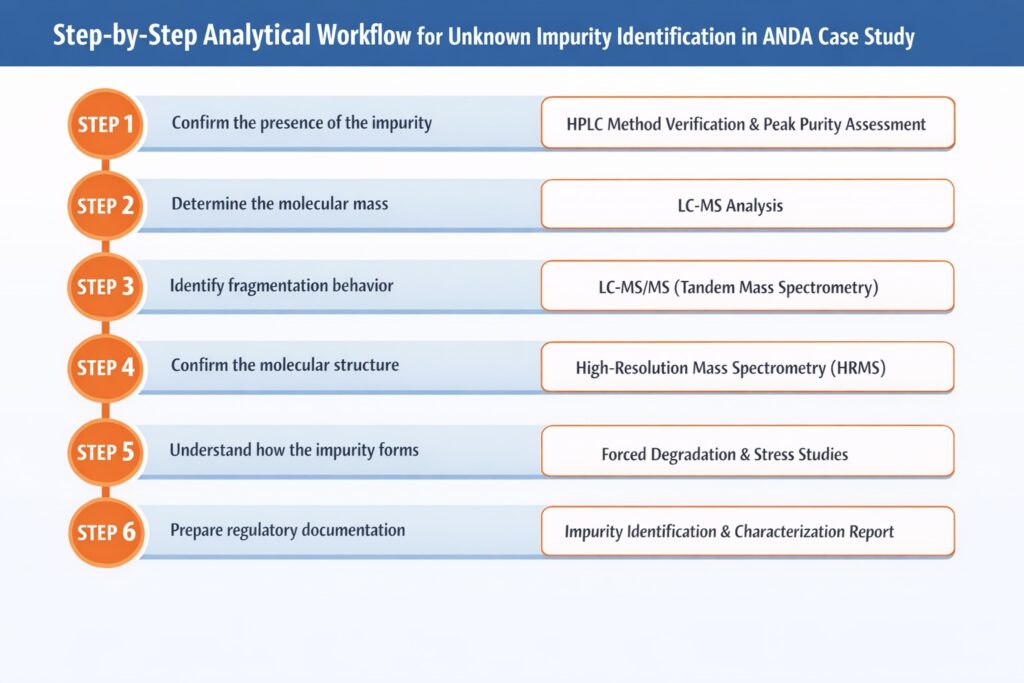
Step-by-Step Analytical Workflow
The investigation typically follows a structured sequence to avoid unnecessary re-testing and to ensure regulatory-ready data.
| Step | Objective | Technique Used |
|---|---|---|
| Step 1 | Confirm the presence of the impurity | HPLC method verification and peak purity assessment |
| Step 2 | Determine the molecular mass | LC-MS analysis |
| Step 3 | Identify fragmentation behavior | LC-MS/MS (tandem mass spectrometry) |
| Step 4 | Confirm the molecular structure | High-resolution mass spectrometry (HRMS) |
| Step 5 | Understand how the impurity forms | Forced degradation and stress studies |
| Step 6 | Prepare regulatory documentation | Impurity identification and characterization report |
This structured analytical process ensures that the impurity is not only detected but scientifically explained, which is essential for regulatory approval in ANDA submissions. A systematic workflow also reduces investigation time, minimizes regulatory risk, and helps development teams avoid costly submission delays.
4: Unknown Impurity Identification ANDA Case Study – LC-MS Investigation
In this Unknown Impurity Identification ANDA Case Study, LC-MS analysis played the most critical role in identifying the unknown impurity. Once the impurity peak was confirmed during stability testing, it was isolated and analyzed using high-resolution LC-MS to determine its molecular mass and structural characteristics.
Organizations working on complex molecules or peptides often require support from Peptide Testing Service or Peptide Analytical Characterization Services.
The purpose of the LC-MS investigation was to answer three key questions quickly:
What is the molecular weight of the impurity? How is it structurally different from the parent drug? Is it process-related or degradation-related?
Key Findings from LC-MS Analysis
The analytical team obtained several important insights from the LC-MS and LC-MS/MS studies:
- The molecular ion peak showed a mass difference of +16 compared to the parent drug substance.
- The fragmentation pattern clearly indicated the presence of an oxidation-related structural change.
- The impurity appeared only under stress conditions, particularly high temperature and humidity.
- No similar fragmentation pattern was observed in process-related impurity profiles.
- The impurity structure was consistent with a typical oxidative degradation product.
These results allowed the analytical team to quickly narrow down the possible impurity structures and eliminate several incorrect hypotheses early in the investigation. Instead of conducting multiple unnecessary experiments, the team was able to focus directly on confirming the oxidation pathway, which significantly reduced investigation time and accelerated the ANDA development timeline.
5: How Was the Unknown Impurity Structure Confirmed?
In this Unknown Impurity Identification ANDA Case Study, the impurity structure was confirmed using a multi-technique analytical approach rather than relying on a single experiment. Regulatory authorities expect strong scientific justification, especially when an impurity appears during stability studies and exceeds the identification threshold.
This is particularly important in projects involving advanced molecules such as peptides, where services like Peptide Characterization in Drug Development and GLP-1 Peptide Analytical Characterization become essential.
The objective was not only to identify the impurity but also to prove its formation mechanism and demonstrate that it does not represent a new toxicological risk.
Structural Confirmation Approach
To ensure regulatory-acceptable identification, the analytical team used the following techniques together:
- High-resolution LC-MS to determine the exact molecular mass
- LC-MS/MS fragmentation interpretation to understand structural changes
- Forced degradation studies to reproduce the impurity under controlled conditions
- Comparison with known degradation pathways of the drug substance
- Literature-based impurity prediction and structural validation
- Cross-verification using stability samples and stress samples
Once the structure was confirmed, the team was able to demonstrate that the impurity was a known oxidative degradation product, not a process-related impurity and not a new toxicological concern. This scientific justification allowed the development team to proceed confidently with stability studies and regulatory documentation without major delays in the ANDA submission timeline.
6: Unknown Impurity Identification ANDA Case Study – Root Cause Analysis
In this Unknown Impurity Identification ANDA Case Study, identifying the impurity structure was only the first step. The next critical objective was to determine why the impurity formed and how it could be controlled. Regulatory authorities require both structural identification and a scientifically justified root-cause explanation before accepting stability data.
Many companies dealing with similar issues also explore Regulatory Support for Generic Drugs US and Canada or Requirements for ANDA Submission Generic Drugs.
The investigation confirmed that the impurity was not process-related but environment-related, specifically linked to storage conditions.
Root Cause Findings
The analytical and stability teams identified the following key factors responsible for impurity formation:
- The impurity formed primarily under high humidity conditions during accelerated stability testing.
- The packaging material was not fully optimized for long-term protection against moisture and oxygen exposure.
- Minor oxidation occurred due to residual oxygen present inside the packaging system.
- The impurity level increased gradually only under stress conditions and not during routine manufacturing.
- Reformulation was not required; instead, packaging optimization effectively controlled the impurity.
This step is extremely important because regulatory agencies do not only ask “What is the impurity?” but also “Why did it form and how will it be controlled?” A clear root-cause investigation strengthens the regulatory justification and helps ensure that the ANDA submission is accepted without major delays.
7: Why Is Unknown Impurity Identification Critical for ANDA Approval?
Unknown impurity identification is critical for ANDA approval because regulatory authorities will not accept stability or quality data if an impurity exceeds the identification threshold and its structure is not confirmed. In simple terms, an unidentified impurity can delay — or even stop — an ANDA submission.
For companies planning full ANDA projects, related resources include:
- Generic Drug Development Process ANDA
- Analytical Requirements ANDA Generic Drugs
- CRO vs In-House ANDA Development
Regulators such as the FDA expect pharmaceutical companies to not only detect impurities but also identify their structure, understand their origin, and demonstrate that they are safe.
Regulatory Importance
Unknown impurity identification plays a key role in regulatory success because it helps:
- Demonstrate product safety and patient risk control
- Ensure full compliance with ICH impurity guidelines (Q3A/Q3B)
- Avoid Complete Response Letters (CRLs) caused by unidentified peaks
- Support acceptance of stability data during ANDA review
- Justify impurity limits scientifically
- Reduce regulatory and submission risk
Without proper identification, the entire ANDA submission timeline can be affected. In many cases, companies are forced to repeat stability studies or perform additional analytical investigations, which can significantly delay approval and increase development costs.
8: Unknown Impurity Identification ANDA Case Study – How the Problem Was Resolved
In this Unknown Impurity Identification ANDA Case Study, the issue was successfully resolved through a combination of advanced analytical expertise and a regulatory-focused strategy. Once the impurity structure was confirmed and the root cause was clearly established, the development team implemented targeted corrective actions instead of repeating the entire development process.
Companies working on full outsourcing models often look for CDMO for Generic Drug Development in Canada or Outsourcing Generic Drug Development Canada.
The objective was not only to identify the impurity but also to demonstrate control, ensure regulatory compliance, and protect the ANDA submission timeline.
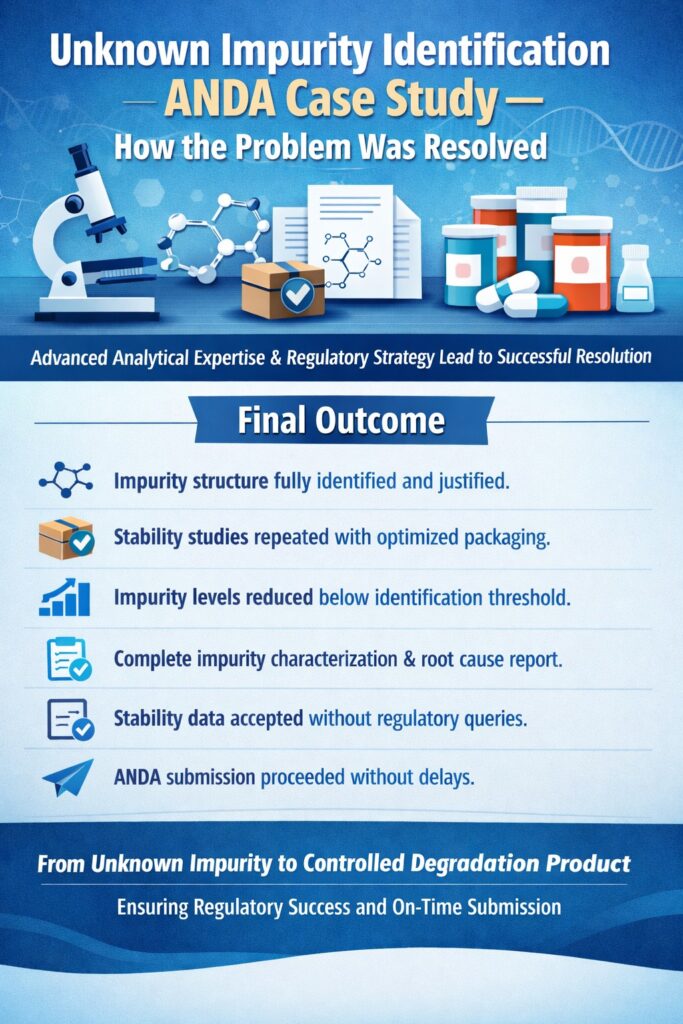
Final Outcome
The investigation and corrective strategy resulted in the following outcomes:
- The impurity structure was fully identified, confirmed, and scientifically justified.
- Stability studies were repeated using optimized packaging conditions.
- Impurity levels were successfully reduced below the identification threshold.
- A complete impurity characterization and root-cause report was prepared for regulatory submission.
- Stability data was accepted without additional regulatory queries.
- The ANDA submission proceeded without major delays.
This outcome clearly shows how a well-planned analytical strategy can transform a major regulatory challenge into a manageable scientific task. Instead of causing long-term delays, the unknown impurity was converted into a fully understood and controlled degradation product, allowing the development team to move forward with confidence.
9: Lessons Learned from This Unknown Impurity Identification ANDA Case Study
This Unknown Impurity Identification ANDA Case Study highlights several important lessons for pharmaceutical companies involved in generic drug development. The investigation clearly shows that unknown impurities are not just analytical challenges — they are regulatory risks that must be managed strategically and scientifically.
If you want to explore similar real-world technical examples, you can also read:
- Generic Peptide Drug Analytical Characterization Case Study
- Peptide Characterization Case Study of Semaglutide
By applying a structured analytical approach early in development, companies can significantly reduce delays, avoid regulatory queries, and improve overall ANDA submission success rates.
Key Takeaways
The case study provides the following practical lessons for development and analytical teams:
- Unknown impurities should be investigated immediately when they are first detected.
- Advanced analytical techniques such as LC-MS/MS and HRMS can significantly reduce investigation time.
- Stability-related impurities are often more common than process-related impurities, especially during accelerated stability studies.
- A structured analytical workflow prevents unnecessary re-testing and repeated stability studies.
- Early involvement of experienced analytical experts reduces both development time and regulatory risk.
- Root-cause analysis is just as important as structural identification.
- Packaging and storage conditions can play a critical role in impurity formation.
These insights can help pharmaceutical companies avoid common mistakes during ANDA development and make impurity investigations faster, more efficient, and fully compliant with regulatory expectations.
10: How an Experienced Analytical Laboratory Helps in Unknown Impurity Identification
In an Unknown Impurity Identification ANDA Case Study, the role of an experienced analytical laboratory becomes critical. Impurity identification is not just a routine analytical task — it requires deep scientific expertise, advanced instrumentation, and a strong understanding of regulatory expectations.
Many laboratories can detect an impurity peak, but only specialized regulatory-focused laboratories can accurately identify the structure, explain the root cause, and prepare submission-ready documentation.
Companies usually look for partners specializing in:
- Pharmaceutical CDMO US and Canada
- Generic Pharmaceutical CDMO Canada
- CDMO vs CRO for Generic Drug Development
What Makes a Specialized Laboratory Different?
An experienced analytical laboratory provides much more than routine testing. The key advantages include:
- Advanced LC-MS, LC-MS/MS, and HRMS capabilities for accurate impurity identification
- Preparation of regulatory-ready impurity identification and characterization reports
- Strong expertise in degradation pathway and stability-related impurity analysis
- Practical experience with ANDA-specific regulatory requirements
- Faster and more reliable resolution of complex impurity problems
- Ability to support both root-cause investigation and control strategy development
Working with the right analytical partner can significantly reduce the risk of unexpected delays during submission. Instead of spending months repeating stability studies or analytical testing, companies can resolve unknown impurity issues quickly and move forward with confidence in their ANDA development program.
Conclusion:
This Unknown Impurity Identification ANDA Case Study demonstrates how a structured scientific approach can successfully resolve one of the most common challenges in generic drug development. Unknown impurities can appear unexpectedly during stability studies, but with the right analytical expertise, they can be identified, explained, and controlled effectively.
By combining advanced mass spectrometry, regulatory-focused strategies, and real-world analytical experience, pharmaceutical companies can minimize regulatory risks and accelerate their ANDA submission timelines. This case study clearly shows that early impurity identification is not only a technical requirement but also a strategic advantage in successful generic drug development.
Frequently Asked Questions:
Unknown impurity identification in an ANDA case study refers to the scientific process of detecting, identifying, and structurally characterizing an unexpected impurity that appears during generic drug development. This is required when impurity levels exceed ICH identification thresholds.
Unknown impurity identification is critical because regulatory authorities require complete structural characterization of impurities that exceed identification limits. Without proper identification, the ANDA submission may face delays or regulatory queries.
Unknown impurities most commonly appear during:
-Stability studies (long-term or accelerated)
-Forced degradation studies
-Scale-up manufacturing batches
-Method transfer between laboratories
-Process or formulation changes
The most commonly used techniques include:
-HPLC method verification
-LC-MS analysis
-LC-MS/MS (tandem mass spectrometry)
-High-resolution mass spectrometry (HRMS)
-Forced degradation studies
-Structural interpretation and impurity characterization
The timeline depends on impurity complexity, but most unknown impurity identification studies take 2–6 weeks when advanced LC-MS and HRMS techniques are used by experienced analytical laboratories.
Yes. If an impurity exceeds identification thresholds and is not properly characterized, regulatory authorities may request additional data. This can delay stability data acceptance and postpone ANDA submission timelines.
Reference
- Alsante KM, Boutros P, Couturier MA, Friedmann RC, Harwood JW, Horan GJ, Jensen AJ, Liu Q, Lohr LL, Morris R, Raggon JW. Pharmaceutical impurity identification: a case study using a multidisciplinary approach. Journal of Pharmaceutical Sciences. 2004 Sep;93(9):2296-309.https://onlinelibrary.wiley.com/doi/abs/10.1002/jps.20120
- Alsante KM, Hatajik TD, Lohr LL, Santafianos D, Sharp TR. Solving impurity/degradation problems: case studies. InSeparation Science and Technology 2004 Jan 1 (Vol. 5, pp. 361-400). Academic Press.https://www.sciencedirect.com/science/article/pii/S0149639503800168
- Basak AK, Raw AS, Al Hakim AH, Furness S, Samaan NI, Gill DS, Patel HB, Powers RF, Yu L. Pharmaceutical impurities: regulatory perspective for abbreviated new drug applications. Advanced drug delivery reviews. 2007 Jan 10;59(1):64-72.https://www.sciencedirect.com/science/article/pii/S0169409X06002778
- Pawar J, Hegde N, Sharma S. Focusing on First Cycle Approval in ANDA Submission: Understanding Common Deficiencies & Case Study Insights. Therapeutic Innovation & Regulatory Science. 2025 May;59(3):426-37.https://www.sciencedirect.com/science/article/pii/S0169409X06002729

