
Introduction
Physicochemical testing under USP , <661.1>, and <661.2> provides a standardized analytical framework for establishing the chemical safety, material composition, and functional suitability of plastic materials of construction and finished packaging systems used in pharmaceutical manufacturing. This regulatory framework assesses critical quality attributes, including ultraviolet (UV) absorbance, total organic carbon (TOC), acidity or alkalinity titrations, non-volatile residue (NVR) mass, and plastic additive leaching, to ensure that packaging components do not compromise drug efficacy or patient safety.
Officially enforced since December 1, 2025, this standard replaces the legacy single-tier packaging Monographs with a mandatory two-tier analytical structure and eliminates historical grandfathering provisions for previously approved packaging data. Under this framework, biopharmaceutical sponsors and component suppliers must demonstrate comprehensive characterization of raw polymeric resins, along with rigorous qualification of fully assembled container-closure systems. Specialized testing methodologies offered by laboratory providers such as ResolveMass Laboratories Inc. assist pharmaceutical organizations in navigating these regulatory changes through advanced chromatographic, spectroscopic, and wet-chemical analytical techniques.
For pharmaceutical manufacturers evaluating packaging-related chemical risks, a comprehensive understanding of extractables and leachables is equally important. Explore the analytical considerations involved in extractables and leachables testing to strengthen packaging qualification strategies.
Share via:
Quick Summary:
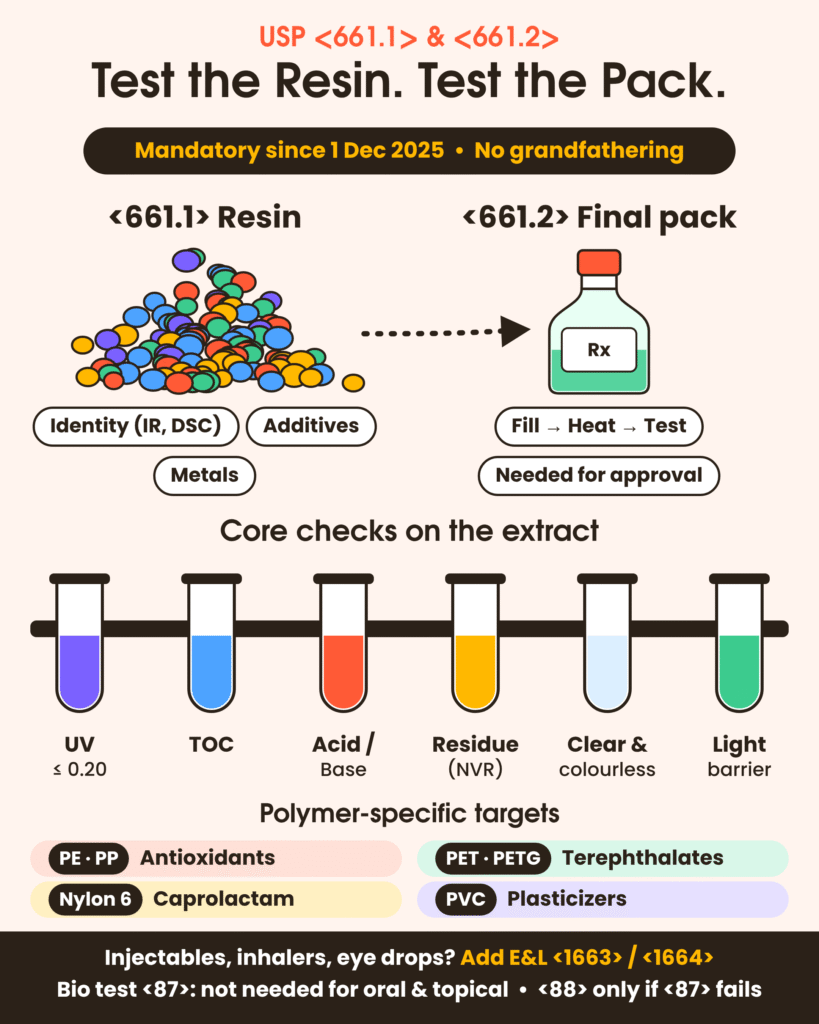
- What it covers: USP <661>, <661.1> and <661.2> set the physicochemical tests that show plastic pharmaceutical packaging is chemically safe and fit for use. The tests include UV absorbance, TOC, acidity/alkalinity, non-volatile residue and additive leaching.
- New mandatory framework: Since December 1, 2025, the legacy <661> tests are obsolete and replaced by a two-tier structure. No previously approved packaging is grandfathered, though existing data can still support the new assessment.
- Two tiers: <661.1> characterizes raw plastic resins, such as PE, PP, PET, PETG, polyamide 6, PC, EVA and PVC. <661.2> qualifies the finished container-closure system, and meeting it is what packaging approval depends on.
- Sample preparation: Resin strips are extracted at a set surface-area-to-volume ratio. Finished containers are filled with purified water and heated (for example, autoclaved at 121 °C) to produce the test extract.
- Core tests on the extract: UV absorbance (230–360 nm, NMT 0.20), acidity/alkalinity titration, TOC, non-volatile residue, solution clarity and colour, and light transmission for light-protective containers.
- Polymer-specific tests: Each polymer has its own targets: antioxidants in PE/PP by HPLC, terephthaloyl moieties and ethylene glycol in PET/PETG, caprolactam in nylon 6 by GC-FID, and plasticizers in PVC.
- Beyond the basics: Passing <661.2> does not prove safety for high-risk products like injectables, inhalers and eye drops, which need E&L studies under <1663>/<1664> using ICP-MS, GC-MS and LC-HRMS. Biocompatibility testing under <87> is not required for oral and topical forms, and <88> is needed only if <87> fails.
Structural Framework of USP , <661.1>, and <661.2> Standards
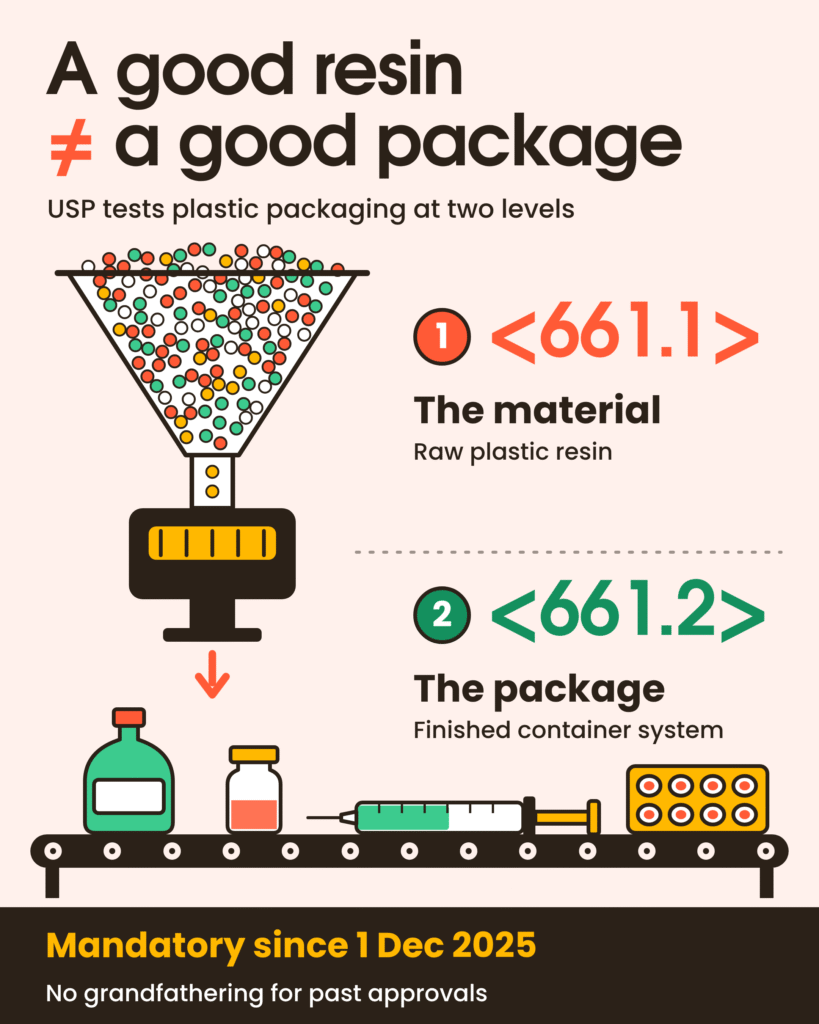
The structural framework of USP , <661.1>, and <661.2> establishes a distinct two-tier qualification approach that separates the characterization of raw plastic materials from the evaluation of finished packaging systems. USP <661.1> addresses the physicochemical and chemical characteristics of raw polymer resins, whereas USP <661.2> assesses the fully assembled packaging system in its final drug-contact configuration.
Material Assessment under USP <661.1> versus System Qualification under USP <661.2>
Material assessment under USP <661.1> establishes the identity, fundamental physicochemical characteristics, elemental impurity profile, and additive composition of individual plastic resins before they are converted into packaging components. This chapter includes specific monographs for thermoplastic polymers commonly used in pharmaceutical and medical packaging applications. These include Polyethylene (PE), Polypropylene (PP), Polyethylene Terephthalate (PET), Polyethylene Terephthalate Glycol (PETG), Cyclic Olefins (COC/COP), Polyamide 6, Polycarbonate (PC), Ethylene Vinyl Acetate (EVA), Polyvinyl Chloride (PVC), and Plasticized PVC. Polymeric materials that are not specifically listed in these monographs are classified as “Unaddressed Materials” and must undergo an equivalent set of physicochemical evaluations to establish their purity and extractable safety.
In contrast, USP <661.2> addresses the qualification of finished container-closure systems, including multi-layer bottles, pre-filled syringes, blister packaging cards, droppers, and vials. Its evaluation considers the combined effects of thermal processing, mold release agents, colorants, surface treatments, and interactions between individual packaging components. Although resin suppliers can share USP <661.1> characterization data with downstream manufacturers to support the development of multiple container designs, compliance with USP <661.1> alone is not sufficient to establish regulatory acceptability for a commercial drug container. The complete packaging system must independently satisfy the applicable testing requirements of USP <661.2>.
For manufacturers working with injectable drug delivery systems, finished-container evaluation requires particular attention to component interactions and potential chemical migration. Learn more about the analytical requirements associated with extractables and leachables testing for pre-filled syringes and their role in packaging qualification.
Mandatory Implementation Timeline and the No-Grandfathering Rule
The mandatory implementation date of December 1, 2025, marked the complete replacement of the original legacy USP requirements, establishing USP <661.1> and USP <661.2> as the enforceable standards for plastic packaging compliance. One of the most important aspects of this regulatory transition is the removal of the “grandfathering” provisions. Packaging systems and raw materials previously approved under legacy USP protocols are not automatically exempt from the updated requirements. Instead, they must undergo complete re-testing and characterization in accordance with the current USP <661.1> and <661.2> monographs to maintain their market authorization.
| Regulatory Aspect | Legacy USP | USP <661.1> (Materials) | USP <661.2> (Systems) |
|---|---|---|---|
| Primary Focus | Single-tier evaluation of finished containers and basic plastics. | Raw plastic resins, compounds, and material components. | Fully fabricated final packaging systems and components. |
| Enforcement Status | Obsolete as of December 1, 2025. | Mandatory active standard. | Mandatory active standard. |
| Identification Protocols | Basic IR spectroscopy and thermal analysis. | Monograph-specific FTIR and DSC melting peak verification (ΔTₘ). | Evaluated through finished system integrity and component suitability. |
| Additive Profiling | Limited heavy metals and general extractables screening. | Quantitative chromatographic assays (HPLC/GC) for antioxidants and monomer residues. | Integrated into Chemical Safety Assessments (E&L per USP /). |
| Grandfathering Status | Historical approvals permitted before 2025. | Prohibited; complete re-characterization required. | Prohibited; complete system re-qualification required. |
Core Physicochemical Testing Parameters under USP , <661.1>, and <661.2>
The core physicochemical parameters specified under USP , <661.1>, and <661.2> quantitatively evaluate aqueous extractables, buffering capacity, total organic carbon, non-volatile residues, and light attenuation. These assessments help identify potential solvent-mediated container degradation and determine whether packaging materials are suitable for their intended pharmaceutical applications. Standardized sample preparation requires an extraction surface area-to-volume ratio of 60 cm² per 20 mL of extraction medium, followed by exposure to specified thermal conditions.
Standardized Sample Preparation and Thermal Extraction Protocols
Accurate sample preparation is essential for generating consistent and reproducible physicochemical testing results across different polymer types. For raw resin evaluation under USP <661.1>, homogeneous plastic specimens are cut into uniform strips measuring approximately 3 mm in width and 5 cm in length. Surface area calculations must include both sides of the plastic specimen, ensuring a ratio of 60 cm² of total surface area for every 20 mL of extraction solvent, irrespective of the specimen’s thickness.
Selecting appropriate extraction media is also important because solvent polarity and extraction strength influence the types and quantities of chemical compounds recovered from polymeric materials. The selection should reflect the polymer composition, intended pharmaceutical application, and analytical objectives of the study. Review the considerations involved in selecting solvents for extractables studies when developing an appropriate extraction strategy.
For finished container evaluation under USP <661.2>, the packaging system is filled to approximately 90%–100% of its nominal capacity with Purified Water to prepare test Solution C1. The extraction vessels are then sealed using impervious closures, such as aluminum foil or inert glass stoppers, and exposed to controlled thermal conditions. The standardized thermal extraction procedures include:
Autoclave Extraction (Solution C1): The sample is heated in an autoclave at 121 ± 2°C for 30 minutes, generally requiring an additional 20–30 minutes for temperature ramp-up. This procedure is primarily used to obtain high-purity aqueous extracts from container systems.
Water Bath Incubation: The sample is maintained in Purified Water at 70 ± 2°C for 24 hours. This extraction condition is commonly applied to polyolefins and other general polymer materials.
Controlled Chamber Storage: The sample is incubated at 49 ± 2°C for 10 days. This procedure is specified for polyester extracts (PET/PETG) using 50% alcohol, 25% alcohol, or n-heptane as the extraction medium.
Quantitative Analytical Testing Parameters and Limits
Ultraviolet-Visible (UV-Vis) Absorbance (USP ): This test determines whether organic chemical compounds containing chromophoric functional groups have migrated into the aqueous extraction medium. The spectral absorbance of Solution C1 or Solution S1 is measured across a wavelength range of 230 nm to 360 nm using a 1 cm quartz cell, with a blank solvent serving as the compensation liquid. The maximum absorbance recorded anywhere within this wavelength range must not exceed 0.20.
Acidity or Alkalinity Titration: This evaluation identifies acidic or basic substances released from plastic materials that could interfere with the pH stability of a pharmaceutical product. A 20 mL portion of the aqueous extract is titrated either potentiometrically or visually using Bromoreagent Phenol (BRP) or methyl orange indicator solutions. To meet the acceptance criteria, the volume of 0.010 N sodium hydroxide (NaOH) or hydrochloric acid (HCl) required to neutralize the extract to pH 7.0 must not exceed 1.5 mL.
Total Organic Carbon (TOC) (USP ): TOC analysis measures non-chromophoric organic compounds released into Solution C1 that cannot be identified through conventional UV spectrophotometry. Following the bulk water procedures described in USP , this technique oxidizes organic molecules into carbon dioxide (CO₂) and measures the resulting total carbon content. The applicable TOC limit is established through suitability testing, which requires demonstrated analytical linearity and minimal background interference relative to the blank extraction medium.
Non-Volatile Residue (NVR): This test determines the mass of organic and inorganic extractables that remain after a specified volume of extraction solution is evaporated to dryness at 105°C. The difference in residue mass between the test sample and the corresponding blank preparation must remain within the applicable monograph limits. These include NMT 12.0 mg for water extracts (70°C), NMT 75.0 mg for 70% alcohol extracts (70°C), and NMT 350.0 mg for hexanes extracts (50°C).
Solution Visual Appearance (Color and Clarity): Solution C1 must appear clear and colorless when compared with Purified Water and primary opalescent suspensions prepared using hydrazine sulfate and hexamethylenetetramine mixtures. The assessment is performed in transparent, neutral glass vessels under diffuse daylight to identify visible discoloration, turbidity, or other changes in the extraction solution.
Spectral Transmission / Light Transmission (USP ): This test evaluates the light-protective barrier characteristics of plastic containers across the ultraviolet and visible spectral regions, covering wavelengths from 290 nm to 450 nm. For plastic containers intended for oral or topical pharmaceutical products, spectral transmission must not exceed 10% at any wavelength within the specified 290–450 nm range.
Polymer-Specific Characterization Protocols under USP <661.1>
Polymer-specific characterization under USP <661.1> combines targeted structural identification with quantitative chromatographic analysis of residual monomers and functional plastic additives. Each polymer classification has specific extraction conditions and analytical requirements designed to evaluate its material composition, structural integrity, and potential chemical impurities.
Polyolefins: Polyethylene (PE) and Polypropylene (PP)
Polyethylene, including High-Density PE and Low-Density PE, and Polypropylene are structurally characterized using Fourier-Transform Infrared (FTIR) spectroscopy and Differential Scanning Calorimetry (DSC). During DSC thermal analysis, the melting peak temperature (ΔTₘ) of the test specimen must remain within 6.0°C of the corresponding standard reference curve.
The quantitative evaluation of plastic additives, including phenolic antioxidants such as Butylated Hydroxytoluene (BHT) and USP Plastic Additives 1 through 6, involves extracting a 2.0 g polyolefin resin sample in 80 mL of toluene under reflux conditions for 1.5 hours to prepare Solution S2. The resulting solution is evaporated to dryness under vacuum at 45°C and subsequently reconstituted in methylene chloride before analysis using High-Performance Liquid Chromatography with UV Detection (HPLC-UV).
Chromatographic separation is performed using an L1 (C18) column measuring 4.6 mm × 25 cm with a particle size of 5 μm. The column operates at flow rates ranging from 1.5 mL/min to 2.0 mL/min, with UV detection at either 280 nm or 227 nm. The peak areas corresponding to the extracted additives are compared against USP Reference Standard mixtures to establish their concentrations and verify compliance with the applicable requirements.
The selection of suitable analytical platforms is essential for detecting additives and degradation products across different volatility and polarity ranges. Depending on the chemical characteristics of the target compounds, laboratories may use complementary chromatographic approaches. Understand the differences between GC-MS and LC-MS in extractables and leachables testing to determine how these techniques contribute to comprehensive chemical characterization.
Polyesters: Polyethylene Terephthalate (PET) and PETG
Polyethylene Terephthalate (PET) and Polyethylene Terephthalate Glycol (PETG) materials undergo thermal characterization to assess their polymer identity and structural properties. The acceptable melting peak temperature deviations (ΔTₘ) are NMT 4.0°C for PET and NMT 6.0°C for PETG compared with their respective reference standards. The extraction procedures use 50% alcohol for PET and 25% alcohol for PETG, along with n-heptane as an additional extraction medium. These samples are maintained at 49°C for 10 days under controlled conditions.
The resulting extracts are evaluated for total terephthaloyl moieties using UV spectrophotometry. The specified absorbance limit is NMT 0.150, corresponding to a maximum of 1 ppm of total terephthaloyl extractables. Residual ethylene glycol is assessed separately by reacting the sample extracts with disodium chromotropate in a sulfuric acid medium. The resulting color development is measured against standard calibration curves to confirm that the ethylene glycol concentration remains at or below 1 ppm.
Polyamides, Polyvinyl Chloride (PVC), and Unaddressed Materials
The characterization of Polyamide 6 (Nylon 6) primarily focuses on determining the concentration of residual caprolactam monomer remaining from the polymerization process. Test specimens are dissolved in anhydrous formic acid and analyzed using Gas Chromatography with Flame Ionization Detection (GC-FID). The analytical procedure employs a capillary column measuring 30 m × 0.25 mm with a 0.25 μm G25 phase. A split injection ratio of 3:1 is used, with the column temperature programmed from 160°C to 210°C at a rate of 5°C/min.
For plasticized Polyvinyl Chloride (PVC), the analytical evaluation primarily targets plasticizers, including DEHP and alternative non-phthalate plasticizers, along with heavy metal stabilizers used in polymer formulations. Materials and polymer formulations that are not specifically covered by the USP <661.1> monographs are designated as “Unaddressed Materials.” These materials must undergo comprehensive physicochemical evaluation, including UV absorbance, TOC, NVR, titration, and heavy metal analysis. The testing strategy should follow the principles established in the existing monographs to demonstrate an equivalent level of material purity and chemical safety.
| Polymer Monograph | Structural Verification | Primary Solvent Extraction Media | Core Physicochemical & Additive Targets | Monograph Limit Specifications |
|---|---|---|---|---|
| Polyethylene (PE) | FTIR & DSC (ΔTₘ ≤ 6.0°C) | Water (70°C, 24 h), Hexanes (50°C) | UV Absorbance, Titration, NVR, Additives | Abs ≤ 0.20; Titrant ≤ 1.5 mL; Water NVR ≤ 12.0 mg; Hexane NVR ≤ 350.0 mg |
| Polypropylene (PP) | FTIR & DSC (ΔTₘ ≤ 6.0°C) | Water (70°C, 24 h), Toluene Reflux (1.5 h) | UV Absorbance, NVR, Phenolic Antioxidants (BHT, Additives 1–6) | Abs ≤ 0.20; HPLC additive peaks match USP Plastic Additive RS calibration |
| PET / PETG | FTIR & DSC (ΔTₘ ≤ 4.0°C PET / 6.0°C PETG) | 50% Alcohol (PET), 25% Alcohol (PETG), n-heptane (49°C, 10 days) | Total Terephthaloyl Moieties, Ethylene Glycol Content, NVR | Terephthaloyl Abs ≤ 0.150 (≤ 1 ppm); Ethylene Glycol ≤ 1 ppm; NVR ≤ 75.0 mg |
| Polyamide 6 | FTIR & DSC | Formic Acid dissolution | Residual Caprolactam Monomer Content (GC-FID) | Caprolactam concentration quantified against primary standard curve |
| Finished System (C1) | Visual Appearance (Color & Clarity) | Purified Water Autoclave (121°C, 30 min) | Solution Color, Clarity, TOC, UV Absorbance, Spectral Transmission | Solution C1 clear/colorless; TOC compliant with USP ; Abs ≤ 0.20; Transmittance ≤ 10% |
Integration of Physicochemical Testing with Risk-Based Chemical Safety Assessments
Physicochemical testing under USP <661.2> establishes the empirical foundation for comprehensive, risk-based Chemical Safety Assessments conducted in accordance with USP , USP (Extractables), and USP (Leachables).
Although compliance with baseline physicochemical testing requirements is mandatory, meeting the specifications of USP <661.1> or USP <661.2> alone does not automatically establish the chemical safety of packaging systems intended for high-risk pharmaceutical products, including parenterals, inhalation aerosols, and ophthalmic solutions. Similarly, an out-of-specification result during preliminary physicochemical testing, such as increased UV absorbance or a marginally elevated NVR mass, does not necessarily lead to the automatic rejection of the packaging system.
Within the risk-management framework of USP , pharmaceutical manufacturers can conduct detailed Extractables and Leachables (E&L) investigations in accordance with USP and to identify, quantify, and toxicologically assess specific chemical species that may migrate from packaging materials into pharmaceutical products. These investigations provide the scientific evidence required to justify packaging safety and demonstrate compliance to regulatory authorities.
A critical component of these investigations is monitoring potential chemical migration throughout the product’s intended shelf life. Changes in storage conditions, temperature, and formulation characteristics can influence the concentration of leachables in pharmaceutical products. Learn more about leachables monitoring during stability studies and its importance in evaluating long-term packaging compatibility.
Analytical characterization performed as part of Chemical Safety Assessments incorporates advanced hyphenated spectroscopic and chromatographic techniques, including:
Inductively Coupled Plasma Mass Spectrometry (ICP-MS): This technique is used to screen for both intentional and unintentional elemental impurities, including heavy metal catalysts, processing contaminants, and colorant residues. The analytical approach supports compliance with USP and ICH Q3D guidelines.
Gas Chromatography-Mass Spectrometry (GC-MS): GC-MS facilitates the identification and quantification of volatile and semi-volatile organic extractables. These compounds may include residual solvents, plasticizer degradation products, and fragments of residual monomers originating from polymer manufacturing or processing.
Liquid Chromatography-High Resolution Mass Spectrometry (LC-HRMS): LC-HRMS enables the detection and characterization of non-volatile organic compounds, including high-molecular-weight antioxidants, thermal stabilizers, and oligomeric degradation products that may not be adequately evaluated using conventional analytical techniques.
Biocompatibility requirements are also determined according to the intended dosage form and administration route. In vitro biological reactivity testing using the USP Agar Diffusion or Elution Test is mandatory for container systems intended for high-risk delivery routes. However, this testing is explicitly exempt for oral and topical liquid or solid dosage forms under the updated USP <661.2> standard.
In vivo biological reactivity testing in accordance with USP is required only when a packaging material demonstrates cytotoxicity during the initial in vitro screening process. Laboratories such as ResolveMass Laboratories Inc. assist biopharmaceutical sponsors by providing integrated physicochemical testing and comprehensive chemical safety evaluations to support global regulatory submissions.
Beyond analytical identification and quantification, the toxicological assessment of detected compounds is necessary to establish whether their presence creates a potential patient safety concern. This process involves evaluating exposure levels, toxicological thresholds, and relevant safety limits. Read more about the toxicological qualification of leachables to understand how analytical findings are translated into patient safety assessments.
Conclusion: Strategic Pathways for Compliance with USP , <661.1>, and <661.2>
Developing and implementing a comprehensive compliance strategy under USP , <661.1>, and <661.2> requires biopharmaceutical manufacturers and packaging suppliers to integrate material-level resin characterization with the qualification of finished container-closure systems. Since the mandatory regulatory transition became fully effective on December 1, 2025, continued reliance on legacy USP data can create substantial regulatory compliance risks during marketing authorization reviews conducted by the FDA or Health Canada.
By implementing robust physicochemical testing procedures covering UV-Vis absorbance, TOC, acidity or alkalinity titration, NVR, and polymer additive profiling, pharmaceutical organizations can systematically evaluate packaging material characteristics and identify potential chemical compatibility concerns. These analytical assessments help establish packaging integrity, support regulatory compliance, and protect patient safety throughout the pharmaceutical product’s intended shelf life.
Finally, selecting suitable packaging materials and establishing their chemical compatibility with the drug formulation can help minimize potential migration-related risks. Manufacturers should prioritize material characterization, appropriate extraction conditions, and risk-based toxicological evaluation when qualifying packaging systems for pharmaceutical applications. For additional guidance, explore low-leachables packaging materials and their role in supporting pharmaceutical product quality and patient safety.
To discuss specialized physicochemical testing, polymer characterization, or USP compliance protocols for your packaging systems, contact the analytical team at ResolveMass Laboratories Inc.:
Contact ResolveMass Laboratories
Frequently Asked Questions
No, previously approved packaging materials and systems cannot automatically retain their compliance status under the updated requirements. Existing plastic resins and finished container-closure systems must undergo the necessary re-testing and characterization to demonstrate compliance with USP <661.1> and USP <661.2>, respectively.
USP <661.1> focuses on evaluating raw plastic materials, including polymer resins and compounds, to establish their identity, composition, and baseline purity. In comparison, USP <661.2> examines complete packaging systems to determine their suitability for pharmaceutical storage and drug contact. Therefore, passing USP <661.1> testing does not eliminate the need for separate finished packaging qualification.
Physicochemical testing generally requires plastic specimens to be cut into uniform strips measuring approximately 3 mm in width and 5 cm in length. The extraction procedure must maintain a surface area-to-volume ratio of 60 cm² per 20 mL of extraction medium, accounting for both sides of the specimen. Depending on the polymer, extraction may involve autoclaving at 121 ± 2°C for 30 minutes or water bath incubation at 70 ± 2°C for 24 hours.
The maximum UV-Vis absorbance of aqueous extracts measured between 230 nm and 360 nm must not exceed 0.20. For acidity or alkalinity testing, the quantity of 0.010 N sodium hydroxide (NaOH) or hydrochloric acid (HCl) required to neutralize a 20 mL extract must not exceed 1.5 mL. These limits help identify potentially harmful substances released from plastic packaging materials.
Total Organic Carbon (TOC) analysis is performed on aqueous packaging extracts, particularly Solution C1, following the applicable bulk water procedures of USP . During this analysis, extracted organic compounds are oxidized into carbon dioxide, allowing their total carbon content to be measured. This method detects non-chromophoric organic substances that may remain undetected during conventional UV spectrophotometric analysis.
No, in vitro biological reactivity testing under the updated USP <661.2> requirements is exempt for packaging systems intended for oral and topical liquid or solid dosage forms. However, biological reactivity assessments remain important for packaging used in higher-risk administration routes, including parenteral, inhalation, and ophthalmic applications. The specific testing requirements depend on the intended pharmaceutical use and applicable regulatory provisions.
Phenolic antioxidants and other plastic additives in polyolefin resins are evaluated through solvent extraction followed by chromatographic analysis. A 2.0 g resin sample is refluxed in 80 mL of toluene for 1.5 hours, after which the extract is evaporated and reconstituted in methylene chloride. HPLC-UV is then used to quantify compounds such as Butylated Hydroxytoluene (BHT) and USP Plastic Additives 1 through 6 by comparing their chromatographic peak areas with USP Reference Standard mixtures.
An out-of-specification physicochemical result does not necessarily mean that the entire packaging system must be rejected. Manufacturers can investigate the result through a risk-based Chemical Safety Assessment and conduct additional Extractables and Leachables (E&L) studies under the applicable USP requirements. These investigations help identify and quantify the chemical substances responsible for the failure and determine their potential toxicological impact on patient safety.
USP <661.1> and USP <661.2> share certain analytical principles with the European Pharmacopoeia (Ph. Eur. 3.1/3.2) and Japanese Pharmacopoeia (JP), but their requirements are not completely harmonized. Differences in extraction solvents, thermal exposure conditions, analytical procedures, and acceptance criteria may affect compliance across regulatory regions. Consequently, pharmaceutical manufacturers supplying international markets may need to establish additional testing protocols to satisfy the requirements of each applicable pharmacopeia.
Reference:
- United States Pharmacopeial Convention. (n.d.). 〈661.2〉 Plastic packaging systems for pharmaceutical use: Revision bulletin. https://www.uspnf.com/sites/default/files/usp_pdf/EN/USPNF/revisions/661.2_rb_notice.pdf
- United States Pharmacopeial Convention. (n.d.). 〈661.1〉 Plastic materials of construction: Revision bulletin. https://www.uspnf.com/sites/default/files/usp_pdf/EN/USPNF/revisions/661.1_rb_notice.pdf
- United States Pharmacopeial Convention. (n.d.). 〈661〉 Plastic packaging systems and their materials of construction: Revision bulletin. https://www.uspnf.com/sites/default/files/usp_pdf/EN/USPNF/revisions/661_rb_notice.pdf
- Paskiet, D., Jenke, D., Ball, D., Houston, C., Norwood, D. L., & Markovic, I. (2013). The Product Quality Research Institute (PQRI) leachables and extractables working group initiatives for parenteral and ophthalmic drug product (PODP). PDA Journal of Pharmaceutical Science and Technology, 67(5), 430–447. https://doi.org/10.5731/pdajpst.2013.00936
Get In Touch With Us
About The Author