
Introduction
Qualification of USP Elastomeric Closures serves as a regulatory cornerstone for verifying the material safety, chemical cleanliness, and biological compatibility of primary packaging components used in parenteral drug delivery systems. The compliance framework established by the United States Pharmacopeia (USP) General Chapter governs elastomeric components, including rubber stoppers, syringe plungers, tip caps, needle shields, and cartridge seals, that come into direct or indirect contact with injectable drug formulations. By establishing stringent limits for physicochemical extractables and biological reactivity, this standard ensures that elastomeric components do not release harmful chemical substances, affect drug potency, or compromise patient safety throughout the product lifecycle. Contract analytical testing laboratories, such as ResolveMass Laboratories Inc., perform cGMP-compliant testing procedures under this framework to provide biopharmaceutical drug developers with submission-ready data required for regulatory approvals.
The primary reason for implementing rigorous qualification procedures lies in the complex chemical composition of synthetic and natural elastomers. Base polymer networks, such as bromobutyl, chlorobutyl, and synthetic polyisoprene, are compounded with curing agents, accelerators, antioxidants, fillers, and plasticizers to achieve the necessary mechanical elasticity and sealing properties. However, these low-molecular-weight additives may migrate into aqueous or non-aqueous formulations, potentially triggering drug degradation, protein aggregation, or toxicological exposure. Therefore, meeting the requirements of USP Elastomeric Closures is an essential prerequisite for submitting Investigational New Drug (IND) applications and New Drug Applications (NDAs) to the U.S. Food and Drug Administration (FDA).
Explore how leachable compounds are evaluated to establish patient safety through toxicological qualification of leachables.
Share via:
Quick Summary:
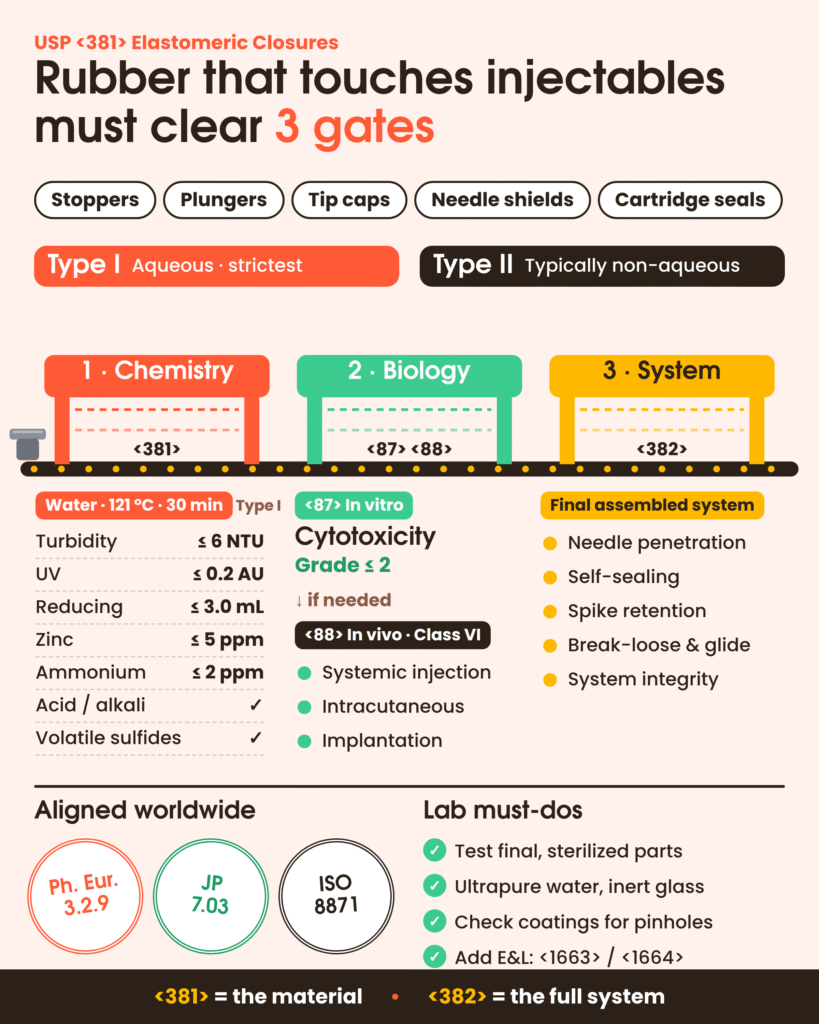
- Purpose: USP <381> sets the quality standard for rubber parts that touch injectable drugs, such as vial stoppers, syringe plungers, tip caps, needle shields and cartridge seals. Its goal is to make sure these parts don’t release harmful chemicals or affect the drug.
- Why it matters: Elastomers contain additives like curing agents, antioxidants and fillers that can migrate into the drug. This can cause degradation, protein aggregation or toxicity, so meeting <381> is essential for IND and NDA submissions.
- Type I vs Type II: Type I closures are typically used for aqueous products and must meet the strictest limits. Type II closures are typically for non-aqueous products and have wider limits.
- Chemical tests: The parts are autoclaved in water at 121 °C for 30 minutes. The extract is then tested for turbidity, acidity or alkalinity, UV absorbance, reducing substances, zinc, ammonium and volatile sulfides. Type I limits include UV ≤ 0.2 AU and reducing substances ≤ 3.0 mL.
- Biological tests: USP <87> cytotoxicity on L-929 cells must show grade ≤ 2. If needed, USP <88> Class VI adds three animal tests: systemic injection, intracutaneous injection and implantation.
- <381> vs <382>: <381> now covers material quality (chemistry and biology). The new <382> covers how the assembled system performs, including penetration, self-sealing, plunger break-loose and glide force, and container closure integrity.
- Global alignment and best practice: <381> broadly aligns with Ph. Eur. 3.2.9, JP 7.03 and ISO 8871, with some regional differences. Labs should test final sterilized parts, use ultrapure water and inert glassware, and check coatings for defects. <381> testing should also be combined with a full extractables and leachables program under USP <1663> and <1664>.
Scope and Classification Framework of USP Elastomeric Closures
The qualification framework of USP Elastomeric Closures classifies primary packaging components into Type I and Type II categories according to their intended clinical applications and potential risks associated with aqueous contact. Type I closures are subject to the most stringent purity requirements and are primarily intended for aqueous parenteral preparations. In comparison, Type II closures are designated for non-aqueous or specific parenteral formulations and are subject to less stringent extractable limits.
The scope of USP encompasses all elastomeric components used in primary packaging and delivery systems for injectable products. These include vial stoppers, bottle closures, prefilled syringe plungers, syringe tip caps, autoinjector needle shields, cartridge plungers, and elastomeric seals used in Blow-Fill-Seal (BFS) containers.
| Component Category | Target Components | Primary Material Substrates | Critical Operational Requirement |
|---|---|---|---|
| Vial & Bottle Closures | Serum stoppers, freeze-dry stoppers, infusion seals | Halobutyl rubber (Bromobutyl/Chlorobutyl) | Low gas/moisture permeability, minimal extractable profile |
| Prefilled Syringe Components | Syringe plungers, tip caps, needle shields | Synthetic polyisoprene, bromobutyl | Consistent friction mechanics, barrier film integrity |
| Cartridge Delivery Systems | Cartridge plungers, neck seals | Halobutyl, high-modulus synthetic elastomers | Precise dimensional fit, minimal break-loose force |
| Infusion & Access Systems | IV bag access ports, injection septa | Synthetic polyisoprene, thermoplastic elastomers (TPE) | High puncture resilience, immediate self-sealing |
Discover the analytical considerations involved in evaluating syringe components through extractables and leachables testing for prefilled syringes.
The distinction between Type I and Type II components determines the level of analytical stringency required during qualification. Since aqueous parenteral preparations present a greater risk of solvent-mediated extraction of inorganic ions and organic volatile compounds, Type I components must comply with strict limits for UV light absorption, reducing substances, and extractable metals. Type II elastomers are generally intended for oil-based suspensions or non-aqueous liquid formulations, where aqueous extraction profiles do not directly represent the risks associated with actual product contact.
Learn more about the chemical characterization requirements for injectable delivery devices through extractables and leachables testing for autoinjectors.
Physicochemical Testing Protocols and Extraction Mechanics
Physicochemical testing under USP quantifies the chemical substances released from elastomeric closures into particle-free water under accelerated thermal extraction conditions. The standard requires test samples to undergo autoclaving in water at 121 ± 2 °C for 30 minutes to produce a representative aqueous extract. This extract is subsequently subjected to several analytical evaluations.
The extraction procedure requires accurate preparation of the surface area-to-volume ratio to ensure consistent and reproducible extract concentrations. The resulting solution is examined through multiple complementary chemical assays to determine the total organic and inorganic extractable content.
Understand how solvent selection influences chemical recovery and extractables identification in solvents for extractables studies.
Appearance, Turbidity, and Color
This test evaluates the optical clarity of the aqueous extract by comparing it with standard reference suspensions (A, B, C, and D) and corresponding color reference fluids. Type I extracts must remain within a turbidity limit corresponding to 6 NTU, ensuring that insoluble macro-extractables or particulates are not present beyond the specified threshold.
Acidity or Alkalinity
This test determines the ionic changes caused by substances extracted from the elastomer. To 20 mL of the extract, 0.1 mL of Bromothymol blue solution is added. Titration is then performed using 0.01 N Sodium Hydroxide (when the solution is yellow) or 0.01 N Hydrochloric Acid (when the solution is blue) until a neutral green endpoint is obtained. For Type I closures, titrant consumption must not exceed 0.3 mL of 0.01 N NaOH or 0.8 mL of 0.01 N HCl.
Absorbance (UV Spectrophotometry)
This test measures light-absorbing organic extractables, including aromatic antioxidants, vulcanization residues, and compounds containing conjugated double bonds. The extract is passed through an inert 0.45 µm membrane filter, and its spectral absorbance is measured across wavelengths ranging from 220 nm to 360 nm, using a matched cell containing blank water as the reference. Type I closures must exhibit a maximum absorbance (AU) of 0.2, whereas Type II closures permit a maximum absorbance of 4.0 AU.
Reducing Substances
This test determines the presence of readily oxidizable organic compounds and inorganic substances, such as sulfur compounds. A 20 mL aliquot of the sample extract is mixed with 1 mL of diluted sulfuric acid and 20 mL of 0.002 M Potassium Permanganate (KMnO4). The mixture is boiled for 3 minutes, allowed to cool, and then treated with 1 g of potassium iodide (KI). Immediate titration with 0.01 M Sodium Thiosulfate, using a starch indicator, determines the net volume of permanganate consumed. The difference between the titration volumes of the sample and the blank must not exceed 3.0 mL for Type I or 7.0 mL for Type II.
Extractable Heavy Metals and Zinc
This evaluation identifies the migration of trace divalent cations from elastomeric components. The heavy metal content, expressed as lead equivalent, must not exceed 2 ppm. Extractable zinc, which commonly originates from vulcanization activator residues such as ZnO, is restricted to 5 ppm when measured using atomic absorption spectroscopy or inductively coupled plasma optical emission spectrometry (ICP-OES).
Explore the application of inductively coupled plasma mass spectrometry in ICP-MS extractables and leachables testing.
Ammonium and Volatile Sulfides
Ammonium ions, determined through a colorimetric reaction with alkaline potassium tetraiodomercurate (Nessler’s reagent), must not exceed 2 ppm. Volatile sulfides are identified by positioning lead acetate paper over the opening of an extraction flask during autoclaving at 121 °C. Any black lead sulfide staining produced during this process must not exceed the intensity of a control solution containing 0.154 mg of sodium sulfide.
Summary of Physicochemical Acceptance Criteria
| Physicochemical Test Parameter | Analytical Reference Method | Acceptance Criteria (Type I) | Acceptance Criteria (Type II) |
|---|---|---|---|
| Appearance / Turbidity | Visual comparison with Reference Suspensions A-D | ≤ 6 NTU (Clear/Opalescent limit) | ≤ 18 NTU |
| Acidity or Alkalinity | Potentiometric / Bromothymol Blue Titration | ≤ 0.3 mL of 0.01 N NaOH / ≤ 0.8 mL of 0.01 N HCl | ≤ 0.3 mL of 0.01 N NaOH / ≤ 0.8 mL of 0.01 N HCl |
| UV Absorbance (220-360 nm) | UV/Vis Spectrophotometry (0.45 µm filtered) | ≤ 0.2 AU | ≤ 4.0 AU |
| Reducing Substances | Permanganate / Thiosulfate Titration | ≤ 3.0 mL difference vs. blank | ≤ 7.0 mL difference vs. blank |
| Extractable Zinc | ICP-OES or Atomic Absorption | ≤ 5 ppm | ≤ 5 ppm |
| Ammonium (NH4+) | Colorimetric Nesslerization | ≤ 2 ppm | ≤ 2 ppm |
| Volatile Sulfides | Lead Acetate Paper Staining | Staining ≤ Sodium Sulfide Control | Staining ≤ Sodium Sulfide Control |
Biological Reactivity Evaluation: In Vitro and In Vivo Safety Standards
Biological reactivity testing under USP assesses the biocompatibility of elastomeric compounds to verify that the components are free from cytotoxicity, systemic toxicity, and localized tissue toxicity. Compliance requires a two-tiered testing framework governed by USP General Chapters (Biological Reactivity Tests, In Vitro) and (Biological Reactivity Tests, In Vivo).
In Vitro Cytotoxicity Testing
In vitro cytotoxicity testing, conducted according to USP, serves as the primary screening method. Elastomeric samples are extracted using cell culture media, typically Minimum Essential Medium supplemented with serum, at 37 °C for 24 hours. The resulting extract is then applied to monolayer cultures of L-929 mammalian fibroblast cells and incubated for 48 hours. Microscopic examination is performed to identify cellular lysis, vacuolization, and morphological changes. Materials exhibiting no more than mild reactivity (Grade 0 to Grade 2 on a 0-4 scale) meet the in vitro acceptance criteria.
In Vivo Biological Reactivity and USP Class VI Qualification
If an elastomeric formulation demonstrates cytotoxic reactivity or complete regulatory characterization is necessary for high-risk applications, in vivo testing under USP is performed to establish USP Class VI status. USP Class VI qualification includes three separate animal assays conducted using four extraction media: 0.9% Sodium Chloride, 1:20 Alcohol in Sodium Chloride, Polyethylene Glycol 400, and Vegetable Oil.
Systemic Injection Test
This test examines potential systemic toxicological responses following the intravenous or intraperitoneal injection of elastomeric extracts into mice.
Intracutaneous Injection Test
This evaluation identifies localized dermal irritation, erythema, and edema following the intradermal administration of extracts in rabbits.
Intramuscular Implantation Test
This test examines localized tissue responses in the areas surrounding elastomeric strips implanted directly into rabbit muscle tissue for a minimum period of 120 hours.
The Evolving Paradigm: Interplay Between USP Elastomeric Closures and USP
The regulatory framework governing primary packaging components is based on a clearly defined division of responsibilities, in which USP Elastomeric Closures establishes raw material quality requirements, while USP addresses the functional performance of the final delivery system. Historically, USP covered both chemical extractables and basic physical component tests, including penetrability, fragmentation, and self-sealing. However, regulatory updates have redefined USP as a material qualification standard.
Under this harmonized approach, USP establishes requirements for material composition suitability, chemical extractable limits, and biological safety at the individual component level. Conversely, USP assesses functional suitability across the complete, assembled drug-device container closure system. System-level mechanical properties, including syringe plunger break-loose force (BLF), glide force (GF), multi-puncture self-sealing capacity, spike retention force, and closed system transfer device (CSTD) integration, are evaluated under USP using final commercial drug products or representative fluids.
Component-Level and System-Level Qualification Comparison
| Qualification Parameter | USP Mandate | USP Mandate | Testing Execution Level |
|---|---|---|---|
| Chemical Extractables | UV Absorbance, Reducing Substances, Heavy Metals, Zinc, Ammonium | Out of Scope (Refers to USP / ) | Isolated Elastomeric Component |
| Biological Reactivity | In Vitro Cytotoxicity (USP), In Vivo Class VI (USP) | Out of Scope (Refers to USP) | Raw Material / Molded Component |
| Penetrability & Piercing Force | Traditional Component Penetration Test | System Piercing Force (Max 200 mm/min) | Assembled System / Final Packaging |
| Plunger Mechanics (BLF / GF) | Out of Scope | Break-Loose Force & Glide Force Profiles | Assembled Syringe / Cartridge |
| Container Closure Integrity (CCI) | Out of Scope | Deterministic Leak Testing (Link to USP) | Final Sealed Delivery System |
Global Harmonization: Aligning USP with EP 3.2.9, JP 7.03, and ISO Standards
Global biopharmaceutical filing strategies require elastomeric component qualification to comply with multiple international pharmacopeial standards simultaneously. USP Elastomeric Closures demonstrates broad technical alignment with European Pharmacopoeia (Ph. Eur.) Chapter 3.2.9 (Rubber Closures for Containers for Aqueous Parenteral Preparations) and Japanese Pharmacopoeia (JP) General Test 7.03 (Test for Rubber Closure for Aqueous Infusions), in addition to ISO 8871.
Although these testing frameworks share considerable similarities, differences in regional requirements necessitate careful customization of analytical protocols. For instance, EP 3.2.9 includes an additional gravimetric Residue on Evaporation limit of ≤ 2.0 mg, which is not explicitly specified in the corresponding USP section. Similarly, JP 7.03 establishes specific quantitative limits for cadmium (≤ 100 ppm or non-detect) and heavy metals, along with optical transmittance requirements across visible-spectrum wavelengths.
Comparative Pharmacopeial Requirements
| Pharmacopeial Test Parameter | USP Requirement | EP 3.2.9 Requirement | JP 7.03 Requirement |
|---|---|---|---|
| UV Spectrophotometry | ≤ 0.2 AU (220-360 nm, Type I) | ≤ 0.2 AU (220-360 nm) | Spectrum Scan + Transmittance Limits |
| Reducing Substances | ≤ 3.0 mL (0.01 M Na2S2O3, Type I) | ≤ 3.0 mL (0.01 M Na2S2O3) | Permanganate Titration Limit |
| Residue on Evaporation | Not Specified in Standard Section | ≤ 2.0 mg gravimetric residue | ≤ 2.0 mg gravimetric residue |
| Extractable Cadmium & Lead | Evaluated under Heavy Metals (≤ 2 ppm) | Evaluated under Heavy Metals (≤ 2 ppm) | Specific Cadmium (≤ 100 ppm) & Lead limits |
| Biological Safety Assays | USP In Vitro & USP In Vivo | EP Biocompatibility Standards | JP Cytotoxicity & Biological Reactivity |
Analytical Best Practices for Stopper and Plunger Qualification
Conducting qualification studies for USP Elastomeric Closures requires effective control over sample pre-conditioning, extraction apparatus cleanliness, and surface treatment characterization. Modern biopharmaceutical stoppers and plungers frequently feature specialized surface treatments, including fluoropolymer films (e.g., ETFE, PTFE), silicone oil lubrication, and bonded lubricious coatings. These treatments help minimize particulate generation and reduce plunger glide friction.
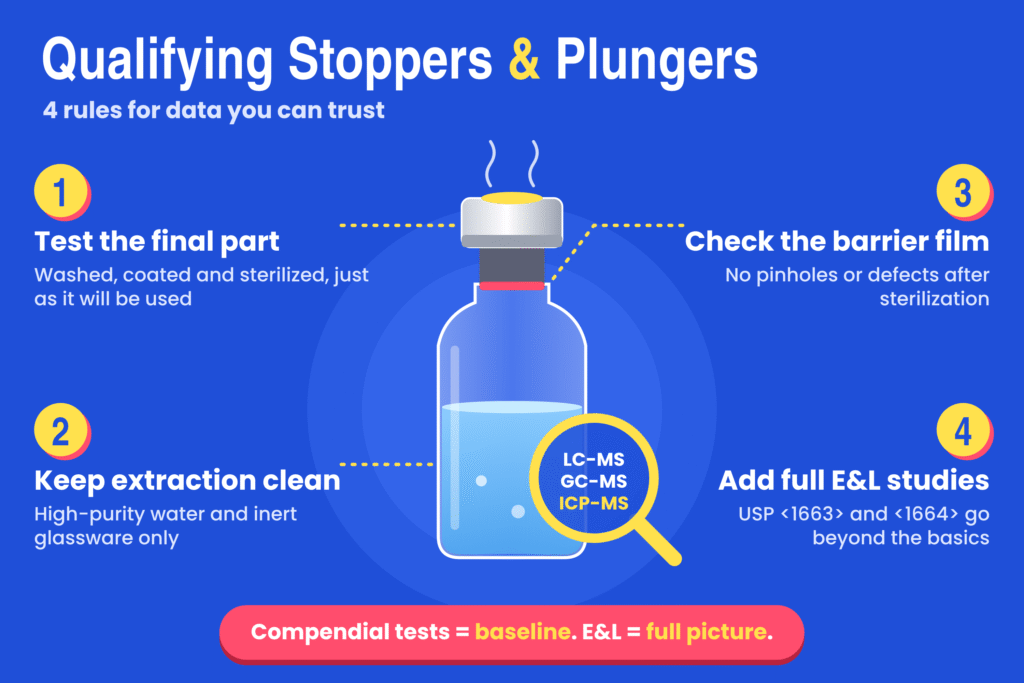
To generate submission-ready compliance data, analytical testing programs should follow four essential operational principles.
Test Samples in Final Processed State
Samples submitted for USP testing must accurately represent the finished components after completing all manufacturing, processing, washing, siliconization, fluoropolymer coating, and sterilization procedures, such as gamma irradiation, moist heat autoclaving, and ethylene oxide sterilization. Sterilization heat exposure can modify polymer cross-linking and cause antioxidant degradation, directly affecting the resulting extractable profiles.
Control Extraction Glassware and Water Purity
Physicochemical extraction performed at 121 °C is particularly sensitive to background inorganic contamination. Therefore, testing must be conducted using high-purity, particle-free water (18.2 MΩ·cm) and inert, non-leaching neutral glass vessels with flat bases and glass stoppers. These precautions help prevent false-positive titration results and UV absorbance artifacts.
Learn how robust documentation and traceability practices support reliable analytical results in data integrity for extractables and leachables testing.
Account for Surface Barrier Coatings
Fluoropolymer-faced stoppers significantly reduce organic extractable levels compared with uncoated halobutyl substrates. Nevertheless, testing must confirm that the barrier layer remains intact after sterilization and is free from pinholes or mechanical defects that could expose the underlying elastomeric compound to the aqueous extraction medium.
Explore material selection considerations and packaging solutions through low-leachables packaging materials.
Integrate Strategy with Extractables & Leachables (E&L) Programs
Meeting USP requirements establishes a fundamental compendial quality baseline. However, to achieve comprehensive regulatory risk mitigation under FDA and ICH Q3E guidelines, biopharmaceutical manufacturers should combine USP screening with advanced chemical characterization using LC-MS, GC-MS, and ICP-MS under USP (Extractables) and USP (Leachables).
Understand the differences between these complementary analytical platforms in GC-MS vs. LC-MS for extractables and leachables testing.
Conclusion
Establishing full compliance with USP Elastomeric Closures remains an essential requirement for ensuring the chemical safety, biological compatibility, and overall quality of primary packaging components used in parenteral drug delivery systems. By establishing stringent limits for UV light-absorbing substances, oxidizable reducing compounds, heavy metals, and cytotoxicity, this standard helps protect therapeutic products from component-induced chemical degradation and toxicity caused by leachables. As regulatory expectations continue to evolve alongside the system-level functional requirements of USP, biopharmaceutical developers must implement a dual-tiered qualification strategy that combines component-level material cleanliness with comprehensive container and delivery system performance assessments.
To discuss specialized analytical testing strategies, compendial extractable screening, or cGMP qualification programs for your drug delivery components, contact the technical experts at ResolveMass Laboratories Inc. by visiting ResolveMass Contact Us.
Frequently Asked Questions
Type I elastomeric closures are primarily intended for aqueous parenteral preparations and must satisfy more stringent physicochemical extractable limits. Type II closures are generally used for non-aqueous or specific parenteral formulations and allow comparatively higher levels of certain extractables. Their classification determines the applicable acceptance criteria for parameters such as UV absorbance and reducing substances.
USP requires several physicochemical evaluations using an aqueous extract prepared under controlled autoclaving conditions at 121 °C for 30 minutes. The testing includes Appearance and Turbidity, Acidity or Alkalinity, UV Spectrophotometric Absorbance, Reducing Substances, Extractable Heavy Metals, Extractable Zinc, Ammonium, and Volatile Sulfides. These assessments help identify chemical substances that may migrate from elastomeric materials.
Biological safety is assessed through in vitro and in vivo testing procedures to identify potential adverse reactions associated with elastomeric materials. In vitro cytotoxicity testing under USP examines the effects of material extracts on L-929 mammalian fibroblast cells. In vivo evaluations under USP assess systemic toxicity, localized intracutaneous reactions, and tissue responses following intramuscular implantation to establish USP Class VI compliance.
USP primarily establishes the chemical and biological quality requirements for individual elastomeric components, including extractable limits and biological reactivity. USP, on the other hand, focuses on the functional performance of the complete container closure and drug delivery system. Its evaluations include parameters such as break-loose force, glide force, penetration force, spike retention, and container closure integrity.
Yes, elastomeric closures featuring fluoropolymer coatings, laminated surfaces, or silicone lubrication must undergo appropriate qualification in their final manufactured condition. Testing should account for all processing stages, including surface treatment, coating, washing, and sterilization. This approach verifies that neither the underlying elastomer nor the applied coating introduces unacceptable chemical extractables into the drug formulation.
USP, EP 3.2.9, and JP 7.03 establish comparable requirements for evaluating the chemical quality and safety of rubber closures used in pharmaceutical packaging. Their testing approaches overlap in areas such as UV absorbance, reducing substances, and extractable metals. However, certain regional requirements differ, as EP 3.2.9 specifies Residue on Evaporation limits, while JP 7.03 includes additional provisions for cadmium content and visible-light transmittance.
Elastomeric samples must be appropriately prepared and exposed to particle-free water in clean, inert glass extraction vessels. The extraction procedure involves heating the samples in an autoclave to 121 °C ± 2 °C, maintaining this temperature for 30 minutes, and subsequently cooling the extract under controlled conditions. Proper sample preparation and temperature control are essential for obtaining consistent and reproducible analytical results.
Zinc-containing compounds, including zinc oxide (\(\text{ZnO}\)) and zinc dithiocarbamates, are commonly incorporated into rubber formulations as vulcanization activators and accelerators. However, residual zinc may migrate from elastomeric closures into injectable formulations and potentially affect product quality or stability. Monitoring extractable zinc helps control this contamination risk and ensures that the material complies with the applicable USP acceptance criteria.
Fluoropolymer coatings, such as ETFE and PTFE films, provide a chemically resistant barrier between the elastomeric substrate and the drug formulation. This barrier can significantly restrict the migration of organic compounds, reducing substances, and extractable metals from the underlying rubber material. When properly applied and maintained, these coatings can help elastomeric closures achieve the stringent extractable limits required for Type I classification.
Reference:
- U.S. Food and Drug Administration. (1999, May). Container closure systems for packaging human drugs and biologics: Chemistry, manufacturing, and controls documentation. https://www.fda.gov/media/70788/download
- International Council for Harmonisation of Technical Requirements for Pharmaceuticals for Human Use. (2025, August 1). ICH harmonised guideline: Q3E guideline for extractables and leachables (Draft version). U.S. Food and Drug Administration.
https://www.fda.gov/media/189890/download - Zhong, M. (2018). Extractable and leachable testing in pharmaceutical analysis. Pharmaceutica Analytica Acta, 9(6), e193. https://doi.org/10.4172/2153-2435.1000e193
- Murat, P., Harohalli Puttaswamy, S., Ferret, P.-J., Coslédan, S., & Simon, V. (2020). Identification of potential extractables and leachables in cosmetic plastic packaging by microchambers-thermal extraction and pyrolysis-gas chromatography-mass spectrometry. Molecules, 25(9), 2115. https://doi.org/10.3390/molecules25092115
Get In Touch With Us
About The Author