

Introduction
Evaluating a contract development and manufacturing organization (CDMO) for peptide active pharmaceutical ingredients (APIs) involves more than assessing conventional small-molecule manufacturing capabilities. It requires a detailed examination of specialized synthesis technologies, high-resolution analytical capabilities, and regulatory expertise specific to peptide development and manufacturing. When biopharmaceutical companies determine what to look for in a peptide CDMO, they must consider sequence-specific process optimization, advanced purification infrastructure, and a strong understanding of continuously evolving global regulatory requirements.
Selecting an experienced manufacturing partner is an important step in establishing a reliable peptide development strategy. Understand how to choose a peptide CDMO in the US.
The rapid growth of peptide therapeutics, driven by metabolic GLP-1 receptor agonists such as semaglutide, liraglutide, and tirzepatide, along with emerging peptide-drug conjugates (PDCs), has created unprecedented pressure on chemical manufacturing and controls (CMC) infrastructure. Moving a synthetic peptide candidate from discovery-stage chemistry to cGMP commercial manufacturing involves several complex synthetic and analytical challenges. Since synthetic peptides occupy a distinct regulatory category between small molecules and recombinant biologics, choosing a CDMO with expertise in sequence-specific process optimization and advanced impurity profiling is essential for minimizing risks and achieving commercial success.
Share via:
Quick Summary:
- Peptides are their own regulatory category. Chains of 40 amino acids or fewer are regulated as drugs under section 505 of the FD&C Act, not as biologics under section 351 of the PHS Act — and ICH Q3A/Q3B impurity thresholds explicitly exclude peptides, so small-molecule CMC logic doesn’t transfer.
- No single synthesis platform covers everything. SPPS suits roughly 15–50 residues but accumulates deletion sequences and carries a very high process mass intensity; LPPS fits short peptides and fragments; hybrid SPPS–LPPS fragment condensation is the scalable route for sequences beyond 40 residues, including GLP-1 analogs, because fragments can be made in parallel and avoid near-end deletion impurities.
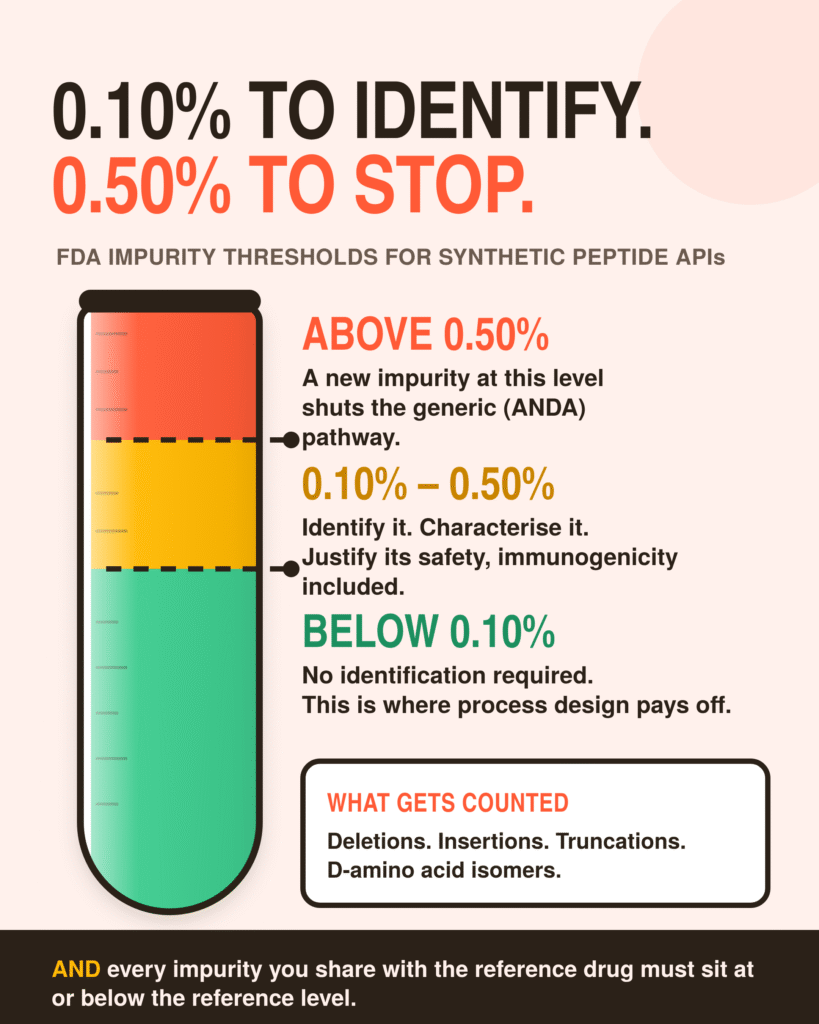
- Impurity thresholds are tight and consequential. Under FDA’s May 2021 guidance for synthetic peptide ANDAs referencing rDNA listed drugs, every peptide-related impurity at 0.10% or above must be identified; common impurities must not exceed RLD levels; and a new impurity above 0.5% means the ANDA pathway is no longer suitable (0.10–0.5% must be identified, characterized and justified).
- Immunogenicity needs a tiered assessment, not an assumption. Deletion, insertion and aggregate species can provoke immune responses, so a CDMO should run in silico MHC class II binding prediction, in vitro PBMC T-cell proliferation assays, and innate immune response modulating impurity (IIRMI) screens.
- Analytical depth is the real differentiator. UHPLC coupled to high-resolution MS (Orbitrap or Q-TOF) with ETD/HCD fragmentation is needed to confirm sequence, map disulfides and resolve subtle modifications such as deamidation (+0.984 Da) or oxidation (+15.995 Da), plus chiral and orthogonal methods to separate peptide-related from process-related impurities.
- Finishing steps are often where quality is lost. Validated TFA-to-acetate or hydrochloride counter-ion exchange with ion-chromatography confirmation, and a developed lyophilization cycle controlling cake structure and residual moisture, both matter for stability and downstream formulation.
- Green chemistry and track record round out the evaluation. SPPS averages a PMI near 13,000, so replacing DMF/NMP/DCM with NBP, 2-MeTHF or propylene carbonate and adopting tag-assisted synthesis (roughly 90% less solvent, about 50% fewer reagent equivalents) is now a cost and compliance issue — alongside FDA/EMA inspection history, DMF experience, prep-HPLC or MCSGP capacity, and qualified raw-material supply.
Advanced Synthesis Technologies: SPPS, LPPS, and Hybrid Platforms
Choosing the most appropriate peptide synthesis technology requires careful consideration of the amino acid sequence length, intended production scale, purity requirements, and solvent efficiency to minimize process mass intensity. A competent CDMO should provide solid-phase, liquid-phase, and hybrid fragment condensation technologies to accommodate the specific manufacturing requirements of each therapeutic molecule.
Solid-Phase Peptide Synthesis (SPPS)
Solid-Phase Peptide Synthesis (SPPS) is widely used to manufacture short- and medium-length peptides, generally containing 15 to 50 amino acids, through Fmoc/tBu or Boc/Bzl protection strategies. This technique supports rapid synthesis cycles, complete automation, and the routine incorporation of non-natural amino acids and structural modifications.
However, conventional linear SPPS encounters progressively greater coupling inefficiencies as peptide sequences become longer. For peptides containing more than 40 residues, sequence-dependent chain aggregation on the resin bead can restrict access to free amine groups. This can significantly increase the formation of deletion sequences and truncated byproducts. Additionally, linear SPPS is associated with high Process Mass Intensity (PMI), frequently producing thousands of kilograms of solvent waste for every kilogram of API manufactured. Consequently, relying exclusively on SPPS can become economically and environmentally impractical when production requirements reach metric-ton commercial scales.
Liquid-Phase Peptide Synthesis (LPPS)
Liquid-Phase Peptide Synthesis (LPPS) does not require an insoluble resin support. Instead, it uses sequential or convergent coupling reactions in solution to achieve greater manufacturing volume efficiency. Although LPPS requires customized, molecule-specific process development and the isolation of individual intermediates, it offers several advantages, including higher yields per unit reactor volume, reduced solvent consumption, and lower cost-of-goods-sold (COGS) for short peptides and individual fragment building blocks.
Despite these benefits, LPPS is generally unsuitable as a standalone manufacturing strategy for long and structurally complex peptide sequences. This limitation primarily results from the considerable labor and purification requirements associated with repeated solution-phase coupling and intermediate isolation steps.
Hybrid SPPS-LPPS Fragment Condensation
Hybrid synthesis offers a highly scalable manufacturing approach for long-chain peptides containing more than 40 amino acids and large commercial production programs, including GLP-1 analogs. This strategy combines the advantages of SPPS and LPPS to improve manufacturing efficiency and overall process performance.
In a typical hybrid process, shorter, fully protected peptide fragments, generally consisting of 3 to 5 fragments with 8–12 residues each, are initially produced using SPPS. These protected fragments are subsequently isolated, purified, and connected through solution-phase LPPS fragment condensation.
This convergent manufacturing approach allows individual fragments to be synthesized simultaneously, reducing overall batch manufacturing lead times. An important advantage is that fragment condensation produces crude peptide mixtures without the near-end deletion impurities commonly associated with extended linear SPPS. This reduces the purification burden on overloaded preparative HPLC columns and helps improve overall product recovery yields.
| Synthesis Modality | Optimal Sequence Length | Scalability & Commercial Suitability | Solvent Intensity (PMI) | Primary Impurity & Risk Profile |
|---|---|---|---|---|
| Linear SPPS | 15–50 residues | High for clinical-phase manufacturing; moderate for large-scale commercial production | Very High (PMI approximately 13,000) | Accumulation of deletion sequences, truncated fragments, and sequence aggregation |
| Linear LPPS | 2–15 residues | Excellent for manufacturing short peptides at high commercial volumes | Low to Moderate | Unreacted starting materials and racemization during solution activation |
| Hybrid SPPS-LPPS | More than 40 residues / Complex sequences | Superior for large-scale commercial manufacturing of complex peptides, including GLP-1s | Optimized / Significantly Reduced | Epimerization at fragment junction sites and incomplete fragment coupling |
Explore specialized manufacturing approaches for improving peptide production efficiency and supporting larger commercial batches.
Learn about peptide CDMO scale-up services.
Regulatory Alignment and Peptide-Specific FDA Impurity Guidance
Obtaining regulatory approval for synthetic peptides requires strict adherence to specific impurity identification, characterization, and qualification thresholds established by regulatory authorities, including the FDA. An experienced CDMO develops its Chemical Manufacturing and Controls (CMC) strategies around regulatory requirements specific to peptide therapeutics rather than relying exclusively on conventional small-molecule ICH Q3A frameworks.
Synthetic Peptide Regulatory Framework
Under FDA regulatory definitions, synthetic peptides containing 40 or fewer amino acids are regulated as chemically synthesized drug substances under section 505 of the FD&C Act rather than as recombinant biologics under section 351 of the PHS Act.
Although general impurity reporting requirements are guided by ICH Q3A(R2) for drug substances and ICH Q3B(R2) for drug products, synthetic peptides are specifically excluded from the standard ICH Q3A qualification thresholds. Because of the inherent structural complexity of synthetic peptides, regional regulatory requirements may introduce additional and more stringent expectations for impurity identification, characterization, and qualification.
Critical Impurity Limits and Qualification Thresholds
Regulatory expectations establish specific concentration-based limits for impurity characterization and qualification. These thresholds help determine when an impurity must be identified and when additional safety evidence is necessary.
Identification Threshold (≥ 0.10%): Any peptide-related impurity present at a concentration equal to or greater than 0.10% of the drug substance must undergo structural identification using appropriate advanced analytical techniques. This requirement helps establish the identity and potential significance of impurities present in the final API.
New Impurity Qualification Limit (> 0.50%): Any newly specified peptide-related impurity exceeding 0.50% requires comprehensive justification supported by appropriate safety and immunogenicity assessments. In generic Abbreviated New Drug Application (ANDA) submissions referencing recombinant origins, such as synthetic liraglutide or semaglutide referencing recombinant DNA (rDNA) Reference Listed Drugs (RLDs), the presence of a new peptide-related impurity above 0.50% generally prevents the use of the abbreviated regulatory pathway.
Comparative RLD Profiling: For generic peptide submissions, specified impurities identified in both the generic candidate and the Reference Listed Drug (RLD) must be controlled at concentrations equal to or lower than those observed in the RLD. This comparative assessment helps demonstrate that the generic product maintains an appropriate impurity profile relative to the reference product.
Strengthen peptide quality strategies through appropriate impurity identification, characterization, and control procedures.
Explore impurity control strategies under ICH Q3A.
Immunogenicity Risk Mitigation Protocols
One of the most significant regulatory concerns associated with synthetic peptide APIs is unintended immunogenicity resulting from structural variations. Unlike residual organic solvents, modified amino acid sequences, insertion impurities, deletion variants, and higher-order aggregates may stimulate adaptive or innate immune responses.
A qualified CDMO should therefore maintain established non-clinical immunogenicity assessment protocols to evaluate potential immune-related risks associated with peptide impurities. Important approaches include:
In Silico MHC Binding Assessments: Computational modeling techniques are used to predict whether newly identified deletion or insertion sequences introduce T-cell epitopes capable of binding to Major Histocompatibility Complex (MHC) class II molecules. These assessments help identify potential immunogenicity concerns before proceeding with additional experimental investigations.
In Vitro Functional T-Cell Assays: Human peripheral blood mononuclear cell (PBMC) proliferation assays provide an experimental approach for evaluating potential adaptive immune responses. These assays help determine whether specific peptide variants or impurities can stimulate T-cell proliferation under controlled laboratory conditions.
Innate Immune Response Modulating Impurity (IIRMI) Assays: Cell-based reporter assays, including Toll-like receptor (TLR) and nod-like receptor activation screens, are designed to identify low-level process-related or product-related contaminants that may activate innate immune signaling pathways and trigger inflammatory responses.
Analytical Depth and Characterization Infrastructure
Reliable characterization of synthetic peptide drug substances requires the use of complementary analytical technologies capable of identifying minor sequence variants, structural isomers, and trace-level process impurities. A capable CDMO should maintain advanced analytical infrastructure centered on UHPLC-HRMS to confirm primary sequence identity and investigate potential degradation pathways.
Mass Spectrometry and Orthogonal Chromatography
Comprehensive peptide characterization requires Ultra-High Performance Liquid Chromatography coupled with High-Resolution Mass Spectrometry (UHPLC-HRMS). This analytical approach commonly incorporates Orbitrap or Time-of-Flight (Q-TOF) mass analyzers to provide accurate mass measurements and detailed structural information.
MS/MS fragmentation techniques, including Electron-Transfer Dissociation (ETD) and Higher-Energy C-Trap Dissociation (HCD), are particularly important for confirming primary amino acid sequences, establishing disulfide connectivity, and identifying subtle molecular modifications.
These techniques can detect specific mass changes associated with chemical modifications, including single-dalton deamidation events (+0.984 Da) and oxidation (+15.995 Da). Such characterization capabilities help determine whether structural changes have occurred during synthesis, purification, storage, or subsequent manufacturing operations.
Comprehensive Impurity Profiling
The analytical capabilities of a CDMO must be sufficient to distinguish between two major categories of impurities: peptide-related impurities and process-related impurities. Identifying and characterizing both categories is essential for maintaining API quality and demonstrating regulatory compliance.
Peptide-Related Impurities: These impurities are structurally similar peptide variants that may develop during synthesis or storage. They include deletion sequences (n-1), insertion sequences (n+1), truncated sequences, and diastereomers formed through amino acid racemization, particularly D-amino acid formation during coupling reactions. Other potential impurities include beta-alanine insertion and β-amyloid-like aggregates. Their presence may influence peptide purity, structural integrity, biological activity, and immunogenicity.
Process-Related Impurities: These contaminants originate from the chemicals and materials used during peptide synthesis and purification. Examples include residual cleavage scavengers such as ethanedithiol (EDT) and triisopropylsilane (TIS), coupling reagents such as HATU and DIC, unreacted protecting groups such as Fmoc, t-butyl, and Trt, residual organic solvents, and heavy metal elemental impurities. Appropriate analytical procedures are necessary to detect, quantify, and control these contaminants within acceptable limits.
Discover how integrated analytical capabilities can support peptide characterization and regulatory quality requirements.
Explore one-stop CDMO analytical services.
Counter-Ion Control and Lyophilization Engineering
Most SPPS cleavage procedures use trifluoroacetic acid (TFA), resulting in the formation of crude peptide material in its TFA salt form. However, residual trifluoroacetate may contribute to cellular toxicity or affect the stability of final drug product formulations.
To address these concerns, CDMOs must demonstrate validated counter-ion exchange procedures that convert TFA salts into acetate or hydrochloride forms. Residual TFA concentrations should also be appropriately quantified using ion chromatography to confirm effective removal and ensure suitable product quality.
In addition to counter-ion management, CDMOs should possess dedicated freeze-drying (lyophilization) process development capabilities. These capabilities are necessary to optimize cake morphology, regulate residual moisture content, and preserve long-term solid-state stability. A properly developed lyophilization process helps maintain the physical and chemical integrity of peptide APIs during storage and subsequent formulation activities.
Learn how lyophilization development contributes to the stability and quality of injectable peptide formulations.
Read about formulating a lyophilized peptide injectable.
Sustainable Process Development and Greener Peptide Chemistry
Contemporary peptide manufacturing increasingly depends on environmentally responsible synthetic approaches that can replace hazardous dipolar aprotic solvents, including DMF, NMP, and DCM, without compromising coupling efficiency or product quality. Advanced CDMOs are adopting alternative green solvents and tag-assisted technologies to reduce Process Mass Intensity (PMI) and support compliance with international environmental expectations.
Alternatives to Dipolar Aprotic Solvents
Traditional SPPS processes consume substantial quantities of N,N-dimethylformamide (DMF), N-methyl-2-pyrrolidone (NMP), and dichloromethane (DCM). These solvents face significant regulatory restrictions because of their reproductive toxicity concerns.
To address these limitations, leading CDMOs are developing and validating greener solvent systems that can maintain resin swelling characteristics and coupling reaction kinetics without adversely affecting optical purity.
Important alternatives include:
N-Butylpyrrolidinone (NBP): NBP is a green polar aprotic solvent alternative that offers favorable solubility, relatively low toxicity, and effective resin swelling properties. These characteristics make it a potential replacement for conventional solvents in selected peptide synthesis applications.
2-Methyltetrahydrofuran (MeTHF): MeTHF is an ether-based green solvent derived from renewable biomass. It is particularly useful for solution-phase extraction procedures and LPPS fragment coupling reactions, where it can support more sustainable processing strategies.
Propylene Carbonate (PC): Propylene Carbonate is another green solvent option that can be used independently or in binary solvent mixtures. It supports selected Fmoc deprotection and amino acid activation steps during peptide synthesis.
Binary Solvent Systems: These formulations combine green esters and carbonates to achieve solvent properties comparable to the dielectric characteristics of DMF. Properly optimized binary systems can help suppress histidine and cysteine racemization during prolonged coupling cycles while maintaining suitable reaction performance.
Solvation and Yield Optimization Technologies
Beyond replacing conventional solvents, advanced CDMOs are implementing Tag-Assisted Peptide Synthesis (TAPS) to improve manufacturing efficiency and reduce environmental impact.
This approach involves attaching hydrophobic or ionic solubilizing tags to intermediate peptide fragments. These tags improve fragment solubility and facilitate solution-phase assembly using environmentally preferable solvents.
TAPS can substantially decrease organic solvent consumption by more than 90% and reduce excess amino acid usage by up to 50%. These improvements support lower Process Mass Intensity (PMI), improved material utilization, and more sustainable peptide manufacturing operations.
Critical Evaluation Criteria: What to Look For in a Peptide CDMO
When biopharmaceutical developers evaluate what to look for in a peptide CDMO, several operational and technical factors must be considered. The most important evaluation areas include regulatory inspection history, advanced modification capabilities, purification scalability, and supply chain resilience.
A comprehensive assessment of these capabilities helps pharmaceutical companies identify manufacturing partners capable of supporting efficient clinical development and commercial scale-up without compromising product quality or regulatory timelines.
Inspection History & Quality Management: Manufacturing facilities should demonstrate a satisfactory regulatory inspection history with the USFDA, EMA, and relevant local authorities. They should also maintain comprehensive Quality Management Systems (QMS) capable of supporting Drug Master File (DMF) preparation and filings, IND/NDA submissions, and commercial release testing. A well-established quality framework is essential for ensuring consistent manufacturing practices, documentation integrity, and regulatory compliance.
Advanced Modification Chemistry: The selected CDMO should demonstrate practical experience with specialized post-translational and synthetic modifications. Important capabilities include fatty-acid acylation (lipidation for half-life extension in GLP-1s), PEGylation, head-to-tail cyclization, side-chain lactam bridging, and regioselective multi-disulfide bond formation. Expertise in these modifications is particularly important for developing complex peptide therapeutics that require precise structural control and optimized biological performance.
Scalable Purification Infrastructure: Preparative HPLC facilities should be capable of handling high-throughput manufacturing batches while maintaining the required purity specifications and recovery rates. These capabilities may be further supported by continuous chromatography technologies, such as MCSGP, which can improve the separation of closely eluting deletion impurities and maximize overall product recovery.
Raw Material Traceability & Supply Chain Resilience: Effective supplier qualification systems should govern the sourcing and evaluation of protected amino acids, resins, and coupling reagents. Comprehensive raw material traceability helps prevent batch-to-batch variability, minimize impurity carryover, and maintain consistent manufacturing quality. A resilient supply chain is also important for reducing procurement-related disruptions during clinical development and commercial production.
Compare different outsourcing models to determine which partnership structure best supports your peptide development requirements.
Understand the differences between peptide CDMO and CMO services.
| Evaluation Area | Key Criteria & Standards | Verification Benchmark |
|---|---|---|
| Regulatory Compliance | USFDA / EMA inspection track record; DMF drafting experience | Zero major Form FDA 483 observations; approved ANDA/NDA filings |
| Synthesis Platforms | Integrated SPPS, LPPS, and hybrid fragment condensation platforms | Demonstrated yield recovery and low COGS for long sequences (more than 40 residues) |
| Analytical Infrastructure | In-house UHPLC-HRMS, Orbitrap/Q-TOF, Chiral HPLC, and LC-MS/MS | Structural identification of all peptide impurities ≥ 0.10% |
| Immunogenicity Testing | In silico MHC binding models, in vitro PBMC, and IIRMI cell assays | Validated assays for new specified impurities (0.10%–0.50%) |
| Green Chemistry | Implementation of non-DMF solvent systems, including NBP, MeTHF, and TAPS | Measurable Process Mass Intensity (PMI) reduction metrics |
Conclusion
Selecting the right contract development and manufacturing partner requires a careful alignment of sequence-specific synthesis requirements, regulatory expertise, analytical capabilities, and sustainable manufacturing practices. Pharmaceutical developers must evaluate whether a CDMO can manage the technical complexities of peptide synthesis while maintaining consistent product quality, effective impurity control, and compliance with applicable regulatory expectations.
Compare regional peptide manufacturing capabilities before selecting a suitable development and manufacturing partner.
Explore peptide CDMO services in Canada.
Ultimately, understanding what to look for in a peptide CDMO enables drug developers to make informed outsourcing decisions, navigate complex CMC workflows, and establish a reliable pathway toward successful commercial manufacturing and uninterrupted product supply.
Evaluate domestic and international manufacturing options to identify a suitable outsourcing strategy.
Compare US and overseas peptide CDMOs.
To access advanced analytical characterization, regulatory impurity profiling, and customized contract research solutions, connect with the expert technical team through the ResolveMass Laboratories Contact Page.
Frequently Asked Questions
Peptide-related impurities present at concentrations of 0.10% or higher require structural identification under the applicable FDA guidance. Additional safety and immunogenicity assessments may be necessary for newly identified impurities, particularly those exceeding 0.50%. These evaluations help establish an acceptable impurity profile and support regulatory approval.
Hybrid SPPS-LPPS synthesis combines solid-phase fragment preparation with liquid-phase fragment condensation to manufacture longer peptide sequences efficiently. Individual protected fragments can be produced simultaneously, reducing synthesis time and limiting aggregation-related challenges. This approach can also improve purification efficiency, increase product recovery, and support cost-effective commercial manufacturing of complex GLP-1 peptides.
CDMOs evaluate potential immunogenicity concerns through computational predictions and laboratory-based testing. In silico MHC-binding assessments help identify possible T-cell epitopes, while in vitro PBMC proliferation assays investigate adaptive immune responses. IIRMI cell-based assays provide additional information about impurities that may activate innate immune pathways and cause inflammatory reactions.
UHPLC-HRMS is an important analytical platform for establishing peptide identity and investigating complex impurity profiles. It provides accurate molecular mass measurements and detailed structural information for detecting deletion sequences, insertion variants, and chemical modifications. It also supports primary sequence confirmation and the investigation of disulfide connectivity and structural differences.
Trifluoroacetic acid (TFA) is commonly used during SPPS cleavage, which can leave TFA counter-ions associated with the resulting peptide. Excess residual TFA may negatively affect cellular compatibility and the stability of pharmaceutical formulations. Therefore, CDMOs use validated counter-ion exchange procedures to replace TFA with suitable alternatives, such as acetate or hydrochloride, and verify residual levels before product release.
Process Mass Intensity represents the total quantity of materials consumed during manufacturing relative to the amount of API produced. High PMI increases solvent consumption, raw material requirements, manufacturing expenses, and waste generation. CDMOs can improve process efficiency by introducing solvent recovery systems, environmentally preferable solvents, and hybrid synthesis approaches.
Several alternative solvents are being investigated and implemented to reduce dependence on conventional DMF-based peptide synthesis. These include N-Butylpyrrolidinone (NBP), 2-Methyltetrahydrofuran (MeTHF), and Propylene Carbonate, along with specially developed binary solvent systems. When appropriately validated, these alternatives can support effective resin swelling and coupling reactions while reducing environmental and occupational safety concerns.
D-amino acid impurities can develop through racemization during peptide coupling and may influence molecular structure, biological activity, and product quality. CDMOs commonly investigate these variants using chiral High-Performance Liquid Chromatography (Chiral HPLC) and Gas Chromatography-Mass Spectrometry (GC-MS). These techniques can be applied following suitable peptide hydrolysis procedures to identify and quantify amino acid stereochemical variations.
A CDMO establishes API sameness by providing comprehensive evidence that the generic peptide matches the Reference Listed Drug (RLD) in its primary amino acid sequence and relevant physicochemical characteristics. Comparative analytical testing, biological activity assessments, and detailed impurity profiling help demonstrate product similarity. Specified impurities should be controlled at levels equal to or below those in the RLD, with appropriate evaluation of any newly identified impurities to support the ANDA submission.
Reference:
- U.S. Food and Drug Administration. (2026, July 28). FDA publishes revised draft product-specific guidances for certain generic peptide products. https://www.fda.gov/drugs/drug-alerts-and-statements/fda-publishes-revised-draft-product-specific-guidances-certain-generic-peptide-products
- U.S. Food and Drug Administration. (2021, May). ANDA submissions for highly purified synthetic peptide drug products that refer to listed drugs of rDNA origin: Guidance for industry. U.S. Department of Health and Human Services. https://www.hhs.gov/guidance/sites/default/files/hhs-guidance-documents/FDA/GUI_FINAL_Highly-Purified-Synthetic-Peptides_Published_May-2021.pdf
- Li, Y. (2022, September 20). Common deficiencies associated with comparative peptide impurity profile studies and qualification of impurity levels and proposed limits [Presentation]. U.S. Food and Drug Administration, Center for Drug Evaluation and Research. https://www.fda.gov/media/166572/download
- Pang, E. (2022, September 20). Assessing immunogenicity risk of peptides: The synthetic peptide guidance and PSGs [Presentation]. U.S. Food and Drug Administration, Center for Drug Evaluation and Research. https://www.fda.gov/media/166571/download
- ResearchGate. (n.d.). Are there any alternative solvents for DMF/DCM? https://www.researchgate.net/post/Are-there-any-alternative-solvents-for-DMF-DCM
Get In Touch With Us
About The Author