


Introduction:
Gas Chromatography Testing is an advanced analytical method used to separate and analyze compounds that can be vaporized without decomposition. It is one of the most reliable techniques for detecting impurities, residual solvents, and volatile substances across multiple industries.
In modern laboratories, Gas Chromatography Testing plays a critical role in quality control, regulatory compliance, and research development. Its ability to deliver precise and reproducible results makes it indispensable for industries requiring high analytical accuracy.
Share via:
Summary:
- Gas Chromatography Testing is a powerful analytical technique used to separate, identify, and quantify volatile and semi-volatile compounds.
- It is widely used in pharmaceuticals, environmental analysis, food safety, petrochemicals, and forensic testing.
- The technique offers high sensitivity, precision, and reproducibility for trace-level detection.
- Key components include injector, column, detector, and carrier gas system.
- Regulatory compliance (USP, ICH, EPA) makes it essential for validated testing environments.
- Choosing expert laboratories like ResolveMass ensures accurate, compliant, and reliable results.
1: What is Gas Chromatography Testing?
Gas Chromatography Testing is an analytical technique used to separate, identify, and quantify volatile compounds by vaporizing a sample and transporting it through a column using an inert carrier gas.
Key Principles:
- Sample Injection & Vaporization
The sample is introduced into the system and rapidly vaporized in the injector. - Carrier Gas Flow
An inert gas (such as helium or nitrogen) carries the vaporized analytes through the column. - Separation Mechanism
Compounds separate based on differences in volatility and interaction with the stationary phase inside the column. - Detection & Quantification
A detector measures each separated component, generating signals proportional to their concentration.
2: How does Gas Chromatography Testing work?
Gas Chromatography Testing works by separating complex chemical mixtures into individual components, allowing accurate identification and quantification based on their physical and chemical properties.
Step-by-Step Process:
- Sample Injection
The liquid or gaseous sample is introduced into the injector using a syringe or autosampler. - Vaporization
The sample is rapidly heated and converted into the gas phase inside the injector. - Separation in Column
The vaporized compounds travel through the column, where they separate based on volatility and interaction with the stationary phase. - Detection
As compounds exit the column, the detector measures each component and generates a signal. - Data Analysis
The system produces a chromatogram, where peak areas and retention times are used for identification and quantification.
3: Key Components of Gas Chromatography System
Understanding the core components is essential for accurate and efficient Gas Chromatography Testing, as each part plays a critical role in separation and analysis.
| Component | Function |
|---|---|
| Injector | Introduces the sample into the system and facilitates rapid vaporization |
| Carrier Gas | Transports analytes through the column (commonly helium, nitrogen, or hydrogen) |
| Column | Separates compounds based on volatility and interaction with the stationary phase |
| Oven | Maintains and controls temperature to optimize separation |
| Detector | Identifies and quantifies the separated analytes |
| Data System | Processes signals and generates chromatograms for analysis |
4: Types of Detectors used in Gas Chromatography Testing
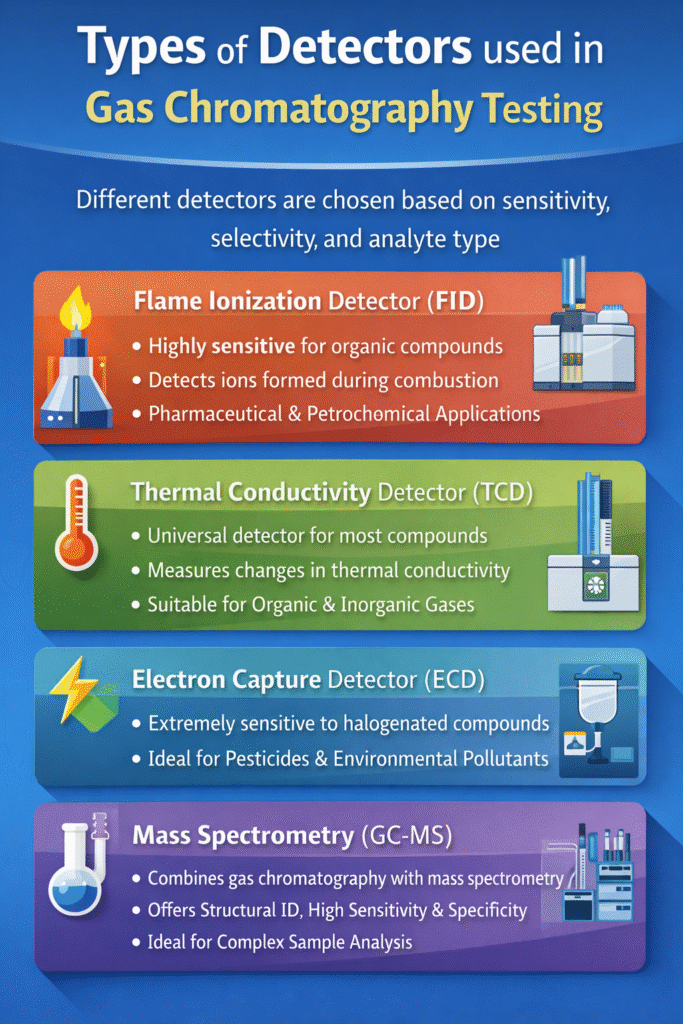
Different detectors are used in Gas Chromatography Testing depending on the nature of the analytes and the required sensitivity, selectivity, and application.
Common Detectors:
- Flame Ionization Detector (FID)
Highly sensitive for organic compounds, FID detects ions formed during combustion and is widely used in pharmaceutical and petrochemical analysis. - Thermal Conductivity Detector (TCD)
A universal detector that measures changes in thermal conductivity, making it suitable for detecting both organic and inorganic gases. - Electron Capture Detector (ECD)
Extremely sensitive to halogenated compounds, ECD is commonly used in environmental testing for pesticides and pollutants. - Mass Spectrometry (GC-MS)
Combines gas chromatography with mass spectrometry to provide structural identification, high sensitivity, and specificity, making it ideal for complex sample analysis.
5: Applications of Gas Chromatography Testing
Gas Chromatography Testing is widely used across multiple industries due to its ability to accurately separate, identify, and quantify volatile and semi-volatile compounds.
1. Pharmaceutical Industry
- Residual solvent analysis to ensure compliance with regulatory limits
- Impurity profiling for drug safety and quality
- Stability studies to monitor degradation products over time
2. Environmental Analysis
- Detection of pollutants in air, water, and soil
- Monitoring of volatile organic compounds (VOCs) for environmental safety
3. Food & Beverage Testing
- Flavor and aroma profiling for product quality
- Identification of contaminants, additives, and preservatives
4. Petrochemical Industry
- Hydrocarbon composition analysis in crude oil and fuels
- Fuel quality testing to meet industry standards
5. Forensic Science
- Drug identification in biological samples
- Toxicology screening for forensic investigations
6: Advantages of Gas Chromatography Testing
Gas Chromatography Testing offers several advantages that make it one of the most reliable and widely used analytical techniques for separating and analyzing volatile compounds.
Key Advantages:
- Compatibility with Advanced Detectors (e.g., GC-MS)
Easily integrates with advanced detection systems for enhanced sensitivity and structural identification. - High Sensitivity and Accuracy
Enables precise detection and quantification of compounds, even at very low concentrations. - Excellent Resolution of Complex Mixtures
Effectively separates multiple components within complex samples for clear identification. - Rapid Analysis Time
Provides fast results, making it suitable for high-throughput laboratory environments. - Reproducible Results
Delivers consistent and reliable data across repeated analyses under the same conditions. - Suitable for Trace-Level Detection
Capable of detecting impurities and analytes at trace (ppm or ppb) levels.
7: Limitations of Gas Chromatography Testing
Despite its many advantages, Gas Chromatography Testing has certain limitations that must be considered during method selection and analysis.
Common Limitations:
- Limited to Volatile and Thermally Stable Compounds
Only compounds that can be vaporized without decomposition are suitable for analysis. - Sample Preparation Required for Non-Volatile Substances
Non-volatile or thermally unstable compounds often require derivatization or additional preparation steps before analysis. - High Instrumentation Cost
Advanced GC systems, especially when coupled with mass spectrometry (GC-MS), can be expensive to acquire and maintain. - Requires Skilled Expertise
Method development, optimization, and data interpretation require trained and experienced analysts.
8: Method Development in Gas Chromatography Testing
Effective Gas Chromatography Testing relies on well-optimized method development to achieve accurate, reproducible, and high-resolution results.
Key Parameters:
- Column Selection (Length, Diameter, Stationary Phase)
Choosing the right column is critical, as it directly affects separation efficiency, resolution, and analysis time. - Carrier Gas Flow Rate
Optimizing flow rate ensures proper analyte movement through the column, balancing speed and resolution. - Temperature Programming
Controlled temperature gradients improve separation of compounds with varying boiling points. - Injection Technique (Split/Splitless)
Selection depends on sample concentration; split mode for concentrated samples and splitless for trace-level analysis. - Detector Settings
Proper detector configuration enhances sensitivity, selectivity, and signal accuracy.
Optimization Goals:
- Improved Resolution
Achieve clear separation of closely related compounds. - Reduced Analysis Time
Optimize conditions to increase throughput without compromising quality. - Enhanced Sensitivity
Detect low-level analytes with greater accuracy. - Reproducibility
Ensure consistent and reliable results across multiple runs.
9: Validation Parameters for Gas Chromatography Testing
Validation ensures that Gas Chromatography Testing methods are reliable, accurate, and compliant with regulatory standards such as ICH and USP guidelines.
| Parameter | Description |
|---|---|
| Accuracy | Closeness of the measured value to the true or accepted reference value |
| Precision | Degree of repeatability and consistency of results under the same conditions |
| Specificity | Ability to accurately measure the analyte in the presence of impurities or other components |
| Linearity | Ability of the method to produce results directly proportional to analyte concentration |
| Detection Limit (LOD) | Lowest amount of analyte that can be detected, but not necessarily quantified |
| Quantitation Limit (LOQ) | Lowest amount of analyte that can be quantitatively determined with acceptable accuracy and precision |
| Robustness | Ability of the method to remain unaffected by small, deliberate variations in method parameters |
10: Regulatory Compliance in Gas Chromatography Testing
Gas Chromatography Testing must comply with globally accepted regulatory standards to ensure data reliability, safety, and acceptance across industries such as pharmaceuticals, environmental analysis, and food testing.
Key Guidelines:
- ICH Q2 (R1) – Method Validation
Provides guidelines for validating analytical methods, ensuring accuracy, precision, specificity, and robustness. - USP <467> – Residual Solvents
Defines acceptable limits and testing procedures for residual solvents in pharmaceutical products using gas chromatography. - EPA Methods – Environmental Testing
Standardized methods for detecting pollutants and volatile organic compounds (VOCs) in air, water, and soil. - FDA & GMP Compliance
Ensures adherence to Good Manufacturing Practices (GMP) and regulatory expectations for data integrity, traceability, and quality control.
Why Regulatory Compliance Matters
- Ensures data integrity and reliability
- Guarantees reproducibility of analytical results
- Meets global regulatory requirements
- Supports product safety and quality assurance
- Facilitates regulatory approvals and audits
Adhering to these regulatory frameworks ensures that Gas Chromatography Testing results are accurate, compliant, and globally accepted.
11: Why choose expert Gas Chromatography Testing Services?
Selecting a reliable laboratory significantly impacts the quality of analytical results.
What Sets Expert Labs Apart:
- Advanced instrumentation (GC, GC-MS)
- Experienced analytical scientists
- Validated and compliant methods
- High data accuracy and reproducibility
- Customized analytical solutions
ResolveMass Laboratories Inc. delivers trusted Gas Chromatography Testing services backed by scientific expertise and regulatory compliance.
12: Future Trends in Gas Chromatography Testing
Gas Chromatography Testing continues to evolve with technological advancements.
Emerging Trends:
- Integration with high-resolution mass spectrometry
- Automation and AI-driven data analysis
- Miniaturized and portable GC systems
- Green chromatography techniques
- Enhanced sensitivity for ultra-trace analysis
Conclusion:
Gas Chromatography Testing remains a cornerstone analytical technique for industries requiring precise separation and quantification of volatile compounds. Its robustness, accuracy, and versatility make it essential for quality control, research, and regulatory compliance.
By partnering with experienced laboratories like ResolveMass, organizations can ensure reliable, compliant, and high-quality Gas Chromatography Testing results tailored to their specific analytical needs.
Frequently Asked Questions:
Gas Chromatography Testing is used to separate, identify, and quantify volatile and semi-volatile compounds in complex mixtures. It plays a crucial role in ensuring product quality and safety across industries. Common applications include residual solvent analysis, impurity profiling, and environmental monitoring. The technique provides highly accurate and reproducible results. It is widely trusted in regulated industries like pharmaceuticals and food testing.
Gas Chromatography Testing is ideal for gases, volatile liquids, and semi-volatile compounds. It can also analyze non-volatile substances after appropriate sample preparation, such as derivatization. Samples from pharmaceuticals, environmental matrices, and food products are commonly tested. Proper sample handling ensures accurate and reliable results. The method is highly versatile across multiple sample types.
Gas Chromatography Testing offers high sensitivity and excellent resolution for separating complex mixtures. It provides rapid analysis, making it suitable for high-throughput laboratories. The technique ensures reproducible and reliable results across multiple runs. It is capable of detecting compounds at trace levels (ppm or ppb). Additionally, it can be coupled with advanced detectors like GC-MS for enhanced analysis.
Gas Chromatography Testing is limited to compounds that are volatile and thermally stable. Non-volatile substances often require additional preparation steps before analysis. The instrumentation and maintenance costs can be relatively high. Method development and optimization require skilled analysts. Despite these limitations, it remains highly effective for suitable applications.
Gas Chromatography Testing is highly accurate when validated according to regulatory guidelines. It follows parameters such as accuracy, precision, linearity, and robustness. The technique ensures consistent and reproducible results across repeated analyses. Proper calibration and method validation enhance reliability. It is widely accepted in regulated industries for quantitative analysis.
Gas Chromatography Testing is widely used in pharmaceuticals, environmental analysis, and food and beverage industries. It is also essential in petrochemical analysis and forensic science. The technique helps in detecting contaminants, analyzing chemical composition, and ensuring compliance. Its versatility makes it suitable for both research and routine testing. Many industries rely on it for quality control and safety assessments.
Reference
- B’Hymer C. Residual solvent testing: a review of gas-chromatographic and alternative techniques. Pharmaceutical research. 2003 Mar;20(3):337-44.https://link.springer.com/article/10.1023/A:1022693516409
- Huestis MA, Oyler JM, Cone EJ, Wstadik AT, Schoendorfer D, Joseph Jr RE. Sweat testing for cocaine, codeine and metabolites by gas chromatography–mass spectrometry. Journal of Chromatography B: Biomedical Sciences and Applications. 1999 Oct 15;733(1-2):247-64.https://www.sciencedirect.com/science/article/pii/S0378434799002467
- Striebich RC, Motsinger MA, Rauch ME, Zabarnick S, Dewitt M. Estimation of select specification tests for aviation turbine fuels using fast gas chromatography (GC). Energy & fuels. 2005 Nov 16;19(6):2445-54.https://pubs.acs.org/doi/abs/10.1021/ef050136o
- Goldberger BA, Cone EJ. Confirmatory tests for drugs in the workplace by gas chromatography-mass spectrometry. Journal of chromatography A. 1994 Jul 15;674(1-2):73-86.https://www.sciencedirect.com/science/article/pii/0021967394852189

