


Introduction:
Differential Scanning Calorimetry (DSC) Testing is a thermoanalytical technique used to measure how a material absorbs or releases heat as it is heated, cooled, or held at a constant temperature. In simple terms, DSC helps scientists understand how a substance behaves when exposed to temperature changes.
In the pharmaceutical and material science industries, Differential Scanning Calorimetry (DSC) Testing plays a critical role in identifying thermal transitions such as melting points, crystallization behavior, and glass transition temperatures. These properties directly impact product stability, performance, and shelf life.
At ResolveMass Laboratories Inc., DSC testing is performed using highly calibrated instruments and validated protocols to ensure accurate, reproducible, and regulatory-compliant results.
Summary:
- Differential Scanning Calorimetry (DSC) Testing is an analytical technique used to measure heat flow associated with material transitions as a function of temperature.
- It is widely used in pharmaceuticals, polymers, materials science, and quality control to understand thermal behavior.
- DSC helps identify melting points, crystallization, glass transition temperature (Tg), purity, stability, and compatibility of materials.
- It is a critical tool for formulation development and regulatory compliance in the pharmaceutical industry.
- ResolveMass Laboratories Inc. provides advanced DSC testing services with high precision, regulatory alignment, and validated analytical workflows.
1: What is Differential Scanning Calorimetry (DSC) Testing?
Differential Scanning Calorimetry (DSC) Testing is a thermal analysis technique that measures the difference in heat flow between a sample and an inert reference as both are subjected to controlled heating or cooling.
In simple terms, it shows how much heat a material absorbs or releases when its temperature changes, helping scientists understand its physical and chemical behavior.
Key Principle of DSC
The fundamental principle of Differential Scanning Calorimetry (DSC) Testing is based on detecting heat flow changes that occur during material transitions such as:
- Melting
- Crystallization
- Glass transition
- Chemical reactions
When a sample undergoes any of these changes, it either absorbs heat (endothermic process) or releases heat (exothermic process). The DSC instrument precisely measures this heat difference compared to a reference material that remains inert.
How DSC Works in Practice
- A sample and a reference are heated or cooled under the same controlled conditions.
- The instrument continuously monitors the difference in heat flow between them.
- Any thermal event in the sample is recorded as a peak on a DSC curve (thermogram).
- This curve helps identify key thermal properties with high accuracy.
Why It Is Important
Differential Scanning Calorimetry (DSC) Testing is widely used because it provides precise insights into material stability, purity, compatibility, and thermal transitions—making it essential in pharmaceuticals, polymers, and material science research.
2: How Differential Scanning Calorimetry (DSC) Testing Works
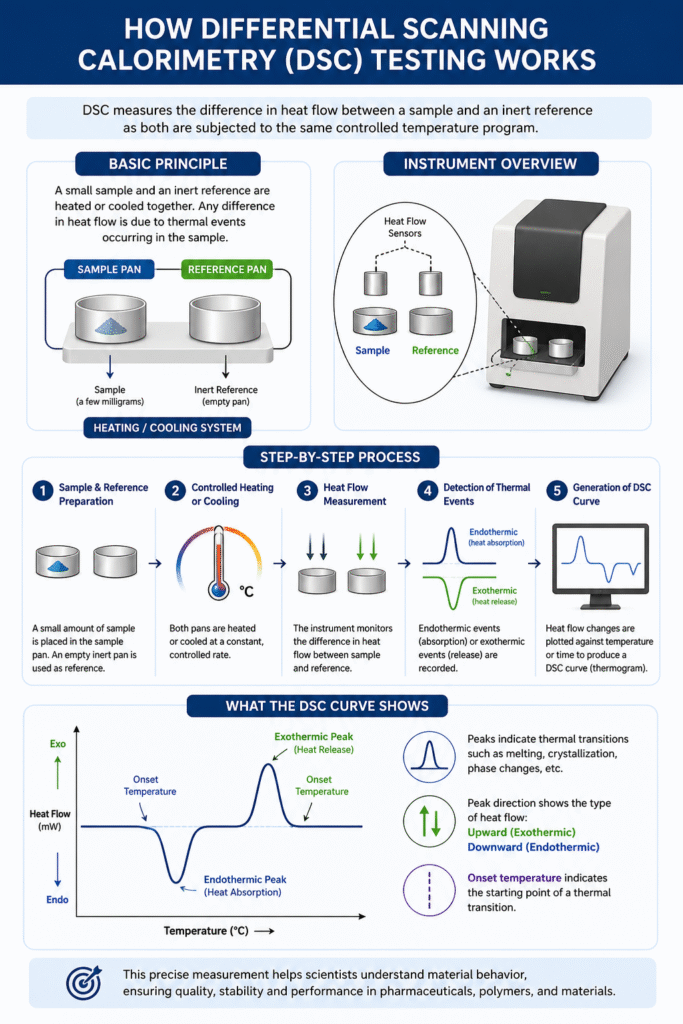
Differential Scanning Calorimetry (DSC) Testing works by measuring the difference in heat flow between a sample and an inert reference as both are subjected to the same controlled temperature program. This allows precise detection of thermal events such as melting, crystallization, and glass transition.
Basic Working Principle:
In DSC analysis, a very small sample (typically a few milligrams) is placed in a sealed sample pan, while an empty or inert reference pan is placed in a parallel chamber. Both pans are then exposed to identical heating or cooling conditions.
Because the reference does not undergo any physical or chemical change, any difference in heat flow is directly attributed to the sample.
Step-by-Step Process of DSC Testing:
The working of Differential Scanning Calorimetry (DSC) Testing can be understood in a simple sequence:
1. Sample and Reference Preparation
A small amount of the test material is placed in the sample pan, while an empty inert pan acts as the reference.
2. Controlled Heating or Cooling
Both pans are subjected to a precisely controlled temperature program, either increasing (heating) or decreasing (cooling) at a constant rate.
3. Heat Flow Measurement
The instrument continuously monitors the difference in heat flow between the sample and reference.
4. Detection of Thermal Events
During this stage, any physical or chemical change in the sample is recorded:
- Endothermic events → Heat is absorbed (e.g., melting)
- Exothermic events → Heat is released (e.g., crystallization)
5. Generation of DSC Curve
All heat flow changes are plotted against temperature or time to produce a graphical output known as a thermogram or DSC curve.
What the DSC Curve Shows
The DSC curve is the final output of Differential Scanning Calorimetry (DSC) Testing and provides critical insights into material behavior:
- Peaks indicate thermal transitions such as melting, crystallization, or phase changes
- Peak direction shows heat flow type (upward or downward depending on endothermic or exothermic reactions)
- Onset temperature marks the beginning of a transition, helping determine exact thermal properties
- Peak area represents enthalpy change, which reflects the energy involved in the process
Why This Process is Important
This controlled measurement process allows scientists to accurately understand how materials behave under different temperature conditions, making Differential Scanning Calorimetry (DSC) Testing essential for drug development, polymer analysis, and material quality control.
3: Key Applications of Differential Scanning Calorimetry (DSC) Testing
Differential Scanning Calorimetry (DSC) Testing is a highly versatile thermal analysis technique used across pharmaceuticals, polymers, food science, and material engineering. Its ability to precisely measure heat flow during material transitions makes it essential for both research and quality control.
1. Pharmaceutical Industry
In pharmaceuticals, Differential Scanning Calorimetry (DSC) Testing is a core analytical tool used during drug development, formulation, and stability assessment.
Key applications include:
- Drug polymorphism identification: Detects different crystalline forms of the same drug, which can affect bioavailability and stability.
- Stability testing: Evaluates how drug substances behave under temperature changes over time.
- Drug–excipient compatibility: Identifies potential interactions between active pharmaceutical ingredients (APIs) and formulation components.
- Melting point determination: Helps confirm identity and purity of drug compounds.
- Purity analysis: Impurities often alter thermal transitions, which DSC can detect with high sensitivity.
Overall, DSC ensures safe, effective, and stable pharmaceutical formulations.
2. Polymer Science
In polymer research and manufacturing, Differential Scanning Calorimetry (DSC) Testing is used to understand and optimize thermal behavior.
Key applications include:
- Glass transition temperature (Tg): Determines the temperature at which polymers transition from rigid to flexible states.
- Crystallization and melting behavior: Helps evaluate processing conditions and material performance.
- Degree of crystallinity: Impacts mechanical strength, transparency, and durability of polymers.
- Thermal stability assessment: Determines how polymers respond to heat during processing and end-use.
This makes DSC critical for designing high-performance plastic materials and composites.
3. Food Industry
In food science, Differential Scanning Calorimetry (DSC) Testing is used to study thermal properties that directly impact quality, texture, and shelf life.
Key applications include:
- Fat melting behavior: Important for texture and mouthfeel in products like chocolate and dairy.
- Moisture content effects: Helps understand how water content influences food stability.
- Shelf-life stability: Predicts how food products change under storage conditions.
DSC helps food manufacturers improve product consistency and consumer experience.
4. Material Science
In advanced materials research, DSC is widely used to analyze structural and thermal properties of engineering materials.
Key applications include:
- Phase transitions: Studies changes between solid, liquid, and intermediate states.
- Thermal resistance evaluation: Determines how materials behave under high temperatures.
- Composite material behavior: Helps optimize multi-component materials used in aerospace, automotive, and electronics industries.
This ensures materials meet performance and safety standards in demanding applications.

4: Important Thermal Properties Measured by DSC
Differential Scanning Calorimetry (DSC) provides precise information about how a material behaves when exposed to temperature changes. It is especially useful for identifying thermal transitions that define material performance, stability, and purity.
Key Thermal Properties Measured by DSC
| Thermal Property | Description | Importance / Application |
|---|---|---|
| Melting Point | Temperature at which a solid changes into a liquid state. | Used for material identification, purity assessment, and quality control. |
| Glass Transition Temperature (Tg) | Temperature where a material changes from a rigid (glassy) state to a flexible (rubbery) state. | Critical for predicting polymer performance, flexibility, and processing conditions. |
| Crystallization Temperature | Temperature at which a material forms a crystalline structure during cooling. | Helps evaluate material stability, processing behavior, and storage conditions. |
| Enthalpy (ΔH) | The amount of heat absorbed or released during a transition. | Indicates energy changes during physical or chemical transformations. |
| Phase Transitions | Structural changes in a material (solid–solid, solid–liquid, etc.). | Essential for complete material characterization and formulation development. |
Why These Properties Matter in DSC Analysis
Differential Scanning Calorimetry (DSC) Testing is widely used because it translates heat flow data into meaningful material insights. Each thermal property helps scientists understand how a substance will behave under real-world conditions.
Key importance in industries:
- Pharmaceuticals: Ensures drug stability, purity, and compatibility
- Polymers: Defines mechanical strength, flexibility, and processing temperature
- Food industry: Improves texture, shelf life, and thermal stability
- Material science: Supports development of high-performance engineering materials
5: Advantages of Differential Scanning Calorimetry (DSC) Testing
Differential Scanning Calorimetry (DSC) Testing is a widely preferred thermal analysis technique because it delivers accurate, fast, and highly sensitive measurements of material behavior under temperature changes. Its versatility makes it essential in pharmaceuticals, polymers, food science, and material research.
Key Advantages of DSC Testing
1. High Sensitivity for Thermal Transitions
Differential Scanning Calorimetry (DSC) Testing can detect even very small energy changes during phase transitions. This makes it highly effective for identifying subtle thermal events such as glass transitions, melting points, and crystallization.
2. Requires Small Sample Size
Only a few milligrams of material are needed for analysis. This is especially beneficial when working with expensive, rare, or early-stage research compounds.
3. Fast and Reliable Results
DSC provides rapid thermal analysis with high reproducibility. Results are generated in real-time as the temperature program runs, enabling efficient decision-making in research and development.
4. Minimal Sample Preparation
One of the major strengths of Differential Scanning Calorimetry (DSC) Testing is its simplicity. Samples usually require little to no complex preparation, reducing the chances of contamination or experimental error.
5. Applicable to Multiple Material Types
DSC is highly versatile and can be used for:
- Solids
- Liquids
- Polymers
- Semi-crystalline materials
This makes it suitable for a wide range of industries and applications.
6. Supports Regulatory Documentation in Pharmaceuticals
DSC data is widely accepted in regulatory submissions such as stability studies, drug characterization, and formulation development. It supports compliance with global standards like ICH and USP guidelines.
Quality Assurance at ResolveMass Laboratories Inc.
At ResolveMass Laboratories Inc., Differential Scanning Calorimetry (DSC) Testing is performed under strict quality systems to ensure highly reliable and regulatory-compliant results.
Key quality practices include:
- Validated Standard Operating Procedures (SOPs)
- GMP-aligned laboratory environment
- Calibrated and high-precision DSC instruments
- Strict data integrity and documentation control
- Expert interpretation by trained scientists
These practices ensure that every DSC analysis delivers accurate, reproducible, and audit-ready results for clients across pharmaceutical and material science industries.
7: Limitations of DSC Testing
While powerful, DSC has certain limitations:
- Cannot identify chemical structure directly
- Overlapping transitions may complicate interpretation
- Requires careful calibration and baseline correction
- Small sample size may not represent bulk material in rare cases
However, these limitations are mitigated by combining DSC with complementary techniques such as TGA, FTIR, or XRD.
8: Differential Scanning Calorimetry in Pharmaceutical Development
In pharmaceutical research, DSC is not just an analytical tool—it is a regulatory necessity.
Why DSC is important in pharma:
- Ensures drug stability under storage conditions
- Helps detect incompatibility between drug and excipients
- Supports formulation optimization
- Assists in identifying polymorphic forms of APIs
For regulatory submissions (such as IND, NDA, ANDA), DSC data is often included as part of the stability and characterization package.
9: Role of DSC in Quality Control and R&D
DSC plays a dual role in both R&D and quality control environments.
In Research & Development:
- Helps design stable formulations
- Assists in selecting appropriate excipients
- Evaluates thermal behavior of new compounds
In Quality Control:
- Ensures batch-to-batch consistency
- Detects impurities or deviations
- Validates manufacturing processes
ResolveMass Laboratories Inc. integrates DSC testing into both development and QC workflows, ensuring seamless product lifecycle support.
10: Why Differential Scanning Calorimetry (DSC) Testing Requires Expertise
Although DSC instruments are automated, interpretation of results requires deep scientific expertise.
Incorrect interpretation can lead to:
- Wrong formulation decisions
- Stability misjudgments
- Regulatory setbacks
At ResolveMass Laboratories Inc., DSC analysis is performed by experienced scientists trained in thermal analysis, material science, and regulatory compliance standards.
This ensures:
- Accurate data interpretation
- Reliable reporting
- Regulatory-ready documentation
11: Industry Standards and Regulatory Alignment
DSC testing must comply with global standards to ensure data credibility.
Common standards include:
- USP (United States Pharmacopeia) guidelines
- ICH Q6A & Q1A stability guidelines
- ASTM E1356 (Standard Test Method for DSC)
- ISO thermal analysis standards
ResolveMass Laboratories Inc. ensures all DSC testing is aligned with these global standards, making results suitable for regulatory submissions and audits.
12: Why Choose ResolveMass Laboratories Inc. for DSC Testing?
ResolveMass Laboratories Inc. is a trusted partner for advanced analytical testing, including Differential Scanning Calorimetry (DSC) Testing.
Key strengths:
- State-of-the-art DSC instrumentation
- Highly experienced analytical scientists
- GMP/GLP-compliant environment
- Regulatory-ready documentation support
- Fast turnaround time with high accuracy
- Expertise in pharmaceutical and material testing
The organization focuses on delivering scientifically robust, reproducible, and audit-ready analytical results that support global regulatory expectations.
Conclusion:
Differential Scanning Calorimetry (DSC) Testing is a fundamental analytical technique used to study thermal properties of materials with high precision. From pharmaceutical development to polymer science, DSC provides essential insights into melting behavior, stability, crystallization, and phase transitions.
At ResolveMass Laboratories Inc., DSC testing is performed with a strong emphasis on scientific accuracy, regulatory compliance, and data integrity. The combination of advanced instrumentation and expert interpretation ensures reliable results that support critical research and development decisions.
As industries continue to demand higher precision and compliance, Differential Scanning Calorimetry (DSC) Testing remains an indispensable tool for innovation and quality assurance.
Frequently Asked Questions:
Only a very small amount of sample is needed for Differential Scanning Calorimetry (DSC) Testing, usually a few milligrams. This makes it ideal for expensive or limited-availability materials. Despite the small quantity, it provides highly accurate and reproducible results. Minimal sample requirement also reduces waste and cost. It is efficient for both research and routine testing.
DSC can analyze a wide variety of materials including solids, liquids, polymers, and semi-crystalline substances. It is highly versatile and used across multiple industries. Pharmaceuticals, food products, and engineering materials are commonly tested using DSC. The technique helps understand thermal behavior under controlled conditions. This makes it useful for both research and industrial applications.
A DSC curve shows how heat flow changes with temperature or time. It identifies thermal transitions such as melting, crystallization, and glass transition. Peaks on the curve represent energy absorption or release. It also provides onset temperature and enthalpy changes. This data helps in detailed material characterization.
Differential Scanning Calorimetry (DSC) Testing measures heat flow associated with material transitions, unlike TGA which measures weight changes. DSC focuses on energy changes during physical or chemical processes. It is highly sensitive to small thermal events. Other techniques may not detect such subtle transitions. DSC is therefore preferred for precise thermal analysis.
Yes, DSC Testing can help detect impurities because they affect melting behavior and shift thermal peaks. Even small amounts of impurity can change the shape or position of DSC curves. This makes it useful for purity assessment. It is commonly used in quality control and pharmaceutical analysis. However, it is often combined with other techniques for confirmation.
Reference
- Leyva-Porras C, Cruz-Alcantar P, Espinosa-Solís V, Martínez-Guerra E, Piñón-Balderrama CI, Compean Martínez I, Saavedra-Leos MZ. Application of differential scanning calorimetry (DSC) and modulated differential scanning calorimetry (MDSC) in food and drug industries. Polymers. 2019 Dec 18;12(1):5.https://www.mdpi.com/2073-4360/12/1/5
- Menczel JD, Judovits L, Prime RB, Bair HE, Reading M, Swier S. Differential scanning calorimetry (DSC). Thermal analysis of polymers: Fundamentals and applications. 2009 Apr 3:7-239.https://onlinelibrary.wiley.com/doi/pdf/10.1002/9780470423837#page=15
- Spink CH. Differential scanning calorimetry. Methods in cell biology. 2008 Jan 1;84:115-41.https://www.sciencedirect.com/science/article/pii/S0091679X07840052
- Ahmadi Khoshooei M, Fazlollahi F, Maham Y. A review on the application of differential scanning calorimetry (DSC) to petroleum products: M. Ahmadi Khoshooei et al. Journal of Thermal Analysis and Calorimetry. 2019 Dec;138(5):3455-84.https://link.springer.com/article/10.1007/s10973-019-08244-2
- Sheng M, Valco D, Tucker C, Cayo E, Lopez T. Practical use of differential scanning calorimetry for thermal stability hazard evaluation. Organic Process Research & Development. 2019 Aug 15;23(10):2200-9.https://pubs.acs.org/doi/abs/10.1021/acs.oprd.9b00266

