

Introduction
The choice between the 505(b)(2) vs ANDA Regulatory Pathway depends largely on whether the proposed drug product is an exact pharmaceutical duplicate of a Reference Listed Drug (RLD) or represents a modified drug entity that requires additional safety, efficacy, or bioanalytical bridging data. Section 505(j) Abbreviated New Drug Applications (ANDAs) require a high degree of sameness with respect to active ingredients, dosage forms, routes of administration, and strength. In contrast, Section 505(b)(2) New Drug Applications (NDAs) provide sponsors with a mechanism to introduce specific modifications while relying, in part, on the US Food and Drug Administration’s (FDA) existing findings regarding the safety and efficacy of an approved reference product. These two abbreviated regulatory mechanisms were established through the Drug Price Competition and Patent Term Restoration Act of 1984 (Hatch-Waxman Amendments), creating the foundation for modern non-innovator drug development in the United States.
The regulatory route selected at the beginning of development has significant downstream consequences for nonclinical requirements, bioanalytical method validation, Chemistry, Manufacturing, and Controls (CMC) testing expectations, user fee obligations, and potential post-marketing exclusivity. An ANDA generally provides a more streamlined and cost-efficient route to commercialization; however, its strict sameness requirements substantially restrict opportunities for product differentiation. A 505(b)(2) application, on the other hand, generally requires greater upfront clinical and regulatory investment and is subject to PDUFA user fees, but it can provide opportunities for differentiated products, proprietary market exclusivity, and greater long-term commercial value. Contract Research Organizations and analytical testing providers, including ResolveMass Laboratories Inc., can contribute to this regulatory decision by conducting high-resolution mass spectrometry, extractables/leachables profiling, structural characterization, and bioanalytical studies needed to demonstrate equivalence or establish pharmacokinetic bridging for either submission pathway.
Deciding whether to partner with a CRO or a full CDMO for your regulatory analytical package? Read our detailed guide on Peptide CDMO vs CRO to determine the right operational model for your pipeline.
Share via:
Quick Summary:
- ANDA (505(j)) is best for an exact generic duplicate of the RLD, while 505(b)(2) is designed for modified products requiring additional bridging or safety/efficacy data.
- ANDA requires strict sameness in API, dosage form, route, strength, and applicable Q1/Q2 excipient composition; 505(b)(2) allows greater formulation, strength, dosage-form, route, and delivery modifications.
- Bioequivalence vs. PK Bridging: ANDA focuses on demonstrating bioequivalence, commonly using Cmax and AUC with the 80–125% range. A 505(b)(2) application can use comparative bioavailability and a scientifically justified PK bridge to existing safety/efficacy findings.
- Suitability Petitions under Section 505(j)(2)(C) may permit certain differences while retaining the ANDA pathway, but they can face FDA rejection, public disclosure, and potentially lengthy review.
- Costs and timelines differ: For FY 2026, the ANDA application fee is $358,247, while 505(b)(2) fees range from $2.341 million to $4.682 million depending on clinical data. Standard review goals are 10 months, with priority goals of 8 months for eligible ANDAs and 6 months for eligible 505(b)(2)s.
- Commercial strategy: ANDAs generally offer an AB-rated generic and lower development costs but can face significant price erosion. 505(b)(2) products can support differentiation, premium pricing, patents, and 3-, 5-, or 7-year exclusivity when applicable.
- Strategic selection depends on the product: Sponsors should evaluate formulation changes, API characteristics, clinical requirements, regulatory risk, cost, and commercial goals. Strong analytical characterization, validated bioanalytical methods, impurity profiling, and stability testing are essential for either pathway.
Core Differences in the 505(b)(2) vs ANDA Regulatory Pathway Framework
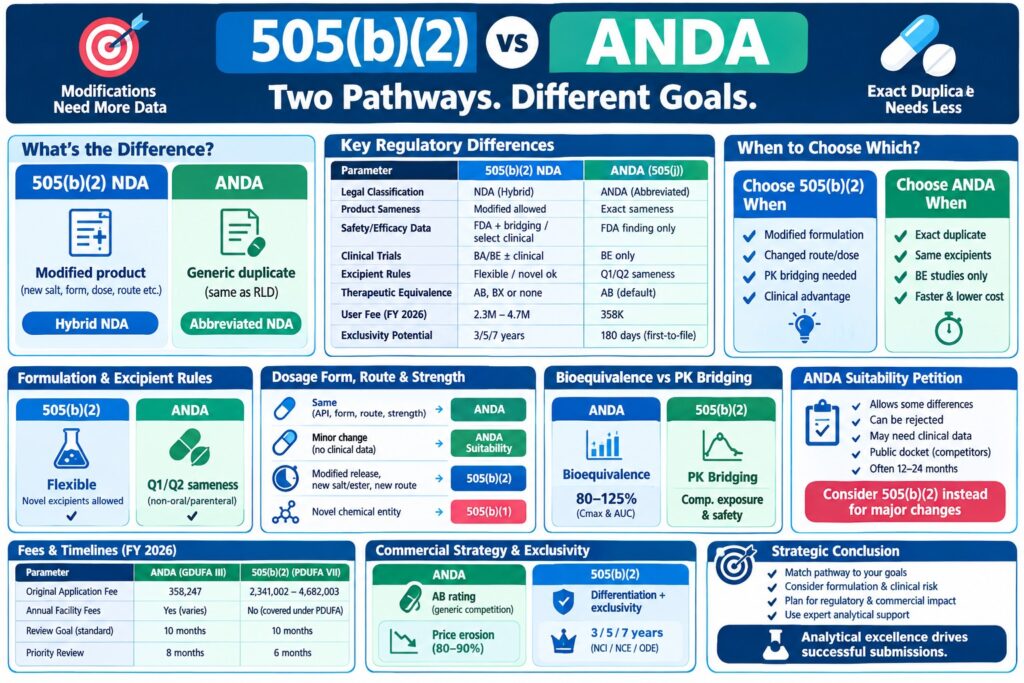
The fundamental distinction between an ANDA and a 505(b)(2) NDA is based on the regulatory expectation of pharmaceutical sameness versus the ability to introduce defined modifications supported by non-original clinical, scientific, or literature information. Under Section 505(j) of the Federal Food, Drug, and Cosmetic (FD&C) Act, an ANDA applicant must demonstrate that the proposed generic drug corresponds to the Reference Listed Drug (RLD) with respect to the active pharmaceutical ingredient (API), route of administration, dosage form, strength, conditions of use, and labeling. Section 505(b)(2) of the FD&C Act establishes a hybrid NDA mechanism that permits modifications to one or more of these characteristics when the applicant provides appropriate bridging information, such as comparative bioavailability studies, to support reliance on FDA findings concerning the safety and efficacy of a listed drug.
From a legal and regulatory perspective, a stand-alone NDA submitted under Section 505(b)(1) requires full reports of original investigations demonstrating the product’s safety and efficacy, with those investigations conducted entirely by or for the sponsor. An ANDA submitted under Section 505(j), by contrast, does not ordinarily require independent clinical safety or efficacy investigations because it relies on the FDA’s previous determination regarding the RLD once pharmaceutical equivalence and bioequivalence have been adequately established. The 505(b)(2) pathway occupies an intermediate position between these two mechanisms. It is legally classified as a full NDA because it requires full reports of safety and effectiveness, yet it operates as an abbreviated development route because at least part of the supporting information originates from studies that were not conducted by or for the applicant and for which the applicant has not obtained a right of reference.
Are you planning complex drug development projects requiring regulatory-compliant analytical support? Learn more about our specialized Peptide Drug Development CDMO capabilities.
| Regulatory Parameter | Section 505(j) ANDA (Generic Duplicate) | Section 505(b)(2) NDA (Hybrid Application) |
|---|---|---|
| Legal Classification | Abbreviated New Drug Application | New Drug Application (Hybrid NDA) |
| Product Sameness Standard | Mandatory sameness in API, strength, dosage form, and route | Permitted modifications in API salt/ester, strength, dosage form, route, or indication |
| Safety & Efficacy Data Source | Complete reliance on FDA finding of safety/efficacy for RLD | Partial reliance on FDA findings or literature; supplemented by bridging data |
| Clinical Trial Requirements | In vivo Bioequivalence (BE) studies only; no efficacy trials | Comparative BA/BE studies; targeted clinical safety/efficacy trials if needed |
| Excipient Composition Rules | Strict Q1/Q2 sameness for non-oral/parenteral exception excipients | Flexible excipient design; novel excipients permitted with safety qualification |
| Therapeutic Equivalence Rating | Granted an AB rating by default upon approval | May receive an AB, BX, or no therapeutic equivalence rating |
| FDA Statutory User Fee Act | Generic Drug User Fee Amendments (GDUFA III) | Prescription Drug User Fee Act (PDUFA VII) |
| Market Exclusivity Potential | 180-day Paragraph IV exclusivity (first-to-file generic) | 3-year Hatch-Waxman NCI, 5-year NCE, or 7-year Orphan exclusivity |
Key Decision Criteria for Selecting the 505(b)(2) vs ANDA Regulatory Pathway
Determining whether an ANDA or a 505(b)(2) application is appropriate requires a detailed assessment of the active ingredient identity, inactive excipient qualitative and quantitative (Q1/Q2) sameness, proposed dosage form changes, and the technical feasibility of establishing either a bioequivalence protocol or a pharmacokinetic bridging strategy. When a development program deliberately modifies drug delivery characteristics, release mechanisms, or systemic pharmacokinetics to achieve a clinical or therapeutic advantage, the resulting product generally falls outside the standard ANDA framework. In such circumstances, the 505(b)(2) pathway becomes the applicable regulatory route.
Formulation Sameness and Excipient Composition
The ANDA pathway establishes stringent qualitative (Q1) and quantitative (Q2) excipient sameness requirements for non-oral formulations, whereas the 505(b)(2) pathway provides substantially greater flexibility for formulation development and the incorporation of novel excipients when adequate safety justification is available. For parenteral, ophthalmic, and otic drug products submitted under Section 505(j), FDA regulations require inactive ingredients to remain qualitatively the same and quantitatively within ±95% to 105% of the RLD, subject to limited exceptions for preservatives, buffers, and antioxidants. For oral dosage forms, an ANDA may accommodate certain minor differences in excipient composition when those changes do not affect the rate or extent of active ingredient absorption. However, when formulation development involves substantial excipient modifications, such as converting an immediate-release (IR) tablet into an extended-release (ER) matrix, or adding novel polymer excipients that require independent toxicological qualification, the resulting product generally requires consideration under Section 505(b)(2).
Developing generic ophthalmic products subject to strict Q1/Q2 sameness rules? Discover how our CDMO Services for Generic Ophthalmic Drug Products streamline regulatory approvals.
Dosage Form, Route of Administration, and Strength Modifications
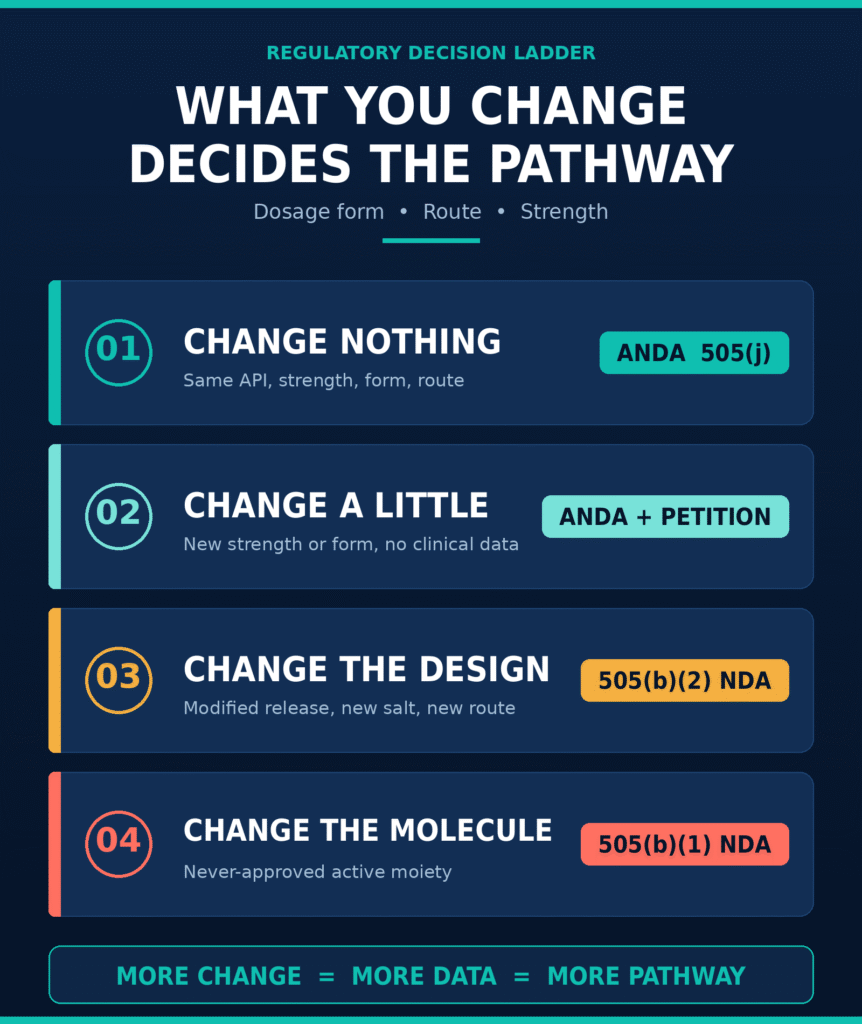
An intentional change to a drug product’s dosage form, route of administration, or strength that affects systemic exposure or creates a need for independent safety information can make the product unsuitable for a conventional ANDA. In these circumstances, the sponsor must evaluate whether the proposed modification can be adequately supported through the abbreviated generic framework or whether a 505(b)(2) application is necessary. Key considerations include:
- Identical API, Dosage Form, Route, and Strength: A 505(j) ANDA filing is generally required.
- Minor Changes in Strength or Dosage Form (Without Clinical Data Needs): The product may potentially qualify for an ANDA Suitability Petition under Section 505(j)(2)(C).
- Modified Release Profiles, New Salt/Ester Forms, or Alternate Routes: These modifications require a 505(b)(2) NDA, with comparative bioavailability potentially used to establish a bridge to the listed drug.
- Completely Novel Chemical Entities or Unapproved Molecular Moieties: These products fall outside both abbreviated pathways and require a full 505(b)(1) NDA.
Considering whether to build internal analytical infrastructure or outsource your drug development program? Explore the benefits of Outsourcing Peptide Manufacturing to a CDMO.
Pharmacokinetic Bridging and Bioequivalence Protocols
An ANDA requires the applicant to establish bioequivalence by demonstrating that the proposed generic product provides a comparable rate and extent of absorption, commonly assessed using pharmacokinetic parameters such as CmaxC_{max} and AUCAUC, relative to the RLD. In an ANDA development program, bioequivalence is generally assessed using the standard 80.00% to 125.00% 90% confidence interval for log-transformed CmaxC_{max} and AUCAUC parameters. A 505(b)(2) application follows a different scientific objective because the sponsor may not be attempting to demonstrate statistical equivalence in the same manner as an ANDA. Instead, the sponsor develops a scientifically justified “PK bridge” connecting the modified product’s systemic exposure characteristics with the established safety and efficacy information associated with the listed drug. This assessment determines the extent to which systemic exposure differs from the RLD and evaluates whether those differences introduce concerns regarding patient safety or therapeutic efficacy. When appropriately justified, this approach can avoid repeating Phase II and Phase III pivotal clinical trials that were previously conducted for the reference product.
Complex peptides like GLP-1 analogs require extensive characterization to demonstrate equivalence or establish a PK bridge. Review our specialized GLP-1 Peptide Analytical Characterization and read a practical application in our Peptide Characterization Case Study of Semaglutide.
Navigating ANDA Suitability Petitions Under Section 505(j)(2)(C)
An ANDA Suitability Petition provides a mechanism through which a sponsor can request FDA authorization to submit a 505(j) generic application for a product that differs from the RLD in dosage form, route of administration, strength, or active ingredient in a combination drug, provided that the proposed difference does not create a need for clinical safety or efficacy studies. Established under Section 505(j)(2)(C) of the FD&C Act, an approved suitability petition permits the sponsor to pursue an ANDA despite a specified difference from the RLD. This preserves the comparatively lower user fee structure and bioequivalence-focused data requirements associated with the generic drug pathway.
Despite these potential advantages, ANDA Suitability Petitions can present substantial regulatory challenges and may be rejected when the proposed modification creates additional scientific or clinical requirements. The FDA may deny a suitability petition when the proposed change necessitates nonclinical toxicological evaluations, clinical safety or efficacy studies, or complex pediatric assessments under the Pediatric Research Equity Act (PREA). For example, the FDA denied a suitability petition proposing a change to Ultram (tramadol hydrochloride) from an oral tablet to an oral solution because the modification was associated with pharmacokinetic variability in pediatric populations that required dedicated clinical characterization.
From an operational and commercial perspective, suitability petitions can also create strategic disadvantages. Because petitions are placed into public dockets after submission, competitors may become aware of a sponsor’s development strategy well before the associated application is submitted. In addition, FDA review of suitability petitions can extend beyond 12 to 24 months, while increasing regulatory scrutiny may further reduce the probability of approval. Consequently, some regulatory development strategies avoid the suitability petition process and instead pursue the 505(b)(2) NDA pathway, particularly when the product modification is substantial enough to require a clearly defined clinical or pharmacokinetic bridging strategy.
Ensure your submission package meets rigorous FDA standards from day one with our One-Stop CDMO Analytical Services for ANDA.
Financial and Operational Analysis: GDUFA III vs PDUFA VII Fees and Review Timelines
An application submitted through the ANDA pathway generally involves lower initial filing fees under GDUFA III than those associated with a 505(b)(2) NDA under PDUFA VII. However, ANDA sponsors must also consider recurring annual facility fees and generic applicant program fees, which can materially influence the long-term economics of a generic drug portfolio. FDA user fees for Fiscal Year 2026, effective from October 1, 2025, through September 30, 2026, demonstrate the substantial difference in upfront financial commitments between the two regulatory frameworks.
Under PDUFA VII, a 505(b)(2) NDA that requires clinical data carries an FY 2026 application fee of 4,682,003, while an application that does not require clinical data has a fee of 2,341,002. In comparison, the FY 2026 ANDA application fee under GDUFA III is 358,247, representing an 11.3% increase compared with FY 2025, attributed to lower overall generic submission volumes. Generic drug sponsors must also budget for annual GDUFA facility fees and generic applicant program fees, with these costs varying according to the applicant’s portfolio and applicable facility classifications.
| FDA Fee & Performance Parameter | GDUFA III (Section 505(j) ANDA) | PDUFA VII (Section 505(b)(2) NDA) |
|---|---|---|
| Original Application Fee (With Clinical Data) | Not Applicable (Clinical data invalidates ANDA) | 4,682,003 |
| Original Application Fee (No Clinical Data) | 358,247 | 2,341,002 |
| Drug Master File (Type II DMF) Fee | 102,584 | Exempt (Covered under NDA review) |
| Domestic Finished Dosage Form (FDF) Facility Fee | 238,943 (Annual) | Exempt (Covered under PDUFA program fee) |
| Foreign Finished Dosage Form (FDF) Facility Fee | 253,943 (Annual) | Exempt |
| Domestic Contract Manufacturing Org. (CMO) Fee | 57,346 (Annual) | Exempt |
| Foreign Contract Manufacturing Org. (CMO) Fee | 72,346 (Annual) | Exempt |
| Annual Program Fee | Small: 191,838; Medium: 767,351; Large: 1,918,377 | 442,213 per approved product |
| Standard FDA Review Performance Goal | 10 Months from receipt | 10 Months from receipt |
| Priority FDA Review Performance Goal | 8 Months (Eligible submissions) | 6 Months (Eligible submissions) |
The standard FDA review performance goal for original applications under both pathways is 10 months from receipt. The priority review timelines, however, differ between the two regulatory mechanisms. Eligible ANDAs, including certain submissions associated with drug shortage interventions, may receive an 8-month review goal, while eligible priority 505(b)(2) NDAs may receive a 6-month review goal. In addition to the stated review goals, ANDA programs can experience operational delays associated with Refuse-to-Receive (RTR) determinations and additional review cycles resulting from Complete Response Letters (CRLs), including those related to relatively minor bioanalytical or CMC deficiencies. Consequently, developing a complete and scientifically robust analytical data package is essential for reducing the risk of avoidable review deficiencies and potentially prolonged approval timelines.
Choosing the right manufacturing partner in North America is critical to avoiding regulatory delays. Read how to navigate your search in How to Choose a Peptide CDMO in the US and compare regional advantages with Canadian vs US Peptide CDMOs.
Commercial Strategy, Exclusivity, and Market Protection
An approved ANDA typically results in an AB-rated generic product that can qualify for automatic pharmacy substitution, but generic sponsors may face substantial price erosion once multiple products enter the market. In contrast, a 505(b)(2) NDA can provide opportunities for proprietary product differentiation, premium pricing, and several forms of market exclusivity. Generic products approved under Section 505(j) are generally assigned therapeutic equivalence ratings relative to their RLDs, allowing applicable state-level substitution laws to facilitate replacement of brand-name prescriptions with therapeutically equivalent generic products at the point of dispensing. Although this mechanism can accelerate market penetration, it also places generic manufacturers in direct competition with other generic suppliers. As additional manufacturers enter the market, commodity-based pricing pressure can substantially reduce margins, with drug prices in some competitive markets declining by 80% to 90% within months of multi-source entry.
The 505(b)(2) pathway creates a different commercial framework by allowing certain differentiated products to obtain independent market exclusivity and potentially pursue patent protection. When a 505(b)(2) application contains new clinical investigations, other than bioequivalence studies, that are essential to approval, the FDA may award 3 years of Hatch-Waxman New Clinical Investigation (NCI) exclusivity. Products incorporating novel active moieties or prodrugs may qualify for 5 years of New Chemical Entity (NCE) exclusivity, while eligible orphan-designated modifications may receive 7 years of Orphan Drug Exclusivity (ODE).
Because 505(b)(2) products may involve modifications to formulation, strength, dosage form, or drug delivery characteristics, they may receive non-equivalent therapeutic ratings, such as BX, or may not receive a therapeutic equivalence rating relative to the original RLD. As a result, automatic pharmacy substitution may not apply in the same manner as it does for an AB-rated generic product. Sponsors pursuing a 505(b)(2) strategy therefore need commercial plans that may include targeted physician detail networks, differentiated product positioning, and payer reimbursement strategies. The reduced exposure to automatic substitution and direct generic interchangeability can provide greater protection from immediate generic price erosion. This allows sponsors to position differentiated products at premium price points and establish longer-term brand value when the product offers meaningful clinical, formulation, or delivery advantages.
Navigating the technical differences between contract manufacturing types? Review our breakdown of Peptide CDMO vs CMO to understand how CDMOs provide advanced analytical and development support.
Conclusion: Selecting Your Regulatory Path
Successfully navigating the 505(b)(2) vs ANDA Regulatory Pathway requires sponsors to align active ingredient characterization, formulation capabilities, clinical risk tolerance, regulatory requirements, and long-term commercial objectives. The ANDA pathway offers an efficient and comparatively economical route to market for genuine generic duplicates when the sponsor can satisfy the applicable Q1/Q2 excipient requirements, pharmaceutical equivalence expectations, and bioequivalence requirements under GDUFA III. By comparison, the 505(b)(2) NDA pathway provides a flexible regulatory mechanism for developing and commercializing value-added drug products with modified formulations, delivery characteristics, strengths, or clinical indications. This pathway can provide opportunities for market exclusivity, premium pricing, and expanded clinical utility without requiring sponsors to reproduce all of the foundational safety investigations conducted for the reference product.
Regardless of the selected regulatory strategy, successful development depends on comprehensive analytical characterization, validated bioanalytical method development, impurity profiling, and stability testing. Working with experienced analytical testing facilities such as ResolveMass Laboratories Inc. can help sponsors generate the technical evidence required for their selected regulatory pathway. Whether the development objective involves demonstrating bioequivalence for an ANDA or establishing a scientifically defensible pharmacokinetic bridge for a 505(b)(2) NDA, a well-designed analytical and bioanalytical program is essential for developing a regulatory submission package that addresses FDA expectations.
Ready to advance your drug candidate through the right regulatory pathway? Partner with North America’s premier analytical team—explore our comprehensive Peptide CDMO Scale-Up Services and high-throughput Peptide Analytical Characterization Services today.
For technical inquiries regarding analytical characterization, method development, or bioanalytical testing for your regulatory submission, contact the expert team at ResolveMass Laboratories Inc.: https://resolvemass.ca/contact/
Frequently Asked Questions (FAQs)
When the FDA rejects a 505(j)(2)(C) Suitability Petition, the proposed product cannot proceed through the ANDA pathway based on the requested modification. The sponsor may instead need to pursue a 505(b)(2) NDA and generate appropriate bridging, nonclinical, or clinical data to support the proposed change in formulation, strength, dosage form, or route of administration.
Comparative bioavailability (BA) or bioequivalence (BE) studies are commonly important components of 505(b)(2) development, particularly when the sponsor needs to establish a relationship between the proposed product and a listed drug. The resulting pharmacokinetic information can provide a scientific “PK bridge” supporting reliance on the FDA’s existing safety and efficacy findings.
For FY 2026, the original ANDA application fee under GDUFA III is 358,247. Under PDUFA VII, a 505(b)(2) NDA carries a fee of 2,341,002 when clinical data are not required and 4,682,003 when clinical data are required. ANDA sponsors may also incur recurring facility and generic applicant program fees.
No. Approval through the 505(b)(2) pathway does not automatically result in an AB therapeutic equivalence rating in the Orange Book. Because these products may contain intentional differences from the listed drug, their therapeutic equivalence status must be determined based on the applicable regulatory and scientific evidence rather than assumed from the approval pathway.
Generally, no. An ANDA requires the proposed generic product to meet the applicable sameness requirements for the active pharmaceutical ingredient (API), including its relevant molecular form. A change to the salt or ester can create a different active ingredient and may therefore require development through the 505(b)(2) pathway rather than a conventional ANDA.
An ANDA may provide 180-day exclusivity to an eligible first-to-file applicant following a qualifying Paragraph IV patent challenge. Depending on the product and regulatory circumstances, a 505(b)(2) application may qualify for 3 years of Hatch-Waxman New Clinical Investigation exclusivity, 5 years of New Chemical Entity exclusivity, or 7 years of Orphan Drug Exclusivity. Applicable patent protection may provide an additional layer of market protection.
A company may select the 505(b)(2) route when it intends to develop a differentiated product rather than an exact generic duplicate. Modified release characteristics, improved patient compliance, altered delivery, or a new indication can create commercial opportunities that are unavailable through a conventional ANDA. The pathway can also allow reliance on existing reference-product safety information where scientifically and legally appropriate.
A “PK bridge” is a scientific strategy used to connect the pharmacokinetic profile of a proposed 505(b)(2) product with the established information for a referenced drug. Comparative pharmacokinetic studies can characterize differences in systemic exposure and help determine whether those differences are adequately understood. This evidence supports the sponsor’s justification for relying on relevant existing FDA findings.
The FDA may conduct risk-based Pre-Approval Inspections (PAIs) for facilities associated with both ANDA and 505(b)(2) applications when an inspection is considered necessary. Depending on the application and manufacturing arrangement, inspections may assess cGMP compliance, data integrity, manufacturing operations, and testing controls. Inspection requirements are determined by the FDA based on the specific regulatory and compliance risk profile.
Reference:
- Dhulia, I., Patel, H., Chauhan, N., & Pardeshi, N. (2021). FDA’s drug regulatory pathways, its development strategies and regulatory considerations. International Journal of Drug Regulatory Affairs, 9(2), 6–15. https://doi.org/10.22270/ijdra.v9i2.460
- Alam, A. M. U. (2025, July 30). Comparison of US FDA GDUFA fees: FY 2025 vs FY 2026. ResearchGate. https://doi.org/10.13140/RG.2.2.34318.68166
- Murugan, S. (2025, August 2). USFDA FDA user fee rates for FY 2026: A comparative overview for prescription drugs, medical devices, generics, and outsourcing facilities. Regulatory Affairs News. https://www.regulatoryaffairsnews.com/post/usfda-fda-user-fee-rates-for-fy-2026-a-comparative-overview-for-prescription-drugs-medical-devices
- U.S. Food and Drug Administration. (n.d.). Generic Drug User Fee Amendments. https://www.fda.gov/industry/fda-user-fee-programs/generic-drug-user-fee-amendments
Get In Touch With Us
About The Author


