Introduction
Cyclodextrin-based dendrimers have emerged as powerful nanostructures in drug delivery, combining the benefits of cyclodextrins and dendrimers into a single, highly functionalized entity. These hybrid molecules exhibit unique properties, including enhanced solubility, targeted delivery, and controlled release of drugs. However, the synthesis of cyclodextrin-based dendrimers is a complex and meticulous process, requiring precise techniques to ensure the desired structural and functional attributes. At Resolvemass Laboratories, a leading Contract Research Organization (CRO) specializing in custom synthesis and analytical services, we understand the importance of mastering these synthesis methods to meet the specific needs of our clients in the pharmaceutical industry. This blog provides an in-depth exploration of the various synthesis methods for cyclodextrin-based dendrimers, highlighting the techniques and strategies that are pivotal in creating these advanced nanocarriers.
Overview of Cyclodextrin-Based Dendrimers
Before delving into the synthesis methods, it is essential to understand the basic structure and components of cyclodextrin-based dendrimers:
Cyclodextrins: Cyclodextrins are cyclic oligosaccharides with a hydrophobic interior cavity and a hydrophilic exterior surface. These molecules can form inclusion complexes with various guest molecules, particularly hydrophobic drugs, thereby enhancing their solubility and stability.
Dendrimers: Dendrimers are highly branched, tree-like macromolecules that consist of a central core, branching units (dendrons), and terminal functional groups. They offer precise control over molecular size, shape, and surface functionality, making them ideal for drug delivery applications.
By combining these two components, cyclodextrin-based dendrimers leverage the drug encapsulation abilities of cyclodextrins with the multivalency and customization potential of dendrimers, resulting in a versatile platform for advanced drug delivery systems.
Explore our specialized expertise in cyclodextrin chemistry: Learn more about our Cyclodextrins Services
Functionalization Strategies for Surface Modification
Surface functionalization plays a crucial role in enhancing the performance of cyclodextrin-based dendrimers in biomedical applications. By modifying the terminal groups of dendrimers, researchers can introduce specific chemical functionalities that improve solubility, biocompatibility, and targeting efficiency. Functional groups such as amines, carboxyls, and polyethylene glycol (PEG) chains are commonly attached to tailor the dendrimer surface. These modifications not only stabilize the structure but also reduce toxicity and improve circulation time in biological systems.
In addition, ligand-based functionalization enables active targeting of specific tissues or cells. For instance, attaching antibodies, peptides, or small molecules to the dendrimer surface allows selective binding to receptors overexpressed in diseased cells. This targeted approach significantly enhances drug delivery efficiency while minimizing off-target effects. As a result, surface engineering has become an indispensable step in designing advanced cyclodextrin-based dendrimers for precision medicine.
Need precise analysis for your peptide-linked dendrimers? View our NMR for Peptides and Proteins services
Synthesis Methods for Cyclodextrin-Based Dendrimers
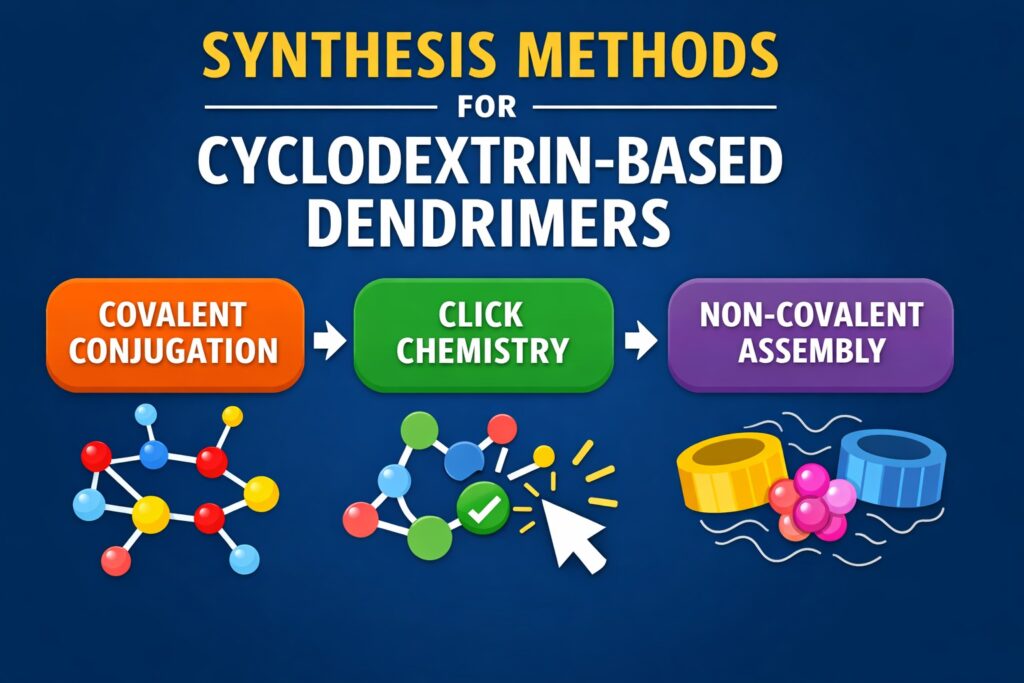
The synthesis of cyclodextrin-based dendrimers involves the strategic conjugation of cyclodextrins to dendritic structures. Several methods are employed to achieve this, each offering unique advantages depending on the desired properties of the final product. Below are the primary synthesis methods used for creating cyclodextrin-based dendrimers:
Covalent Conjugation
Covalent conjugation is one of the most widely used methods for synthesizing cyclodextrin-based dendrimers. This approach involves the formation of stable covalent bonds between cyclodextrins and dendritic cores, ensuring that the components remain securely attached under physiological conditions.
- Step-by-Step Conjugation: This method involves the sequential addition of cyclodextrin molecules to a pre-synthesized dendrimer. The process typically begins with the functionalization of the dendrimer’s surface groups, followed by the introduction of cyclodextrin molecules via reactive intermediates. This stepwise approach allows for precise control over the number and orientation of cyclodextrins on the dendrimer surface, enabling the fine-tuning of drug encapsulation and release properties.
- Click Chemistry: Click chemistry has become increasingly popular for the synthesis of cyclodextrin-based dendrimers due to its efficiency, selectivity, and mild reaction conditions. The copper(I)-catalyzed azide-alkyne cycloaddition (CuAAC) reaction, a type of click chemistry, is often used to link cyclodextrins to dendritic structures. This method allows for rapid and efficient conjugation, resulting in well-defined dendrimer architectures with high cyclodextrin loading.
- Cross-Linking Strategies: Cross-linking is another approach used in covalent conjugation, where bifunctional or multifunctional linkers are employed to attach cyclodextrins to dendrimers. Cross-linking can enhance the stability of the final product and provide additional sites for drug encapsulation. However, it requires careful optimization to avoid excessive cross-linking, which could lead to aggregation or loss of functionality.
Role of Protecting Groups in Synthesis
The use of protecting groups is essential in the controlled synthesis of cyclodextrin-based dendrimers, particularly during covalent conjugation processes. Cyclodextrins possess multiple hydroxyl groups that can react simultaneously, leading to unwanted side reactions or structural heterogeneity. Protecting groups help selectively block certain reactive sites, allowing chemists to direct reactions toward specific positions. This level of control is critical for achieving uniform and reproducible dendrimer architectures.
Moreover, the choice of protecting group and its subsequent removal must be carefully optimized to avoid damaging the dendrimer structure. Mild deprotection conditions are often preferred to preserve the integrity of both cyclodextrin and dendritic components. The strategic use of protecting groups not only improves reaction specificity but also enhances overall yield and product consistency, making it a vital aspect of advanced dendrimer synthesis.
Non-Covalent Assembly
Non-covalent assembly relies on weaker interactions, such as hydrogen bonding, electrostatic forces, or host-guest interactions, to attach cyclodextrins to dendritic structures. This method is particularly advantageous when reversible assembly and disassembly are desired, allowing for dynamic release or exchange of cyclodextrin components.
- Host-Guest Interactions: Cyclodextrins are well-known for their ability to form host-guest complexes with a wide range of molecules. By utilizing this property, dendrimers can be designed with guest molecules that interact non-covalently with cyclodextrins. This approach allows for the reversible attachment of cyclodextrins to the dendrimer, enabling the development of stimuli-responsive drug delivery systems.
- Hydrogen Bonding: Hydrogen bonding is another non-covalent interaction used to assemble cyclodextrins and dendrimers. The strength and directionality of hydrogen bonds can be exploited to create well-organized dendrimer structures with cyclodextrin moieties. This method is particularly useful in applications where the dendrimer needs to be disassembled or reconfigured in response to environmental changes.
- Electrostatic Interactions: Electrostatic assembly involves the use of oppositely charged cyclodextrins and dendrimers to form complexes. This method can be employed to create dendrimers with charged surfaces, which can interact with similarly charged or oppositely charged drugs, enhancing encapsulation efficiency and stability. Electrostatic assembly is particularly useful in developing pH-sensitive drug delivery systems, where the release of the drug can be triggered by changes in the local pH environment.
Stimuli-Responsive Dendrimer Systems
Stimuli-responsive cyclodextrin-based dendrimers represent a significant advancement in smart drug delivery technologies. These systems are designed to respond to specific environmental triggers such as pH, temperature, light, or enzymatic activity. By incorporating responsive linkages or functional groups, dendrimers can release their drug payload selectively at the target site. For example, pH-sensitive dendrimers can exploit the acidic microenvironment of tumors to achieve controlled drug release.
Furthermore, multi-stimuli-responsive systems are being developed to enhance precision and adaptability. These advanced dendrimers can respond to more than one trigger simultaneously, ensuring highly controlled therapeutic outcomes. Such innovations not only improve drug efficacy but also reduce systemic toxicity. As research progresses, stimuli-responsive dendrimers are expected to play a pivotal role in next-generation personalized medicine.
Hybrid Synthesis Techniques
Hybrid synthesis techniques combine elements of both covalent and non-covalent approaches to create cyclodextrin-based dendrimers with enhanced functionality and versatility.
- Layer-by-Layer Assembly: Layer-by-layer (LbL) assembly is a technique that involves the alternate deposition of positively and negatively charged layers on a dendritic core. By incorporating cyclodextrins into one or more of these layers, it is possible to create dendrimers with complex, multilayered structures that offer controlled drug release properties. This method allows for the creation of dendrimers with multiple functional layers, each capable of carrying different drugs or targeting different sites within the body.
- Self-Assembly Techniques: Self-assembly techniques involve the spontaneous organization of cyclodextrins and dendrimers into well-defined structures. These techniques often rely on a combination of covalent and non-covalent interactions, allowing for the creation of dendrimers with tailored properties. Self-assembly is particularly useful in the development of dendrimers with hierarchical structures, where the organization of cyclodextrins within the dendrimer can be precisely controlled to achieve specific drug delivery goals.
Green Chemistry Approaches in Synthesis
With increasing emphasis on sustainability, green chemistry principles are being integrated into the synthesis of cyclodextrin-based dendrimers. Traditional synthetic methods often involve toxic solvents, high energy consumption, and hazardous reagents. Green approaches aim to minimize environmental impact by using eco-friendly solvents such as water or ethanol, along with energy-efficient reaction conditions. These methods not only reduce waste but also improve safety during synthesis.
In addition, the use of biodegradable materials and renewable feedstocks is gaining attention in dendrimer research. Enzymatic catalysis and solvent-free reactions are also being explored as alternatives to conventional techniques. By adopting green chemistry strategies, researchers can develop more sustainable and cost-effective synthesis processes without compromising the quality and functionality of the dendrimers.
Challenges and Considerations in Synthesis
While the synthesis of cyclodextrin-based dendrimers offers many advantages, it also presents certain challenges that must be carefully considered:
- Purity and Yield: Achieving high purity and yield is critical in the synthesis of cyclodextrin-based dendrimers. Impurities or incomplete reactions can lead to dendrimers with inconsistent properties, affecting their performance in drug delivery applications. Careful optimization of reaction conditions and purification techniques is essential to ensure the quality of the final product.
- Scalability: Scaling up the synthesis of cyclodextrin-based dendrimers from laboratory to industrial production can be challenging. The complexity of the synthesis process, particularly in covalent conjugation methods, may require extensive optimization to achieve consistent results on a larger scale.
- Cost and Accessibility: The cost of raw materials and reagents, as well as the complexity of the synthesis process, can impact the accessibility of cyclodextrin-based dendrimers for widespread pharmaceutical use. Research into cost-effective synthesis methods and alternative materials is ongoing to make these advanced nanocarriers more accessible to the industry.
Ensure the highest purity of your synthesis with our analytical support: Learn more about Impurity Profiling using LCMS
Characterization Techniques for Dendrimers
Accurate characterization is essential to confirm the structure and functionality of cyclodextrin-based dendrimers. Various analytical techniques are employed to assess parameters such as molecular weight, size distribution, and surface chemistry. Nuclear magnetic resonance (NMR) spectroscopy and mass spectrometry are commonly used to verify chemical composition and structural integrity. These techniques provide detailed insights into the success of the synthesis process.
Additionally, methods such as dynamic light scattering (DLS) and electron microscopy help evaluate particle size and morphology. Understanding these physical characteristics is crucial for predicting the behavior of dendrimers in biological systems. Comprehensive characterization ensures that the synthesized dendrimers meet the required standards for pharmaceutical applications and perform effectively in drug delivery.
Access high-resolution structural verification: Explore our NMR for Small Molecules & PolymersView our HPLC Analysis Services
Applications Beyond Drug Delivery
While drug delivery remains the primary focus, cyclodextrin-based dendrimers are increasingly being explored for a wide range of other applications. In the field of diagnostics, these nanostructures can be used as carriers for imaging agents, enabling improved detection of diseases. Their ability to encapsulate and stabilize various molecules makes them suitable for biosensing and molecular recognition applications.
Moreover, cyclodextrin-based dendrimers are finding use in environmental and industrial applications. They can be employed for the removal of pollutants, including heavy metals and organic contaminants, from water systems. Their unique structural properties also make them valuable in catalysis and material science. This versatility highlights their potential beyond pharmaceuticals, opening new avenues for interdisciplinary research and innovation.
Partner with a CRO that understands complex synthesis: Learn more about our Custom Synthesis Services
Conclusion
Cyclodextrin-based dendrimers continue to redefine the landscape of nanotechnology-driven drug delivery through their unique structural versatility and functional adaptability. The diverse synthesis strategies—from covalent conjugation to hybrid and green approaches—offer researchers multiple pathways to engineer highly specialized nanocarriers. As advancements in functionalization, characterization, and stimuli-responsive design continue to emerge, these dendrimers are becoming increasingly sophisticated and application-specific.
Looking ahead, the integration of sustainable synthesis methods and the expansion of applications beyond traditional drug delivery will further enhance their relevance in both pharmaceutical and industrial domains. At Resolvemass Laboratories, our focus remains on leveraging innovative synthesis techniques and rigorous analytical methodologies to deliver high-quality dendrimer solutions. Continued research and technological progress in this field promise to unlock new possibilities, ultimately contributing to more effective therapies and broader scientific advancements.
Frequently Asked Questions
Covalent conjugation is the most widely used method due to its stability and precision. It involves forming strong chemical bonds between cyclodextrins and dendrimer cores. This ensures that the structure remains intact under physiological conditions. The method also allows fine control over the number of attached cyclodextrin units.
Click chemistry is favored because it offers high efficiency, selectivity, and mild reaction conditions. It minimizes unwanted byproducts and simplifies purification steps. This method enables rapid and reproducible attachment of cyclodextrins to dendrimers. As a result, it is ideal for creating well-defined nanostructures.
One major challenge is controlling the uniformity of the final dendrimer structure. Side reactions and incomplete functionalization can lead to inconsistencies. Additionally, achieving high yield and purity requires careful optimization of reaction conditions. Scaling up the process for industrial use is also complex.
Non-covalent assembly relies on weaker interactions like hydrogen bonding or host–guest inclusion rather than permanent chemical bonds. This allows reversible formation and disassembly of the structure. Such flexibility is useful for stimuli-responsive drug delivery. However, these systems may be less stable compared to covalent ones.
Cyclodextrins act as functional units that provide a hydrophobic cavity for encapsulating drug molecules. During synthesis, they are attached to dendrimers to enhance drug-loading capacity. They also improve the solubility and stability of poorly water-soluble compounds. This makes them essential for pharmaceutical applications.
Yes, green chemistry approaches are increasingly being used in their synthesis. Researchers are adopting safer solvents, energy-efficient reactions, and biodegradable materials. These methods reduce environmental impact while maintaining product quality. Sustainable synthesis is becoming an important focus in modern nanotechnology research.
Reference:
- González-Méndez, I., Loera-Loera, E., Sorroza-Martínez, K., Vonlanthen, M., Cuétara-Guadarrama, F., Bernad-Bernad, M. J., Rivera, E., & Gracia-Mora, J. (2022). Synthesis of β-cyclodextrin-decorated dendritic compounds based on EDTA core: A new class of PAMAM dendrimer analogs. Pharmaceutics, 14(11), 2363. https://doi.org/10.3390/pharmaceutics14112363
- Wang, H., Shao, N., Qiao, S., & Cheng, Y. (2012). Host–guest chemistry of dendrimer–cyclodextrin conjugates: Selective encapsulations of guests within dendrimer or cyclodextrin cavities revealed by NOE NMR techniques. The Journal of Physical Chemistry B, 116(36), 11217–11224. https://doi.org/10.1021/jp3062916
- Arima, H. (2021). Twenty years of research on cyclodextrin conjugates with PAMAM dendrimers. Pharmaceutics, 13(5), 655. https://doi.org/10.3390/pharmaceutics13050655