

Introduction
In the rapidly evolving fields of biotechnology and pharmaceuticals, the demand for high-quality peptide reference standards has surged. Peptides play crucial roles in numerous biological processes and have become essential tools in drug discovery, diagnostics, and therapeutic development. Accurate and reliable peptide reference standards are vital for ensuring the validity and reproducibility of research results. At Resolvemass Laboratories, a leading Contract Research Organization (CRO) specializing in custom synthesis and analytical services, we offer state-of-the-art peptide reference standard synthesis services tailored to meet the specific needs of our clients.
Share via:
The Importance of Peptide Reference Standards
Peptide reference standards serve as benchmarks for the identification, quantification, and validation of peptides in various research and clinical applications. They are critical for:
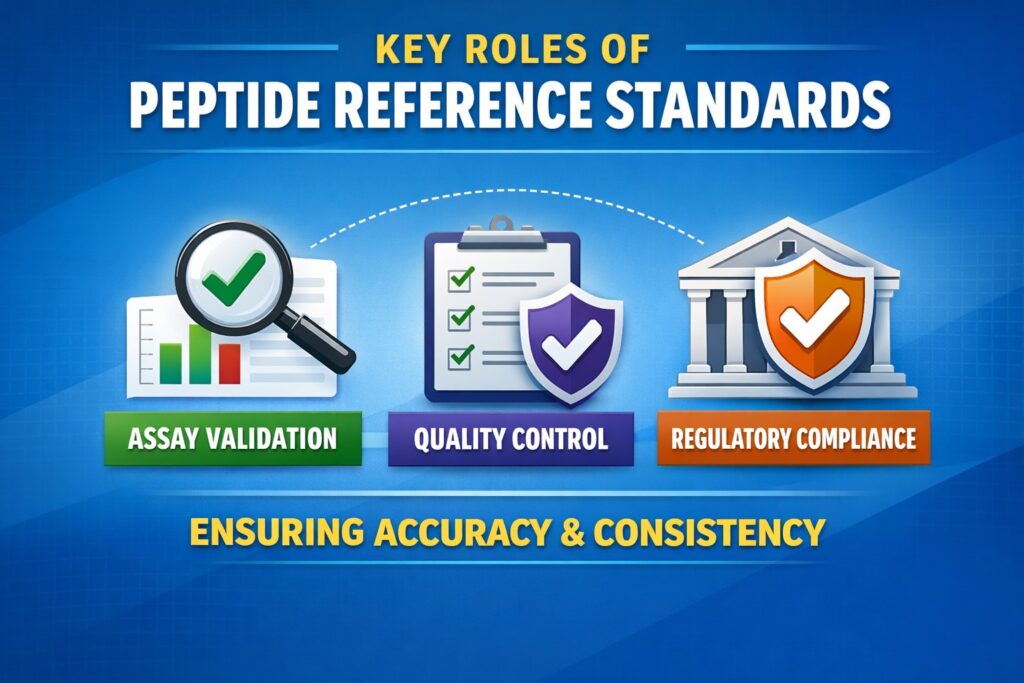
Assay Development and Validation: Accurate reference standards are essential for developing and validating bioanalytical assays. These assays are used to quantify peptides in biological samples, ensuring precise and consistent measurements. Without reliable reference standards, assays may produce inaccurate or inconsistent results, compromising the validity of the research or diagnostic tests.
Quality Control: Reference standards are used to verify the performance and accuracy of analytical instruments and methods, ensuring the reliability of experimental data. For example, during the production of peptide-based drugs, quality control measures rely on reference standards to confirm that each batch meets the required specifications for purity, potency, and consistency.
Regulatory Compliance: Regulatory agencies require the use of validated reference standards in pharmaceutical development and manufacturing to ensure product quality and safety. Compliance with these standards is essential for gaining regulatory approval for new drugs and therapies, as it demonstrates that the products meet stringent quality criteria.
Research and Development: High-quality reference standards facilitate the exploration of peptide functions, interactions, and mechanisms in basic and applied research. Researchers can use these standards to study the biological activities of peptides, investigate disease pathways, and develop new therapeutic agents.
Learn more about our core expertise: Peptide Characterization Service
Role of Peptide Reference Standards in Advanced Biopharmaceutical Research
Peptide reference standards play a critical role in modern biopharmaceutical research, particularly in the development of peptide-based therapeutics and biologics. As pharmaceutical companies increasingly explore peptide molecules for targeted therapies, the need for highly accurate standards becomes essential. These standards allow researchers to compare experimental results against known peptide profiles, ensuring consistency during method development and analytical validation. Without reliable reference materials, researchers may encounter inconsistencies in peptide detection, quantification, or structural confirmation, which can compromise experimental reliability.
In advanced drug discovery programs, peptide reference standards also help scientists understand peptide stability, degradation pathways, and interaction patterns within biological systems. By comparing experimental peptides with validated reference materials, researchers can identify impurities, confirm structural modifications, and improve formulation strategies. This capability significantly accelerates drug development timelines while maintaining high scientific and regulatory standards.
Discover our specialized local services: Peptide Characterization Service in Canada
Custom Peptide Reference Standard Synthesis
Custom peptide reference standard synthesis involves designing, synthesizing, and characterizing peptides with the highest precision and purity. At Resolvemass Laboratories, our comprehensive synthesis process ensures the production of peptide standards that meet stringent quality criteria. Here’s a detailed look at our process:
1. Peptide Design and Sequence Optimization
The first step in custom peptide reference standard synthesis is the design and optimization of the peptide sequence. This involves selecting the appropriate amino acid sequence based on the specific application and desired properties of the peptide. Our experienced scientists use advanced bioinformatics tools and algorithms to design peptides that exhibit optimal stability, solubility, and biological activity. We consider factors such as peptide length, sequence homology, and the inclusion of post-translational modifications to ensure the peptide functions as intended.
Ensure your sequence is precise: Peptide Sequencing Service
Selection of Raw Materials and Reagents
The quality of peptide reference standards begins with the careful selection of raw materials and reagents used during synthesis. High-purity amino acids, solvents, and coupling reagents are essential to ensure the accuracy and reproducibility of the final peptide product. At advanced synthesis facilities, all raw materials undergo strict quality verification before entering the production workflow. This ensures that impurities, contamination, or reagent inconsistencies do not affect the final peptide structure or purity.
Additionally, reagent compatibility plays a significant role in preventing unwanted side reactions during peptide synthesis. Proper selection of protecting groups, coupling agents, and reaction conditions helps maintain the structural integrity of the peptide chain throughout the synthesis process. By controlling the quality of these inputs, laboratories can significantly improve yield, purity, and reproducibility, which are essential characteristics for reliable peptide reference standards.
2. Solid-Phase Peptide Synthesis (SPPS)
Solid-Phase Peptide Synthesis (SPPS) is the cornerstone of peptide synthesis. This technique involves the stepwise assembly of peptides on a solid support, allowing for precise control over the sequence and length of the peptide chain. The process includes the following steps:
- Coupling: The amino acids are sequentially added to the growing peptide chain through chemical reactions, ensuring the correct sequence is formed. Each coupling step is optimized to maximize efficiency and minimize side reactions.
- Deprotection: Protective groups on the amino acids are removed to allow for the formation of peptide bonds. This step ensures that only the desired reactions occur, preventing unwanted modifications.
- Cleavage: The synthesized peptide is cleaved from the solid support, yielding the crude peptide. The cleavage process is carefully controlled to preserve the integrity of the peptide and prevent degradation.
SPPS offers several advantages, including high efficiency, scalability, and the ability to incorporate non-standard amino acids and modifications. It allows for the synthesis of complex peptide sequences with high purity and consistency.
Automation and Modern Peptide Synthesizers
Modern peptide synthesis has greatly benefited from automation technologies that enhance precision and reproducibility. Automated peptide synthesizers allow researchers to control each step of the synthesis process with exceptional accuracy, including reagent addition, reaction timing, temperature control, and washing cycles. This automation reduces human error and ensures consistent synthesis conditions across multiple batches of peptides.
Furthermore, automated systems enable the synthesis of complex peptide sequences that would be difficult to produce manually. By integrating programmable synthesis cycles and monitoring systems, researchers can optimize reaction efficiency while minimizing reagent waste. These advancements have significantly increased the scalability of peptide production, making it easier to generate high-quality peptide reference standards for both research and commercial applications.
3. Purification and Characterization
After synthesis, the crude peptide undergoes rigorous purification to achieve the desired purity and quality. At Resolvemass Laboratories, we utilize advanced purification techniques such as High-Performance Liquid Chromatography (HPLC) to isolate the target peptide from impurities. The purified peptide is then characterized using sophisticated analytical methods, including:
- Mass Spectrometry (MS): Confirms the molecular weight and composition of the peptide. MS provides precise data on the peptide’s mass, ensuring it matches the theoretical value.
- Nuclear Magnetic Resonance (NMR) Spectroscopy: Provides detailed structural information. NMR analysis confirms the correct folding and conformation of the peptide, which is crucial for its biological activity.
- Amino Acid Analysis: Verifies the amino acid composition and sequence. This analysis ensures that the peptide sequence matches the intended design, with no errors or omissions.
- High-Performance Liquid Chromatography (HPLC): Assesses purity and identifies any residual impurities. HPLC analysis ensures that the peptide meets the required purity standards, typically above 95%.
These comprehensive characterization steps ensure that the peptide reference standards meet the highest quality standards and are suitable for use in critical applications. Each batch is accompanied by a certificate of analysis (CoA) detailing the results of these tests.
Understand why purity is critical: What is Peptide Purity by HPLC and Why It Matters
Importance of Analytical Method Validation
Analytical method validation is a crucial step in ensuring that peptide reference standards provide accurate and reliable results. Validation procedures evaluate parameters such as precision, accuracy, specificity, linearity, and sensitivity of the analytical methods used to analyze peptides. By validating these analytical techniques, laboratories can ensure that measurement results remain consistent across different instruments, operators, and experimental conditions.
In pharmaceutical and biotechnology environments, validated analytical methods are also necessary to meet regulatory expectations. Regulatory authorities require documented proof that analytical procedures are capable of producing dependable results. Therefore, integrating validated analytical techniques with peptide reference standards not only strengthens research credibility but also supports regulatory submissions and product approvals.
Explore advanced mapping techniques: Peptide Mapping in Biopharmaceuticals
4. Stability Studies and Quality Control
Stability studies are conducted to evaluate the shelf life and storage conditions of the peptide reference standards. These studies involve subjecting the peptides to various environmental conditions, such as temperature, humidity, and light, to assess their stability over time. Stability data is crucial for determining the appropriate packaging and storage requirements for the final product. For instance, some peptides may require lyophilization and storage at low temperatures to maintain their stability and activity.
Our quality control processes are designed to ensure that each batch of peptide reference standards meets stringent quality criteria. This includes rigorous testing for purity, identity, and activity, as well as compliance with relevant regulatory guidelines. Regular audits and quality assessments are conducted to maintain the highest standards of production and ensure that our clients receive reliable and consistent products.
What to look for in a partner: Peptide Testing Services for Pharmaceutical R&D: What You Need to Know Before Outsourcing
Packaging and Storage of Peptide Reference Standards
Proper packaging and storage conditions are essential for maintaining the integrity and long-term stability of peptide reference standards. Peptides are often sensitive to environmental factors such as temperature fluctuations, moisture exposure, and light. To protect against degradation, peptides are typically stored in lyophilized form within airtight, moisture-resistant containers. Specialized packaging materials help preserve the chemical stability and biological activity of the peptide.
In addition to protective packaging, clearly defined storage guidelines are provided to ensure optimal shelf life. Many peptide standards require storage at low temperatures, such as −20°C or −80°C, to prevent oxidation or hydrolysis. By implementing strict storage protocols and proper packaging solutions, laboratories can ensure that peptide reference standards remain reliable and usable for extended periods.
Applications of Peptide Reference Standards
Peptide reference standards have a wide range of applications in research and industry, including:
- Pharmaceutical Development: Used in drug discovery and development to validate analytical methods, study pharmacokinetics, and evaluate the stability and efficacy of peptide-based drugs. Reference standards are crucial for the accurate quantification of peptides in biological matrices, supporting preclinical and clinical studies.
- Clinical Diagnostics: Essential for developing and validating diagnostic assays that detect and quantify biomarkers in clinical samples. Peptide standards ensure the accuracy and reproducibility of diagnostic tests, which are critical for disease diagnosis and monitoring.
- Proteomics and Biomarker Research: Used to study protein-protein interactions, identify novel biomarkers, and investigate disease mechanisms. High-quality peptide standards enable researchers to explore the role of peptides in various biological processes and disease states.
- Quality Control in Manufacturing: Employed in the production of biopharmaceuticals to ensure product consistency and compliance with regulatory standards. Peptide reference standards are used to verify the purity and potency of peptide drugs throughout the manufacturing process, ensuring batch-to-batch consistency.
Role in Mass Spectrometry-Based Proteomics
Mass spectrometry has become one of the most powerful tools for studying proteins and peptides in complex biological systems. In proteomics research, peptide reference standards are widely used to calibrate instruments, validate analytical workflows, and confirm peptide identification. These standards provide known molecular signatures that help researchers accurately interpret mass spectrometry data and distinguish target peptides from background noise.
In quantitative proteomics, peptide reference standards also support the development of targeted assays such as Multiple Reaction Monitoring (MRM). By using well-characterized peptide standards, scientists can establish calibration curves and achieve precise quantification of peptides in biological samples. This approach improves the reliability of biomarker discovery studies and strengthens the interpretation of complex proteomic datasets.
Case Study: Development of a Peptide Reference Standard for Cancer Biomarker Analysis
One of our recent projects involved the development of a peptide reference standard for a cancer biomarker analysis. The objective was to create a high-purity standard that could be used to validate an assay for detecting a specific peptide biomarker associated with breast cancer.
Challenges
- High Purity Requirement: The reference standard needed to have a purity of over 99% to ensure the accuracy and reliability of the assay. Achieving such high purity required meticulous optimization of the synthesis and purification processes.
- Stability: The peptide had to be stable under various storage conditions to maintain its integrity over time. Stability challenges included susceptibility to oxidation and degradation, which needed to be mitigated through formulation strategies.
- Sequence Complexity: The peptide sequence included post-translational modifications, adding complexity to the synthesis and characterization process. These modifications required precise control and verification to ensure the peptide’s functionality.
Solution
- Optimized SPPS: We employed optimized SPPS protocols to achieve high coupling efficiency and minimize side reactions, resulting in a highly pure peptide. Advanced deprotection and coupling chemistries were used to enhance yield and reduce impurities.
- Advanced Purification Techniques: The crude peptide was purified using preparative HPLC, and the purity was confirmed to be over 99% using analytical HPLC. Multiple purification steps were employed to remove residual by-products and achieve the desired purity.
- Comprehensive Characterization: The peptide was thoroughly characterized using MS, NMR, and amino acid analysis to confirm its identity and purity. Detailed structural analysis ensured that the peptide retained its biological activity and conformation.
- Stability Testing: Stability studies were conducted under various conditions to ensure the peptide remained stable over time. Accelerated stability testing provided data on the peptide’s shelf life and optimal storage conditions.
Outcome
The developed peptide reference standard exhibited excellent purity and stability, making it suitable for validating the cancer biomarker assay. The successful completion of this project demonstrated our capability to deliver high-quality peptide reference standards for critical applications in cancer research. The validated assay provided reliable and reproducible results, supporting the early detection and monitoring of breast cancer.
Conclusion
Peptide reference standards have become indispensable components of modern biotechnology, pharmaceutical development, and advanced analytical research. Their role extends beyond simple calibration materials; they serve as essential tools for validating analytical methods, ensuring product quality, and supporting regulatory compliance across various scientific applications. As peptide-based therapeutics and biomarker studies continue to expand, the demand for highly reliable reference standards will only grow.
At Resolvemass Laboratories, our expertise in peptide design, synthesis, purification, and analytical characterization enables us to deliver reference standards that meet the highest industry expectations. By combining advanced synthesis technologies, rigorous quality control processes, and deep scientific expertise, we provide solutions that support accurate research outcomes and accelerate scientific innovation. Partnering with Resolvemass Laboratories ensures access to dependable peptide reference standards that help researchers and pharmaceutical companies achieve precise, reproducible, and regulatory-compliant results.
Contact Us
For more information about our peptide reference standard synthesis services and how we can assist in your research and development projects, please visit Resolvemass laboratories & contact us
Frequently Asked Questions
Peptide reference standards are used as verified comparison materials in scientific experiments and analytical testing. They help researchers confirm the identity, purity, and concentration of peptides in samples. These standards are widely applied in drug development, biomarker research, and diagnostic assay validation. Using reliable reference materials ensures that experimental results remain accurate and reproducible.
High purity is essential because impurities can interfere with analytical results and lead to inaccurate conclusions. When peptide standards contain unwanted by-products, they may affect assay sensitivity or distort measurement data. Highly purified peptides ensure reliable calibration and consistent analytical performance. This is especially important in pharmaceutical research and regulatory testing.
Peptide reference standards are typically synthesized using techniques such as Solid-Phase Peptide Synthesis (SPPS). In this process, amino acids are sequentially added to build the desired peptide chain with precise control. After synthesis, the peptide is purified and characterized using analytical techniques like HPLC and mass spectrometry. These steps confirm the peptide’s identity, purity, and structural integrity.
Several analytical methods are used to verify peptide reference standards. High-Performance Liquid Chromatography (HPLC) is commonly used to determine purity, while mass spectrometry confirms molecular weight. Nuclear Magnetic Resonance (NMR) spectroscopy may also be used to analyze structural features. Together, these techniques ensure the peptide meets the required quality specifications.
Peptide reference standards are usually stored under controlled conditions to prevent degradation. Most peptides are kept in lyophilized form and stored at low temperatures, often at −20°C or lower. Proper storage helps protect the peptide from moisture, oxidation, and light exposure. Following recommended storage guidelines ensures long-term stability and reliable performance.
Reference:
- McCarthy, D., Han, Y., Carrick, K., Schmidt, D., Workman, W., Matejtschuk, P., Duru, C., & Atouf, F. (2023). Reference standards to support quality of synthetic peptide therapeutics. Pharmaceutical Research, 40(6), 1317–1328. https://doi.org/10.1007/s11095-023-03493-1
- Elsayed, Y. Y., Kühl, T., & Imhof, D. (2025). Regulatory guidelines for the analysis of therapeutic peptides and proteins. Journal of Peptide Science, 31(3), e70001. https://doi.org/10.1002/psc.70001
- Isidro-Llobet, A., Kenworthy, M. N., Mukherjee, S., Kopach, M. E., Wegner, K., Gallou, F., Smith, A. G., & Roschangar, F. (2019). Sustainability challenges in peptide synthesis and purification: From R&D to production. The Journal of Organic Chemistry, 84(8), 4615–4628. https://doi.org/10.1021/acs.joc.8b03001

