Introduction:
The rapid expansion of GLP-1 receptor agonist therapeutics has increased the need for robust GLP-1 Biosimilar Characterization strategies. Peptide drugs such as semaglutide and exenatide are structurally complex molecules that require advanced analytical approaches to demonstrate biosimilarity, product quality, and manufacturing consistency.
Mass spectrometry has become one of the most powerful tools for peptide therapeutic characterization because it enables highly sensitive identification of molecular variants, degradation pathways, sequence modifications, and process-related impurities. For biosimilar manufacturers, accurate characterization is critical not only for regulatory approval but also for establishing product comparability and long-term stability through comprehensive biosimilar characterization using mass spectrometry workflows.
At ResolveMass Laboratories Inc., advanced mass spectrometry workflows are used to support peptide drug developers through comprehensive analytical characterization services tailored to regulatory expectations and complex peptide therapeutics, including specialized GLP bioanalytical services.
Summary:
- GLP-1 biosimilar characterization is essential for ensuring the safety, efficacy, and regulatory compliance of peptide therapeutics such as semaglutide and exenatide.
- Advanced mass spectrometry (MS) techniques help identify peptide sequence integrity, impurities, degradation products, and post-translational modifications.
- Semaglutide presents unique analytical challenges due to its fatty acid side chain and complex formulation behavior.
- Exenatide characterization requires highly sensitive methods for detecting oxidation, deamidation, aggregation, and truncation impurities.
- LC-MS, HRMS, peptide mapping, and orthogonal analytical methods are central to regulatory-grade biosimilar comparability studies.
- Accurate characterization supports biosimilar developers in meeting expectations from agencies such as the FDA and EMA.
1: What Are GLP-1 Biosimilars?
GLP-1 biosimilars are follow-on biologic or peptide therapeutics developed to demonstrate high similarity to approved GLP-1 receptor agonist drugs. These therapies are widely used for:
- Type 2 diabetes
- Obesity management
- Metabolic disorders
- Cardiovascular risk reduction
Common GLP-1 Therapeutics
| Drug | Molecule Type | Key Analytical Complexity |
|---|---|---|
| Semaglutide | Modified GLP-1 analog | Lipid conjugation and acylation |
| Exenatide | Synthetic peptide | Oxidation and aggregation sensitivity |
| Liraglutide | Acylated peptide | Fatty acid conjugation |
| Dulaglutide | Fusion protein | Large molecular complexity |
Because these molecules are peptide-based biologics, analytical characterization is significantly more complex than traditional small-molecule drugs. Advanced techniques such as LC-MS, HRMS, peptide mapping in biosimilars, and impurity profiling of biosimilars are essential to confirm structural similarity, stability, purity, and regulatory compliance during biosimilar development.
2: Why Is Mass Spectrometry Important for GLP-1 Biosimilar Characterization?
Mass spectrometry plays a critical role in GLP-1 Biosimilar Characterization because it enables highly sensitive and accurate analysis of peptide therapeutics. It helps confirm molecular identity, sequence integrity, impurities, and structural modifications that are essential for demonstrating biosimilarity and regulatory compliance while supporting successful biosimilar bioanalysis workflows.
In GLP-1 biosimilar development, MS-based analytical workflows help answer important regulatory and quality-related questions, including:
- Is the amino acid sequence identical to the reference product?
- Are post-translational modifications properly controlled?
- Are process-related impurities within acceptable limits?
- Is the biosimilar structurally comparable to the innovator drug?
- Are degradation products fully identified and characterized?
Advanced mass spectrometry techniques such as LC-MS, HRMS, and tandem MS provide detailed molecular insights that conventional analytical methods may miss. Even minor structural variations in peptide therapeutics can potentially impact efficacy, pharmacokinetics, immunogenicity, and long-term product stability, potentially leading to biosimilar comparability failure if not properly characterized.
Because GLP-1 drugs like semaglutide and exenatide contain complex peptide structures and are sensitive to degradation pathways such as oxidation and deamidation, robust MS characterization is essential throughout development, manufacturing, and stability studies.
3: Key Mass Spectrometry Techniques Used in GLP-1 Biosimilar Characterization
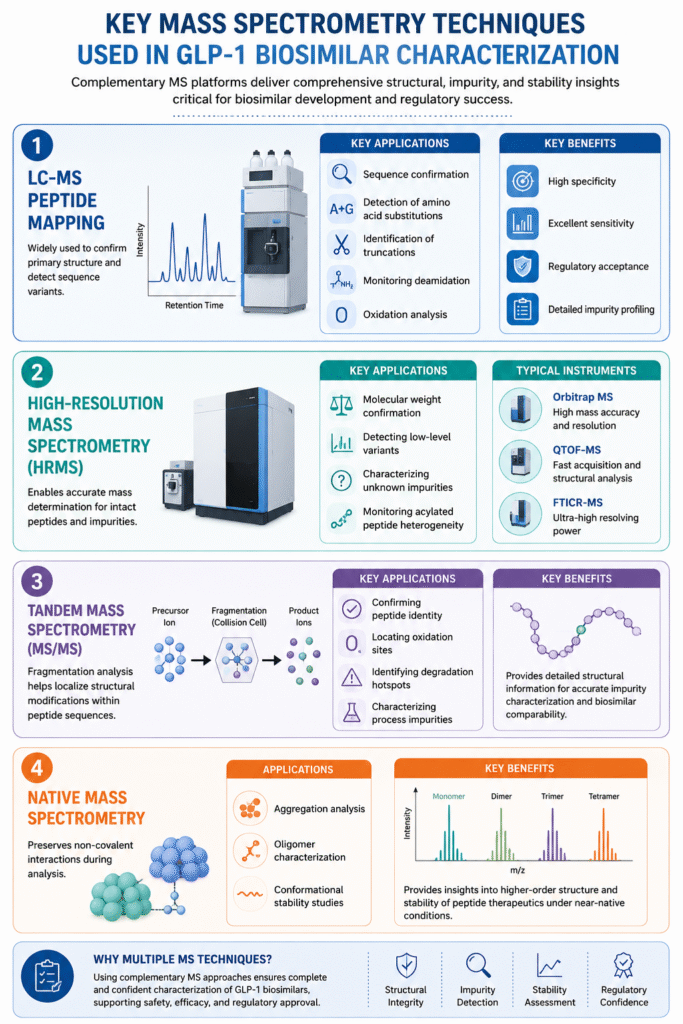
Comprehensive GLP-1 Biosimilar Characterization typically requires multiple complementary mass spectrometry techniques. Each analytical platform provides unique structural and impurity-related information necessary for demonstrating biosimilarity, product quality, and regulatory compliance.
1. LC-MS Peptide Mapping
LC-MS peptide mapping is one of the most widely used analytical approaches for peptide therapeutic characterization. It helps confirm the primary amino acid sequence and identify structural variants with high sensitivity. Comprehensive peptide mapping in biosimilars is particularly valuable for detecting subtle molecular differences between biosimilars and reference GLP-1 products.
Key Applications
- Sequence confirmation
- Detection of amino acid substitutions
- Identification of truncation products
- Monitoring deamidation
- Oxidation analysis
Advantages
- High specificity
- Excellent analytical sensitivity
- Strong regulatory acceptance
- Detailed impurity profiling
LC-MS peptide mapping is particularly valuable for detecting subtle molecular differences between biosimilars and reference GLP-1 products.
2. High-Resolution Mass Spectrometry (HRMS)
High-resolution mass spectrometry (HRMS) provides accurate mass measurements for intact peptides, degradation products, and impurities. It is essential for identifying low-level variants that may not be detected using conventional analytical techniques and supports advanced intact mass analysis biosimilars workflows.
Key Applications
- Molecular weight confirmation
- Detection of low-abundance variants
- Characterization of unknown impurities
- Monitoring acylated peptide heterogeneity
Common HRMS Instruments
| Instrument | Key Benefit |
|---|---|
| Orbitrap MS | High mass accuracy and resolution |
| QTOF-MS | Fast acquisition and structural analysis |
| FTICR-MS | Ultra-high resolving power |
HRMS plays a critical role in analyzing complex GLP-1 molecules such as semaglutide, where lipid conjugation can create analytical heterogeneity.
3. Tandem Mass Spectrometry (MS/MS)
Tandem mass spectrometry (MS/MS) uses fragmentation analysis to identify and localize structural modifications within peptide sequences.
MS/MS provides detailed structural information that supports impurity profiling of biosimilars and biosimilar comparability assessments.
Key Applications
- Confirming peptide identity
- Locating oxidation sites
- Identifying degradation hotspots
- Characterizing process-related impurities
MS/MS provides detailed structural information that supports impurity characterization and biosimilar comparability assessments.
4. Native Mass Spectrometry
Although native MS has traditionally been used for large proteins, it is increasingly applied to complex peptide therapeutics and higher-order structural investigations in GLP-1 biosimilar development. Advanced native mass spectrometry for biosimilars workflows are becoming increasingly important for aggregation and conformational analysis.
Applications
- Aggregation analysis
- Oligomer characterization
- Conformational stability studies
Although native MS has traditionally been used for large proteins, it is increasingly applied to complex peptide therapeutics and higher-order structural investigations in GLP-1 biosimilar development.
4: Mass Spectrometry Challenges in Semaglutide Characterization
Semaglutide is considered one of the most analytically complex GLP-1 therapeutics due to its engineered peptide structure and lipid conjugation. These molecular modifications significantly increase the difficulty of accurate GLP-1 Biosimilar Characterization, especially during impurity profiling, stability studies, and comparability assessments.
These molecular modifications significantly increase the difficulty of accurate GLP-1 Biosimilar Characterization, especially during impurity profiling, stability studies, and biosimilar comparability studies.
Advanced LC-HRMS methods are often required to improve sensitivity and resolution while evaluating important critical quality attributes (CQAs) in biosimilars.
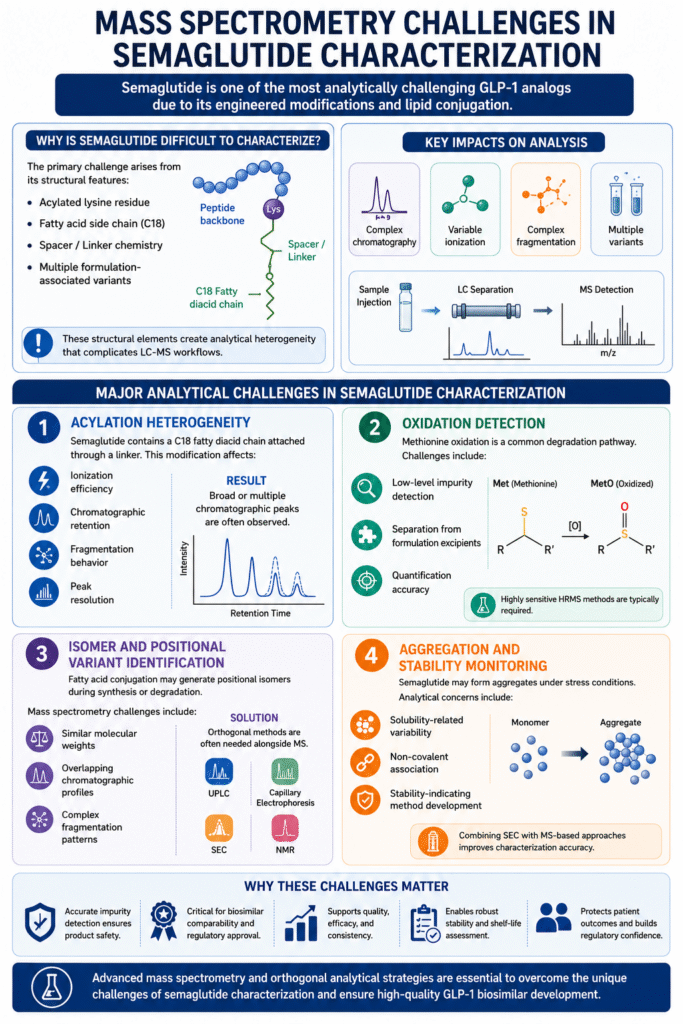
Why Is Semaglutide Difficult to Characterize?
The primary analytical challenges in semaglutide characterization arise from several structural features, including:
- Acylated lysine residue
- Fatty acid side chain
- Spacer/linker chemistry
- Multiple formulation-associated variants
These modifications create substantial analytical heterogeneity that can complicate LC-MS workflows, chromatographic separation, ionization efficiency, and fragmentation analysis.
Major Analytical Challenges in Semaglutide Characterization
1. Acylation Heterogeneity
One of the most significant analytical challenges is semaglutide’s C18 fatty diacid chain attached through a linker to the peptide backbone.
Because oxidative variants may exist at trace levels, highly sensitive high-resolution mass spectrometry (HRMS) workflows and properly designed forced degradation of biosimilars studies are typically necessary for reliable characterization.
This acylation affects several analytical parameters:
- Ionization efficiency
- Chromatographic retention behavior
- Fragmentation patterns
- Peak resolution during LC-MS analysis
As a result, analysts frequently observe broad, split, or multiple chromatographic peaks, making impurity profiling and structural confirmation more complex.
Key Analytical Concerns
| Challenge | Impact on Analysis |
|---|---|
| Variable ionization | Reduced quantification accuracy |
| Lipophilic behavior | Difficult chromatographic separation |
| Complex fragmentation | Challenging MS/MS interpretation |
| Multiple conformations | Broader peak profiles |
Advanced LC-HRMS methods are often required to improve sensitivity and resolution.
2. Oxidation Detection
Methionine oxidation is one of the most common degradation pathways observed in semaglutide formulations.
Analytical Challenges Include
- Detection of low-level oxidative impurities
- Separation from formulation excipients
- Accurate impurity quantification
- Stability-indicating method development
Because oxidative variants may exist at trace levels, highly sensitive high-resolution mass spectrometry (HRMS) workflows are typically necessary for reliable characterization.
3. Isomer and Positional Variant Identification
Fatty acid conjugation and peptide modification processes may generate positional isomers or structurally related variants during synthesis, storage, or degradation.
Orthogonal analytical workflows help confirm structural identity and improve regulatory confidence. In some peptide therapeutics, advanced charge variant analysis in biosimilars mass spectrometry approaches for heterogeneity may also be required to investigate molecular heterogeneity.
Major MS Challenges
- Nearly identical molecular weights
- Overlapping chromatographic profiles
- Similar fragmentation behavior
- Complex MS/MS spectral interpretation
These challenges make it difficult to distinguish closely related variants using a single analytical technique alone.
Common Orthogonal Approaches
To improve characterization accuracy, laboratories often combine MS with:
- UPLC separation
- Capillary electrophoresis
- SEC analysis
- NMR spectroscopy
Orthogonal analytical workflows help confirm structural identity and improve regulatory confidence.
4. Aggregation and Stability Monitoring
Semaglutide may form aggregates or higher-order molecular associations under stress conditions such as temperature fluctuations, agitation, or long-term storage.
Key Analytical Concerns
- Solubility-related variability
- Non-covalent molecular association
- Aggregate formation
- Stability-indicating method validation
Aggregation analysis is particularly important because molecular aggregation can affect:
- Product potency
- Pharmacokinetics
- Immunogenicity risk
- Long-term formulation stability
Combining size exclusion chromatography (SEC) with MS-based analytical techniques significantly improves aggregate characterization and stability assessment accuracy.
5: Mass Spectrometry Challenges in Exenatide Characterization
Exenatide is structurally smaller than semaglutide, but it still presents significant analytical complexities during GLP-1 Biosimilar Characterization. Its sensitivity to multiple degradation pathways makes comprehensive mass spectrometry analysis essential for ensuring product quality, stability, and biosimilar comparability.
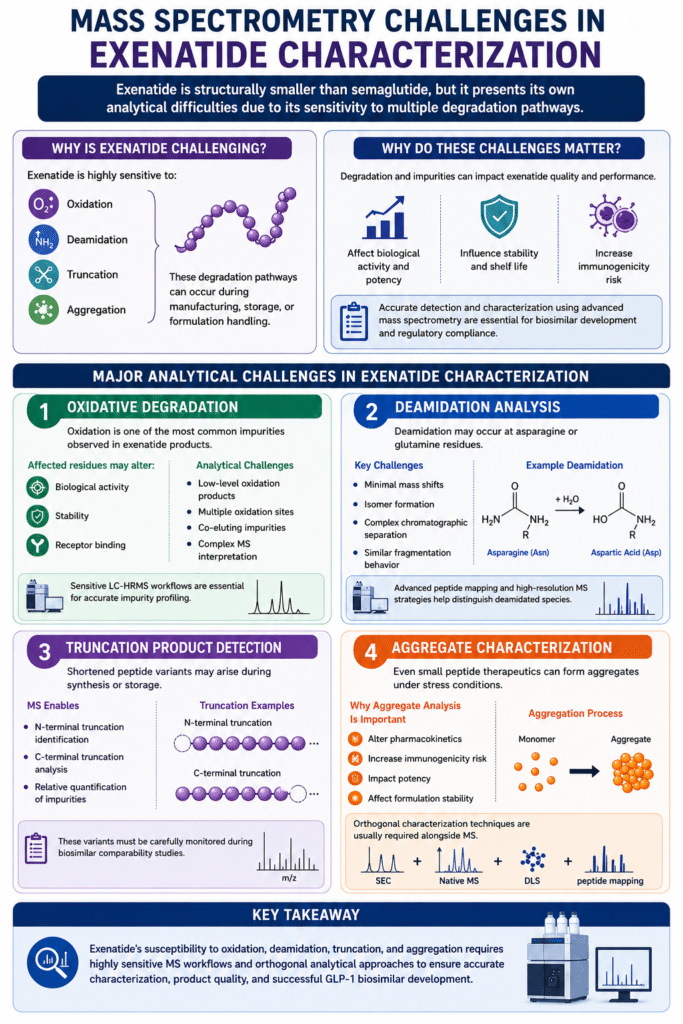
Why Is Exenatide Challenging?
Exenatide is particularly sensitive to several chemical and physical degradation mechanisms, including:
- Oxidation
- Deamidation
- Truncation
- Aggregation
These degradation pathways may occur during:
- Peptide synthesis
- Manufacturing processes
- Storage conditions
- Formulation handling
Because even small molecular modifications can affect biological activity and stability, highly sensitive analytical workflows are required for accurate characterization and reliable biosimilar bioanalysis.
Major Analytical Challenges in Exenatide Characterization
1. Oxidative Degradation
Oxidation is one of the most frequently observed impurities in exenatide formulations and stability studies.
Potential Impact of Oxidation
Oxidative modifications may alter:
- Biological activity
- Peptide stability
- Receptor binding affinity
- Overall therapeutic performance
Analytical Challenges
| Challenge | Analytical Impact |
|---|---|
| Low-level oxidation products | Difficult impurity detection |
| Multiple oxidation sites | Complex spectral interpretation |
| Co-eluting impurities | Reduced chromatographic resolution |
Sensitive LC-HRMS workflows are commonly used to accurately identify and quantify oxidative degradation products.
2. Deamidation Analysis
Deamidation is another critical degradation pathway observed in peptide therapeutics like exenatide.
Because deamidated species may closely resemble the native peptide, advanced peptide mapping and high-resolution MS strategies are essential for accurate differentiation. These studies are commonly integrated into broader biosimilar characterization using mass spectrometry programs.
It commonly occurs at:
- Asparagine residues
- Glutamine residues
Key Analytical Challenges
- Very small mass shifts
- Formation of structural isomers
- Complex chromatographic separation
- Similar fragmentation behavior
Because deamidated species may closely resemble the native peptide, advanced peptide mapping and high-resolution MS strategies are essential for accurate differentiation.
3. Truncation Product Detection
Truncated peptide variants may form during synthesis, purification, storage, or long-term stability studies.
Aggregate characterization often requires:
- Orthogonal analytical methods
- SEC coupled with MS
- Native mass spectrometry for biosimilars
- Stability-indicating analytical workflows
Using multiple complementary techniques improves confidence in impurity detection and biosimilar comparability.
Mass Spectrometry Applications
Mass spectrometry enables:
- N-terminal truncation identification
- C-terminal truncation analysis
- Relative impurity quantification
- Structural confirmation of shortened variants
Why Truncation Monitoring Matters
These variants can potentially affect:
- Product potency
- Stability
- Pharmacokinetics
- Regulatory comparability assessments
As a result, truncation products must be carefully monitored throughout biosimilar development.
4. Aggregate Characterization
Although exenatide is a relatively small peptide therapeutic, it can still form aggregates under stress conditions such as agitation, temperature exposure, or extended storage.
Importance of Aggregate Analysis
Aggregates may:
- Alter pharmacokinetic behavior
- Increase immunogenicity risk
- Reduce therapeutic potency
- Impact formulation stability
Analytical Challenges
Aggregate characterization often requires:
- Orthogonal analytical methods
- SEC coupled with MS
- Native mass spectrometry
- Stability-indicating analytical workflows
Using multiple complementary techniques improves confidence in impurity detection and biosimilar comparability.
6: Future Trends in GLP-1 Biosimilar Characterization
The increasing demand for GLP-1 therapeutics is driving innovation in analytical science.
Emerging analytical strategies are increasingly focused on monitoring complex critical quality attributes (CQAs) in biosimilars and improving analytical throughput through AI-assisted workflows.
Advanced characterization approaches may also integrate:
- glycosylation analysis of biosimilars
- disulfide bond mapping in biosimilars
- Multi-attribute monitoring (MAM)
- Ultra-high-resolution MS platforms
Emerging trends include:
- AI-assisted spectral interpretation
- Ultra-high-resolution MS platforms
- Automated impurity identification
- Multi-attribute monitoring (MAM)
- Native MS for higher-order structure analysis
- Advanced bioinformatics integration
These innovations are expected to improve analytical throughput, sensitivity, and regulatory confidence.
Conclusion:
Comprehensive GLP-1 Biosimilar Characterization is essential for ensuring the quality, safety, and regulatory acceptance of peptide therapeutics such as semaglutide and exenatide. Due to the structural complexity of these molecules, advanced mass spectrometry techniques play a central role in identifying impurities, confirming molecular integrity, and supporting biosimilar comparability studies.
Semaglutide presents unique analytical challenges because of its lipid conjugation and heterogeneity, while exenatide requires sensitive monitoring for oxidation, deamidation, and truncation impurities. Successful characterization therefore depends on a combination of high-resolution mass spectrometry, peptide mapping, orthogonal analytical techniques, and deep scientific expertise in biosimilar characterization using mass spectrometry.
As GLP-1 therapeutics continue to expand globally, robust analytical characterization strategies will remain critical for accelerating biosimilar development and ensuring regulatory success.
Frequently Asked Questions:
Mass spectrometry helps identify peptide sequences, impurities, and structural modifications with very high sensitivity. It supports impurity profiling, degradation analysis, and biosimilar comparability studies. Even small molecular differences can affect therapeutic performance and stability. MS-based workflows provide detailed analytical data required by regulatory agencies. Techniques like LC-MS and HRMS are especially important for complex peptide therapeutics. They improve confidence in product quality and consistency.
Semaglutide contains complex structural modifications including fatty acid conjugation and linker chemistry. These modifications create analytical heterogeneity during LC-MS analysis. Challenges include variable ionization efficiency, difficult chromatographic separation, and complex fragmentation patterns. Multiple formulation-related variants may also appear during analysis. Advanced HRMS and orthogonal analytical techniques are often required. Accurate characterization is critical for biosimilar comparability and stability assessment.
Exenatide is highly sensitive to oxidation, deamidation, truncation, and aggregation. These degradation pathways may occur during manufacturing, storage, or formulation handling. Structural modifications can affect peptide stability, potency, and receptor binding. Advanced mass spectrometry techniques help detect and characterize these impurities. Monitoring degradation products is important for regulatory compliance and product quality. Proper analytical control ensures consistent therapeutic performance.
HRMS provides highly accurate molecular weight measurements for peptides and impurities. It helps detect low-level variants that may not be visible using conventional analytical methods. HRMS is especially useful for characterizing unknown impurities and degradation products. The technique also supports structural confirmation and heterogeneity analysis. Instruments such as Orbitrap and QTOF-MS are commonly used. HRMS plays a major role in GLP-1 biosimilar characterization workflows.
Oxidation can alter peptide stability, biological activity, and receptor binding properties. Oxidative degradation may reduce product efficacy and affect long-term stability. Certain amino acid residues are particularly sensitive to oxidation during storage and manufacturing. Sensitive LC-HRMS workflows are required for accurate detection of oxidative impurities. Monitoring oxidation is essential for biosimilar quality assessment. Proper control helps ensure safety and therapeutic consistency.
Deamidation analysis is difficult because it produces very small mass changes that are challenging to detect. The process may also generate structural isomers with similar analytical behavior. Chromatographic separation of deamidated species can be complex. Advanced peptide mapping and HRMS methods are often necessary for accurate identification. Deamidation may affect peptide stability and biological performance. Careful monitoring is important during biosimilar development and stability studies.
Regulatory agencies such as the FDA and EMA require extensive analytical characterization for biosimilar approval. Developers must demonstrate structural similarity, impurity control, and stability comparability. Agencies also expect validated analytical methods and orthogonal characterization strategies. Mass spectrometry plays a central role in regulatory submissions. Detailed impurity profiling and degradation analysis are especially important. Comprehensive characterization supports product safety and efficacy claims.
Reference
- Wen J, Razick A, How‐Volkman C, Bernstein E, Nadora D, Truong A, Razick D, Akhtar M, Karabala M, Frezza E. An exploratory analysis of glucagon‐like peptide‐1 (GLP‐1) agonists and biosimilars: A literature review. Diabetes, Obesity and Metabolism. 2025 Mar;27(3):1113-22.https://dom-pubs.onlinelibrary.wiley.com/doi/abs/10.1111/dom.16110
- Hach M, Engelund DK, Mysling S, Mogensen JE, Schelde O, Haselmann KF, Lamberth K, Vilhelmsen TK, Malmstrøm J, Højlys-Larsen KB, Rasmussen TS. Impact of manufacturing process and compounding on properties and quality of follow-On GLP-1 polypeptide drugs. Pharmaceutical Research. 2024 Oct;41(10):1991-2014.https://link.springer.com/article/10.1007/s11095-024-03771-6
- Staby A, Steensgaard DB, Haselmann KF, Marino JS, Bartholdy C, Videbæk N, Schelde O, Bosch-Traberg H, Spang LT, Asgreen DJ. Influence of Production Process and Scale on Quality of Polypeptide Drugs: a Case Study on GLP-1 Analogs: Staby et al. Pharmaceutical Research. 2020 Jul;37(7):120.https://link.springer.com/article/10.1007/s11095-020-02817-9
- De Groot AS, Mattei A, Gabriel B, Calderini J, Roberts BJ, Lelias S, McAllister M, Boyle C, Martin W, Richard G. Immunogenicity of generic peptide impurities: current orthogonal approaches. Pharmaceutical research. 2025 May;42(5):805-18.https://link.springer.com/article/10.1007/s11095-025-03843-1
About the Author