

Introduction:
When developing a next-generation injectable, implantable, or targeted therapy using poly(lactic-co-glycolic acid) (PLGA), one of the most consequential early decisions is platform geometry. The debate of PLGA nanoparticles vs microspheres is not merely academic — it directly shapes pharmacokinetics, manufacturing complexity, regulatory strategy, and ultimately patient outcomes.
At ResolveMass Laboratories Inc., our formulation scientists work daily at this intersection, translating fundamental polymer science into clinically viable drug products. This guide lays out the core differences, decision criteria, and real-world application contexts so that pharmaceutical developers, biotech innovators, and research teams can make an informed platform selection from the outset.
Developers evaluating polymer selection should also understand the role of PLGA polymer grade in long-acting release formulation, since molecular weight, end-group chemistry, and lactide:glycolide ratio strongly influence release kinetics and formulation stability.
For injectable and implantable systems, selecting the appropriate PLGA (poly(lactic-co-glycolic acid)) for parenteral use is equally critical for ensuring biocompatibility, degradation performance, and regulatory acceptance.
Summary:
- PLGA nanoparticles (1–1000 nm) excel at cellular uptake, BBB penetration, IV delivery, and targeted oncology applications.
- PLGA microspheres (1–1000 µm) are the platform of choice for sustained/depot release, injectable implants, and pulmonary drug delivery.
- The right choice depends on your route of administration, release duration target, therapeutic molecule, and regulatory pathway.
- ResolveMass Laboratories Inc. provides end-to-end PLGA formulation development, characterization, and scale-up services for both platforms.
- Key decision factors include particle size, drug loading efficiency, release kinetics, manufacturing scalability, and clinical precedent.
1: What Are PLGA Nanoparticles?
PLGA nanoparticles are colloidal drug delivery systems typically ranging from 1 to 1000 nanometers in diameter, designed to encapsulate small molecules, peptides, proteins, vaccines, or nucleic acids for controlled intracellular or systemic delivery. Their nanoscale size allows efficient interaction with biological systems, making them highly valuable in targeted and advanced therapeutic applications.
PLGA (poly(lactic-co-glycolic acid)) is an FDA-approved biodegradable and biocompatible copolymer that degrades through hydrolysis into lactic acid and glycolic acid, both of which are naturally metabolized by the body. Because of their favorable safety profile and tunable degradation kinetics, PLGA nanoparticles are widely used in pharmaceutical research, biologics, oncology, vaccine delivery, and precision medicine.
For complex generic and forensic formulation analysis, developers increasingly rely on PLGA reverse engineering CRO services to identify polymer composition, particle architecture, and release mechanisms.
Advanced analytical workflows such as PLGA characterization methods are essential for understanding nanoparticle stability, degradation, encapsulation efficiency, and critical quality attributes.
Common fabrication methods: nanoprecipitation, double emulsion solvent evaporation, and microfluidics-assisted preparation.
2: What Are PLGA Microspheres?
PLGA microspheres are spherical biodegradable particulate delivery systems typically ranging from 1 to 1000 micrometers in diameter. They are primarily designed for sustained-release depot formulations and localized drug delivery applications where therapeutic release over weeks or months is required.
Unlike nanoparticles, PLGA microspheres are generally too large for efficient cellular internalization. Instead, they function as controlled-release depots that gradually degrade at the site of administration, continuously releasing the encapsulated drug over an extended period. This makes them highly effective for reducing dosing frequency and improving patient compliance in chronic therapies.
PLGA (poly(lactic-co-glycolic acid)) is a well-established FDA-approved biodegradable polymer that hydrolyzes into lactic acid and glycolic acid, both naturally metabolized by the body. Because of its excellent safety profile, tunable degradation kinetics, and extensive clinical history, PLGA microsphere technology has become a cornerstone of long-acting injectable drug development.
PLGA microsphere technology has become a cornerstone of long-acting injectable drug delivery technologies because of its excellent safety profile, tunable degradation kinetics, and extensive clinical history.
Organizations developing depot formulations often invest heavily in PLGA microsphere formulation development to optimize burst release, particle morphology, encapsulation efficiency, and long-term stability.
Key Characteristics of PLGA Microspheres
PLGA microspheres offer several important advantages for sustained-release pharmaceutical formulations, including:
- Depot release durations ranging from 1 week to 6 months
- High drug loading capacity for small molecules, peptides, and biologics
- Controlled and predictable release kinetics
- Reduced dosing frequency and improved patient adherence
- Compatibility with subcutaneous (SC) and intramuscular (IM) injections
- Potential for localized therapy with reduced systemic toxicity
- Applications in inhalable microsphere systems for pulmonary drug delivery
Because of their larger particle size and slower polymer degradation, microspheres are especially suitable for therapies requiring long-term drug exposure rather than rapid intracellular delivery.
Common fabrication methods include solvent evaporation, spray drying, and coacervation.
Several successful commercial depot products have highlighted both the opportunities and technical hurdles associated with peptide encapsulation. For example, Leuprolide depot formulation challenges illustrate the importance of polymer selection, peptide stability, and release control in long-acting injectable systems.
Similarly, reverse engineering of PLGA polymer in Lupron Depot® demonstrates how analytical characterization supports generic development and formulation optimization.
Developers working on generic LAIs also benefit from detailed PLGA characterization of Lupron Depot® studies to understand polymer attributes and release performance.
3: PLGA Nanoparticles vs Microspheres: Head-to-Head Comparison
| Parameter | PLGA Nanoparticles | PLGA Microspheres |
|---|---|---|
| Size Range | 1 – 1000 nm | 1 – 1000 µm |
| Primary Release Mechanism | Diffusion + erosion (rapid–moderate) | Erosion + diffusion (slow–extended) |
| Typical Release Duration | Hours to days | Days to months |
| Cellular Uptake | High (endocytosis) | Low to none |
| Routes of Administration | IV, intranasal, ocular, oral | SC, IM, pulmonary, intra-articular |
| Targeting Capability | Active (surface ligands) + passive (EPR) | Primarily passive/local |
| Drug Loading | Moderate (5–20%) | High (up to 40–50%) |
| Sterilization Compatibility | Gamma, filtration (size-dependent) | Gamma irradiation, EO gas |
| Scale-Up Complexity | Moderate–High | Moderate |
| Regulatory Precedent | Growing (oncology, CNS) | Extensive (depot injectables) |
| Burst Release Risk | Higher | Lower (when optimized) |
| Cost of Goods | Moderate–High | Moderate |
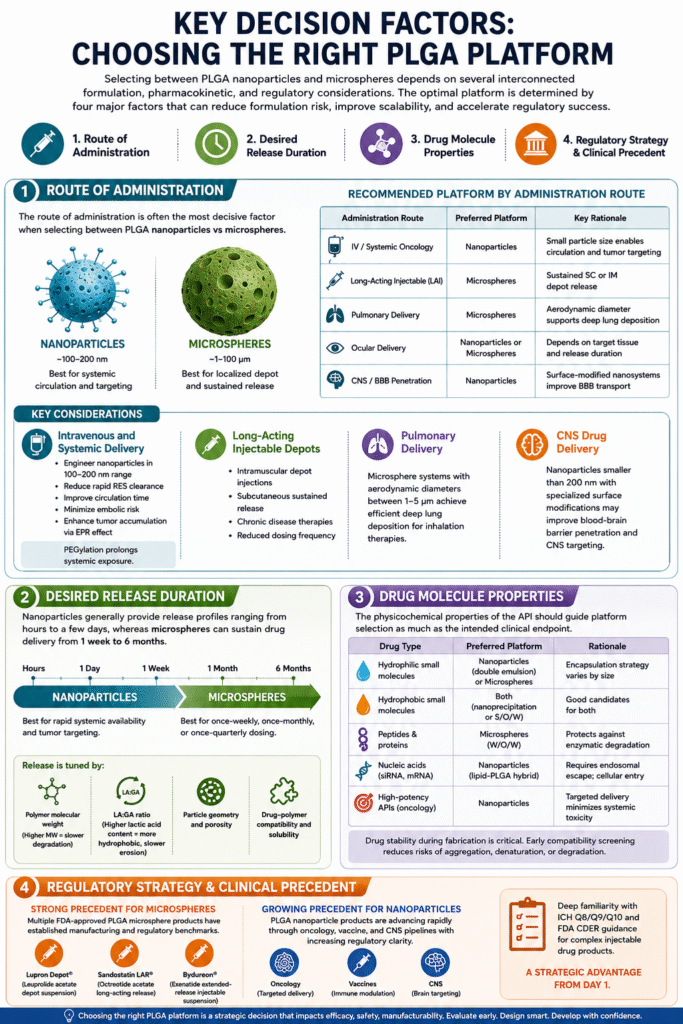
4: Key Decision Factors: Choosing the Right PLGA Platform
Selecting between PLGA nanoparticles and microspheres depends on several interconnected formulation, pharmacokinetic, and regulatory considerations. In most drug development programs, the optimal platform is determined by four major factors:
- Route of administration
- Desired release duration
- Drug molecule properties
- Regulatory strategy and clinical precedent
Understanding these variables early in development can significantly reduce formulation risk, improve scalability, and accelerate regulatory success.
1. Route of Administration
The route of administration is often the most decisive factor when selecting between PLGA nanoparticles vs microspheres.
Intravenous delivery typically requires nanoparticles because large particles may cause embolic risks or rapid clearance. In contrast, long-acting depot injections are generally best suited for microsphere systems that remain localized at the injection site and release drug gradually over time.
For implantable sustained-release systems, case studies such as PLGA for oncology implant applications and dexamethasone implant PLGA characterization provide valuable insight into polymer behavior and release optimization.
Recommended Platform by Administration Route
| Administration Route | Preferred Platform | Key Rationale |
|---|---|---|
| IV / Systemic Oncology | Nanoparticles | Small particle size enables circulation and tumor targeting |
| Long-Acting Injectable (LAI) | Microspheres | Sustained SC or IM depot release |
| Pulmonary Delivery | Microspheres | Aerodynamic diameter supports deep lung deposition |
| Ocular Delivery | Nanoparticles or Microspheres | Depends on target tissue and release duration |
| CNS / BBB Penetration | Nanoparticles | Surface-modified nanosystems improve BBB transport |
Key Considerations:
Intravenous and Systemic Delivery
For IV administration, nanoparticles are generally engineered within the 100–200 nm range to:
- Reduce rapid RES clearance
- Improve circulation time
- Minimize embolic risk
- Enhance tumor accumulation through the EPR effect
PEGylation is commonly used to further prolong systemic exposure.
Long-Acting Injectable Depots
Microspheres are highly effective for:
- Intramuscular depot injections
- Subcutaneous sustained release
- Chronic disease therapies
- Reduced dosing frequency
Manufacturers pursuing commercial LAI programs must also understand GMP PLGA requirements to ensure polymer consistency, traceability, and regulatory compliance throughout scale-up and manufacturing.
Pulmonary Delivery
Microsphere systems designed with aerodynamic diameters between 1–5 µm can achieve efficient deep lung deposition for inhalation therapies.
CNS Drug Delivery
Nanoparticles smaller than 200 nm with specialized surface modifications may improve blood-brain barrier penetration and CNS targeting.
2. Desired Release Duration
Nanoparticles generally provide release profiles of hours to a few days; microspheres deliver from 1 week to 6 months.
If your clinical goal requires once-weekly, once-monthly, or once-quarterly dosing, the microsphere platform is almost universally preferred. Conversely, if rapid systemic availability combined with tumor targeting is the objective, nanoparticles offer superior performance.
At ResolveMass Laboratories Inc., our team designs PLGA formulations by carefully tuning:
- Polymer molecular weight (higher MW = slower degradation)
- LA:GA ratio (higher lactic acid content = more hydrophobic, slower erosion)
- Particle geometry and porosity
- Drug–polymer compatibility and solubility
Developers sourcing excipients for these systems should also evaluate the benefits of selecting the right PLGA supplier because polymer quality variability can significantly affect reproducibility and release performance.
3. Drug Molecule Properties
The physicochemical properties of the API should guide platform selection as much as clinical endpoints.
Peptides and biologics, for example, often require specialized encapsulation approaches to maintain stability and bioactivity. Advanced PLGA peptide delivery systems are increasingly used to achieve prolonged therapeutic exposure while minimizing peptide degradation.
Similarly, oncology formulations involving cytotoxic compounds frequently leverage highly potent APIs formulated using PLGA microspheres to reduce systemic toxicity and improve localized exposure.
The physicochemical properties of your API should guide platform selection as much as clinical endpoints.
| Drug Type | Preferred Platform | Rationale |
|---|---|---|
| Hydrophilic small molecules | Nanoparticles (double emulsion) or Microspheres | Encapsulation strategy varies by size |
| Hydrophobic small molecules | Both (nanoprecipitation or S/O/W) | Good candidates for both |
| Peptides & proteins | Microspheres (W/O/W) | Protects against enzymatic degradation |
| Nucleic acids (siRNA, mRNA) | Nanoparticles (lipid-PLGA hybrid) | Requires endosomal escape; cellular entry |
| High-potency APIs (oncology) | Nanoparticles | Targeted delivery minimizes systemic toxicity |
4. Regulatory Strategy and Clinical Precedent
Microspheres carry a deeper regulatory track record for depot injectables, while nanoparticle-based PLGA products are an increasingly established category with clear FDA guidance.
Multiple FDA-approved PLGA microsphere products (Lupron Depot®, Sandostatin LAR®, Bydureon®) have established manufacturing and regulatory benchmarks. PLGA nanoparticle products are advancing through oncology and CNS pipelines with growing regulatory clarity under the FDA’s nanotechnology guidance framework.
ResolveMass Laboratories Inc. maintains deep familiarity with both ICH Q8/Q9/Q10 frameworks and FDA CDER guidance for complex injectable drug products — a critical advantage when designing your development strategy from Day 1.
Commercial products such as Lupron Depot and Bydureon continue to shape industry standards for PLGA-based long-acting injectables.
For example, Exenatide PLGA microsphere characterization case studies demonstrate how peptide–polymer interactions influence release kinetics, aggregation behavior, and formulation stability.
Companies developing generic equivalents increasingly depend on PLGA reverse engineering for ANDA programs and advanced PLGA polymer characterization for generics to establish Q1/Q2 sameness and support bioequivalence strategies.
In addition, reverse engineering risperidone PLGA microspheres highlights the growing importance of analytical deconvolution in complex injectable generic development.
5: When to Choose PLGA Nanoparticles
PLGA nanoparticles are the preferred platform when the therapeutic objective requires cellular internalization, systemic targeting, or transport across complex biological barriers such as the blood-brain barrier (BBB).
Because of their nanoscale size, high surface-area-to-volume ratio, and tunable surface chemistry, PLGA nanoparticles can interact efficiently with tissues, cells, and intracellular pathways that are inaccessible to larger particulate systems such as microspheres.
In general, PLGA nanoparticles are most suitable when your formulation strategy requires:
- Intracellular drug delivery
- Targeted tissue accumulation
- Enhanced bioavailability
- Rapid systemic distribution
- Barrier penetration
- Controlled short- to medium-term release
Ideal Applications for PLGA Nanoparticles:
1. Oncology Drug Delivery
PLGA nanoparticles are extensively used in oncology because they can improve tumor targeting while reducing systemic toxicity.
Why Nanoparticles Work Well in Cancer Therapy
Tumor tissues often exhibit:
- Leaky vasculature
- Poor lymphatic drainage
This allows nanoparticles to accumulate preferentially through the Enhanced Permeability and Retention (EPR) effect.
In addition, nanoparticles can be functionalized with ligands for active tumor targeting, improving:
- Cellular uptake
- Tumor selectivity
- Intracellular drug delivery
Oncology Advantages
- Reduced off-target toxicity
- Enhanced tumor accumulation
- Improved pharmacokinetics
- Controlled drug release
- Potential multidrug co-delivery
PLGA nanoparticles are especially promising for:
- Chemotherapeutics
- Immuno-oncology agents
- Combination therapies
- Theranostic applications
2. CNS Therapeutics and BBB Penetration
Crossing the blood-brain barrier remains one of the greatest challenges in CNS drug development.
PLGA nanoparticles can improve BBB transport through:
- Receptor-mediated transcytosis
- Surface ligand engineering
- PEGylation strategies
- Controlled nanoscale particle sizing
Common CNS Applications
- Neurodegenerative disorders
- Brain tumors
- Epilepsy
- CNS inflammation
- Gene delivery to neural tissues
Nanoparticles smaller than approximately 200 nm are often preferred for CNS targeting because they exhibit:
- Better vascular transport
- Reduced clearance
- Improved tissue penetration
3. Gene and RNA Delivery
PLGA nanoparticles are highly valuable for intracellular nucleic acid delivery because gene therapies require:
- Cellular uptake
- Cytoplasmic release
- Protection from nuclease degradation
Therapeutic Payloads Commonly Delivered
- siRNA
- mRNA
- DNA plasmids
- CRISPR-related payloads
Hybrid lipid-PLGA nanoparticle systems are increasingly used to improve:
- Endosomal escape
- Transfection efficiency
- Payload stability
Benefits for Nucleic Acid Delivery
- Improved intracellular transport
- Reduced degradation
- Controlled release kinetics
- Enhanced targeting capability
4. Ophthalmic Drug Delivery
PLGA nanoparticles are widely explored in ocular drug delivery because they can improve penetration into both anterior and posterior eye segments.
Ophthalmic Advantages
- Prolonged ocular retention
- Improved corneal penetration
- Reduced dosing frequency
- Sustained therapeutic exposure
Potential Applications
- Retinal disorders
- Glaucoma
- Macular degeneration
- Ocular inflammation
- Anti-VEGF delivery
Their small particle size makes them particularly useful for targeting tissues that are difficult to access using conventional ophthalmic formulations.
5. Oral Delivery of Poorly Soluble Drugs
PLGA nanoparticles can significantly improve oral bioavailability of poorly soluble compounds, especially BCS Class II and IV drugs.
Mechanisms of Improvement
Nanoparticles enhance absorption through:
- Increased dissolution rate
- Mucosal adhesion
- Enhanced epithelial transport
- Protection from gastrointestinal degradation
Suitable Applications
- Poorly water-soluble APIs
- Peptide therapeutics
- Oral anticancer agents
- Drugs with extensive first-pass metabolism
This strategy can improve systemic exposure while reducing dose variability.
6: When to Choose PLGA Microspheres
sustained local or systemic drug release over extended periods ranging from weeks to several months. They are especially valuable for depot-based therapies designed to reduce dosing frequency, improve patient adherence, and maintain stable therapeutic drug levels.
Unlike nanoparticles, PLGA microspheres are generally not intended for intracellular uptake or systemic tissue targeting. Instead, they function as biodegradable drug reservoirs that gradually release the encapsulated therapeutic as the polymer matrix degrades over time.
In most pharmaceutical applications, PLGA microspheres are selected when the formulation strategy requires:
- Long-acting controlled release
- Depot injection capability
- Reduced dosing frequency
- Improved patient compliance
- Localized sustained therapy
- Predictable pharmacokinetics over extended durations
Ideal use cases include:
- Hormonal therapies: Monthly or quarterly depot injections (e.g., LHRH agonists)
- Antipsychotics and CNS disorders: Long-acting injectables for compliance-sensitive populations
- Diabetes / metabolic disease: GLP-1 agonist weekly depots
- Orthopedic / intra-articular: Local sustained anti-inflammatory or analgesic delivery
- Pulmonary delivery: Inhalable microspheres for respiratory disease management
7: Manufacturing and Scale-Up Considerations
Both platforms present unique manufacturing challenges; microspheres generally have a more established GMP manufacturing infrastructure, while nanoparticle processes increasingly benefit from microfluidics and continuous manufacturing.
Key manufacturing considerations:
- Batch reproducibility: Critical quality attributes (CQAs) such as particle size distribution (PSD), encapsulation efficiency (EE%), and residual solvent levels must be tightly controlled for both platforms.
- Sterile manufacturing: Aseptic processing or terminal sterilization must be evaluated early; nanoparticles may allow sterile filtration (if <220 nm) while microspheres typically require gamma irradiation validation.
- Scale-up path: Spray drying and double-emulsion solvent evaporation for microspheres have well-defined GMP precedents; nanoparticle manufacturing via microfluidics offers tighter PSD control and emerging continuous manufacturing options.
- Lyophilization: Both platforms may require lyophilization for shelf-life stability; cryoprotectant optimization is critical to preserve particle architecture.
At ResolveMass Laboratories Inc., we apply Design of Experiments (DoE) and Quality by Design (QbD) principles at every stage of PLGA formulation development — from pre-formulation screening through process development, scale-up, and technology transfer.
8: Characterization: What to Measure and Why
A rigorous characterization package is non-negotiable for both platforms. The table below outlines the critical quality attributes our laboratory team assesses:
| CQA | Analytical Method | Both Platforms? |
|---|---|---|
| Particle size & PDI | DLS, NTA, laser diffraction | Yes |
| Zeta potential | Electrophoretic light scattering | Yes (critical for NP stability) |
| Encapsulation efficiency | HPLC / UV-Vis after extraction | Yes |
| In vitro release | Dialysis, USP4 flow-through cell | Yes |
| Morphology | SEM, TEM, AFM | Yes |
| Residual solvent | GC headspace analysis | Yes |
| Molecular weight of PLGA | GPC / SEC | Yes |
| Aerodynamic diameter | NGI cascade impaction | Microspheres (pulmonary) |
| Surface ligand density | Fluorescence, XPS | Nanoparticles (targeted) |
Conclusion:
The decision between PLGA nanoparticles vs microspheres ultimately hinges on the clinical objective, therapeutic molecule, route of administration, and the release profile needed to achieve both efficacy and patient compliance. Neither platform is inherently superior — each is purpose-built for a distinct class of drug delivery challenges.
- Select nanoparticles for targeted, intracellular, or barrier-crossing applications where particle size below 200 nm and surface engineering are paramount.
- Select microspheres for sustained depot delivery, long-acting injectables, and applications where weeks-to-months release durations reduce dosing burden.
- When in doubt, a formulation feasibility study — comparing both platforms head-to-head with your specific API — is the most scientifically defensible starting point.
At ResolveMass Laboratories Inc., our team of experienced pharmaceutical scientists brings deep hands-on expertise in PLGA-based drug delivery system design, characterization, and GMP-ready manufacturing. Whether you are in early discovery, IND-enabling studies, or scale-up, we are your dedicated formulation partner.
Frequently Asked Questions:
PLGA nanoparticles are preferred when the drug delivery application requires:
-Cellular internalization
-Tumor targeting
-Blood-brain barrier penetration
-Gene or RNA delivery
-Enhanced bioavailability
They are commonly used in oncology, CNS therapeutics, ophthalmics, and precision medicine applications.
PLGA microspheres provide sustained drug release for extended periods ranging from weeks to several months. Their larger particle size allows them to form biodegradable depots after subcutaneous or intramuscular injection, reducing dosing frequency and improving patient compliance.
Yes. PLGA (poly(lactic-co-glycolic acid)) is an FDA-approved biodegradable and biocompatible polymer widely used in pharmaceutical drug delivery systems, implantable devices, and long-acting injectable formulations.
PLGA microspheres are particularly effective for:
-Peptide therapeutics
-Hormonal therapies
-Antipsychotics
-GLP-1 agonists
-Local anti-inflammatory drugs
-Sustained-release analgesics
These formulations are ideal when prolonged therapeutic exposure is required.
Yes. PLGA nanoparticles are widely investigated for delivery of:
-mRNA
-siRNA
-DNA therapeutics
-CRISPR-related payloads
Their nanoscale size and intracellular uptake capability make them highly suitable for advanced gene and RNA therapies.
Key formulation challenges include:
-Particle aggregation
-Burst release
-Sterility maintenance
-Low encapsulation efficiency
-Scale-up reproducibility
-Complex analytical characterization
Advanced formulation optimization and analytical testing are essential for successful development.
Reference
- Lagreca E, Onesto V, Di Natale C, La Manna S, Netti PA, Vecchione R. Recent advances in the formulation of PLGA microparticles for controlled drug delivery. Progress in biomaterials. 2020 Dec;9(4):153-74.https://link.springer.com/article/10.1007/s40204-020-00139-y
- Su Y, Zhang B, Sun R, Liu W, Zhu Q, Zhang X, Wang R, Chen C. PLGA-based biodegradable microspheres in drug delivery: recent advances in research and application. Drug delivery. 2021 Jan 1;28(1):1397-418.https://www.tandfonline.com/doi/abs/10.1080/10717544.2021.1938756
- Guo X, Zuo X, Zhou Z, Gu Y, Zheng H, Wang X, Wang G, Xu C, Wang F. PLGA-based micro/nanoparticles: an overview of their applications in respiratory diseases. International Journal of Molecular Sciences. 2023 Feb 22;24(5):4333.https://www.mdpi.com/1422-0067/24/5/4333
- Martins C, Sousa F, Araújo F, Sarmento B. Functionalizing PLGA and PLGA derivatives for drug delivery and tissue regeneration applications. Advanced healthcare materials. 2018 Jan;7(1):1701035.https://advanced.onlinelibrary.wiley.com/doi/abs/10.1002/adhm.201701035
- Martinez-Borrajo R, Diaz-Rodriguez P, Landin M. Rationalized design to explore the full potential of PLGA microspheres as drug delivery systems. Drug delivery. 2023 Dec 31;30(1):2219864.https://www.tandfonline.com/doi/abs/10.1080/10717544.2023.2219864
About the Author


