

Introduction: Why Technique Selection Is the Foundation of Every E&L Study
In GC-MS vs LC-MS in Extractables and Leachables Testing, selecting the appropriate analytical technique is far more than a matter of laboratory convenience or instrument availability. It is a critical scientific and regulatory decision that directly influences whether an extractables profile is comprehensive, whether leachables data can withstand regulatory scrutiny, and whether toxicological safety thresholds are calculated with confidence and accuracy. Selecting the wrong analytical platform for a specific compound class can result in undetected analytes, incomplete characterization, or quantitative data that may not satisfy the expectations of regulatory authorities such as the FDA, EMA, or Health Canada.
At ResolveMass Laboratories Inc., analytical chemists and regulatory specialists have designed and executed hundreds of extractables and leachables studies involving parenteral drug products, inhalation therapies, combination products, and single-use bioprocessing systems. The discussion below reflects the level of scientific rigor and regulatory understanding necessary to make informed and defensible instrument selection decisions in modern E&L programs.
To explore how these analytical methodologies are applied globally, you can learn more about ResolveMass extractables and leachables testing protocols.
Share via:
Article Summary:
- GC-MS is widely used for the detection and characterization of volatile and semi-volatile organic compounds, particularly non-polar analytes and compounds released during headspace analysis of elastomers and polymer-based materials.
- LC-MS is more suitable for compounds that are non-volatile, heat-sensitive, highly polar, or possess larger molecular weights, including antioxidants, UV stabilizers, degradation byproducts of plasticizers, and manufacturing-related impurities.
- In most extractables and leachables studies involving container closure systems and drug delivery devices, the combined use of GC-MS and LC-MS is necessary to satisfy the analytical expectations outlined in ISO 10993-18, USP <1663>, and ICH Q3E guidance documents.
- The selection of GC-MS or LC-MS depends primarily on four scientific considerations: analyte volatility, thermal stability, chemical polarity, and the nature of the polymer or material being evaluated.
- Depending on only one analytical platform during an E&L assessment can leave important analytical blind spots and increase the likelihood of overlooking compounds that may present toxicological or regulatory concerns.
- A scientifically sound E&L strategy is built on a risk-based evaluation of compound classes and material chemistry rather than applying a single analytical approach to every study design.
The Compound-Class Divide: What Truly Determines Which Technique Is Required
The primary factor governing GC-MS vs LC-MS selection is the volatility of the analyte combined with its thermal stability. Other analytical considerations, including polarity, ionization behavior, and matrix interactions, remain important but are secondary to this fundamental distinction.
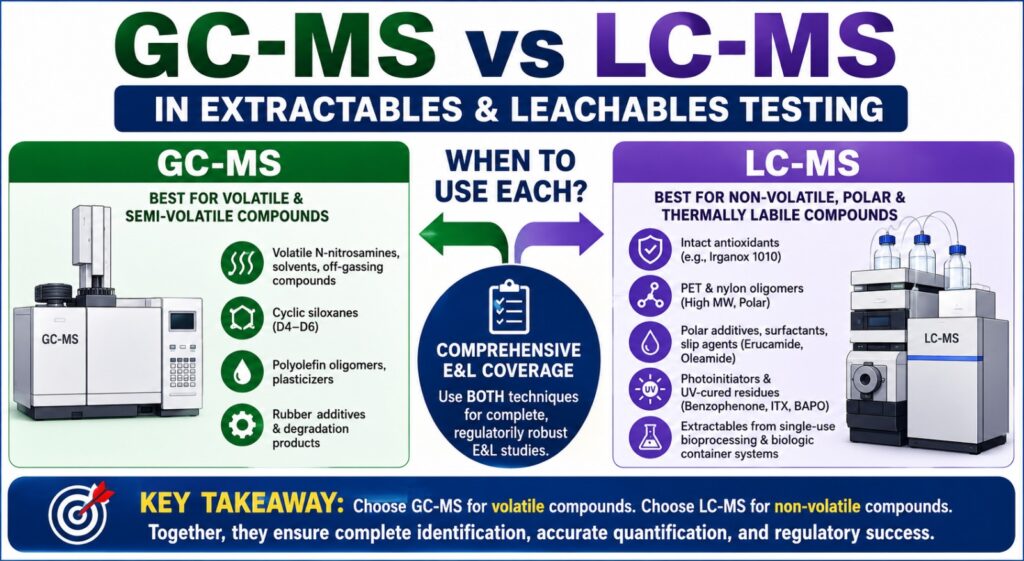
Compounds Best Suited for GC-MS Analysis
GC-MS operates by separating compounds in the gas phase. For an analyte to perform effectively during GC analysis, it must either possess inherent volatility or be capable of derivatization into a volatile form without altering the essential structural features required for accurate identification.
The following compound categories are particularly well suited for GC-MS analysis in E&L investigations:
- Residual monomers and oligomers originating from polyolefins, polyurethanes, and silicone materials, including cyclic siloxanes such as D4, D5, and D6 commonly associated with silicone tubing used in parenteral and inhalation systems
- Processing solvents and plasticizers with low-to-medium boiling points, including acetone, methyl ethyl ketone (MEK), ethyl acetate, DEHP, and DINP
- Volatile degradation products generated from antioxidants such as Irganox 1010, Irganox 1076, and Irgafos 168, all of which produce characteristic GC-compatible fragments upon thermal decomposition
- Rubber vulcanization byproducts including benzothiazole, 2-mercaptobenzothiazole (2-MBT), and N-nitrosamines formed from accelerator systems in EPDM and natural rubber closures
- Off-gassing components released from hot-melt and solvent-based adhesives used in label laminations and medical device assembly
- Volatile compounds released from multilayer films, foils, and packaging materials through static or dynamic headspace GC-MS analysis
One important point frequently overlooked during laboratory selection is that headspace GC-MS remains the only analytically appropriate approach for screening volatile nitrosamines at the ultra-trace sub-ppb concentrations required under recent FDA guidance related to NDMA and NDEA concerns. While LC-MS/MS is often used for confirmatory purposes, the initial screening of volatile N-nitrosamine species in elastomeric closures fundamentally depends on headspace GC-MS methodologies.
To better understand how these selections impact compliance with international guidelines, review the core standards of USP extractables and leachables testing.
Compounds Best Suited for LC-MS Analysis
LC-MS separates analytes in solution and is therefore ideally suited for compounds that would thermally degrade, fail to volatilize, or co-elute under GC conditions.
The following compound classes are generally considered LC-MS specific in E&L testing:
- Intact antioxidants and UV stabilizers such as Irganox 1010 and Tinuvin-series compounds, which are non-volatile and thermally labile. GC-MS can identify only their degradation products rather than the intact parent molecules
- Polar additives and surfactants including slip agents, antiblocking agents, and antistatic compounds such as erucamide, oleamide, and Span/Tween surfactant systems
- Cyclic and linear oligomers from PET and nylon materials in the molecular weight range of approximately 500–2000 Da, which are highly polar and unsuitable for GC analysis
- Residual photoinitiators from UV-cured coatings and inks, including benzophenone, ITX, and BAPO in their unreacted forms
- High-molecular-weight plasticizers such as long-chain phthalate diesters, citrate plasticizers, and adipates
- Colorant and pigment impurities, particularly polar aromatic amines generated from azo pigments that fall under ICH M7 genotoxic impurity considerations
- Leachables associated with biologic container systems, including tungstic acid species, silicone oil oligomers, and barium sulfate particulate contaminants from prefilled syringe assemblies
- Extractables from single-use bioprocessing systems, including antioxidants, processing aids, and oxidative degradation products relevant to biologic manufacturing operations
For specific biological applications, discover how these techniques are applied to extractables and leachables in biopharma production.
Regulatory Framework Alignment: What ISO 10993-18, USP <1663>/<1664>, and ICH Q3E Actually Expect
These regulatory and compendial frameworks do not explicitly mandate the use of GC-MS or LC-MS by name. Instead, they require comprehensive analytical coverage of all plausible extractables and leachables associated with the materials of construction. This distinction is critically important because laboratories that rely exclusively on generalized guidance language may overlook the underlying analytical requirements necessary for complete characterization.
| Framework | Relevance to Technique Selection |
|---|---|
| ISO 10993-18:2020 | Requires exhaustive extraction using multiple solvent systems and orthogonal analytical techniques. Toxicologically driven AET calculations depend on accurate mass assignment, which requires mass spectrometric detection |
| USP <1663> | Recommends a tiered extractables strategy and specifically identifies GC-MS for volatile and semi-volatile compounds while recommending LC-MS or LC-UV for non-volatile analytes |
| USP <1664> | Focuses on establishing the relationship between extractables and observed leachables, requiring analytical selectivity sufficient to detect all compounds identified during extractables assessment |
| ICH Q3E | Represents the most demanding framework for inhalation and nasal products, requiring quantification at extremely low safety concern thresholds of 0.15 µg/day |
The practical implication is straightforward: an E&L program relying solely on GC-MS for products such as prefilled syringes or inhalation devices will not satisfy the expectations of ISO 10993-18 or ICH Q3E because critical non-volatile compound classes, including antioxidants and oligomers, remain analytically uncharacterized.
For a deeper look into real-world agency evaluations, review the FDA extractables and leachables case studies.
When GC-MS Is the Preferred Analytical Approach
GC-MS is the preferred methodology when the material system predominantly releases volatile or semi-volatile organic compounds and when headspace analysis is scientifically appropriate.
Elastomeric Closures: Stoppers, Plungers, and Seals
Rubber-based components including bromobutyl, chlorobutyl, EPDM, and natural rubber are among the most GC-MS-intensive substrates encountered in E&L investigations. Their extractables profiles are typically dominated by:
- N-nitrosamines including NDEA, NDMA, NMBA, and NDBzA, which are considered compounds of concern under ICH M7 guidance
- Vulcanization accelerator degradation products such as benzothiazole derivatives and thiurams
- Processing oils and waxes that generate hydrocarbon distributions readily characterized by GC-MS and FID
- Antidegradants including 6PPD and IPPD, both analytically amenable to GC-MS detection within expected concentration ranges
Polyolefin Films and Single-Use Bags
GC-MS is also highly effective for analyzing:
- Cyclic and linear oligomers derived from LLDPE and LDPE systems within the C20–C40 range
- Residual catalyst fragments associated with Ziegler-Natta polymerization systems, often screened initially by GC-MS and confirmed through ICP-MS analysis
Silicone-Based Components
Silicone tubing, gaskets, and stoppers generate cyclic polysiloxanes ranging from D4 to D10, compounds that are central regulatory concerns in silicone-containing systems. These analytes are fundamentally GC-MS targets because LC-MS ionization efficiency for cyclic siloxanes remains poor, especially at low concentrations in aqueous extraction media.
If your project requires advanced analysis for specialized respiratory delivery devices, read about our E&L testing for inhalation and nasal drug products.
When LC-MS Is the Preferred Analytical Approach
LC-MS becomes indispensable when compounds of concern are non-volatile, thermally unstable, or highly polar.
Intact Antioxidant Identification and Quantification
One of the most critical LC-MS applications in polymer E&L analysis involves the detection and quantification of intact antioxidants.
For example:
- Irganox 1010 possesses a molecular weight of approximately 1177 Da and decomposes prior to volatilization
- GC-MS detects only thermal degradation products such as 3,5-di-tert-butyl-4-hydroxybenzaldehyde and related fragments
- Regulatory reviewers frequently require intact parent compound data because toxicological profiles may differ significantly between parent molecules and degradation products
- LC-MS utilizing ESI or APCI ionization can accurately quantify intact antioxidants at sub-ppm concentrations in standard extraction matrices
PET Oligomers in Drug Contact Applications
Cyclic PET trimers, tetramers, and pentamers are recognized leachables concerns in PET-packaged oral liquids and selected parenteral systems. Their molecular weights, polarity, and thermal instability place them firmly within the analytical scope of LC-MS. Conventional GC-MS methods cannot reliably detect these compounds at concentrations typically observed in aqueous or alcoholic extracts.
Single-Use Bioprocessing Systems
The BioPhorum Operations Group (BPOG) protocol for single-use systems specifically emphasizes LC-MS/MS for non-volatile extractables because biologic manufacturing systems frequently involve:
- Oxidized antioxidant derivatives
- Surface-treatment process residues
- PEG-based surfactants and sorbitan-derived impurities
Photoinitiator Residues from UV-Cured Packaging
For pharmaceutical packaging utilizing UV-cured inks and coatings, LC-MS is essential for:
- Detecting intact photoinitiators such as benzophenone, thioxanthone, and ITX at µg/kg levels
- Monitoring migration through multilayer packaging structures into aqueous simulants
- Supporting ICH Q3E safety concern threshold evaluations
For complex delivery mechanisms, examine how these studies are conducted during E&L testing for pre-filled syringes and similar container closures.
The Necessity of Dual-Technique Deployment
No single analytical platform can provide the complete coverage necessary for a comprehensive E&L program involving modern polymeric materials. Exclusive reliance on either GC-MS or LC-MS creates significant analytical blind spots.
| Compound Class | GC-MS Coverage | LC-MS Coverage | Risk If Missed |
|---|---|---|---|
| Cyclic siloxanes (D4–D6) | Excellent | Poor | Regulatory reproductive toxicity concern |
| Volatile N-nitrosamines | Excellent | Partial | ICH M7 concern |
| Intact Irganox antioxidants | Degradation products only | Excellent | Incomplete toxicological characterization |
| PET cyclic oligomers | Not detectable | Excellent | Potential sensitization concerns |
| 2-Mercaptobenzothiazole | Good | Good | Requires orthogonal confirmation |
| Benzophenone residues | Detectable at high levels | Superior sensitivity | Genotoxic impurity concern |
| Erucamide and oleamide | Limited detection | Excellent | Missed non-volatile additives |
| Higher-order cyclosiloxanes | Reduced sensitivity | Improved detection | Long-term exposure concern |
| DEHP and related plasticizers | Good | Good | Endocrine disruption risk |
| Tungsten species | Not applicable | ICP-MS required | Protein aggregation risk |
To help evaluate project budgets and scope, you can find a breakdown of analytical expenses by checking the cost of extractables and leachables testing.
A Practical Decision Framework for Technique Selection
Step 1: Define the Material System
Identify all materials of construction involved in the product-contact pathway. Polyolefins and PET systems containing antioxidant packages generally require LC-MS analysis, while elastomeric materials involving vulcanization chemistry require GC-MS assessment.
Step 2: Apply a Volatility Assessment
Determine whether each compound class can volatilize below approximately 300°C without decomposition. Volatile compounds are generally assigned to GC-MS. Non-volatile or thermally unstable compounds require LC-MS.
Step 3: Evaluate the Extraction Solvent System
Highly polar extraction media such as water or dilute acidic solutions are generally more compatible with LC-MS workflows. Non-polar solvents including hexane, dichloromethane, and diethyl ether are particularly suitable for GC-MS applications involving non-polar analytes.
Step 4: Align With Applicable Regulatory Expectations
Products governed by ICH Q3E or ISO 10993-18 almost always require both GC-MS and LC-MS methodologies. Lower-risk packaging systems with limited contact duration may permit a GC-MS-focused strategy supplemented by targeted LC-MS analysis for known non-volatile additives.
Step 5: Establish the Analytical Evaluation Threshold (AET)
The AET must be calculated based on the Safety Concern Threshold (SCT) and maximum patient exposure. If the resulting AET falls below 1 µg/mL, both GC-MS and LC-MS methods must demonstrate sufficient sensitivity, typically requiring limits of quantification at or below 10% of the calculated AET.
For specialized advice on configuring these complex steps, review the guidelines on AET for extractables and leachables studies.
GC-MS vs LC-MS in Extractables and Leachables Testing: Method Comparison Summary
| Parameter | GC-MS | LC-MS |
|---|---|---|
| Ideal compound class | Volatile and semi-volatile non-polar analytes | Non-volatile, polar, thermally unstable analytes |
| Typical molecular weight range | Usually below 800 Da | Up to several kDa with HRMS |
| Sample introduction | Solvent injection, headspace, SPME | Reverse-phase, HILIC, ion-pair LC |
| Ionization mode | EI and CI | ESI, APCI, APPI |
| Library matching capability | Excellent using NIST/Wiley libraries | Requires standards or HRMS fragmentation |
| Matrix effects | Lower due to gas-phase separation | Higher; matrix-matched calibration often required |
| Derivatization requirements | Sometimes necessary | Rarely required |
| Established regulatory use | Elastomers, films, volatile extractables | Antioxidants, biologics, SUS applications |
Conclusion
GC-MS vs LC-MS in Extractables and Leachables Testing is fundamentally a question of scientific suitability rather than instrument preference. GC-MS remains the definitive approach for volatile organic extractables associated with elastomers, polyolefins, and silicone-based materials. LC-MS is indispensable for intact antioxidants, non-volatile oligomers, and the increasingly complex extractables profiles encountered in single-use bioprocessing systems and inhalation device applications.
The most scientifically defensible and regulatorily robust E&L programs employ both analytical platforms in a coordinated strategy tailored to the material system, expected compound classes, applicable regulatory guidance, and Analytical Evaluation Threshold requirements.
Ultimately, analytical decisions made during study design represent one of the most important determinants of whether an E&L package successfully withstands regulatory review. A scientifically justified technique selection strategy supported by experienced method development and toxicological risk assessment forms the foundation of every E&L study developed at ResolveMass Laboratories Inc..
If you are looking for a qualified partner to manage your regulatory submissions, consider selecting the best CRO for extractables and leachables (E&L) testing in Canada.
Ready to develop a scientifically rigorous extractables and leachables program for your container closure system, combination product, or single-use bioprocessing platform?
Contact ResolveMass Laboratories Inc. →
Frequently Asked Questions (FAQs)
No, GC-MS by itself is not sufficient for a complete extractables and leachables assessment of a prefilled syringe. These systems contain multiple material types, including elastomeric closures, silicone lubricants, polymeric barrel components, and glass-related manufacturing residues. GC-MS is highly effective for volatile compounds such as nitrosamines and low-molecular-weight siloxanes, but it cannot adequately characterize non-volatile antioxidants, oligomers, or inorganic species like tungsten. To achieve full analytical coverage in accordance with ISO 10993-18 expectations, both GC-MS and LC-MS methods are typically required.
Solvents such as dichloromethane (DCM) and ethyl acetate are commonly preferred for GC-MS extractables studies because they efficiently dissolve a wide range of volatile and semi-volatile organic compounds. These solvents also perform well during GC injection and generally produce cleaner chromatographic backgrounds with reduced column interference. Hexane may be useful for highly lipophilic compounds, including waxes and hydrocarbon fractions, but it can fail to recover moderately polar additives. Although methanol is valuable for LC-MS workflows, it is usually less ideal for GC-MS because water carryover and large solvent peaks can interfere with chromatographic performance.
Headspace GC-MS is typically selected when the target analytes are highly volatile or when the sample matrix is complex, aqueous, or unsuitable for direct injection. This approach minimizes contamination of the GC inlet and column while improving sensitivity for volatile compounds such as residual solvents, nitrosamines, and cyclic siloxanes. Static headspace and SPME-GC-MS methods are especially useful when direct liquid injection could introduce matrix-related complications or suppress analyte signals. In pharmaceutical E&L testing, headspace techniques are often considered the most reliable option for ultra-trace volatile screening.
High-resolution LC-MS platforms such as Orbitrap and Q-TOF systems significantly strengthen unknown compound identification during E&L studies. These instruments provide accurate mass measurements and detailed fragmentation patterns that help analysts identify compounds even when authentic reference standards are unavailable. HRMS is particularly valuable in non-targeted screening workflows because it expands the range of detectable and identifiable extractables. In addition, the enhanced mass accuracy reduces the likelihood of false-positive identifications, which is extremely important when performing toxicological risk assessments for unexpected leachables.
In leachables studies, GC-MS is primarily used to identify and quantify volatile or semi-volatile compounds that migrate into the drug product from packaging materials or delivery systems. These compounds often include residual solvents, low-molecular-weight plasticizers, and volatile degradation products. Because leachables testing involves real or simulated drug formulations, analytical selectivity becomes especially important. While LC-MS/MS is increasingly relied upon for ultra-trace non-volatile leachables, GC-MS remains essential for evaluating volatile contaminants that could impact product safety or stability.
ICH Q3E does not directly mandate the use of specific analytical instruments such as GC-MS or LC-MS. Instead, the guidance focuses on achieving adequate analytical sensitivity based on the Safety Concern Threshold (SCT) and the calculated Analytical Evaluation Threshold (AET). Laboratories must therefore select analytical techniques capable of detecting compounds at or below the required reporting limits. In practice, meeting these low-level sensitivity requirements for inhalation and nasal products usually requires the combined use of both GC-MS and LC-MS methodologies.
Antioxidant assessment generally requires both GC-MS and LC-MS because parent antioxidants and their degradation products behave differently during analysis. Intact antioxidants such as Irganox 1010 are non-volatile and are therefore best analyzed using LC-MS methods. Their thermal or oxidative degradation products, including aldehydes and related volatile compounds, are more effectively characterized by GC-MS. Regulatory toxicologists often evaluate parent compounds and degradants separately, making it important to report both categories accurately within the final E&L package.
Aqueous extracts can create several technical difficulties during GC-MS analysis because water is not an ideal injection solvent for gas chromatography systems. Water introduction may lead to inlet degradation, distorted peak shapes, and interference with early-eluting analytes. In addition, polar compounds often show reduced recovery when transferred into GC-compatible solvents. To overcome these limitations, laboratories commonly use liquid-liquid extraction (LLE), supported liquid extraction (SLE), or SPME techniques prior to analysis in order to improve analyte recovery and maintain chromatographic performance.
Reference:
- International Organization for Standardization. (2020). ISO 10993-18:2020: Biological evaluation of medical devices — Part 18: Chemical characterization of medical device materials within a risk management process (2nd ed.). ISO
- United States Pharmacopeia. (2020). 〈1663〉 Assessment of extractables associated with pharmaceutical packaging/delivery systems. In USP–NF. United States Pharmacopeial Convention. https://doi.org/10.31003/USPNF_M7126_03_01
- United States Pharmacopeia. (2024). 〈1664〉 Assessment of drug product leachables associated with pharmaceutical packaging/delivery systems. In USP–NF. United States Pharmacopeial Convention. https://doi.org/10.31003/USPNF_M7127_04_01
- International Council for Harmonisation of Technical Requirements for Pharmaceuticals for Human Use. (2025). ICH harmonised guideline: Guideline for extractables and leachables Q3E (Draft version, Step 2). https://database.ich.org/sites/default/files/ICH_Q3E_EWG_Step2_DraftGuideline_2025_0704.pdf
- U.S. Food and Drug Administration. (2024). Control of nitrosamine impurities in human drugs: Guidance for industry. U.S. Department of Health and Human Services. https://www.fda.gov/media/70788/download
Get In Touch With Us
About The Author


