

Introduction:
A Biosimilar Forced Degradation Study is a critical analytical exercise used to understand how biosimilar products degrade under stress conditions and how impurities form during storage, manufacturing, and handling. These studies play a major role in demonstrating analytical similarity between a biosimilar and its reference biologic product.
Biologics are inherently complex molecules that can undergo multiple degradation pathways, including oxidation, deamidation, aggregation, fragmentation, and glycation. Regulatory agencies such as the FDA, EMA, and ICH require manufacturers to characterize these degradation products thoroughly to ensure product quality, safety, and efficacy.
Modern LC-MS (Liquid Chromatography–Mass Spectrometry) platforms have transformed forced degradation testing by enabling highly sensitive impurity mapping at peptide and intact protein levels. This analytical capability is especially valuable for monoclonal antibodies, fusion proteins, antibody-drug conjugates, and other complex biosimilars.
At ResolveMass Laboratories Inc., advanced LC-MS workflows are used to support biosimilar developers through detailed degradation characterization and impurity profiling studies aligned with global regulatory expectations.
Summary:
- Biosimilar Forced Degradation Study is essential for identifying degradation pathways, impurity profiles, and product stability.
- Regulatory agencies expect robust forced degradation data to demonstrate biosimilarity and analytical comparability.
- LC-MS-based impurity mapping provides highly sensitive characterization of oxidation, deamidation, aggregation, clipping, and glycation.
- Forced degradation studies help establish product shelf life, formulation robustness, and manufacturing consistency.
- Advanced LC-MS workflows support risk assessment, stability-indicating methods, and regulatory submissions.
- ResolveMass Laboratories Inc. provides specialized biosimilar characterization services using high-resolution mass spectrometry platforms.
1: What Is a Forced Degradation Study for Biosimilars?
A Biosimilar Forced Degradation Study is a scientific evaluation in which a biosimilar drug is intentionally exposed to stress conditions to accelerate degradation and reveal potential stability issues, degradation pathways, and impurity formation. These studies help manufacturers understand how the biosimilar behaves under adverse environmental and chemical conditions.
The primary objectives of a forced degradation study are to determine:
- How the biosimilar molecule degrades
- Which degradation products or impurities are formed
- Whether degradation affects product safety, potency, or efficacy
- How closely the biosimilar matches the reference biologic during stress conditions
Forced degradation studies are commonly conducted during:
- Biosimilar development
- Formulation optimization
- Stability testing programs
- Analytical comparability assessments
- Regulatory submission preparation
Because biosimilars are structurally complex proteins, they can undergo multiple degradation pathways simultaneously. Common degradation mechanisms include oxidation, deamidation, aggregation, fragmentation, glycation, and conformational changes. Advanced analytical tools such as LC-MS are therefore essential for accurately identifying and characterizing these degradation products.
2: Why Biosimilar Forced Degradation Studies Are Important
A Biosimilar Forced Degradation Study is essential for evaluating molecular stability, impurity formation, and analytical comparability between a biosimilar and its reference biologic product. These studies help manufacturers understand how a biosimilar responds to stress conditions and whether degradation could impact product quality, safety, or therapeutic performance.
Forced degradation studies also support the development of robust analytical methods and provide critical scientific evidence required for regulatory submissions.
Key Objectives of Biosimilar Forced Degradation Studies
| Objective | Purpose |
|---|---|
| Identify degradation pathways | Understand molecular vulnerabilities and degradation mechanisms |
| Develop stability-indicating methods | Ensure analytical methods can accurately detect product changes |
| Compare biosimilar vs reference product | Demonstrate analytical similarity under stress conditions |
| Characterize impurities | Assess potential safety and immunogenicity risks |
| Support formulation development | Improve formulation robustness and product stability |
| Establish storage conditions | Determine appropriate shelf-life and storage recommendations |
These studies are particularly important for biologics because protein-based therapeutics are highly sensitive to environmental and chemical stress. Even small structural modifications can affect efficacy, pharmacokinetics, or immunogenicity.
Regulatory agencies such as the FDA, EMA, and ICH expect comprehensive forced degradation data as part of biosimilar characterization programs. In particular, these studies help support compliance with ICH Q5C and other global guidelines related to biologic stability testing and analytical comparability.
3: Common Stress Conditions Used in Biosimilar Forced Degradation Study
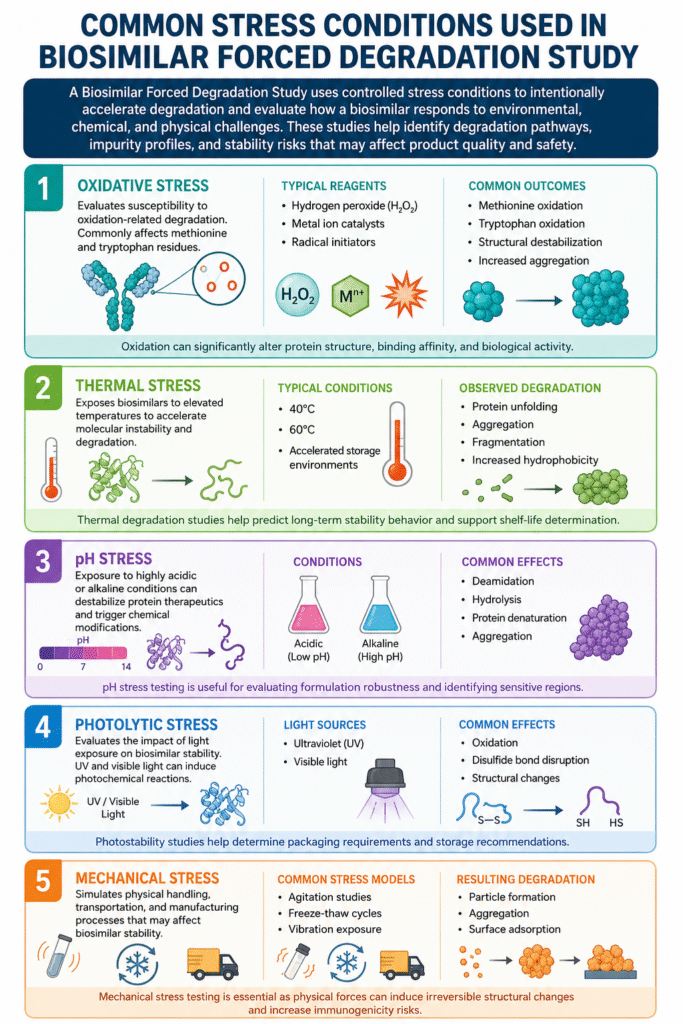
A Biosimilar Forced Degradation Study uses controlled stress conditions to intentionally accelerate degradation and evaluate how a biosimilar responds to environmental and chemical challenges. These stress studies help identify degradation pathways, impurity profiles, and stability risks that may affect product quality and safety.
Because biologics are structurally complex proteins, multiple degradation mechanisms can occur simultaneously under stress conditions. The most commonly applied stress models are outlined below.
1. Oxidative Stress
Oxidative stress is used to evaluate a biosimilar’s susceptibility to oxidation-related degradation. This type of degradation commonly affects amino acid residues such as methionine and tryptophan, which are highly sensitive to reactive oxygen species.
Typical reagents include:
- Hydrogen peroxide (H₂O₂)
- Metal ion catalysts
- Radical initiators
Common outcomes:
- Methionine oxidation
- Tryptophan oxidation
- Structural destabilization
- Increased aggregation
Oxidation can significantly alter protein structure, binding affinity, and biological activity, making oxidative stress studies critical during biosimilar characterization.
2. Thermal Stress
Thermal stress studies expose biosimilars to elevated temperatures to accelerate molecular instability and degradation.
Typical conditions:
- 40°C
- 60°C
- Accelerated storage environments
Observed degradation:
- Protein unfolding
- Aggregation
- Fragmentation
- Increased hydrophobicity
Thermal degradation studies help predict long-term stability behavior and support shelf-life determination.
3. pH Stress
Exposure to highly acidic or alkaline conditions can rapidly destabilize protein therapeutics and trigger chemical modifications.
Common effects include:
- Deamidation
- Hydrolysis
- Protein denaturation
- Aggregation
pH stress testing is especially useful for evaluating formulation robustness and identifying sensitive regions within the protein structure.
4. Photolytic Stress
Photolytic stress evaluates the impact of light exposure on biosimilar stability. Ultraviolet and visible light can induce photochemical reactions that compromise molecular integrity.
Common effects:
- Oxidation
- Disulfide bond disruption
- Structural changes
Photostability studies are important for determining packaging requirements and storage recommendations.
5. Mechanical Stress
Mechanical stress conditions simulate physical handling, transportation, and manufacturing processes that may affect biosimilar stability.
Common stress models:
- Agitation studies
- Freeze-thaw cycles
- Vibration exposure
Resulting degradation:
- Particle formation
- Aggregation
- Surface adsorption
Mechanical stress testing is essential because biologics are highly sensitive to physical forces that can induce irreversible structural changes and increase immunogenicity risks.
4: Role of LC-MS in Biosimilar Forced Degradation Study
LC-MS-based impurity mapping allows detailed identification and quantification of degradation products.
Why LC-MS Is Preferred
LC-MS offers:
- High sensitivity
- Structural specificity
- Accurate mass determination
- Site-specific modification analysis
- Multi-attribute monitoring capability
Traditional analytical methods often detect degradation but cannot fully identify molecular changes. LC-MS fills this gap by providing precise structural characterization.
5: LC-MS Workflows Used for Impurity Mapping
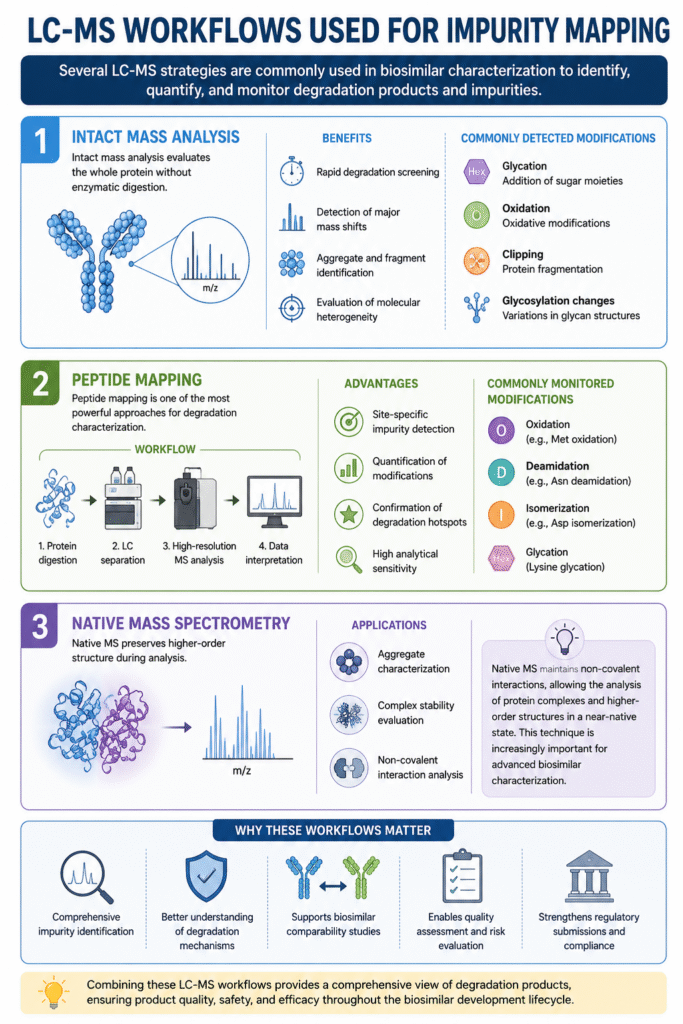
Several advanced LC-MS workflows are commonly used in biosimilar characterization to identify, quantify, and monitor degradation products formed during a Biosimilar Forced Degradation Study. These analytical strategies provide detailed molecular insight into protein stability, impurity formation, and structural modifications.
Each LC-MS workflow offers unique advantages depending on the level of characterization required.
1. Intact Mass Analysis
Intact mass analysis evaluates the entire biosimilar protein without enzymatic digestion. This approach provides a rapid overview of molecular heterogeneity and major degradation-related mass changes.
Benefits of Intact Mass Analysis
- Rapid degradation screening
- Detection of major mass shifts
- Aggregate and fragment identification
- Evaluation of molecular heterogeneity
- Minimal sample preparation
Commonly Detected Modifications
| Modification Type | Analytical Relevance |
|---|---|
| Glycation | Detects sugar-related modifications |
| Oxidation | Identifies oxidative degradation |
| Clipping | Detects protein fragmentation |
| Glycosylation changes | Evaluates glycan heterogeneity |
Intact mass analysis is particularly useful during early-stage biosimilar comparability studies and accelerated degradation screening.
2. Peptide Mapping
Peptide mapping is considered one of the most powerful and widely used LC-MS approaches for detailed degradation characterization. This method enables site-specific analysis of molecular modifications after enzymatic digestion of the biosimilar protein.
Typical Peptide Mapping Workflow
- Protein digestion
- LC separation
- High-resolution MS analysis
- Data interpretation
Advantages of Peptide Mapping
- Site-specific impurity detection
- Quantification of modifications
- Confirmation of degradation hotspots
- High analytical sensitivity
- Detailed structural characterization
Commonly Monitored Modifications
- Oxidation
- Deamidation
- Isomerization
- Glycation
Peptide mapping is especially valuable for identifying critical quality attributes (CQAs) and demonstrating analytical similarity between a biosimilar and its reference product.
3. Native Mass Spectrometry
Native mass spectrometry (Native MS) preserves the higher-order structure and non-covalent interactions of proteins during analysis. Unlike denaturing MS approaches, Native MS allows characterization of biosimilars in a more physiologically relevant state.
Applications of Native MS
- Aggregate characterization
- Complex stability evaluation
- Non-covalent interaction analysis
- Higher-order structure assessment
Native MS is becoming increasingly important in advanced biosimilar characterization because it provides deeper insight into protein conformation, stability, and molecular interactions.
6: Major Impurities Identified During Biosimilar Forced Degradation Study
A Biosimilar Forced Degradation Study can reveal multiple classes of impurities that form either during product degradation or throughout the manufacturing process. Identifying and characterizing these impurities is essential for evaluating biosimilar quality, stability, safety, and regulatory compliance.
Advanced analytical techniques such as LC-MS are widely used to detect and differentiate these impurity types with high sensitivity and structural specificity.
1. Product-Related Impurities
| Impurity Type | Typical Cause |
|---|---|
| Oxidized variants | Reactive oxygen species |
| Deamidated variants | pH and temperature stress |
| Aggregates | Thermal or mechanical stress |
| Fragments | Proteolytic cleavage |
| Glycated species | Sugar exposure |
| Misfolded proteins | Structural instability |
2. Process-Related Impurities
These impurities may originate during manufacturing.
Examples include:
- Host cell proteins
- Residual Protein A
- Leachables and extractables
- Media-derived contaminants
LC-MS can help differentiate process-related impurities from degradation products.
7: Regulatory Expectations for Forced Degradation Studies
Global regulatory agencies expect scientifically justified degradation characterization programs.
Important Regulatory Guidelines
| Guideline | Relevance |
|---|---|
| ICH Q5C | Stability testing of biologics |
| ICH Q6B | Specifications for biotechnology products |
| FDA Biosimilar Guidance | Analytical similarity requirements |
| EMA Biosimilar Guidance | Comparative quality assessment |
Regulators expect:
- Stability-indicating analytical methods
- Detailed impurity characterization
- Comparability between biosimilar and reference product
- Risk-based impurity assessment
LC-MS data significantly strengthens regulatory submissions by providing mechanistic understanding of degradation pathways.
8: Emerging Trends in Biosimilar Forced Degradation Study
The field of Biosimilar Forced Degradation Study is continuously evolving with the introduction of advanced analytical technologies and data-driven approaches. Modern biosimilar characterization now extends beyond traditional impurity detection toward highly integrated, high-resolution, and automated analytical workflows.
Emerging technologies are improving the accuracy, efficiency, and depth of degradation analysis while supporting increasingly complex biosimilar development programs.
1. Multi-Attribute Method (MAM)
The Multi-Attribute Method (MAM) is an advanced LC-MS-based analytical approach that combines targeted quantification with untargeted impurity detection in a single workflow.
Unlike conventional assays that evaluate one quality attribute at a time, MAM simultaneously monitors multiple critical quality attributes (CQAs), making it highly valuable for biosimilar characterization and comparability studies.
Advantages of MAM
| Advantage | Benefit |
|---|---|
| Improved efficiency | Reduces the need for multiple separate assays |
| Enhanced comparability | Facilitates biosimilar vs reference product comparison |
| Simultaneous monitoring of multiple CQAs | Enables comprehensive product characterization |
| Increased analytical sensitivity | Detects low-level modifications and impurities |
| Better process understanding | Supports manufacturing and stability optimization |
Common CQAs Monitored Using MAM
- Oxidation
- Deamidation
- Glycosylation changes
- Fragmentation
- Isomerization
- Aggregation-associated modifications
MAM is increasingly being adopted in both development and quality control environments due to its ability to provide highly detailed molecular information using a single LC-MS platform.
2. AI-Assisted LC-MS Data Interpretation
Artificial intelligence (AI) and machine learning technologies are transforming how LC-MS data is processed and interpreted in biosimilar studies.
Because LC-MS datasets can be extremely large and complex, AI-assisted software tools help improve analytical speed, accuracy, and reproducibility.
AI Applications in Biosimilar Characterization
- Peak annotation
- Pattern recognition
- Automated impurity identification
- Spectral matching
- Data classification
- Trend analysis
Benefits of AI-Assisted Analysis
| AI Capability | Analytical Impact |
|---|---|
| Automated peak detection | Faster data processing |
| Pattern recognition | Improved impurity identification |
| Predictive analytics | Early detection of degradation trends |
| Reduced manual interpretation | Lower risk of analyst variability |
| Large dataset management | Improved workflow efficiency |
AI-driven analytical tools are expected to play a major role in future biosimilar quality assessment and process monitoring strategies.
3. High-Resolution Ion Mobility MS
High-resolution ion mobility mass spectrometry (IM-MS) adds an additional gas-phase separation dimension before mass analysis. This technique separates ions based on their size, shape, and charge, enabling more detailed structural characterization of biosimilar molecules and degradation products.
Ion mobility MS is especially useful for resolving structurally similar species that may be difficult to separate using conventional LC-MS alone.
Key Applications of Ion Mobility MS
- Isomer separation
- Conformational analysis
- Aggregate profiling
- Higher-order structure characterization
- Complex impurity differentiation
Advantages of Ion Mobility MS
- Improved structural resolution
- Enhanced separation of heterogeneous species
- Better characterization of conformational variants
- Increased confidence in impurity identification
This technology is becoming increasingly important for advanced biosimilar characterization, particularly for complex monoclonal antibodies and next-generation biologics.
9: How ResolveMass Laboratories Inc. Supports Biosimilar Characterization
ResolveMass Laboratories Inc. provides advanced analytical support for biosimilar developers through comprehensive LC-MS characterization services.
Capabilities Include
- Forced degradation study design
- LC-MS-based impurity mapping
- Peptide mapping
- Intact mass analysis
- Aggregate characterization
- Stability-indicating method development
- Comparative biosimilar analysis
- Regulatory support studies
The laboratory utilizes advanced high-resolution mass spectrometry systems to support pharmaceutical and biopharmaceutical clients worldwide.
Conclusion:
A comprehensive Biosimilar Forced Degradation Study is essential for understanding molecular stability, impurity formation, and analytical comparability. As biosimilars become increasingly complex, LC-MS-based impurity mapping has emerged as one of the most powerful analytical strategies for characterizing degradation pathways and supporting regulatory compliance.
By combining advanced LC-MS workflows with scientifically designed stress studies, manufacturers can better assess product quality, improve formulation robustness, and ensure patient safety.
Organizations such as ResolveMass Laboratories Inc. provide specialized expertise in biosimilar characterization, helping developers generate high-quality analytical data for successful biosimilar development and approval.
Frequently Asked Questions:
Forced degradation studies help identify degradation pathways and molecular vulnerabilities in biosimilars. They are essential for developing stability-indicating analytical methods and understanding impurity formation. These studies also help compare the biosimilar with the reference product under stress conditions. The data supports formulation optimization, shelf-life determination, and regulatory submissions. Ultimately, they help ensure product safety, efficacy, and consistency.
Common stress conditions include oxidative stress, thermal stress, pH stress, photolytic stress, and mechanical stress. These conditions simulate environmental and handling challenges that biologics may face during storage or transportation. Each stress type helps reveal different degradation pathways and impurity profiles. For example, oxidation can cause methionine modification, while heat may induce aggregation. These studies provide a comprehensive understanding of biosimilar stability.
LC-MS is highly sensitive and provides detailed structural characterization of degradation products. It can identify low-level impurities, molecular modifications, and degradation hotspots with high accuracy. Unlike traditional analytical techniques, LC-MS offers site-specific information about changes occurring in the protein structure. It is especially useful for detecting oxidation, deamidation, glycation, and fragmentation. LC-MS has become essential for biosimilar characterization and regulatory compliance.
Process-related impurities originate from the manufacturing process rather than from degradation of the biologic molecule. Examples include host cell proteins, residual Protein A, media-derived contaminants, and leachables. These impurities may remain in trace amounts after purification. Regulatory agencies require manufacturers to monitor and control them carefully. Advanced LC-MS techniques are commonly used to detect and characterize these impurities.
Peptide mapping is an LC-MS workflow used to analyze biosimilars at the peptide level after enzymatic digestion. The protein is broken into smaller peptides, separated by liquid chromatography, and analyzed using mass spectrometry. This technique provides site-specific information about molecular modifications and degradation hotspots. It is highly effective for identifying oxidation, deamidation, glycation, and sequence variants. Peptide mapping is widely used in biosimilar comparability studies.
Aggregate profiling is the analysis of protein aggregates formed during degradation or manufacturing processes. Aggregates can occur due to thermal stress, agitation, oxidation, or freeze-thaw cycles. These aggregated proteins may affect product stability and increase immunogenicity risk. Techniques such as SEC, LC-MS, and Native MS are commonly used for aggregate characterization. Regulatory agencies consider aggregation a critical quality attribute for biologic products.
Reference
- Kamble R, Puranik A, Narvekar A, Dandekar P, Jain R. Characterization of outcomes of amino acid modifications using a combinatorial approach to reveal physical and structural perturbations: A case study using trastuzumab biosimilar. Journal of Chromatography B. 2022 Oct 15;1209:123430.https://www.sciencedirect.com/science/article/pii/S1570023222003348
- Malani H, Shrivastava A, Nupur N, Rathore AS. LC–MS Characterization and Stability Assessment Elucidate Correlation Between Charge Variant Composition and Degradation of Monoclonal Antibody Therapeutics. The AAPS Journal. 2024 Apr 3;26(3):42.https://link.springer.com/article/10.1208/s12248-024-00915-9
- Sinha A. Biosimilar Comparability Studies: Mass Spectrometry-Based Fingerprinting Approach.https://resolvemass.ca/biosimilar-comparability-studies/
- Nupur N, Joshi S, Gulliarme D, Rathore AS. Analytical similarity assessment of biosimilars: global regulatory landscape, recent studies and major advancements in orthogonal platforms. Frontiers in bioengineering and biotechnology. 2022 Feb 9;10:832059.https://www.frontiersin.org/journals/bioengineering-and-biotechnology/articles/10.3389/fbioe.2022.832059/full
About the Author


