

Introduction: Why the Erosion Mechanism Is Everything
The most critical factor in PLGA formulation design is not particle size or drug loading. It is understanding bulk erosion vs surface erosion in PLGA and how this distinction governs drug release kinetics. Although formulation scientists frequently emphasize encapsulation efficiency, stability, or manufacturing yield, the erosion mechanism ultimately determines the architecture of the entire release profile, including burst release magnitude, lag phase duration, and terminal drug release behavior.
Unlike polymers such as polyanhydrides or poly(ortho esters), which predominantly undergo surface erosion, PLGA degrades through a bulk erosion mechanism. In PLGA systems, water penetrates the polymer matrix much faster than ester bond hydrolysis occurs. Consequently, the entire dosage form becomes hydrated, often within hours, long before measurable mass loss begins. This imbalance between hydration and degradation profoundly influences every stage of drug release.
This article examines the mechanistic basis of PLGA bulk erosion, explains how bulk erosion differs from surface erosion in terms of release behavior, and outlines the formulation strategies used to control these outcomes.
To explore how these degradation mechanics apply directly to long-acting therapeutics, read more about PLGA long acting injectable formulation.
⚡ Quick Summary:
- PLGA degrades through a bulk erosion process in which water rapidly diffuses throughout the polymer network before significant hydrolysis of ester linkages occurs, unlike surface-eroding polymers that degrade layer by layer.
- Drug release from PLGA formulations generally follows a three-stage pattern consisting of an initial burst release, a slower diffusion-controlled phase, and a final accelerated release associated with structural breakdown of the polymer matrix.
- Acidic degradation products can accumulate inside larger PLGA particles or implants, promoting autocatalytic degradation and causing uneven internal erosion that varies according to device size.
- The lactic acid-to-glycolic acid (LA:GA) composition strongly influences degradation speed; formulations with higher glycolide content, such as PLGA 50:50, typically degrade substantially faster than lactide-rich polymers like PLGA 75:25.
- Multiple formulation parameters — including polymer molecular weight, terminal end groups, particle shape and dimensions, and the physicochemical characteristics of the encapsulated drug — collectively affect release behavior and degradation kinetics.
- A clear understanding of PLGA erosion mechanisms is critical for developing controlled-release implants, microspheres, and nanoparticle systems with reliable and reproducible performance.
The Mechanistic Distinction: Bulk Erosion vs Surface Erosion in PLGA
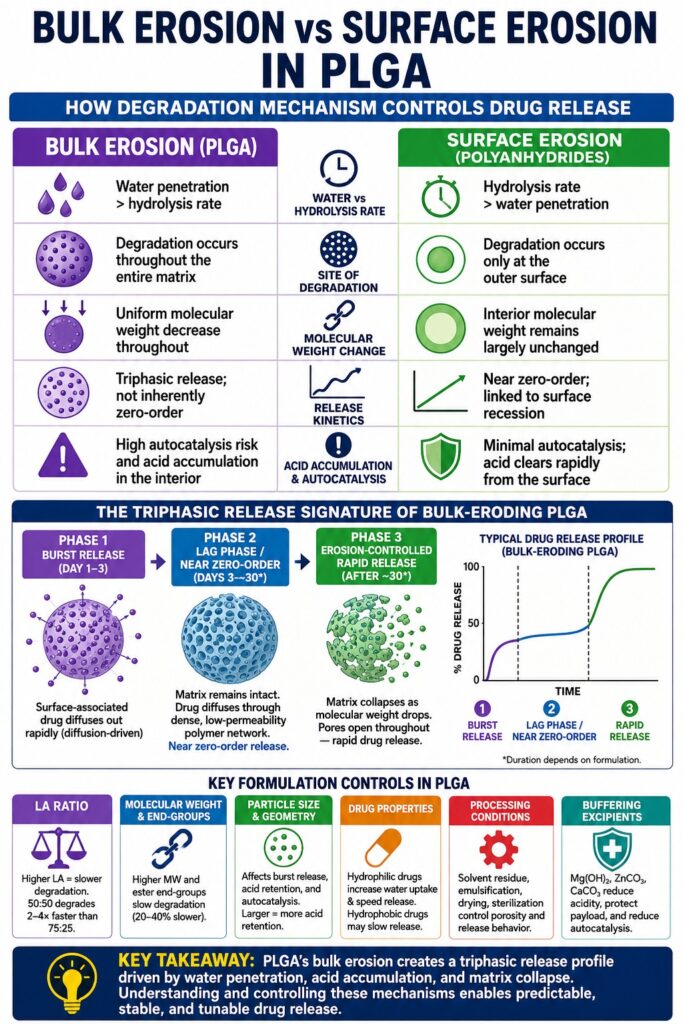
In bulk-eroding polymers, water diffuses into the polymer matrix faster than hydrolytic chain scission occurs. As a result, degradation takes place throughout the entire volume of the device simultaneously instead of progressing gradually from the outer surface inward. In contrast, surface-eroding polymers degrade only at the exterior because hydrolysis at the surface proceeds faster than water penetration into the interior.
| Parameter | Bulk Erosion (PLGA) | Surface Erosion (Polyanhydrides) |
|---|---|---|
| Water vs hydrolysis rate | Water penetration exceeds hydrolysis rate | Hydrolysis rate exceeds water penetration |
| Site of degradation | Entire matrix volume | Outer surface only |
| Molecular weight change | Uniform decrease throughout the device | Interior molecular weight remains largely unchanged |
| Geometry changes | Shape preserved until late-stage collapse | Progressive reduction in size from the surface |
| Release kinetics | Triphasic; not inherently zero-order | Closer to zero-order; linked to surface recession |
| Drug protection from water | Limited because the interior hydrates rapidly | Strong because the interior remains relatively dry |
| Autocatalysis risk | High, especially in large devices | Minimal due to rapid acid clearance |
| Acidic byproduct accumulation | Significant in the interior | Limited to the surface region |
For PLGA-based systems, commercially relevant dosage forms such as microparticles (1–500 µm), implants (millimeter-to-centimeter scale), and nanoparticles (100–500 nm) all exist within the regime where water diffusion dominates over hydrolysis. Therefore, these systems are fundamentally classified as bulk-eroding materials.
For a direct breakdown of how these distinct erosion styles compare across the three most prominent biodegradable polymers, see our detailed guide on PLA vs PLGA vs PCL.
How Bulk Erosion Produces the Triphasic Release Signature
Triphasic release behavior is considered the hallmark of bulk-eroding PLGA systems. Each phase corresponds to a distinct sequence of physicochemical events occurring within the polymer matrix during degradation.
Phase 1 — Burst Release (Day 1 to Day 3)
Immediately after exposure to an aqueous environment, drug molecules located near or at the particle surface diffuse rapidly into the surrounding medium. This includes drug trapped within surface pores, defects, grain boundaries, or loosely associated surface regions.
Several formulation variables influence burst release magnitude, including:
- Drug hydrophilicity
- Surface-to-volume ratio
- Particle porosity
- Extent of surface-associated drug generated during manufacturing
Importantly, burst release is primarily diffusion-driven rather than erosion-driven. The hydrated outer shell of the polymer allows rapid movement of readily accessible drug molecules before substantial polymer degradation occurs.
Phase 2 — Lag Phase / Near Zero-Order Release (Days 3 to ~30, formulation-dependent)
Following the initial burst, the release rate typically decreases significantly. During this phase, the polymer matrix largely retains its structural integrity despite ongoing molecular weight reduction throughout the bulk material.
Drug molecules must diffuse through a dense and minimally porous polymer network, which functions as a low-permeability barrier. As a result, many PLGA systems exhibit near zero-order release kinetics during this interval.
The duration of the lag phase depends primarily on the rate of ester bond hydrolysis, which is controlled by factors such as:
- LA ratio
- Polymer molecular weight
- Temperature
- End-group chemistry
Although the matrix appears physically intact during this stage, hydrolysis is occurring continuously throughout the device interior.
Phase 3 — Erosion-Controlled Rapid Release
Once the polymer reaches a critical molecular weight threshold, polymer fragments become water-soluble and the matrix undergoes rapid structural collapse. At this point, extensive pore networks form throughout the device interior, allowing the remaining encapsulated drug to escape rapidly.
This stage represents true erosion-controlled release because polymer mass loss and drug release become directly coupled.
The sudden transition associated with Phase 3 is a defining feature of bulk erosion. Since degradation progresses uniformly throughout the matrix during the lag phase, the onset of collapse occurs abruptly rather than gradually.
Mechanistic Insight
In surface-eroding polymers, a comparable Phase 3 does not occur. Drug release instead follows continuous surface recession over time. Therefore, the abrupt terminal release observed in PLGA systems is a direct consequence of bulk erosion and should not be mistaken for formulation instability or manufacturing inconsistency.
To better predict and control these distinct release phases, discover how polymer architecture determines performance in PLGA for controlled release.
Autocatalysis: The Hidden Driver of Heterogeneous Bulk Erosion
Autocatalytic degradation is one of the most important and frequently underestimated consequences of bulk erosion in PLGA systems.
As ester bonds hydrolyze, acidic degradation products such as lactic acid and glycolic acid oligomers accumulate within the polymer interior. In surface-eroding systems, these acidic species diffuse rapidly away from the surface. However, in bulk-eroding PLGA matrices, the acidic byproducts become trapped inside the device, leading to localized reductions in microenvironmental pH.
This acidic microenvironment accelerates further ester bond cleavage, creating a self-amplifying degradation cycle.
Size Dependence
Autocatalysis is strongly dependent on particle size.
Larger systems such as implants or large microparticles retain acidic degradation products more effectively because diffusion pathways for acid escape are longer. Conversely, nanoparticles smaller than approximately 300 nm may exhibit minimal autocatalytic effects because acidic species diffuse out almost as quickly as they are generated.
Center-Out Degradation Heterogeneity
In particles larger than approximately 100 µm, the polymer core frequently degrades more rapidly than the outer shell. This phenomenon is the opposite of traditional surface erosion.
As degradation progresses, scanning electron microscopy (SEM) often reveals hollow-core intermediate structures caused by accelerated interior degradation.
Drug Stability Implications
The acidic microenvironment generated during PLGA degradation can reduce internal pH values to approximately 2–4 in some systems. Such conditions may destabilize acid-sensitive peptides, proteins, and small-molecule therapeutics before they are released from the matrix.
This issue is particularly important for biologics encapsulated within PLGA microspheres.
Buffering Strategies
To minimize autocatalytic effects, formulators frequently incorporate basic buffering excipients into the polymer matrix, including:
- Mg(OH)₂
- ZnCO₃
- CaCO₃
These compounds neutralize acidic degradation products, reduce microenvironmental acidification, and improve stability of encapsulated macromolecules.
“Autocatalysis is known to have a complex role in the dynamics of PLGA erosion and drug transport and can lead to size-dependent heterogeneities in otherwise uniformly bulk-eroding polymer microspheres.” — Ford et al., Journal of Controlled Release, 2013
Formulating complex macromolecules requires specialized analytical approaches. Learn how to address these challenges in our overview of characterization of long acting biologics.
LA Ratio as the Primary Lever for Erosion Rate Control
The molar ratio of lactic acid to glycolic acid repeating units is the most influential formulation parameter controlling degradation kinetics in PLGA systems.
| LA Ratio | Hydrophobicity | Degradation Half-Life (37°C, PBS) | Typical Release Duration | Crystallinity Tendency |
| 50:50 | Lowest (most hydrophilic) | ~1–2 months | 1–3 months | Amorphous |
| 65:35 | Intermediate | ~2–4 months | 3–4 months | Amorphous |
| 75:25 | Higher | ~4–5 months | 4–6 months | Predominantly amorphous |
| 85:15 | High | ~5–6 months | 5–7 months | Semi-crystalline possible |
| PLA (100:0) | Highest | >12 months | >12 months | Semi-crystalline |
Glycolide units are more hydrophilic than lactide units because they lack the pendant methyl group present in lactic acid. Increasing glycolide content therefore enhances water uptake and accelerates ester bond hydrolysis throughout the matrix.
PLGA 50:50 typically degrades approximately 2–4 times faster than PLGA 75:25, compressing all three phases of the release profile proportionally.
At higher LA ratios such as 85:15 or PLA-rich systems, crystalline domains may develop. These crystalline regions resist water penetration and can retard degradation rates, sometimes producing biphasic rather than triphasic release profiles.
For a deep dive into the mathematical relationship between polymer composition and release timing, see our guide on PLGA ratio release kinetics.
Additional Formulation Variables That Modulate the Bulk Erosion–Release Relationship
Molecular Weight and End-Group Chemistry
Higher molecular weight PLGA degrades more slowly because fewer chain ends are available to initiate hydrolysis and more ester bonds must be cleaved before solubilization occurs.
End-capped (ester-terminated) PLGA grades are generally more hydrophobic and slower degrading than acid-terminated PLGA grades. Differences of 20–40% in degradation rate are commonly observed between otherwise identical formulations.
To precisely map these structural attributes, learn how to determine molecular weight of PLGA polymers.
Particle Size and Geometry
Particle dimensions influence bulk erosion in two major ways:
- Surface-to-volume ratio affects burst release magnitude
- Diffusion path length affects both water ingress and acid egress, thereby influencing autocatalysis
Nanoparticles smaller than 500 nm generally exhibit reduced autocatalytic behavior and shorter lag phases compared with microparticles of identical composition.
This distinction becomes critically important when translating formulations between nano- and microscale systems.
Drug Physicochemical Properties
Drug properties can substantially alter erosion and release behavior.
Hydrophilic drugs promote water uptake and create osmotic channels within the polymer matrix, accelerating pore formation and increasing drug diffusion rates. This often amplifies burst release and shortens the lag phase.
Hydrophobic drugs may reduce water ingress or act as polymer plasticizers, potentially extending Phase 2 beyond what polymer composition alone would predict.
Additionally, drug–polymer interactions such as hydrogen bonding or ionic interactions can alter diffusivity independently of erosion rate.
Processing Conditions
Manufacturing parameters strongly influence the internal microstructure of PLGA particles.
Critical variables include:
- Residual solvent content
- Emulsification energy
- Drying technique
- Sterilization method
These factors determine the degree of internal porosity established during manufacturing. Pre-existing porosity can bypass the need for erosion-mediated pore formation during Phase 2, significantly altering release behavior even when polymer composition remains unchanged.
Formulation Caution
Scaling between particle sizes is not linear. A PLGA 50:50 microsphere formulation validated at 20 µm will not necessarily exhibit the same release profile at 100 µm because autocatalytic acid accumulation fundamentally changes the internal degradation environment. Each particle size range must therefore be characterized independently for release kinetics and microenvironmental pH behavior.
Translating Erosion Mechanism Knowledge into Formulation Strategy
A mechanistic understanding of bulk erosion versus surface erosion enables rational formulation development instead of empirical trial-and-error optimization.
Strategies to Minimize Burst Release
- Reduce surface area using larger particles or rod-shaped geometries
- Use high molecular weight, end-capped PLGA grades to slow hydration
- Apply surface coatings or co-precipitation techniques to minimize surface-associated drug
Strategies to Extend the Lag Phase
- Increase the LA ratio
- Increase polymer molecular weight
- Limit the use of acid-terminated PLGA grades
- Blend high- and low-molecular-weight PLGA materials to create erosion-rate gradients
Strategies to Protect Peptides and Proteins from Acidic Microenvironments
- Incorporate buffering excipients into the polymer core
- Introduce pore formers that facilitate acid diffusion
- Use solvent systems that reduce autocatalytic intensity
Strategies to Achieve Near Zero-Order Release
Although PLGA is inherently bulk-eroding, near zero-order release can still be approached by:
- Designing geometries with relatively constant surface area during degradation
- Using rod or disc geometries instead of spheres
- Increasing drug loading to establish reservoir-like release behavior
Considerations for Nanoparticle Formulations
For nanoparticle systems, autocatalysis is generally less problematic because acidic degradation products diffuse out rapidly. However, burst release becomes significantly more important, making precise control of surface drug concentration and drug hydrophilicity essential.
When establishing equivalency for regulatory approvals or biosimilars, a comprehensive matching strategy is required. Review the critical parameters in PLGA polymer sameness for ANDA.
Why Bulk Erosion Remains the Defining Challenge — and Opportunity — in PLGA Formulation
The scientific literature surrounding PLGA drug delivery is extensive because bulk erosion creates a highly interconnected system of physicochemical processes that are difficult to control independently.
Water penetration, ester bond hydrolysis, pore formation, acid accumulation, autocatalysis, osmotic effects, polymer swelling, and drug diffusion all occur simultaneously and influence one another in nonlinear ways.
At the same time, this complexity represents one of PLGA’s greatest advantages. By adjusting polymer composition, molecular weight, geometry, and processing conditions, formulators can engineer release durations ranging from several days to more than six months using the same polymer platform.
At ResolveMass Laboratories Inc., formulation development for PLGA-based parenteral systems is driven by mechanistic understanding rather than empirical screening alone. This strategy enables more predictable scale-up, accelerated development timelines, and stronger regulatory justification for formulation decisions.
Navigating regulatory scrutiny requires a robust analysis of physical properties and uniformity. Explore our technical breakdown of PLGA polymer molecular weight and PDI.
Conclusion: Bulk Erosion vs Surface Erosion in PLGA as the Foundational Design Parameter
The distinction between bulk erosion and surface erosion in PLGA is not merely theoretical. It is the mechanistic basis underlying every PLGA drug release profile.
PLGA undergoes simultaneous internal degradation throughout the matrix, generating the characteristic triphasic release pattern observed in many formulations. Once the governing mechanisms are understood, these release behaviors become predictable and controllable.
The major formulation variables — including LA ratio, molecular weight, end-group chemistry, particle geometry, drug physicochemical properties, and buffering approaches — all influence the same fundamental processes: water penetration, acid accumulation, and matrix collapse.
Formulators who understand these mechanistic relationships can navigate formulation design more efficiently and avoid the limitations of purely empirical development strategies. Burst release, lag phase duration, and acid-induced payload degradation should not be treated as isolated issues, but rather as interconnected outcomes of the same bulk erosion process.
Designing formulations that work with bulk erosion, instead of attempting to circumvent it, represents the defining characteristic of advanced PLGA product development.
Frequently Asked Questions
PLGA is classified as a bulk-eroding polymer because water enters the polymer matrix much faster than hydrolysis of ester bonds occurs. Once exposed to an aqueous environment, the entire structure becomes hydrated before noticeable mass loss begins. This means degradation takes place throughout the whole device rather than only at the surface. As a result, internal molecular weight reduction occurs uniformly across the polymer matrix.
The characteristic triphasic release profile of PLGA systems is directly linked to its bulk erosion behavior. The first phase involves rapid diffusion of drug molecules located near the particle surface, producing burst release. During the second phase, the polymer remains structurally intact while gradual hydrolysis slows drug diffusion through the dense matrix. In the final phase, polymer chains become sufficiently degraded for the matrix to collapse, leading to rapid release of the remaining encapsulated drug.
Autocatalysis in PLGA occurs because acidic degradation products, such as lactic acid and glycolic acid oligomers, accumulate within the polymer interior during hydrolysis. These acidic byproducts reduce the internal microenvironmental pH and accelerate additional ester bond cleavage. The process creates a self-reinforcing degradation cycle that can increase erosion rates within the core of the device. In larger particles, autocatalysis may also destabilize acid-sensitive drugs before they are released into the surrounding medium.
The LA ratio controls the hydrophilicity and degradation speed of PLGA. Formulations with higher glycolide content absorb water more readily and undergo faster hydrolysis, resulting in shorter release durations. For example, PLGA 50:50 generally degrades much faster than PLGA 75:25 under physiological conditions. Increasing lactide content slows water penetration and extends all stages of the release profile, making higher LA ratios suitable for long-duration drug delivery systems.
PLGA degradation refers to the cleavage of polymer chains through hydrolysis, which reduces molecular weight without immediately causing physical mass loss. Erosion, on the other hand, occurs when degraded polymer fragments become water-soluble and diffuse out of the matrix. In most PLGA systems, degradation begins well before visible erosion occurs. Consequently, drug release during the intermediate phase is often governed by diffusion through a degrading but structurally preserved polymer network.
Particle size strongly influences both burst release behavior and autocatalytic degradation in PLGA systems. Smaller nanoparticles possess a higher surface-to-volume ratio, which can increase initial burst release but also allows acidic degradation products to escape more easily. Larger microparticles tend to retain acidic byproducts within the core, intensifying autocatalysis and creating heterogeneous degradation patterns. As a result, nanoparticles often exhibit shorter lag phases and more diffusion-controlled release compared with larger microparticles of the same composition.
Under practical pharmaceutical conditions, PLGA behaves as a bulk-eroding polymer rather than a surface-eroding material. Water diffuses into clinically relevant PLGA dosage forms rapidly enough to hydrate the entire matrix before substantial surface recession occurs. Although theoretical discussions suggest that extremely large PLGA structures could display surface erosion characteristics, such dimensions are not relevant to drug delivery applications. Therefore, commercially used PLGA implants, microparticles, and nanoparticles all operate within the bulk erosion regime.
End-group chemistry significantly influences the degradation behavior of PLGA formulations. Acid-terminated PLGA contains free carboxylic acid groups that increase hydrophilicity and accelerate hydrolysis through autocatalytic activity. Ester-terminated or end-capped PLGA is comparatively more hydrophobic, absorbs less water, and degrades more slowly. Because of these differences, end-capped PLGA is commonly selected for extended-release formulations, while acid-terminated grades are often used when faster erosion and shorter release durations are desired.
Reference:
- Siepmann, J., & Siepmann, F. (2025). Release mechanisms of PLGA-based drug delivery systems: A review. International Journal of Pharmaceutics: X, 10, 100440. https://doi.org/10.1016/j.ijpx.2025.100440
- Göpferich, A. (1996). Mechanisms of polymer degradation and erosion. Biomaterials, 17(2), 103–114. https://doi.org/10.1016/0142-9612(96)85755-3
- von Burkersroda, F., Schedl, L., & Göpferich, A. (2002). Why degradable polymers undergo surface erosion or bulk erosion. Biomaterials, 23(21), 4221–4231. https://doi.org/10.1016/S0142-9612(02)00170-9
- Siepmann, J., Elkharraz, K., Siepmann, F., & Klose, D. (2005). How autocatalysis accelerates drug release from PLGA-based microparticles: A quantitative treatment. Biomacromolecules, 6(4), 2312–2319. https://doi.org/10.1021/bm050228k
- Ford Versypt, A. N., Pack, D. W., & Braatz, R. D. (2013). Mathematical modeling of drug delivery from autocatalytically degradable PLGA microspheres—A review. Journal of Controlled Release, 165(1), 29–37. https://doi.org/10.1016/j.jconrel.2012.10.015
- Makadia, H. K., & Siegel, S. J. (2011). Poly lactic-co-glycolic acid (PLGA) as biodegradable controlled drug delivery carrier. Polymers, 3(3), 1377–1397. https://doi.org/10.3390/polym3031377
Get In Touch With Us
About The Author


