


Introduction:
For manufacturers pursuing approval of a generic PLGA-based injectable depot product, demonstrating PLGA polymer sameness for an ANDA submission is far more than a routine regulatory formality. It is a highly technical and scientifically demanding process that undergoes intense FDA scrutiny. The agency’s regulatory experience with complex long-acting injectable products such as Lupron Depot®, Risperdal Consta®, and Sandostatin LAR® has established a clear precedent: inadequate demonstration of PLGA sameness remains one of the leading causes of Complete Response Letters (CRLs) in this category of drug products.
This article outlines the analytical framework and regulatory expectations required to establish a scientifically defensible PLGA polymer sameness package. It discusses the analytical methods, critical quality attributes (CQAs), acceptance criteria, comparative testing strategy, and documentation practices necessary for a regulatory-ready ANDA submission. For organizations involved in advanced PLGA characterization and generic depot formulation development, these considerations are foundational.
Explore Comprehensive Solutions: Discover how our expert manufacturing team can accelerate your path to market with tailored PLGA Contract Manufacturing Services.
Article Summary:
- The FDA considers excipient sameness a mandatory requirement for ANDA approval, and for PLGA-based complex injectable formulations, this requirement represents one of the most technically challenging aspects of generic product development.
- Demonstrating PLGA polymer sameness requires extensive evaluation across several critical quality attribute categories, including chemical composition, molecular weight characteristics, end-group structure, thermal and solid-state behavior, and residual impurity content.
- Core analytical techniques expected in a regulatory-grade PLGA characterization program include ¹H NMR spectroscopy, GPC-MALS, Differential Scanning Calorimetry (DSC), and GC headspace analysis, all of which are regarded as essential by FDA reviewers.
- FDA Product-Specific Guidances (PSGs) for PLGA-containing reference listed drugs establish detailed analytical expectations and testing requirements that applicants are expected to follow during ANDA preparation.
- Regulatory concepts such as the FDA Q-code framework and USP <1043> guidelines serve as the foundation for evaluating excipient comparability and polymer sameness in complex drug products.
- A scientifically valid sameness assessment must include direct comparative characterization between the proposed PLGA material and PLGA extracted from the reference listed drug. A supplier’s certificate of analysis alone is not considered adequate evidence.
- Many PLGA sameness deficiencies arise because of unnoticed variations in key parameters such as the lactide:glycolide (LA:GA) ratio, polymer end-group chemistry, residual catalyst metal levels, and molecular weight distribution patterns.
- Although supplier qualification and sourcing documentation are important parts of regulatory submissions, they cannot replace independent analytical characterization studies required to support a PLGA sameness claim.
Understanding the Regulatory Framework: Defining “Sameness” for PLGA
Within the context of an ANDA, “sameness” for a polymeric excipient means that the proposed PLGA must be the same material used in the reference listed drug (RLD), not merely chemically comparable or sourced from a similar polymer family.
This distinction carries major analytical and regulatory implications. Under 21 CFR 314.94(a)(9)(ii), the FDA evaluates complex excipients such as PLGA with a level of rigor approaching that applied to active pharmaceutical ingredients. Several regulatory references collectively shape the FDA’s expectations for PLGA sameness:
| Regulatory Document | Relevance to PLGA Sameness |
|---|---|
| FDA Product-Specific Guidances (PSGs) | Define required characterization methods, comparison parameters, and acceptance limits |
| USP <1043> Ancillary Materials for Cell, Gene, and Tissue-Engineered Products | Establishes a framework for hierarchical polymer characterization |
| FDA Guidance: “Immunogenicity Assessment for Therapeutic Protein Products” (2014) | Demonstrates regulatory concern regarding excipient-driven immunogenicity risk |
| ICH Q6A Decision Trees | Guides specification development for complex excipients and molecular entities |
| FDA Draft Guidance on ANDA Submissions for Complex Products | Clarifies data expectations for polymer-based excipients |
It is essential to understand that Q1/Q2 sameness alone does not fulfill the FDA’s requirement for PLGA sameness. Even if the proposed formulation contains the same excipient qualitatively (Q1) and quantitatively (Q2) as the RLD, that alone is insufficient. The sponsor must independently establish that the proposed PLGA matches the RLD polymer in structural identity and physicochemical characteristics across all relevant CQAs.
Ensure Compliance: Protect your submission from costly delays by reading our deep dive into the Q1/Q2 Polymer Equivalence Assessment Framework.
Critical Quality Attributes That Establish PLGA Sameness
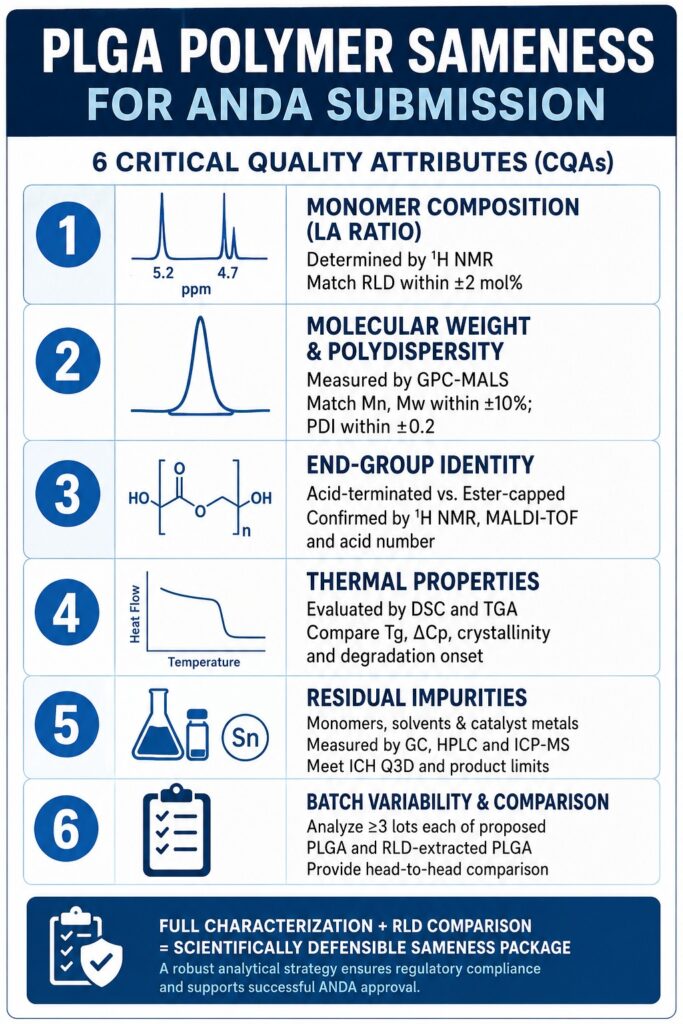
The FDA expects comprehensive characterization of PLGA across multiple analytical dimensions. At minimum, six major attribute categories must be evaluated using direct comparative data between the proposed PLGA and PLGA isolated or characterized from the RLD.
1. Monomer Composition: Determining the LA Ratio
The lactide-to-glycolide molar ratio is the primary identity characteristic of PLGA. Even a relatively small variation in monomer composition can significantly affect the polymer’s glass transition temperature (Tg), hydrophilicity, hydrolytic degradation rate, and drug release kinetics.
Required Analytical Method
Quantitative ¹H NMR spectroscopy performed at 400 MHz or greater using deuterated solvents such as DMSO-d₆ or CDCl₃ is the standard approach. The LA ratio is calculated from the integration of characteristic proton signals:
- Methine proton of lactic acid near 5.2 ppm
- Methylene protons of glycolic acid near 4.7–4.8 ppm
Acceptance Criteria
The proposed PLGA should match the RLD polymer within ±2 mol%, although some product-specific guidances may require tighter acceptance windows. All peak assignments, integration boundaries, acquisition parameters, and spectral conditions must be documented thoroughly.
An important consideration is that polymers with identical bulk LA ratios may still differ in monomer sequence distribution, such as random versus block-like arrangements. Although sequence distribution analysis is not routinely required, products where degradation behavior depends on sequence architecture may benefit from supplementary techniques such as:
- ¹³C NMR dyad/triad analysis
- DOSY NMR evaluation
These methods can strengthen the overall sameness justification.
Master the Spectroscopy: Learn the precise protocols required for setting up NMR Spectroscopy for Accurate Monomer Ratio Analysis.
2. Molecular Weight and Polydispersity: Why GPC-MALS Is Essential
The FDA expects determination of:
- Number-average molecular weight (Mn)
- Weight-average molecular weight (Mw)
- Polydispersity index (PDI)
using GPC coupled with multi-angle light scattering (MALS) and refractive index (RI) detection.
Conventional GPC methods calibrated solely with polystyrene or PMMA standards are considered inadequate because they can significantly misrepresent PLGA molecular weights depending on solvent selection and operating conditions. FDA reviewers are well aware of these limitations.
Expected Analytical Approach
Absolute molecular weight determination using MALS is strongly preferred. If MALS is unavailable, a validated PLGA-specific calibration method using well-characterized standards is expected.
Typical Characterization Ranges
| Parameter | Typical Product-Dependent Range | Expected Tolerance |
| Mn | 5,000 – 75,000 Da | ±10% relative to RLD |
| Mw | 8,000 – 120,000 Da | ±10% relative to RLD |
| PDI (Mw/Mn) | 1.4 – 2.2 | ±0.2 units |
| Intrinsic Viscosity (IV) | 0.1 – 0.8 dL/g | ±0.05 dL/g |
Required GPC Reporting Parameters
The submission should include:
- Column type
- Mobile phase composition
- Flow rate
- Operating temperature
- Injection volume
- Detector configuration
Solvent selection is particularly important. THF and DMF systems can produce materially different molecular weight results for the same polymer. Consistency with the method used for RLD characterization is critical.
Intrinsic viscosity measurements performed using Ubbelohde viscometry in HFIP or chloroform remain highly valuable, particularly for products where PSGs explicitly require IV data. Measurements should be conducted at 30°C ± 0.1°C using at least three concentration points to support proper Mark-Houwink analysis.
Analyze Molecular Heterogeneity: Understand the critical impact of distribution width by reviewing our guide on PLGA PDI in Pharmaceutical Applications.
3. End-Group Identity: Acid-Terminated Versus Ester-Capped PLGA
End-group characterization is one of the most commonly overlooked aspects of PLGA sameness evaluation. PLGA may exist in:
- Acid-terminated form
- Ester-capped form
This distinction profoundly influences polymer behavior despite having no effect on the bulk LA ratio.
Functional Consequences of End-Group Differences
End-group chemistry directly affects:
- Hydrolytic degradation kinetics
- Burst release profile
- Drug release lag time
- Protein stability within the microsphere matrix
- Polymer-drug compatibility
Acid-terminated PLGA generally degrades substantially faster than ester-capped variants.
Recommended Analytical Techniques
¹H NMR End-Group Analysis
Characteristic terminal methyl or methylene resonances associated with ester-capping groups are evaluated.
MALDI-TOF Mass Spectrometry
MALDI-TOF provides additional confirmation through end-group-specific mass shifts across the molecular weight distribution.
Acid Number Titration
For acid-terminated polymers, acid number testing quantifies free carboxylic acid content.
Analytical Challenges
High-molecular-weight PLGA materials may exhibit weak or undetectable end-group signals in standard NMR experiments due to low relative molar abundance. In these cases:
- MALDI-TOF
- ESI-MS/MS fragmentation analysis
become the primary analytical tools.
Regulatory Importance
The ANDA submission must explicitly state whether the proposed PLGA is acid-terminated or ester-capped and provide supporting analytical evidence. Reliance on vendor documentation alone is insufficient.
If the RLD polymer is acid-terminated and the proposed PLGA is ester-capped, the sameness demonstration fails regardless of molecular weight similarity.
Evaluate Kinetic Profiles: Gain insight into how polymer composition shapes your formulation’s behavior over time with our analysis of PLGA Ratio and Release Kinetics.
4. Thermal and Solid-State Characterization: DSC and TGA
Differential Scanning Calorimetry (DSC) provides direct measurement of the glass transition temperature (Tg), a critical property governing microsphere matrix performance under physiological conditions.
Key DSC Parameters
| DSC Parameter | Significance | Typical Range |
| Tg (mid-point) | Controls matrix rigidity | 40–55°C |
| ΔCp at Tg | Reflects polymer mobility | Compared directly to RLD |
| Crystallinity | Influences release kinetics | Typically <5% |
| Melting Endotherm | Detects homopolymer contamination | Generally absent |
Recommended DSC Conditions
- Nitrogen purge atmosphere
- Heating rate of 10°C/min
- Heat-cool-heat cycle
- Tg reported from second heating cycle
Thermogravimetric Analysis (TGA) complements DSC by evaluating:
- Residual moisture
- Residual solvent content
- Thermal degradation onset
A lower degradation onset temperature compared with the RLD may indicate reduced molecular weight or residual catalyst contamination.
Source Premium Materials: Secure high-purity polymers designed to meet rigorous thermal criteria by choosing a trusted PCL and PLA Supplier.
5. Residual Impurities: Monomers, Solvents, and Catalysts
Residual impurities are considered critical quality attributes because they directly affect product safety, stability, degradation behavior, and patient exposure.
Residual Monomers
Residual lactic acid and glycolic acid can arise from incomplete polymerization or hydrolytic degradation.
These impurities may:
- Lower effective molecular weight
- Reduce Tg
- Accelerate degradation
- Promote acidic microenvironment formation
Analytical Methods
- GC-FID headspace analysis
- HPLC with UV or RI detection
Residual monomer levels should generally remain below 0.5% w/w for each monomer.
Residual Solvents
PLGA synthesis and microsphere manufacturing frequently involve Class 2 solvents such as:
- Dichloromethane
- Ethyl acetate
- Acetone
Analytical Method
GC headspace analysis according to USP <467> is required.
The analytical package should document:
- Residual polymerization solvents
- Solvents introduced during purification
- Comparative solvent profiles versus RLD polymer
Residual Metal Catalysts
Stannous octoate remains the most common catalyst used in PLGA ring-opening polymerization.
Residual catalyst metals can accelerate degradation during storage and after administration.
Analytical Methods
- ICP-OES
- ICP-MS
Tin and additional potential catalyst metals should be evaluated against ICH Q3D elemental impurity limits.
Deconstruct the Reference Standard: Ensure your testing matches the target perfectly by utilizing our protocols for PLGA Characterization for RLD Comparison.
Structure of a Regulatory-Ready Comparative Analytical Package
A complete PLGA sameness package should contain six major components, each linked to critical quality attributes and supported by comparative analytical evidence.
PLGA Sameness Package Structure
1. Regulatory Justification Section
- Applicable PSG citations
- Q1/Q2 sameness declaration
- Excipient sourcing and chain-of-custody information
2. Characterization of Proposed PLGA
- ¹H NMR
- GPC-MALS
- DSC
- TGA
- Intrinsic viscosity
- GC headspace analysis
- ICP-MS evaluation
3. Characterization of RLD-Derived PLGA
- Full analytical characterization using the same methods applied to the proposed polymer
4. Head-to-Head Comparative Assessment
- Spectral overlays
- Chromatographic overlays
- Thermogram comparisons
- Statistical equivalence analysis where appropriate
5. Batch Variability Assessment
- Minimum of three proposed PLGA lots
- Minimum of three RLD lots
6. Supplier Qualification Documentation
- DMF or eDMF references
- Manufacturing process overview
Extracting PLGA From the RLD: A Major Analytical Challenge
Meaningful comparative analysis requires direct characterization of PLGA isolated from the RLD itself rather than relying solely on bulk supplier material.
For microsphere products, extraction methods must remove the API without altering polymer integrity.
Common Extraction Strategies
Solvent Extraction
The microsphere matrix is dissolved in an organic solvent, followed by PLGA precipitation using an anti-solvent system.
Drug removal is verified by:
- HPLC
- UV-Vis analysis
The extraction procedure must demonstrate that no meaningful molecular weight degradation occurs.
Enzymatic Extraction
Protease treatment may be used for protein-containing formulations.
Polymer recovery and integrity must be carefully validated.
Aqueous Extraction
For water-soluble APIs, repeated aqueous washing may remove drug while retaining polymer in the organic phase.
Residual API levels within the isolated polymer must still be quantified.
Any extraction-related molecular weight reduction caused by:
- Hydrolysis
- Temperature exposure
- UV exposure
must be fully characterized and scientifically addressed.
Typically, characterization of three to five commercial RLD lots is expected to establish acceptable variability ranges.
Design Long-Acting Formulations: Apply these isolated polymer insights effectively with our technical blueprint for PLGA Depot Formulation Development.
Product-Specific Guidance Examples for PLGA Sameness
FDA PSGs define product-specific expectations for PLGA characterization.
| RLD Product | Key PLGA Sameness Requirements |
| Lupron Depot® | LA ratio, IV, Mw, acid number, Tg |
| Risperdal Consta® | LA ratio, Mw, PDI, Tg, residual solvents, blend ratio characterization |
| Vivitrol® | LA ratio, end-group characterization, Mw by GPC-MALS, residual tin |
For products containing multiple PLGA grades, each polymer fraction must be independently characterized. Composite analysis of blended polymers is not considered acceptable.
Common Deficiencies Observed in PLGA Sameness Submissions
FDA review experience consistently identifies several recurring deficiencies in ANDA submissions involving PLGA products.
Frequent Deficiency Patterns
- Dependence solely on vendor certificates of analysis
- Use of polystyrene-calibrated GPC methods without MALS
- Lack of end-group characterization
- Single-lot comparative studies
- Absence of RLD-extracted PLGA data
- Missing elemental impurity analysis for catalyst metals
- Failure to correlate particle morphology with PLGA CQAs
Each of these deficiencies can significantly delay regulatory review or result in CRLs.
Conclusion: Developing a Scientifically Defensible PLGA Sameness Strategy
Demonstrating PLGA polymer sameness for an ANDA submission requires a comprehensive analytical strategy supported by rigorous comparative data and aligned with evolving FDA expectations. A scientifically credible package must include:
- Full characterization of the proposed polymer
- Comparative analysis against RLD-extracted PLGA
- Batch variability assessment
- Thorough documentation of all CQAs
As FDA review standards for complex injectable products continue to evolve, incomplete or underdeveloped PLGA characterization programs increasingly become a major source of development delays and regulatory setbacks.
Implementing a robust analytical strategy early in development is both scientifically necessary and commercially prudent.
ResolveMass Laboratories Inc. provides advanced polymer characterization services, including ANDA-ready PLGA sameness studies, analytical method development and validation, RLD extraction workflows, and regulatory support tailored to FDA expectations.
Contact ResolveMass Laboratories Inc. to discuss your PLGA characterization and ANDA submission strategy.
Frequently Asked Questions (FAQs)
A Drug Master File (DMF) contains confidential manufacturing information, raw material controls, and process-related details about the PLGA polymer. However, the FDA does not consider a DMF alone sufficient to establish polymer sameness in an ANDA. Applicants are still expected to generate independent analytical characterization data comparing the proposed PLGA directly against PLGA isolated from the reference listed drug (RLD). A DMF may support the submission, but it cannot substitute for a complete comparative analytical package.
In most cases, the FDA expects comparative characterization using at least three batches of the proposed PLGA material along with three separately sourced RLD lots. This approach allows the applicant to evaluate normal batch-to-batch variability and establish statistically meaningful analytical ranges. Relying on a single batch comparison is generally viewed as inadequate because it does not demonstrate consistency across manufacturing variability. Multi-lot analysis strengthens the scientific credibility of the sameness assessment.
FTIR spectroscopy can confirm the presence of characteristic functional groups within the PLGA structure, including ester linkages and carbonyl peaks. However, FTIR does not provide sufficient resolution to determine critical attributes such as molecular weight distribution, end-group chemistry, or exact LA ratios. Because of these limitations, FTIR should only be used as one component of a broader characterization strategy. The FDA expects complementary analytical techniques such as NMR, GPC-MALS, DSC, and residual impurity analysis.
Validated cold solvent extraction methods are commonly used to isolate PLGA from microsphere-based RLD products. Organic solvents such as dichloromethane or ethyl acetate are typically combined with anti-solvent precipitation using cold ether or hexane to recover the polymer. The extraction process must be carefully validated to confirm that it does not reduce molecular weight or alter polymer properties. Any extraction-related changes identified during method validation should be documented and scientifically addressed in the comparative analysis.
PLGA grade names alone are not considered reliable indicators of sameness because naming conventions differ among suppliers and manufacturers. Two materials labeled with the same commercial grade may still vary significantly in molecular weight, end-group chemistry, thermal behavior, or degradation characteristics. The FDA focuses on analytical evidence rather than supplier nomenclature when evaluating polymer sameness. Therefore, comprehensive physicochemical characterization is more important than matching a commercial product name or grade designation.
PLGA molecular weight has a direct influence on degradation behavior, matrix erosion, and drug release kinetics in long-acting injectable formulations. Even relatively small differences in molecular weight between the proposed and RLD polymers can produce measurable changes in drug release profiles. Because in vitro release testing is often used to support bioequivalence assessments for depot products, molecular weight consistency becomes a critical regulatory consideration. Accurate molecular weight matching is therefore essential for demonstrating formulation equivalence.
The FDA does not provide a single universal acceptance range for LA ratio variation across all PLGA-based products. In some cases, product-specific guidances may define acceptable limits, while other products rely on comparative characterization against multiple RLD lots. Generally, the proposed PLGA should fall within the natural variability range observed for the RLD polymer. Significant deviations in monomer composition, especially differences exceeding approximately 5 mol%, are typically considered unacceptable because they may alter degradation and release performance.
A scientifically sound sameness strategy should include characterization of multiple RLD lots obtained from different manufacturing periods. Evaluating at least three to five RLD batches helps establish the normal variability range for key PLGA critical quality attributes. Proposed specification ranges should then be aligned with the variability observed in the RLD data set. This approach demonstrates that the proposed material consistently falls within the expected performance window of the reference product.
Reference:
- U.S. Food and Drug Administration. (n.d.). Product-specific guidance for generic drug development (PSG_019732). U.S. Department of Health and Human Services. https://www.accessdata.fda.gov/drugsatfda_docs/psg/PSG_019732.pdf
- U.S. Food and Drug Administration. (n.d.). Product-specific guidance for generic drug development (PSG_210655). U.S. Department of Health and Human Services. https://www.accessdata.fda.gov/drugsatfda_docs/psg/PSG_210655.pdf
- U.S. Food and Drug Administration. (2014, August). Immunogenicity assessment for therapeutic protein products: Guidance for industry. U.S. Department of Health and Human Services. https://www.fda.gov/media/86660/download
- United States Pharmacopeia. (2019). 〈1043〉 Ancillary materials for cell, gene, and tissue-engineered products. USP–NF. https://doi.org/10.31003/USPNF_M620_02_01
- International Council for Harmonisation of Technical Requirements for Pharmaceuticals for Human Use. (1999, October 6). Specifications: Test procedures and acceptance criteria for new drug substances and new drug products: Chemical substances Q6A. https://database.ich.org/sites/default/files/Q6A%20Guideline.pdf
Get In Touch With Us
About The Author


