


Introduction:
Biosimilar stability testing is not simply a regulatory checkbox — it is a rigorous scientific discipline that determines whether a biologic product maintains its quality, safety, and efficacy throughout its intended shelf life. Unlike small-molecule drugs, biosimilars are large, structurally complex proteins whose therapeutic activity is exquisitely sensitive to molecular changes such as oxidation, deamidation, aggregation, and glycosylation shifts. Detecting these changes accurately, early, and comprehensively demands methods that go far beyond traditional UV-based HPLC or electrophoresis.
At ResolveMass Laboratories Inc., we have built our analytical platform around stability-indicating mass spectrometry (MS) methods — a suite of cutting-edge techniques that provide the molecular-level resolution required to characterize biosimilar degradation with confidence. This blog explains the science behind these methods, the regulatory expectations surrounding them, and how ResolveMass translates technical capability into actionable stability data for biosimilar developers.
Summary:
- Biosimilar stability testing requires analytical methods that can detect and quantify even minor degradation products to ensure product quality over shelf life.
- Mass spectrometry (MS) provides unmatched sensitivity, specificity, and structural resolution compared to conventional stability methods.
- Stability-indicating MS methods cover forced degradation studies, peptide mapping, glycan profiling, oxidation and deamidation monitoring, and higher-order structure (HOS) analysis.
- Regulatory frameworks (ICH Q5C, ICH Q1A, FDA guidance) explicitly require stability-indicating assay validation for biologics and biosimilars.
- ResolveMass Laboratories Inc. offers a complete analytical platform combining LC-MS/MS, native MS, HDX-MS, and ion mobility MS to support biosimilar development and registration packages.
- Key degradation pathways tracked by MS include deamidation, oxidation, aggregation, glycosylation changes, disulfide scrambling, and fragmentation.
- Method validation for stability-indicating MS assays must demonstrate specificity, accuracy, precision, linearity, range, and stability-indicating capability (discriminating power).
1: What Are Stability-Indicating Methods — and Why Does Mass Spectrometry Excel?
A stability-indicating method is an analytical procedure validated to accurately detect changes in the quality attributes of a drug substance or drug product over time — specifically, the ability to resolve the drug from its degradation products. For biosimilars, this means the method must detect and quantify structurally distinct degradation species without interference from formulation excipients or the intact molecule itself.
Mass spectrometry outperforms UV-HPLC and gel-based methods because it provides direct molecular mass measurement with sub-ppm accuracy, enabling unambiguous identification of chemical modifications — not just a “peak shift” on a chromatogram. It detects co-eluting species that UV absorbance cannot resolve, and it characterizes both the identity and quantity of degradation products simultaneously.
Core Advantages of Mass Spectrometry in Biosimilar Stability Testing:
- Structural specificity: Identifies the exact site and type of modification (e.g., Met-oxidation at position 252 of an IgG1 Fc region).
- Dynamic range: Quantifies low-level degradants (<0.1%) alongside the primary species in a single run.
- Multiplex capability: Simultaneously monitors dozens of quality attributes — charge variants, glycoforms, disulfide bonds, and fragments — in one analytical platform.
- Higher-order structure (HOS) insights: Techniques like HDX-MS reveal conformational changes that UV or fluorescence cannot detect.
- Speed and throughput: Modern LC-MS/MS platforms process complex stability samples in hours rather than days.
- Regulatory alignment: FDA and EMA analytical guidelines increasingly reference MS-based characterization as the gold standard for biosimilar comparability studies.
2: Key Biosimilar Degradation Pathways Monitored by Stability-Indicating MS Methods
Biosimilars degrade through predictable pathways, each traceable by specific mass spectrometric signatures. Understanding these mechanisms is essential before designing a biosimilar stability testing program.
| Degradation Pathway | MS Signature (Mass Shift) | Common Stress Conditions | Functional Impact |
|---|---|---|---|
| Deamidation (Asn → Asp/isoAsp) | +0.984 Da per site | Elevated temperature, alkaline pH | Altered charge, reduced potency |
| Oxidation (Met, Trp, His) | +16 Da per site | Light, H₂O₂, peroxide excipients | Reduced Fc receptor binding, aggregation |
| Disulfide scrambling | Differential peptide mapping | Reducing conditions, high pH | Conformational instability, aggregation |
| Fragmentation (clip) | Fragment-specific masses | Heat, acidic pH, agitation | Loss of therapeutic domain |
| Glycosylation changes | Glycan mass profile shifts | Cell culture changes, temperature | Altered ADCC, immunogenicity risk |
| Aggregation (non-covalent) | Native MS charge-state envelope shifts | Agitation, freeze-thaw cycles | Immunogenicity, reduced efficacy |
| Succinimide intermediates | −18 Da (water loss) | Alkaline pH, elevated temperature | Structural heterogeneity |
3: Forced Degradation Studies: Building the Foundation of Biosimilar Stability Testing
Forced degradation (stress testing) is the cornerstone of any stability-indicating method development. It deliberately exposes the biosimilar to thermal, photolytic, oxidative, acidic, alkaline, and mechanical stresses to generate a comprehensive degradation profile that informs the analytical strategy.
By intentionally producing degradation products under controlled stress conditions, ResolveMass scientists confirm that the MS method resolves and quantifies all relevant species — establishing the “discriminating power” of the assay before it is applied to real stability samples.
Forced Degradation Protocol at ResolveMass:
- Thermal stress: 40°C, 50°C, and 60°C for 1–4 weeks; 80°C for short-term acceleration
- Oxidative stress: 0.01–1.0% H₂O₂ treatment; light exposure (ICH Q1B conditions)
- Acidic/alkaline hydrolysis: pH 2–4 (acid) and pH 9–12 (base) for defined periods
- Photodegradation: UV/visible light per ICH Q1B using calibrated light chambers
- Mechanical stress: Agitation on orbital shakers and freeze-thaw cycling (−80°C ↔ 25°C)
Each stressed sample is analyzed by LC-MS/MS peptide mapping, native MS, and size-exclusion chromatography coupled to MS (SEC-MS) to catalog all degradation products generated. This forced degradation library becomes the reference against which real-time and accelerated stability samples are compared.
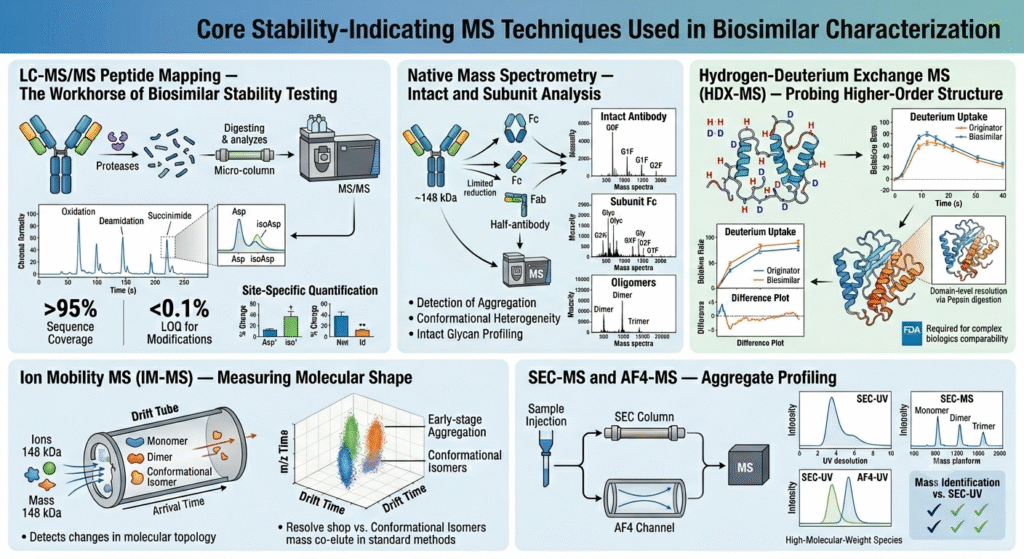
4: Core Stability-Indicating MS Techniques Used in Biosimilar Characterization
ResolveMass Laboratories employs a complementary suite of mass spectrometry platforms, each targeting distinct stability-indicating attributes of biosimilars.
1. LC-MS/MS Peptide Mapping — The Workhorse of Biosimilar Stability Testing
Peptide mapping by LC-MS/MS remains the most information-dense tool for monitoring sequence-level modifications. The biosimilar protein is digested (typically with trypsin, Lys-C, or Glu-C), and the resulting peptides are separated by reversed-phase HPLC and analyzed by tandem mass spectrometry.
- Achieves >95% sequence coverage for most therapeutic monoclonal antibodies
- Quantifies site-specific deamidation, oxidation, succinimide, and clip levels with <0.1% LOQ
- Discriminates isoaspartate (isoAsp) from aspartate (Asp) — a distinction invisible to UV methods
- Tracks glycopeptide profiles in the same run
2. Native Mass Spectrometry — Intact and Subunit Analysis
Native MS preserves non-covalent interactions, enabling analysis of the biosimilar in a near-physiological state. This technique is essential for detecting aggregation, conformational heterogeneity, and glycoform distributions.
- Intact mass measurement at the whole-antibody level (~148 kDa for IgG1) to detect bulk changes
- Subunit analysis (Fc, Fab, half-antibody) after limited reduction to resolve domain-level modifications
- Detects non-covalent dimers and oligomers that may precede visible aggregation
- Glycan profiling at the intact glycoprotein level for rapid screening
3. Hydrogen-Deuterium Exchange MS (HDX-MS) — Probing Higher-Order Structure
HDX-MS measures the exchange rate of backbone amide hydrogens for deuterium, providing a footprint of protein conformation and dynamics. This is one of the few techniques capable of detecting subtle three-dimensional structural changes during stability studies.
- Identifies regions of the biosimilar that unfold or become more solvent-exposed under thermal or chemical stress
- Detects conformational drift between originator and biosimilar — critical for comparability
- Provides domain-level resolution when coupled with pepsin digestion (MS/MS-based HDX)
- Increasingly required by FDA for complex biologics comparability packages
4. Ion Mobility MS (IM-MS) — Measuring Molecular Shape
Ion mobility separation adds a gas-phase size and shape dimension to mass analysis. For biosimilars, IM-MS detects changes in molecular topology — including early-stage aggregation and conformational isomers — that co-elute in LC and are indistinguishable by mass alone.
5. SEC-MS and AF4-MS — Aggregate Profiling
Size-exclusion chromatography coupled online to MS (SEC-MS), and Asymmetric Flow Field-Flow Fractionation (AF4-MS), provide size-based separation of monomers, dimers, oligomers, and high-molecular-weight species followed by direct mass identification — vastly superior to SEC-UV alone for stability-indicating aggregate characterization.
5: Glycan Stability Profiling: A Biosimilar-Specific Critical Quality Attribute
Glycosylation directly impacts biosimilar efficacy (via Fc receptor binding and ADCC activity), immunogenicity, and pharmacokinetics — making glycan stability monitoring a mandatory component of any biosimilar stability testing program.
MS-Based Glycan Stability Monitoring at ResolveMass:
- Released glycan analysis: PNGase F-released N-glycans are fluorescently labeled (or kept native) and analyzed by HILIC-MS or RP-MS, providing complete glycan occupancy and composition profiles.
- Glycopeptide mapping: Site-specific glycosylation monitoring by LC-MS/MS tracks changes at each glycosylation sequon (e.g., Asn-297 in IgG Fc).
- Stability-indicating glycan changes detected include:
- Sialic acid loss under acidic conditions
- High-mannose accumulation under thermal stress
- Galactosylation shifts affecting Fc receptor binding
- Fucosylation changes impacting ADCC potency
6: Regulatory Framework for Stability-Indicating Biosimilar Stability Testing
Regulatory expectations for biosimilar stability testing are well-defined and explicitly require the use of validated, stability-indicating methods. Understanding these requirements is essential for designing a registration-ready analytical program.
| Regulatory Guideline | Key Requirement | Relevance to MS Methods |
|---|---|---|
| ICH Q5C | Stability testing of biotechnological/biological products | Mandates stability-indicating methods capable of detecting degradation; defines accelerated, real-time, and stress testing conditions |
| ICH Q1A(R2) | Stability testing of new drug substances and products | Defines stress testing requirements that align with forced degradation design |
| ICH Q2(R1) | Validation of analytical procedures | Specificity, precision, accuracy, LOD/LOQ, linearity — all required for MS stability methods |
| FDA Guidance (2015) — Scientific Considerations for Biosimilars | Comparability and analytical similarity | Requires orthogonal methods including MS for structural characterization and stability comparison |
| EMA Guideline on Biosimilars (EMEA/CHMP/BMWP/42832/2005) | Physico-chemical and biological characterization | Expects in-depth characterization using state-of-the-art analytical tools, including MS-based methods |
ResolveMass Regulatory Expertise: Our analytical scientists have deep familiarity with ICH Q5C, Q1A, and Q2(R1) frameworks and design all biosimilar stability method validation packages to meet FDA, EMA, and Health Canada submission requirements. Every method released from our laboratory carries a full validation report aligned to current regulatory expectations.
7: Method Validation for Stability-Indicating MS Assays: What Regulators Expect
Validation of stability-indicating MS methods must demonstrate that the assay can accurately, precisely, and specifically detect and quantify degradation products in the presence of the intact biosimilar and formulation matrix. Regulators specifically look for evidence of “discriminating power.”
Required Validation Parameters:
- Specificity/Selectivity: The method must resolve degradation products from the intact molecule and from each other — demonstrated via forced degradation spike-in experiments.
- Linearity and Range: Demonstrated across the expected range of degradant levels (typically 0.05%–10% relative to the main peak).
- Accuracy: Recovery studies using known amounts of purified degradants spiked into formulated product.
- Precision (repeatability and intermediate precision): Within-run and between-run CVs typically <5% for quantitative MS peptide mapping methods.
- LOD and LOQ: Signal-to-noise based determination; for site-specific modifications, LOQ typically ≤0.1% by LC-MS/MS.
- Stability of Analytical Solutions: Bench-top, freeze-thaw, and autosampler stability of digested samples.
- Robustness: Method performance under deliberate variations in key parameters (column lot, protease batch, gradient conditions).
8: ResolveMass Laboratories: Our Biosimilar Stability MS Platform in Practice
At ResolveMass Laboratories Inc., biosimilar stability testing is not a single test — it is a scientifically integrated program tailored to each molecule’s known liability profile and regulatory destination.
Our End-to-End Biosimilar Stability MS Workflow:
- Pre-formulation risk assessment: Review originator literature and our own forced degradation data to identify high-risk degradation sites specific to the molecule class (mAb, Fc-fusion, ADC, etc.).
- Forced degradation study execution: Systematic stress panel generates the full degradation product library.
- Stability-indicating method development: LC-MS/MS peptide mapping, native MS, HDX-MS, and glycan profiling methods are developed and optimized.
- Formal method validation: Full ICH Q2(R1) validation per regulatory submission requirements.
- Stability study sample analysis: Real-time and accelerated stability time points analyzed with validated methods; all data reported with uncertainty analysis.
- Comparability and similarity assessment: Statistical analysis comparing biosimilar to originator reference standard across the full stability-indicating attribute panel.
- Regulatory dossier support: Method validation reports, analytical procedures, and stability data summaries prepared in CTD format.
Instrumentation at ResolveMass Laboratories:
- Orbitrap-based LC-MS/MS systems (high-resolution, accurate mass) for peptide mapping and intact MS
- Q-TOF instruments for native MS and ion mobility MS
- HDX automation system with nanoflow LC for conformational analysis
- HILIC-FLR-MS for released glycan profiling
- SEC-MS and AF4-MALS-MS for aggregate characterization
9: Case Application: Monitoring mAb Stability with Biosimilar Stability Testing by MS
To illustrate how our platform works in practice, consider a typical monoclonal antibody (mAb) biosimilar stability study conducted at ResolveMass. This reflects the types of findings our team routinely characterizes and reports.
Scenario: IgG1 mAb Biosimilar — 12-Month Accelerated Stability Study
| Quality Attribute | MS Method | Key Stability Finding |
|---|---|---|
| Deamidation at Asn-388 (LC) | LC-MS/MS peptide mapping | Progressive increase from 1.2% (T0) to 4.8% (12M/40°C); no change at 5°C |
| Met-252 oxidation (Fc) | LC-MS/MS peptide mapping | Increased from 0.3% to 2.1% under light stress; stable under thermal stress |
| Glycoform distribution (Asn-297) | Glycopeptide mapping / Released glycan MS | G0F/G1F ratio stable; no sialic acid loss under any condition at 5°C or 25°C |
| High-molecular-weight species | SEC-MS | <0.5% HMWS at all conditions through 12 months; no covalent aggregates detected |
| Conformational stability (Fc) | HDX-MS | No significant deuterium uptake changes in CH2/CH3 domains through 6 months at 25°C |
These results, generated through validated stability-indicating MS methods, would typically form the core of the analytical section of a biosimilar BLA or abbreviated BLA (aBLA) submission, providing regulators with confident, science-based evidence of product stability.
10: Emerging Trends in Biosimilar Stability Testing Using Mass Spectrometry
The field continues to advance rapidly, and ResolveMass actively integrates emerging MS capabilities into our biosimilar stability workflow.
- Top-down MS: Intact protein fragmentation in the mass spectrometer to locate modifications without enzymatic digestion — improving speed and reducing sample preparation variability.
- Data-independent acquisition (DIA) for peptide mapping: Comprehensive, reproducible quantitation of all peptides in a single DIA experiment, improving throughput for large stability studies.
- Real-time MS monitoring: Online DART-MS and REIMS approaches for rapid screening of stability samples without chromatographic separation.
- AI-assisted spectral interpretation: Machine learning algorithms applied to MS data to automatically flag outlier degradation profiles across stability time points.
- Multi-attribute monitoring (MAM): A single LC-MS/MS experiment replacing multiple independent assays (CEX, glycan release, SEC) — now gaining traction as a stability release method at FDA-inspected facilities.
Conclusion:
Biosimilar stability testing has entered a new era. The structural complexity of biologics, combined with increasingly demanding regulatory expectations, makes conventional single-attribute methods insufficient for modern biosimilar development programs. Stability-indicating mass spectrometry methods — from LC-MS/MS peptide mapping and native MS to HDX-MS and glycan profiling — provide the molecular-level resolution, sensitivity, and specificity needed to characterize biosimilar stability with confidence.
ResolveMass Laboratories Inc. has built a purpose-designed analytical infrastructure to support the full lifecycle of biosimilar stability testing: from early-stage forced degradation profiling and method development, through formal ICH Q2(R1) validation, to real-time and accelerated stability study analysis for regulatory submissions. Our team combines deep mass spectrometry expertise with practical regulatory knowledge of FDA, EMA, and Health Canada requirements — ensuring that every stability data package we deliver is scientifically defensible and submission-ready.
If you are developing a biosimilar and need a partner with proven expertise in biosimilar stability testing by mass spectrometry, we invite you to connect with our scientific team.
Frequently Asked Questions:
Mass spectrometry provides highly sensitive and specific analysis of protein modifications and degradation products. It can detect subtle molecular changes such as oxidation, deamidation, glycation, and fragmentation that may affect product quality. This detailed characterization makes mass spectrometry an essential tool for stability-indicating testing.
Biosimilars may experience several degradation pathways, including oxidation, deamidation, glycation, aggregation, and fragmentation. These changes can impact biological activity, structural integrity, and immunogenicity. Identifying and monitoring these degradation mechanisms is a key objective of stability testing programs.
Peptide mapping is a mass spectrometry-based technique that involves enzymatic digestion of proteins followed by peptide analysis. It allows scientists to identify specific modification sites and monitor structural changes over time. Peptide mapping is considered one of the most powerful tools for stability-indicating analysis of biosimilars.
Regulatory agencies such as the FDA, EMA, and Health Canada expect biosimilar manufacturers to follow established stability guidelines. Commonly referenced standards include ICH Q5C, ICH Q6B, and ICH Q1A(R2). These guidelines emphasize scientifically sound stability programs and validated analytical methods.
Reference
- Legrand P, Dufaÿ S, Mignet N, Houzé P, Gahoual R. Modeling study of long-term stability of the monoclonal antibody infliximab and biosimilars using liquid-chromatography–tandem mass spectrometry and size-exclusion chromatography–multi-angle light scattering. Analytical and bioanalytical chemistry. 2023 Jan;415(1):179-92.https://link.springer.com/article/10.1007/s00216-022-04396-7
- Hermosilla J, Sánchez-Martín R, Pérez-Robles R, Salmerón-García A, Casares S, Cabeza J, Cuadros-Rodríguez L, Navas N. Comparative Stability Studies of Different Infliximab and Biosimilar CT-P13 Clinical Solutions by Combined Use of Physicochemical Analytical Techniques and Enzyme-Linked Immunosorbent Assay (ELISA) J. Hermosilla et al. BioDrugs. 2019 Apr 11;33(2):193-205.https://link.springer.com/article/10.1007/s40259-019-00342-9
- Hassan LA, Shatat SM, Eltanany BM, Al-Ghobashy MA, Abbas SS. Stability and biosimilarity assessment of infliximab using an orthogonal testing protocol and statistically-guided interpretation of peptide mapping. Analytical Methods. 2019;11(25):3198-211.https://pubs.rsc.org/en/content/articlehtml/2019/ay/c9ay00903e
- Weiser S, Burns C, Zartler ER. Physicochemical stability of PF-06439535 (bevacizumab-bvzr; Zirabev®), a bevacizumab biosimilar, under extended in-use conditions. Journal of Oncology Pharmacy Practice. 2023 Jul;29(5):1032-43.https://journals.sagepub.com/doi/abs/10.1177/10781552221088020
About the Author


