

Introduction:
The generic pharmaceutical industry operates on razor-thin timelines and tighter regulatory scrutiny than ever before. For any manufacturer pursuing an Abbreviated New Drug Application (ANDA), the journey begins long before the first page of the application is written — it begins with a fundamental question: Is our product truly the same as the Reference Listed Drug (RLD)?
Pre-ANDA sameness evaluation is the systematic, proactive process of scientifically confirming that a proposed generic drug product meets the FDA’s “sameness” criteria under 21 CFR § 314.92 — before the ANDA is formally filed. Done right, it is one of the most powerful risk-reduction tools available to generic drug developers. Done wrong — or skipped entirely — it becomes the single most expensive mistake in the development lifecycle.
At ResolveMass Laboratories Inc., we work closely with generic drug manufacturers at every stage of development, and we see the same pattern repeatedly: companies that invest in structured pre-ANDA sameness strategy consistently achieve faster approvals, fewer Complete Response Letters (CRLs), and stronger market entry positions than those that leave sameness questions to be resolved during FDA review.
This article outlines a complete strategic framework for de-risking sameness evaluation early — including the regulatory foundations, common failure points, and the analytical and regulatory tools you should be using right now.
Summary:
- Pre-ANDA sameness evaluation is the strategic process of confirming that a proposed generic drug is the “same” as its reference listed drug (RLD) before filing an Abbreviated New Drug Application (ANDA) — reducing costly rejections and delays.
- Early sameness evaluation covers four critical dimensions: active ingredient, dosage form, route of administration, and strength.
- Common de-risking strategies include early RLD sourcing, pre-formulation characterization, comparative physicochemical testing, and leveraging FDA’s formal Q&A programs.
- Proactive regulatory intelligence and documented scientific rationale can dramatically shorten review timelines.
- ResolveMass Laboratories Inc. offers end-to-end pre-ANDA consulting and analytical testing to help generic drug manufacturers de-risk sameness determinations from day one.
1: What Does “Sameness” Mean in the Context of an ANDA?
Under the Federal Food, Drug, and Cosmetic Act (FD&C Act) and FDA regulations, a generic drug must be the “same as” the RLD in five key dimensions:
| Sameness Parameter | FDA Requirement | Key Risk Area |
|---|---|---|
| Active Ingredient(s) | Identical active ingredient(s) — same salt, ester, or polymorph where relevant | Polymorphic forms, particle size, impurity profiles |
| Dosage Form | Same dosage form as approved for the RLD | Differences in delivery mechanism or classification |
| Route of Administration | Same route (e.g., oral, intravenous, topical) | Dual-use or ambiguous route classifications |
| Strength | Same labeled strength | Unit dose vs. concentration interpretations |
| Labeling | Same conditions of use (with permissible carve-outs) | Patent-protected indications requiring “skinny labeling” |
The first four elements — active ingredient, dosage form, route, and strength — form the core of what regulators evaluate for pharmaceutical equivalence. Bioequivalence (BE) addresses sameness in terms of rate and extent of absorption, and while it is a critical companion to sameness, this article focuses primarily on the pharmaceutical equivalence dimension.
2: The High Cost of Getting Sameness Wrong
Sameness errors are among the leading causes of ANDA rejection and delay. A single misjudgment — for example, selecting the wrong polymorph of the active ingredient, or misclassifying the dosage form — can result in:
- Complete Response Letters (CRLs) requiring full re-analysis and resubmission
- Patent infringement risk if sameness assumptions lead to an incorrect paragraph IV certification
- Wasted BE studies — costing $500,000 to $5 million or more — that are scientifically invalid because sameness was never established
- Competitive disadvantage as competitors with cleaner sameness strategies win first-to-file status
The FDA’s Office of Generic Drugs (OGD) has consistently emphasized that sameness determinations are not administrative formalities — they are scientific conclusions that require documented, rigorous analytical support.
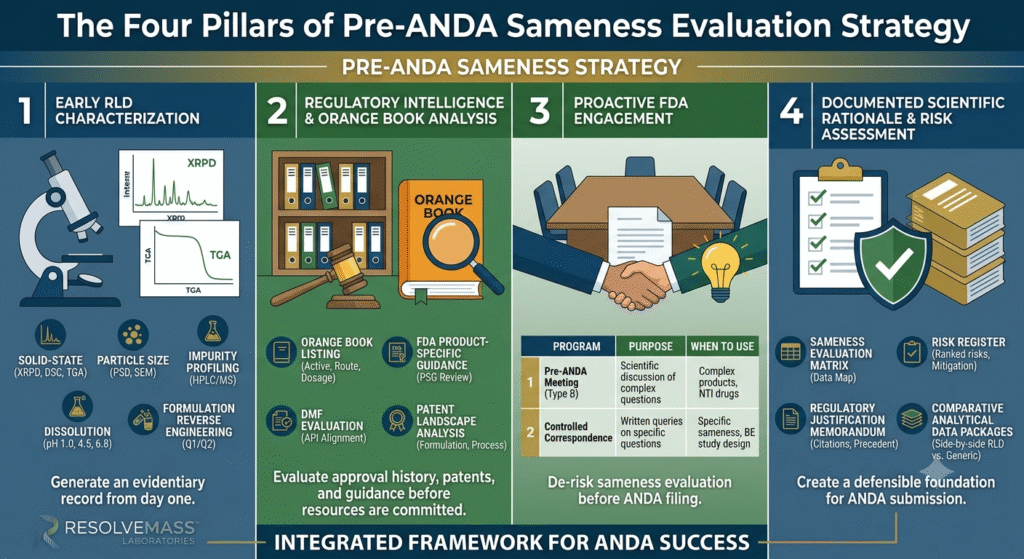
3: The Four Pillars of Pre-ANDA Sameness Evaluation Strategy
Pillar 1 — Early Reference Listed Drug (RLD) Characterization
The first step in pre-ANDA sameness evaluation is comprehensive characterization of the Reference Listed Drug itself — before any formulation work begins.
Too many manufacturers begin formulation development with assumptions about the RLD’s active ingredient characteristics. This is a critical error. Early, rigorous RLD characterization should include:
- Solid-state characterization — X-ray powder diffraction (XRPD), differential scanning calorimetry (DSC), and thermogravimetric analysis (TGA) to identify the crystalline form, salt form, and hydration/solvation state of the active ingredient
- Particle size and morphology analysis — laser diffraction, dynamic light scattering (DLS), or scanning electron microscopy (SEM) to understand particle size distribution that may affect dissolution and BE
- Impurity profiling — HPLC/MS characterization of degradation products and process-related impurities against which the generic must be compared
- Dissolution profiling — comparative dissolution under multiple pH conditions (1.0, 4.5, 6.8) and agitation conditions per FDA dissolution guidance
- Formulation reverse engineering — qualitative and, where feasible, quantitative characterization of excipients present in the RLD
At ResolveMass Laboratories Inc., our pre-ANDA characterization packages are designed specifically to generate the evidentiary record you need to support sameness claims from the earliest stages of development.
Pillar 2 — Regulatory Intelligence and Orange Book Analysis
Regulatory intelligence means understanding the full landscape of the RLD’s approval history, patent protections, and FDA guidance before committing resources to development.
A structured Orange Book and regulatory intelligence review for pre-ANDA sameness should cover:
- Orange Book listing review — confirming the current RLD designation, active ingredient listing, route and dosage form classification, and strength(s)
- FDA product-specific guidance (PSG) — the FDA publishes Product-Specific Guidances for hundreds of drug products that outline recommended BE approaches, RLD selection, and specific sameness considerations; these are updated regularly and must be reviewed in their current form
- Drug master files (DMFs) — evaluating whether the active pharmaceutical ingredient (API) supplier’s DMF aligns with the RLD’s API characteristics
- Patent landscape analysis — mapping formulation, process, and polymorph patents that may constrain how sameness can be achieved
- Prior approval supplement (PAS) and CBE-30 history — understanding post-approval changes the innovator has made to the RLD, which may affect the relevant sameness comparator
Failing to identify a recent FDA PSG update or a post-approval change to the RLD has caused more than one generic program to develop the wrong product for months before the error was discovered.
Pillar 3 — Proactive FDA Engagement Through Formal Programs
Engaging FDA proactively before ANDA filing is one of the most underutilized — and most effective — strategies for de-risking sameness evaluation.
FDA offers several formal mechanisms for pre-submission scientific dialogue:
| FDA Program | Purpose | When to Use |
|---|---|---|
| Pre-ANDA Meeting (Type B) | Scientific discussion of complex ANDA development questions, including sameness determinations | Complex products, NTI drugs, novel dosage forms |
| Controlled Correspondence | Written scientific queries on specific regulatory or scientific questions related to generic drug development | Specific sameness classification questions, BE study design |
| Product-Specific Guidance Comment Process | Submitting comments on draft PSGs when published FDA recommendations conflict with your scientific data | When data support an alternative BE approach or RLD selection |
| GDUFA II Enhanced Communication Programs | Expedited communication pathways under the Generic Drug User Fee Act for enhanced pre-submission meetings | Complex or high-risk ANDA programs |
One of the most strategically valuable uses of a Controlled Correspondence is to ask FDA directly whether the agency considers a specific formulation difference — such as a different salt form or different polymorphic form — to constitute a different active ingredient, thereby requiring a 505(b)(2) NDA rather than an ANDA. Getting this answer in writing before investing in a full ANDA program can save years of development time.
Pillar 4 — Documented Scientific Rationale and Risk Assessment
The final pillar of a pre-ANDA sameness strategy is creating a documented, scientifically defensible rationale for every sameness conclusion your team reaches during development.
This documentation framework should include:
- A sameness evaluation matrix mapping each of the five sameness parameters to the specific data, analyses, and regulatory references supporting your determination
- A risk register identifying the sameness-related risks in your program, ranked by likelihood and consequence, with mitigation strategies for each
- A regulatory justification memorandum citing applicable FDA regulations, guidance documents, and precedent decisions for each key sameness conclusion
- Comparative analytical data packages showing side-by-side comparisons of your proposed generic and the RLD across all relevant physical, chemical, and biopharmaceutical parameters
This documented approach does more than protect your program internally — it becomes the evidentiary foundation of your ANDA submission, and it positions ResolveMass Laboratories (or your regulatory affairs team) to respond efficiently and persuasively to any FDA information requests.
4: Common Sameness Evaluation Failure Points — And How to Avoid Them
Understanding where generic drug programs most commonly fail on sameness is essential for building an effective de-risking strategy.
Active Ingredient Failures
- Polymorphic misidentification — The active ingredient in your generic is a different polymorphic form than the RLD, leading to different dissolution and potentially different bioavailability
- Salt form ambiguity — Assuming that different salts of the same base molecule are “the same” active ingredient; FDA may disagree depending on the product context
- Particle size divergence — Significant differences in API particle size distribution that affect in vitro dissolution and potentially in vivo bioavailability
Dosage Form Failures
- Misclassification of modified-release systems — Extended-release vs. delayed-release vs. immediate-release distinctions are strictly regulated; misclassification leads to automatic ANDA refusal
- Combination product ambiguity — Products that include a device component (e.g., auto-injectors, metered-dose inhalers) require careful analysis of whether the drug component meets ANDA sameness requirements
- Complex dosage form evolution — The RLD may have evolved through post-approval supplements; the current commercially distributed RLD may differ from the originally approved product
Strength and Labeling Failures
- Concentration vs. unit dose ambiguity — For solutions and suspensions, strength can be expressed per mL or per unit dose; ensuring alignment with how FDA classified the RLD’s strength is critical
- Skinny label carve-out errors — Incorrectly identifying which indications are patent-protected, resulting in either under-carving (patent infringement risk) or over-carving (potential market access limitations)
5: Pre-ANDA Sameness Evaluation for Complex Drug Products
Complex drug products — including locally acting drugs, complex formulations, drug-device combination products, and products with complex routes of administration — present the most challenging sameness evaluation scenarios.
For these product categories, the FDA’s Complex Drug Substances and Drug Products Program within OGD has developed a specific regulatory framework. Key considerations include:
- In vitro testing as a surrogate for in vivo sameness — For topical, inhalation, and locally acting products, FDA increasingly relies on in vitro testing (e.g., comparative pharmacokinetics, IVIVC modeling) to establish pharmaceutical and therapeutic equivalence
- Q1/Q2/Q3 sameness criteria — For some complex products (notably nasal sprays and certain topical products), FDA requires not just bioequivalence but also qualitative and quantitative formulation sameness (Q1/Q2) and structural sameness (Q3)
- 505(b)(2) pathway consideration — When sameness cannot be fully established through an ANDA pathway, the 505(b)(2) hybrid application may be appropriate, but this requires a fundamentally different regulatory strategy
6: Building Your Pre-ANDA Sameness Evaluation Timeline
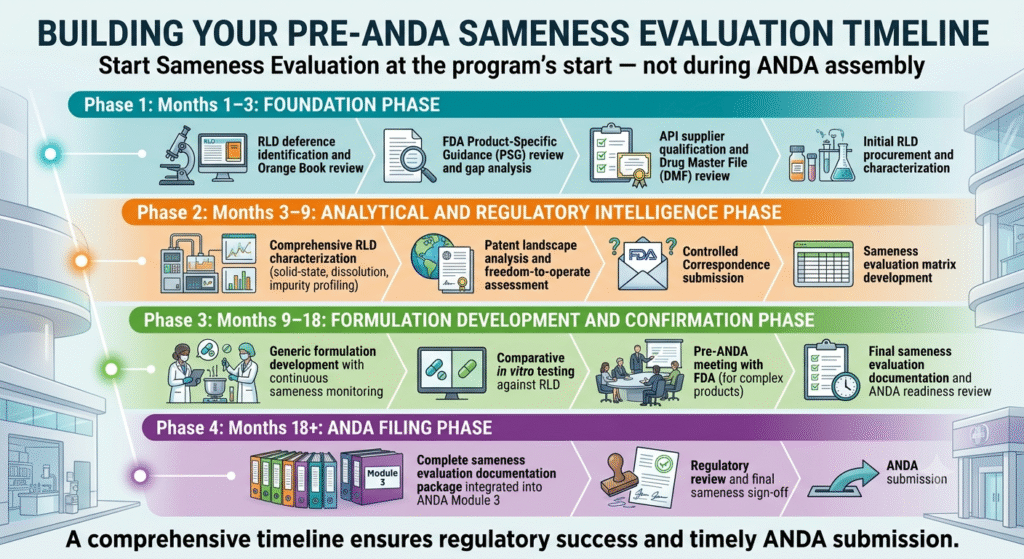
The right time to begin sameness evaluation is at the very start of your generic drug development program — not during ANDA assembly. A practical timeline looks like this:
Months 1–3: Foundation Phase
- RLD identification and Orange Book review
- FDA Product-Specific Guidance review and gap analysis
- API supplier qualification and DMF review
- Initial RLD procurement and characterization
Months 3–9: Analytical and Regulatory Intelligence Phase
- Comprehensive RLD characterization (solid-state, dissolution, impurity profiling)
- Patent landscape analysis and freedom-to-operate assessment
- Controlled Correspondence submission to FDA (if needed) on key sameness questions
- Sameness evaluation matrix development
Months 9–18: Formulation Development and Confirmation Phase
- Generic formulation development with continuous sameness monitoring
- Comparative in vitro testing against RLD
- Pre-ANDA meeting with FDA (for complex products)
- Final sameness evaluation documentation and ANDA readiness review
Months 18+: ANDA Filing Phase
- Complete sameness evaluation documentation package integrated into ANDA Module 3
- Regulatory review and final sameness sign-off
- ANDA submission
7: How ResolveMass Laboratories Inc. Supports Pre-ANDA Sameness Evaluation
ResolveMass Laboratories Inc. is a specialized regulatory sciences and analytical testing organization with deep expertise in generic drug development strategy. Our team combines decades of pharmaceutical regulatory experience with state-of-the-art analytical capabilities to help our clients de-risk sameness evaluation at every stage of development.
Our pre-ANDA services include:
- Comprehensive RLD characterization programs covering solid-state, particle characterization, dissolution profiling, and impurity analysis
- Regulatory strategy consulting for sameness determination, FDA program navigation, and Complex Drug Products guidance interpretation
- Controlled Correspondence and FDA meeting preparation support
- Sameness evaluation documentation packages designed to FDA audit-readiness standards
- Expert witness and regulatory defense support for sameness-related FDA challenges
We work with both emerging generic manufacturers and established pharmaceutical companies to build scientifically rigorous, regulatorily defensible pre-ANDA sameness strategies that protect development investments and accelerate path to approval.
Conclusion:
Pre-ANDA sameness evaluation is not a regulatory box to check — it is a strategic imperative for any generic drug program that wants to reach market efficiently, cost-effectively, and with a defensible regulatory posture.
The manufacturers who win in the generic drug market are those who treat sameness evaluation as a scientific discipline, not an afterthought. They invest in rigorous RLD characterization, engage FDA proactively, document their scientific rationale meticulously, and build sameness risk mitigation into every phase of their development program.
The cost of getting sameness wrong — in Complete Response Letters, wasted BE studies, lost first-to-file status, and delayed market entry — far exceeds the cost of doing it right from the beginning.
ResolveMass Laboratories Inc. is ready to be your scientific and regulatory partner in building a pre-ANDA sameness evaluation strategy that stands up to FDA scrutiny and gives your program the strongest possible foundation for approval.
Frequently Asked Questions:
Early sameness evaluation helps developers identify formulation and analytical gaps before significant resources are invested. Detecting differences in composition, impurities, or product performance at an early stage reduces the risk of costly reformulations and project delays. It also strengthens regulatory readiness and supports more informed development decisions. Ultimately, early characterization can shorten development timelines and improve approval prospects.
Q1 sameness refers to having the same inactive ingredients as the RLD, while Q2 sameness focuses on matching the quantities of those ingredients. Q3 sameness evaluates physicochemical characteristics such as particle size, viscosity, dissolution behavior, and morphology. Together, these assessments help demonstrate that the generic product performs similarly to the reference product. Regulatory expectations vary depending on the complexity of the dosage form.
Ideally, a Pre-ANDA Sameness Evaluation should begin before formulation development starts. Early characterization of the RLD allows developers to identify critical quality attributes and establish appropriate analytical strategies. Starting early reduces uncertainty and minimizes the likelihood of discovering significant product differences later in development. This proactive approach supports more efficient project planning and risk management.
Impurity profiling helps identify and compare impurities present in both the generic product and the RLD. Differences in impurity profiles may indicate variations in manufacturing processes, raw materials, or stability characteristics. Understanding these impurities early helps developers address potential regulatory concerns and establish robust quality control strategies. Detailed impurity characterization is often critical for regulatory acceptance.
Extractables and leachables (E&L) studies assess whether packaging materials or container closure systems introduce chemicals into the drug product. These studies help determine potential safety risks, product compatibility, and regulatory compliance. Packaging-related differences can affect product quality and long-term stability. Therefore, E&L evaluations are an important component of a comprehensive sameness assessment strategy.
Advanced characterization provides detailed scientific data about a product’s composition, structure, purity, and performance. By generating objective evidence early in development, companies can identify potential issues before they become regulatory obstacles. This data-driven approach supports stronger scientific justifications in ANDA submissions and reduces the likelihood of receiving regulatory deficiencies or information requests.
Reference
- Brunet-Manquat L, Combedazou A, Ahuja B, Maden A, Ramus C, Mardovina T, Frolet C. Pre-ANDA strategy and Human Factors activities to de-risk pharmaceutical companies ANDA submission of drug–device combination products: case study of a formative Comparative Use Human Factors study. Expert Opinion on Drug Delivery. 2024 May 3;21(5):767-78.https://www.tandfonline.com/doi/abs/10.1080/17425247.2024.2356678
- Stoll C, Combedazou A, Brunet-Manquat L, Tabet C, Frolet C. Feasibility of switching between different autoinjector designs: positive insights from formative Comparative Use Human Factors studies. Expert Opinion on Drug Delivery. 2025 Aug 3;22(8):1223-36.https://www.tandfonline.com/doi/abs/10.1080/17425247.2025.2514222
- Lance PT, Greenaway RV, Edwards B. An Assessment of Concerns Regarding New Regulatory Guidance for Combination Products: A review of the submissions made to the FDA regarding their proposed draft new guidance on human factors studies for a combination product in an abbreviated new drug application. Therapeutic Innovation & Regulatory Science. 2019 Mar;53(2):254-63.https://journals.sagepub.com/doi/abs/10.1177/2168479018775659
- Ghosh I, Deodhar S, Gutka H, Sridharan S, Bindra D. Subcutaneous drug delivery of high concentration antibody products–part 2: formulation, device options, and clinical bridging strategies for patient-centric commercial presentations. InmAbs 2026 Dec 31 (Vol. 18, No. 1, p. 2680773). Taylor & Francis.https://www.tandfonline.com/doi/abs/10.1080/19420862.2026.2680773
About the Author


