

Introduction:
The convergence of peptide chemistry and oligonucleotide biology has produced one of the most promising — and analytically demanding — therapeutic modalities of the decade. Peptide-Oligonucleotide Conjugate Toxicology Studies sit at the intersection of two already-complex disciplines, requiring study designs that can simultaneously interrogate the safety of a nucleic acid payload, an amino acid-based targeting vector, and their conjugated form as a single hybrid entity. At ResolveMass Laboratories Inc., we have developed specialized frameworks and comprehensive Peptide-Oligonucleotide Conjugates Preclinical Services to help sponsors navigate this complexity with scientific rigor and regulatory confidence.
Peptide-oligonucleotide conjugates (POCs) are engineered molecules where a synthetic peptide — often serving as a cell-penetrating, receptor-targeting, or endosomal escape moiety — is covalently linked to a therapeutic oligonucleotide such as an antisense oligonucleotide (ASO), siRNA, splice-switching oligonucleotide (SSO), or microRNA mimic. Understanding the mechanism of action of peptide-oligonucleotide conjugates is critical because each component brings distinct pharmacological activity, distinct metabolic fate, and distinct toxicological liabilities.
This article provides a comprehensive CRO perspective on the critical design elements of POC toxicology programs, from species selection and dose range finding to bioanalytical method development, immunogenicity testing, and regulatory submission strategy.
Summary:
- What peptide-oligonucleotide conjugates (POCs) are and why they present unique toxicology challenges
- Key regulatory frameworks guiding POC toxicology study design (ICH S6, ICH S9, ICH M3)
- How hybridization-dependent and hybridization-independent toxicities differ — and how to detect both
- Bioanalytical strategies for simultaneous peptide and oligonucleotide PK/TK quantification
- Species selection, dose justification, and study duration considerations specific to POC programs
- Immunogenicity assessment tailored to the dual-entity architecture of POCs
- Common pitfalls in POC tox study design and how an experienced CRO helps avoid them
- How ResolveMass Laboratories Inc. supports POC IND-enabling programs end-to-end
1: Understanding the Toxicological Landscape of Peptide-Oligonucleotide Conjugates
POCs carry dual toxicological liabilities: those derived from the oligonucleotide backbone and those from the peptide vector. Regulatory agencies expect study designs that characterize both independently and in combination, across multiple tissue compartments and timepoints. The toxicological profile can vary considerably depending on the types of peptide-oligonucleotide conjugates being developed, as different targeting strategies can influence biodistribution, efficacy, and safety outcomes.
Hybridization-Dependent vs. Hybridization-Independent Toxicity
The most important toxicological classification in oligonucleotide therapeutics separates sequence-specific (hybridization-dependent) effects from class-based (hybridization-independent) effects:
| Toxicity Type | Driver | Examples | Detection Strategy |
|---|---|---|---|
| Hybridization-Dependent | Sequence-specific target engagement | Exaggerated pharmacology, off-target gene silencing | Transcriptomics, species with pharmacological relevance |
| Hybridization-Independent (Oligo Class) | Chemical backbone / motif | Complement activation, coagulation, renal proximal tubule toxicity | Standard safety panels, urinalysis, complement assays |
| Peptide-Specific | Amino acid sequence, charge, hydrophobicity | Membrane disruption, mast cell degranulation, histamine release | In vitro hemolysis, degranulation assays, histopathology |
| Conjugate-Emergent | Linker chemistry or steric effects unique to the hybrid | Altered biodistribution, unexpected metabolite toxicity | Whole-body autoradiography, metabolite profiling, PBPK modelling |
Why Conjugate-Emergent Toxicity Demands Standalone Attention
Conjugate-emergent effects — toxicities that arise specifically from the joined molecule rather than either component alone — represent the most scientifically under-characterized category in POC development. At ResolveMass Laboratories Inc., we routinely design comparative arms within toxicology studies that evaluate the unconjugated peptide, the unconjugated oligonucleotide, and the intact POC in parallel. This three-arm design is particularly informative for:
- Tissue distribution changes conferred by the peptide vector
- Metabolite profiles that differ substantially from either parent molecule
- Novel inflammatory or immunogenic responses triggered at the conjugate junction
- Linker stability and the kinetics of in vivo decoupling
The nature of the peptide-oligonucleotide conjugate linker chemistry can significantly affect toxicity outcomes, making linker characterization an important component of nonclinical safety assessmen
2: Regulatory Framework for Peptide-Oligonucleotide Conjugate Toxicology Studies
There is no single ICH guideline governing POC toxicology. Sponsors must draw on overlapping frameworks — primarily ICH S6(R1) for biologics, ICH M3(R2) for small molecules, and the oligonucleotide-specific thinking embedded in ICH S9 and emerging FDA/EMA reflection papers. The regulatory strategy must be agreed proactively with health authorities, ideally via pre-IND or scientific advice meetings.
Key Regulatory Guidelines and Their Application to POCs
| Guideline | Primary Application to POCs | Critical Consideration |
|---|---|---|
| ICH S6(R1) | Peptide component if immunogenic or biologic-like | Species relevance based on receptor binding, not just sequence homology |
| ICH M3(R2) | Small-molecule-like oligonucleotide backbone | Duration-to-dose ratio for chronic administration |
| ICH S9 | Oncology indication POCs | Abbreviated nonclinical package may suffice for life-threatening indications |
| ICH S2(R1) | Genotoxicity for novel linker chemistries | New chemical entities in the linker require Ames + in vitro micronucleus |
| ICH S7A/S7B | Safety pharmacology CNS/CV/Resp | POCs with CNS-targeting peptides require focused CNS safety pharmacology |
| FDA 2016 Oligo Guidance | Baseline oligonucleotide tox expectations | Class-based tox tests, complement, coagulation, platelet function |
ResolveMass Laboratories Inc. Insight: Engage health authorities early. POCs often require a combination of biologic and small-molecule regulatory logic. A pre-IND meeting that explicitly proposes your justification for guideline selection will save months of back-and-forth during review.
3: Species Selection in Peptide-Oligonucleotide Conjugate Toxicology Studies
Species selection for POC studies must consider pharmacological relevance for both the oligonucleotide (target gene expression and conservation) and the peptide (receptor binding, cell-penetrating efficiency). The effectiveness of peptide-oligonucleotide conjugates drug delivery systems should also be evaluated because peptide-mediated targeting may alter tissue exposure patterns across species.
Species Selection Decision Framework
- Rodents (rat preferred over mouse): Adequate for general toxicity, renal tox assessment, and initial PK. Must confirm oligonucleotide target gene is expressed and accessible in the chosen strain.
- Non-Human Primates (cynomolgus monkey): Preferred second species when peptide receptor homology is high in cynomolgus. Provides cardiovascular, immunologic, and reproductive toxicity signals.
- Minipig: Emerging option when dermal or GI-targeting peptides are used; skin and GI architecture more human-like than NHP for these routes.
- Humanized mouse models: May be necessary when human-specific receptor targeting by the peptide cannot be modelled in standard species — requires explicit regulatory justification.
- In vitro bridging studies: Hepatocyte toxicity cross-species comparisons (human, rat, NHP) should supplement in vivo species selection for liver-targeted POCs.
A key ResolveMass Laboratories Inc. recommendation: perform a receptor binding characterization study (in vitro) across candidate species before finalizing the tox species selection. Submitting this data in an IND module 4 appendix significantly strengthens species justification and preempts regulatory questions.
4: Bioanalytical Strategy for Dual-Entity Pharmacokinetic/Toxicokinetic Characterization
Bioanalytical method development is one of the most technically demanding aspects of POC toxicology programs. Effective studies require robust bioanalytical method development for POC therapeutics capable of accurately quantifying intact conjugates, free oligonucleotides, free peptides, and linker-derived metabolites.
Advanced peptide-oligonucleotide conjugate analysis approaches are necessary to characterize exposure, metabolism, and toxicokinetic behavior throughout development.
Recommended Bioanalytical Platform Matrix for POC Programs
| Analyte | Preferred Method | Matrix | Key Challenge |
|---|---|---|---|
| Intact POC | LC-MS/MS (hybrid ligand binding + mass detection) | Plasma, tissue homogenates | Intact molecule lability; requires cold-chain sample handling |
| Free Oligonucleotide | Hybridization ELISA or HPLC-UV | Plasma, urine, CSF | Distinguishing parent from metabolites (5’/3′ truncations) |
| Free Peptide | LC-MS/MS or ELISA | Plasma, urine | Rapid proteolytic degradation in matrix; stabilizer required at collection |
| Linker Metabolites | High-resolution MS (HRMS) | Plasma, liver, kidney | Unknown metabolite identification requires full scan HRMS |
| TK Parameters | Non-compartmental analysis (NCA) | All above | AUC calculation complicated by biphasic release from conjugate |
Sample Collection and Stability Considerations
Peptide-oligonucleotide conjugates present unique sample stability challenges that are routinely underestimated. Comprehensive evaluation of peptide-oligonucleotide conjugate stability is essential to ensure accurate toxicokinetic and bioanalytical data throughout the study lifecycle. ResolveMass Laboratories Inc. bioanalytical teams build stability data packages covering:
- Bench-top stability at room temperature and on ice (critical for blood collection windows)
- Freeze-thaw stability (minimum 3 cycles) in all relevant matrices
- Long-term frozen storage stability at -80°C, aligned with study duration
- Matrix-specific stability in tissue homogenates (liver, kidney, target organ)
- Phosphodiesterase inhibitor and protease inhibitor cocktail optimization for sample preservation
- Dilutional integrity testing across the expected concentration range in toxicology studies
Characterizing peptide-oligonucleotide conjugates degradation pathways is equally important because degradation products may possess unique pharmacological or toxicological properties that influence safety assessments and regulatory review.
5: Study Design Architecture: From Dose Range Finding to GLP Pivotal Studies
A robust POC toxicology program typically follows a staged architecture: in vitro safety screening, followed by a non-GLP dose range finding (DRF) study, followed by GLP pivotal studies of appropriate duration to support the first-in-human (FIH) clinical dose and duration.
Before initiating toxicology programs, sponsors should establish robust POC synthesis and characterization workflows to confirm molecular identity, purity, conjugation efficiency, and structural integrity.
Stage 1: In Vitro Safety Screening Panel
- Cytotoxicity: MTT/LDH assays in human primary cells (hepatocytes, renal proximal tubule cells, PBMCs)
- Hemolysis: RBC lysis assay to screen for membrane-disruptive peptide components
- Complement activation: CH50 and AP50 assays; C3a/C5a ELISA for phosphorothioate oligonucleotide backbone
- Platelet aggregation: Light transmission aggregometry in human platelet-rich plasma (PRP)
- hERG channel inhibition: Patch clamp or fluorescence assay for cardiovascular liability
- Genotoxicity screen: Mini-Ames test and in vitro micronucleus for novel linker chemistries
Stage 2: Non-GLP Dose Range Finding Study
The DRF study in one species (typically rat) uses 3–5 dose levels over 2–4 weeks with comprehensive endpoints to establish the no-observed-adverse-effect level (NOAEL) range for GLP study dose selection. Critical DRF-specific endpoints for POCs include:
- Full clinical chemistry panel with special attention to liver enzymes (AST, ALT, ALP, bilirubin) and renal function markers (BUN, creatinine, urinary KIM-1, NGAL)
- Urinalysis with microscopy — proximal tubular vacuolation is a well-characterized class-based oligonucleotide finding
- Histopathology of liver, kidney, spleen, lymph nodes, injection site, and known peptide receptor-expressing tissues
- Immunophenotyping — lymphocyte subsets, NK cell counts — particularly relevant when the peptide has an immune cell targeting function
- Complement assays at multiple timepoints post-dose to capture kinetic patterns
Stage 3: GLP Pivotal Toxicology Studies
| Study Type | Duration | Species | Key Regulatory Trigger |
|---|---|---|---|
| Single-Dose Tolerability (GLP) | Single dose + 14-day observation | Rat + NHP | FIH dose selection; maximum tolerated dose definition |
| Repeat-Dose General Toxicity | 4-week (28-day) GLP | Rat + NHP | Support ≤2-week Phase 1 clinical study |
| Repeat-Dose General Toxicity | 13-week (90-day) GLP | Rat + NHP | Support ≤3-month clinical study; standard Phase 2 entry |
| Genotoxicity Battery | Per ICH S2(R1) | In vitro (bacterial + mammalian) | Required for novel linker chemical entities |
| Safety Pharmacology | Standalone or integrated | Dog/NHP (CV); rat (CNS, resp) | Core battery per ICH S7A |
| Embryo-Fetal Development (EFD) | GD6–17 (rat), GD20–50 (rabbit) | Rat + Rabbit | FIH in females of childbearing potential |
6: Immunogenicity Assessment in POC Toxicology Programs
Immunogenicity for POCs must be assessed for both the peptide component and the intact conjugate. Anti-drug antibody (ADA) responses can alter the pharmacokinetics, toxicokinetics, and safety profile of the conjugate in unpredictable ways.
Two-Tiered Immunogenicity Testing Strategy
- Tier 1 — Screening Assay: Electrochemiluminescence (ECL) or bridging ELISA to detect total ADA against intact POC in all toxicokinetic animals at baseline, mid-study, and study termination
- Tier 2 — Confirmatory Assay: Confirm positive signals with competitive inhibition using excess drug; determine titre
- Tier 3 — Characterization: IgG subclass analysis; neutralizing antibody assessment using cell-based or PK-based approach
- Peptide-Specific ADA: If peptide is immunodominant, develop a separate assay against free peptide to determine which entity drives the ADA response
- ADA-PK Correlation: Correlate ADA titres with TK data — hypervariable TK profiles are often the first signal of an immunogenic response
Key Consideration: Phosphorothioate-modified oligonucleotides are generally not immunogenic. The peptide vector is typically the more immunogenic component. However, the conjugation chemistry itself may create neoepitopes not present in either parent molecule. This is why ADA assays against the intact POC — not just the individual components — are essential for a complete immunogenicity risk characterization.
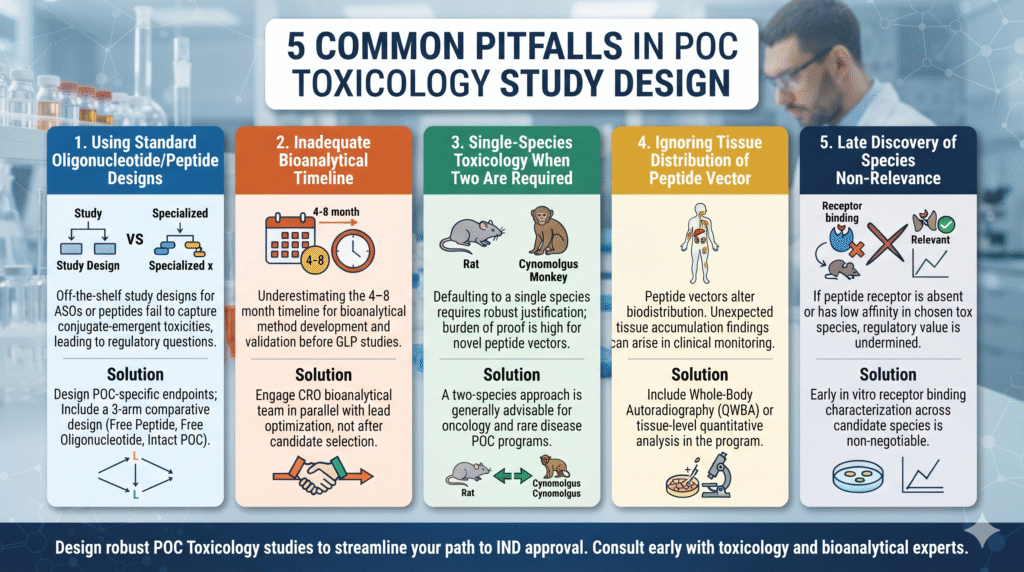
7: Common Pitfalls in POC Toxicology Study Design — and How to Avoid Them
Many challenges encountered during development stem from broader challenges in peptide-oligonucleotide conjugates, including analytical complexity, stability limitations, species relevance concerns, and manufacturing hurdles.
Pitfall 1: Using Standard Oligonucleotide or Peptide Study Designs Without POC-Specific Adaptation
Off-the-shelf study designs for ASOs or peptides will fail to capture conjugate-emergent toxicities and may lead to regulatory questions during IND review. Always design POC-specific endpoints — including the three-arm comparative design (free peptide, free oligonucleotide, intact POC) — from the outset of program planning.
Pitfall 2: Inadequate Bioanalytical Method Development Timeline
POC bioanalytical methods require 4–8 months of development and validation before a GLP study begins. Sponsors who underestimate this timeline frequently face pivotal study delays. Engage your CRO bioanalytical team in parallel with lead optimization, not after candidate selection is finalized.
Pitfall 3: Single-Species Toxicology When Two Are Required
Given the overlapping regulatory frameworks, defaulting to a single species requires robust written justification. The burden of proof for single-species adequacy is high, particularly for POCs with novel peptide targeting vectors. A two-species approach is almost always advisable for general oncology and rare disease POC programs entering Phase 1.
Pitfall 4: Ignoring Tissue Distribution of the Peptide Vector
Peptide vectors are specifically engineered to alter biodistribution. If whole-body autoradiography (QWBA) or tissue-level quantitative analysis is not built into the program, sponsors may be surprised by unexpected tissue accumulation findings that emerge during clinical safety monitoring — findings that are far more costly to investigate after the IND is filed.
Pitfall 5: Late Discovery of Species Non-Relevance
If the peptide receptor is absent or has very low affinity in the chosen tox species, the regulatory value of the entire toxicology package may be undermined at review. Early in vitro receptor binding characterization across candidate species is non-negotiable and should be treated as a pre-tox study requirement.
8: The ResolveMass Laboratories Inc. Approach to POC Toxicology Programs
ResolveMass Laboratories Inc. supports sponsors throughout the development lifecycle, from CMC services for peptide-oligonucleotide conjugates to bioanalytical testing, toxicology strategy, and regulatory submission support.
Our advanced mass spectrometry characterization of peptide-oligonucleotide conjugates enables detailed structural confirmation, impurity identification, metabolite characterization, and regulatory-grade analytical documentation.
| Service Area | ResolveMass Capability | Benefit to POC Sponsor |
|---|---|---|
| Study Design & Regulatory Strategy | POC-specific toxicology design with regulatory strategy guidance | Regulatory-ready protocols; pre-IND meeting preparation support |
| Bioanalytical Method Development | Hybrid LC-MS/MS for intact POC + oligonucleotide + peptide | Single-CRO bioanalytical accountability across all analytes |
| In Vitro Safety Screening | Full safety panel including complement, hemolysis, hERG, genotoxicity | Early identification of high-risk candidates before in vivo investment |
| Non-GLP DRF Studies | Rodent DRF with POC-specific histopathology endpoints | Scientifically optimized dose selection for GLP pivotal studies |
| GLP Pivotal Toxicology | GLP-compliant 28-day and 90-day rat and NHP studies | IND-ready toxicology data packages |
| Immunogenicity Testing | Tiered ADA testing against intact POC and peptide separately | Complete immunogenicity risk characterization |
| PBPK / Data Integration | Toxicokinetic modelling and allometric scaling for human dose projection | Informed FIH dose selection with regulatory-grade justification |
Manufacturing and Development Considerations
As programs advance toward clinical development, sponsors must address peptide-oligonucleotide conjugate manufacturing requirements to ensure product quality, process robustness, and regulatory compliance.
Successful commercialization also depends on effective scale-up of peptide-oligonucleotide conjugates while maintaining critical quality attributes and product consistency.
Comprehensive QC testing for peptide-oligonucleotide conjugates is necessary to support release testing, stability studies, and regulatory submissions throughout development.
Sponsors preparing for clinical and commercial supply should establish strategies aligned with GMP manufacturing of peptide-oligonucleotide conjugates to ensure long-term development success.
Conclusion:
Peptide-Oligonucleotide Conjugate Toxicology Studies demand a study design philosophy that goes beyond simply combining oligonucleotide and peptide precedents. The hybrid nature of these molecules creates a distinct safety profile — one that requires experienced CRO partners capable of developing fit-for-purpose bioanalytical methods, selecting pharmacologically relevant species, designing in vitro safety screens that capture all relevant mechanisms of toxicity, and building GLP packages that satisfy regulators across overlapping guideline frameworks.
Understanding peptide-oligonucleotide conjugates pharmacokinetics is fundamental for establishing exposure-safety relationships and supporting first-in-human dose selection. Likewise, comprehensive peptide-oligonucleotide conjugates impurity profiling strengthens safety assessments by identifying process-related and degradation-related impurities that may impact toxicological outcomes.
Sponsors evaluating targeting technologies may also benefit from understanding the differences between peptide vs antibody oligonucleotide conjugates when selecting the most appropriate delivery platform. Furthermore, choosing suitable peptide-oligonucleotide conjugate synthesis methods during early development can significantly influence manufacturability, stability, analytical characterization, and long-term safety outcomes.
At ResolveMass Laboratories Inc., our integrated expertise in oligonucleotide bioanalytics, peptide characterization, regulatory toxicology, and specialized Peptide-Oligonucleotide Conjugates Preclinical Services positions us as a trusted partner for sponsors advancing innovative conjugate therapeutics through IND-enabling programs and beyond.
Frequently Asked Questions:
Peptide-Oligonucleotide Conjugate Toxicology Studies help determine whether these advanced therapeutics are safe for human use. They identify potential toxicities, establish safe dose ranges, and evaluate organ-specific risks. These studies also support regulatory submissions by providing evidence of safety before clinical trials begin. Because both the peptide and oligonucleotide components can influence toxicity, comprehensive assessment is essential. Well-designed studies reduce development risks and support successful clinical progression.
The primary toxicological concerns include liver and kidney toxicity, immunogenicity, off-target gene modulation, and tissue accumulation. Peptide components may interact with unintended receptors, while oligonucleotides can trigger immune responses or affect non-target genes. Biodistribution patterns may also influence safety outcomes. Understanding these risks is critical for designing effective toxicology programs. Comprehensive studies help identify and mitigate potential safety issues early in development.
Traditional oligonucleotides often face challenges related to poor cellular uptake and limited tissue targeting. Peptide conjugation enhances delivery efficiency by directing the therapeutic to specific tissues or cell types. While this improves efficacy, it can also introduce new safety considerations related to peptide-mediated biological interactions. As a result, toxicology assessments are often more complex. Additional biodistribution and immunogenicity studies may be required.
The liver and kidneys are typically the primary organs evaluated because oligonucleotide therapeutics often accumulate in these tissues. The spleen, lymph nodes, heart, and injection sites may also be examined depending on the therapeutic platform. Histopathological analysis helps identify any treatment-related changes. Organ-specific toxicity assessments are important for determining safety margins. These findings guide dose selection and clinical monitoring strategies.
Rodent species such as mice and rats are commonly used during early nonclinical development. Non-human primates may be selected when they offer better pharmacological relevance or target similarity to humans. Species selection is based on target expression, biodistribution, and regulatory expectations. The chosen model should accurately reflect the therapeutic’s biological activity. Appropriate species selection improves the predictability of human safety outcomes.
Toxicokinetics evaluates how the therapeutic is absorbed, distributed, metabolized, and eliminated from the body. It establishes the relationship between drug exposure and observed toxicological effects. These data help determine safety margins and identify exposure levels associated with adverse findings. Toxicokinetic assessments are often integrated into repeat-dose studies. Regulatory agencies rely on these results to support clinical dose selection.
Immunogenicity is evaluated by examining immune responses triggered by the therapeutic. Common assessments include cytokine measurements, anti-drug antibody testing, complement activation studies, and immune cell profiling. These tests help identify the potential for hypersensitivity or inflammatory reactions. Understanding immunogenicity risks is particularly important for repeated dosing regimens. The results support overall safety evaluation and clinical risk management.
A GLP toxicology study is a regulated safety study conducted according to internationally recognized quality standards. GLP ensures the reliability, integrity, and traceability of study data used in regulatory submissions. These studies evaluate toxicity, exposure, and potential risks associated with the therapeutic. Regulatory agencies typically require GLP-compliant studies to support IND or CTA applications. They form a critical part of the nonclinical safety package.
Biodistribution studies determine where the therapeutic travels and accumulates within the body. Tissue accumulation can directly influence both efficacy and toxicity. Understanding biodistribution helps identify potential target organs of toxicity and informs dose selection. These studies are particularly important for peptide-conjugated therapeutics because targeting peptides may alter tissue exposure patterns. The results support a more accurate safety assessment.
Reference
- Srivastava V, editor. Peptide therapeutics: strategy and tactics for chemistry, manufacturing, and controls. Royal Society of Chemistry; 2019 Aug 16.https://books.google.com/books?hl=en&lr=&id=Cw6xDwAAQBAJ&oi=fnd&pg=PT20&dq=Toxicology+Study+Design+for+Peptide-Oligonucleotide+Conjugate+Therapeutics:+A+CRO+Perspective&ots=BTDa9n_gTT&sig=o8wP2FA-q_tpIv22YZ_nFd1THlg
- Gupta S, Gupta A, Mukherjee M, Bose S, Sinha S. Chemical Insights into Oligonucleotide–Protein Binding for Therapeutic Applications. Journal of Medicinal Chemistry. 2025 May 7;68(10):9848-63.https://pubs.acs.org/doi/abs/10.1021/acs.jmedchem.5c00427
- Malinowska AL, Huynh HL, Bose S. Peptide–oligonucleotide conjugation: chemistry and therapeutic applications. Current issues in molecular biology. 2024 Sep 30;46(10):11031-47.https://www.mdpi.com/1467-3045/46/10/655
- Kim EJ, Lee Y, Ryu J, Kim H, Park J, Lee J. Cell-penetrating peptides for therapeutic applications: emerging design strategies and future directions. Organic & Biomolecular Chemistry. 2025.https://pubs.rsc.org/en/content/articlehtml/2025/ob/d6ob00146g
- Venkatesan N, Kim BH. Peptide conjugates of oligonucleotides: synthesis and applications. Chemical reviews. 2006 Sep 13;106(9):3712-61.https://pubs.acs.org/doi/full/10.1021/cr0502448
- Klabenkova K, Fokina A, Stetsenko D. Chemistry of peptide-oligonucleotide conjugates: a review. Molecules. 2021 Sep 6;26(17):5420.https://www.mdpi.com/1420-3049/26/17/5420
About the Author


