


The development and clinical advancement of hybrid biotherapeutics relies heavily on specialized HPLC Purification Services for Peptide-Oligonucleotide Conjugates that can effectively address the complex molecular heterogeneity generated during chemical ligation processes. By integrating the sequence-specific gene-silencing or splice-modulating functions of synthetic oligonucleotides with the targeted delivery and cell-penetrating capabilities of peptides, these conjugated biomolecules provide innovative solutions for overcoming intracellular delivery challenges.
Explore the diverse types of peptide-oligonucleotide conjugates used in modern therapeutic development.
However, the structural design of these hybrid molecules combines highly hydrophilic, polyanionic nucleic acid backbones with structurally diverse peptide sequences that are often strongly basic or hydrophobic. As a result, synthesis generates highly complex mixtures containing numerous closely eluting impurities, including unreacted starting materials, sequence-deleted fragments, truncated species, and multi-addition side products. Successfully separating these complex mixtures requires sophisticated chromatographic strategies, specialized stationary phases, and validated analytical workflows capable of delivering clinical-grade purity while preserving structural integrity.
Discover our specialized CMC services for peptide-oligonucleotide conjugates designed to streamline your development process.
Share via:
Article Summary:
- Peptide-oligonucleotide conjugates (POCs) combine the gene-targeting capabilities of oligonucleotides with the delivery and cell-penetrating properties of peptides, making them promising candidates for advanced therapeutic applications.
- Purifying POCs is highly challenging because their peptide and oligonucleotide components possess very different chemical properties, resulting in complex mixtures containing truncated products, sequence deletions, and unreacted starting materials.
- Modern purification workflows rely on orthogonal chromatographic techniques such as Ion-Pair Reversed-Phase HPLC (IP-RP-HPLC) and Strong Anion-Exchange HPLC (SAX-HPLC) to separate impurities based on both hydrophobicity and charge characteristics.
- Wide-pore chromatography columns operated at elevated temperatures (60–80°C) improve separation efficiency by reducing molecular aggregation, disrupting secondary structures, and generating sharper chromatographic peaks.
- Continuous purification technologies like Multi-Column Solvent Gradient Purification (MCSGP) significantly enhance product recovery, increase yields by over 20%, and reduce solvent consumption, while Tangential Flow Filtration (TFF) removes salts and concentrates purified products.
- Specialized ion-pairing systems and carefully controlled shallow solvent gradients help resolve difficult impurities, including sequence-failure products, truncated species, and phosphorothioate diastereomers that are often difficult to separate using conventional methods.
- Comprehensive quality control combines advanced analytical tools such as HRMS, LC-MS/MS, 2D-LC, and LC-ICP-MS to verify molecular identity, conjugation sites, purity, and quantitative accuracy, ensuring regulatory compliance and supporting clinical development.
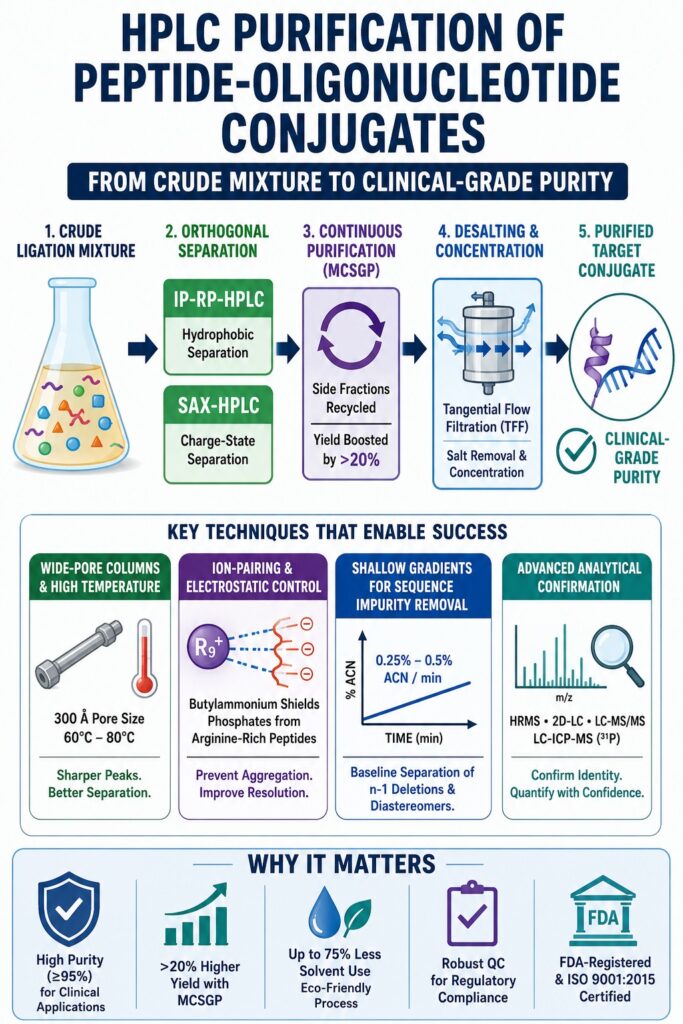
Advanced Methodologies in HPLC Purification Services for Peptide-Oligonucleotide Conjugates
Advanced HPLC purification methodologies employ orthogonal separation mechanisms, including ion-pair reversed-phase chromatography and strong anion-exchange chromatography, to resolve conjugates according to both hydrophobic and electrostatic characteristics. This integrated strategy overcomes the limitations associated with single-mode chromatographic systems when separating target conjugates from structurally related impurities.
Learn more about the underlying mechanism of action for peptide-oligonucleotide conjugates in biological systems.
The purification of peptide-oligonucleotide conjugates (POCs) is particularly challenging because of the fundamentally different physicochemical properties exhibited by the two biomolecular components. The oligonucleotide segment contains a highly charged and hydrophilic phosphodiester or phosphorothioate backbone, whereas the peptide segment may contain hydrophobic, hydrophilic, or highly basic regions depending on its amino acid composition.
Master effective peptide-oligonucleotide conjugate linker chemistry to enhance stability and targeting.
Traditional reversed-phase chromatography offers insufficient retention for highly hydrophilic nucleic acids, while anion-exchange chromatography lacks sensitivity toward hydrophobic modifications present within peptide domains. To address these shortcomings, modern purification platforms primarily utilize Ion-Pair Reversed-Phase High-Performance Liquid Chromatography (IP-RP-HPLC).
                            [ Crude Ligation Mixture ]
                                        │
                                        ▼
             ┌─────────────────────────────────────────────────────┐
             │            Orthogonal Separation Strategy           │
             └──────────────────┬────────────────────────┬─────────┘
                                │                        │
         Hydrophobic Separation │                        │ Charge-State Separation
                                ▼                        ▼
                   ┌────────────────────────┐  ┌──────────────────┐
                   │       IP-RP-HPLC       │  │     SAX-HPLC     │
                   └────────────┬───────────┘  └─────────┬────────┘
                                │                        │
                                └───────────┬────────────┘
                                            │
                                            ▼
                             ┌──────────────────────────────┐
                             │    Continuous Purification   │
                             │           (MCSGP)            │
                             └──────────────┬───────────────┘
                                            │
                                            ▼
                             ┌──────────────────────────────┐
                             │    Desalting & Isolation     │
                             │   (Tangential Flow Filter)   │
                             └──────────────┬───────────────┘
                                            │
                                            ▼
                             [ Purified Target Conjugate ]
The retention mechanism of IP-RP-HPLC is based on a dynamic mixed-mode interaction. Volatile alkylamine ion-pairing reagents (IPRs) present in the mobile phase adsorb onto the hydrophobic stationary phase, creating a positively charged surface layer that electrostatically attracts negatively charged phosphate groups within the oligonucleotide component. At the same time, hydrophobic regions of the peptide interact directly with the stationary phase ligands, enabling highly efficient separation of intact conjugates from structurally related impurities.
Successful optimization of these interactions requires precise control over ion-pairing reagent selection, mobile-phase composition, pH, organic modifier gradients, and operating temperature, as summarized below.
| Separation Mode | Targeted Impurity Profiles | Key Column Systems | Optimized Mobile Phase A | Optimized Mobile Phase B | Operating Temperature |
|---|---|---|---|---|---|
| IP-RP-HPLC (Short POCs) [cite: 1, 2, 3] | Unreacted free oligonucleotides, truncated peptide fragments, organic linker impurities | Wide-pore C18 silica, 1.7 μm to 3 μm particles, 300 Å pore size | 15 mM Hexylamine, 50 mM HFIP in H₂O [cite: 3] | 15 mM Hexylamine, 50 mM HFIP in Acetonitrile | 60°C to 80°C [cite: 3] |
| IP-RP-HPLC (Large & PS-POCs) [cite: 1, 2, 3] | Unreacted alkyne/azide precursors, diastereomeric species, n-x shortmers | Wide-pore C18 silica, 3 μm particles, 300 Å pore size | 15 mM Tripropylamine (TPA), 100 mM HFIP in H₂O [cite: 3] | 15 mM TPA, 100 mM HFIP in Methanol/Acetonitrile | 80°C [cite: 3] |
| SAX-HPLC (Anion-Exchange) [cite: 1, 12, 15] | n-1 nucleic acid deletions, truncated variants, acidic peptide impurities | Non-porous polymethacrylate with amide-functionalized SAX bonded phase | Aqueous Sodium Hydroxide (pH 12) | Aqueous Sodium Hydroxide (pH 12) with 1 M Sodium Perchlorate | 50°C to 60°C [cite: 15, 17] |
| HILIC (Polar Profiling) [cite: 1] | Highly polar intermediates, glycosylated conjugate isomers | Zwitterionic or amide-bonded stationary phases | High organic modifier buffer (e.g., 90% Acetonitrile with Ammonium Acetate) | Low organic modifier buffer (e.g., 10% Acetonitrile with Ammonium Acetate) | 40°C to 50°C [cite: 1] |
Column and Temperature Selection in HPLC Purification Services for Peptide-Oligonucleotide Conjugates
Column and temperature selection strategies depend on wide-pore, high-pH-resistant stationary phases operated under elevated temperatures to disrupt secondary structures and molecular self-association. Maintaining column temperatures between 60°C and 80°C is essential for producing sharp chromatographic peaks and achieving baseline separation.
The substantial physicochemical size of peptide-oligonucleotide conjugates restricts efficient mass transfer within conventional small-pore stationary phases ranging from 80 Å to 120 Å. To eliminate diffusion limitations and reduce peak tailing, wide-pore silica matrices with pore sizes around 300 Å are required. Superficially porous particle (SPP) technologies, including Poroshell columns, provide enhanced chromatographic performance through a solid silica core surrounded by a thin porous shell. This architecture minimizes diffusion pathways for large biomolecular conjugates and maintains high separation efficiency under elevated temperature and high-pH operating conditions while preserving loading capacity.
Additionally, both peptide and oligonucleotide components can form higher-order structures through Watson-Crick base pairing, hairpin formation, peptide folding, and other intramolecular interactions. These structural conformations coexist dynamically in solution and frequently result in peak splitting or chromatographic band broadening.
Operating wide-pore columns at elevated temperatures between 60°C and 80°C disrupts these secondary structures through thermal denaturation, forcing the conjugate population into a more uniform conformational state. This process sharpens chromatographic peaks, improves mass transfer kinetics, and facilitates efficient isolation of full-length conjugates from unreacted or truncated synthesis products.
Refine your workflow with our optimized peptide-oligonucleotide conjugate synthesis methods.
Technical Capacity of Continuous Chromatography and Prep-Scale Fractionation
The capabilities of preparative-scale fractionation are significantly enhanced through the integration of continuous counter-current systems such as Multi-Column Solvent Gradient Purification (MCSGP), combined with downstream Tangential Flow Filtration (TFF) for rapid desalting and concentration. This integrated workflow enables seamless transition from milligram-scale research production to multi-gram clinical manufacturing.
   [ Batch Chromatography ]              [ MCSGP Continuous Chromatography ]

       Yield-Purity Limit                    Continuous Recycling
         ┌────────────┐                         ┌────────────┐
         │ Pure Heart │                         │ Pure Heart │──────► [ Pure Product ]
         │    Cut     │                         │    Cut     │
         └─────┬──────┘                         └─────┬──────┘
               │                                      │
               ▼                                      ▼
     [ Side Overlaps Lost ]                [ Side Overlaps Recycled ]
     (Lowered Yield/Recovery)               (Yield boosted by >20%)
Ensure a smooth transition to clinical manufacturing with our scale-up of peptide-oligonucleotide conjugates expertise.
Conventional preparative batch chromatography is constrained by a strict purity-versus-yield compromise. During the separation of complex conjugation mixtures, target peaks frequently overlap with closely related impurities such as n-1 deletions or unreacted linker-modified oligonucleotides. Achieving purity levels of ≥95% often requires collecting only a narrow central fraction of the target peak while discarding overlapping portions, resulting in significant product loss.
Leverage our peptide-oligonucleotide conjugates preclinical services to accelerate your drug candidate validation.
MCSGP addresses this challenge by employing multiple chromatographic columns operating in a continuous cyclic process. Pure center fractions are collected, while partially contaminated leading and trailing fractions are recycled automatically into the purification system. This approach increases target recovery by more than 20% while reducing solvent usage by as much as 75%, making it both economically and environmentally advantageous.
Following collection, purified fractions still contain substantial concentrations of volatile salts and ion-pairing reagents such as triethylammonium acetate and hexafluoroisopropanol. Because these compounds are incompatible with biological applications, complete removal is essential before formulation or lyophilization.
Tangential Flow Filtration (TFF) is commonly employed for this purpose. Unlike traditional dead-end filtration methods, TFF directs fluid parallel to the membrane surface, reducing membrane fouling and minimizing shear-related damage to sensitive bioconjugates. This process enables efficient concentration and continuous buffer exchange, producing highly purified, salt-free solutions suitable for clinical applications.
Mitigating Electrostatic Interactions and Sequence Failures
Successful mitigation of electrostatic interactions and sequence-related impurities requires the strategic application of tailored ion-pairing systems and highly optimized gradient elution methods. These approaches effectively disrupt aggregation while enabling separation of full-length target conjugates from precursor molecules and deletion products.
Custom Ion-Pairing Systems and Electrostatic Disruption
Purification becomes particularly challenging when working with cell-penetrating peptides (CPPs), which often contain highly basic amino acid sequences enriched with lysine or arginine residues, such as nona-arginine (R₉) or Tat-derived peptide domains. Under physiological or near-neutral pH conditions, the positively charged guanidinium groups present in arginine side chains strongly interact with negatively charged phosphate groups along the nucleic acid backbone.
This intense electrostatic attraction promotes intramolecular wrapping and aggregation, frequently causing precipitation or producing unresolved chromatographic smears under standard aqueous conditions.
To address these challenges, specialized chromatographic methods utilize butylammonium acetate as the primary ion-pairing reagent. The hydrophobic and sterically bulky butylammonium cations dynamically associate with the negatively charged oligonucleotide backbone, creating an effective electrostatic shielding layer.
This shielding mechanism prevents interactions between arginine-rich peptide domains and nucleic acid phosphate groups. When combined with elevated column temperatures approaching 80°C, residual non-covalent interactions are disrupted, stabilizing the conjugate in a denatured monomeric form that produces sharp, symmetrical peaks and superior chromatographic resolution on wide-pore C18 stationary phases.
Resolving Synthesis-Related Sequence Contaminants
                    Solid-Phase Synthesis (SPPS & Oligo)
                                     │
                                     ▼
                Sequence Failures (n-1 shortmers, deletions)
                                     │
                                     ▼
                      Conjugation Ligation Reactions
                                     │
                                     ▼
                 Complex Target Peak & Failure Impurities
                                     │
                  ┌──────────────────┴──────────────────┐
                  ▼                                     ▼
      [ Traditional Prep-HPLC ]                [ Optimized Shallow Gradients ]
       Broad overlapping peaks,                 0.25%–0.5% Acetonitrile/min,
       poor target resolution.                  baseline separation.
The solid-phase synthesis of peptides and oligonucleotides proceeds through repeated coupling cycles that, despite high reaction efficiencies, inevitably generate populations of n-1, n-2, and other truncated shortmer impurities. During subsequent ligation reactions, including click chemistry, native chemical ligation, or thiol-maleimide coupling, these incomplete species also participate in conjugation, generating contaminants that closely resemble the intended target product.
In addition, phosphorothioate (PS)-modified conjugates contain chiral phosphorus centers that produce complex mixtures of 2ⁿ diastereomers. This diastereomeric diversity contributes significantly to chromatographic peak broadening and complicates separation from sequence-failure impurities.
To achieve effective separation of these closely related species, high-capacity HPLC systems employ carefully optimized shallow organic solvent gradients, typically increasing acetonitrile concentration by only 0.25% to 0.5% per minute. Combined with elevated operating temperatures and dynamic ion-pairing systems, these gradients maximize subtle differences in hydrophobicity and electrostatic behavior between target conjugates and related impurities. This strategy enables efficient removal of sequence deletions, unreacted alkyne-modified oligonucleotides, amino-modified oligonucleotides, and other synthesis-related contaminants.
Comprehensive Analytical Characterization and Quality Control Workflow
Comprehensive analytical characterization and quality control programs utilize high-resolution mass spectrometry (HRMS) together with multidimensional chromatographic techniques to confirm sequence integrity, molecular mass, and stoichiometric accuracy. These validated workflows provide the detailed structural evidence required to meet stringent regulatory standards.
Stay compliant with current regulations regarding NDA vs. ANDA nitrosamine submission requirements.
The complexity of peptide-oligonucleotide conjugates makes single-dimensional chromatographic analysis insufficient for regulatory submissions. To satisfy requirements associated with Investigational New Drug (IND) applications and clinical development programs, specialized laboratories such as ResolveMass Laboratories Inc. have established integrated quality control infrastructures within FDA-registered facilities (ID: 3042696771) operating under ISO 9001:2015-certified quality systems.
These advanced analytical platforms combine two-dimensional liquid chromatography (2D-LC) with high-resolution mass spectrometry. The first chromatographic dimension separates structural isomers under denaturing conditions, while the second dimension desalts collected fractions before direct mass spectrometric analysis for precise verification of molecular mass and stoichiometry.
Characterization of intact conjugates and associated impurities is performed using advanced mass analyzer platforms summarized below.
| Mass Analyzer Platform | Resolving Power (FWHM) | Mass Accuracy Range | Optimal Ionization Target | Primary Quality Control Utility |
| Orbitrap FT-MS [cite: 2, 3] | 100,000 to 500,000 [cite: 3] | <1 to 3 ppm [cite: 3] | Intact conjugates, trace isotopic impurities, complex isotopic envelopes | Absolute molecular formula verification and resolution of overlapping charge-state distributions in large chimeric molecules |
| Q-TOF MS [cite: 2, 3] | 30,000 to 60,000 [cite: 3] | 2 to 5 ppm [cite: 3] | Rapid screening, fragment sequencing, peptide-linker mapping | High-throughput identity confirmation and analysis of synthesis intermediates and digestion products |
Covalent Linkage Site Mapping and Sequence Verification
To identify the exact covalent linkage site and verify sequence integrity, a multistep enzymatic digestion workflow is employed:
Intact Conjugate → FabRICATOR Digestion → Fragments → Nuclease P1 / Trypsin Digestion → Mononucleotides / Peptides → LC-MS/MS → Conjugation Site Map
The intact conjugate initially undergoes site-specific cleavage using approaches such as FabRICATOR digestion. Subsequent size-exclusion chromatography-mass spectrometry (SEC-MS) analysis evaluates overall structural integrity and screens for major deletions.
The oligonucleotide component is then digested using Nuclease P1, while the peptide segment is enzymatically cleaved with trypsin. The resulting peptide-linker-oligonucleotide fragments are analyzed by tandem liquid chromatography-mass spectrometry (LC-MS/MS) utilizing Electron-Activated Dissociation (EAD) or Collision-Induced Dissociation (CID). These methods accurately identify the conjugation site at the individual amino acid and nucleotide level, providing definitive confirmation of structural identity.
Quantitative Standard-Free Tracking via LC-ICP-MS
    [ LC Column Effluent ] ──────► [ High-Temperature Argon Plasma ]
                                                 │
                                                 ▼
                                     Complete Atomization &
                                    Ionization of Phosphorus
                                                 │
                                                 ▼
                                  [ Mass Spectrometry (31P+) ]
                                                 │
                                                 ▼
                                 Direct, Standard-Free Absolute
                                  Quantitation (LOD < 40 ppb)
For standard-free absolute quantification of peptide-oligonucleotide conjugates, specialized analytical workflows employ Liquid Chromatography coupled with Inductively Coupled Plasma Mass Spectrometry (LC-ICP-MS). In this technique, a high-temperature argon plasma completely atomizes and ionizes chromatographic effluent, converting phosphorus atoms within the oligonucleotide backbone into elemental ³¹P⁺ ions.
Because the phosphorus signal remains independent of the surrounding organic molecular matrix, LC-ICP-MS provides a direct measurement of oligonucleotide content. This enables absolute quantification of intact conjugates as well as any residual free oligonucleotide impurities.
By utilizing volatile trifluoroacetic acid (TFA)-based mobile phases compatible with both reversed-phase chromatography and ICP-MS detection, analysts can achieve phosphorus detection limits approaching approximately 40 ppb. This level of sensitivity represents roughly a seven-fold improvement compared with conventional HFIP/TEA mobile-phase systems.
The resulting quantitative accuracy allows researchers to establish complete mass balances, verify conjugate stoichiometry, and generate the detailed documentation required for stringent regulatory submissions.
Conclusion
The successful clinical translation of hybrid biotherapeutics depends on access to highly advanced HPLC Purification Services for Peptide-Oligonucleotide Conjugates capable of consistently isolating target molecules at both research and manufacturing scales. Overcoming the significant physicochemical differences between highly hydrophilic oligonucleotides and structurally diverse peptide ligands requires chromatographic approaches that extend well beyond traditional single-mode purification methods.
By integrating wide-pore, high-temperature ion-pair reversed-phase chromatography with strong anion-exchange polishing and continuous counter-current MCSGP technologies, modern purification workflows effectively eliminate sequence deletions, resolve diastereomeric broadening, and remove unreacted precursors.
As regulatory requirements for biotherapeutic characterization continue to become more demanding, the incorporation of high-resolution mass spectrometry (HRMS), tandem LC-MS/MS sequence mapping, and quantitative LC-ICP-MS phosphorus analysis has evolved from a valuable enhancement into an essential component of clinical development. Collaborating with a specialized FDA-registered contract research organization (CRO) such as ResolveMass Laboratories Inc. provides drug developers with access to advanced chromatographic infrastructure, validated purification methodologies, and rigorous GMP-aligned quality systems required to support IND submissions and regulatory approval.
Through careful optimization of both chemical design and purification strategy, the full therapeutic potential of these highly sophisticated hybrid macromolecules can be realized with confidence.
For inquiries regarding specialized chromatographic capabilities, custom method development, or project initiation, please visit the ResolveMass Laboratories Inc. Contact Us page.
FAQ: HPLC Purification Services for Peptide-Oligonucleotide Conjugates
HPLC Purification Services for Peptide-Oligonucleotide Conjugates require significantly more sophisticated chromatographic strategies than traditional purification methods used for standalone peptides or oligonucleotides. These hybrid molecules possess both highly charged nucleic acid regions and structurally diverse peptide domains, creating complex separation challenges. To achieve effective purification, specialized ion-pairing reagents, elevated temperatures, and orthogonal chromatography techniques are often employed. This integrated approach enables the resolution of closely related impurities while maintaining the integrity of the target conjugate.
Large biomolecular conjugates require wide-pore stationary phases, typically around 300 Å, to ensure efficient penetration into the chromatographic media and unrestricted mass transfer. Smaller pore sizes, such as 80 Å to 120 Å, can limit molecular diffusion and negatively affect chromatographic performance. These diffusion limitations often result in peak tailing, reduced resolution, and lower product recovery. Wide-pore columns provide the necessary accessibility and improve separation efficiency for large peptide-oligonucleotide constructs.
Strong anion-exchange chromatography frequently operates under highly alkaline conditions, often reaching pH 12, to improve the separation of nucleic acid-containing compounds. At these elevated pH levels, nucleobases become deprotonated, which disrupts hydrogen bonding and minimizes secondary structure formation. This structural simplification reduces chromatographic variability and enhances peak sharpness. Therefore, SAX-HPLC columns must be engineered to withstand prolonged exposure to harsh alkaline environments without compromising performance or column longevity.
The physicochemical properties of the peptide-targeting ligand have a direct influence on chromatographic behavior, including retention time, selectivity, and peak shape. Peptides containing highly basic amino acids, particularly arginine-rich sequences, can strongly interact with the negatively charged oligonucleotide backbone. These interactions may lead to aggregation, adsorption, or poor chromatographic resolution. Customized ion-pairing systems are often required to minimize these effects and maintain consistent purification performance.
LC-ICP-MS is an exceptionally sensitive analytical technique for monitoring phosphorus-containing oligonucleotide conjugates. When optimized trifluoroacetic acid (TFA)-based mobile phases are utilized, phosphorus detection limits can reach approximately 40 ppb. This level of sensitivity allows analysts to detect trace quantities of residual oligonucleotide impurities with high confidence. As a result, LC-ICP-MS has become a valuable tool for absolute quantification and regulatory-quality analytical characterization.
Phosphorothioate-modified conjugates often exhibit complex chromatographic profiles because of the presence of multiple diastereomeric species. To improve separation, purification methods commonly combine elevated column temperatures with carefully controlled shallow solvent gradients. Higher temperatures help reduce conformational variability and improve mass transfer characteristics within the stationary phase. This approach narrows peak widths and enhances the separation of target conjugates from closely related impurities and structural variants.
Linear solid-phase synthesis presents several challenges due to the differing chemical stability requirements of peptide and oligonucleotide components. Acidic deprotection conditions may damage sensitive peptide regions, while basic treatment can negatively affect oligonucleotide integrity. These incompatible reaction environments increase the likelihood of degradation, premature cleavage, and incomplete sequence assembly. Consequently, synthesis often produces truncated products and reduced overall yields if process conditions are not carefully optimized.
Reference:
- High-resolution HPLC for separating peptide–oligonucleotide conjugates. (2025). Molecules, 30(11), 2442. https://doi.org/10.3390/molecules30112442
- Catron, B., Caruso, J. A., & Limbach, P. A. (2012). Selective detection of peptide-oligonucleotide heteroconjugates utilizing capillary HPLC-ICPMS. Journal of the American Society for Mass Spectrometry, 23(6), 1053–1061. https://doi.org/10.1007/s13361-012-0366-2
- Gilar, M., Schomann, N., Schott, S., & Rühl, M. (2025). Challenges and solutions in oligonucleotide analysis, Part II: A detailed look at ion-pairing reversed-phase separations. LCGC International, 2(9), 6–15. https://doi.org/10.56530/lcgc.int.mh1387e9
- Liu, X., Li, Y., Zhang, H., Wang, J., & Chen, Z. (2025). Recent advances in analytical and purification strategies for oligonucleotide therapeutics. Molecules, 30(11), 2457. https://doi.org/10.3390/molecules30112457
- Catlin, D. H., & Hatton, C. K. (1991). Use of reversed-phase high-performance liquid chromatography for the purification of synthetic peptides. Analytical Biochemistry, 198(2), 268–273. https://doi.org/10.1016/0003-2697(91)90408-R
Get In Touch With Us
About The Author


