


Introduction to Regulatory Expectations for Peptide-Oligonucleotide Conjugates in IND Submissions
The regulatory pathway for advancing Peptide-Oligonucleotide Conjugates (POCs) in Investigational New Drug (IND) submissions represents a significant and highly complex stage in the development of next-generation genetic therapies. These hybrid therapeutic molecules are created by covalently linking synthetic peptide targeting vectors with therapeutic oligonucleotide payloads. As a result, regulatory agencies assess them using an integrated framework that incorporates guidance applicable to small molecules, synthetic peptides, and nucleic acid-based therapeutics.
Need expert advice on your conjugate’s regulatory path? Explore our CMC services for peptide-oligonucleotide conjugates.
Over the last decade, nucleic acid therapeutics (NATs) have experienced remarkable growth, with more than 20 products receiving approval from the US Food and Drug Administration (FDA) and the European Medicines Agency (EMA). These therapies have enabled the treatment of previously “undruggable” transcriptomes that were once considered inaccessible through conventional drug development approaches. Despite these advancements, unmodified antisense oligonucleotides (ASOs) and small interfering RNAs (siRNAs) continue to face important delivery limitations, including restricted tissue distribution, rapid renal clearance, and inadequate cellular uptake. Conjugating oligonucleotides with peptides to generate Peptide-Oligonucleotide Conjugates (POCs) effectively addresses these challenges by utilizing cell-penetrating peptides (CPPs) or receptor-targeting peptides to improve intracellular delivery while enabling efficient targeting of extrahepatic tissues.
Understand the core functionality of these therapeutics: Learn more about peptide-oligonucleotide conjugates mechanism of action.
From a regulatory standpoint, both the Center for Drug Evaluation and Research (CDER) and the EMA generally classify these bioconjugates as synthetic drug substances. Consequently, sponsors preparing an Investigational New Drug (IND) application must satisfy extensive Chemistry, Manufacturing, and Controls (CMC) requirements. Developing a comprehensive understanding of the regulatory expectations surrounding Peptide-Oligonucleotide Conjugates in IND Submissions is therefore essential for achieving successful clinical advancement.
Share via:
Article Summary:
- Peptide-Oligonucleotide Conjugates (POCs) are advanced hybrid therapeutics that combine peptides with oligonucleotides to improve targeted drug delivery and overcome the limitations of conventional nucleic acid therapies, making regulatory compliance a key step toward successful IND approval.
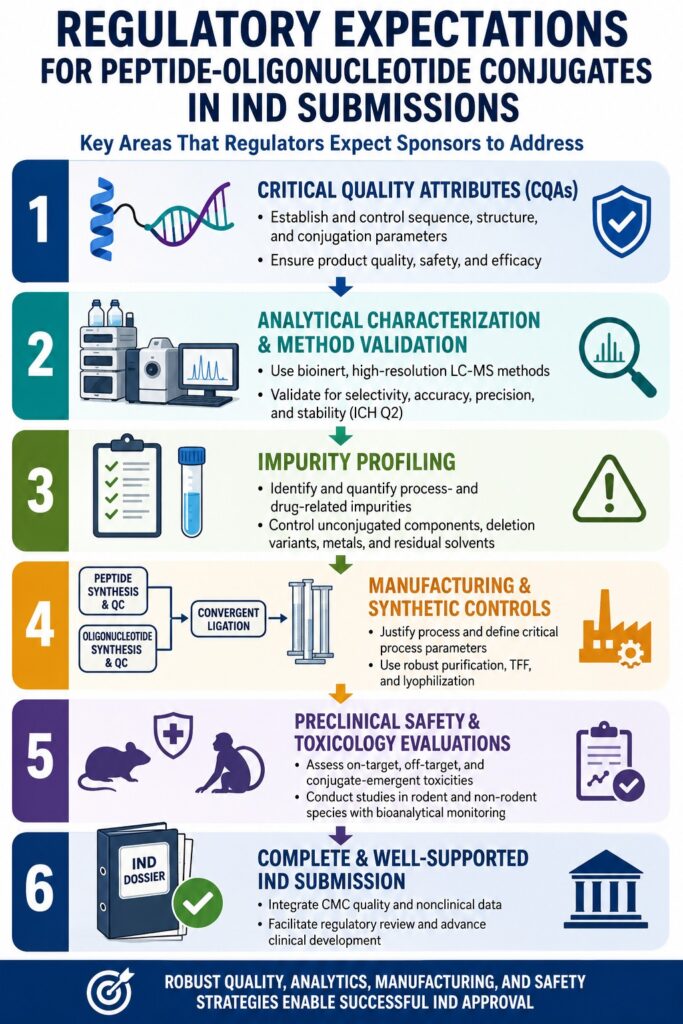
- Maintaining critical quality attributes (CQAs) is essential for regulatory acceptance. Sponsors must demonstrate consistent sequence accuracy, conjugation efficiency, structural integrity, and product uniformity across manufacturing batches using validated analytical techniques.
- Robust analytical characterization is required to confirm product quality and stability. Regulatory agencies expect validated, stability-indicating methods, including high-resolution chromatography and mass spectrometry, that accurately evaluate both peptide and oligonucleotide components.
- Comprehensive impurity profiling is necessary to identify and control process- and product-related impurities such as unconjugated components, deletion variants, residual metals, and organic solvents in accordance with ICH and regulatory guidelines.
- Manufacturing documentation must clearly define the synthesis strategy, conjugation chemistry, purification processes, and critical process parameters to ensure consistent production of a safe, high-quality drug substance suitable for clinical development.
- Preclinical safety studies should evaluate both sequence-related and conjugate-specific toxicities through validated in vitro and in vivo models, supported by bioanalytical methods that monitor exposure, tissue distribution, metabolism, and clearance.
- A successful IND submission depends on integrating strong CMC documentation, validated analytical methods, rigorous manufacturing controls, impurity management, and comprehensive nonclinical safety data to meet FDA and EMA regulatory expectations while reducing development risks.
Critical Quality Attributes of Peptide-Oligonucleotide Conjugates in IND Submissions
The critical quality attributes (CQAs) of peptide-oligonucleotide conjugates must be established through comprehensive evaluation of sequence accuracy, conjugation stoichiometry, conjugation site occupancy, and structural conformation. Regulatory authorities expect sponsors to provide a detailed quality profile demonstrating that these attributes remain well controlled and consistent throughout all clinical manufacturing batches.
Early identification and control of CQAs are essential for minimizing risks associated with off-target biological activity and unpredictable in vivo pharmacokinetic behavior. Both the primary amino acid sequence and the oligonucleotide sequence must be independently verified to confirm sequence fidelity, including the accurate incorporation of any non-natural modifications. In addition, sponsors should establish the drug-to-peptide ratio, which typically targets a 1:1 stoichiometry, to ensure consistent dosing and reproducible therapeutic performance.
Dive deeper into structural nuances: Review our guide on the structural characterization of peptide-oligonucleotide conjugates.
Characterization of the higher-order structure (HOS) of the bioconjugate is also considered a critical regulatory expectation. Covalent attachment of hydrophobic or cationic peptides may alter the structural conformation of double-stranded siRNA duplexes or promote self-aggregation, potentially reducing therapeutic efficacy while increasing the likelihood of adverse immune responses. Advanced biophysical characterization techniques, including Circular Dichroism (CD) and Microfluidic Modulation Spectroscopy (MMS), are commonly employed to evaluate secondary structural elements. In addition, Size Exclusion Chromatography coupled with Multi-Angle Light Scattering (SEC-MALS) is routinely used to detect and quantify aggregate formation.
| Critical Quality Attribute (CQA) | Impact on Quality, Safety, and Efficacy | Standard Analytical Technique |
|---|---|---|
| Sequence Fidelity (Both Domains) | Even a single-base deletion or an incorrect amino acid can result in off-target effects or reduced target gene knockdown efficiency. | High-Resolution Accurate Mass (HRAM) ESI-MS/MS mapping |
| Conjugation Site and Site Occupancy | Non-specific or heterogeneous conjugation produces isomeric mixtures that may alter receptor-binding affinity and reduce the therapeutic index. | Trypsin-digested peptide mapping and intact mass spectrometry |
| Conjugation Stoichiometry | Variability in loading ratios influences molecular charge, molecular size, and in vivo biodistribution. | Reverse-phase HPLC (RP-HPLC) and mass determination |
| Higher-Order Structure (HOS) | Structural alterations, including disruption of peptide α-helices or siRNA duplexes, may accelerate clearance and increase immunogenicity. | Circular Dichroism (CD), MMS, and SEC-MALS |
Analytical Characterization and Method Validation for Peptide-Oligonucleotide Conjugates in IND Submissions
Analytical characterization of peptide-oligonucleotide conjugates depends on high-resolution chromatographic and mass spectrometric methods specifically designed for bioinert applications. These analytical procedures must be validated to demonstrate selectivity, sensitivity, accuracy, precision, and stability across both the peptide and oligonucleotide components. Regulatory agencies also expect analytical methods to be stability-indicating and fully validated according to ICH Q2 guidelines.
Ensure your testing protocols meet regulatory standards: See our QC testing for peptide-oligonucleotide conjugates.
The unique physicochemical properties of POCs create significant analytical separation challenges because they combine highly anionic, hydrophilic nucleic acids with hydrophobic, cationic peptide structures. Conventional reversed-phase liquid chromatography (RP-HPLC) often exhibits irreversible on-column adsorption and pronounced peak tailing due to interactions between these biopolymers and traditional metallic HPLC systems. To overcome these limitations, analytical laboratories typically employ bioinert, wide-pore stationary phases, most commonly 300 Å C18 or C4 columns, incorporating specialized bioinert surface coatings that minimize undesirable interactions.
Method development studies have consistently demonstrated that both mobile phase composition and column operating temperature are critical factors in achieving high-resolution, reproducible separations. Ion-pairing reagents, including butylammonium acetate (BAA) and triethylammonium acetate (TEAA), must be carefully optimized to regulate oligonucleotide charge-state retention while maintaining compatibility with online electrospray ionization mass spectrometry (ESI-MS). Furthermore, elevated column temperatures ranging from 60°C to 80°C are routinely employed to disrupt secondary conformations, reduce self-aggregation, and improve the resolution of minor impurities.
| Analytical Parameter | Target Specifications | Technical Rationale for Validation |
|---|---|---|
| Chromatographic Column | Wide-pore (300 Å) C18 stationary phase with bioinert surface coatings | Minimizes steric hindrance, reduces on-column peptide adsorption, and limits sample carry-over |
| Column Operating Temperature | Optimized between 60°C and 80°C | Disrupts secondary conformations and base-pairing interactions to produce sharp, symmetrical chromatographic peaks |
| Mobile Phase Composition | Aqueous Phase: 0.1 M TEAA or BAA; Organic Phase: Acetonitrile | Optimizes ion-pairing for oligonucleotide retention while providing sufficient organic strength for peptide elution |
| Mass Spectrometry Interface | Electrospray Ionization (ESI) operated in both positive and negative ion modes | Negative ion mode detects the anionic oligonucleotide, whereas positive ion mode efficiently analyzes neutral morpholinos (PMOs) and polycationic peptide domains |
Overcoming technical hurdles: Read about the challenges in peptide-oligonucleotide conjugates analysis.
Impurity Profiling Guidelines for Peptide-Oligonucleotide Conjugates in IND Submissions
Impurity profiling for peptide-oligonucleotide conjugates requires comprehensive identification, quantification, and qualification of both process-related and drug-related impurities, with particular emphasis on unconjugated peptides and unconjugated oligonucleotides. Since a POC contains two distinct pharmacologically active components, sponsors are expected to develop highly sensitive analytical methods capable of detecting sequence-specific deletion variants, truncated species, diastereomers, and unconjugated active intermediates.
The impurity profile associated with peptide-oligonucleotide conjugates is inherently complex. During stepwise solid-phase peptide synthesis (SPPS), the harsh acidic and basic conditions required for deprotection may cause chemical degradation of the oligonucleotide component. Likewise, the basic deprotection cycles used in phosphoramidite chemistry may adversely affect chemically sensitive peptide sequences. In convergent solution-phase conjugation, incomplete reaction kinetics can leave measurable amounts of unreacted starting materials, particularly free peptide and free oligonucleotide. Regulatory agencies require rigorous quantification of both unconjugated components because free peptides may contribute to off-target toxicity or immunogenicity, while unconjugated oligonucleotides may induce uncontrolled gene silencing.
According to CDER and ICH guidance, impurities exceeding established reporting thresholds, typically 0.05% or 0.1%, must be documented. Drug-related impurities exceeding qualification thresholds, generally ranging from 0.15% to 0.5%, depending on the proposed clinical dose, must undergo structural characterization and appropriate qualification through nonclinical toxicology studies. This evaluation includes monitoring sequence-related n-1 deletion variants, oxidized products such as methionine sulfoxide within peptide sequences, and chiral impurities or enantiomeric species generated through phosphorothioate linkages.
| Impurity Subclass | Primary Origin / Source of Formation | Regulatory Control Limit & IND Expectation |
|---|---|---|
| Unconjugated Active Fragments | Incomplete coupling during convergent solution-phase ligation or cleavage of unstable linkers | Must be quantified within final product specifications and is generally controlled to <2% to minimize off-target biological activity |
| n-1 Deletion Sequences | Stepwise coupling failures during automated peptide or oligonucleotide solid-phase synthesis | Controlled according to ICH Q3A guidelines and structurally qualified when exceeding the 0.15%–0.5% qualification threshold |
| Trace Transition Metals | Residual copper catalyst remaining after copper-catalyzed azide-alkyne cycloaddition (CuAAC) | Strictly controlled to prevent cellular toxicity and monitored using ICP-MS in accordance with ICH Q3D guidelines |
| Residual Organic Solvents | High-volume solvent usage during SPPS and purification procedures, including DMF, ACN, and piperidine | Evaluated under ICH Q3C residual solvent requirements using validated headspace GC-MS methods |
Documentation of Manufacturing Processes and Synthetic Controls for Peptide-Oligonucleotide Conjugates in IND Submissions
Comprehensive documentation of the manufacturing process must include a detailed description of the synthetic pathway, intermediate purification procedures, and in-process control strategies employed during either stepwise or convergent conjugation. Regulatory agencies expect sponsors to provide a well-supported rationale for their selected manufacturing approach while clearly identifying the critical process parameters (CPPs) that ensure the bioconjugation process preserves the structural integrity and functional performance of the final drug substance.
Peptide-Oligonucleotide Conjugates (POCs) can be manufactured using either a linear stepwise on-support synthesis or a convergent post-synthetic ligation approach. Linear synthesis involves the sequential construction of both the peptide and oligonucleotide fragments on a single resin support. This strategy requires carefully designed orthogonal protecting group systems to prevent unwanted cross-reactivity throughout the synthesis process. Although effective, this method is generally more complex and less commonly used for large-scale clinical production. Consequently, convergent assembly has become the preferred manufacturing strategy for clinical-grade POCs. In this workflow, the peptide and oligonucleotide components are synthesized independently, purified separately, and fully characterized before being chemically conjugated in the solution phase to produce the final hybrid molecule.
Optimize your production strategy: Learn about our services for the scale-up of peptide-oligonucleotide conjugates.
The selection of conjugation chemistry is a major area of focus during regulatory review because it directly influences product consistency, purity, stability, and safety. Commonly employed ligation strategies include:
- Thiol-maleimide coupling for rapid, site-specific 1:1 bioconjugation.
- Disulfide bond formation, which exploits the reducing intracellular environment of the cytosol to enable controlled release of the therapeutic payload.
- Bio-orthogonal click chemistry, including copper-catalyzed azide-alkyne cycloaddition (CuAAC) and Strain-Promoted Azide-Alkyne Cycloaddition (SPAAC).
When CuAAC chemistry is used, sponsors must implement rigorous purification procedures to eliminate residual copper catalysts. Trace amounts of copper may induce significant in vivo cellular toxicity while also promoting oxidative degradation of the bioconjugate. To mitigate these risks, many clinical developers favor copper-free SPAAC or enzymatic ligation methods, both of which proceed under mild, aqueous reaction conditions and minimize the potential for metal-induced toxicity.
Following conjugation, downstream purification is generally performed using high-resolution preparative chromatography techniques such as Multi-Column Solvent Gradient Purification (MCSGP). This continuous chromatographic process enables recycling of overlapping fractions, significantly improving product recovery while reducing solvent consumption. After purification, the product undergoes Tangential Flow Filtration (TFF) for desalting and buffer exchange before the final drug substance is isolated as a stable lyophilized powder, suitable for long-term storage and subsequent formulation.
[Peptide Fragment Synthesis & QC] -----\
                                        +---> [Convergent Ligation (e.g., SPAAC)] ---> [Continuous Chromatography (MCSGP)] ---> [TFF Diafiltration] ---> [Lyophilization / API Isolation]
[Oligonucleotide Synthesis & QC] ------/
Master the chemical assembly:Explore our resources on peptide-oligonucleotide conjugate linker chemistry. Compare synthesis methods:Read our analysis on peptide-oligonucleotide conjugate synthesis methods.
Preclinical Safety and Toxicology Evaluations for Peptide-Oligonucleotide Conjugates in IND Submissions
Preclinical safety assessment of peptide-oligonucleotide conjugates requires a comprehensive, multi-tiered toxicological evaluation that addresses both hybridization-dependent off-target effects and conjugate-emergent toxicities in rodent and non-rodent animal models. These nonclinical safety studies should be designed in accordance with the FDA’s late 2024 guidance document, “Nonclinical Safety Assessment of Oligonucleotide-Based Therapeutics,” together with the relevant recommendations outlined in ICH S6 and ICH S9 guidelines for bioconjugate therapeutics.
Sequence-dependent toxicities are generally classified into hybridization-dependent on-target effects and hybridization-dependent off-target effects. On-target toxicities represent exaggerated pharmacological activity occurring at the intended molecular target, whereas off-target toxicities arise from unintended Watson-Crick hybridization with partially complementary RNA or DNA sequences elsewhere within the transcriptome or genome. Regulatory authorities expect sponsors to conduct comprehensive in silico sequence alignment analyses across both human and relevant animal genomes to identify potential high-risk off-target binding sites. These computational assessments should then be supported by in vitro validation studies, including cell-based reporter assays, RNA sequencing (RNA-seq), or other appropriate functional assays to evaluate potential safety concerns.
Conjugate-emergent toxicities represent adverse effects that arise specifically from the intact hybrid bioconjugate rather than from its individual peptide or oligonucleotide components. For example, highly cationic cell-penetrating peptides (CPPs) may induce non-specific membrane disruption, acute mast cell degranulation, or systemic immunogenic responses. Conversely, certain oligonucleotide backbone chemistries, particularly phosphorothioate-modified oligonucleotides, may bind non-specifically to plasma proteins, potentially resulting in transient immune activation or increased renal accumulation.
Prepare for your preclinical trials: See our peptide-oligonucleotide conjugates preclinical services.
A comprehensive IND-enabling toxicology program should evaluate these safety parameters through both single-dose and repeat-dose toxicity studies conducted in at least two mammalian species, typically one rodent species and one non-rodent species, such as non-human primates. These studies should incorporate validated bioanalytical methods capable of monitoring systemic exposure, tissue distribution, metabolic stability, and clearance of both the intact conjugate and its individual components.
| Target Analyte | Preferred Bioanalytical Assay | Specimen Matrix | Primary Analytical Objective |
|---|---|---|---|
| Intact POC | LC-MS/MS with hybrid ligand-binding methodology | Plasma, cerebrospinal fluid (CSF), and tissue homogenates | Evaluates systemic exposure to the intact drug while monitoring chemical stability during circulation |
| Free Oligonucleotide | Hybridization ELISA or RT-qPCR | Plasma, urine, and target tissues | Measures accumulation of the active oligonucleotide payload and evaluates tissue distribution and clearance |
| Free Peptide Vector | Quantitative LC-MS/MS or target-specific ELISA | Plasma and urine clearance matrices | Determines systemic exposure to the carrier peptide and monitors peptide-associated toxicity |
Understanding pharmacokinetic behavior: Learn about peptide-oligonucleotide conjugates pharmacokinetics.
Conclusion: Successfully Navigating Peptide-Oligonucleotide Conjugates in IND Submissions
Successfully preparing an Investigational New Drug (IND) dossier for Peptide-Oligonucleotide Conjugates (POCs) requires the development of a carefully designed Chemistry, Manufacturing, and Controls (CMC) strategy supported by a comprehensive nonclinical safety program. This emerging therapeutic class offers significant potential for targeting difficult-to-access extrahepatic tissues while enabling the treatment of disease targets that were previously considered undruggable. However, because these molecules combine two distinct biopolymer systems within a single therapeutic entity, meeting global regulatory expectations demands highly specialized analytical methodologies, manufacturing controls, and quality assurance strategies.
Ensure your submission is compliant: Get professional advice on NDA vs ANDA nitrosamine submission requirements.
By implementing a robust analytical control strategy, utilizing bioinert chromatographic stationary phases, and establishing thoroughly qualified impurity profiling workflows, developers can substantially reduce development risks while minimizing the likelihood of regulatory delays during CDER or EMA IND review. ResolveMass Laboratories Inc. provides specialized high-resolution analytical platforms, advanced multi-technique structural characterization capabilities, and comprehensive phase-appropriate regulatory support designed to assist complex conjugate development programs from preclinical candidate selection through successful IND submission. Organizations seeking guidance on customized study design, assay development, or regulatory strategy are encouraged to contact ResolveMass Laboratories Inc. through its Contact Us page to consult with its scientific and regulatory experts.
Frequently Asked Questions
Regulatory authorities, including the FDA and the EMA, generally classify Peptide-Oligonucleotide Conjugates (POCs) as synthetic drug substances because they combine chemically synthesized peptides with therapeutic oligonucleotides. Their evaluation follows an integrated regulatory framework that incorporates requirements for both peptide-based and oligonucleotide-based therapeutics. Sponsors must therefore provide comprehensive Chemistry, Manufacturing, and Controls (CMC), analytical, and nonclinical data to demonstrate product quality, safety, and consistency before initiating clinical studies.
One of the primary manufacturing challenges is preventing degradation of both molecular components during synthesis. Harsh deprotection conditions used in solid-phase peptide synthesis (SPPS) can damage sensitive oligonucleotides, while phosphoramidite chemistry may affect peptide stability. For this reason, many manufacturers prefer convergent solution-phase conjugation, where both components are synthesized and purified separately before conjugation, resulting in improved product purity and better process control.
The chemical linker plays a critical role in determining the stability, release profile, and biological behavior of a peptide-oligonucleotide conjugate. Some linkers are designed to remain stable throughout systemic circulation, whereas others are engineered to release the oligonucleotide after entering target cells. Consequently, analytical methods must accurately monitor both the intact conjugate and any cleavage products to demonstrate product stability and support regulatory expectations.
Higher column temperatures, typically ranging from 60°C to 80°C, help eliminate secondary structural interactions that can interfere with chromatographic separation. Elevated temperatures reduce self-aggregation, disrupt base pairing, and improve peak symmetry, allowing closely related impurities to be separated more effectively. This results in more reliable purity assessment and improved analytical reproducibility during quality control testing.
Regulatory agencies expect manufacturers to carefully quantify and control unconjugated peptide and oligonucleotide impurities because both may affect product safety and efficacy. Free peptides may contribute to unintended biological activity, immunogenicity, or systemic toxicity, whereas free oligonucleotides can produce unwanted gene-silencing effects. Sensitive analytical methods should therefore be incorporated into product specifications to ensure these impurities remain within acceptable limits.
In most cases, regulatory agencies expect a validated potency assay as part of an IND submission to demonstrate the biological activity of the drug product. The assay should confirm that the conjugate consistently produces its intended pharmacological effect throughout development. However, in certain situations involving highly characterized antisense oligonucleotides (ASOs) or siRNA products, regulators may accept a scientific justification for an alternative approach on a case-by-case basis.
Evaluation of sequence-dependent off-target effects typically begins with in silico genomic and transcriptomic analyses to identify potential unintended binding sites. These computational predictions are then confirmed using in vitro functional studies, such as RNA sequencing (RNA-seq), reporter gene assays, or other cell-based experiments. This combined strategy helps identify potential safety risks before clinical testing and supports regulatory expectations for nonclinical safety assessment.
Hybrid LC-MS/MS methods are widely regarded as the preferred analytical approach for measuring intact peptide-oligonucleotide conjugates in biological samples. These techniques combine ligand-binding specificity with highly sensitive mass spectrometric detection, allowing accurate quantification in plasma, cerebrospinal fluid (CSF), and tissue samples. Such methods are essential for evaluating pharmacokinetics, systemic exposure, and metabolic stability throughout preclinical toxicology studies.
Reference:
- Malinowska, A. L., Huynh, H. L., & Bose, S. (2024). Peptide–oligonucleotide conjugation: Chemistry and therapeutic applications. Current Issues in Molecular Biology, 46(10), 11031–11047. https://doi.org/10.3390/cimb46100655
- U.S. Food and Drug Administration. (2024, June). Clinical pharmacology considerations for the development of oligonucleotide therapeutics: Guidance for industry. https://www.fda.gov/regulatory-information/search-fda-guidance-documents/clinical-pharmacology-considerations-development-oligonucleotide-therapeutics
- Hanna, N., Oh, C., Rhee, Y., & Kim, D. (2023). Analytical strategies for the characterization of therapeutic oligonucleotides and their conjugates. Molecules, 28(8), 3365. https://doi.org/10.3390/molecules28083365
- United States Pharmacopeia. (2019). Control strategies and analytical test methods for peptide-conjugates (On-Demand). https://www.usp.org/events-training/course/control-strategies-and-analytical-test-methods-peptide-conjugates-demand
- Morais, M., Ma, M. T., & Blower, P. J. (2021). Chemical strategies for peptide and protein conjugation: Current trends and future directions. Drug Discovery Today, 26(10), 2431–2444. https://doi.org/10.1016/j.drudis.2021.05.028
- Duncan, K. (2022). CMC regulatory experiences and expectations [Conference presentation]. United States Pharmacopeia (USP). https://www.usp.org/sites/default/files/usp/document/events-and-training/03-CMC-Regulatory-Experiences-and-Expectations_Katharine-Duncan.pdf
- U.S. Food and Drug Administration. (2024, November). Nonclinical safety assessment of oligonucleotide-based therapeutics: Guidance for industry (Draft guidance). Center for Drug Evaluation and Research. https://www.fda.gov/media/183496/download
Get In Touch With Us
About The Author


