

Introduction
A comprehensive analytical data package prepared for an Investigational New Drug (IND) submission provides regulatory agencies with robust structural, physicochemical, and chemical evidence confirming the identity, purity, potency, and stability of a peptide drug candidate. Leveraging comprehensive Peptide Characterization CRO Services for IND Submission enables biopharmaceutical companies to generate orthogonal analytical datasets that verify batch-to-batch consistency, structural integrity, and product safety before initiating human clinical studies. Therapeutic peptides now represent one of the fastest-growing categories in pharmaceutical innovation, accounting for more than one-quarter of global biopharmaceutical development pipelines. Positioned between conventional small-molecule drugs and complex biologics, synthetic peptides—defined by the U.S. Food and Drug Administration (FDA) as alpha-amino acid polymers containing 40 or fewer amino acid residues—require specialized analytical methodologies to meet regulatory expectations.
Learn more about partnering with a specialized CRO for GLP-1 peptide characterization to build robust IND analytical packages.
The evolution from recombinant production systems to solid-phase peptide synthesis (SPPS) and liquid-phase peptide synthesis (LPPS) has significantly improved manufacturing scalability while introducing unique impurity profiles. Manufacturing-related by-products, including deletion peptides, truncation products, diastereomers, and residual cleavage reagents, must be thoroughly characterized to demonstrate product quality and patient safety. Under Title 21 of the Code of Federal Regulations (21 CFR 312.23(a)(7)(iv)), sponsors are required to provide complete Chemistry, Manufacturing, and Controls (CMC) information describing the structure, quality, purity, and strength of both the drug substance and finished drug product. Insufficient structural confirmation or incomplete impurity characterization remains a frequent reason for FDA clinical holds under 21 CFR 312.42(b)(1)(iv). As a result, collaborating with an experienced Contract Research Organization (CRO) capable of generating a high-resolution, multi-platform analytical dossier is critical for achieving regulatory compliance and supporting progression into Phase 1 clinical trials.
Review the regulatory requirements for GLP-1 peptide characterization to ensure your IND dossier meets global standards.
Share via:
Article Summary:
- A complete peptide characterization package is essential for IND submissions, providing scientific evidence of a drug candidate’s identity, purity, potency, structural integrity, and stability to support regulatory approval for clinical studies.
- Regulatory agencies expect a comprehensive analytical strategy aligned with standards such as USP, FDA, EMA, and ICH guidelines, ensuring that peptide products meet stringent Chemistry, Manufacturing, and Controls (CMC) requirements.
- Primary structure verification combines advanced techniques such as high-resolution mass spectrometry, LC-MS/MS, amino acid analysis, and sequence confirmation methods to validate molecular identity, sequence accuracy, and disulfide bond arrangements.
- Higher-order structure characterization evaluates peptide folding and conformational stability using complementary biophysical methods, while purity testing quantifies active peptide content, counterions, moisture, residual solvents, and elemental impurities.
- Comprehensive impurity profiling identifies synthesis-related variants, degradation products, aggregates, residual solvents, heavy metals, and microbial contaminants using orthogonal analytical techniques to ensure product quality and patient safety.
- Stability studies performed under real-time, accelerated, and forced degradation conditions establish shelf life, reveal degradation pathways, and confirm that analytical methods can reliably detect changes throughout product storage.
- Choosing an experienced peptide characterization CRO with advanced instrumentation, orthogonal analytical capabilities, regulatory expertise, and validated methodologies helps generate an IND-ready analytical package that minimizes regulatory risks and supports successful progression into clinical development.
Regulatory Standards Governing Peptide IND Submissions
Regulatory expectations for synthetic peptide IND submissions are established through multiple guidance documents, including USP chapters, EMA draft guidelines for synthetic peptides, FDA guidance documents, and ICH Q6B standards. Collectively, these regulatory frameworks require manufacturers to implement orthogonal analytical strategies that confirm sequence identity, monitor peptide-related impurities, evaluate higher-order structural attributes, and verify manufacturing process controls. Historically, therapeutic peptides occupied a regulatory position between traditional small-molecule guidance (ICH Q3A/Q3B) and biologics regulations (ICH Q6B). More recent regulatory developments have introduced dedicated quality frameworks specifically addressing the unique characteristics of synthetic peptide therapeutics.
The United States Pharmacopeia introduced USP <1047> (Quality Attributes of Synthetic Peptide Drug Substances) to establish critical quality attributes (CQAs) together with suitable analytical approaches for synthetic peptide drug substances. This chapter is supported by USP <1048> (Quality Attributes of Starting Materials Used in the Manufacture of Synthetic Peptides), which defines minimum quality requirements for protected amino acid derivatives, solid-phase resins, and peptide coupling reagents. Internationally, the European Medicines Agency (EMA) released its draft guideline on the Development and Manufacture of Synthetic Peptides, outlining quality expectations for synthetic peptide sequences containing more than four amino acids. In addition, FDA guidance on synthetic peptides emphasizes detailed assessment of peptide-related impurities together with their potential immunogenicity risks.
| Regulatory Guideline | Issuing Body | Primary Scope and Application | Core Analytical Expectations |
|---|---|---|---|
| USP <1047> | United States Pharmacopeia | Quality attributes for synthetic peptide drug substances. | Structural verification, orthogonal purity assessment, impurity profiling thresholds, and counterion analysis. |
| USP <1048> | United States Pharmacopeia | Quality requirements for starting materials used in synthetic peptide manufacturing. | Limits for impurities in protected amino acids, enantiomeric purity evaluation, and residual solvent control. |
| FDA Synthetic Peptide Guidance | U.S. FDA (CDER) | Comparative impurity profiling and immunogenicity assessment. | Confirmation of sequence identity, characterization of new impurities ≥ 0.10% or 0.5%, and stress stability comparisons. |
| EMA Draft Guideline | European Medicines Agency | Synthetic peptides containing >4 amino acids. | Manufacturing process controls, aggregation assessment, higher-order structure characterization, and evaluation of nitrosamine and elemental impurity risks. |
| ICH Q6B | ICH | Test procedures and acceptance criteria for biotechnological and biological products. | Primary structure determination, physicochemical characterization, higher-order structural evaluation, and biological activity/potency assessment. |
Essential Components of the Full Analytical Data Package
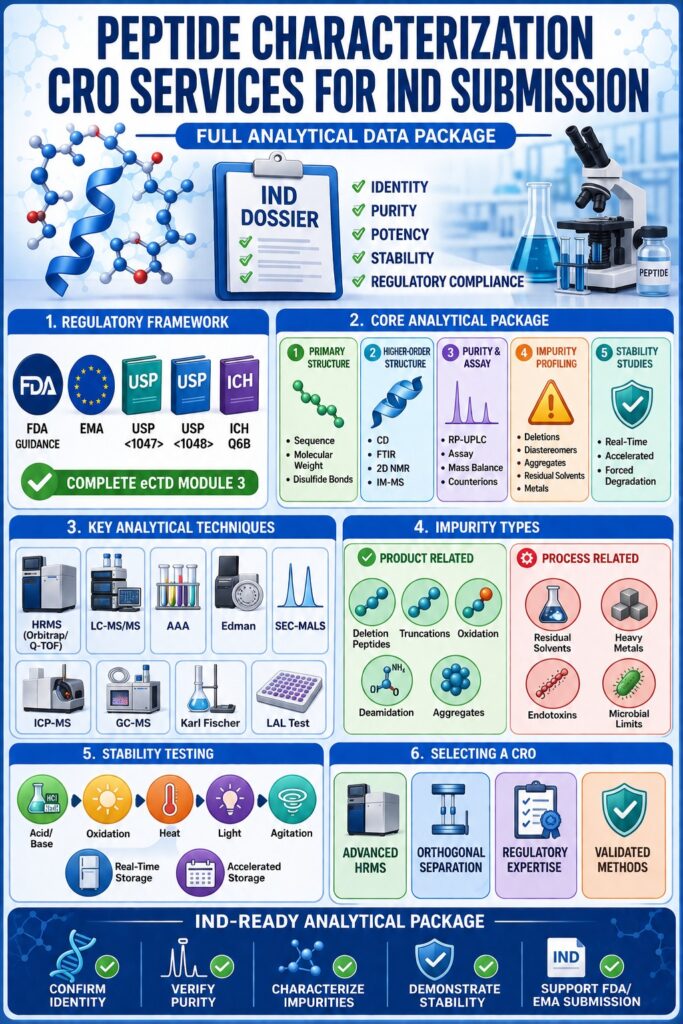
A complete analytical package for peptide IND submissions comprises five fundamental datasets: primary structure confirmation, higher-order structure (HOS) characterization, quantitative purity and assay evaluation, comprehensive impurity profiling, and stability assessment under both stress and long-term storage conditions. Together, these analytical datasets populate Module 3 (Sections 3.2.S and 3.2.P) of the electronic Common Technical Document (eCTD), providing the scientific evidence required to support regulatory submissions.
The analytical framework for a compliant Module 3 dossier is systematically organized to comprehensively characterize both the drug substance and the finished drug product:
- Primary Structure Verification: Complete amino acid sequence confirmation, molecular weight determination, verification of N- and C-terminal modifications, and analysis of disulfide bond connectivity.
- Higher-Order Structure (HOS): Characterization of secondary and tertiary structural conformations using complementary spectroscopic and biophysical techniques.
- Purity and Assay Quantitation: Orthogonal chromatographic measurement of active peptide concentration, counterion content, moisture levels, and inorganic salt composition.
- Impurity Identification: Structural characterization of product-related impurities, high-molecular-weight aggregates, residual solvents, and elemental impurities.
- Stability Protocols: Real-time, accelerated, and forced degradation studies performed to establish product shelf life and identify degradation mechanisms.
Access our comprehensive peptide characterization CRO deliverables checklist to streamline your submission workflow.
Primary Structure Elucidation and Sequence Confirmation
Primary structure characterization confirms the linear amino acid sequence, molecular weight, terminal modifications, and covalent disulfide bonding pattern of a therapeutic peptide. High-resolution mass spectrometry (HRMS), combined with tandem mass spectrometry (LC-MS/MS), N-terminal Edman degradation, and Amino Acid Analysis (AAA), provides definitive evidence of sequence identity. HRMS platforms, including Orbitrap and Quadrupole Time-of-Flight (Q-TOF) instruments, deliver highly accurate molecular mass measurements with mass accuracy within 5 ppm, enabling confirmation of the expected empirical chemical formula.
Discover our specialized workflows for peptide sequencing of GLP-1 drugs and GLP-1 analog peptide sequencing workflow.
Multiple fragmentation approaches in tandem mass spectrometry—including Collision-Induced Dissociation (CID), Higher-Energy Collisional Dissociation (HCD), and Electron-Transfer Dissociation (ETD)—produce comprehensive b/y and a/x fragment ion series for complete sequence verification. ETD is particularly advantageous because it preserves labile post-translational and synthetic modifications, including phosphorylation, sulfation, and glycosylation, during fragmentation. N-terminal sequencing using Edman degradation provides an independent, non-mass spectrometric method for confirming the first 10 to 15 amino acid residues, ensuring the absence of N-terminal truncations or chemically blocked N-termini.
Amino Acid Analysis (AAA) accurately determines the stoichiometric composition of individual amino acids following acid hydrolysis, providing additional confirmation of the peptide’s primary chemical composition. For cyclic peptides or molecules containing multiple disulfide bonds, enzymatic digestion or chemical mapping techniques are integrated with mass spectrometry to verify covalent disulfide linkage patterns (Cys-Cys), ensuring that disulfide scrambling or incorrect bond formation has not occurred during peptide synthesis or cleavage.
Read about specific approaches to cyclic peptide characterization for complex structural formats.
Higher-Order Structure and Conformational Analysis
Higher-order structure (HOS) characterization examines the secondary and tertiary conformations of a peptide drug candidate to verify proper molecular folding and ensure manufacturing consistency between production batches. Spectroscopic and biophysical techniques—including Far-UV Circular Dichroism (CD), Fourier Transform Infrared Spectroscopy (FTIR), two-dimensional Nuclear Magnetic Resonance (2D NMR), and Ion Mobility Mass Spectrometry (IM-MS)—are employed to evaluate conformational stability and spatial folding characteristics. Although short linear peptides containing fewer than 10 amino acids commonly adopt flexible random-coil conformations, longer synthetic peptides and constrained macrocyclic peptides frequently exhibit defined secondary structural elements such as alpha-helices, beta-sheets, and turn motifs.
Far-UV Circular Dichroism measurements collected between 190 and 250 nm quantify the relative abundance of secondary structural elements, producing characteristic negative ellipticity minima at 208 nm and 222 nm for alpha-helical structures and approximately 218 nm for beta-sheet conformations. FTIR spectroscopy evaluates the Amide I (1600–1700 cm⁻¹) and Amide II (1500–1600 cm⁻¹) vibrational regions, providing complementary information on structural organization in both solution and solid-state samples. High-resolution two-dimensional Nuclear Magnetic Resonance techniques—including ¹H–¹⁵N HSQC, TOCSY, and NOESY—generate atomic-level conformational fingerprints that confirm tertiary structural organization and reveal spatial interactions between non-adjacent amino acid residues. In addition, Ion Mobility Mass Spectrometry (IM-MS) determines gas-phase Collision Cross Section (CCS, Ų) values, providing a rapid and highly sensitive method for detecting subtle conformational differences, cis/trans proline isomerization, and structural destabilization.
Dive deeper into structural techniques like 2D NMR for peptide characterization and CD spectroscopy for peptide secondary structure characterization.
| Technique | Target Attribute | Detection Limit / Metric |
|---|---|---|
| HRMS (Orbitrap / Q-TOF) | Monoisotopic Mass / Identity | <5 ppm mass accuracy |
| LC-MS/MS (CID/HCD/ETD) | Complete Sequence Verification | Full b/y ion series coverage |
| Far-UV Circular Dichroism | Secondary Structure Distribution | Ellipticity at 208/222 nm (alpha-helix) and 218 nm (beta-sheet) |
| 2D NMR (HSQC / NOESY) | Tertiary Structure / HOS | Atomic spatial proximity (<5 Å) |
| IM-MS (Ion Mobility) | Conformational Heterogeneity | Gas-phase Collision Cross Section (CCS, Ų) |
Purity, Quantitation, and Assay Methodologies
Quantitative assay and purity assessment are performed to determine the amount of intact active peptide relative to the total peptide population, together with the levels of counterions, moisture, and inorganic constituents. Reverse-Phase Ultra-High Performance Liquid Chromatography with UV detection (RP-UPLC-UV), supported by mass balance calculations, provides a comprehensive evaluation of peptide purity and potency. Since peptides exhibit inherent UV absorbance through peptide backbone amide bonds (210–220 nm) as well as aromatic amino acid residues such as phenylalanine (Phe), tyrosine (Tyr), and tryptophan (Trp) at 280 nm, dual-wavelength detection is commonly employed to maximize sensitivity while ensuring selective and accurate quantitation.
A clear distinction must be made between chromatographic purity and absolute peptide assay. Chromatographic purity represents the percentage of the target peptide peak relative to all peptide-related chromatographic peaks, whereas assay reflects the actual mass percentage of pure active peptide present in the sample. Synthetic peptides are frequently isolated as trifluoroacetic acid (TFA) or acetate salts and are inherently hygroscopic, resulting in variable quantities of bound water and counterions. Therefore, the complete analytical package must establish an overall mass balance using the following equation:
Mass Balance (%) = Peptide Content (%) + Counterion Content (%) + Water Content (%) + Residual Solvents (%) + Inorganic Impurities (%)
Counterion content is quantified using Ion Chromatography (IC) or ¹⁹F/¹H High-Performance NMR spectroscopy, whereas Karl Fischer titration is applied to accurately determine water content. Elemental impurities are evaluated using Inductively Coupled Plasma Mass Spectrometry (ICP-MS) in accordance with the requirements outlined in ICH Q3D.
Review our complete menu of peptide physicochemical characterization services for mass balance analysis.
Comprehensive Impurity Profiling in Peptide Characterization CRO Services for IND Submission
Comprehensive impurity profiling within Peptide Characterization CRO Services for IND Submission focuses on the systematic identification, quantification, and classification of product-related impurities, high molecular weight aggregates, and manufacturing-derived contaminants. Contract Research Organizations (CROs) employ high-resolution orthogonal analytical techniques to characterize impurities present at or above the 0.10% reporting threshold, ensuring that peptide drug candidates satisfy clinical safety expectations.
Learn more about targeted methods for GLP-1 peptide impurity characterization.
Peptide-Related Impurities and Synthesis Artifacts
Peptide-related impurities consist of structurally related variants generated during peptide synthesis or subsequent storage. These include deletion sequences (n-1), insertion sequences (n+1), truncated peptides, stereoisomers, and other sequence-related variants. High-resolution LC-MS/MS combined with chiral chromatographic separation is required to resolve and structurally identify these closely related species. During solid-phase peptide synthesis, repetitive amino acid coupling cycles may occasionally proceed incompletely, producing deletion products (n-1, n-2), whereas premature cleavage events and side reactions can generate truncated peptides or insertion variants (n+1).
Racemization presents another major analytical concern during peptide synthesis. During activation of protected amino acid building blocks, inversion at the α-carbon may occur, producing diastereomeric impurities containing D-amino acids. Because these diastereomers possess identical mass-to-charge (m/z) values as the intended peptide sequence, conventional LC-MS alone cannot reliably distinguish them. Accurate identification therefore requires chiral liquid chromatography or highly optimized reverse-phase chromatographic methods employing sub-2 μm stationary phases to achieve complete separation of stereoisomeric species.
Additional chemical degradation pathways further increase impurity complexity:
- Oxidation: Methionine and cysteine residues are particularly susceptible to oxidation, producing methionine sulfoxide, methionine sulfone, or unintended intra- and intermolecular disulfide bond formation.
- Deamidation: Asparagine and glutamine residues undergo degradation through cyclic imide intermediates, generating aspartic acid, isoaspartic acid, glutamic acid, and pyroglutamic acid derivatives.
- Cyclization: N-terminal glutamine or glutamic acid residues readily cyclize to form pyroglutamate, while certain N-terminal dipeptide sequences may undergo intramolecular cyclization to generate diketopiperazine (DKP) derivatives.
Aggregates and High Molecular Weight Species
Aggregates and High Molecular Weight Species (HMWS) consist of self-associated dimers, oligomers, or particulate assemblies that may significantly increase immunogenicity risk following clinical administration. Size-Exclusion Chromatography coupled with Multi-Angle Light Scattering (SEC-MALS), Analytical Ultracentrifugation (AUC), and Dynamic Light Scattering (DLS) are routinely employed to characterize aggregate populations spanning sub-nanometer to micron-sized particles. Non-native aggregation may occur during purification, lyophilization, formulation, or long-term storage.
SEC-MALS serves as the primary analytical technique for quantifying soluble dimers, trimers, and higher-order oligomeric species. Because hydrophobic peptides may interact non-specifically with chromatographic stationary phases, SEC mobile phases are carefully optimized with appropriate ionic strength and organic modifiers to minimize analytical artifacts. Larger colloidal aggregates and sub-visible particles are further evaluated using Sedimentation Velocity Analytical Ultracentrifugation (SV-AUC), Field-Flow Fractionation (FFF), and Dynamic Light Scattering (DLS), providing complementary, matrix-independent measurements of aggregate content.
Discover specialized strategies for peptide aggregation analysis to mitigate immunogenicity risks.
Process-Related and Non-Peptide Impurities
Process-related impurities encompass non-peptide chemical contaminants remaining from the manufacturing process, including residual organic solvents, cleavage scavengers, heavy metal catalysts, and microbial contaminants. Headspace Gas Chromatography-Mass Spectrometry (HS-GC-MS), ICP-MS, and pharmacopeial microbiological assays are used to confirm that these impurities remain within the safety limits established by ICH guidelines. Synthetic peptide manufacturing commonly utilizes organic solvents such as N,N-dimethylformamide (DMF), N-methylpyrrolidone (NMP), dichloromethane (DCM), and acetonitrile, together with cleavage reagents containing TFA, ethanedithiol (EDT), and triisopropylsilane (TIPS). HS-GC-MS is applied to quantify residual solvent concentrations in compliance with ICH Q3C requirements.
Microbiological quality is another essential consideration, particularly for parenteral peptide drug products. Bacterial endotoxin concentrations are determined using the Limulus Amebocyte Lysate (LAL) assay, while Total Aerobic Microbial Count (TAMC) and Total Combined Yeasts and Molds Count (TYMC) are measured to verify microbiological quality in accordance with applicable pharmacopeial standards.
| Impurity Category | Specific Impurity Type | Causative Mechanism / Source | Analytical Detection Strategy | Regulatory Threshold / Concern |
|---|---|---|---|---|
| Product-Related | Deletion Sequences (n-1) | Incomplete amino acid coupling during SPPS | High-Resolution RP-UPLC-MS/MS | ≥0.10% reporting threshold; potential competition with target binding |
| Product-Related | Diastereomers (D-amino acids) | α-carbon racemization during activation | Chiral LC-MS / Optimized RP-UPLC | Characterization required due to altered PK/PD and immunogenicity risk |
| Product-Related | Deamidation (Iso-Asp) | Formation of succinimide intermediates | Cation-Exchange Chromatography / LC-MS/MS | Characterization required because of possible loss of biological activity |
| Product-Related | Aggregates / HMWS | Hydrophobic association and disulfide exchange | SEC-MALS, SV-AUC, FFF | High immunogenicity risk; typically controlled below 1.0% |
| Process-Related | Residual Solvents | DMF, NMP, TFA, DCM remaining from synthesis and cleavage | Headspace GC-FID / GC-MS | Must comply with ICH Q3C limits |
| Process-Related | Heavy Metals / Catalysts | Raw materials and peptide coupling reagents | ICP-MS | Must comply with ICH Q3D elemental impurity limits |
Stability Studies and Stress Characterization for IND Submissions
Stability studies conducted for IND submissions are designed to evaluate the chemical and physical stability of peptide drug substances and finished drug products throughout storage under real-time, accelerated, and stress conditions. Stability-indicating analytical methods performed in accordance with ICH Q1A and ICH Q1B guidelines establish preliminary shelf-life estimates while identifying the primary degradation pathways of the molecule.
Explore analytical approaches for GLP-1 peptide stability analytical methods under forced degradation and real-time storage.
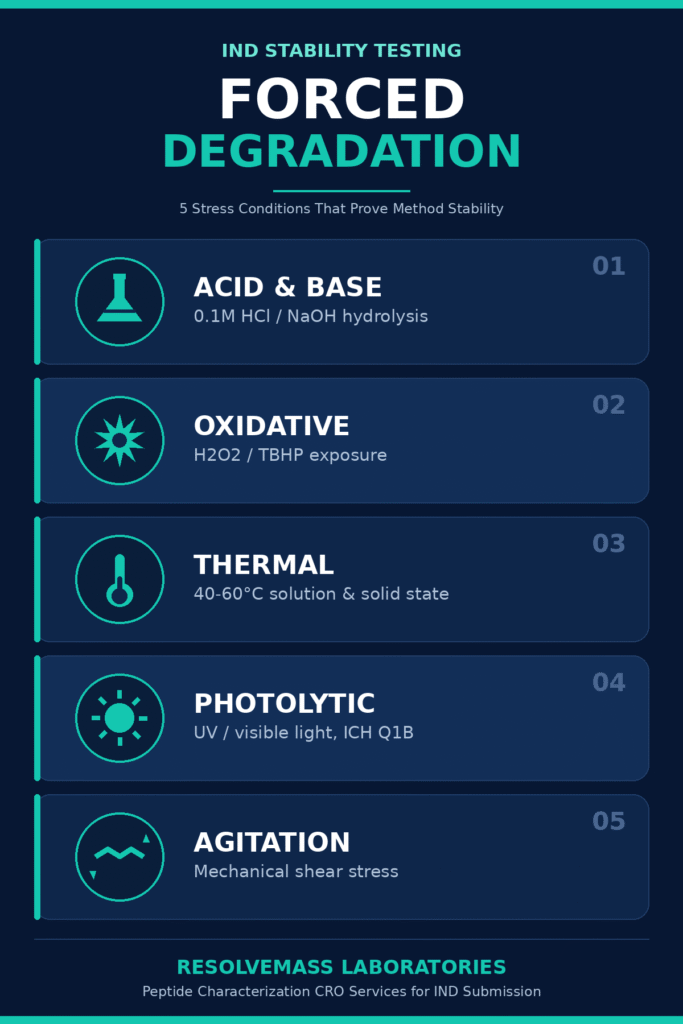
Forced degradation, or stress testing, intentionally exposes peptide drug substances to controlled environmental challenges designed to achieve approximately 10–20% degradation. These studies demonstrate that analytical methods can successfully distinguish intact drug molecules from all degradation products without chromatographic co-elution. Standard stress-testing protocols include:
- Acidic and Basic Hydrolysis: Exposure to 0.1 M HCl and 0.1 M NaOH to evaluate peptide bond hydrolysis, deamidation, and cyclic imide formation.
- Oxidative Stress: Treatment with hydrogen peroxide (H₂O₂) or tert-butyl hydroperoxide (TBHP) to identify oxidation-sensitive methionine and cysteine residues.
- Thermal and Solution Stress: Storage at elevated temperatures ranging from 40°C to 60°C in both solution and solid-state forms to assess thermal degradation and aggregate formation.
- Photolytic Stress: Exposure to controlled visible and ultraviolet light in accordance with ICH Q1B recommendations to evaluate photo-oxidative degradation.
- Agitation and Shear Stress: Mechanical agitation or vortex mixing to induce interfacial denaturation and fibril formation.
Formal stability programmes supporting Phase 1 IND submissions generally require real-time storage studies (for example, 2°C–8°C or −20°C) together with accelerated stability studies conducted at 25°C/60% RH across three representative development batches. Stability-indicating release specifications typically include appearance, chromatographic purity, mass spectrometric identity, biological potency, water content, pH, aggregate levels, and bacterial endotoxin measurements.
Key Considerations When Selecting Peptide Characterization CRO Services for IND Submission
Selecting a qualified CRO for peptide characterization requires careful assessment of its high-resolution analytical capabilities, orthogonal separation technologies, and practical experience with regulatory CMC requirements. An experienced CRO generates fully compliant eCTD Module 3 datasets that reduce the likelihood of regulatory review delays and minimize the risk of FDA clinical holds.
When assessing prospective CRO partners, sponsors should carefully evaluate four key operational capabilities:
Advanced Mass Spectrometry Infrastructure
The laboratory should possess state-of-the-art HRMS platforms, including Orbitrap Exploris and Q-TOF systems, equipped with multiple fragmentation techniques such as CID, HCD, and ETD. These capabilities are essential for comprehensive structural mapping, accurate disulfide bond assignment, and the detection of low-abundance impurities.
Orthogonal Separation Capabilities
The CRO should demonstrate expertise across a broad range of complementary chromatographic and separation techniques beyond conventional RP-HPLC. Capabilities should include Cation Exchange Chromatography (CEX), Hydrophilic Interaction Liquid Chromatography (HILIC), SEC-MALS, chiral chromatography, and Ion Mobility Mass Spectrometry (IM-MS), enabling complete characterization of structurally diverse peptide impurities.
Regulatory Expertise
The organization should have well-documented experience working with USP <1047>, USP <1048>, EMA draft guidance for synthetic peptides, and FDA regulatory expectations. This expertise facilitates efficient preparation of analytical datasets for direct incorporation into eCTD Module 3 (Sections 3.2.S and 3.2.P).
Phase-Appropriate Method Validation
A capable CRO should balance the analytical requirements of early-phase IND submissions with long-term commercial development objectives by implementing robust analytical method validation strategies that align with ICH Q2(R1) and ICH Q2(R2) guidelines. This approach ensures that analytical methods remain suitable throughout both clinical development and future commercial manufacturing.
Conclusion
A comprehensive, high-resolution analytical data package developed through professional Peptide Characterization CRO Services for IND Submission plays a pivotal role in supporting successful regulatory submissions and smooth clinical advancement. Demonstrating confirmed molecular identity, high purity, well-controlled impurity profiles, and validated stability enables sponsors to meet the quality expectations established by the FDA, EMA, and ICH. A thoroughly characterized analytical package provides the structural confirmation, impurity assessment, and stability evidence necessary to confidently progress therapeutic peptide candidates into first-in-human clinical studies. By integrating high-resolution orthogonal analytical techniques with detailed impurity profiling and scientifically robust stability studies, sponsors can reduce development risks while maintaining compliance with evolving global regulatory standards.
Partner with our team for expert GLP-1 peptide sequencing CRO services and complete multi-attribute profiling for your IND submission.
For organizations seeking specialized scientific expertise, advanced analytical technologies, and tailored bioanalytical support for upcoming IND submissions, collaborating with an experienced peptide characterization partner is a strategic next step. Engaging with expert analytical scientists early in development can help streamline CMC preparation, strengthen regulatory documentation, and address project-specific analytical challenges. To discuss customized analytical testing solutions for your peptide development programme, contact the technical team through the ResolveMass Contact Page.
Frequently Asked Questions
USP <1047> establishes a dedicated quality framework for synthetic peptide drug substances by defining critical quality attributes and appropriate analytical approaches. It outlines expectations for confirming molecular identity, evaluating purity, controlling impurities, assessing structural integrity, and measuring counterion content. Following this chapter helps sponsors generate analytical data that aligns with current regulatory expectations for IND submissions.
Comprehensive sequence verification relies on multiple complementary analytical techniques rather than a single method. High-resolution LC-HRMS/MS using fragmentation approaches such as CID, HCD, and ETD provides detailed peptide sequence information through extensive fragment ion analysis. These results are further supported by N-terminal Edman degradation and Amino Acid Analysis (AAA), which independently verify sequence identity and amino acid composition.
Diastereomeric impurities possess the same molecular weight as the intended peptide, making them difficult to distinguish using mass spectrometry alone. To overcome this challenge, CROs combine high-resolution chromatographic techniques with optimized separation conditions, including chiral chromatography or advanced reverse-phase UPLC methods. Careful adjustment of column chemistry, mobile phase composition, and operating temperature enables accurate identification and quantification of these stereoisomeric impurities.
Higher-order structure (HOS) analysis confirms that a synthetic peptide adopts the correct secondary and tertiary conformations required for its intended biological function. It also helps identify structural changes that may occur during manufacturing or storage, including aggregation or conformational instability. Techniques such as Far-UV Circular Dichroism, FTIR, 2D NMR, and Ion Mobility Mass Spectrometry provide complementary evidence of structural consistency across production batches.
Many synthetic peptides are purified using trifluoroacetic acid (TFA) or formulated as acetate or hydrochloride salts, leaving measurable amounts of counterions associated with the final product. These counterions influence the overall mass balance, solubility, stability, and, in some cases, the safety profile of the drug substance. Regulatory agencies therefore expect accurate quantification using validated techniques such as Ion Chromatography (IC) or ¹⁹F/¹H Nuclear Magnetic Resonance (NMR).
ICH Q3A and ICH Q3B were developed specifically for conventional small-molecule pharmaceuticals and do not fully address the unique impurity profiles associated with synthetic peptides. Peptide manufacturing can generate sequence variants, stereoisomers, truncation products, and other synthesis-related impurities that require specialized analytical evaluation. Consequently, regulatory authorities rely on peptide-specific guidance documents, including USP <1047>, relevant pharmacopeial standards, and product-specific FDA recommendations to establish appropriate impurity control strategies.
Forced degradation studies expose peptide drug substances to controlled stress conditions in order to evaluate degradation behaviour and demonstrate the specificity of analytical methods. Typical studies include acidic and alkaline hydrolysis, oxidative degradation using peroxide reagents, photostability testing in accordance with ICH Q1B, elevated temperature storage, and mechanical agitation. These experiments confirm that degradation products can be accurately separated from the intact peptide during routine quality testing.
The assessment of peptide aggregation requires multiple orthogonal analytical techniques because aggregate species can vary considerably in size and complexity. SEC-MALS is commonly used to quantify soluble dimers, oligomers, and other low-molecular-weight aggregates, while Analytical Ultracentrifugation (AUC), Field-Flow Fractionation (FFF), and Dynamic Light Scattering (DLS) are applied to characterize larger colloidal aggregates and sub-visible particles. Together, these methods provide a comprehensive evaluation of aggregation-related immunogenicity risks.
eCTD Module 3 contains the complete Chemistry, Manufacturing, and Controls (CMC) documentation for both the drug substance (Section 3.2.S) and drug product (Section 3.2.P). Sponsors are expected to include detailed structural characterization reports, starting material specifications, validated analytical methods for release and stability testing, impurity characterization data, batch analytical results, and comprehensive stability studies, including forced degradation data. Collectively, these documents provide regulators with the evidence needed to assess the quality, consistency, and safety of the peptide product before clinical development proceeds.
Reference:
- U.S. Food and Drug Administration. (2021, May). ANDAs for certain highly purified synthetic peptide drug products that refer to listed drugs of rDNA origin: Guidance for industry. U.S. Department of Health and Human Services. https://www.fda.gov/media/107622/download
- U.S. Food and Drug Administration. (2020, January). Chemistry, manufacturing, and control (CMC) information for human gene therapy investigational new drug applications (INDs): Guidance for industry. U.S. Department of Health and Human Services. https://www.fda.gov/media/113760/download
- Rana, A., Sharma, S., Kumari, A., & Gupta, V. (2025). Synthetic peptides in modern therapeutics: Advances, regulatory perspectives, and future opportunities. AAPS Open, 11, Article 9. https://doi.org/10.1186/s41120-025-00109-2
- European Medicines Agency. (2023, October 18). Draft guideline on the development and manufacture of synthetic peptides (EMA/CHMP/CVMP/QWP/387541/2023). https://www.ema.europa.eu/en/documents/scientific-guideline/draft-guideline-development-manufacture-synthetic-peptides_en.pdf
- Egyptian Drug Authority. (2023, December 3). Regulatory guide on the registration of synthetic peptides human pharmaceutical products that refer to a reference peptide product of rDNA origin (Code: EDREX:GL.CAPP.036, Version 1). https://edaegypt.gov.eg/media/cg0jbhfw/synthetic-peptide-regulatory-guide.pdf
Get In Touch With Us
About The Author


