


The Regulatory Imperative for a Peptide Characterization CRO Deliverables Checklist
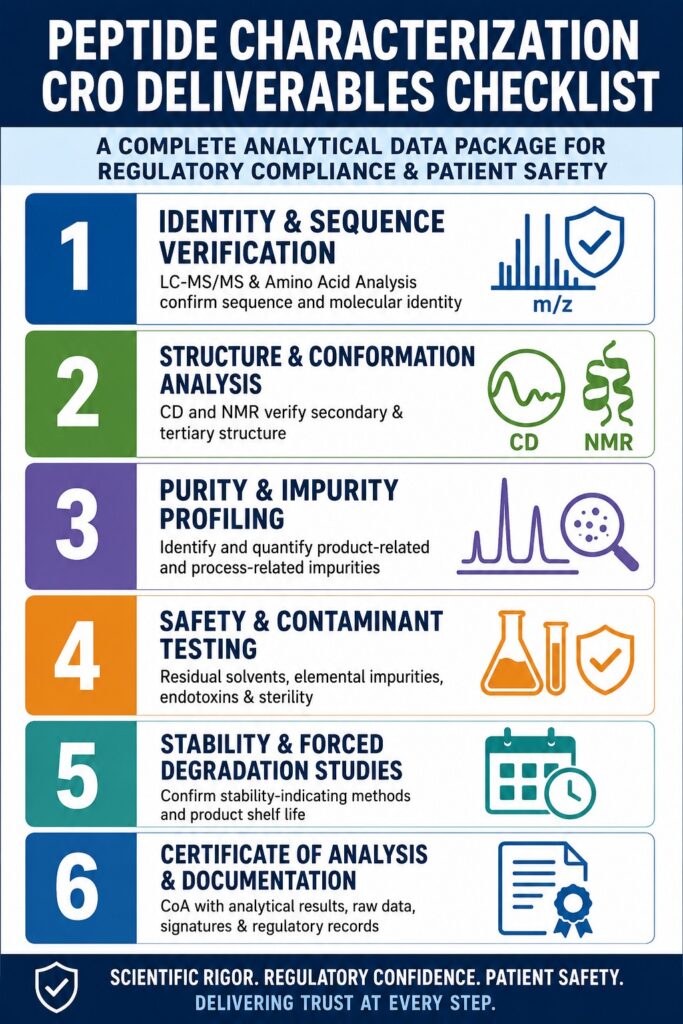
A peptide characterization CRO deliverables checklist serves as a fundamental regulatory requirement for demonstrating the identity, purity, safety, and potency of therapeutic peptide drug substances before the initiation of clinical studies. A well-structured analytical data package confirms that all testing activities comply with the rigorous standards established by the FDA and ICH guidelines. Regulatory authorities regard comprehensive physicochemical characterization as an essential component of the approval pathway. Drug developers are required to provide detailed documentation covering sequence accuracy, impurity characterization, structural integrity, conformational attributes, and biological activity to support chemistry, manufacturing, and controls (CMC) compliance.
Access comprehensive guidelines and regulatory strategies by visiting the Regulatory Requirements for GLP-1 Peptide Characterization page.
In accordance with regulatory definitions, the FDA classifies any alpha-amino acid polymer containing 40 or fewer amino acids as a peptide, while chemically synthesized polymers composed of 41 to 99 amino acids are categorized as chemically synthesized polypeptides. For synthetic peptides that reference a previously approved peptide derived from recombinant deoxyribonucleic acid (rDNA), including glucagon, liraglutide, nesiritide, teriparatide, or teduglutide, the regulatory pathway, particularly the suitability of an Abbreviated New Drug Application (ANDA), is largely determined by structural equivalence and impurity profile comparability. A generic synthetic peptide must demonstrate an impurity profile that is comparable to or cleaner than that of the reference listed drug (RLD), with no newly detected impurity exceeding the strict threshold of 0.5% unless it has been thoroughly identified and toxicologically qualified. Employing a standardized Peptide Characterization CRO Deliverables Checklist helps ensure that every critical quality attribute (CQA) is systematically evaluated throughout analytical development.
Article Summary:
- A Peptide Characterization CRO Deliverables Checklist is essential for meeting FDA and ICH regulatory requirements, ensuring the identity, purity, safety, potency, and overall quality of therapeutic peptides before clinical development.
- Comprehensive primary structure verification relies on high-resolution mass spectrometry and amino acid analysis to confirm peptide sequence accuracy, molecular weight, and structural integrity.
- Standardized data processing and bioinformatics workflows help convert raw analytical data into reproducible, traceable formats, supporting reliable peptide identification, modification analysis, and regulatory compliance.
- Quantitative amino acid analysis is used to determine actual peptide content by accounting for moisture and counterions, enabling accurate dosage calculations and active ingredient quantification.
- Higher-order structural characterization employs techniques such as Circular Dichroism (CD) and Nuclear Magnetic Resonance (NMR) to evaluate peptide folding, secondary structure, tertiary conformation, and biological functionality.
- Purity and safety assessments focus on identifying product-related impurities, residual solvents, elemental contaminants, endotoxins, and other process-related residues to ensure patient safety and compliance with regulatory standards.
- Stability studies, forced degradation testing, and a complete Certificate of Analysis (CoA) provide evidence of product robustness, shelf-life suitability, manufacturing control, and readiness for regulatory submissions, helping reduce development risks and approval delays.
Watch the Full Video on “The 40-Amino-Acid Line: Peptide or Protein? (And Why It Decides Everything)”
Primary Structure Verification: Identity and Sequence Fidelity
Primary structure verification involves the analytical confirmation of the exact amino acid sequence and molecular mass of a peptide. A comprehensive analytical package should integrate high-resolution mass spectrometry with quantitative amino acid analysis to establish complete sequence fidelity and molecular identity.
Partner with international experts for your validation needs through Peptide Sameness Study Services in Canada
or explore regional testing via Peptide Sameness Study Services in United States.
Integrating the Peptide Characterization CRO Deliverables Checklist into Mass Spectrometry Workflows
Incorporating the Peptide Characterization CRO Deliverables Checklist into mass spectrometry workflows ensures that both intact molecular mass and sequence-specific fragmentation data are thoroughly verified. High-resolution mass spectrometry serves as the principal analytical technique for confirming that the experimentally observed mass corresponds to the theoretical peptide sequence. Electrospray Ionization Mass Spectrometry (ESI-MS) and Matrix-Assisted Laser Desorption/Ionization Time-of-Flight (MALDI-TOF) mass spectrometry are routinely employed to determine intact molecular mass and compare it against the expected theoretical value within established instrument tolerances. Since intact mass measurements alone cannot distinguish sequence rearrangements or isobaric amino acid substitutions, tandem mass spectrometry (MS/MS) must also be performed to either establish de novo sequence information or validate the sequence through characteristic fragmentation patterns.
Discover advanced instrumentation setups by reading about LC-MS Characterization of GLP-1 Peptides.
The selection of a mass spectrometer directly affects analytical resolution and acquisition speed. Orbitrap mass spectrometers provide ultra-high resolution (≥ 500k) and are particularly suitable for intact mass determination and de novo sequencing applications. In contrast, Quadrupole Time-of-Flight (Q-TOF) systems offer rapid scan speeds and are highly effective for routine LC-MS/MS workflows. For highly concentrated peptide formulations or samples susceptible to aggregation, native mass spectrometry and Size-Exclusion Chromatography coupled with Multi-Angle Light Scattering (SEC-MALS) are frequently employed to detect and characterize multimeric aggregates.
Learn more about sequence mapping protocols at Peptide Sequencing of GLP-1 Peptides
and review workflow steps using the GLP-1 Analog Peptide Sequencing Workflow.
For the preparation of complex peptide formulations or conjugated therapeutic products, the analytical package should include documentation of a standardized sample preparation procedure. Filter-Assisted Sample Preparation (FASP) is widely recognized as an industry-standard methodology. The sample, ideally containing at least 50 μg of protein or peptide, is denatured and reduced using tris(2-carboxyethyl)phosphine (TCEP) at pH 6.5. Following reduction, the sample is transferred to a 30 kDa Microcon nitrocellulose filter and centrifuged at 14,000 × g. Alkylation is subsequently performed using iodoacetamide (IAM) under dark conditions, followed by multiple washing steps utilizing Lyso-Asyl Digestion Buffer (LADB). Trypsin, such as SOLu-Trypsin, is added at an enzyme-to-protein ratio of approximately 1:10, and digestion is carried out at 37°C for four hours with continuous mixing. The resulting peptide fragments are eluted, acidified using formic acid, and analyzed by LC-MS. High-resolution chromatographic separations are optimized using extended column lengths ranging from 50 mm to 250 mm, coupled with a narrow internal diameter of 2.1 mm to maximize mass spectrometer sensitivity. Smaller pore sizes between 100 and 150 Å further improve the resolution of complex peptide maps.
Raw Data Processing and Bioinformatics Pipelines
Raw data processing converts vendor-specific instrument files into standardized formats that enable reproducible peptide identification and comprehensive post-translational modification analysis. The implementation of standardized computational pipelines supports compliance with international data integrity requirements.
To transform proprietary instrument files into open-source formats, data-processing workflows commonly utilize command-line tools such as ProteoWizard’s msconvert. A representative command for generating analysis-ready datasets is shown below:
msconvert original_file.raw –mzML –filter “peakPicking true” –filter “zeroSamples removeExtra”
This workflow converts raw data into the standardized mzML format, applies native centroiding algorithms to both MS1 and MS2 scans, and removes redundant zero-intensity values to enhance computational efficiency while reducing file size.
The resulting standardized files are analyzed using platforms such as BioPharma Finder 3.0 for peptide mapping studies. Search parameters should be clearly documented, including trypsin specificity, carboxymethylation (+58.005 Da) as a fixed modification of cysteine residues, and dynamic modifications such as oxidation (+15.995 Da) of methionine and tryptophan, deamidation (+0.984 Da) of asparagine and glutamine, and pyroglutamination (-18.011 Da) of N-terminal glutamic acid residues. In quantitative proteomics and comparability assessments, software platforms such as MaxQuant MaxLFQ are employed to integrate peptide abundance ratios through global optimization strategies. Alternatively, the Common Data Analysis Pipeline (CDAP) uses established software tools, including ReAdW4Mascot2, MSGF+, ProMS, PhosphoRS, and PSMLab, to standardize raw mass spectrometry data and generate reproducible, auditable protein assembly databases.
Quantitative Amino Acid Analysis and Net Peptide Content
Quantitative amino acid analysis determines the precise amino acid composition of a sample and calculates the actual net peptide content. Verification of this value is essential because lyophilized peptides inherently contain moisture and counterions that can reduce the proportion of active peptide material by 10% to 30%.
Amino Acid Analysis (AAA) remains one of the most important analytical approaches for confirming the molecular composition of synthetic peptides. Charged amino acid residues, including aspartic acid, glutamic acid, lysine, arginine, and histidine, exhibit significant hygroscopic properties and readily absorb moisture from the surrounding environment, often resulting in viscous, transparent oils that distort gravimetric measurements. Through acid hydrolysis followed by chromatographic separation and quantitative detection, the molar ratios of individual amino acids can be accurately determined. By subtracting non-peptide components such as residual moisture and counterions from the gross sample weight, the Net Peptide Content (NPC) can be calculated. ResolveMass Laboratories Inc. applies quantitative Nuclear Magnetic Resonance (qNMR) alongside advanced AAA methodologies to establish precise active pharmaceutical ingredient (API) concentrations, providing the high-accuracy dosing data required for toxicology and preclinical studies.
Higher-Order Structural Elucidation and Conformational Analysis
Higher-order structural characterization defines the secondary and tertiary conformations of a peptide to ensure that it adopts the biologically active three-dimensional structure required for therapeutic function. The use of orthogonal physicochemical techniques minimizes the risk that structural alterations will lead to reduced potency or unwanted immunogenicity.
Secondary Structure Mapping via Circular Dichroism
Circular dichroism spectroscopy evaluates secondary structural elements, including alpha-helices and beta-sheets, in therapeutic peptides under solution conditions. It serves as a rapid and highly sensitive biophysical technique for monitoring conformational changes across different environmental conditions.
Circular Dichroism (CD) spectroscopy is highly responsive to the spatial organization of peptide bonds. Within a comprehensive analytical package, CD spectra verify that the peptide has adopted the intended biologically active secondary structure. In addition, CD functions as an effective stability screening tool by monitoring structural transitions resulting from variations in pH, temperature, and ionic strength. These biophysical profiles should be included to demonstrate that manufacturing modifications do not adversely affect the physicochemical characteristics of the peptide drug substance.
To understand secondary structure resolution techniques, explore CD Spectroscopy for Peptide Secondary Structure Characterization.
Atomic-Level Conformation via Nuclear Magnetic Resonance
Nuclear magnetic resonance spectroscopy provides atomic-resolution verification of peptide folding, three-dimensional structure, and conformational dynamics. It remains one of the most definitive analytical methods for establishing tertiary structural equivalence and confirming disulfide bond connectivity.
Nuclear Magnetic Resonance (NMR) spectroscopy provides highly detailed structural information regarding atomic arrangement and molecular folding behavior in three-dimensional space. This capability is particularly important for complex modified peptides, including cyclic peptides, PEGylated peptides, lipidated peptides, and peptide-oligonucleotide conjugates (POCs). NMR can verify the stereochemistry of chiral centers, confirm correct disulfide bridge pairing, and monitor solution-state molecular dynamics.
Review detailed atomic modeling examples at 2D NMR for Peptide Characterization
and check specific structural parameters for complex targets under Cyclic Peptide Characterization.
To satisfy regulatory expectations, NMR data should be evaluated alongside orthogonal physicochemical techniques. While NMR, CD spectroscopy, and high-resolution MS/MS provide core structural and conformational information, additional biophysical methods are routinely employed to strengthen overall characterization.
| Biophysical Parameter | Primary Analytical Method | Primary Outcome / Result | QC Application Status |
|---|---|---|---|
| Primary Structure & Sequence | LC-MS/MS & Edman Degradation | Sequence order, disulfide connectivity | No |
| Secondary Structure | Circular Dichroism (CD) | Detection of α-helices and β-sheets | No |
| Chemical & Conformational Change | UV/vis Spectroscopy | Tertiary structure environment | Yes |
| Thermal Parameters | DSC / DSF | Melting point (Tm) determination | No |
| Solution 3D Folding | 1D/2D NMR Spectroscopy | Atomic-level folding and spatial dynamics | No |
| Charge Variant Profile | Ion Exchange (IEC) / IEF | Isoelectric point (pI), charge distribution | Yes |
| Molecular Weight/Aggregation | SDS-PAGE / Capillary Electrophoresis | Molecular weight verification and aggregate detection | Yes |
| Hydrodynamic Size | Size-Exclusion Chromatography (SEC) | Aggregate profiling and monomer purity | Yes |
Purity Profiling and Impurity Characterization Frameworks
Purity profiling establishes the concentration of the active peptide component while identifying all product-related and process-related impurities. A robust analytical package must define clear qualification thresholds for low-level impurities to ensure patient safety and regulatory compliance.
Product-Related Impurities and Diastereomer Separation
Product-related impurities, including truncated sequences, oxidized residues, and diastereomers, should be identified and quantified to levels as low as 0.1%. The separation of closely related stereoisomers requires highly sensitive chromatographic methodologies coupled with advanced mass spectrometric detection.
During Solid-Phase Peptide Synthesis (SPPS), numerous side reactions can generate structurally related impurities. These product-related species may include truncated sequences, sequence extensions, oxidized amino acid residues such as methionine sulfoxide, deamidated residues including aspartic acid isomers, and stereoisomeric diastereomers. FDA guidance for synthetic peptide ANDAs requires that specified common impurities remain at or below the levels observed in the corresponding RLD. Any newly detected impurity present between 0.1% and 0.5% must undergo structural characterization, while impurities exceeding 0.5% require comprehensive toxicological justification and comparative immunogenicity assessments.
Diastereomers generated through racemization of L-amino acids into D-amino acids present a unique analytical challenge because they possess identical molecular masses. Their identification requires peptide hydrolysis, derivatization of liberated amino acids using chiral reagents, and subsequent separation and quantification through Multiple Reaction Monitoring (MRM) on a triple-quadrupole mass spectrometer. Application of this methodology to Teriparatide API impurity profiling has successfully enabled quantification of low-level diastereomers at <0.3% w/w, facilitating more efficient batch release and regulatory submissions. ResolveMass Laboratories Inc. utilizes a dedicated Peptide Impurities Characterization platform specifically designed to identify, characterize, and isolate trace-related substances in support of IND-enabling programs.
Learn about trace isolation protocols by reviewing the GLP-1 Peptide Impurity Characterization platform.
Process-Related Contaminants and Safety Screenings
Process-related contaminants consist of chemical and biological residues introduced during peptide synthesis and purification. These substances must be monitored according to USP requirements to ensure product safety and quality.
Potential safety risks associated with synthesis reagents, solvents, and biological contaminants are assessed using targeted pharmacopeial methods:
Residual Solvents: Solvents used during peptide synthesis, including trifluoroacetic acid, acetonitrile, and dimethylformamide, are quantified using Gas Chromatography-Mass Spectrometry (GC-MS) headspace analysis in accordance with USP and ICH Q3C guidelines.
Elemental Impurities: Heavy metals such as lead, mercury, arsenic, and cadmium are measured using Inductively Coupled Plasma Mass Spectrometry (ICP-MS) in compliance with USP and ICH Q3D requirements.
Bacterial Endotoxins: Since therapeutic peptides are commonly administered by injection, endotoxin testing is performed using the Limulus Amebocyte Lysate (LAL) assay under USP guidelines, with a stringent safety specification of <0.25 EU/mL.
Sterility and Bioburden: Validated microbiological methods are required to verify the absence of viable microorganisms in sterile peptide formulations.
Stability-Indicating Assays and Forced Degradation Studies
Stability-indicating assays evaluate peptide degradation under controlled environmental stress conditions over time. These studies play a critical role in determining product shelf life, selecting appropriate excipients, and validating container closure systems in accordance with ICH Q1A and Q1B guidelines.
Peptides are susceptible to a variety of degradation pathways that can affect structural integrity, biological activity, and overall safety. To satisfy FDA and ICH expectations, forced degradation studies are conducted during product development. These studies expose the peptide API to stress conditions such as elevated temperatures, extreme pH environments, oxidative reagents, and photolytic exposure. Following stress treatment, samples are analyzed using reverse-phase high-performance liquid chromatography (RP-HPLC) to demonstrate that the analytical method can effectively separate the intact peptide from its degradation products, thereby confirming stability-indicating capability.
For validation methodologies, see the GLP-1 Peptide Stability Analytical Methods guide.
| Physical / Chemical Stability Issue | Primary Kinetic Cause | High-Risk Environmental Conditions | Analytical & Formulation Solutions |
| Non-Covalent Aggregation | Hydrophobic interactions, conformational changes | Temperature stress, mechanical shear, moisture | Optimize pH, add polyols/sugars, control temperature |
| Covalent Aggregation | Disulfide scrambling | Exposure to alkaline pH during processing | Optimize pH and utilize protein denaturants |
| Deamidation | Hydrolytic cleavage of Gln/Asn side chains | pH values <5.0 or >6.0 | Strict pH control using phosphate or acetate buffers |
| Cleavage and Hydrolysis | Acid/base-catalyzed peptide bond hydrolysis | Highly acidic or alkaline environments, protease contamination | Optimize pH and eliminate protease contaminants |
| Oxidation | Free-radical degradation of Met, Trp, and Cys residues | Light exposure, active oxygen species, trace metals | Incorporate antioxidants and light-protective packaging |
| Surface Denaturation | Adsorption onto container surfaces | Container incompatibility and hydrophobic peptides | Use surfactants and inert glass/polymer containers |
To minimize these degradation pathways during formulation development, carefully selected excipients are incorporated into the final drug product. These excipients must be thoroughly evaluated to ensure compatibility with the active peptide while avoiding the introduction of additional chemical or physical instability.
| Excipient Class | Representative Examples | Intended Formulation / Stabilizing Effect |
| Surfactants | Poloxamer, Polysorbate 20, Polysorbate 80 | Anti-adsorption, cryoprotection, lyoprotection |
| Polymers | Dextran, Cyclodextrin, Polyethylene Glycol (PEG), PVP, PLGA | Steric stabilization, anti-adsorption, controlled release |
| Sugars | Glucose, Sucrose, Trehalose | Cryoprotection, lyoprotection, structural stabilization |
| Polyols | Glycerol, Mannitol, Sorbitol | Physical stabilization, tonicity adjustment, cryoprotection |
| Antioxidants | Ascorbic acid, Ectoine, Glutathione, Monothioglycerol, Vitamin E | Protection against oxidation |
| Chelating Agents | Citric acid, EDTA, Thioglycolic acid | Metal chelation and oxidation prevention |
| Buffer Salts | Phosphate, bicarbonate, sulfate, acetate, chloride, pyruvate | pH control, stabilization, tonicity adjustment |
| Antacids | Magnesium hydroxide, Zinc carbonate | Solid-state pH control |
| Amino Acids | Alanine, arginine, aspartic acid, glycine, histidine, lysine, proline | Solubilization, stabilization, anti-aggregation |
Certificate of Analysis and Regulatory Documentation Deliverables
A regulatory Certificate of Analysis (CoA) consolidates analytical results, product specifications, and supporting chromatographic data into a traceable and auditable document. It represents the final deliverable within the peptide characterization CRO deliverables checklist and confirms readiness for clinical or commercial application.
A comprehensive Certificate of Analysis should include:
Header and Independent Laboratory Information: Identification of the testing laboratory, physical address, and applicable GLP or ISO 17025 accreditations.
Product and Batch Identification: Peptide name, catalog number, chemical formula, CAS number, and unique batch or lot number linked to manufacturing documentation.
Physical Properties: Description of physical appearance, expected molecular weight, and solubility testing results.
Purity Analysis (HPLC): Chromatographic purity data accompanied by raw RP-HPLC chromatograms showing retention times and peak integration results.
Identity Confirmation (MS): Mass spectrometry results comparing observed and theoretical molecular weights.
Safety and Contaminant Screening: Endotoxin, residual solvent, and elemental impurity results evaluated against predefined acceptance criteria.
Amino Acid Analysis: Quantitative amino acid composition and calculated net peptide content.
Traceability, Signatures, and Conclusion: Overall pass/fail status, analyst approval signatures, review dates, and a Letter of Authorization from the DMF holder when applicable.
Regulatory compliance also requires extensive in-process controls and raw material characterization records. Documentation should include resin specifications such as substitution levels, swelling characteristics, particle size distribution, and density, along with protected amino acid purity information. In-process monitoring data, including Kaiser, TNBS, and chloranil colorimetric tests used during coupling and deprotection steps, should also be retained. For final drug product manufacturing, critical process parameters such as component addition order, holding times, bulk solution storage conditions, and lyophilization cycle settings must be documented to establish scientific control throughout the manufacturing process. ResolveMass Laboratories Inc. provides complete ICH-compliant Certificates of Analysis containing raw HPLC chromatograms and MS spectra to support IND and DMF submissions with full transparency.
Conclusion: Securing Compliance with the Peptide Characterization CRO Deliverables Checklist
A robust and fully integrated analytical data package forms the foundation of regulatory compliance and patient safety. Effective execution of the Peptide Characterization CRO Deliverables Checklist helps organizations avoid costly clinical delays, regulatory setbacks, and manufacturing failures. Therapeutic peptides possess unique physicochemical challenges, including aggregation, oxidation, deamidation, and stereochemical isomerization, which cannot be adequately evaluated using conventional non-orthogonal testing strategies.
The incorporation of advanced orthogonal analytical technologies, including high-resolution mass spectrometry, two-dimensional NMR spectroscopy, circular dichroism, and quantitative amino acid analysis, ensures comprehensive characterization of sequence variants, conformational changes, and trace-level product-related impurities. This integrated analytical framework establishes the scientific rigor and process control expected by regulatory authorities worldwide and supports the successful development of safe, effective, and compliant peptide therapeutics.
FAQs on Peptide Characterization
A Certificate of Analysis (CoA) is a critical regulatory document that verifies the quality, identity, purity, and safety of a therapeutic peptide batch. It consolidates analytical results from multiple tests, including mass spectrometry, HPLC purity analysis, residual solvent screening, and endotoxin assessments. The document provides complete traceability for manufacturing and testing activities while demonstrating compliance with predefined release specifications. Regulatory agencies rely on the CoA as supporting evidence during IND, NDA, and DMF evaluations.
The FDA and EMA both follow internationally recognized ICH guidelines for peptide characterization, but their regulatory expectations can vary in certain areas. The FDA often issues product-specific guidance documents, particularly for synthetic peptide ANDA submissions, with a strong focus on demonstrating impurity profile comparability. The EMA generally emphasizes comprehensive characterization through multiple orthogonal analytical techniques to confirm structural integrity and impurity identification. Despite these differences, both agencies require extensive evidence of quality, safety, and consistency.
Product-related impurities originate from chemical reactions that occur during peptide synthesis, purification, storage, or degradation and are structurally related to the target peptide. Examples include truncated sequences, oxidized amino acids, deamidated variants, and diastereomers. Process-related impurities, on the other hand, arise from manufacturing materials or procedures and may include residual solvents, catalyst residues, reagents, heavy metals, or endotoxins. Both impurity categories require detailed identification and quantification using validated analytical techniques.
Net Peptide Content (NPC) refers to the actual amount of active peptide present within a peptide preparation after accounting for moisture, counterions, and other non-peptide components. Since lyophilized peptides frequently contain residual water and salt forms, the gross weight does not always reflect the true peptide concentration. Techniques such as Amino Acid Analysis (AAA) and quantitative NMR (qNMR) are commonly used to calculate NPC accurately. Determining NPC is essential for precise dosing, potency calculations, and reproducible biological studies.
A stability-indicating HPLC method is designed to separate the intact peptide from any degradation products that may develop during storage or handling. Regulatory authorities require this capability because peptide therapeutics can undergo chemical and physical degradation over time. The method is typically validated through forced degradation studies involving stress conditions such as heat, oxidation, and extreme pH exposure. This approach ensures that stability testing accurately reflects changes in product quality throughout its shelf life.
According to FDA definitions, a peptide is an alpha-amino acid polymer containing 40 or fewer amino acids. Chemically synthesized molecules consisting of 41 to 99 amino acids are categorized as chemically synthesized polypeptides. Molecules containing a defined amino acid sequence of 100 or more residues are generally classified as proteins. This distinction is important because it can influence the applicable regulatory pathway and product classification.
Peptide mapping is a widely used analytical technique for confirming the primary structure and sequence integrity of therapeutic peptides and proteins. The molecule is enzymatically or chemically cleaved into smaller fragments, which are then separated chromatographically and analyzed using LC-MS/MS. This process helps verify amino acid sequence coverage, identify modification sites, and confirm disulfide bond connectivity. As a result, peptide mapping provides detailed structural information that supports product identity and quality assessments.
Trifluoroacetic acid (TFA) is frequently used during peptide synthesis and purification, causing many synthetic peptides to be isolated as TFA salts. Residual TFA can interfere with biological testing by affecting cell viability, altering assay responses, or introducing unwanted physiological effects. Replacing TFA with more biologically compatible counterions such as acetate or hydrochloride can improve assay reliability and reproducibility. Maintaining very low residual TFA levels helps ensure that experimental results reflect the properties of the peptide rather than the counterion.
Reference:
- U.S. Food and Drug Administration. (2022, September). Assessing immunogenicity risk of peptides: The synthetic peptide guidance and product-specific guidances (PSGs) [Presentation]. U.S. Department of Health and Human Services. https://www.fda.gov/media/166571/download
- Purohit, V. S., & Ranjan, R. (2025). Regulatory guidelines for the analysis of therapeutic peptides and proteins. Methods and Protocols, 8(1), 9. https://doi.org/10.3390/mps8010009
- U.S. Food and Drug Administration. (2021, May). ANDAs for certain highly purified synthetic peptide drug products that refer to listed drugs of recombinant DNA origin: Guidance for industry. U.S. Department of Health and Human Services. https://www.fda.gov/media/107622/download
- Canadian Food Inspection Agency. (n.d.). RG-1 regulatory guidance: Chapter 2 – Data requirements for single ingredient approval and feed registration. Government of Canada. https://inspection.canada.ca/en/animal-health/livestock-feeds/regulatory-guidance/rg-1/chapter-2
Get In Touch With Us
About The Author


