

Peptide-Oligonucleotide Conjugate Sequence Confirmation Strategies (MS/MS + Enzymatic Digestion)
 By Anusha Sinha
•
August 8, 2026
By Anusha Sinha
•
August 8, 2026
Introduction

Peptide-Oligonucleotide Conjugate Sequence Confirmation Strategies utilize a dual-analytical approach that combines high-resolution tandem mass spectrometry (MS/MS) with selective enzymatic digestion techniques to characterize both biopolymer backbones and confirm covalent attachment sites. This comprehensive, multi-level analytical methodology addresses challenges associated with differential fragmentation behavior and electrostatic interactions that can otherwise hinder complete sequence characterization of chimeric biopharmaceutical molecules.
Therapeutic platforms incorporating synthetic oligonucleotides—including antisense oligonucleotides (ASOs), small interfering RNAs (siRNAs), and microRNA inhibitors—often encounter biological limitations such as inefficient intracellular transport and restricted tissue distribution. Covalent attachment of cell-penetrating peptides (CPPs), nuclear localization sequences, or receptor-specific peptide ligands can substantially improve receptor-mediated uptake and enhance tissue-targeted delivery. Nevertheless, confirming primary sequence fidelity, terminal modifications, and exact cross-linking locations within these hybrid biomolecules remains analytically demanding. The contrasting physicochemical characteristics of polycationic or hydrophobic peptides and polyanionic oligonucleotides influence gas-phase ionization, chromatographic behavior, and MS/MS fragmentation patterns. The application of validated Peptide-Oligonucleotide Conjugate Sequence Confirmation Strategies provides the structural evidence necessary to support chemistry, manufacturing, and controls (CMC) requirements for regulatory submissions.
Learn more about overcoming biological barriers and enhancing intracellular transport: Discover Peptide-Oligonucleotide Conjugates for Targeted Drug Delivery
Need Reliable Sequence Confirmation for Peptide–Oligonucleotide Conjugates?
Contact ResolveMass today to discuss your POC sequence confirmation challenges and learn how our LC-MS/MS, HRMS, and enzymatic mapping expertise can support your research, development, and quality control programs. Contact us
Article Summary Key Takeaways
- Peptide–oligonucleotide conjugates (POCs) require advanced analytical strategies to confirm peptide and oligonucleotide sequences, terminal modifications, and exact conjugation sites.
- MS/MS fragmentation provides complementary information: CID/HCD are highly effective for oligonucleotide sequencing, while ETD/ECD preserve peptide linkages and improve peptide sequence and attachment-site characterization.
- EThcD combines ETD and HCD, helping overcome electrostatic interactions between positively charged peptides and negatively charged oligonucleotides while enabling dual-domain sequence coverage.
- Enzymatic digestion simplifies complex conjugates: exonucleases such as SVPD and BSPD generate nucleotide ladders, while trypsin, Lys-C, Glu-C, DNase I, and RNase enzymes produce smaller fragments for easier structural analysis.
- Exonuclease ladder sequencing can localize conjugation sites by monitoring predictable mass changes and identifying where enzymatic digestion stops because of the attached peptide or linker.
- High-resolution LC-MS/MS workflows using IP-RP-LC or HILIC, HRAM/FT-MS, mass-defect filtering, accurate-mass analysis, and customized databases improve sequence assignment and detection of modifications.
- Integrated MS/MS, enzymatic digestion, and rigorous QC provide reliable confirmation of sequence fidelity, linkage sites, impurities, purity, and manufacturing consistency—supporting drug development and regulatory submissions.
Structural Heterogeneity and Analytical Challenges in Heteroconjugates
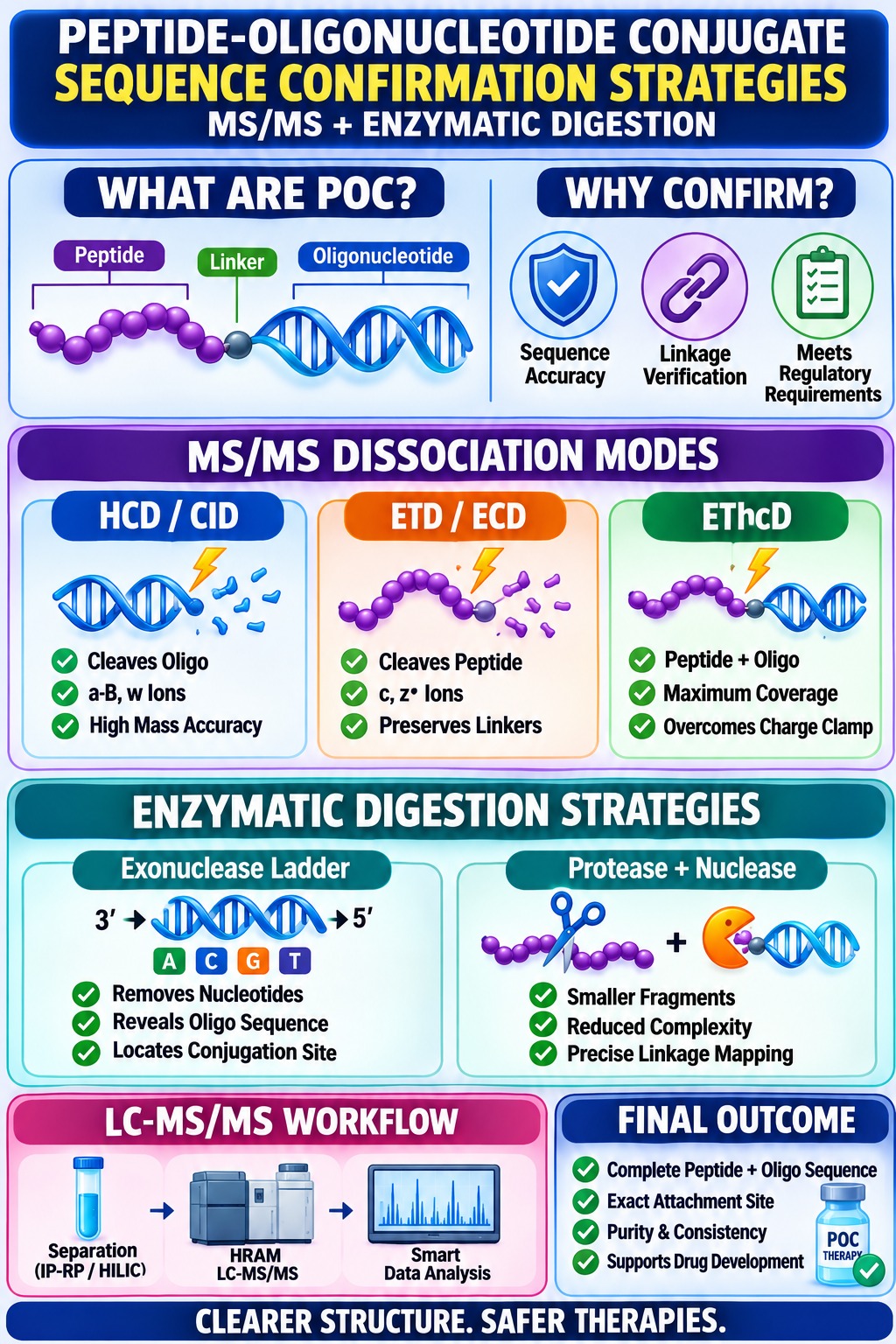
Structural diversity within peptide-oligonucleotide conjugates originates from opposing charge distributions along the backbone, differences in gas-phase fragmentation susceptibility, and distinct elemental mass defect characteristics associated with peptide and nucleic acid components. These fundamental chemical distinctions frequently result in preferential cleavage of phosphodiester linkages rather than peptide amide bonds during conventional collision-based dissociation methods.
Combining peptide and nucleic acid components produces a chimeric structure possessing unique bioanalytical characteristics. Peptides composed of canonical or non-canonical amino acids exhibit varying charge states and hydrophobic properties depending on their sequence composition. Under acidic electrospray ionization (ESI) conditions, basic amino acids such as arginine and lysine readily acquire protons, generating highly charged positive ions. In contrast, synthetic oligonucleotides containing phosphodiester or phosphorothioate backbones ionize efficiently in negative ESI mode because of the acidic nature of their phosphate groups.
Dive deeper into the mechanisms driving cellular uptake and endosomal transport: Learn How Peptide-Oligonucleotide Conjugates Enter Cells
Following covalent linkage, the opposing charges present within the heteroconjugate may induce intramolecular electrostatic clamping, where positively charged peptide side chains interact closely with the negatively charged oligonucleotide backbone. Such interactions can significantly reduce dissociation efficiency during gas-phase fragmentation. Furthermore, peptides generally display positive mass defects due to enrichment in hydrogen and nitrogen atoms, whereas oligonucleotides exhibit negative mass defects as a consequence of their elevated oxygen and phosphorus content. High-Resolution Accurate Mass (HRAM) instruments exploit these characteristic mass defect differences during liquid chromatography-tandem mass spectrometry (LC-MS/MS) analyses to distinguish and accurately annotate overlapping fragment ion populations.
Examine common obstacles in bioconjugate characterization and synthesis: Address Key Challenges in Peptide-Oligonucleotide Conjugates
Tandem Mass Spectrometry Dissociation Modes for Peptide-Oligonucleotide Conjugate Sequence Confirmation Strategies
Tandem mass spectrometry dissociation techniques facilitate comprehensive sequence characterization of peptide-oligonucleotide conjugates by employing complementary activation mechanisms, including collision-induced dissociation for nucleic acid sequencing and electron-transfer dissociation for peptide sequencing. Alternating or combined fragmentation approaches allow complete characterization of both molecular domains while preserving fragile linkage chemistries.
Collision-Induced Dissociation (CID) and Higher-Energy C-Trap Dissociation (HCD)
Collision-induced dissociation (CID) and higher-energy C-trap dissociation (HCD) predominantly cleave phosphodiester and phosphorothioate bonds within the oligonucleotide segment, generating predictable fragment ion series that are highly informative for sequence determination. However, because these activation methods rely on vibrational energy deposition, fragmentation tends to occur preferentially at the most labile bonds, often resulting in limited peptide backbone cleavage.
During low-energy CID and beam-type HCD experiments, precursor ions collide with neutral gases such as helium, nitrogen, or argon, converting kinetic energy into internal vibrational energy. Since phosphodiester bonds possess lower dissociation energies than peptide amide bonds, the deposited energy is preferentially localized within the nucleic acid backbone. As a result, CID/HCD spectra obtained from heteroconjugates are frequently dominated by base-loss products and oligonucleotide fragment ions, including a-B and w-type ions, while providing comparatively little peptide sequence information. Despite this inherent bias, HCD performed on FT-Orbitrap systems offers exceptional mass accuracy (<5 ppm), enabling reliable confirmation of modified nucleosides, phosphorothioate substitution patterns, and terminal capping modifications.
Electron Transfer Dissociation (ETD) and Electron Capture Dissociation (ECD)
Electron transfer dissociation (ETD) and electron capture dissociation (ECD) generate radical-mediated, non-ergodic fragmentation along the peptide backbone, producing characteristic c and z• ion series while preserving phosphodiester bonds and fragile conjugation chemistries. This fragmentation mechanism plays a critical role in peptide sequence analysis and precise localization of covalent attachment sites.
Unlike collision-based activation methods, ETD involves transfer of an electron from a radical anion reagent, such as fluoranthene, to a multiply protonated precursor ion. Electron capture initiates rapid cleavage of N-Cα bonds throughout the peptide backbone before energy redistribution can occur. Because this non-ergodic process avoids extensive thermal activation, labile post-translational modifications and synthetic linker chemistries—including triazole structures formed through copper-catalyzed azide-alkyne cycloaddition, phosphoramidate bonds, and maleimide-thiol conjugations—remain intact during fragmentation. Consequently, ETD is highly effective for identifying the exact peptide residue involved in conjugation. Sequence coverage generally improves with increasing precursor charge state, particularly when z ≥ +3.
Discover how conjugation chemistry impacts linker stability and dissociation: Explore Peptide-Oligonucleotide Conjugate Linker Chemistry
Hybrid Dissociation Modes: EThcD and ETciD
Hybrid dissociation strategies such as Electron-Transfer Higher-Energy Collisional Dissociation (EThcD) combine electron-transfer fragmentation with supplemental collisional activation to overcome non-covalent electrostatic interactions that can hinder fragment separation. This dual-activation approach generates spectra containing informative fragment ions from both peptide and oligonucleotide domains simultaneously.
Strong electrostatic interactions between basic peptide residues and negatively charged phosphate groups can prevent physically cleaved fragments from separating in the gas phase. EThcD addresses this limitation by first inducing ETD fragmentation and then applying controlled HCD activation. The supplemental energy disrupts non-covalent interactions while releasing c and z• peptide ions together with sequence-informative oligonucleotide fragments. As a result, EThcD can provide extensive sequence coverage of both molecular components within a single analytical experiment.
| Dissociation Mode | Primary Cleavage Site | Major Fragment Ion Series | Key Analytical Advantage | Limitations for Conjugates |
|---|---|---|---|---|
| Collision-Induced Dissociation (CID) | Phosphodiester / Phosphorothioate backbone | Oligo: a-B, w, d, z; Peptide: Sparse b, y | High sensitivity; highly effective for oligonucleotide sequence mapping | Limited peptide backbone fragmentation |
| Higher-Energy Collisional Dissociation (HCD) | Beam-type CID backbone cleavage | Oligo: a-B, w, d, z; Peptide: b, y, internal ions | High mass accuracy FT-MS analysis; effective for mapping nucleoside modifications | Elevated energy may induce neutral base losses |
| Electron-Transfer Dissociation (ETD) | Peptide N-Cα backbone | Peptide: c, z•; Oligo: Minimal cleavage | Preserves labile linkers and PTMs while enabling peptide sequencing | Requires higher precursor charge states (z ≥ +3); limited oligonucleotide fragmentation |
| Electron-Transfer Higher-Energy CD (EThcD) | Dual peptide N-Cα and oligo phosphodiester cleavage | Hybrid: b, y, c, z• and a, w, c, y | Overcomes electrostatic clamping and enables simultaneous dual-domain sequencing | More complex spectral interpretation and slower acquisition rates |
Swipe horizontally to view the full table on smaller screens.
Enzymatic Digestion Tactics for Peptide-Oligonucleotide Conjugate Sequence Confirmation Strategies
Enzymatic digestion approaches simplify analysis of high-molecular-weight peptide-oligonucleotide conjugates by generating shorter, well-defined fragment populations through the use of sequence-specific exonucleases, endonucleases, and proteases. These controlled digestion strategies reduce spectral complexity and facilitate definitive sequence confirmation through liquid chromatography-mass spectrometry (LC-MS).
Exonuclease Ladder Sequencing Strategies
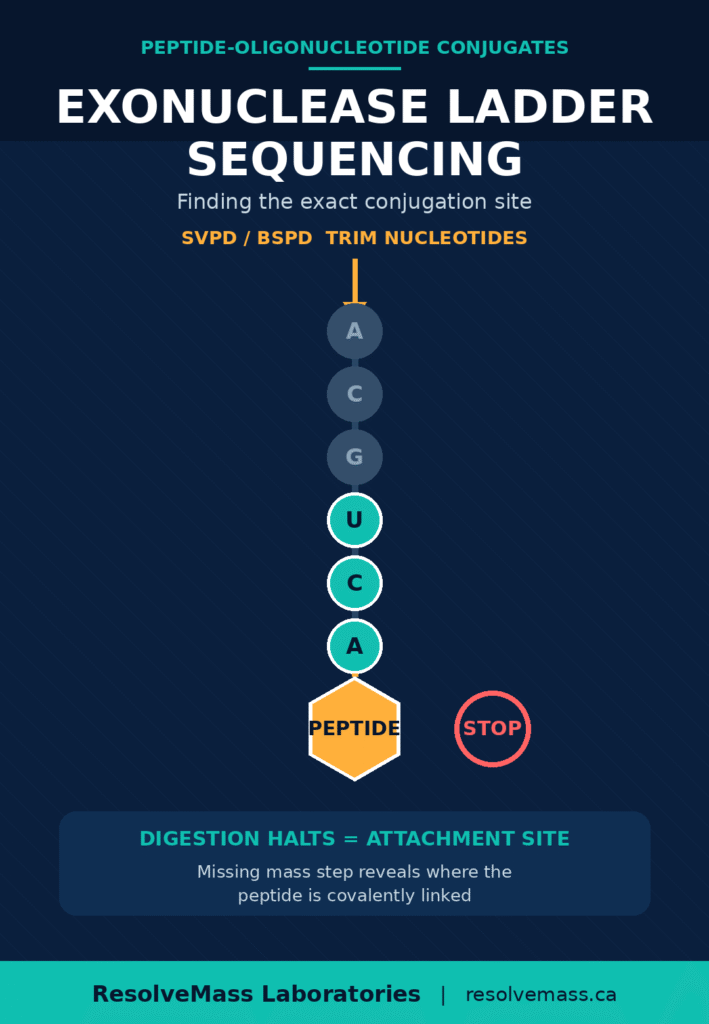
Exonuclease ladder sequencing employs 3′-exonucleases, such as Snake Venom Phosphodiesterase, and 5′-exonucleases, such as Bovine Spleen Phosphodiesterase, to sequentially remove nucleotides from terminal ends. This process generates a series of intermediates with predictable mass differences that directly reveal the nucleotide sequence of the oligonucleotide domain.
Time-dependent monitoring of exonucleolytic degradation using LC-MS/MS provides robust verification of oligonucleotide sequence integrity. Snake Venom Phosphodiesterase (SVPD) progressively hydrolyzes phosphodiester bonds from the 3′-terminus, generating a series of truncated intermediates. In contrast, Bovine Spleen Phosphodiesterase (BSPD) degrades nucleic acid strands from the 5′-terminus. The mass difference between adjacent ladder fragments corresponds directly to the removed nucleoside monophosphate (A = 313.05 Da, C = 289.05 Da, G = 329.05 Da, U = 290.03 Da, T = 304.05 Da). When the enzymatic digestion process reaches the covalent peptide attachment site, steric constraints or localized chemical modifications frequently inhibit further exonuclease activity. This characteristic digestion arrest provides direct evidence for the specific nucleotide involved in peptide conjugation.
Targeted Proteolytic and Endonucleolytic Processing
Proteolytic enzymes such as trypsin, endoproteinase Lys-C, and Glu-C selectively hydrolyze peptide backbones at defined basic or acidic amino acid residues, generating smaller peptide-linker-nucleotide fragments that are more amenable to detailed characterization. At the same time, non-specific or sequence-specific endonucleases, including DNase I and RNase A/T1, shorten the oligonucleotide component, thereby reducing the extensive phosphodiester-associated charge burden that can complicate electrospray ionization and subsequent mass spectrometric analysis.
The use of dual-enzyme digestion strategies significantly reduces spectral complexity in heteroconjugate analyses. For example, treatment of a cell-penetrating peptide-ASO conjugate with trypsin selectively cleaves lysine- and arginine-containing regions within the CPP segment, producing smaller peptide fragments. Subsequent digestion with a nuclease or phosphodiesterase further trims the oligonucleotide portion to a short mononucleotide or dinucleotide segment that remains attached to the residual peptide linker. MS/MS analysis of this simplified core structure enables precise determination of both the conjugation site and linker chemistry while minimizing interference from intact peptide and nucleic acid backbones.
Uncover techniques for thorough architectural analysis of complex heteroconjugates: Read About Structural Characterization of Peptide-Oligonucleotide Conjugates
| Enzyme Class | Specific Enzyme | Target Cleavage Site | Primary Analytical Application in POC Analysis |
|---|---|---|---|
| 3′-Exonuclease | Snake Venom Phosphodiesterase (SVPD) | 3′-terminal phosphodiester bonds | 3′-to-5′ nucleoside ladder sequencing and conjugation site localization |
| 5′-Exonuclease | Bovine Spleen Phosphodiesterase (BSPD) | 5′-terminal phosphodiester bonds | 5′-to-3′ nucleoside ladder sequencing and verification of 5′-terminal conjugation |
| Serine Protease | Trypsin / Endoproteinase Lys-C | C-terminal to lysine and arginine residues | Generation of shorter peptide fragments from basic CPP sequences |
| Endonuclease | DNase I / RNase T1 | Internal phosphodiester bonds | Structural footprinting and reduction of oligonucleotide mass complexity |
| Phosphatase | Alkaline Phosphatase | Terminal 5’/3′ phosphate groups | Removal of terminal phosphate groups that contribute to charge heterogeneity before MS analysis |
Swipe horizontally to view the full table on smaller screens.
High-Resolution LC-MS/MS Workflow Integration and Data Processing
High-resolution LC-MS/MS workflows combine ion-pairing reversed-phase chromatography (IP-RP-LC) or hydrophilic interaction liquid chromatography (HILIC) with High-Resolution Accurate Mass (HRAM) mass spectrometers to effectively separate intact, partially digested, and fragmented heteroconjugates. Advanced informatics platforms further enhance characterization by incorporating mass defect filtering, custom sequence databases, and specialized search algorithms capable of identifying precursor and product ions originating from both molecular domains.
Successful chromatographic separation of peptide-oligonucleotide conjugates requires mobile phase conditions that accommodate the contrasting physicochemical properties of peptides and nucleic acids. Ion-pairing reversed-phase chromatography (IP-RP-LC) employs volatile alkylamine reagents such as triethylammonium acetate (TEAA) or combinations of triethylamine and hexafluoroisopropanol (TEA/HFIP). These reagents temporarily associate with negatively charged phosphodiester groups, enhancing retention on hydrophobic C18 stationary phases. Alternatively, hydrophilic interaction liquid chromatography (HILIC) enables retention of highly polar conjugates without requiring ion-pairing reagents, thereby facilitating efficient direct electrospray ionization. Online desalting systems are commonly incorporated to remove residual non-volatile salts originating from enzymatic digestion buffers, reducing alkali metal adduct formation and improving spectral quality during ESI-MS analysis.
Data analysis platforms used for peptide-oligonucleotide conjugates must be capable of processing fragmentation nomenclature associated with both peptides and nucleic acids. Customized software workflows typically incorporate:
- Peptide fragment ion series (a, b, c, x, y, z•), including internal fragment ions and neutral loss products.
- Oligonucleotide fragment ion series (a, a-B, b, c, d from the 5′-terminus and w, x, y, z from the 3′-terminus).
- Variable mass modifications associated with cross-linking chemistries, phosphorothioate stereochemical mixtures, 2′-O-methyl substitutions, 2′-fluoro modifications, and Locked Nucleic Acid (LNA) residues.
Application of stringent high-mass-accuracy filtering criteria (<5 ppm) together with detailed isotopic pattern analysis enables reliable charge-state determination and significantly reduces the likelihood of false-positive sequence assignments.
Bioanalytical Execution and Quality Control for Heteroconjugates
Reliable bioanalytical characterization of peptide-oligonucleotide conjugates requires rigorous quality control procedures, automated sample preparation systems, and thoroughly validated LC-MS/MS methods. Leading analytical laboratories implement standardized fragmentation workflows, digestion monitoring strategies, and comprehensive quality systems to ensure accurate characterization while supporting regulatory expectations and submission requirements.
At ResolveMass Laboratories Inc., advanced bioanalytical platforms integrate orthogonal fragmentation approaches—including EThcD, HCD, and ETD—with automated digestion robotics to characterize a broad range of conjugate architectures, including cell-penetrating peptide-ASO conjugates, GalNAc-siRNA analogs, and peptide-PNA chimera constructs. Analytical methodologies are validated within robust quality control frameworks designed to support regulatory submissions to agencies such as the FDA, EMA, and Health Canada. Through the integration of high-resolution FT-Orbitrap instrumentation and sophisticated data-processing pipelines, ResolveMass Laboratories Inc. successfully resolves complex heteroconjugate fragmentation patterns and supports structural characterization from early-stage research through commercial manufacturing and batch release testing.
Discover testing protocols for identity, purity, and strength confirmation: Learn More About QC Testing for Peptide-Oligonucleotide Conjugates
Conclusion
Implementation of comprehensive Peptide-Oligonucleotide Conjugate Sequence Confirmation Strategies ensures accurate primary sequence determination, precise linkage verification, and reliable purity assessment for emerging biopharmaceutical conjugates. The combination of targeted enzymatic digestion approaches with complementary MS/MS fragmentation techniques—including HCD, ETD, and EThcD—provides the detailed structural evidence required for drug development, regulatory review, and product approval.
By integrating collision-based fragmentation methods such as HCD and CID for oligonucleotide sequence characterization with electron-based dissociation approaches including ETD and ECD for peptide sequencing, modern bioanalytical workflows achieve comprehensive dual-domain sequence verification. The addition of exonuclease ladder sequencing and selective proteolytic digestion further strengthens structural characterization by enabling precise localization of conjugation sites, confirmation of primary structure, and detection of sequence-related impurities. Adoption of robust Peptide-Oligonucleotide Conjugate Sequence Confirmation Strategies plays a critical role in ensuring the quality, safety, and manufacturing consistency required to advance therapeutic heteroconjugates throughout clinical development and into commercial production.
Support early-stage therapeutic development with comprehensive analytical assays: Explore Preclinical Services for Peptide-Oligonucleotide Conjugates
For specialized biopharmaceutical characterization, mass spectrometry testing, and analytical consultation, visit the ResolveMass Laboratories Contact Page
Frequently Asked Questions
How does Electron-Transfer Dissociation (ETD) improve heteroconjugate sequence confirmation when used alongside CID?
Electron-Transfer Dissociation (ETD) complements CID by targeting the peptide backbone rather than the oligonucleotide chain. Through electron-driven fragmentation, ETD generates peptide-specific c and z• ions while preserving sensitive linker chemistries and nucleic acid structures. When combined with CID data, researchers can obtain a more complete structural picture of both domains within the conjugate.
Why is EThcD highly beneficial for analyzing arginine-rich cell-penetrating peptide conjugates?
Arginine-rich cell-penetrating peptides often form strong electrostatic interactions with negatively charged oligonucleotide backbones. These interactions can prevent fragmented ions from separating efficiently during mass spectrometric analysis. EThcD addresses this issue by combining electron-transfer fragmentation with supplemental collisional activation, helping release informative fragments from both molecular components and improving sequence coverage.
What is exonuclease ladder sequencing, and how does it verify oligonucleotide sequences within conjugates?
Exonuclease ladder sequencing is a technique that progressively removes nucleotides from either the 3′- or 5′-end of an oligonucleotide strand using exonuclease enzymes. As digestion proceeds, LC-MS analysis tracks the mass differences between sequential intermediates. These predictable mass shifts correspond to individual nucleotides, allowing accurate reconstruction and confirmation of the oligonucleotide sequence.
How do mass defect characteristics help interpret peptide-oligonucleotide LC-MS/MS data?
Peptides and oligonucleotides possess distinct mass defect patterns because of differences in their elemental composition. Peptides generally display positive mass defects, whereas oligonucleotides often exhibit negative mass defects due to their phosphorus- and oxygen-rich structures. High-resolution mass spectrometers can leverage these differences to distinguish overlapping ion populations and improve confidence in fragment identification.
What function do proteolytic enzymes such as trypsin and Lys-C serve in conjugate characterization?
Proteolytic enzymes such as trypsin and Lys-C selectively cleave peptide chains at specific amino acid residues, producing smaller and more manageable fragments. This reduction in molecular size simplifies mass spectra and decreases structural complexity. As a result, the resulting peptide-linker-nucleotide fragments can be analyzed more efficiently, enabling precise sequence and linkage characterization.
Can mass spectrometry determine the exact covalent attachment site in click-chemistry conjugates?
Yes, advanced mass spectrometry techniques can accurately identify the location of covalent attachment in click-chemistry-derived conjugates. Fragmentation approaches such as ETD and EThcD preserve stable linker structures while generating informative sequence ions. By examining the resulting fragmentation patterns, analysts can pinpoint the specific amino acid and nucleotide residues involved in the conjugation process.
Why is ion-pairing reversed-phase liquid chromatography (IP-RP-LC) commonly used before ESI-MS analysis?
Ion-pairing reversed-phase liquid chromatography improves the chromatographic behavior of oligonucleotide-containing conjugates before mass spectrometric detection. Ion-pairing agents such as TEAA or TEA/HFIP temporarily associate with negatively charged phosphate groups, enhancing retention on reversed-phase columns. This approach improves separation efficiency and produces cleaner, more reproducible ESI-MS data.
How do phosphorothioate backbone modifications influence enzymatic digestion workflows?
Phosphorothioate modifications alter the chemical properties of the oligonucleotide backbone by replacing a non-bridging oxygen atom with sulfur. This modification often increases resistance to exonuclease activity and can significantly slow enzymatic digestion rates. Consequently, analytical workflows may require adjusted digestion conditions, longer incubation periods, or alternative enzymatic strategies to achieve effective sequence characterization.
How are bioinformatics search tools adapted for peptide-oligonucleotide conjugate identification?
Conventional proteomics search engines are typically customized to accommodate the unique fragmentation patterns generated by peptide-oligonucleotide conjugates. These adaptations include support for peptide and oligonucleotide ion series, synthetic linker masses, modified nucleotides, and cross-linked residues. Such specialized configurations enable automated interpretation of complex MS/MS datasets and improve identification accuracy for heteroconjugates.
Reference:
- Malinowska, A. L., Huynh, H. L., & Bose, S. (2024). Peptide–oligonucleotide conjugation: Chemistry and therapeutic applications. Current Issues in Molecular Biology, 46(10), 11031–11047. https://doi.org/10.3390/cimb46100655
- Klabenkova, K., Fokina, A., & Stetsenko, D. (2021). Chemistry of peptide-oligonucleotide conjugates: A review. Molecules, 26(17), 5420. https://doi.org/10.3390/molecules26175420
- Gao, L., Zhang, L., Cho, B. P., & Chiarelli, M. P. (2008). Sequence verification of oligonucleotides containing multiple arylamine modifications by enzymatic digestion and liquid chromatography mass spectrometry (LC/MS). Journal of the American Society for Mass Spectrometry, 19(8), 1147–1155. https://doi.org/10.1016/j.jasms.2008.04.034
- Wityk, P., Piątek, R., Nowak, R., & Kostrzewa-Nowak, D. (2020). Generation and characterization of a DNA-GCN4 oligonucleotide-peptide conjugate: The impact DNA/protein interactions on the sensitization of DNA. Molecules, 25(16), 3630. https://doi.org/10.3390/molecules25163630
- Wu, H., Chan, C., & Aboleneen, H. (1998). Sequencing regular and labeled oligonucleotides using enzymatic digestion and ionspray mass spectrometry. Analytical Biochemistry, 263(2), 129–138. https://doi.org/10.1006/abio.1998.2812
- Shen, Y., Tolić, N., Purvine, S. O., & Smith, R. D. (2012). Improving CID, HCD, and ETD FT MS/MS degradome-peptidome identifications using high accuracy mass information. Journal of Proteome Research, 11(2), 668–677. https://doi.org/10.1021/pr200597j
- Williams, A., Staroseletz, Y., Zenkova, M. A., Jeannin, L., Aojula, H., & Bichenkova, E. V. (2015). Peptidyl-oligonucleotide conjugates demonstrate efficient cleavage of RNA in a sequence-specific manner. Bioconjugate Chemistry, 26(6), 1129–1143. https://doi.org/10.1021/acs.bioconjchem.5b00193
Need Reliable Sequence Confirmation for Peptide–Oligonucleotide Conjugates?
Contact ResolveMass today to discuss your POC sequence confirmation challenges and learn how our LC-MS/MS, HRMS, and enzymatic mapping expertise can support your research, development, and quality control programs.
Contact usAbout The Author
Anusha Sinha
Anusha Sinha, B.Pharm, is an experienced pharma professional with a strong background in Analytical Chemistry and Polymer Chemistry. With a passion for translating complex scientific data into clear, accessible content, she plays a vital role in communicating ResolveMass Laboratories Inc.’s advanced testing capabilities. In addition to her scientific expertise, Anusha leads Business Development initiatives, helping clients across pharmaceutical, biotechnology, and materials science sectors find tailored analytical solutions. Her combined experience in science and strategy positions her at the forefront of client engagement and technical communication.

