
.
.
.
Peptide CDMO Services
Peptide therapeutics continue to gain importance in areas such as obesity management, diabetes, oncology, endocrinology, and rare diseases. However, peptide molecules present unique development challenges, including complex impurity profiles, degradation pathways, formulation stability concerns, and stringent regulatory requirements.
ResolveMass Laboratories Inc. offers specialized Peptide CDMO Services focused on analytical characterization, quality assessment, method development, stability testing, and regulatory support. Our team leverages advanced mass spectrometry, chromatography, and pharmaceutical analytical expertise to help clients generate the scientific data required for successful development and submission programs.
Learn how peptides differ from traditional small-molecule drugs: Difference Between a Peptide and a Small Molecule Drug
Share via:
Our Peptide CDMO Services
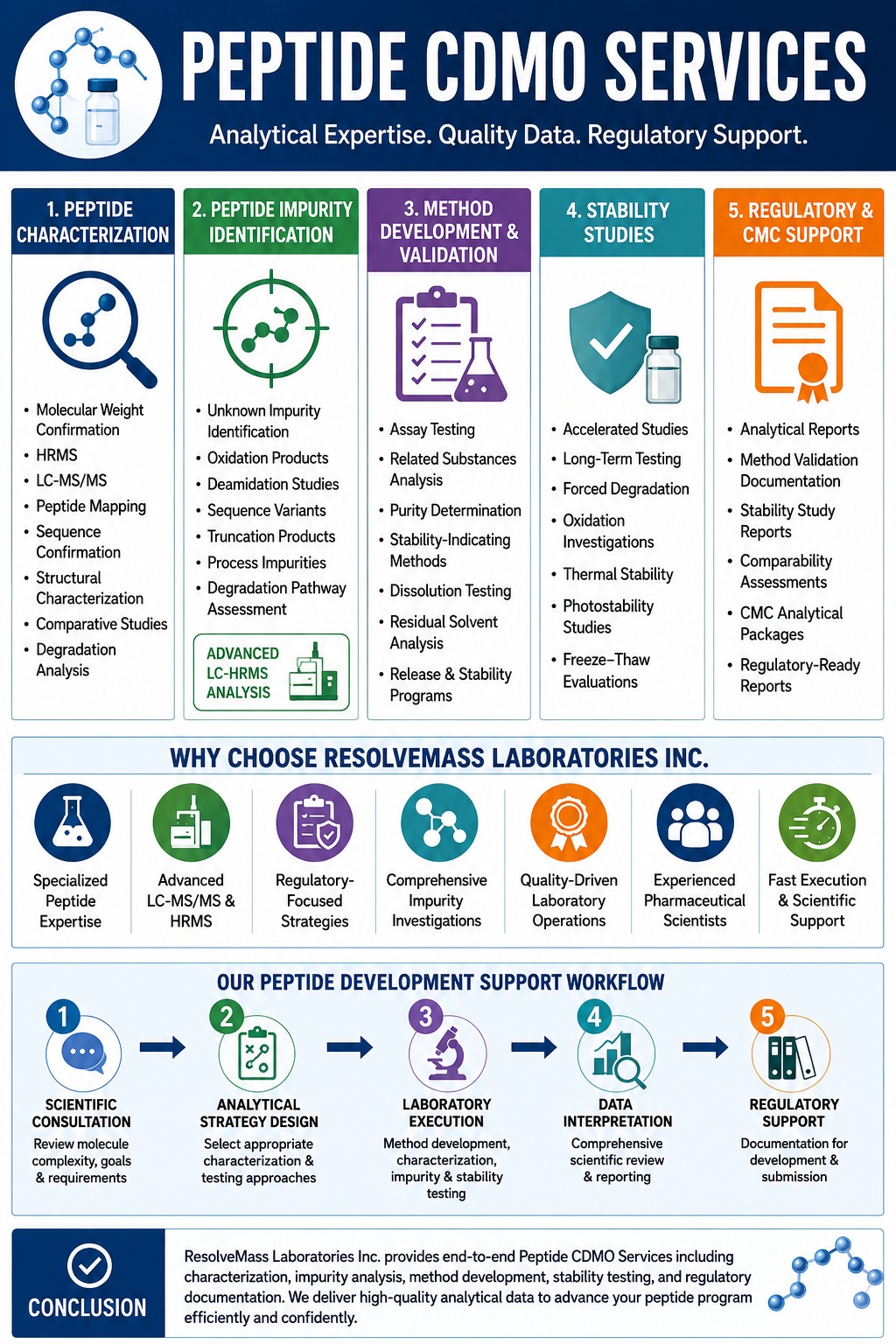
Peptide Characterization
Comprehensive characterization is essential for understanding peptide identity, purity, structure, and critical quality attributes.
Our capabilities include:
- Molecular weight confirmation
- High-resolution mass spectrometry (HRMS)
- LC-MS/MS analysis
- Peptide mapping
- Sequence confirmation
- Structural characterization
- Comparative characterization studies
- Degradation product analysis
See how we perform full analytical characterization for GLP-1 peptides: GLP-1 Peptide Analytical Characterization
Peptide Impurity Identification
Regulatory agencies expect detailed knowledge of peptide-related impurities and degradation products.
We support:
- Unknown impurity identification
- Oxidation product analysis
- Deamidation studies
- Sequence variant characterization
- Truncation product identification
- Process impurity investigations
- Degradation pathway assessment
Advanced LC-HRMS workflows help identify and characterize impurities that may impact product quality and stability.
Method Development and Validation
Reliable analytical methods are critical for development, quality control, and regulatory compliance.
Our scientists develop and validate methods for:
- Assay testing
- Related substances analysis
- Purity determination
- Stability-indicating methods
- Dissolution testing
- Residual solvent analysis
- Release and stability testing programs
Read our detailed case study on analytical characterization: Peptide Characterization Case Study of Semaglutide
Stability Studies
Peptides are highly sensitive to environmental and formulation conditions.
ResolveMass supports:
- Accelerated stability studies
- Long-term stability testing
- Forced degradation studies
- Oxidation investigations
- Thermal stability assessments
- Photostability studies
- Freeze-thaw evaluations
These studies provide valuable insights into product shelf-life and formulation performance.
Learn about formulation strategies for stable peptide injectables: Formulating a Lyophilized Peptide Injectable
Regulatory and CMC Support
Scientific documentation plays a critical role in regulatory submissions.
Our team supports peptide programs through:
- Analytical characterization reports
- Method validation documentation
- Stability study reports
- Comparability assessments
- CMC analytical support packages
- Regulatory-ready scientific reports
Why Choose ResolveMass Laboratories Inc.
ResolveMass Laboratories Inc. combines advanced analytical technologies with experienced scientific expertise to support complex peptide development programs.
Our advantages include:
- Specialized peptide analytical expertise
- Advanced LC-MS/MS and HRMS capabilities
- Regulatory-focused testing strategies
- Comprehensive impurity investigations
- Quality-driven laboratory operations
- Experienced pharmaceutical scientists
- Fast project execution and scientific support
We help clients generate reliable analytical data that supports development decisions, quality assessments, and regulatory submissions.
Key criteria to evaluate when selecting a peptide manufacturing and development partner: How to Choose a Peptide CDMO in the US
Our Peptide Development Support Workflow
1. Scientific Consultation
Review of molecule complexity, development goals, and analytical requirements.
2. Analytical Strategy Design
Selection of appropriate characterization and testing approaches.
3. Laboratory Execution
Method development, characterization, impurity analysis, and stability testing.
4. Data Interpretation
Comprehensive scientific review and reporting of results.
5. Regulatory Support
Generation of documentation suitable for development and submission activities.
Understanding scale-up considerations for peptide APIs: Peptide API Scale-Up
Conclusion
Successful peptide development requires extensive analytical expertise, advanced instrumentation, and a strong understanding of regulatory expectations. ResolveMass Laboratories Inc. provides specialized Peptide CDMO Services that support peptide characterization, impurity analysis, method development, stability studies, and regulatory documentation.
Whether you are developing a novel peptide therapeutic, a generic peptide product, or a complex formulation, our scientific team can help generate the high-quality analytical data needed to advance your program efficiently and confidently.
Ready to discuss your peptide project?
Contact ResolveMass Laboratories Inc.:
Frequently Asked Questions
Peptide synthesis and storage can generate impurities that may affect product quality, performance, or stability. Identifying and characterizing these impurities allows developers to understand their origin and assess potential risks. Comprehensive impurity investigations also support regulatory expectations and help establish appropriate control strategies during development.
Mass spectrometry is a powerful analytical tool used to evaluate peptide structure, composition, and purity. It can confirm molecular weight, detect sequence variations, identify degradation products, and characterize unknown impurities. The detailed information generated through mass spectrometry helps scientists make informed decisions throughout the development lifecycle.
Stability-indicating methods are analytical procedures designed to accurately measure a peptide product while distinguishing it from its degradation products. These methods help monitor quality changes during storage and stability studies. Reliable stability-indicating methods are essential for determining shelf life and demonstrating product consistency over time.
Peptide development often involves challenges related to chemical instability, impurity formation, aggregation, and complex analytical characterization. Certain peptides may also be sensitive to temperature, oxidation, or formulation conditions. Addressing these challenges early through comprehensive analytical studies can reduce development risks and improve program success.
A peptide characterization package typically contains detailed information about molecular identity, purity, sequence confirmation, impurity profiles, and stability characteristics. It may also include analytical method summaries, mass spectrometry data, chromatographic results, and degradation assessments. This information provides a comprehensive understanding of the peptide’s critical quality attributes.
Stability studies evaluate how a peptide product maintains its quality, purity, and performance throughout its intended storage period. These studies help identify degradation trends and establish suitable storage conditions. The generated data are critical for shelf-life determination and regulatory submissions.
Experienced peptide CDMO partners provide scientific expertise, advanced analytical capabilities, and regulatory-focused support that can help reduce development timelines. Early identification of quality concerns, robust analytical strategies, and comprehensive characterization data allow sponsors to make faster and more informed development decisions. This can improve efficiency while minimizing costly delays during later stages of development.
Reference:
- Li, Y., Zhang, X., Wang, H., Chen, J., Liu, Z., & Zhao, W. (2025). Advances in peptide therapeutics: Current trends, challenges, and future perspectives. Pharmaceutics, 17(6), 845. https://doi.org/10.3390/pharmaceutics17060845
- Kekessie, I., Wegner, K., Martinez, I., Kopach, M. E., White, T. D., Tom, J. K., Kenworthy, M. N., Gallou, F., Lopez, J., Koenig, S. G., Payne, P. R., Eissler, S., Arumugam, B., Li, C., Mukherjee, S., Isidro-Llobet, A., Ludemann-Hombourger, O., Richardson, P., Kittelmann, J., Pedersen, D. S., & van den Bos, L. J. (2024). Process mass intensity (PMI): A holistic analysis of current peptide manufacturing processes informs sustainability in peptide synthesis. Journal of Organic Chemistry, 89(7), 4261–4282. https://doi.org/10.1021/acs.joc.3c01494
- Yuan, S., Kaur, B., Fuchs, N. S., Cho, S., Abdo, A. N., & Gabr, M. T. (2026). Peptides as programmable molecular scaffolds: From chemical synthesis and engineering to translational medicine. RSC Chemical Biology. Advance online publication. https://doi.org/10.1039/D6CB00117C