

What Is the Difference Between a Peptide and a Small-Molecule Drug in Manufacturing?
 By Anusha Sinha
•
August 6, 2026
By Anusha Sinha
•
August 6, 2026
Introduction
The Difference Between a Peptide and a Small-Molecule Drug in manufacturing is fundamentally defined by the shift from conventional, highly scalable solution-phase chemistry to the intricate, iterative processes required for Solid-Phase Peptide Synthesis (SPPS) and specialized downstream purification. For more than a century, pharmaceutical manufacturing has perfected the large-scale production of low-molecular-weight chemical entities through predictable thermodynamic behavior, convergent synthetic routes, and relatively simple isolation techniques such as crystallization. The growing prominence of peptide therapeutics—positioned between traditional small-molecule drugs and complex recombinant biologics in both structure and function—has introduced a new set of manufacturing challenges and opportunities, requiring a substantial evolution in Chemistry, Manufacturing, and Controls (CMC) strategies.
Peptides present unique biochemical and physicochemical complexities that necessitate specialized analytical monitoring, stringent control of Process Mass Intensity (PMI), and sophisticated lyophilization processes to preserve molecular stability and structural integrity. In addition, the expiration of patents covering early blockbuster peptide therapies has created new opportunities for generic development, while simultaneously increasing regulatory complexity. Demonstrating molecular equivalence for generic peptide Abbreviated New Drug Applications (ANDAs) is significantly more challenging than for traditional small-molecule products. Such demonstrations often require advanced orthogonal analytical techniques, including High-Resolution Mass Spectrometry (HRMS) and Circular Dichroism (CD) spectroscopy, to establish structural and functional similarity.
This detailed technical report examines the scientific, engineering, and operational distinctions that separate peptide therapeutics from small-molecule drugs. It also highlights how modern pharmaceutical organizations and specialized analytical laboratories operating under stringent Health Canada and FDA Good Manufacturing Practice (GMP) requirements support the transition of innovative therapies from research and development to successful commercial manufacturing.
Explore comprehensive outsourcing strategies and industry standards in our Peptide CDMO Services.
Need Expert Support for Peptide or Small-Molecule Drug Development? Our team helps pharmaceutical and biotechnology companies generate the high-quality data needed to accelerate development, ensure product quality, and support global regulatory submissions. Contact us today to discuss your project requirements and discover how our scientific expertise can support your development program. Contact us
Article Summary Key Takeaways
- Peptide and small-molecule drugs use fundamentally different manufacturing approaches. Small molecules are produced through convergent solution-phase synthesis and crystallization, while peptides require sequential Solid-Phase Peptide Synthesis (SPPS), followed by chromatographic purification and lyophilization.
- Peptide manufacturing is more complex and difficult to scale. Linear synthesis, sequence-dependent aggregation, resin stability, and impurity formation increase production challenges as peptide length and manufacturing scale grow.
- Purification and final product isolation differ significantly. Small molecules are typically purified by crystallization and dried using conventional methods, whereas peptides rely on preparative RP-HPLC and freeze-drying (lyophilization) to maintain stability.
- Peptide production has a much higher environmental impact. Traditional SPPS generates substantially higher Process Mass Intensity (PMI) due to extensive solvent use, prompting the adoption of greener technologies such as aqueous SPPS, rotating bed reactors, and ultrasound-assisted synthesis.
- Regulatory requirements for generic peptides are considerably more stringent. Unlike standard ANDA bioequivalence for small molecules, generic peptides require comprehensive FDA sameness studies with strict impurity limits (≤0.1%) and extensive structural characterization.
- Advanced analytical techniques are essential for peptide characterization. Manufacturers use HRMS, LC-MS/MS, qNMR, Circular Dichroism (CD), and SEC-MALS to verify sequence, higher-order structure, aggregation, and equivalence to reference products.
- Successful peptide manufacturing requires specialized expertise and infrastructure. From SPPS and large-scale purification to advanced analytical testing and GMP compliance, peptide therapeutics demand significantly more sophisticated manufacturing and quality control than conventional small-molecule drugs.
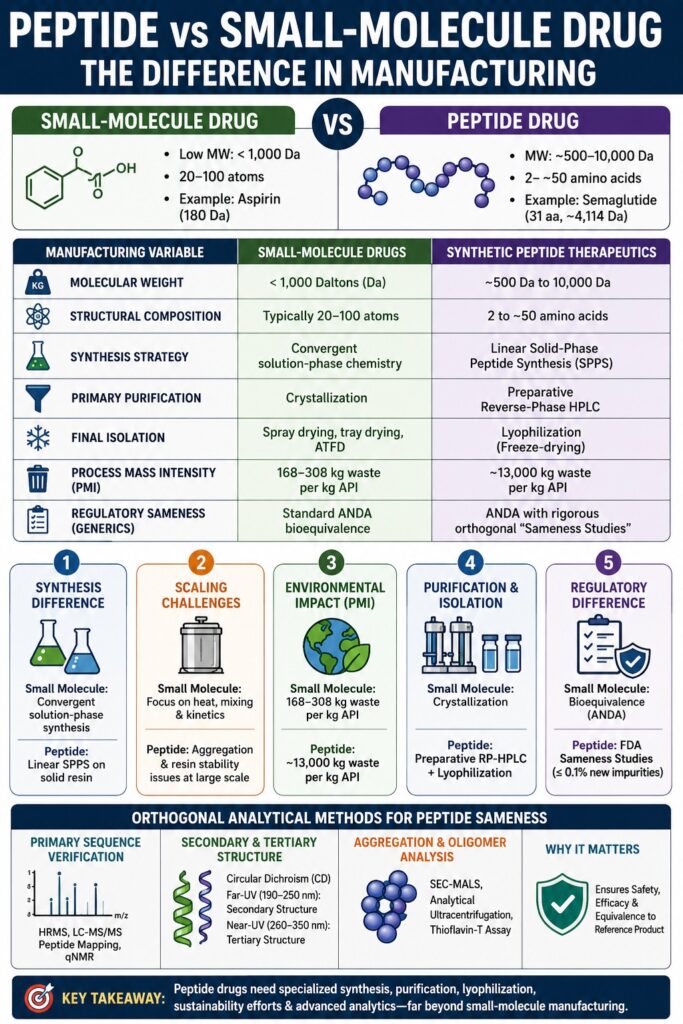
The Core Difference Between a Peptide and a Small-Molecule Drug in Manufacturing
The primary difference between a peptide and a small-molecule drug in manufacturing is governed by molecular size and synthetic design. Small molecules are generally produced through highly convergent solution-phase chemical processes and are commonly purified through crystallization. Peptides, in contrast, require sequential chain assembly on solid supports, followed by solvent-intensive chromatographic purification and lyophilization.
These fundamental differences influence manufacturing infrastructure, regulatory requirements, scalability strategies, and overall production economics.
Small-molecule pharmaceuticals are typically defined as compounds with molecular weights below 1,000 Daltons (Da), often containing between 20 and 100 atoms. Common examples include aspirin (180 Da) and metformin. Their manufacturing relies heavily on Classical Solution-Phase Synthesis (CSPS), which is characterized by convergent synthetic pathways. In convergent synthesis, several molecular fragments are produced independently in separate reaction vessels and subsequently joined during a final coupling stage. This approach maximizes atom efficiency and enables seamless scale-up from laboratory settings to commercial reactors exceeding 5,000 liters while maintaining high yields, consistent purity, and favorable Cost of Goods Sold (COGS).
Peptides are considerably larger and structurally more complex, generally ranging from approximately 500 Da to 10,000 Da and consisting of short chains of 2 to roughly 50 amino acids connected through amide (peptide) bonds. For example, semaglutide is composed of 31 amino acids and possesses a molecular weight of approximately 4,114 Da. Unlike small molecules, peptides are commonly synthesized through a strictly linear process. In SPPS, the first amino acid is covalently attached to an insoluble polymeric resin bead. Additional amino acids are then incorporated sequentially, one residue at a time.
Because peptide assembly is linear rather than convergent, inefficiencies occurring during any coupling step accumulate throughout the synthesis. For example, if a 40-amino-acid peptide experiences a coupling efficiency of 99% at each stage, the overall yield of the correctly assembled product decreases significantly as the sequence progresses. At the same time, closely related deletion sequences and other structurally similar impurities accumulate within the reaction mixture, increasing purification complexity and reducing manufacturing efficiency.
Learn more about selecting the ideal partner by reviewing the Best Peptide CDMO criteria.
| Manufacturing Variable | Small-Molecule Drugs | Synthetic Peptide Therapeutics |
|---|---|---|
| Molecular Weight | < 1,000 Daltons (Da) | ~500 Da to 10,000 Da |
| Structural Composition | Typically 20–100 atoms | 2 to ~50 amino acids |
| Synthesis Strategy | Convergent solution-phase chemistry | Linear Solid-Phase Peptide Synthesis (SPPS) |
| Primary Purification | Crystallization | Preparative Reverse-Phase HPLC |
| Final Isolation | Spray drying, tray drying, ATFD | Lyophilization (Freeze-drying) |
| Process Mass Intensity (PMI) | 168–308 kg waste per kg API | ~13,000 kg waste per kg API |
| Regulatory Sameness (Generics) | Standard ANDA bioequivalence | ANDA with rigorous orthogonal “Sameness Studies” |
Swipe horizontally to view the full table on smaller screens.
Synthesis Methodologies Shaping the Difference Between a Peptide and a Small-Molecule Drug
The synthetic methodology underlying the difference between a peptide and a small-molecule drug is largely defined by the use of solid supports in peptide manufacturing, which enable rapid removal of excess reagents through washing and filtration. This contrasts sharply with the solution-based isolation and purification approaches traditionally used for small molecules.
Small-molecule synthesis benefits from the ability to isolate intermediates through conventional liquid-liquid extraction, precipitation, or crystallization techniques before progressing to subsequent reaction steps. Although Classical Solution-Phase Peptide Synthesis (CSPS) attempts to apply similar principles to peptide assembly, the approach becomes increasingly impractical as peptide chains lengthen. Longer peptides often exhibit reduced solubility, while repeated purification by column chromatography becomes labor-intensive, time-consuming, and economically unfavorable.
To overcome these limitations, the pharmaceutical industry broadly adopted SPPS, originally developed by Robert Merrifield in 1963. In this methodology, the C-terminal amino acid is anchored to a solid resin support while the N-terminus is protected using fluorenylmethyloxycarbonyl (Fmoc) chemistry. During synthesis, reagents and solvents pass through the resin bed to remove protecting groups and facilitate coupling with activated amino acids. Since the growing peptide chain remains attached to the resin throughout the process, reactions can be driven toward completion using substantial excesses of reagents, after which residual materials and byproducts are easily removed through filtration and washing.
Modern peptide manufacturing increasingly integrates the advantages of both solid-phase and solution-phase chemistry. To address the declining yields associated with linear SPPS for peptides exceeding approximately 30 amino acids, manufacturers frequently employ hybrid fragment condensation strategies. In this approach, shorter peptide segments—such as 10-mer fragments—are synthesized individually through SPPS, cleaved from the resin, and subsequently joined in solution using Liquid-Phase Peptide Synthesis (LPPS) or enzymatic ligation technologies. This sophisticated manufacturing strategy is currently utilized for the large-scale commercial production of complex peptide therapeutics, including the GLP-1 receptor agonist tirzepatide.
Discover advanced structural analysis methods via Peptide Analytical Characterization Services.
Scaling Challenges: From Milligrams to Multi-Kilogram Commercial Production
One of the most significant differences in scale-up engineering between peptides and small molecules is that small-molecule manufacturing primarily focuses on optimizing heat transfer, mixing efficiency, and process kinetics, whereas peptide manufacturing must address sequence-dependent aggregation phenomena and resin stability challenges that emerge at larger scales.
Scaling a small-molecule Active Pharmaceutical Ingredient (API) from laboratory development to commercial manufacturing generally involves refining reaction chemistry, controlling stereochemistry, optimizing late-stage functionalization, and establishing reproducible crystallization behavior in compliance with ICH Q7 Good Manufacturing Practice requirements. Once the synthetic route is finalized, increasing production volume largely becomes an engineering exercise centered on thermodynamics and fluid mechanics.
Peptide manufacturing presents a far more complex set of scale-up challenges. As peptide chains extend beyond approximately 15 to 20 amino acid residues, the molecules increasingly tend to fold and interact through intra- and intermolecular hydrogen bonding. These interactions often promote the formation of highly ordered beta-sheet structures. When aggregation occurs, the reactive N-terminus may become physically inaccessible to incoming activated amino acids, slowing or completely halting coupling reactions. The result is increased formation of deletion sequences and other synthesis-related impurities.
In addition, large-scale SPPS introduces considerable mechanical stress. Commercial peptide production commonly occurs within custom-designed, jacketed solid-phase reactors ranging from approximately 300 to 5,000 liters. These systems incorporate specialized retention barriers, such as polypropylene mesh screens, to prevent resin loss during processing. Because polymeric resins undergo substantial swelling when exposed to organic solvents, they become highly susceptible to mechanical damage. Under the combined influence of hydrostatic pressure, agitation forces, and large batch volumes, resin particles may fracture or degrade. Such damage can result in filter blockage, uneven solvent distribution, reduced reaction efficiency, and, in severe cases, complete batch failure.
Evaluate strategic outsourcing paths using Peptide CDMO vs CRO.
Process Mass Intensity (PMI) and the Environmental Difference Between a Peptide and a Small-Molecule Drug
The environmental impact of pharmaceutical manufacturing further emphasizes the substantial difference between a peptide and a small-molecule drug. Traditional SPPS generates dramatically higher levels of waste per kilogram of API compared with small-molecule synthesis, primarily because of extensive solvent usage throughout repeated washing and purification operations.
Process Mass Intensity (PMI) is a key sustainability metric that quantifies the total mass of materials required to manufacture one kilogram of isolated product. Small-molecule manufacturing generally demonstrates relatively efficient PMI values, typically ranging from 168 to 308. Strong atom economy, efficient reaction pathways, and established solvent recovery systems contribute to these favorable metrics. Many solvents used in small-molecule manufacturing can be recovered and reused through conventional distillation technologies, further reducing waste generation.
In contrast, SPPS exhibits a substantially higher environmental burden, with average PMI values approaching 13,000. During peptide synthesis, the resin must be thoroughly washed following every deprotection and coupling cycle to prevent contamination and ensure reaction fidelity. Consequently, extremely large volumes of solvent are consumed throughout the manufacturing process. The most commonly used solvent, N,N-dimethylformamide (DMF), provides excellent resin swelling characteristics but is widely recognized as a hazardous and reprotoxic substance.
The purification stage contributes significantly to the overall environmental footprint of peptide production. Preparative chromatographic purification alone accounts for approximately 50% of total PMI because peptide products are often processed within highly dilute aqueous-organic solvent systems. Managing and disposing of these large solvent volumes remains a major challenge for the industry.
To improve sustainability and reduce environmental impact, Contract Research Organizations (CROs) and Contract Development and Manufacturing Organizations (CDMOs) are increasingly implementing green chemistry initiatives. Key advancements include:
- Rotating Bed Reactors (RBRs): Improving solid-to-liquid ratios and reducing solvent consumption by as much as 82%.
- Aqueous SPPS: Employing innovative water-soluble protecting groups such as Smoc and Sps, thereby eliminating the need for many hazardous polar aprotic solvents.
- Sustainable Ultrasound-Assisted SPPS (SUS-SPPS): Utilizing low-frequency ultrasound to enhance coupling efficiency in challenging peptide sequences, reducing reaction times and minimizing reagent overuse.
These innovations represent important steps toward making peptide manufacturing more sustainable while maintaining the quality, consistency, and scalability required for modern pharmaceutical production.
Review comprehensive production capabilities with Peptide Drug Development CDMO.
Purification and Isolation: Chromatography and Lyophilization vs. Crystallization
The final stages of manufacturing further emphasize the fundamental distinction between peptide therapeutics and small-molecule drugs. Small molecules can typically be purified and isolated through highly efficient crystallization processes, whereas peptides require solvent-intensive preparative chromatography followed by sophisticated freeze-drying procedures to achieve long-term stability.
Within small-molecule Chemistry, Manufacturing, and Controls (CMC) programs, crystallization functions as both a purification and isolation strategy. By precisely controlling variables such as temperature, pH, solvent composition, and anti-solvent addition, the desired molecule organizes into a highly ordered crystal lattice. During this process, impurities are naturally excluded from the crystal structure, resulting in a highly purified product. The isolated solid can then be recovered using scalable technologies such as spray drying, Agitated Thin-Film Drying (ATFD), or vacuum tray drying.
Peptides, however, cannot generally be purified through crystallization. The impurities generated during SPPS, including des-amido variants, oxidized methionine species, and deletion sequences, are often nearly identical to the target peptide in terms of structure, physicochemical properties, and molecular behavior. As a result, separation requires the exceptional resolving capability of preparative Reverse-Phase High-Performance Liquid Chromatography (RP-HPLC).
During purification, crude peptide mixtures are passed through large-scale industrial chromatography columns, which may reach diameters of up to 1,000 mm and are packed with hydrophobic stationary phases. Subtle differences in hydrophobicity allow the desired peptide to be separated from structurally related impurities. However, this process requires substantial quantities of highly purified water, acetonitrile, and buffering systems, making peptide purification considerably more resource-intensive than small-molecule purification.
The Critical Thermodynamics of Lyophilization
Following purification, peptides present an additional challenge because they are inherently unstable in aqueous environments. Exposure to water can lead to hydrolytic degradation, structural changes, and aggregation phenomena that compromise product quality and shelf life. To create a commercially viable dosage form, the highly dilute peptide solutions generated during HPLC purification must undergo lyophilization (freeze-drying) to produce a stable solid-state product.
Lyophilization is a highly sophisticated thermodynamic operation that is both time-intensive and technically demanding. The process consists of three distinct phases:
Thermal Treatment (Freezing)
The purified peptide solution, often formulated with carefully selected cryoprotectants such as saccharides or polyols and additional bulking agents, is cooled under controlled conditions to ensure complete ice nucleation and uniform freezing. Cryoprotectants play a critical role by protecting the peptide’s delicate secondary structure during the freezing and drying stages while minimizing aggregation and structural disruption.
Primary Drying (Sublimation)
Once freezing is complete, a deep vacuum is applied, typically within the range of 30 to 300 mTorr. The shelf temperature of the lyophilizer is then gradually increased. By maintaining system pressure below the triple point of water, ice is converted directly into vapor through sublimation without passing through the liquid phase. This controlled removal of frozen solvent preserves the structural integrity of the peptide matrix.
Secondary Drying (Desorption)
During the final phase, shelf temperatures are increased further while maintaining a high-vacuum environment. This step removes residual moisture molecules that remain bound within the dried matrix. The result is a highly porous and stable solid cake with improved storage stability and extended shelf life.
Although lyophilization significantly enhances peptide stability and reduces reliance on stringent cold-chain distribution requirements, it remains one of the most significant bottlenecks in peptide manufacturing. Processing a single commercial batch can require several days, making lyophilization one of the longest and most resource-intensive unit operations within the entire manufacturing workflow.
Examine localized partner benefits with Peptide CDMO in United States.
Analyzing the Difference Between a Peptide and a Small-Molecule Drug via FDA Sameness Studies
The regulatory framework governing generic development highlights another major difference between peptides and small molecules. Generic small-molecule drugs typically rely on established compendial testing and bioequivalence studies, whereas synthetic peptide products must undergo comprehensive orthogonal characterization programs designed to demonstrate structural and biological equivalence to the reference product.
When manufacturers submit an Abbreviated New Drug Application (ANDA) for a generic small-molecule drug, regulatory evaluation primarily focuses on demonstrating pharmaceutical equivalence and bioequivalence. Active pharmaceutical ingredient (API) identity and sameness are generally confirmed through routine HPLC testing, United States Pharmacopeia (USP) identity procedures, and standard physicochemical characterization techniques.
Peptides occupy a more complex regulatory position. The FDA defines peptides as alpha-amino acid polymers containing 40 or fewer amino acids and regulates them as drugs under Section 505 of the Federal Food, Drug, and Cosmetic (FD&C) Act. Molecules exceeding 40 amino acids are generally classified as biological products and require approval through a Biologics License Application (BLA) pathway.
Many therapeutic peptides currently on the market, including glucagon, liraglutide, and teriparatide, were originally manufactured using recombinant DNA (rDNA) technology in living cellular systems. When generic manufacturers produce these same peptide sequences through synthetic methods such as SPPS or LPPS, they must demonstrate that the chemically synthesized product is indistinguishable from the recombinant reference listed drug (RLD).
This requirement creates a specialized regulatory pathway centered on extensive characterization and formal “Sameness Studies.”
The 0.1% Impurity Threshold and Immunogenicity Risk
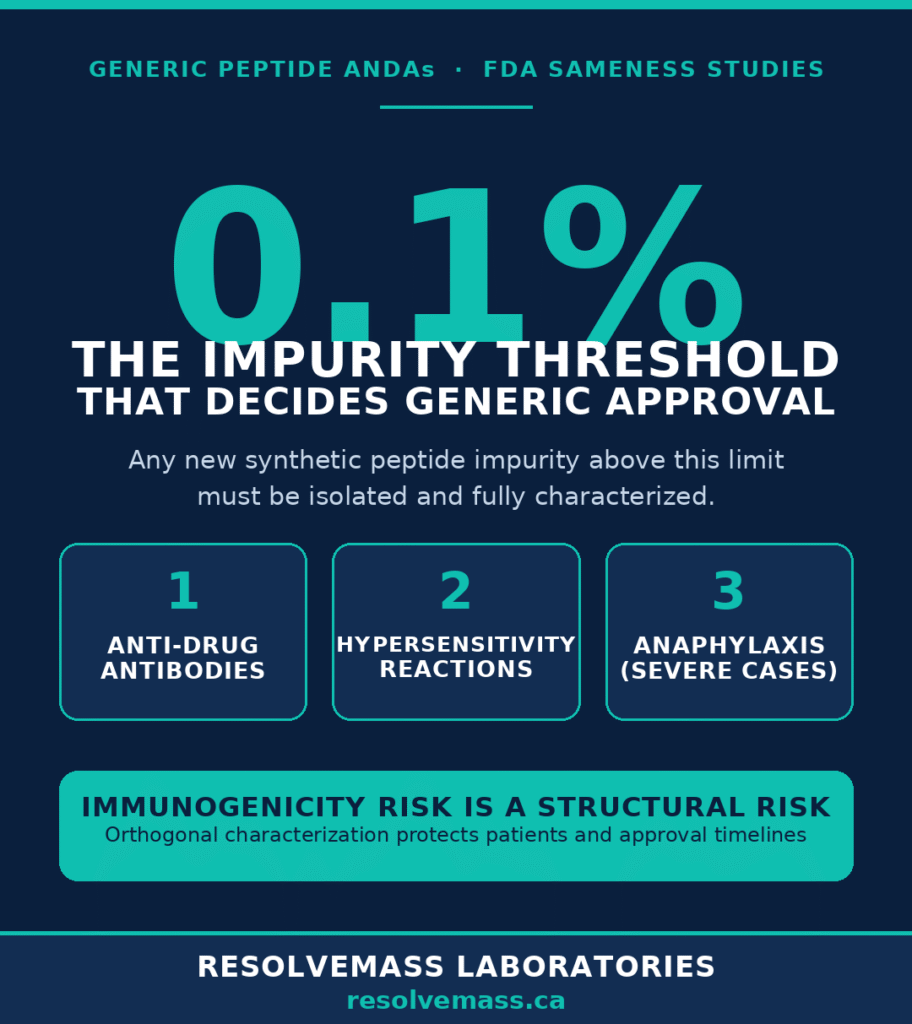
The FDA imposes exceptionally stringent impurity requirements for synthetic peptide products. When a specific impurity exists in both the generic product and the reference listed drug, the impurity level in the generic product must not exceed the level observed in the reference product. More importantly, the synthetic peptide must not contain any new peptide-related impurity at levels greater than 0.1%.
Impurities introduced during chemical synthesis—including stereochemical inversions, amino acid misincorporations, incomplete deprotection products, or residual protecting groups—can significantly influence the three-dimensional structure and biological behavior of a peptide. Even subtle structural changes may alter how the immune system recognizes the molecule.
If the immune system identifies the synthetic peptide as foreign rather than endogenous, undesirable immune responses may occur, including the generation of anti-drug antibodies, hypersensitivity reactions, or, in severe cases, anaphylaxis. Consequently, whenever a newly identified impurity exceeds the 0.1% threshold, manufacturers must isolate and characterize the impurity and provide scientific evidence demonstrating that it does not adversely affect the safety, efficacy, or immunogenicity profile of the final product.
Deploying Orthogonal Analytical Methodologies
To establish peptide sameness and satisfy regulatory expectations, manufacturers must employ a comprehensive suite of orthogonal analytical technologies capable of evaluating the peptide’s primary structure, higher-order conformation, and aggregation profile.
Primary Sequence Verification
Primary sequence confirmation is typically performed using High-Resolution Mass Spectrometry (HRMS) and LC-MS/MS peptide mapping methodologies. The peptide may be subjected to controlled acid hydrolysis, and the resulting amino acid composition is quantitatively compared with that of the reference listed drug. In addition, quantitative NMR (qNMR) is extensively utilized to verify structural identity and achieve highly accurate quantification without requiring analyte-specific reference standards.
Secondary and Tertiary Structure Assessment
Higher-order structural characterization is commonly performed using Circular Dichroism (CD) spectrophotometry. Measurements in the far-UV region (190–250 nm) provide information regarding secondary structural elements such as alpha-helices and beta-sheets. Near-UV measurements (260–350 nm) are used to evaluate tertiary structural organization and compare conformational attributes against those of the innovator product.
Oligomeric and Aggregation State Analysis
Because synthetic peptides may self-associate and form potentially harmful oligomeric species or fibrillar aggregates, comprehensive aggregation analysis is essential. Common analytical approaches include Size Exclusion Chromatography coupled with Multi-Angle Light Scattering (SEC-MALS), Analytical Ultracentrifugation, and Thioflavin-T fluorescence assays. These techniques enable detailed characterization of aggregation behavior and oligomer distribution profiles.
Successfully meeting these demanding CMC and analytical requirements requires access to advanced laboratory infrastructure and highly specialized expertise. Organizations operating under strict Good Laboratory Practice (GLP) standards while maintaining active Health Canada Drug Establishment Licences (DELs) and FDA registrations represent the forefront of modern analytical science. Through integrated capabilities encompassing LC-MS/MS, HRMS, NMR, and other advanced bioanalytical technologies, these facilities help ensure data integrity from early-stage impurity assessment through commercial GMP release testing.
Learn how to safely transition production via Outsource Peptide Manufacturing to CDMO.
Conclusion
The Difference Between a Peptide and a Small-Molecule Drug extends far beyond molecular size, defining two fundamentally distinct approaches to pharmaceutical manufacturing, environmental stewardship, and regulatory compliance. The traditional pharmaceutical industry was built upon the efficiency of small-molecule CMC, leveraging convergent solution-phase chemistry to achieve scalable production, reduced waste generation, and relatively straightforward purification through crystallization. Peptide therapeutics, in contrast, require the precision and complexity of Solid-Phase Peptide Synthesis (SPPS), introducing unique manufacturing challenges that demand specialized expertise and infrastructure.
Successful peptide manufacturing requires overcoming significant obstacles, including sequence-dependent aggregation, elevated Process Mass Intensity (PMI), and highly demanding downstream operations such as preparative RP-HPLC purification and thermodynamically controlled lyophilization. These challenges become increasingly significant as manufacturing progresses from early development to large-scale commercial production.
The regulatory environment for generic peptide development is equally demanding. Achieving market authorization requires demonstrating rigorous structural, physicochemical, and oligomeric equivalence to recombinant DNA-derived reference products through comprehensive FDA sameness studies. Meeting the strict 0.1% impurity threshold requires analytical capabilities that extend well beyond conventional compendial testing and often necessitate integrated platforms that include High-Resolution Mass Spectrometry (HRMS), LC-MS/MS, quantitative NMR (qNMR), and advanced structural characterization technologies.
As peptide therapeutics continue to expand across multiple therapeutic areas, collaboration with specialized CDMOs and CROs possessing robust GMP systems, FDA registrations, and Health Canada Drug Establishment Licences becomes increasingly important. Such partnerships help mitigate development risks, streamline regulatory pathways, and accelerate the successful commercialization of complex peptide-based medicines.
If your organization requires advanced scientific expertise for bioanalytical testing, custom peptide synthesis, FDA sameness studies, or comprehensive CMC support for modern drug development programs, specialized technical resources and regulatory guidance are available.
Contact us: https://resolvemass.ca/contact/
Frequently Asked Questions
How do the manufacturing synthesis methods differ between the two?
Small-molecule manufacturing typically relies on convergent solution-phase chemistry, where separate molecular building blocks are synthesized independently and combined during later stages of production. Peptides are most commonly produced through Solid-Phase Peptide Synthesis (SPPS), a sequential process in which amino acids are added one at a time to a growing chain attached to a solid resin support. This difference greatly influences scalability, purification requirements, and production efficiency.
Why can’t peptides be purified using crystallization like small molecules?
Crystallization works effectively for small molecules because impurities are often structurally distinct and can be excluded from the crystal lattice during formation. In peptide manufacturing, many impurities differ from the target molecule by only a single amino acid, minor oxidation event, or subtle structural modification. Because these differences are extremely small, preparative Reverse-Phase HPLC is required to achieve the level of separation necessary for pharmaceutical-quality purification.
What is Process Mass Intensity (PMI), and how does it compare between the two?
Process Mass Intensity (PMI) is a sustainability metric used to measure the total quantity of materials consumed to produce one kilogram of finished Active Pharmaceutical Ingredient (API). Small-molecule manufacturing generally exhibits relatively low PMI values due to efficient synthetic routes and solvent recovery practices. Peptide production through SPPS generates substantially higher PMI values because repeated washing, deprotection, and purification steps require significant quantities of solvents and reagents throughout the manufacturing cycle.
What are the specific scale-up risks unique to peptide manufacturing?
Peptide manufacturing faces challenges that are rarely encountered in small-molecule production. As peptide chains become longer, they can fold into ordered structures such as beta-sheets, which may interfere with coupling reactions and reduce synthesis efficiency. Additionally, large-scale SPPS operations place considerable mechanical stress on resin particles, increasing the risk of resin degradation, uneven solvent flow, filtration problems, and reduced batch performance.
How is lyophilization different from standard small-molecule drying?
Most small molecules can tolerate conventional drying methods such as spray drying, vacuum drying, or tray drying without significant degradation. Peptides are often highly sensitive to moisture and elevated temperatures, making traditional drying approaches unsuitable. Lyophilization removes water by freezing the product and sublimating ice under vacuum, preserving molecular stability and maintaining the peptide’s structural integrity during long-term storage.
How does the FDA regulate synthetic generic peptides differently than small molecules?
Generic small-molecule drugs generally follow a traditional ANDA pathway focused on demonstrating pharmaceutical equivalence and bioequivalence. Synthetic peptide products often require significantly more extensive characterization, particularly when the reference product was originally manufactured using recombinant DNA technology. Manufacturers must provide comprehensive evidence showing that the synthetic peptide matches the reference product in structure, composition, and critical quality attributes through detailed sameness studies.
What is the FDA’s 0.1% impurity threshold for peptides?
The FDA maintains strict impurity requirements for peptide therapeutics because even trace structural variations can affect safety and immunogenicity. Any newly introduced peptide-related impurity resulting from chemical synthesis must generally remain below 0.1% of the final product composition. If this threshold is exceeded, the impurity must be isolated, structurally characterized, and scientifically evaluated to demonstrate that it does not negatively impact product safety or performance.
What advanced analytical technologies are required for peptide manufacturing?
Peptide characterization requires a combination of highly specialized orthogonal analytical techniques capable of evaluating multiple structural attributes. High-Resolution Mass Spectrometry (HRMS) and LC-MS/MS are used for sequence confirmation, while Quantitative NMR (qNMR) supports structural verification and accurate quantification. Additional tools such as Circular Dichroism (CD) spectroscopy and SEC-MALS help assess higher-order structure, aggregation behavior, and molecular stability to satisfy regulatory expectations.
What is a hybrid SPPS/LPPS strategy?
A hybrid SPPS/LPPS strategy combines the advantages of both solid-phase and liquid-phase peptide synthesis. Instead of constructing an entire long peptide sequence on a single resin, manufacturers first synthesize shorter peptide fragments using SPPS and purify them individually. These fragments are then joined together through Liquid-Phase Peptide Synthesis (LPPS) or related ligation methods, improving overall yield, reducing aggregation challenges, and supporting efficient large-scale commercial manufacturing of complex peptide therapeutics such as tirzepatide.
Reference:
- Kekessie, I., Wegner, K., Martinez, I., Kopach, M. E., White, T. D., Tom, J. K., Kenworthy, M. N., Gallou, F., Lopez, J., Koenig, S. G., Payne, P. R., Eissler, S., Arumugam, B., Li, C., Mukherjee, S., Isidro-Llobet, A., Ludemann-Hombourger, O., Richardson, P., Kittelmann, J., Pedersen, D. S., & van den Bos, L. J. (2024). Process mass intensity (PMI): A holistic analysis of current peptide manufacturing processes informs sustainability in peptide synthesis. Journal of Organic Chemistry, 89(7), 4261–4282. https://doi.org/10.1021/acs.joc.3c01494
- United States Pharmacopeia. (2021, February 1). USP–NF 2021, Issue 2 commentary. United States Pharmacopeial Convention. https://www.uspnf.com/sites/default/files/usp_pdf/EN/USPNF/usp-nf-commentary/usp-nf-2021-issue-2-commentary.pdf
- U.S. Food and Drug Administration. (2021, May). ANDAs for certain highly purified synthetic peptide drug products that refer to listed drugs of rDNA origin: Guidance for industry. U.S. Department of Health and Human Services. https://www.fda.gov/media/107622/download
- Mattei, A. E., Roberts, B. J., Lelias, S., Miah, S., Howard, K. E., Weaver, J. L., Verthelyi, D., Pang, E. S., Edwards, K., & De Groot, A. S. (2025). Immunogenicity risk assessment of peptide-related impurities identified in generic teriparatide products. Frontiers in Immunology, 16, Article 1730346. https://doi.org/10.3389/fimmu.2025.1730346
- Kent, S. B. H. (2025). Fundamental aspects of SPPS and green chemical peptide synthesis. Journal of Peptide Science, 31(5), e70013. https://doi.org/10.1002/psc.70013
Need Expert Support for Peptide or Small-Molecule Drug Development?
Our team helps pharmaceutical and biotechnology companies generate the high-quality data needed to accelerate development, ensure product quality, and support global regulatory submissions. Contact us today to discuss your project requirements and discover how our scientific expertise can support your development program.
Contact usAbout The Author
Anusha Sinha
Anusha Sinha, B.Pharm, is an experienced pharma professional with a strong background in Analytical Chemistry and Polymer Chemistry. With a passion for translating complex scientific data into clear, accessible content, she plays a vital role in communicating ResolveMass Laboratories Inc.’s advanced testing capabilities. In addition to her scientific expertise, Anusha leads Business Development initiatives, helping clients across pharmaceutical, biotechnology, and materials science sectors find tailored analytical solutions. Her combined experience in science and strategy positions her at the forefront of client engagement and technical communication.

