

Introduction
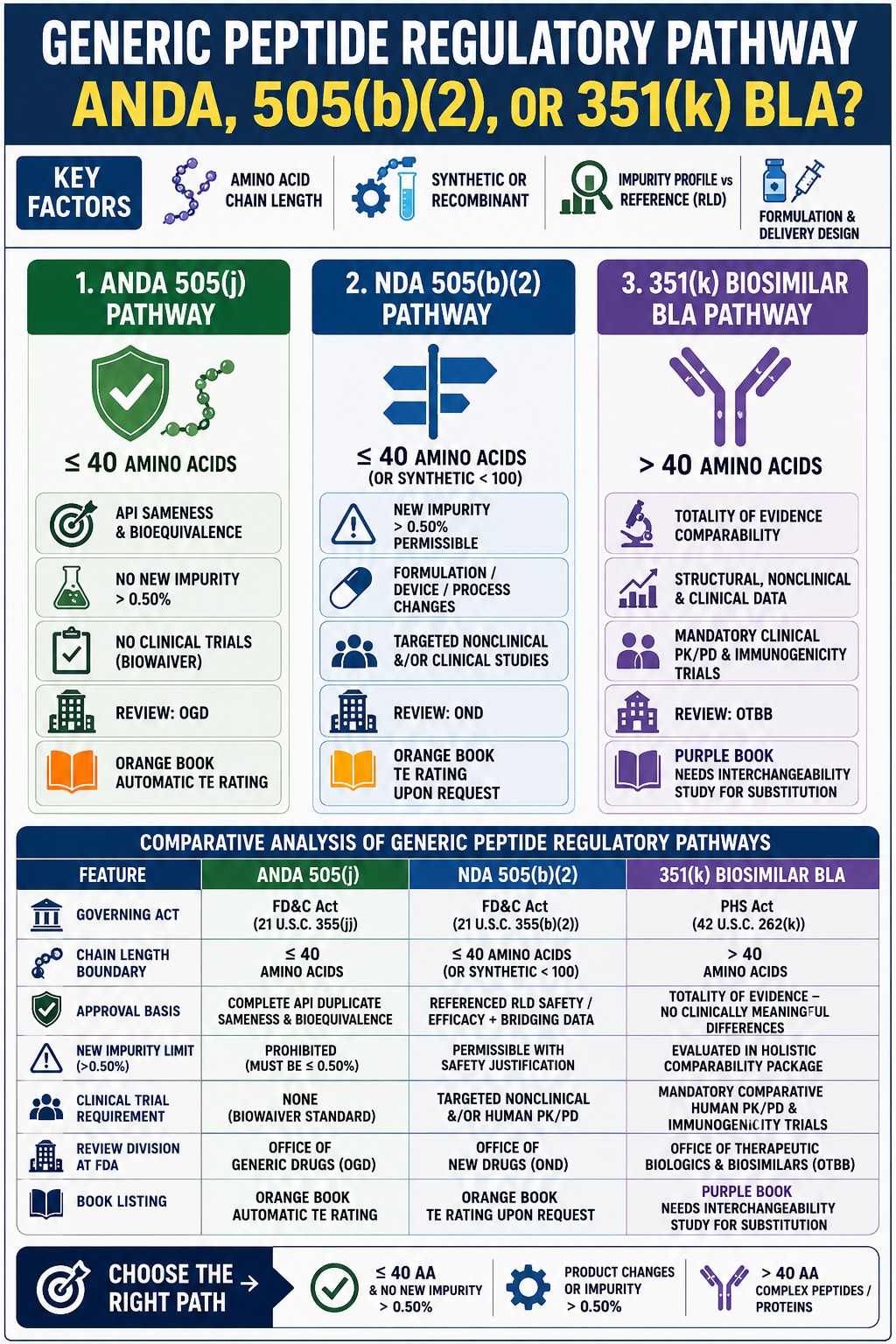
Selecting the appropriate Generic Peptide Regulatory Pathway—whether an Abbreviated New Drug Application (ANDA) under Section 505(j), a hybrid New Drug Application (NDA) under Section 505(b)(2), or a Biologics License Application (BLA) under Section 351(k)—is primarily determined by factors such as the peptide’s amino acid chain length, whether it is produced through synthetic or recombinant processes, and how its analytical impurity profile compares with that of the reference listed drug (RLD). Synthetic peptides containing 40 or fewer amino acids may be developed through the ANDA 505(j) pathway when active pharmaceutical ingredient (API) sameness and bioequivalence have been demonstrated and no new impurities exceed applicable regulatory limits. In contrast, peptide products that involve formulation modifications, innovative delivery technologies, or additional nonclinical bridging requirements because of new impurities above 0.50% may require submission through Section 505(b)(2). Peptide therapeutics containing more than 40 amino acids are generally considered biological products under the applicable statutory framework and may require development through the biosimilar pathway under Section 351(k) of the Public Health Service Act (PHS Act).
Learn More: Understanding the Structural Differences: Small Molecules vs. Peptides
The regulatory landscape for generic peptides has evolved considerably following the expiration of patents covering major metabolic therapies, including glucagon-like peptide-1 (GLP-1) receptor agonists such as liraglutide (31 amino acids), semaglutide (31 amino acids), and tirzepatide (39 amino acids). At the same time, established peptide products such as teriparatide (34 amino acids) and glucagon (29 amino acids) have provided important precedents for the approval of synthetic generic versions of recombinant reference products. Demonstrating active ingredient sameness for structurally complex peptides requires sophisticated bioanalytical characterization, including ultra-high performance liquid chromatography coupled with high-resolution mass spectrometry (UHPLC-HRMS), nuclear magnetic resonance (NMR) spectroscopy, and orthogonal cell-based immunogenicity assays. Specialized analytical testing laboratories, including ResolveMass Laboratories Inc., can assist generic developers in producing the structural characterization and impurity profile data necessary to address FDA expectations.
Explore Services: One-Stop CDMO Analytical Testing & Characterization Services for ANDA Submissions
Share via:
Quick Summary:
- Regulatory pathway selection depends mainly on peptide chain length, manufacturing method (synthetic vs. recombinant), impurity profile, formulation, and delivery system.
- ANDA 505(j) is generally the preferred route for synthetic peptides ≤40 amino acids when API sameness, structural comparability, and bioequivalence to the RLD are demonstrated, with no new impurity >0.50%.
- 505(b)(2) NDA is suited to peptides that cannot meet ANDA requirements because of significant formulation/device changes, different manufacturing approaches, or new impurities >0.50% requiring additional safety or bridging studies.
- 351(k) biosimilar BLA generally applies to biological products >40 amino acids, requiring a totality-of-the-evidence assessment covering structural, functional, nonclinical, clinical, and immunogenicity comparability.
- Analytical characterization is critical, using complementary methods such as LC-MS/MS, UHPLC-HRMS, chiral analysis, CD, NMR, FTIR, SEC-MALS, AUC, and DLS to establish sequence, chirality, higher-order structure, and aggregation.
- Impurity and immunogenicity assessment is essential: impurities below 0.10% are generally routinely monitored; new impurities at 0.10–0.50% require characterization and immunogenicity-risk assessment; levels >0.50% may prevent ANDA eligibility.
- Key decision rule: ≤40 amino acids + sameness + acceptable impurities → 505(j); significant product changes or elevated impurities → 505(b)(2); >40 amino acids/complex biological proteins → 351(k).
Classification Criteria: Determining the Generic Peptide Regulatory Pathway
One of the primary factors used to determine whether a generic peptide is regulated as a drug or biological product is its amino acid chain length, with 40 amino acids representing the key statutory boundary under United States law. Peptides consisting of 40 or fewer amino acids are generally treated as chemically synthesized drug substances under the Federal Food, Drug, and Cosmetic Act (FD&C Act), allowing sponsors to pursue abbreviated drug approval pathways regardless of whether the reference listed drug was manufactured using recombinant DNA (rDNA) technology or through chemical synthesis.
Read Next: How to Choose the Right Peptide CDMO in the US
The statutory distinction between drugs and biological products was established through amendments to Section 351(i) of the PHS Act. Under this framework, an alpha-amino acid polymer containing 40 or fewer residues is categorized as a drug, whereas polymers containing more than 40 amino acids are classified as proteins and regulated as biological products. In certain circumstances, synthetic peptides containing up to 100 amino acids may also be considered within the drug framework when they do not possess defined tertiary protein structures, although commercial development in practice is largely concentrated on shorter peptide chains.
The principal physical and regulatory characteristics of major therapeutic peptide categories can be summarized as follows:
- Short-Chain Synthetic Peptides (≤ 40 Amino Acids): These products are regulated as small-molecule drugs under FD&C Act Section 505 and may be eligible for either the 505(j) ANDA or 505(b)(2) NDA pathway. Representative examples include Glucagon (29 amino acids), Liraglutide (31 amino acids), Semaglutide (31 amino acids), Teduglutide (33 amino acids), Teriparatide (34 amino acids), and Tirzepatide (39 amino acids).
- Long-Chain Biological Proteins (> 40 Amino Acids): These products are regulated as biological products under PHS Act Section 351 and may be developed through a 351(a) BLA or a 351(k) Biosimilar BLA. Representative examples include Human Insulin (51 amino acids), Dulaglutide (Fc-fusion protein), and Somatropin (191 amino acids).
The ANDA 505(j) Generic Peptide Regulatory Pathway
The 505(j) ANDA pathway represents the principal abbreviated approval route for generic synthetic peptides containing 40 or fewer amino acids when the product demonstrates active pharmaceutical ingredient sameness and bioequivalence to the reference listed drug without requiring independent preclinical or clinical safety studies. Sponsors pursuing Section 505(j) can rely on the FDA’s previous findings regarding the safety and efficacy of the reference product, provided that the synthetic API demonstrates the required similarity to the RLD with respect to sequence, chirality, higher-order structure, and impurity risk.
Learn More: Peptide API Scale-Up Strategies for Generic Drug Development
Active Ingredient Sameness and Higher-Order Structure (HOS)
Establishing active pharmaceutical ingredient sameness under Section 505(j) involves demonstrating that the generic synthetic peptide has the same primary amino acid sequence, peptide chirality, and relevant higher-order secondary structures as the RLD. Even relatively subtle differences in molecular conformation or aggregation behavior may influence biological activity and product performance. Consequently, comprehensive physicochemical characterization using multiple orthogonal analytical techniques is essential for establishing comparability.
Verification of sequence identity and conformational integrity requires an integrated analytical strategy that addresses four major structural attributes:
- Primary Sequence Identification: Comprehensive peptide mapping and complete sequence coverage using tandem liquid chromatography-mass spectrometry (LC-MS/MS) are used to confirm the precise amino acid sequence and identify any deletion, insertion, or sequence-related variants.
- Amino Acid Chirality and Racemization: Quantitative chiral amino acid analysis following total acid hydrolysis is performed to establish the absolute configuration of D- and L-enantiomers and determine whether racemization occurred during the chemical synthesis process.
- Secondary and Tertiary Conformation: Circular dichroism (CD), two-dimensional nuclear magnetic resonance (2D-NMR), and Fourier-transform infrared (FTIR) spectroscopy provide complementary information for assessing alpha-helical, beta-sheet, and random coil structural characteristics relative to the RLD.
- Aggregation and Oligomeric State: Size-exclusion chromatography with multi-angle light scattering (SEC-MALS), analytical ultracentrifugation (AUC), and dynamic light scattering (DLS) can be used to evaluate self-association behavior and confirm the absence or control of high-molecular-weight aggregates.
Explore Deep Dive: Reference Listed Drug (RLD) Sourcing & Reverse Engineering for ANDA Filings
Impurity Thresholds and Immunogenicity Assessment
The FDA synthetic peptide framework applies specific impurity considerations in addition to the standard ICH Q3A/Q3B principles. Specified peptide-related impurities should not exceed the corresponding levels observed in the reference listed drug. In addition, newly observed peptide-related impurities present between 0.10% and 0.50% require detailed assessment of their potential immunogenicity risk, while a new impurity exceeding 0.50% may prevent the product from qualifying for the 505(j) ANDA pathway.
Read Next: Impurity Control Strategies Under ICH Q3A Rules
The impurity control strategy for synthetic generic peptides can therefore be considered across three principal concentration ranges:
- Impurities Below 0.10%: These levels are below the reporting threshold and are generally managed through routine mass spectrometry-based monitoring without requiring individual immunogenicity characterization for each impurity.
- New Impurities Between 0.10% and 0.50%: Such impurities should be structurally identified and appropriately characterized, followed by comparative immunogenicity risk assessment to establish that they do not introduce an increased risk of T-cell activation compared with the RLD.
- New Impurities Above 0.50%: A new peptide-related impurity at a level above 0.50% is considered unacceptable for ANDA approval under this framework. Such an impurity may necessitate modification of the chemical manufacturing process to reduce its concentration or may result in the need to pursue the 505(b)(2) pathway.
Assessment of potential immunogenicity associated with new impurities in the 0.10% to 0.50% range requires a two-pronged strategy addressing both adaptive and innate immune responses. Adaptive immunogenicity can be investigated using in silico Major Histocompatibility Complex (MHC) class II binding algorithms, including EpiMatrix and JanusMatrix, together with in vitro HLA-DR binding assays and human peripheral blood mononuclear cell (PBMC) T-cell proliferation assays. Innate immune response risk can be evaluated using the finished drug product through cell-based Innate Immune Response Modulating Impurity (IIRMI) functional assays, including Toll-Like Receptor (TLR) reporter cell lines and NF-κB activation monitoring systems. These approaches help determine whether process-related contaminants could activate systemic inflammatory pathways.
Explore Services: Bioequivalence Study Design for Complex Generic Drug Products
The 505(b)(2) NDA Generic Peptide Regulatory Pathway
The Section 505(b)(2) pathway serves as a hybrid approval mechanism for peptide products that cannot fully satisfy the requirements of a conventional ANDA because they incorporate formulation changes, novel dosage forms, alternative routes of administration, or new peptide-related impurities exceeding 0.50%. This pathway allows sponsors to reference the established safety and efficacy information for the RLD while generating additional nonclinical toxicology, clinical pharmacology, or other bridging data needed to support specific differences between the proposed product and the reference product.
Section 505(b)(2) applications are reviewed by the FDA’s Office of New Drugs (OND), rather than the Office of Generic Drugs (OGD). Although development through the 505(b)(2) pathway can involve greater user fees and additional nonclinical or clinical requirements compared with a conventional ANDA, it provides important development flexibility for peptide products that cannot satisfy the strict sameness requirements of Section 505(j). Key situations that may support a 505(b)(2) filing include:
- Excess Impurity Profile: A novel peptide-related impurity that cannot be eliminated through the manufacturing process and exceeds 0.50% may require additional nonclinical toxicology or clinical safety qualification.
- Formulation and Excipient Changes: Changes to the excipient composition that influence local absorption, modifications to sustained-release polymers, or conversion between lyophilized powders and liquid solutions may require additional supporting evidence.
- Device Modifications: Transitioning a peptide product to a different autoinjector, pen injector, or needle-free administration device may necessitate comparative human factors evaluation or clinical bioequivalence bridging.
- Expression System Divergence: Producing a recombinant version of a peptide for which the reference listed drug was manufactured synthetically, or producing a synthetic version of a recombinant reference product, may generate distinct host-cell or process-related impurity profiles that require additional characterization.
Learn More: Formulating Lyophilized Peptide Injectables for Market Success
In addition, eligible 505(b)(2) products may receive 3 to 5 years of Hatch-Waxman marketing exclusivity for certain novel clinical indications, dosage forms, or formulations. This can provide commercial exclusivity benefits that are generally not available through a conventional ANDA.
The 351(k) Biosimilar BLA Pathway for Complex Peptides
Complex peptide products containing more than 40 amino acids are classified as biological therapeutics under the applicable framework and may require development through the Section 351(k) biosimilar pathway of the PHS Act. Approval is based on a totality-of-the-evidence comparability assessment. Because longer peptide and protein molecules can exhibit structural heterogeneity, complex tertiary folding, and post-translational modifications, sponsors must demonstrate that the proposed biosimilar is highly similar to the reference biological product and does not have clinically meaningful differences in safety, purity, or potency.
The 351(k) BLA framework is overseen by the FDA’s Office of Therapeutic Biologics and Biosimilars (OTBB) and follows a step-wise evidence hierarchy that includes:
- Extensive Structural Characterization: Comprehensive multi-method analytical characterization is used to evaluate primary sequence identity, higher-order folding, post-translational modifications, and charge variant distribution.
- Nonclinical Assessment: Comparative in vitro bioassays, receptor binding affinity and kinetics, and targeted animal pharmacokinetics/pharmacodynamics (PK/PD) studies may be performed to establish functional and pharmacological similarity.
- Comparative Clinical Trials: Human studies may evaluate comparative PK/PD, safety, and clinical immunogenicity, including anti-drug antibody titers and the incidence of neutralizing antibodies.
Unlike drug products approved under Section 505, biosimilar biological products listed in the FDA’s Purple Book do not automatically receive pharmacy-level automatic substitution ratings. Sponsors seeking an “interchangeable biosimilar” designation must satisfy the applicable interchangeability requirements, including the necessary clinical switching evidence to support substitution at the retail pharmacy level.
Read Next: Peptide CDMO vs CMO: Understanding the Key Strategic Differences
Comparative Analysis of Generic Peptide Regulatory Pathways
Choosing the most appropriate generic peptide regulatory pathway requires an integrated assessment of amino acid chain length, synthetic chemistry capabilities, impurity characteristics, formulation strategy, and drug delivery design in relation to the applicable FDA statutory and regulatory requirements. The following comparison summarizes the major characteristics of the three principal regulatory pathways used for generic peptide therapeutics.
| Regulatory Feature | ANDA Section 505(j) | NDA Section 505(b)(2) | Biosimilar Section 351(k) BLA |
|---|---|---|---|
| Statutory Governing Act | FD&C Act (21 U.S.C. 355(j)) | FD&C Act (21 U.S.C. 355(b)(2)) | PHS Act (42 U.S.C. 262(k)) |
| Chain Length Boundary | ≤ 40 Amino Acids | ≤ 40 Amino Acids (or synthetic < 100) | > 40 Amino Acids |
| Approval Basis | Complete API duplicate sameness and bioequivalence | Referenced RLD safety/efficacy plus targeted bridging data | Totality of evidence demonstrating no clinically meaningful differences |
| New Impurity Limit (>0.50%) | Prohibited (Must be ≤ 0.50%) | Permissible with nonclinical/clinical safety justification | Evaluated under a holistic biosimilar comparability package |
| Clinical Trial Requirement | None (Clinical biowaiver standard for solution injectables) | Targeted nonclinical toxicology and/or human PK/PD studies | Mandatory comparative human PK/PD and immunogenicity trial |
| Review Division at FDA | Office of Generic Drugs (OGD) | Office of New Drugs (OND) | Office of Therapeutic Biologics & Biosimilars (OTBB) |
| Orange / Purple Book Listing | Listed in Orange Book; automatic therapeutic equivalence rating | Listed in Orange Book; therapeutic equivalence rating upon request | Listed in Purple Book; requires interchangeability study for substitution |
Learn More: Evaluating US vs. Overseas Peptide CDMO Partners
Conclusion: Mastering the Generic Peptide Regulatory Pathway
Choosing and successfully implementing the appropriate Generic Peptide Regulatory Pathway requires careful integration of amino acid chain length, chemical manufacturing controls, analytical impurity profiles, formulation considerations, and device design. For synthetic peptides containing 40 or fewer amino acids, the Section 505(j) ANDA pathway can provide the most streamlined route to approval when active ingredient sameness has been established and new peptide-related impurities remain below 0.50%. When significant product modifications or elevated impurity levels prevent the product from satisfying ANDA requirements, Section 505(b)(2) can provide a suitable hybrid approval pathway. In contrast, biological peptides containing more than 40 amino acids may require development within the Section 351(k) biosimilar framework.
Advanced bioanalytical characterization remains a fundamental component of peptide regulatory development. High-resolution mass spectrometry, 2D-NMR spectroscopy, and complementary cell-based immunogenicity assays collectively provide the analytical evidence needed to characterize molecular structure, impurities, and potential immunogenicity across different regulatory pathways. Establishing robust analytical comparability and addressing critical differences early in development can reduce regulatory uncertainty and support a more efficient market authorization process.
Get Started: CMC Documentation Requirements at a CDMO for Generic ANDA Filings
To discuss advanced bioanalytical testing, mass spectrometry characterization, and customized regulatory testing strategies for your peptide development program, visit the ResolveMass Laboratories Inc. Contact Us Page.
Frequently Asked Questions
A newly identified peptide-related impurity at 0.30% falls within the range that requires detailed characterization and immunogenicity risk evaluation. Sponsors should establish the impurity’s structure and assess its potential immune response using appropriate in silico MHC binding assessments and in vitro cell-based assays to support a comparative risk evaluation against the RLD.
A new peptide-related impurity above 0.50% may prevent a product from qualifying for the conventional 505(j) ANDA pathway because the impurity profile no longer meets the applicable requirements for an abbreviated application. The manufacturer may need to optimize the synthesis process to lower the impurity or consider Section 505(b)(2), where additional safety and bridging data can be provided.
Not necessarily. When an injectable peptide demonstrates the required qualitative (Q1) and quantitative (Q2) formulation sameness, along with appropriate API and physicochemical comparability, clinical efficacy trials may not be necessary. The specific evidence required depends on the product, dosage form, route of administration, and FDA’s applicable bioequivalence recommendations.
Q1 sameness means that the generic formulation contains the same inactive ingredients as the reference listed drug. Q2 sameness refers to matching the concentration of those inactive ingredients to the reference product within the applicable regulatory criteria, which may include an accepted variation such as ±5% where appropriate.
Semaglutide is a 31-amino-acid peptide and is regulated as a drug under the applicable FD&C Act framework rather than as a biological product solely on the basis of its amino acid chain length. Depending on the product characteristics and development strategy, a proposed generic or follow-on semaglutide product may require evaluation under Section 505(j) or Section 505(b)(2).
IIRMI assessment can be performed using functional cell-based assays designed to detect innate immune activation caused by process-related contaminants. Methods such as Toll-Like Receptor (TLR) reporter assays and NF-κB activation systems can help determine whether impurities stimulate pathways associated with inflammatory responses in relevant cellular models.
Yes, a peptide product incorporating a substantially modified delivery device may be considered for development under Section 505(b)(2) when the change cannot be adequately supported through the conventional ANDA pathway. For example, transitioning from a pre-filled syringe to an autoinjector pen may require additional human factors, pharmacokinetic, or clinical bridging information depending on the nature of the modification.
Synthetic generic peptide products submitted as Section 505(j) ANDAs are reviewed by the Office of Generic Drugs (OGD) within the Center for Drug Evaluation and Research (CDER). The OGD evaluates whether the proposed product meets applicable requirements for pharmaceutical equivalence, bioequivalence, quality, and other ANDA-specific criteria.
Applicants can obtain regulatory feedback before filing by using mechanisms such as Controlled Correspondence or requesting a formal Pre-ANDA meeting with the Office of Generic Drugs. These interactions can help sponsors clarify expectations concerning active ingredient sameness, analytical characterization, impurity assessment, bioequivalence, and proposed regulatory strategies before submitting the ANDA.
Reference:
- Klein, K., Borchard, G., Shah, V. P., Flühmann, B., McNeil, S. E., & de Vlieger, J. S. B. (2021). A pragmatic regulatory approach for complex generics through the U.S. FDA 505(j) or 505(b)(2) approval pathways. Annals of the New York Academy of Sciences, 1502(1), 5–13. https://doi.org/10.1111/nyas.14662
- U.S. Food and Drug Administration. (n.d.). Abbreviated New Drug Application (ANDA). U.S. FDA
- U.S. Food and Drug Administration. (2022, September 20). Assessing immunogenicity risk of peptides: The synthetic peptide guidance and PSGs [Presentation]. Center for Drug Evaluation and Research. FDA document
- U.S. Food and Drug Administration. (1999, December). Applications covered by Section 505(b)(2). U.S. Food and Drug Administration (fda.gov)
- U.S. Food and Drug Administration. (2022). Overview of the 505(b)(2) regulatory pathway for new drug applications [Presentation]. Center for Drug Evaluation and Research. FDA document
Get In Touch With Us
About The Author


