

Introduction
Reference Listed Drug (RLD) Sourcing and Reverse Engineering provide the essential scientific and regulatory foundation for Abbreviated New Drug Application (ANDA) submissions, allowing contract development and manufacturing organizations (CDMOs) to establish qualitative, quantitative, and structural sameness with innovator drug products. As innovator formulations continue to become more structurally and chemically complex—including non-biological complex substances, modified-release matrices, topical semisolids, and parenteral delivery systems—generic sponsors increasingly depend on specialized CDMOs to perform chemical reverse engineering, reduce regulatory risks, and pursue 180-day market exclusivity pathways under Paragraph IV certifications.
The successful development and submission of an ANDA depend on demonstrating that a proposed generic drug product contains the same active pharmaceutical ingredient (API), dosage form, strength, route of administration, and relevant performance characteristics as its corresponding RLD. Establishing this level of scientific equivalence without infringing existing intellectual property requires sophisticated deformulation methodologies combined with strategic RLD sample acquisition under contemporary legislative frameworks. Through the integration of advanced spectroscopic, thermal, chromatographic, and solid-state characterization techniques, CDMOs convert empirical reverse engineering findings into robust formulation designs, giving generic applicants the scientific evidence needed to qualify for biowaivers, demonstrate in vitro bioequivalence (BE), and facilitate efficient FDA approval timelines.
Streamline your filing process with comprehensive analytical capabilities. Explore One-Stop CDMO Analytical Services for ANDA
Share via:
Article Summary:
- RLD sourcing and reverse engineering provide the scientific foundation for ANDA development by establishing qualitative, quantitative, and physicochemical similarity to the innovator product.
- Strategic RLD sourcing requires multiple representative lots, controlled storage, chain-of-custody, and comparison of fresh versus aged samples to capture lot-to-lot variability and degradation.
- Advanced analytical techniques such as HPLC, LC-MS/GC-MS, FTIR, NMR, Raman, XRPD, DSC/TGA, and ICP-MS enable systematic identification and quantification of APIs, excipients, impurities, polymers, and solid-state characteristics.
- Q1/Q2/Q3 sameness is critical for generic approval: Q1 confirms qualitative composition, Q2 addresses quantitative excipient levels, and Q3 compares physicochemical and microstructural properties.
- Dosage-form requirements vary: parenteral/ophthalmic/otic products emphasize Q1/Q2 sameness, topical products require Q1/Q2/Q3 characterization, while oral solids can benefit from matching the innovator excipient matrix for dissolution and biowaiver strategies.
- Reverse engineering reduces regulatory and development risks by overcoming IID limitations, supporting BCS-based biowaivers, and enabling FDA Controlled Correspondence before ANDA submission.
- CDMOs translate analytical findings into scalable formulations, addressing polymer grades, API polymorphism, trace excipients, and RTR risks—ultimately supporting compliant ANDAs, faster approval, potential cost/time savings, and eligible 180-day market exclusivity.
Strategic Reference Listed Drug (RLD) Sourcing and Regulatory Supply Chains
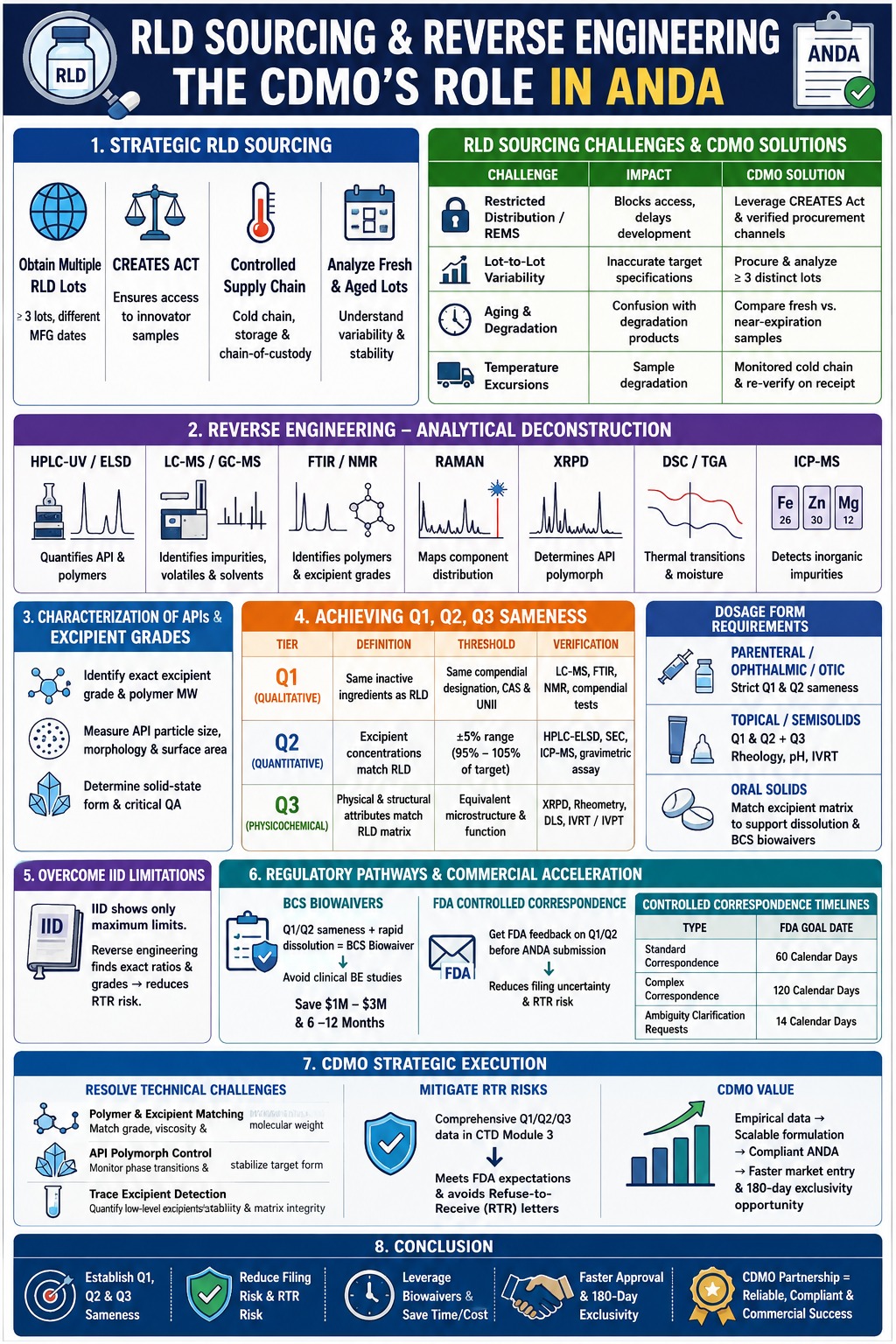
Strategic Reference Listed Drug (RLD) sourcing encompasses the systematic procurement and regulatory management of innovator drug batches required to establish physical, chemical, and bioequivalent parity during generic formulation development. Obtaining representative RLD samples is essential for establishing empirical reference points, assessing batch-to-batch variability, and comparing both fresh and aged innovator samples throughout their shelf-life trajectory.
Navigating Sample Acquisition and Regulatory Protections
Obtaining adequate quantities of innovator samples requires navigating complex distribution networks and utilizing statutory mechanisms such as the CREATES Act to address restrictions on innovator drug supply. Historically, generic manufacturers faced significant obstacles when seeking sufficient quantities of brand-name drug products for development and analytical testing. Innovator companies could use restricted distribution systems or Risk Evaluation and Mitigation Strategies (REMS) with Elements to Assure Safe Use (ETASU) to limit sample access, potentially delaying generic product development and market entry. The enactment of the Creating and Restoring Equal Access to Equivalent Samples (CREATES) Act in 2019 established an important legal mechanism by providing generic developers with a private right of action against brand sponsors that refuse to provide drug samples on commercially reasonable, market-based terms.
CDMOs utilize established and compliant supply chain channels to obtain certified RLD lots from global sources while maintaining stringent storage, temperature, and chain-of-custody requirements. Acquiring multiple distinct manufacturing lots of the RLD is essential for accounting for expected manufacturing differences in excipient concentrations, API particle size distributions, and degradation profiles throughout the product’s shelf life.
Strategic Impact of RLD Lot Selection
The analysis of multiple distinct manufacturing lots representing different stages of shelf life enables CDMOs to characterize baseline innovator variability and avoid incorrectly classifying degradation products as functional excipients. Assessment of both recently manufactured and near-expiration RLD lots provides valuable information regarding the product’s stability envelope and the chemical transformations that occur within the innovator formulation. This multi-batch analytical profiling enables formulation scientists to differentiate intentionally incorporated excipients from secondary degradation products and trace impurities, thereby reducing false-positive findings during quantitative deformulation.
| Sourcing Challenge | Regulatory/Operational Impact | CDMO Mitigation Strategy |
|---|---|---|
| Restricted Distribution Networks / REMS | Blocked access to innovator samples, delaying analytical benchmarking. | Leverage CREATES Act mechanisms and verified regulatory procurement channels. |
| Innovator Lot-to-Lot Variability | Inaccurate target formulation specifications resulting from baseline fluctuations. | Procure and analyze ≥ 3 distinct RLD lots spanning different manufacturing dates. |
| Excipient/API Aging and Degradation | Confusion between degradation products and initially incorporated functional excipients. | Perform comparative stress testing of fresh versus near-expiration RLD samples. |
| Supply Chain Temperature Excursions | Sample degradation that can affect Q3 physical characterization. | Use monitored cold-chain logistics and conduct validated analytical re-verification upon receipt. |
Methodological Framework for Reference Listed Drug (RLD) Sourcing and Reverse Engineering
The methodological framework for Reference Listed Drug (RLD) Sourcing and Reverse Engineering incorporates an integrated analytical platform comprising high-resolution chromatographic, spectroscopic, thermal, and solid-state techniques to systematically deconstruct innovator matrices into their constituent components. Deformulation involves the sequential analytical breakdown of a commercial formulation to isolate, identify, and quantify all active pharmaceutical ingredients and functional excipients.
Analytical Deconstruction and Separation Stack
Analytical deconstruction separates complex drug matrices into their individual constituents through orthogonal physical isolation approaches followed by high-precision qualitative and quantitative analysis. Deformulation typically begins with physical isolation and separation procedures, including solvent extraction, centrifugation, solid-phase extraction (SPE), or gel filtration chromatography. Following separation, individual constituents are subjected to rigorous qualitative identification and quantitative analysis using complementary analytical platforms.
Chromatographic techniques, particularly High-Performance Liquid Chromatography (HPLC) coupled with Ultra-Violet (UV), Refractive Index (RI), or Evaporative Light Scattering Detection (ELSD), are routinely used to determine API content and quantify non-UV-absorbing organic excipients, including polymers and surfactants. Mass spectrometry coupled with liquid or gas chromatography (LC-MS/MS, GC-MS) supports structural elucidation of unknown impurities, degradation products, and volatile matrix components.
Spectroscopic approaches, including Fourier-Transform Infrared Spectroscopy (FTIR), Raman micro-spectroscopy, and Nuclear Magnetic Resonance (NMR) spectroscopy, establish the chemical identity and functional grade of complex polymers. In addition, X-Ray Powder Diffraction (XRPD), Differential Scanning Calorimetry (DSC), and Thermogravimetric Analysis (TGA) are used to characterize API polymorphic forms, crystalline characteristics, and thermal hydration states. Elemental analysis using Inductively Coupled Plasma Mass Spectrometry (ICP-MS) enables the detection and characterization of trace inorganic fillers and buffers.
| Analytical Method | Primary Deformulation Application | Targeted Attributes |
|---|---|---|
| HPLC-UV / ELSD | Assays API concentration and quantifies polymer levels. | Chemical concentration and mass balance. |
| LC-MS / GC-MS | Identifies unknown impurities and volatile components. | Molecular weight, trace structure, residual solvents. |
| FTIR / Solid-State NMR | Elucidates polymeric functional groups and excipient grades. | Chemical bonding, polymer identity, substitution ratio. |
| Raman Spectroscopy | Provides non-destructive mapping of cross-sectional spatial domains. | Component distribution and spatial matrix arrangement. |
| XRPD | Determines API crystal polymorphism and amorphous state. | Polymorphic form, crystallinity, phase purity. |
| DSC / TGA | Evaluates thermal transitions, hydrates, and moisture. | Melting point, glass transition, solvation state. |
| ICP-MS | Quantifies inorganic excipients and elemental impurities. | Metal catalysts, inorganic fillers, ionic buffers. |
Learn more about structural intricacies and high-end analytical testing. Discover GLP-1 Peptide Analytical Characterization
Characterization of Complex APIs and Excipient Grades
Deformulation extends beyond the identification of raw chemical constituents to the characterization of specific compendial excipient grades, polymer molecular weight distributions, and API solid-state critical quality attributes. Advanced reverse engineering must determine not only the chemical identity of each constituent but also the specific compendial grade, molecular weight distribution, and functional characteristics of polymeric excipients, including hypromellose viscosity grades, carbomers, or povidones. Even relatively small differences in excipient grade can substantially influence drug release kinetics, viscosity, and physical stability, potentially resulting in bioequivalence failures.
For the API, characterization encompasses particle size distribution (PSD) determination using laser diffraction, morphology assessment, specific surface area measurement, and solid-state crystal form identification. Matching these critical quality attributes (CQAs) helps ensure that the generic prototype reproduces the dissolution behavior and systemic absorption rate of the innovator product.
Differentiate between traditional components and advanced formulations. Explore the Difference Between a Peptide and a Small Molecule Drug
Achieving Q1, Q2, and Q3 Sameness for ANDA Approval
Achieving Q1, Q2, and Q3 sameness requires demonstrating a qualitative composition match, quantitative excipient concentrations within appropriate target tolerances, and equivalent physicochemical microstructure relative to the reference listed drug. The FDA applies these criteria to assess whether generic drug products can perform equivalently to their innovator counterparts without introducing additional safety or efficacy concerns.
Regulatory Requirements Across Dosage Forms
Regulatory expectations for Q1, Q2, and Q3 sameness differ considerably according to the route of administration and dosage form. Requirements range from compositional identity for parenteral and ophthalmic products to detailed microstructural matching for topical formulations. The applicability and level of stringency associated with Q1, Q2, and Q3 sameness depend on the administration route and dosage form, as outlined by 21 CFR 314.94 and applicable product-specific guidances (PSGs):
- Parenteral, Ophthalmic, and Otic Formulations: Under FDA regulations, generic formulations intended for parenteral, ophthalmic, or otic administration are generally expected to demonstrate strict Q1 and Q2 sameness. Permitted variations are limited to specific circumstances involving components such as preservatives, buffers, or antioxidants, provided that the applicant demonstrates that the proposed modifications do not adversely affect safety or efficacy.
- Topical and Semisolid Formulations: For creams, ointments, and gels, demonstrating Q1 and Q2 sameness is important for pursuing in vitro bioequivalence pathways and potentially avoiding costly clinical endpoint studies. In addition, Q3 physicochemical characterization must establish comparable rheological properties, including yield stress and viscosity profiles, as well as globule size distribution, pH, osmolality, and in vitro release rates (IVRT).
- Oral Solid Dosage Forms: Although oral tablets and capsules are not universally subject to a strict legal requirement for complete Q1/Q2 sameness, reproducing the innovator’s excipient matrix remains a reliable strategy for aligning dissolution profiles and supporting eligibility for BCS-based biowaivers.
Optimize your generic pipeline for specific administration routes. Explore CDMO Services for Generic Ophthalmic Drug Products
| Sameness Tier | Definition | Regulatory Threshold | Analytical Verification Method |
|---|---|---|---|
| Q1 (Qualitative) | The generic product contains the identical inactive ingredients as the RLD. | Same compendial designation, CAS number, and UNII identifier. | High-resolution LC-MS, FTIR, NMR, and compendial testing. |
| Q2 (Quantitative) | The concentrations of inactive ingredients match the RLD within target ranges. | Excipient concentrations fall within a ±5% range (±95–105% of target). | Quantitative HPLC-ELSD, SEC, ICP-MS, and gravimetric assaying. |
| Q3 (Physicochemical) | Physical and structural attributes match the arrangement in the RLD matrix. | Equivalent viscosity, particle/droplet size, crystalline form, and yield stress. | XRPD, rheometry, dynamic light scattering (DLS), IVRT/IVPT testing. |
Overcoming Inactive Ingredient Database (IID) Limitations
Chemical reverse engineering addresses the limitations of the Inactive Ingredient Database (IID) by determining exact excipient ratios and specific grades instead of relying solely on maximum historical threshold estimates. Although the FDA IID provides maximum allowable amounts of excipients according to the route of administration, it does not reveal the exact excipient ratios used in an individual RLD formulation. Deformulation addresses this important information gap. By evaluating multiple RLD batches, a CDMO can determine precise excipient ratios instead of depending on trial-and-error formulation estimates, thereby reducing the risk of formulation failures and Refuse-to-Receive (RTR) decisions during FDA review.
Regulatory Pathways: Biowaivers, Controlled Correspondence, and Commercial Acceleration
Accurate reverse engineering allows generic sponsors to optimize regulatory pathways through BCS-based biowaivers, reduce filing uncertainties through FDA Controlled Correspondence, and support faster product commercialization. Strategic analytical deconstruction can therefore provide direct financial and timeline benefits throughout generic drug development and approval.
Leveraging BCS-Based Biowaivers
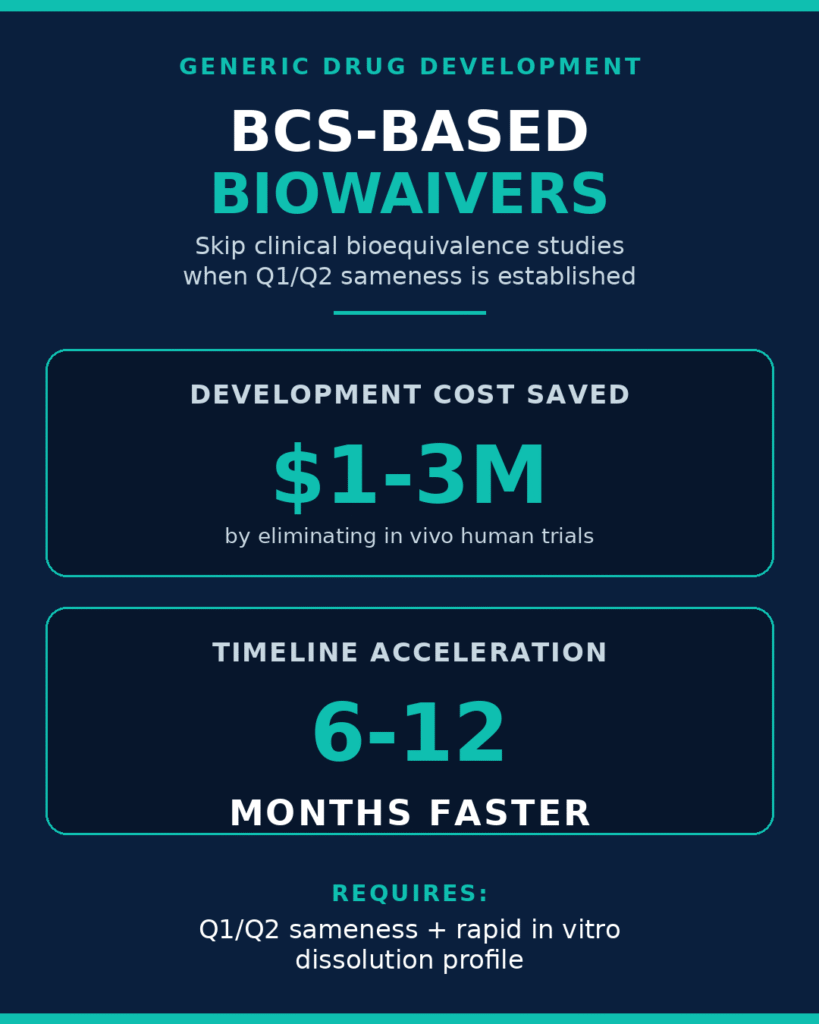
Biopharmaceutics Classification System (BCS) biowaivers can allow generic applicants to avoid certain in vivo clinical bioequivalence studies when appropriate Q1/Q2 sameness and rapid in vitro dissolution profiles are conclusively established. For oral solid dosage forms containing BCS Class I (high solubility, high permeability) or Class III (high solubility, low permeability) active ingredients, demonstrating Q1/Q2 excipient sameness can support a request for a waiver of in vivo bioequivalence studies. Obtaining a biowaiver can eliminate the need for human clinical trials in eligible cases, potentially reducing development expenditure by approximately 1 million to 3 million and shortening project timelines by approximately 6 to 12 months.
Streamline clinical correlations with advanced evaluation methods. Read about Bioequivalence Study Design for Complex Generic Drug Products
De-Risking via FDA Controlled Correspondence
Controlled Correspondence provides a formal GDUFA mechanism through which generic applicants can seek pre-submission feedback from the FDA regarding formulation Q1/Q2 sameness relative to the reference listed drug. After a CDMO completes Q1/Q2 deformulation, the generic applicant can use the Controlled Correspondence process to obtain FDA feedback on the proposed formulation composition before submitting the ANDA. Under the Controlled Correspondence process established through the Generic Drug User Fee Amendments (GDUFA), applicants submit their proposed qualitative and quantitative formulation information to the FDA Office of Generic Drugs (OGD).
The FDA evaluates the proposed formulation against relevant information in its RLD database and provides feedback regarding whether the proposed generic formulation satisfies the applicable Q1 and Q2 criteria. Under GDUFA II goal dates, standard Controlled Correspondences are reviewed within 60 days, while complex correspondences are processed within 120 days. Obtaining FDA feedback can reduce the risk of submitting an ANDA containing non-compliant excipient levels.
| Controlled Correspondence Submission Type | FDA Goal Date Response Time | Primary Strategic Purpose |
|---|---|---|
| Standard Controlled Correspondence | 60 Calendar Days | Validates Q1/Q2 sameness for standard drug products. |
| Complex Controlled Correspondence | 120 Calendar Days | Evaluates complex generics or novel in vitro testing protocols. |
| Ambiguity Clarification Requests | 14 Calendar Days | Resolves specific FDA review comments or ambiguities. |
Strategic Execution: The CDMO’s Imperative in Generic Formulation Development
Contract Development and Manufacturing Organizations (CDMOs) connect empirical reverse engineering findings with scalable drug product reconstruction, helping to minimize technical formulation risks and regulatory submission deficiencies. Converting raw analytical reverse engineering results into a scalable and commercially viable manufacturing process requires extensive technical expertise in pharmaceutical development and formulation science.
Resolving Technical Challenges in Complex Formulations
Advanced CDMO capabilities address complex formulation challenges, including polymer grade selection, polymorph stabilization, and trace excipient quantification, through comprehensive analytical screening protocols. Deformulation can reveal sophisticated formulation challenges such as trace polymer cross-linking, surfactant micellization, phase inversion phenomena, or polymorphic transformations that may occur during processing. CDMOs employ specialized analytical methodologies to address these technical challenges:
- Polymer and Excipient Grade Matching: Determining the precise chemical substitution pattern, viscosity grade, and molecular weight distribution of polymeric carriers helps reproduce comparable drug release profiles.
- API Solid-State Polymorphism: Monitoring potential API phase transitions during wet granulation or high-shear processing helps ensure that the final product maintains the targeted polymorph throughout its shelf life.
- Trace Excipient Detection: Precise measurement of low-level functional excipients, including antioxidants, chelating agents, or pH adjusters, helps prevent stability concerns and maintain matrix integrity.
Partner with industry specialists to transition from early lab design to full commercial production. Outsource Peptide Manufacturing to a Trusted CDMO
Mitigating Refuse-to-Receive (RTR) Risks
Comprehensive deformulation packages can reduce Refuse-to-Receive (RTR) risks by ensuring that Common Technical Document (CTD) Module 3 contains appropriate scientific evidence demonstrating regulatory sameness. The FDA may issue Refuse-to-Receive (RTR) letters when an ANDA submission does not contain complete chemical or bioequivalence characterization information required for an acceptable filing. Collaborating with an experienced CDMO such as ResolveMass Laboratories Inc. helps ensure that analytical testing, solid-state characterization, and comparative equivalence data are generated in alignment with current regulatory expectations. By incorporating comprehensive Q1/Q2/Q3 analytical packages directly into Module 3 (Chemistry, Manufacturing, and Controls) of the Common Technical Document (CTD), sponsors can establish a clear scientific record of equivalence capable of withstanding regulatory review.
Master regulatory requirements to prevent review delays. Explore CMC Documentation at a CDMO for ANDA
Conclusion
In conclusion, Reference Listed Drug (RLD) Sourcing and Reverse Engineering represent a strategic pillar of contemporary ANDA development, enabling CDMOs to reduce risks associated with generic drug filings and establish bioequivalence. Comprehensive reference drug deconstruction provides generic pharmaceutical manufacturers with the empirical baseline needed to demonstrate Q1, Q2, and Q3 equivalence, facilitate regulatory review, and support earlier commercial market entry. By utilizing statutory protections such as the CREATES Act, generic sponsors can obtain innovator samples through appropriate channels, while advanced CDMO analytical platforms systematically deconstruct complex drug matrices to identify critical quality attributes.
Ultimately, establishing qualitative, quantitative, and physicochemical sameness can enable eligible generic applicants to avoid redundant clinical studies through BCS biowaivers, utilize FDA Controlled Correspondence mechanisms, and pursue 180-day market exclusivity pathways. Partnering with an experienced CDMO ensures that empirical deformulation findings are translated into robust, compliant, and commercially viable generic drug products.
Navigate provider selection with confidence and secure optimal collaboration terms. Learn How to Choose a Peptide CDMO in the US
For technical consultations or to initiate RLD deformulation and analytical characterization projects, contact the analytical development team directly through the ResolveMass Contact Portal.
Frequently Asked Questions (FAQs)
Q1 (Qualitative Sameness) refers to using the same active and inactive ingredients as those present in the RLD. Q2 (Quantitative Sameness) concerns matching the amount or concentration of inactive ingredients within the applicable target range. Q3 (Physicochemical Sameness) focuses on comparable physical and structural characteristics, including viscosity, particle size distribution, rheology, crystalline form, and in vitro release behavior.
Testing multiple RLD manufacturing lots helps establish the normal variability associated with API content, excipient levels, particle size distributions, and other product attributes. Including both recently manufactured and near-expiration samples also helps distinguish the original formulation composition from changes caused by aging, degradation, or storage. This approach produces a more reliable target profile for generic formulation development.
Generic products administered through parenteral, ophthalmic, and otic routes are subject to stringent Q1 and Q2 sameness expectations under applicable FDA requirements. Any permitted differences, such as certain changes involving preservatives, buffers, or antioxidants, must be appropriately justified and should not adversely affect the safety, quality, or performance of the drug product.
For eligible oral solid dosage forms containing BCS Class I or Class III active ingredients, establishing appropriate Q1 and Q2 sameness can support a request for a BCS-based biowaiver. When regulatory requirements are satisfied, the applicant may avoid certain in vivo bioequivalence studies, potentially reducing development expenses and accelerating the overall path toward commercialization.
CDMOs use multiple complementary analytical techniques to identify and characterize excipient grades and polymer properties. Size Exclusion Chromatography (SEC) can assess polymer molecular weight characteristics, while Fourier-Transform Infrared Spectroscopy (FTIR) helps identify functional groups and chemical identity. Rheometry, HPLC, Mass Spectrometry (MS), and Evaporative Light Scattering Detection (ELSD) can provide additional information on viscosity, composition, and polymeric components.
FDA Controlled Correspondence enables generic applicants to seek regulatory feedback on specific formulation or development questions before submitting an ANDA. After completing Q1/Q2 deformulation, sponsors can present relevant qualitative and quantitative formulation information to the FDA Office of Generic Drugs. The resulting feedback can help identify potential formulation or regulatory concerns early and reduce the likelihood of avoidable deficiencies during ANDA review.
CDMOs apply techniques such as X-Ray Powder Diffraction (XRPD), solid-state Nuclear Magnetic Resonance (ssNMR), Raman micro-spectroscopy, and Differential Scanning Calorimetry (DSC) to investigate API solid-state characteristics. These methods can identify crystalline forms, solvates, hydrates, amorphous material, and potential phase transitions. Such characterization helps confirm that manufacturing and processing conditions maintain the desired polymorphic form.
Topical creams, ointments, and gels require detailed Q3 characterization to demonstrate comparable physical and microstructural properties. Relevant parameters can include yield stress, viscosity and shear-rate behavior, globule or droplet size distribution, droplet morphology, pH, osmolality, and In Vitro Release Testing (IVRT). Depending on the product and applicable regulatory guidance, these attributes help establish comparable product performance and support in vitro bioequivalence approaches.
Comprehensive reverse engineering generates detailed analytical evidence that can support the formulation, characterization, and chemistry information included in CTD Module 3. By accurately identifying and quantifying APIs, inactive ingredients, and relevant physicochemical attributes, sponsors can identify formulation discrepancies before ANDA submission. This early assessment helps reduce the risk of incomplete documentation, unsupported formulation differences, and other deficiencies that could contribute to an FDA Refuse-to-Receive (RTR) decision.
Reference:
- Bansal, A. K., & Koradia, V. (2005). The role of reverse engineering in the development of generic formulations. Pharmaceutical Technology, 29(8), 50–55. ResearchGate
- U.S. House of Representatives, Committee on the Judiciary, Subcommittee on Regulatory Reform, Commercial and Antitrust Law. (2018). Antitrust concerns and the FDA approval process (Serial No. 115-27). U.S. Government Publishing Office. https://www.govinfo.gov/content/pkg/CHRG-115hhrg30235/html/CHRG-115hhrg30235.htm
- U.S. Food and Drug Administration. (2024). Presentations relating to GDUFA science and research in fiscal year 2023. FDA
- Kathpalia, H., Venkatesh, A., Kaushik, A., & Tammannavar, V. (2025). Analytical techniques for reverse engineering of reference products for the development of generic oral solid dosage forms. International Journal of Pharmaceutical Sciences and Drug Research, 17(1), 74–82. https://doi.org/10.25004/IJPSDR.2025.170111
Get In Touch With Us
About The Author


