

Introduction
Accelerating Health Canada ANDS Submission timelines requires a coordinated regulatory strategy that integrates pre-filing bioequivalence data verification, technical auditing of Modules 1–5 within the electronic Common Technical Document (eCTD), and rapid-response procedures for regulatory clarification requests. Generic pharmaceutical sponsors seeking to secure market share within Canada’s generic drug sector must satisfy stringent requirements established under Part C, Division 8 of the Food and Drug Regulations. Because filing priority can have a direct effect on commercial opportunities, minimizing regulatory obstacles during the initial screening and subsequent scientific review stages is critical.
This case study examines how a Canadian generic pharmaceutical sponsor optimized its Abbreviated New Drug Submission (ANDS) for a complex solid oral dosage formulation. Facing demanding commercial launch timelines, stringent Drug Establishment License (DEL) requirements, and the possibility of Notice of Deficiency (NOD) issues, the sponsor partnered with ResolveMass Laboratories Inc. to implement a comprehensive pre-submission clearance strategy. The approach focused on identifying and resolving analytical inconsistencies, harmonizing chemistry manufacturing and controls (CMC) documentation, and establishing proactive communication with Health Canada. As a result, the submission proceeded directly to scientific review without encountering screening deficiency holds.
Explore our complete suite of CDMO analytical services for ANDA submissions.
Share via:
Quick Summary:
- Pre-filing technical audits help accelerate Health Canada ANDS submissions by identifying bioequivalence, CMC, administrative, and eCTD deficiencies before filing.
- OSIP intake and formal screening are critical checkpoints; complete REP metadata, fee documentation, HC/SC 3011, CPID-CE, labelling, and quality attestations help prevent SDN holds.
- Bioequivalence readiness requires verification of pharmacokinetic data and confirmation that the 90% confidence intervals for Cmax and AUCₜ remain within 80.00%–125.00%.
- CMC optimization should include nitrosamine risk assessment, ICH Q3D elemental impurity controls, stability information, and standardized QOS-CE/CPID-CE documentation.
- Canadian Module 1 compliance requires bilingual English/French labelling and Product Monograph documents, accurate regional forms, and verification of active Drug Establishment Licences (DELs) for relevant sites.
- Rapid clarification management reduces review disruption: triage queries within 24 hours, assemble technical evidence within 72 hours, and submit complete responses ahead of regulatory deadlines.
- Proactive preparation can shorten timelines from approximately 340–500 days to ~225–235 days by preventing SDN/NOD cycles and enabling faster progression toward NOC/DIN and market access.
Regulatory Framework and Friction Points in Health Canada ANDS Reviews
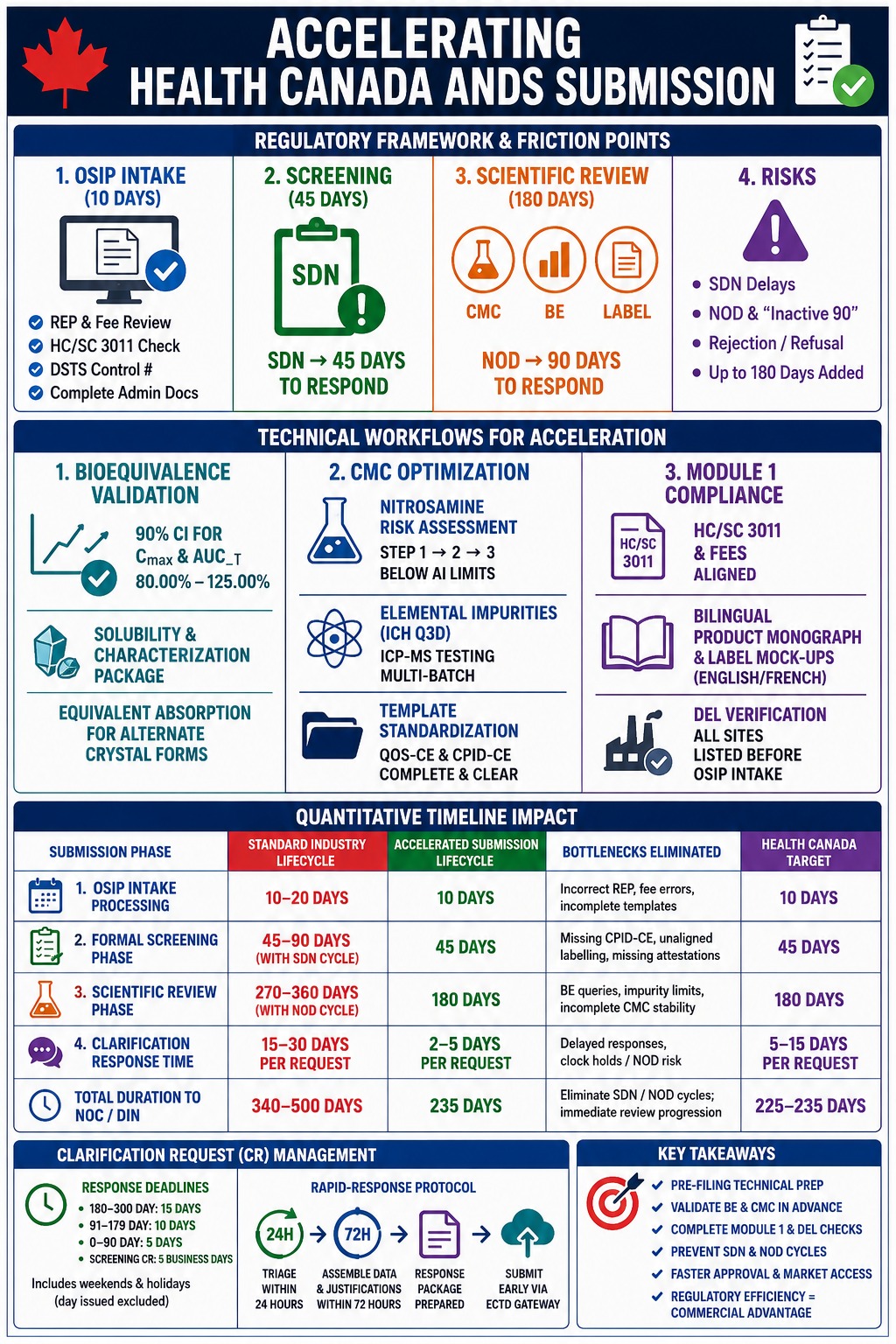
Successfully navigating Health Canada ANDS review bottlenecks requires rigorous compliance with Part C, Division 8 of the Food and Drug Regulations. Administrative deficiencies or scientific gaps identified at the intake stage can significantly extend the time required to obtain market authorization, potentially adding up to 180 calendar days to the overall process. Generic drug applications are assessed through a structured, multi-stage process administered by the Health Products and Food Branch (HPFB), with each section of the eCTD dossier evaluated for completeness, consistency, and technical accuracy.
Administrative Processing and OSIP Intake Bottlenecks
The Office of Submissions and Intellectual Property (OSIP) conducts the initial administrative processing within 10 calendar days after receiving a submission. During this stage, the agency reviews Regulatory Enrolment Process (REP) templates and applicable fee structures before assigning a Drug Submission Tracking System (DSTS) control number. OSIP also evaluates whether the submission contains all necessary administrative documentation, including the HC/SC 3011 template, and determines whether data protection provisions under Section C.08.004.1 of the Food and Drug Regulations affect the filing.
If required REP Product Information (PI) or Regulatory Transaction (RT) metadata is missing, or if discrepancies are identified in the applicable fee calculations, the submission may be placed on hold before it reaches the formal screening stage. Resolving these administrative deficiencies before filing is therefore an important component of an efficient ANDS submission strategy.
Learn more about our structured CMC documentation at a CDMO for ANDA.
Navigating Screening Deficiency Notices and Scientific Review Holds
Health Canada’s formal screening process has a 45-calendar-day target. During this period, deficiencies such as missing quality attestations or incomplete Certified Product Information Documents (CPID-CE) can result in a Screening Deficiency Notice (SDN), effectively interrupting progression of the review. When the review division identifies administrative, documentation, or formatting deficiencies during screening, an SDN may be issued, after which the sponsor is provided with a 45-calendar-day period to submit the required corrections.
The sponsor must address the SDN completely and within the specified timeframe. Failure to provide a satisfactory response can result in formal rejection of the submission, requiring the applicant to initiate the filing process again and pay the applicable standard filing fees.
Following issuance of a Screening Acceptance Letter (SAL), the submission advances to scientific review. A standard ANDS has a 180-calendar-day target for this stage. Scientific assessment is conducted through three primary parallel streams: Quality (CMC), Bioequivalence, and Labelling. Material scientific deficiencies, including inadequate impurity characterization or unresolved statistical discrepancies in bioequivalence studies, may result in a Notice of Deficiency (NOD).
An NOD can place the active review process into an “Inactive 90” status. The sponsor must then prepare and submit a comprehensive response package within 90 calendar days. Failure to adequately address the identified deficiencies within the specified period may result in a Notice of Non-Compliance (NON) and eventual refusal of the submission.
Technical Workflows for Accelerating Health Canada ANDS Submission Pathways
Improving Health Canada ANDS Submission performance requires parallel technical workflows covering bioequivalence datasets, chemistry manufacturing and controls (CMC), and Canadian-specific Module 1 requirements. Conducting these activities before filing allows potential technical uncertainties to be identified and addressed before they develop into regulatory queries or deficiencies during formal review.
Bioequivalence Statistical Validation and Pharmacokinetic Alignment
Demonstration of bioequivalence requires the 90% confidence interval for the geometric mean ratios of Cmax and AUC_T to remain strictly within the 80.00% to 125.00% acceptance range when compared with the designated Canadian Reference Product (CRP). As part of the pre-submission technical assessment, the team performed a comprehensive re-analysis of the raw bioanalytical and pharmacokinetic datasets generated from both fasted and fed comparative bioavailability studies.
Review our overall strategy for bioequivalence study design for complex generic drug products.
In addition, under updated Health Canada guidance, generic formulations containing identical therapeutically active components may qualify for ANDS filing even when certain characteristics, including specific solvates, hydrates, or polymorphic forms, differ from those of the CRP. To address this possibility, the technical team assembled a comprehensive comparative solubility and characterization package. The package demonstrated that the alternative crystal form produced an equivalent systemic rate and extent of absorption, thereby reducing the likelihood of bioequivalence-related clarification requests after submission.
Discover our approach to reference listed drug sourcing and reverse engineering.
Chemistry, Manufacturing, and Controls (CMC) Optimization
Optimization of Module 3 (Quality) requires accurate completion of the Quality Overall Summary – Chemical Entities (QOS-CE) template together with appropriate nitrosamine and elemental impurity risk assessments. ResolveMass Laboratories Inc. contributed to the technical audit by conducting an extensive CMC review focused on three key areas:
- Nitrosamine Impurity Risk Assessments: Comprehensive Step 1 structural risk evaluations, Step 2 confirmatory testing, and Step 3 control strategies were performed to establish that potential Nitrosamine Drug Substance-Related Impurities (NDSRIs) remained below applicable health-based acceptable intake limits.
- Elemental Impurities and Control Strategy: ICH Q3D-compliant risk documentation was prepared and supported by multi-batch inductively coupled plasma mass spectrometry (ICP-MS) analytical testing to assess and control potential elemental impurities.
- Template Standardization: The QOS-CE and CPID-CE templates were completed and standardized to provide reviewers with clear and consistent access to critical process parameters, specifications, and supporting quality information.
Read our detailed breakdown on impurity control strategies under ICH Q3A.
Module 1 Canadian Regional and Labelling Compliance
Compliance with Canadian Module 1 requirements includes complete bilingual conversion of the Product Monograph, covering Parts I, II, and III, as well as confirmation that all applicable manufacturing and testing facilities are associated with an active Drug Establishment License (DEL). The regional documentation developed during the optimization process included the following components:
- Form HC/SC 3011 and Fee Documentation: The proposed drug details, container closure systems, and applicable fee categories were reviewed and aligned to ensure consistency throughout the submission.
- Bilingual Product Monograph and Mock-ups: Inner and outer labels, together with the Product Monograph, were prepared in both English and French in accordance with applicable Health Canada formatting expectations.
- DEL and Foreign Site Audits: All foreign drug substance and drug product manufacturing, packaging, and analytical testing facilities were verified against the Canadian importer’s active DEL before OSIP intake to confirm that the relevant sites were appropriately listed.
Quantitative Timeline Impact: Accelerating Health Canada ANDS Submission Performance Metrics
Comparative performance data indicate that comprehensive pre-submission auditing can substantially reduce the overall time required to progress from filing to approval. By preventing avoidable deficiency cycles, the process can move from a standard industry lifecycle of approximately 340–500 calendar days toward Health Canada’s benchmark target of approximately 225 calendar days. Avoiding even one Notice of Deficiency (NOD) cycle can prevent as much as 180 calendar days of additional review-related delays and associated resource requirements.
| Submission Phase | Standard Industry Lifecycle | Accelerated Submission Lifecycle | Operational Bottlenecks Eliminated | Health Canada Target Standard |
|---|---|---|---|---|
| OSIP Intake Processing | 10–20 Calendar Days | 10 Calendar Days | Incorrect REP metadata, fee miscalculations, and incomplete administrative templates | 10 Calendar Days |
| Formal Screening Phase | 45–90 Calendar Days (with SDN cycle) | 45 Calendar Days | Missing CPID-CE forms, unaligned labelling, and absent quality attestations | 45 Calendar Days |
| Scientific Review Phase | 270–360 Calendar Days (with NOD cycle) | 180 Calendar Days | Bioequivalence statistical queries, unvalidated impurity limits, and incomplete CMC stability information | 180 Calendar Days |
| Clarification Response Time | 15–30 Days per request | 2–5 Days per request | Delayed technical response authoring, potentially resulting in clock holds or NOD issuance | 5–15 Calendar Days |
| Total Duration to NOC / DIN | 340–500 Calendar Days | 235 Calendar Days | Elimination of SDN/NOD cycles and immediate progression through scientific review upon completion | 225–235 Calendar Days |
Compare regional factors between Canadian vs US peptide CDMOs.
Managing Clarification Requests and Health Canada Liaison Strategy
Health Canada may issue Clarification Requests during scientific review, with mandatory response deadlines that require sponsors to rapidly evaluate the questions, compile supporting evidence, and submit complete responses. Maintaining continuous regulatory oversight helps ensure that scientific queries are addressed promptly and reduces the risk of escalation to a Notice of Deficiency (NOD).
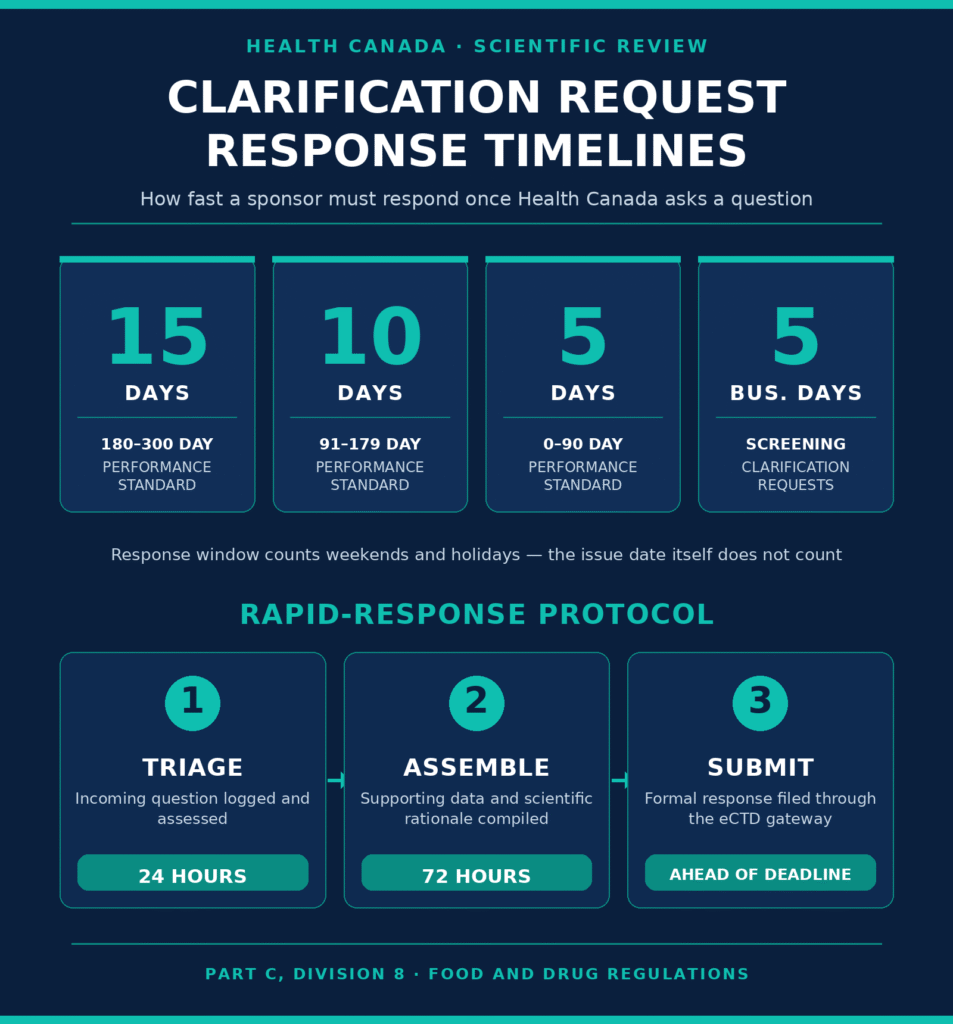
Clarification Requests (CRs) issued during scientific evaluation do not automatically stop the target review clock when the sponsor provides a complete response within the applicable response period. The required response period varies according to the performance standard assigned to the submission:
- 180- to 300-Day Performance Standard (ANDS): 15 calendar days.
- 91- to 179-Day Performance Standard: 10 calendar days.
- 0- to 90-Day Performance Standard: 5 calendar days.
- Screening Clarification Requests: 5 business days.
Explore full capabilities for CDMO services for generic ophthalmic drug products.
The applicable response periods include weekends and statutory holidays, with the date on which the request is issued excluded from the calculation. To maintain an efficient response process, the sponsor implemented a rapid-response protocol. Incoming regulatory questions were initially triaged within 24 hours. Relevant supplementary bioanalytical data, CMC justifications, and scientific rationales were then assembled within 72 hours. Formal response packages were subsequently prepared with the appropriate dossier identification, control number, and clearly documented scientific responses before being submitted through the eCTD gateway several days ahead of the applicable statutory deadline.
Learn how we support generic ophthalmic suspension ANDA development.
Conclusion
Accelerating Health Canada ANDS Submission pathways depends on comprehensive pre-filing technical preparation, rigorous impurity risk management, accurate bioequivalence assessment, and error-free eCTD compilation. Generic pharmaceutical manufacturers can reduce the risk of avoidable regulatory delays by validating bioequivalence datasets in advance, completing QOS-CE templates accurately, ensuring Canadian Module 1 compliance, and confirming Drug Establishment License alignment before submission.
Read our selection guide on how to choose a peptide CDMO in the US.
A proactive approach to technical auditing and regulatory communication allows sponsors to identify potential deficiencies before they enter the formal review process. By addressing analytical discrepancies, CMC documentation gaps, labelling requirements, and administrative issues before filing, sponsors can minimize the likelihood of SDN and NOD cycles and support a more predictable path toward market authorization. In this way, regulatory preparation becomes not only a compliance activity but also a strategic component of commercial planning, helping generic pharmaceutical sponsors convert regulatory efficiency into a sustainable market advantage.
Find out more about our dedicated peptide CDMO in Canada.
To strengthen your regulatory filing strategy and support faster drug submission approvals, connect with the technical specialists at ResolveMass Laboratories Inc. through the Contact Us page: https://resolvemass.ca/contact/.
Frequently Asked Questions
An Abbreviated New Drug Submission (ANDS) is used to obtain authorization for a generic drug by demonstrating pharmaceutical equivalence and bioequivalence to a Canadian Reference Product (CRP). In contrast, a New Drug Submission (NDS) generally requires comprehensive evidence supporting the safety, efficacy, and quality of a new drug. An ANDS therefore relies on established reference-product data rather than repeating the complete clinical development program.
A Screening Deficiency Notice (SDN) may be issued when Health Canada identifies missing, incomplete, inconsistent, or improperly formatted information during the formal screening stage. Examples can include incomplete REP templates, missing CPID-CE documentation, or absent quality attestations. Sponsors are generally required to provide a complete response within the applicable 45-calendar-day period.
A Notice of Deficiency (NOD) indicates that significant scientific or technical deficiencies have been identified during the review of an ANDS. The submission may be placed into “Inactive 90” status, requiring the sponsor to prepare a comprehensive response addressing the identified concerns. Failure to provide an adequate response within the specified period can lead to a Notice of Non-Compliance (NON) and submission refusal.
For applicable bioequivalence studies, the 90% confidence interval for the geometric mean ratios of Cmax and AUC_T between the generic product and the Canadian Reference Product (CRP) must fall within the specified 80.00% to 125.00% acceptance range. Statistical evaluation of these pharmacokinetic parameters is an important component of demonstrating bioequivalence. The assessment should be supported by appropriately validated bioanalytical and pharmacokinetic data.
The Quality Overall Summary – Chemical Entities (QOS-CE) template provides a structured summary of important quality information within Module 3. Although its status may be considered optional in certain Health Canada submission contexts, including a complete and well-organized QOS-CE can facilitate reviewer access to key CMC information. Accurate completion can also help minimize avoidable clarification requests during scientific review.
Drug Establishment License (DEL) compliance is an important consideration when preparing a Canadian generic drug submission. The Canadian importer must ensure that applicable foreign manufacturing, packaging, and testing sites are appropriately listed on its active DEL. Verifying these details before submission helps prevent administrative issues and supports compliance with Canadian regulatory requirements.
Nitrosamine risk assessments should evaluate the potential formation and presence of nitrosamine impurities associated with the drug substance, drug product, and manufacturing process. The assessment may involve Step 1 structural risk evaluation, Step 2 confirmatory testing, and Step 3 implementation of appropriate control strategies, where applicable. The objective is to demonstrate that identified Nitrosamine Drug Substance-Related Impurities (NDSRIs) remain within applicable health-based acceptable intake limits.
The response period for a Health Canada Clarification Request depends on the performance standard assigned to the submission. For an ANDS under a 180- to 300-day performance standard, the applicable response period is 15 calendar days, while screening clarification requests generally require a response within 5 business days. Sponsors should establish a rapid-response process to review, compile, and submit complete technical responses within the specified timeframe.
Reference:
- Health Canada. (2025, October 1). Guidance on management of drug submissions and applications: Processing and screening. Government of Canada. https://www.canada.ca/en/health-canada/services/drugs-health-products/drug-products/applications-submissions/guidance-documents/management-drug-submissions-applications/processing-screening.html
- Health Canada. (2026, July 13). Guidance on management of drug submissions and applications: Review. Government of Canada. https://www.canada.ca/en/health-canada/services/drugs-health-products/drug-products/applications-submissions/guidance-documents/management-drug-submissions-applications/review.html
- Health Canada. (2024, May 7). Access to generic drugs in Canada. Government of Canada. https://www.canada.ca/en/health-canada/services/drugs-health-products/drug-products/fact-sheets/access-to-generic-drugs.html
- Health Canada. (2024, December 18). Quality (chemistry and manufacturing) guidance: New drug submissions and abbreviated new drug submissions. Government of Canada. https://www.canada.ca/en/health-canada/services/drugs-health-products/drug-products/applications-submissions/guidance-documents/chemical-entity-products-quality/guidance-document-quality-chemistry-manufacturing-guidance-new-drug-submissions-ndss-abbreviated-new-drug-submissions.html
Get In Touch With Us
About The Author


