

Introduction
Lipidated and long-acting peptides employ hydrophobic acyl chains or polymer conjugates to prolong systemic circulation half-lives from only a few minutes to several days or even weeks. The engineering of Lipidated and Long-Acting Peptides represents a major approach to transforming peptide therapeutics by reducing rapid renal clearance and enzymatic degradation, thereby enabling extended clinical dosing intervals, including once-weekly or once-monthly administration. Natural, unmodified peptides generally have very short in vivo half-lives, frequently below ten minutes, because molecules below the approximately 30–50 kDa renal filtration threshold undergo efficient glomerular filtration. In parallel, peptide backbones are rapidly degraded by metabolic enzymes, including dipeptidyl peptidase-4 (DPP-4), neutral endopeptidases, and vascular endopeptidases.
To address these pharmacokinetic limitations without compromising target receptor affinity, biopharmaceutical researchers employ structural half-life extension strategies, particularly chemical modification through polyethylene glycol (PEGylation) and fatty-acid acylation (lipidation). PEGylation increases the hydrodynamic radius of a peptide through extensive polymer hydration, whereas fatty-acid acylation enables the peptide to associate reversibly with endogenous human serum albumin (HSA), which functions as a circulating drug carrier. The clinical success of long-acting metabolic therapeutics, including liraglutide, semaglutide, and multi-receptor agonists such as tirzepatide, demonstrates the therapeutic value of carefully engineered acylation strategies.
Nevertheless, incorporation of long hydrophobic acyl tails or large polymeric chains into otherwise hydrophilic peptide sequences creates substantial chemical, biophysical, and manufacturing challenges. During Solid-Phase Peptide Synthesis (SPPS) and Liquid-Phase Peptide Synthesis (LPPS), lipidated intermediates can undergo extensive aggregation and form highly viscous gels. These physical changes restrict reagent diffusion, interfere with reaction kinetics, and ultimately reduce synthetic yields. Downstream purification can require specialized reversed-phase chromatography capable of disrupting micellar self-assemblies and separating the desired peptide from over-acylated, truncated, and other structurally related impurities. In addition, regulatory compliance requires comprehensive analytical workflows that combine techniques such as dual-enzyme tandem mass spectrometry (LC-MS/MS) and multidimensional nuclear magnetic resonance (NMR) spectroscopy to confirm site-specific conjugation and monitor critical quality attributes.
Need support for complex peptide synthesis and development?
Explore custom peptide synthesis services for specialized peptide development and synthesis requirements.
Share via:
Quick Summary:
- Lipidation and PEGylation extend peptide half-life from minutes to days or weeks by reducing renal clearance and enzymatic degradation.
- Fatty-acid acylation enables reversible human serum albumin (HSA) binding, while PEGylation increases hydrodynamic volume to slow renal filtration.
- Linker design using γ-Glu and ADO/AEEA spacers helps maintain receptor activity while improving albumin interaction and solubility.
- Manufacturing challenges include hydrophobic aggregation, gel formation, poor reagent diffusion, incomplete coupling, and reduced synthesis yields; MgCl₂ complexation can improve processability.
- Purification requires specialized RP-HPLC conditions, including wide-pore columns, elevated temperatures, and optimized organic co-solvents to overcome micelle formation, strong retention, and surface adsorption.
- Advanced characterization combines high-resolution LC-MS/MS, dual-enzyme digestion, 2D NMR, native MS, RP-HPLC, and IEX to confirm sequence, lipidation sites, higher-order structure, and impurities.
- Overall, successful long-acting peptide development integrates molecular engineering, scalable synthesis, optimized purification, and advanced analytical control to achieve prolonged exposure, maintained potency, and regulatory-quality products.
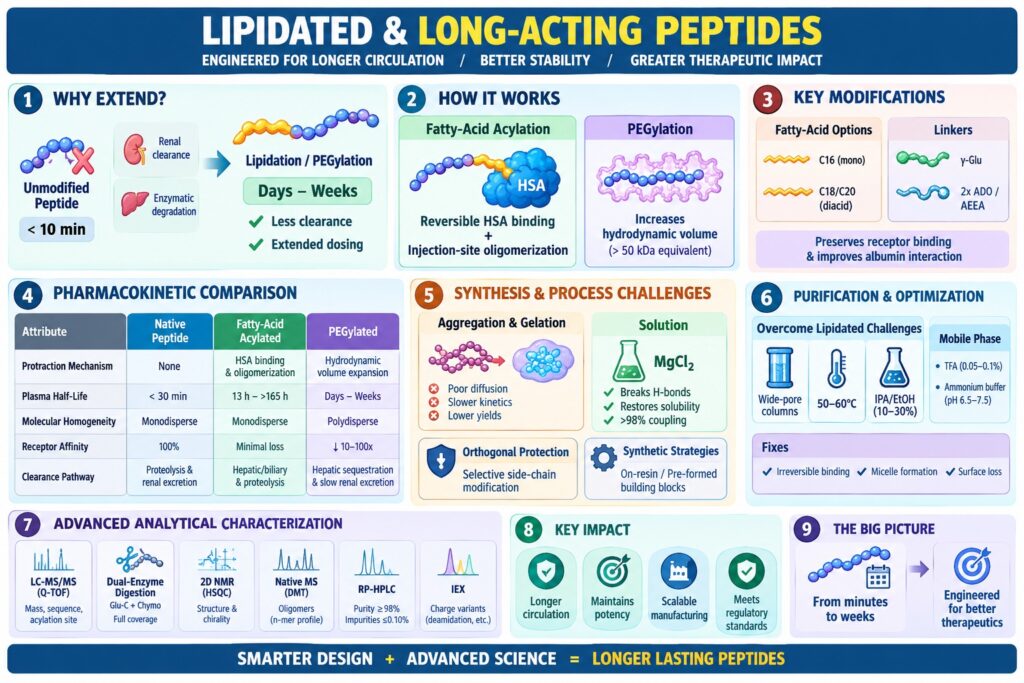
Pharmacokinetic Mechanisms in Lipidated and Long-Acting Peptides
Pharmacokinetic prolongation in lipidated and long-acting peptides is primarily achieved through reversible non-covalent interactions with human serum albumin (HSA) or through expansion of the peptide’s hydrodynamic volume. Both approaches can reduce exposure of the peptide backbone to proteolytic enzymes while limiting renal filtration through the glomerular filtration barrier.
Small unmodified peptides, particularly those below approximately 5 kDa, are removed rapidly from systemic circulation through renal filtration and extensive vascular proteolysis, producing plasma half-lives that can be less than 10 minutes. Addition of a fatty acid promotes reversible binding to circulating HSA and creates a protected circulating drug–albumin complex that can substantially prolong systemic exposure, with some engineered peptides achieving circulation half-lives exceeding 100 hours. In contrast, PEGylation increases the apparent hydrodynamic volume of the peptide, potentially placing the conjugate above the effective renal filtration threshold. However, this increase in steric volume can also modify the spatial accessibility of the peptide at its target receptor.
Fatty-Acid Acylation and Albumin Docking
Fatty-acid acylation involves attaching hydrophobic acyl chains to selected amino acid side chains, allowing the modified peptide to associate with serum albumin and establish a circulating drug depot. Human serum albumin is the most abundant protein in human plasma, with a concentration of approximately 0.6 mM, and has an extended circulating half-life of approximately 19 days. Its prolonged persistence is associated with neonatal Fc receptor (FcRn) endosomal recycling pathways. Once an acylated peptide reaches systemic circulation, its lipid moiety can reversibly interact with high-affinity hydrophobic binding pockets within HSA.
The thermodynamic affinity between an acylated peptide and HSA is influenced by the length, molecular architecture, and charge characteristics of the attached acyl chain. Conventional mono-carboxylic saturated fatty acids, including myristic acid (C14) and palmitic acid (C16, utilized in liraglutide), provide moderate albumin-binding characteristics and can support once-daily dosing profiles. More advanced long-acting peptide architectures use dicarboxylic acids, also referred to as fatty diacids, such as octadecanedioic acid (C18 diacid, present in semaglutide) and icosanedioic acid (C20 diacid, present in tirzepatide). The terminal carboxylate group of a fatty diacid can establish electrostatic interactions with basic amino acid residues positioned near the entrances of HSA binding cavities, while the hydrophobic aliphatic chain extends into the non-polar interior of the binding pocket.
Chemical linkers positioned between the lysine side chain (ε-amino group) and the fatty acid moiety are designed to balance receptor interaction with albumin binding. Common linker architectures include:
- γ-glutamyl (γ-Glu) moieties, which introduce a localized negative charge that can enhance aqueous solubility and appropriately orient the lipid chain.
- Oligo-ethylene glycol spacers, including 8-amino-3,6-dioxaoctanoic acid (ADO or AEEA), which are frequently incorporated as paired units to extend the lipid tail away from the peptide backbone.
This molecular architecture reduces the possibility that the hydrophobic tail will sterically interfere with the peptide’s receptor-binding region, thereby helping preserve native biological potency. In addition, acylated peptides such as liraglutide and insulin degludec can undergo self-association into di-hexamers or heptamers at the subcutaneous injection site. These higher-order assemblies contribute to the formation of a sustained-release local depot before the peptide undergoes systemic albumin binding.
Learn about GMP peptide API manufacturing services for development and production of peptide active pharmaceutical ingredients under controlled manufacturing conditions.
PEGylation Dynamics and Biophysical Trade-Offs
PEGylation involves attaching repeating polyethylene glycol units (−[CH2CH2O]n−) to selected peptide residues to increase the molecule’s hydrodynamic sphere and potentially place it above the effective renal filtration cutoff. Unlike lipidation, which depends on reversible interaction with a circulating carrier protein, PEGylation primarily extends systemic exposure through steric volume expansion and extensive hydration. Each ethylene glycol unit can coordinate multiple water molecules, generating a dynamic, highly hydrated sheath surrounding the peptide core.
Although PEGylation can substantially increase peptide half-life, the approach introduces several important biophysical limitations:
- Polydispersity: Conventional commercial PEG reagents are often polydisperse polymer mixtures (Mw/Mn > 1.02). This produces molecular heterogeneity in the final drug substance and can make detailed mass spectrometry characterization more complex.
- Receptor Steric Hindrance: The uncharged PEG polymer layer can partially shield important receptor-binding residues. Depending on the attachment site and polymer size, this may result in a 10- to 100-fold reduction in target receptor binding affinity relative to the unmodified peptide.
- Immunogenicity and Organ Accumulation: Repeated administration of high-molecular-weight PEGylated biopharmaceuticals can result in the development of anti-PEG antibodies, potentially contributing to accelerated blood clearance. Low polymer biodegradability can also contribute to vacuolation within renal epithelial tissues.
| Modification Attribute | Native Unmodified Peptide | Fatty-Acid Acylated Peptide | PEGylated Peptide |
|---|---|---|---|
| Primary Protraction Mechanism | None (Unmodified core) | Reversible Non-Covalent HSA Binding & Injection-Site Oligomerization | Hydrodynamic Volume Expansion (>50 kDa equivalent sphere) |
| Typical Plasma Half-Life | Minutes (<30 minutes) | 13 hours to >165 hours (Once-daily to once-weekly/monthly) | Days to Weeks (Dependent on polymer mass) |
| Molecular Homogeneity | Monodisperse single species | Monodisperse single species | Polydisperse mixture |
| Impact on Receptor Affinity | 100% Native Potency | Minimal loss (Optimized via γ-Glu-2xADO linkers) | Significant potency reduction (Steric masking of binding domain) |
| Metabolic Clearance Pathway | Rapid Proteolysis & Glomerular Excretion | Hepatic/biliary lipid metabolism & gradual peptide proteolysis | Hepatic sequestration & slow renal excretion of non-degradable polymer |
Synthesis and Process Chemistry Challenges for Lipidated and Long-Acting Peptides
Manufacturing lipidated and long-acting peptides through Solid-Phase Peptide Synthesis (SPPS) or hybrid Liquid-Phase Peptide Synthesis (LPPS) requires specialized process chemistry approaches to address hydrophobic aggregation, gel formation, and steric limitations. The incorporation of bulky lipid tails or poly-ether chains can substantially restrict molecular mobility and interfere with coupling efficiency and reaction kinetics.
Processing Challenges of Lipidated Side-Chains
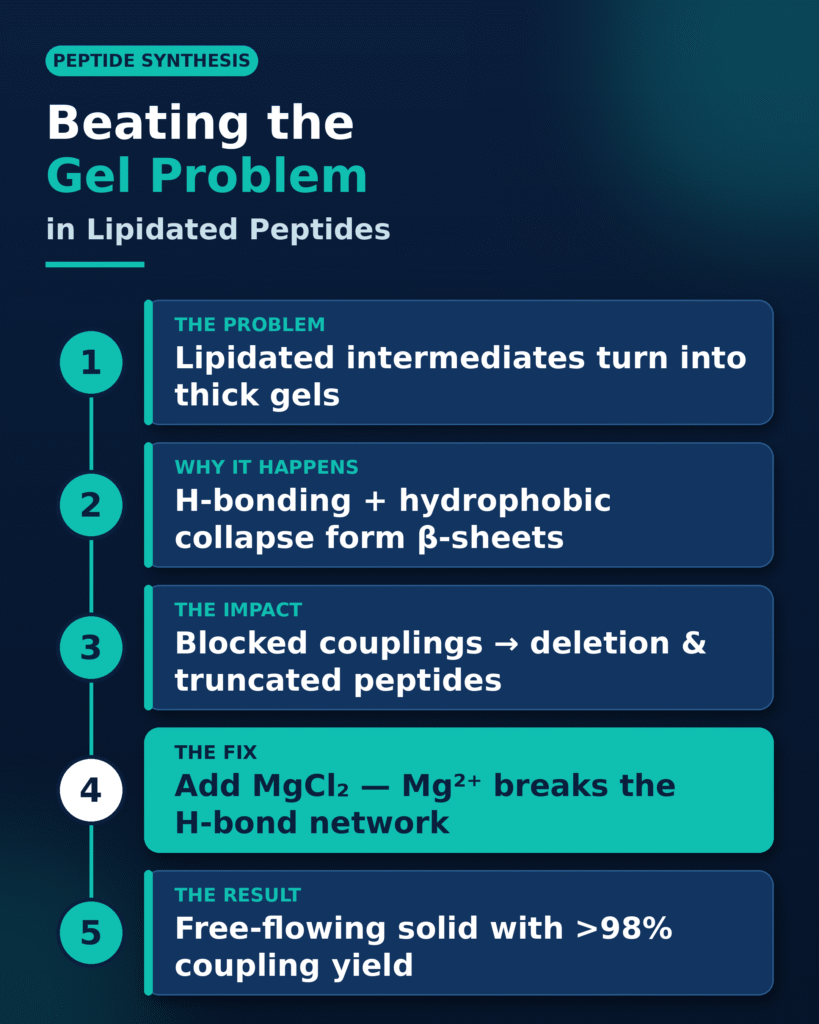
Lipidated peptide intermediates can readily form highly viscous gel phases during chemical synthesis. Such gel formation restricts diffusion of reagents into the reaction matrix and can reduce amino acid coupling efficiency. During the assembly of structurally complex branched peptide sequences, including semaglutide and tirzepatide, intermediates containing long fatty diacids (C18 or C20) together with hydrophobic/hydrophilic linker systems, such as Fmoc-Lys(Alloc)-OH modified with γ-Glu-2xADO-C18 diacid(OtBu), can exhibit pronounced intermolecular hydrogen bonding and hydrophobic association.
These intermolecular interactions can result in gel formation when the intermediates are processed in commonly used polar solvents such as dimethylformamide (DMF) or N-methyl-2-pyrrolidone (NMP). As the lipidated peptide chain becomes longer on the resin, hydrophobic collapse can occur, promoting organized β-sheet secondary structures. The resulting aggregation can conceal the N-terminal amine and interfere with subsequent Fmoc deprotection and amino acid coupling steps. Incomplete reactions can consequently generate deletion sequences and truncated by-products.
To reduce gel formation and restore adequate batch solubility, process chemists can use inorganic salt complexation strategies. Addition of Lewis acids, including anhydrous magnesium chloride (MgCl2), to lipidated building block solutions can disrupt intermolecular hydrogen-bonding networks within the peptide structure. The divalent magnesium ion (Mg2+) can coordinate with carbonyl oxygen atoms distributed across amide bonds and linker structures, thereby interfering with the molecular interactions responsible for gel assembly. This complexation can convert viscous, gel-like intermediates into free-flowing, soluble crystalline solids and can restore coupling yields (>98%) during industrial scale-up.
The conversion of a gel-forming lipidated intermediate into a more processable building block occurs through complexation of MgCl2 with the amide backbone. This interaction disrupts hydrogen-bonding networks and generates a stable, free-flowing solid that is compatible with automated peptide synthesis.
See scaling a GLP-1 analog from preclinical synthesis to GMP kilogram-scale manufacturing for considerations associated with peptide process scale-up.
Orthogonal Protection and Synthetic Strategies
Synthesis of acylated peptides requires orthogonal protection strategies that permit selective modification of peptide side chains while maintaining the integrity of the principal peptide sequence and protecting groups that are sensitive to the reaction conditions. Two major synthetic approaches are commonly employed in commercial manufacturing.
On-Resin Stepwise Conjugation
The linear peptide backbone is constructed using conventional Fmoc/tBu protecting group chemistry. The lysine residue selected for lipidation is introduced using an orthogonally protected derivative, such as Fmoc-Lys(Alloc)-OH, Fmoc-Lys(Dde)-OH, or Fmoc-Lys(IVDde)-OH.
- After completion of the peptide backbone assembly, the orthogonal protecting group is selectively removed:
- Alloc is cleaved using catalytic tetrakis(triphenylphosphine)palladium(0) (Pd(PPh3)4) in the presence of phenylsilane scavengers.
- Dde/IVDde groups are removed using mild hydrazine hydrate solutions in DMF.
- Once the ε-amino group of the target Lysine has been unmasked, it is functionalized directly on the resin through sequential coupling of linker components, including Fmoc-ADO-OH and Fmoc-Glu-OtBu, followed by the terminal mono-protected fatty diacid (HOOC-(CH2)n-COOtBu).
Pre-Synthesized Lipidated Building Block Coupling
To reduce the number of on-resin reaction steps and potentially improve final product purity, modern manufacturing processes frequently use pre-synthesized lipidated building blocks. A fully assembled side-chain construct, such as Fmoc-Lys(γ-Glu-2xADO-C18 diacid(OtBu))-OH, can be incorporated directly into the growing peptide chain during automated synthesis. Although this strategy decreases the number of individual synthetic operations, it requires careful control of solvent composition and temperature to minimize building block aggregation during liquid-phase handling.
To minimize backbone aggregation during extended SPPS cycles, microwave-assisted heating, typically maintaining reaction temperatures between 60°C and 80°C, can be combined with chaotropic agents such as LiCl or pseudoproline dipeptides. These measures help maintain swelling of the peptide-resin matrix and preserve the accessibility and reactivity of the growing peptide chain.
Downstream Purification and Process Optimization
Downstream purification of lipidated and long-acting peptides depends on customized reversed-phase high-performance liquid chromatography (RP-HPLC) methods designed to disrupt amphiphilic self-assembly while minimizing irreversible retention on the chromatographic stationary phase. Careful optimization of stationary-phase characteristics, mobile-phase modifiers, and column temperature is essential for obtaining adequate resolution and high product recovery.
Downstream Physicochemical Hurdles
The amphiphilic molecular architecture of lipidated peptides produces several significant challenges during chromatographic purification:
- Irreversible Column Binding and Peak Broadening: Strong hydrophobic interactions between long aliphatic acyl chains (C16-C20) and conventional dense silica C18 stationary phases can result in excessive retention, peak tailing, and reduced recovery of the desired product.
- Micellar Aggregation: In aqueous mobile phases, lipidated peptides can undergo self-association and form supramolecular micelles when their concentration exceeds the critical micelle concentration (CMC). These micellar species modify chromatographic selectivity and may produce split peaks or co-elution with structurally related deletion sequences.
- Surface Adsorption Losses: Because lipidated peptides have substantial hydrophobic character, they can readily adsorb to hydrophobic polymeric surfaces and glass surfaces. Such adsorption can contribute to product loss during concentration, solvent evaporation, and lyophilization.
Review peptide analytical testing services for analytical approaches supporting peptide identity, purity, structural characterization, and quality assessment.
Chromatographic Optimization Parameters
High-resolution separation of lipidated peptides from truncated, over-acylated, deamidated, and other structurally related impurities requires careful optimization of chromatographic conditions.
Stationary Phase Design
Dense C18 stationary phases are often replaced with wide-pore (300 Å) silica or hybrid organo-silica matrices containing shorter alkyl ligands, including C4, C8, or phenyl-hexyl phases. The increased pore diameter provides improved accommodation of the larger hydrodynamic volume associated with lipidated peptides and facilitates mass transfer into and out of the stationary phase.
Elevated Column Temperature
Preparative RP-HPLC purification of lipidated peptides is commonly performed at elevated temperatures, typically between 50°C and 60°C. Increasing the temperature can disrupt non-covalent hydrophobic interactions and reduce micelle formation within the mobile phase. These effects can sharpen chromatographic peak profiles and improve recovery of the target peptide.
Mobile Phase Engineering
Acetonitrile-based mobile phases can be supplemented with organic co-solvents such as isopropanol (IPA) or ethanol at concentrations of approximately 10–30% v/v. These additional solvents improve the solubility of hydrophobic peptide fractions and can support improved chromatographic recovery. Mobile-phase additives are selected according to the specific stage of purification:
- Trifluoroacetic acid (TFA, 0.05–0.1% v/v) is commonly used during primary purification to maintain an acidic environment, facilitate ion-pairing with basic residues, and reduce silanol activity.
- Neutral to slightly basic ammonium acetate or ammonium bicarbonate buffer systems, generally within a pH range of 6.5–7.5, can be used during secondary polishing to resolve charge variants, including deamidated impurities, while limiting acid-catalyzed degradation.
See impurity control strategies under ICH Q3A for considerations related to impurity identification, qualification, and control.
Advanced Analytical Characterization and Regulatory Quality Control of Lipidated and Long-Acting Peptides
Comprehensive characterization of lipidated and long-acting peptides requires multiple orthogonal analytical techniques, with LC-MS/MS and multidimensional NMR serving as important approaches for confirming structural integrity, sequence coverage, and site-specific acylation. Such analytical strategies support stringent regulatory assessment of impurities, molecular identity, and higher-order structural characteristics.
Characterization workflows commonly employ electrospray ionization liquid chromatography-tandem mass spectrometry (ESI LC-MS/MS) for intact mass determination and impurity profiling. To establish comprehensive primary sequence coverage and determine the precise location of the lipid modification, analytical samples can undergo dual-enzyme digestion using Glu-C and chymotrypsin. Higher-order structural characterization and assessment of stereochemical integrity can subsequently be performed using two-dimensional 1H-13C HSQC NMR spectroscopy together with native mass spectrometry.
Explore one-stop CDMO analytical services for ANDA development for coordinated analytical support across development and regulatory workflows.
High-Resolution LC-MS/MS and Impurity Profiling
Liquid chromatography coupled with tandem mass spectrometry (LC-MS/MS) is a central analytical technique for sequence confirmation and impurity characterization of long-acting peptide therapeutics. High-resolution mass spectrometers, including Quadrupole Time-of-Flight (Q-TOF) and Orbitrap platforms, can provide sub-5 ppm mass accuracy, enabling differentiation between the intended molecular species and closely related peptide impurities.
Analytical Challenges
Hydrophobic lipid groups can decrease gas-phase ionization efficiency and produce signal suppression in electrospray ionization sources when compared with unmodified peptide fragments. In addition, non-canonical amino acid residues, including α-aminoisobutyric acid (AIB) at position 2 in semaglutide and tirzepatide, together with complex side-chain linker systems, can complicate conventional collision-induced dissociation (CID) fragmentation and peptide mapping.
Dual-Enzyme Digestion Strategy
Conventional enzymatic digestion using trypsin may be incomplete because acylation of the ε-amino group of Lysine can prevent normal tryptic cleavage at the modified residue. To address this limitation, analytical workflows can incorporate a dual-enzyme digestion strategy using endoproteinase Glu-C, which cleaves at glutamic and aspartic acid residues, together with chymotrypsin. The combined enzymatic approach generates overlapping peptide fragments that enable isolation of the lipidated Lysine-containing region, supporting comprehensive MS/MS sequence coverage and direct confirmation of the acylation site.
Critical Quality Attribute (CQA) Monitoring
Regulatory authorities, including the FDA CDER and EMA, require comprehensive monitoring and control of synthetic impurities, particularly those present at levels ≥0.10%. Important impurity classes assessed using high-resolution LC-MS include:
- Over-Acylation Derivatives: These represent additional fatty-acid attachments occurring at unintended sites, including the N-terminal amine or secondary Lysine residues.
- Fatty Acid Chain Variants: These impurities can originate from lower-purity lipid reagents and may include C16 diacid variants occurring within a C18 diacid raw material.
- Deamidation Products: These arise through spontaneous conversion of Asparagine to Aspartate or isoAspartate.
- Diastereomeric Impurities: These can result from racemization of chiral centers during prolonged or repeated peptide coupling cycles.
Review extractables and leachables testing for peptide injectables for analytical considerations associated with packaging and manufacturing-contact materials.
Higher-Order Structure (HOS) and Biophysical Analysis
Because the pharmacokinetic behavior of long-acting peptides can depend substantially on molecular self-association, structural characterization must extend beyond primary sequence confirmation. Assessment of higher-order structure and oligomerization provides additional information about the molecular attributes that may influence peptide performance.
Two-Dimensional NMR Spectroscopy
Multidimensional NMR methods, including 1H-13C HSQC and 1H-15N HMBC, provide chemical shift information that can characterize the peptide backbone and the local molecular environment surrounding the lipid tail. NMR analysis can also be used to assess the chiral configuration of non-canonical residues, including AIB, and to investigate whether side-chain lipidation alters structural features such as the α-helical secondary structure required for target receptor engagement.
Native Mass Spectrometry and Direct Mass Technology
Native MS is designed to preserve non-covalent quaternary assemblies during transfer into the gas phase. When combined with Electron-Capture Dissociation (ECD) and Direct Mass Technology (DMT), native MS can provide information regarding oligomerization states and molecular assemblies. For example, liraglutide demonstrates organized self-association behavior and can form stable oligomeric structures (n=7 up to n=25-62), which contribute to the characteristics of its subcutaneous release profile.
| Analytical Platform | Measured Quality Attribute | Target Value / Specification |
|---|---|---|
| High-Resolution LC-MS/MS (Q-TOF) | Intact molecular weight, primary sequence coverage, lipidation site localization | Confirms >99% sequence coverage and verifies acyl tail attachment exclusively at target Lys residue. |
| Dual-Enzyme LC-MS/MS (Glu-C / Chymotrypsin) | Peptide fragment mapping, linker composition verification | Maps hydrophobic regions containing AIB, γ-Glu, and ADO/AEEA spacers. |
| 2D 1H-13C HSQC NMR | Secondary fold conformation, chiral center integrity, local lipid environment | Confirms helical backbone structure and verifies chiral purity of modified residues. |
| Native MS & Direct Mass Technology (DMT) | Higher-Order Structure (HOS), oligomeric distribution (n-mer profile) | Characterizes self-association species, including hexamers/heptamers, associated with depot release. |
| Reversed-Phase HPLC (RP-HPLC) | Chromatographic purity, quantification of over-acylated and truncated impurities | Main peak purity ≥ 98.0%; individual specified impurities ≤ 0.10%. |
| Ion-Exchange Chromatography (IEX) | Charge variant profiling (deamidation, oxidation products) | Resolves acidic and basic degradation variants from the main neutral peptide. |
Conclusion
The therapeutic and commercial development of Lipidated and Long-Acting Peptides requires the integration of sophisticated structural engineering, scalable process chemistry, and high-resolution analytical characterization. Strategic incorporation of fatty-acid acylation motifs, chemical linkers, and modified peptide backbones enables drug developers to regulate systemic clearance and extend circulating half-lives from minutes to more than a week in appropriately engineered molecules. At the same time, critical manufacturing challenges—including gelation of lipidated building blocks during synthesis, pronounced hydrophobic retention during purification, and complex impurity characterization—necessitate carefully controlled process chemistry and advanced analytical capabilities.
As development of generic and biosimilar peptides continues within regulatory frameworks such as the FDA ANDA pathway, comprehensive comparability packages, extensive sequence coverage, and well-defined higher-order structural profiles become important components of pharmaceutical development. Advanced analytical workflows incorporating high-resolution LC-MS/MS Q-TOF characterization, dual-enzymatic peptide mapping, multidimensional NMR, and native mass spectrometry provide essential analytical evidence for evaluating batch consistency, molecular identity, structural integrity, safety, and regulatory compliance.
Explore peptide CDMO services in Canada and peptide CDMO services in the United States to review regional options for peptide development and manufacturing support.
For specialized analytical characterization, sequence verification, and impurity profiling of complex lipidated peptide candidates, visit the ResolveMass Laboratories Inc. Contact Us page.
Frequently Asked Questions
Fatty-acid acylation introduces a defined lipid moiety that enables reversible albumin binding while maintaining a relatively discrete molecular structure. PEGylation instead uses polyethylene glycol to increase hydrodynamic volume and reduce renal clearance. PEGylation may introduce polydispersity and steric interference with receptor binding, whereas lipidation can use flexible linkers to help preserve receptor accessibility.
Lipidated intermediates containing long hydrophobic chains, particularly C16 to C20 diacids, can strongly associate in polar solvents such as DMF and NMP. Hydrophobic interactions and intermolecular hydrogen bonding promote self-assembly and formation of viscous gel phases. This physical aggregation restricts reagent diffusion, reduces coupling efficiency, and can increase the formation of deletion sequences and truncated impurities.
Inorganic salts such as anhydrous magnesium chloride (MgCl2) can interfere with the intermolecular interactions responsible for lipidated peptide gelation. Mg2+ ions coordinate with carbonyl oxygen atoms within amide bonds and linker structures, weakening organized hydrogen-bonding networks. This helps transform aggregated intermediates into more soluble, free-flowing materials that remain accessible for subsequent synthetic reactions.
Chemical linkers provide controlled separation between the peptide backbone and its attached fatty acid while influencing solubility and molecular orientation. ADO/AEEA spacers extend the lipid chain away from the peptide structure, reducing steric interference with receptor binding. γ-Glu can introduce a localized negative charge that improves aqueous behavior and contributes to appropriate positioning of the lipid moiety for HSA interaction.
The C16-C20 fatty acid chains produce strong hydrophobic interactions with conventional C18 stationary phases, which can cause excessive retention, peak broadening, and tailing. Lipidated peptides may also form micelles in aqueous mobile phases, complicating chromatographic selectivity. Wide-pore columns, elevated temperatures, and organic modifiers such as isopropanol can help disrupt these interactions and improve recovery.
Modification of the ε-amino group of Lysine can interfere with conventional tryptic cleavage at the modified residue. Combining endoproteinase Glu-C with chymotrypsin provides alternative cleavage sites and generates overlapping peptide fragments. These fragments improve sequence coverage and allow the lipidated Lysine, linker structure, and exact modification site to be characterized by MS/MS.
Quality control programs can monitor several impurity classes, including over-acylated species, unintended fatty acid chain variants, deamidated products, truncated sequences, and diastereomeric impurities. Over-acylation may occur at the N-terminal amine or additional Lysine residues, while raw-material variability can introduce fatty acid chain variants. Racemization during synthesis can additionally produce diastereomeric forms requiring analytical control.
Regulatory evaluation of generic synthetic peptides requires comprehensive demonstration of molecular identity, sequence consistency, purity, and relevant structural characteristics. For lipidated peptides, characterization can additionally address site-specific acylation, chiral purity, higher-order structure, and impurity profiles. Applicants must establish appropriate controls for specified impurities and demonstrate that the product meets applicable regulatory quality requirements.
Following subcutaneous administration, some acylated peptides can associate into oligomeric assemblies, including di-hexamers or heptamers, through hydrophobic interactions. These structures can slow movement of the peptide from the injection site into systemic circulation. Gradual dissociation of individual peptide molecules, followed by albumin binding in circulation, contributes to prolonged and controlled systemic exposure.
Reference:
- Østergaard, S., Paulsson, J. F., Kofoed, J., Zosel, F., Olsen, J., Jeppesen, C. B., Spetzler, J., Ynddal, L., Schleiss, L. G., Christoffersen, B. Ø., Raun, K., Sensfuss, U., Nielsen, F. S., Jørgensen, R., & Wulff, B. S. (2021). The effect of fatty diacid acylation of human PYY₃₋₃₆ on Y₂ receptor potency and half-life in minipigs. Scientific Reports, 11, 21179. https://doi.org/10.1038/s41598-021-00654-3
- Sánchez, M. R., et al. (2024). Toward once-monthly insulin therapy via synergy in two pharmacokinetic protractors: Fc-conjugation and fatty acid acylation. Frontiers in Endocrinology. https://pmc.ncbi.nlm.nih.gov/articles/PMC11289878/
- Myšková, A., Sýkora, D., Kuneš, J., & Maletínská, L. (2023). Lipidization as a tool toward peptide therapeutics. Drug Delivery, 30(1), 2284685. https://doi.org/10.1080/10717544.2023.2284685
- Wang, Y., Chang, J., & Liu, J. (2026). Molecular engineering approaches to half-life extension of therapeutic biomolecules. Frontiers in Pharmacology, 17, 1778569. https://doi.org/10.3389/fphar.2026.1778569
- Wang, W., Qin, Q., Li, X., Liu, Y., Wu, F., Shen, R. C., & Li, Y. (2023). GLP-1R signaling and functional molecules in incretin therapy. International Journal of Molecular Sciences, 24(2), 1636. https://pmc.ncbi.nlm.nih.gov/articles/PMC9866634/
- Yang, E.-J., Kim, S. H., Kim, A., Choi, J., Jeong, H. J., & Na, D. H. (2026). Regulatory and analytical considerations for the quality assessment of peptide drugs. Journal of Pharmaceutical Investigation. https://doi.org/10.1007/s40005-026-00817-2
Get In Touch With Us
About The Author


