

Introduction
Scaling a GLP-1 analog from preclinical synthesis to Good Manufacturing Practice (GMP) kilogram-scale manufacturing involves moving beyond small-scale discovery procedures toward optimized continuous, batch, or hybrid manufacturing platforms designed to maximize product yield and minimize impurity generation. This chemical scale-up presents several fundamental process chemistry challenges, including intra-chain sequence aggregation, sterically hindered couplings involving non-canonical amino acids, substantial solvent requirements, and the control of trace degradants to meet global regulatory expectations. When scaling a GLP-1 analog from preclinical synthesis, process chemists must establish a reliable and reproducible transition from milligram-scale benchtop synthesis to multi-kilogram active pharmaceutical ingredient (API) production under stringent cGMP controls.
Discover our full capabilities in peptide drug development CDMO services to accelerate your pipeline.
Glucagon-like peptide-1 (GLP-1) receptor agonists, which comprise approximately 30 to 39 amino acids and include semaglutide, liraglutide, and tirzepatide analogues, contain structurally complex features such as non-canonical residues like α-aminobutyric acid (Aib) at position 8 and lipophilic side-chain diacid acylations. These structural modifications extend biological half-life by reducing susceptibility to rapid enzymatic degradation by dipeptidyl peptidase-4 (DPP-IV). However, during chemical scale-up, the hydrophobic regions of these sequences can promote intermolecular β-sheet self-association while the peptide is attached to the solid support. This behavior can result in incomplete coupling, formation of truncated deletion peptides, and reduced batch yields. Addressing these physical and chemical challenges requires a comprehensive operational approach that combines optimized synthetic platforms, green process chemistry, dynamic downstream isolation, and high-resolution analytical characterization.
Explore our technical platforms for GLP-1 peptide analytical characterization and release testing.
Share via:
Quick Summary:
- Scale-up requires a robust GMP strategy that addresses aggregation, difficult couplings, solvent consumption, trace degradants, yield, and reproducibility during the transition from milligram to kilogram production.
- Synthetic route selection is critical: SPPS, continuous-flow SPPS, hybrid SPPS–LPPS, and recombinant-chemical platforms offer different scalability, purity, PMI, cost, and impurity-control advantages.
- Hybrid and continuous-flow approaches can improve scalability, reducing sequence-deletion impurities, aggregation, solvent usage, and process mass intensity compared with conventional batch SPPS.
- Green process chemistry is increasingly important: alternatives to DMF/NMP, such as propylene carbonate, DMSO mixtures, and green esters, combined with elevated-temperature flow coupling, can improve reaction efficiency and potentially reduce PMI by up to 60%.
- Advanced downstream purification is essential: DAC-based RP-HPLC with orthogonal 2D chromatography can separate closely related impurities, achieving >98.5% API purity and >90% step recovery.
- Comprehensive impurity control supports regulatory compliance: peptide impurities, residual solvents, elemental impurities, aggregates, degradation products, and starting-material impurities require appropriate analytical techniques such as HRMS, LC-MS, HPLC, GC, ICP-MS, SEC-HPLC, and NMR.
- Successful commercial manufacturing depends on integration: advanced process chemistry, sustainable solvents, continuous/hybrid manufacturing, dynamic purification, high-resolution analytics, and stringent GMP/ICH/FDA controls are all needed for reliable kilogram-scale GLP-1 API production.
Strategic Synthetic Route Selection for Scaling a GLP-1 Analog from Preclinical Synthesis
Choosing an appropriate synthetic route for scaling a GLP-1 analog requires a detailed assessment of solid-phase peptide synthesis (SPPS), liquid-phase fragment condensation (LPPS), continuous-flow architectures, and recombinant-chemical hybrid platforms. The objective is to maximize manufacturing throughput while limiting sequence deletion and impurity formation. The selected process architecture has a direct influence on the accumulation of co-eluting deletion impurities, overall process mass intensity (PMI), and commercial cost of goods. When scaling a GLP-1 analog from preclinical synthesis, process development teams must carefully assess the respective advantages and limitations of solid-phase resin loading and solution-phase fragment assembly to establish an efficient manufacturing strategy.
Read our practical guide on how to choose a peptide CDMO in the US for your commercial program.
Preclinical discovery programs generally depend on automated, parallel Fmoc/tBu SPPS performed on low-loading polystyrene resins because this approach can rapidly generate milligram-scale quantities required for bioassays and early characterization. However, directly transferring conventional SPPS to kilogram-scale manufacturing can introduce significant challenges, including non-linear mass transfer resistance, excessive solvent consumption, and pronounced aggregation across hydrophobic sequence regions. To address these limitations, contemporary process development frequently incorporates hybrid SPPS-LPPS strategies or continuous-flow SPPS (CF-SPPS) based on dynamic column reactors. In liquid-phase fragment condensation, short and fully protected peptide blocks, typically containing 4 to 8 residues, are first prepared through SPPS, isolated, and subsequently coupled in solution using carbodiimide coupling reagents. This fragment-based approach reduces the generation of single-amino-acid deletion sequences, which can exhibit chromatographic characteristics very similar to those of the full-length GLP-1 API and therefore be difficult to remove.
Learn how to efficiently outsource peptide manufacturing to a CDMO with proven experience.
Another option is recombinant expression of a fusion pro-peptide precursor in Escherichia coli or Pichia pastoris. This strategy can provide a scalable manufacturing route for producing the peptide backbone, which can then undergo enzymatic cleavage followed by liquid-phase functionalization with fatty acid side chains. For example, expression of the semaglutide main chain precursor (Arg34-GLP-1(9-37)) as a fusion protein can provide more than 5 grams per liter of fermentation broth, presenting an economical alternative for large-scale production of the peptide backbone.
Understand the core differences in peptide CDMO vs CMO models to select the right partner.
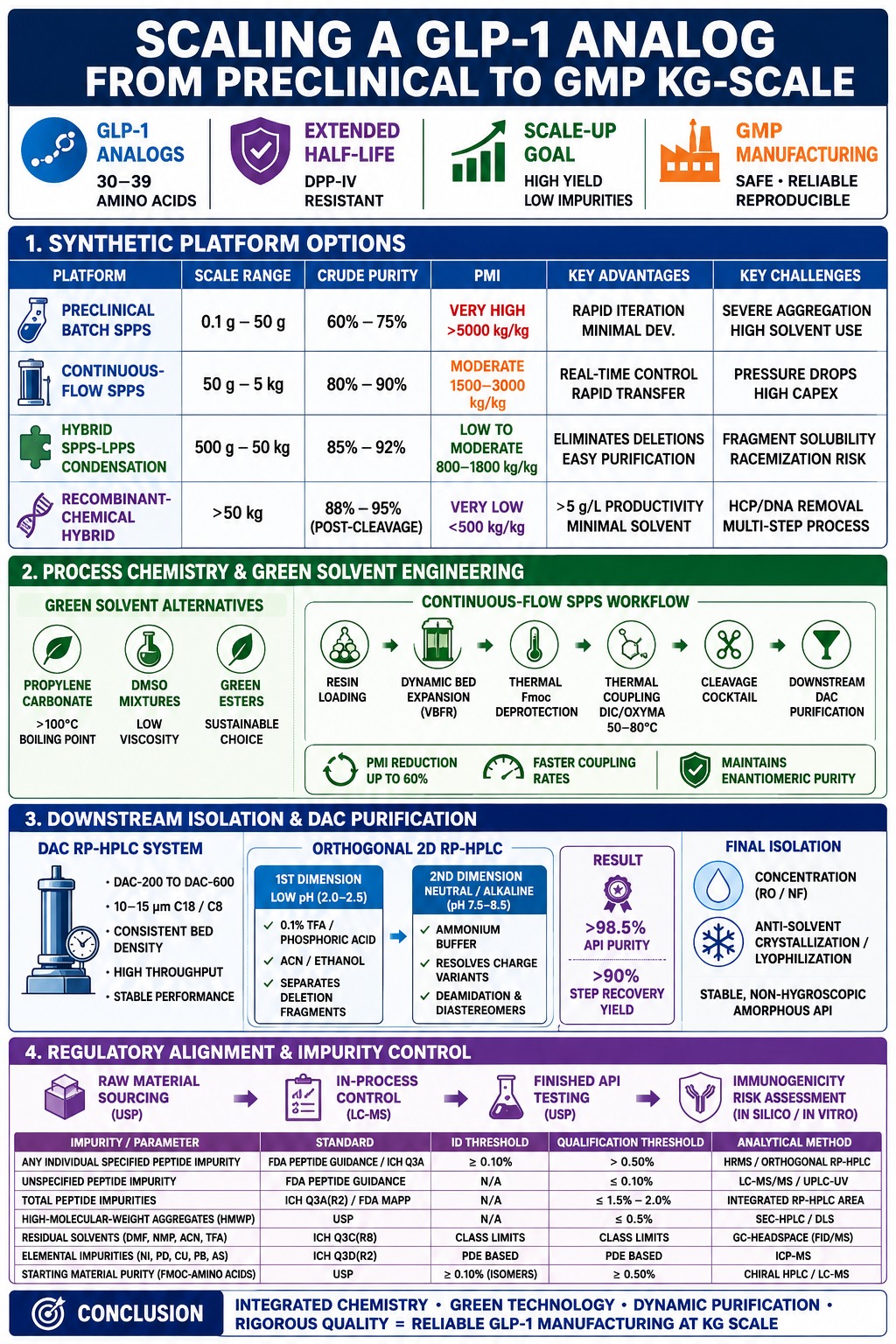
| Synthetic Platform | Scalability Range | Typical Crude Purity | Process Mass Intensity (PMI) | Primary Technical Advantages | Primary Technical Challenges |
|---|---|---|---|---|---|
| Preclinical Batch SPPS | 0.1 g – 50 g | 60% – 75% | Very High (>5000 kg/kg) | Rapid sequence iteration; minimal upfront process development. | Severe aggregation; high solvent footprint; non-scalable mixing. |
| Continuous-Flow SPPS (CF-SPPS) | 50 g – 5 kg | 80% – 90% | Moderate (1500–3000 kg/kg) | Real-time bed compression; rapid thermal transfer; precise residence control. | Dynamic pressure drops; high capital equipment expenditure. |
| Hybrid SPPS-LPPS Condensation | 500 g – 50 kg | 85% – 92% | Low to Moderate (800–1800 kg/kg) | Eliminates near-neighbor deletion impurities; easy liquid-phase purification. | Solubility limits of protected fragments; racemization risk at fragment junctions. |
| Recombinant-Chemical Hybrid | >50 kg | 88% – 95% (Post-cleavage) | Very Low (<500 kg/kg) | Ultra-high volumetric productivity (>5 g/L); minimal organic solvent for backbone. | Host cell protein/DNA removal; multi-step enzymatic cleavage and side-chain acylation. |
Process Chemistry Optimization and Green Solvent Engineering
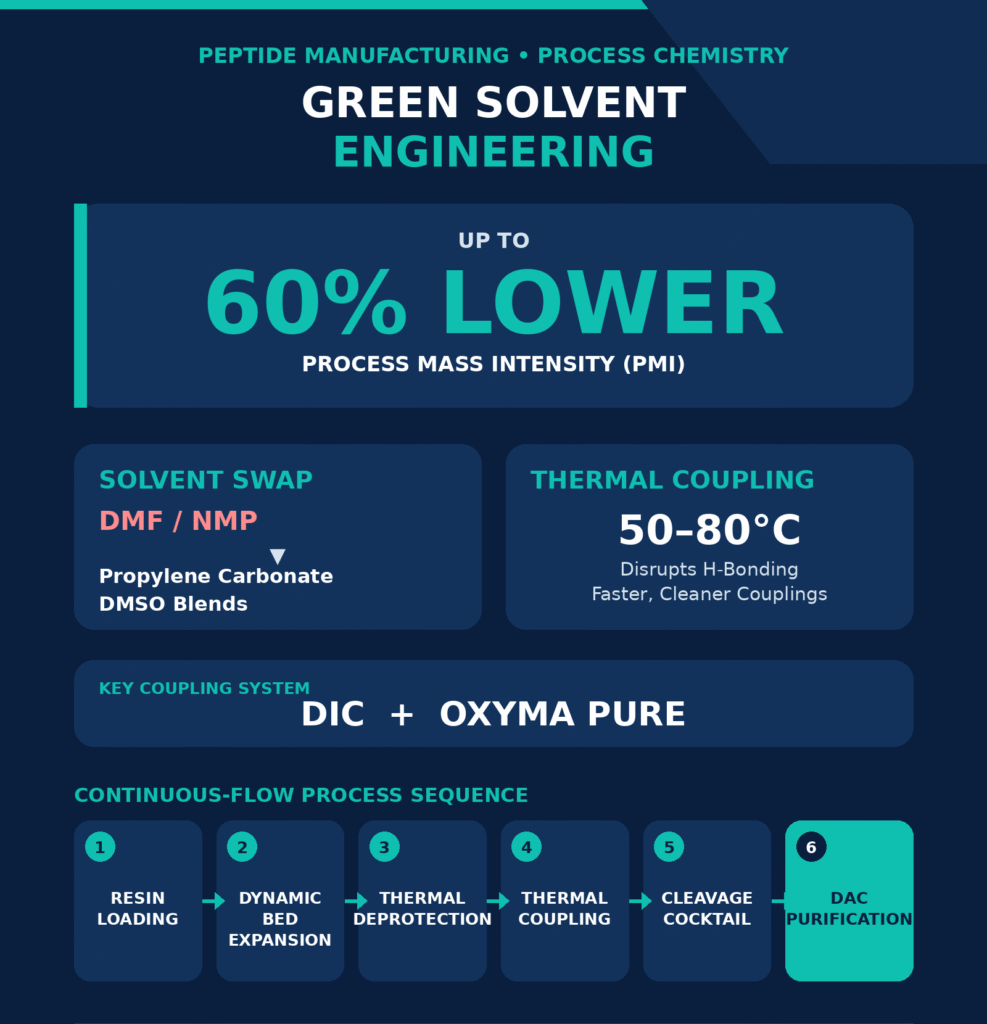
Process chemistry optimization for industrial GLP-1 manufacturing emphasizes the replacement of hazardous dipolar aprotic solvents with more sustainable alternatives while incorporating elevated-temperature flow chemistry to reduce secondary-structure-driven aggregation. These process improvements can substantially decrease Process Mass Intensity (PMI), with reductions of up to 60%, while simultaneously increasing coupling reaction rates and maintaining the required enantiomeric purity.
Compare key operational advantages between United States vs overseas peptide CDMOs for high-yield synthesis.
Conventional SPPS depends extensively on N,N-dimethylformamide (DMF) and N-methylpyrrolidone (NMP), both of which are subject to stringent regulatory controls under REACH because of their reproductive toxicity concerns. Consequently, modern process development increasingly evaluates alternatives such as propylene carbonate (PC), dimethyl sulfoxide (DMSO) binary mixtures, and green esters. Propylene carbonate offers several physical characteristics that can be advantageous during scale-up, including a high boiling point (>100°C), relatively low viscosity (<4 mPa·s), and high resin swelling capacity (>4 mL/g). In continuous-flow manufacturing, Variable Bed Flow Reactors (VBFR) can continuously compensate for changes in column volume associated with physical expansion of the resin bed during assembly of a 30+ residue peptide chain. This dynamic adjustment helps minimize channeling and excessive backpressure.
Resin Loading -> Dynamic Bed Expansion (VBFR) -> Thermal Flow Deprotection (Fmoc) -> Thermal Coupling (DIC/Oxyma, 50-80°C) -> Cleavage Cocktail Treatment -> Downstream DAC Purification
Thermal activation during continuous-flow synthesis can further improve overall process performance. Performing coupling cycles at elevated temperatures ranging from 50°C to 80°C can disrupt inter-strand hydrogen bonding and improve accessibility of sterically hindered N-termini to incoming Fmoc-protected amino acids. Coupling reagents must be selected and paired with suitable additives to control racemization, particularly at sensitive residues such as Cys, His, and Trp. One commonly evaluated combination is N,N’-diisopropylcarbodiimide (DIC) with Oxyma Pure, also known as ethyl 2-cyano-2-(hydroxyimino)acetate. Following completion of peptide chain assembly, global cleavage and deprotection require carefully optimized trifluoroacetic acid (TFA) cocktails containing scavengers such as triisopropylsilane, ethanedithiol, and water. These components help limit re-alkylation of Cys and Trp residues while also reducing the formation of unwanted carbocation-derived adducts.
Review our technical processes for peptide API scale-up services to meet commercial regulatory demands.
Downstream Isolation and High-Throughput Dynamic Axial Compression (DAC) Purification
Isolation of kilogram-scale GLP-1 analogs generally relies on high-throughput reversed-phase high-performance liquid chromatography (RP-HPLC), using Dynamic Axial Compression (DAC) columns together with orthogonal two-dimensional elution strategies. This multidimensional purification approach can increase crude peptide purity from approximately 70–80% to more than 98.5% API purity while providing step recovery yields above 90%.
Learn more about our dedicated peptide CDMO facilities in Canada serving global clients.
At commercial manufacturing scale, conventional packed HPLC columns may experience deterioration of bed packing and the development of voids as a result of repeated pressure cycling. Dynamic Axial Compression (DAC) systems, including configurations such as DAC-200 to DAC-600, use a continuously applied hydraulic piston mechanism to preserve consistent bed density throughout the column. These systems can accommodate 10 μm to 15 μm C18 or C8 reverse-phase silica stationary phases. Because GLP-1 analogues can contain closely related degradation products, including D-amino acid diastereomers, deamidated variants, and des-amino truncated species, relying on a single chromatographic dimension may not provide sufficient resolution to achieve required monograph purity.
An orthogonal two-dimensional RP-HPLC strategy can help resolve these closely related impurities:
- Primary Dimension (Low pH): Uses an acidic aqueous mobile phase, such as 0.1% TFA or phosphoric acid at pH 2.0–2.5, together with acetonitrile or ethanol. This separation dimension primarily differentiates major truncated deletion fragments according to differences in hydrophobicity.
- Secondary Dimension (Neutral/Near-Alkaline pH): Uses a buffered mobile phase, such as 10–50 mM ammonium acetate or ammonium bicarbonate at pH 7.5–8.5. The change in pH modifies the ionization behavior of acidic side chains, including Glu, Asp, and the C-terminus, allowing improved separation of co-eluting charge variants, deamidation isomers, and diastereomers.
After chromatographic purification, the collected fractions can be concentrated through reverse osmosis or nanofiltration to reduce and remove organic modifiers. The concentrated material can then undergo controlled anti-solvent crystallization or freeze-drying (lyophilization), producing a stable, non-hygroscopic amorphous active pharmaceutical ingredient (API).
Examine our detailed case study on the peptide characterization of semaglutide for structural validation insights.
Regulatory Alignment and Impurity Control in Scaling a GLP-1 Analog from Preclinical Synthesis
Regulatory compliance for synthetic GLP-1 analogs requires the implementation of stringent quality control specifications based on FDA guidance for synthetic peptides, USP / chapters, and ICH Q3A–D guidelines. Peptide-related impurities present at or above 0.10% must be structurally identified, while newly observed impurities above 0.50% require extensive nonclinical justification and assessment of potential immunogenicity risks.
Access complete regulatory data using our one-stop CDMO analytical services for ANDA submissions.
Synthetic peptides containing 40 or fewer amino acids are generally classified as chemically synthesized drug substances rather than biological products, meaning that regulatory development can follow Abbreviated New Drug Application (ANDA) or New Drug Application (NDA) chemical pathways, depending on the development context. However, synthetic GLP-1 peptides present additional considerations compared with conventional small molecules because trace impurities with altered T-cell epitopes or high-molecular-weight protein (HMWP) aggregates may contribute to the potential development of anti-drug antibodies (ADAs). Therefore, a comprehensive impurity control strategy must evaluate both product-related and process-related impurities throughout manufacturing and release testing.
Raw Material Sourcing (USP ) -> In-Process Control (LC-MS) -> Finished API Testing (USP ) -> Immunogenicity Risk Assessment (In Silico / In Vitro)
Process-related impurities, including residual solvents, trace coupling reagents, and heavy metals, require strict monitoring and control. Residual solvents are monitored using Gas Chromatography-Headspace, while trace metal catalysts such as nickel, palladium, and copper that may be introduced during cleavage or fragment coupling can require quantification down to parts-per-billion (ppb) concentrations using Inductively Coupled Plasma Mass Spectrometry (ICP-MS), consistent with ICH Q3D. Metal ions can promote catalytic oxidation and aggregation, making their effective control important for maintaining peptide quality. Product-related impurities, including β-aspartate shifts, deamidation products, and oxidation isomers, can be routinely evaluated through high-resolution LC-MS, peptide mapping, circular dichroism (CD), and nuclear magnetic resonance (NMR) spectroscopy.
Evaluate geographic capabilities with our breakdown of Canadian vs US peptide CDMOs for high-throughput production.
| Impurity Specification Parameter | Applicable Regulatory Standard | Identification Threshold | Qualification Threshold | Primary Analytical Method |
|---|---|---|---|---|
| Any Individual Specified Peptide Impurity | FDA Synthetic Peptide Guidance / ICH Q3A | ≥ 0.10% | > 0.50% | HRMS / Orthogonal RP-HPLC |
| Unspecified Peptide Impurity | FDA Synthetic Peptide Guidance | N/A | ≤ 0.10% | LC-MS/MS / UPLC-UV |
| Total Peptide Impurities | ICH Q3A(R2) / FDA MAPP | N/A | Typically ≤ 1.5% – 2.0% | Integrated RP-HPLC Area Count |
| High-Molecular-Weight Aggregates (HMWP) | USP | N/A | ≤ 0.5% | SEC-HPLC / Dynamic Light Scattering (DLS) |
| Residual Solvents (DMF, NMP, ACN, TFA) | ICH Q3C(R8) | Class-specific limits | Class-specific limits | GC-Headspace with FID/MS Detection |
| Elemental Impurities (Ni, Pd, Cu, Pb, As) | ICH Q3D(R2) | PDE based on exposure | PDE based on exposure | ICP-MS |
| Starting Material Purity (Fmoc-Amino Acids) | USP | ≥ 0.10% for isomers | ≥ 0.50% | Chiral HPLC / LC-MS |
Conclusion: Mastering the Scaling of a GLP-1 Analog from Preclinical Synthesis
Successfully scaling a GLP-1 analog from preclinical synthesis to commercial GMP kilogram-scale manufacturing requires coordinated integration of advanced process chemistry, sustainable solvent technologies, dynamic downstream chromatography, and rigorous regulatory control. Transitioning from conventional manual batch synthesis toward continuous-flow SPPS or hybrid LPPS architectures can help pharmaceutical manufacturers decrease process mass intensity while maintaining stringent ICH compliance and achieving the throughput required for commercial production. Successfully addressing these complex synthetic and purification challenges requires sophisticated analytical capabilities combined with extensive process engineering expertise.
Partner with our team for end-to-end peptide CDMO scale-up services tailored to your target volume.
To support your GLP-1 development program, improve complex peptide analytical characterization, or obtain specialized testing and manufacturing assistance, explore the ResolveMass Contact Page.
Frequently Asked Questions (FAQs)
Synthetic GLP-1 analogs containing 40 or fewer amino acids are generally treated as chemically synthesized drug substances rather than recombinant biologics. Depending on the development pathway, they may be submitted through ANDA or NDA routes instead of a Biologics License Application (BLA). Their development therefore requires appropriate control, identification, and qualification of peptide-related impurities under applicable regulatory expectations.
Propylene carbonate (PC) and dimethyl sulfoxide (DMSO) binary mixtures are among the alternatives being evaluated to replace DMF and NMP in large-scale SPPS. These solvents can provide suitable resin swelling and processability while reducing reliance on solvents associated with greater regulatory concerns. Their selection must also consider viscosity, resin compatibility, reaction performance, and downstream solvent removal.
Hybrid SPPS-LPPS enables short, protected peptide fragments to be produced through SPPS and subsequently assembled through liquid-phase condensation. This approach can reduce the accumulation of closely related single-amino-acid deletion impurities that may be difficult to separate from the full-length peptide. It can also provide greater flexibility for purification and scale-up of complex peptide sequences.
Racemization can be controlled through careful selection of coupling chemistry, activation conditions, and reaction temperature. Carbodiimide coupling reagents such as DIC are commonly paired with oxime additives such as Oxyma Pure to improve coupling efficiency while limiting stereochemical changes. Maintaining controlled activation temperatures and avoiding excessive tertiary amine bases can further reduce racemization risk.
Dynamic Axial Compression (DAC) columns maintain consistent packing density by applying continuous hydraulic compression to the stationary phase. This design helps minimize bed void formation, channeling, and packing deterioration during high-pressure operation. As a result, DAC systems can support reliable chromatographic resolution and improved batch-to-batch reproducibility during large-scale GLP-1 purification.
Trace elemental impurities such as nickel and copper can adversely affect GLP-1 API stability by promoting catalytic oxidation and aggregation reactions. These impurities may originate from catalysts, raw materials, reagents, or processing equipment. Their concentrations therefore require strict monitoring, commonly using ICP-MS, to ensure compliance with applicable ICH Q3D requirements.
The potential immunogenicity of a newly identified peptide impurity can be assessed using complementary in silico and in vitro approaches. In silico analysis may evaluate potential T-cell epitope formation, while suitable in vitro assays can investigate immune-response potential. The resulting evidence helps support assessment of whether the impurity could contribute to an anti-drug antibody (ADA) response.
Continuous-Flow SPPS (CF-SPPS) using Variable Bed Flow Reactors allows the reactor volume to adapt dynamically as the resin bed changes during peptide assembly. This helps maintain effective fluid distribution and mass transfer throughout the synthesis. The approach can improve coupling performance, provide better residence-time control, and potentially reduce overall solvent consumption.
Protected amino acid derivatives used in synthetic peptide manufacturing must meet established quality specifications and applicable USP requirements. Critical attributes may include enantiomeric purity, related amino acid impurities, residual solvents, and elemental impurities. Rigorous control of these starting materials helps prevent impurity carryover and supports consistent quality of the final GLP-1 API.
Reference:
- Zhang, J., Zhao, M., He, Y., & Dong, Y. (2023). Hectogram-scale synthesis of [Aib⁸, Arg³⁴]-GLP-1 (7–37) by liquid-phase fragment condensation. Journal of Peptide Science, 29(3), e3452. https://doi.org/10.1002/psc.3452
- Pacini, L., Muthyala, M. K., Zitterbart, R., Rovero, P., & Papini, A. M. (2024). Sustainable scale-up of GLP-1 agonist peptides through green solid phase peptide synthesis [Conference paper]. 37th European Peptide Symposium. https://doi.org/10.17952/37EPS.2024.P2050
- Hui, H., Zhao, X., & Perfetti, R. (2005). Structure and function studies of glucagon-like peptide-1 (GLP-1): The designing of a novel pharmacological agent for the treatment of diabetes. Diabetes/Metabolism Research and Reviews, 21(4), 313–331. https://doi.org/10.1002/dmrr.553
- Staby, A., Steensgaard, D. B., Haselmann, K. F., Marino, J. S., Bartholdy, C., Videbæk, N., Schelde, O., Bosch-Traberg, H., Spang, L. T., & Asgreen, D. J. (2020). Influence of production process and scale on quality of polypeptide drugs: A case study on GLP-1 analogs. Pharmaceutical Research, 37, 120. https://doi.org/10.1007/s11095-020-02817-9
- Kim, S.-G., Shin, S.-Y., Park, Y.-C., Shin, C.-S., & Seo, J.-H. (2011). Production and solid-phase refolding of human glucagon-like peptide-1 using recombinant Escherichia coli. Protein Expression and Purification, 78(2), 197–203. https://doi.org/10.1016/j.pep.2011.03.008
- U.S. Food and Drug Administration. (2026). Assessing impurity acceptance criteria as part of specifications for NDAs, ANDAs, and BLAs based on clinical relevance (MAPP 5017.2 Rev. 2). Center for Drug Evaluation and Research. FDA document
- U.S. Food and Drug Administration. (2026, July 28). FDA publishes revised draft product-specific guidances for certain generic peptide products. U.S. Food and Drug Administration
Get In Touch With Us
About The Author


