

Introduction:
GIP/GLP-1 Dual Agonist Forced Degradation is an analytical strategy used to understand how a dual-receptor peptide therapeutic responds to chemical and physical stress, and to identify the degradation products that could affect its quality, safety, or shelf life. It’s a foundational step in developing any complex peptide, and one that regulators expect to see well before a stability-indicating method is ever used for GMP release.
Dual agonists such as tirzepatide combine activity at the glucose-dependent insulinotropic polypeptide (GIP) receptor and the glucagon-like peptide-1 (GLP-1) receptor within a single molecule, typically built on a modified peptide backbone with a fatty-acid or fatty-diacid conjugation for extended half-life. That added structural complexity creates analytical challenges that differ meaningfully from those seen with conventional small-molecule APIs — multiple oxidation-prone residues, deamidation-susceptible asparagine and glutamine positions, and a conjugation site that introduces its own hydrolysis risk.
For peptide therapeutics generally, degradation can involve several distinct pathways, including:
- Oxidation
- Hydrolysis
- Deamidation
- Peptide-bond cleavage
- Isomerization
- Epimerization
- Modification of side chains
- Aggregation or higher-molecular-weight species
Simply measuring the disappearance of the parent peak isn’t sufficient to characterize any of this. The real analytical objective is to determine what degradation occurred, where it occurred within the sequence, and whether the analytical method in use can adequately detect and characterize the resulting products. ICH Q1A(R2) makes this explicit: stress testing helps identify likely degradation products, establish degradation pathways, understand intrinsic stability, and demonstrate the stability-indicating capability of analytical procedures — which is exactly the framework this case study follows.
Summary:
- GIP/GLP-1 Dual Agonist Forced Degradation exposes the peptide to acid, base, oxidative, thermal, and photolytic stress to reveal degradation pathways and challenge the specificity of stability-indicating analytical methods.
- Dual agonists like tirzepatide combine GIP and GLP-1 receptor activity in one complex peptide backbone, creating analytical challenges that differ from conventional small-molecule APIs.
- A 2026 tirzepatide forced degradation study reported remaining API of roughly 94.0%, 90.6%, and 97.6% after acidic, basic, and oxidative stress respectively — and found that conventional HPLC could not fully resolve some degradants from the parent peak.
- Chromatography alone shows that degradation occurred; high-resolution LC-MS/MS and peptide mapping are needed to show where and how the molecule changed.
- Controlled degradation (typically 5–20% loss of parent) preserves interpretable chemical relationships; over-stressing a peptide generates secondary degradants that complicate structural assignment.
- The resulting degradant map directly supports stability-indicating method development, formulation decisions, and CMC/impurity documentation for regulatory submission.
1: Why GIP/GLP-1 Dual Agonist Forced Degradation Matters
GIP/GLP-1 Dual Agonist Forced Degradation matters because it’s the only reliable way to confirm that a stability-indicating method can actually detect the ways a dual agonist peptide is likely to break down — before that method is relied on for release and long-term stability testing.
What Is GIP/GLP-1 Dual Agonist Forced Degradation?
GIP/GLP-1 dual agonist forced degradation is a controlled study in which the peptide drug substance or product is deliberately exposed to selected stress conditions to accelerate degradation and generate structurally informative degradation products — not to mimic normal storage conditions.
| Stress Pathway | Analytical Purpose |
|---|---|
| Acid hydrolysis | Evaluate acid-sensitive bonds and chemical modifications |
| Base hydrolysis | Investigate base-sensitive degradation and deamidation |
| Oxidation | Identify oxidation-prone residues (Met, Trp) |
| Thermal stress | Examine temperature-related instability and aggregation |
| Photolysis | Assess light sensitivity per ICH Q1B |
| Humidity (where appropriate) | Investigate moisture-related degradation |
| Solution/formulation stress | Evaluate stability in formulation-relevant environments |
ICH Q1A(R2) specifically calls out temperature, humidity, oxidation, photolysis, and hydrolysis across a pH range as core stress categories; ICH Q1B adds recommendations for evaluating intrinsic photostability. These same principles underpin ResolveMass’s broader forced degradation and stress testing programs across peptide and biologic modalities.
2: Case Study: Tirzepatide as a Representative Dual Agonist
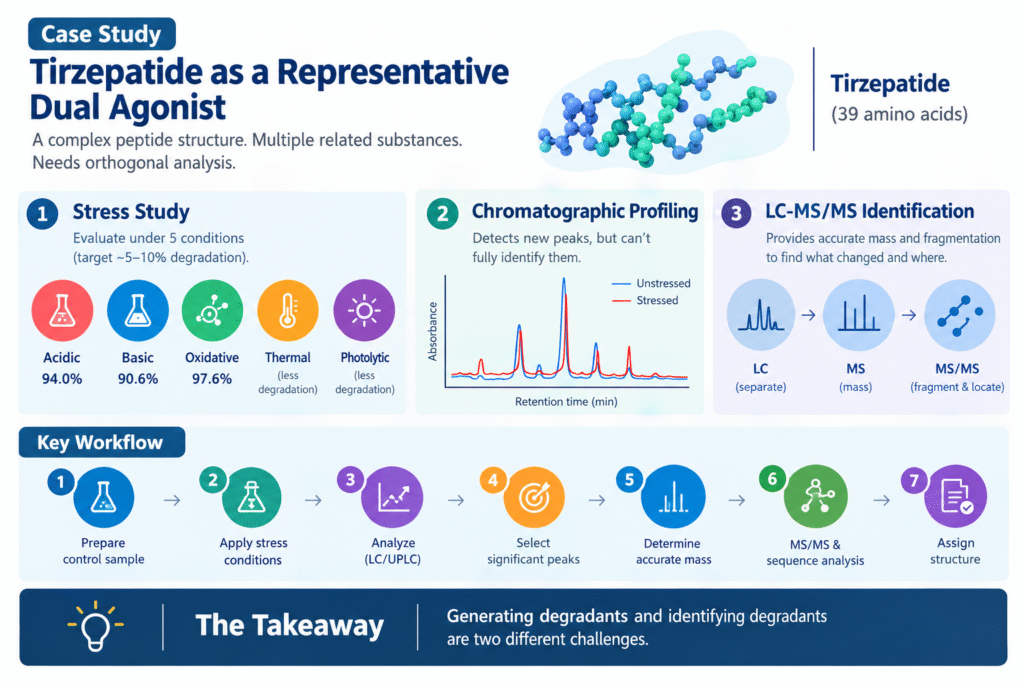
Tirzepatide is a useful representative case for GIP/GLP-1 dual agonist forced degradation because its complex peptide structure can generate multiple related substances that require orthogonal analytical techniques to characterize properly.
A 2026 study presented at the Pharmaceutical Society of Korea evaluated tirzepatide under acidic, basic, oxidative, accelerated, and photolytic conditions, deliberately targeting roughly 5–10% API degradation to generate meaningful degradants without excessive secondary decomposition. The study reported remaining tirzepatide of approximately:
- 94.0% after acidic stress
- 90.6% after basic stress
- 97.6% after oxidative stress
with substantially less degradation observed under the accelerated and photolytic conditions tested. Notably, the researchers found that conventional HPLC resolution was insufficient to fully separate the parent from some degradant peaks — which pushed the investigation toward LC-MS/MS for definitive characterization.
This is the central lesson of the case study: generating degradants and identifying degradants are two different analytical challenges. A chromatogram can tell you something changed; only mass spectrometry and fragmentation data can tell you what changed and where.
Step 1: Designing the Stress Study
The first step is selecting stress conditions that generate measurable, interpretable degradation without triggering excessive secondary decomposition. A practical workflow looks like this:
- Prepare an unstressed control sample
- Select acid, base, oxidative, thermal, and photolytic conditions
- Run preliminary experiments to determine suitable exposure time and intensity
- Target controlled degradation (commonly 5–20% loss) rather than destroying the parent
- Quench or neutralize samples where appropriate
- Analyze stressed and unstressed samples using the same method
- Identify new or increasing chromatographic peaks
- Select significant degradants for mass-spectrometric characterization
Over-stressing the molecule risks generating secondary products that obscure the primary degradation pathway — the tirzepatide literature reinforces why preliminary optimization matters before committing to a full stress panel.
Step 2: Chromatographic Profiling
RP-HPLC or UPLC is the first-line tool for determining whether stress produces new species and whether the method separates them from the parent. A typical comparison evaluates:
- Parent peak area and mass balance
- New degradation peaks and their relative abundance
- Retention-time shifts
- Peak resolution and purity
- Consistency of trends across stress conditions
Published work on tirzepatide and semaglutide has shown that forced degradation reliably generates chromatographically distinguishable products under acid, base, oxidative, thermal, and photolytic stress. But chromatographic separation alone generally can’t establish the chemical structure of an unknown peptide-related impurity — which is where LC-MS becomes essential.
Step 3–4: LC-MS Screening and LC-MS/MS Structural Identification
LC-MS provides the molecular-mass data needed to connect an unknown chromatographic peak with a candidate chemical modification; LC-MS/MS then moves the investigation from “what is the mass difference?” to “where is the modification located?”
A structural-identification workflow typically includes:
- Detect the degradant by LC and determine its accurate molecular mass
- Compare the measured mass against the theoretical parent mass
- Identify plausible chemical modifications from the mass shift
- Perform MS/MS fragmentation (HCD/CID)
- Compare fragment ions against the expected peptide sequence
- Localize the modified residue or region
- Evaluate alternative structural explanations
- Assign a confidence level based on the total weight of evidence
Peptides commonly generate multiple charge states in electrospray ionization, so spectral deconvolution is needed before the molecular mass can be compared meaningfully. Recent tirzepatide research reported oxidative species with mass shifts consistent with oxidation-related modification, alongside at least one unknown species that required further MS/MS work for full characterization. FDA guidance for synthetic peptides similarly emphasizes high-resolution UHPLC-HRMS as the standard for detecting and characterizing peptide-related impurities.
What a Mass Shift Can (and Can’t) Tell You
| Observation | Possible Interpretation* |
|---|---|
| Parent − fragment mass | Truncation or cleavage |
| Mass increase consistent with oxygen incorporation | Oxidation |
| Mass change from water loss/gain | Hydrolysis-related chemistry |
| Changes localized to susceptible residues | Site-specific modification |
| Multiple related molecular forms | Isomerization or heterogeneous degradation |
| High-molecular-weight species | Aggregation or association |
*A mass shift is evidence, not proof — confirmation requires MS/MS, chromatographic, and orthogonal data together. FDA materials recognize truncated, deamidated, isomerized, oxidized, and mismatched disulfide-linked variants as common peptide degradation forms, with HPLC, mass spectrometry, and peptide mapping each contributing part of the picture.
3: Why HPLC Alone Isn’t Enough
A conventional UV-based chromatogram can confirm degradation occurred, quantify how much, and show whether products are separated — but it can’t determine molecular mass, pinpoint which residue changed, or distinguish oxidation from cleavage from isomerization. The 2026 tirzepatide study is a direct illustration: conventional HPLC didn’t fully resolve some degradants from the API, making LC-MS/MS the necessary next step for precise characterization. This is precisely why ResolveMass pairs its forced degradation and photostability studies with high-resolution mass spectrometry as standard practice, rather than treating chromatography as a stand-alone endpoint.
Key Analytical Challenges
The core challenge in GIP/GLP-1 dual agonist forced degradation is that related degradation species can be chemically similar, making them difficult to separate, detect, and structurally assign with a single technique.
- Multiple charge states — peptides ionize into several charge states, requiring careful spectral deconvolution
- Low-level degradants — some products form at low abundance and demand sensitive detection
- Co-eluting species — related variants can share retention characteristics, complicating interpretation
- Secondary degradation — over-stressing generates products unrelated to the primary pathway
- Isomeric degradants — species with near-identical mass need MS/MS and chromatographic evidence to distinguish
- Interpretation risk — a mass difference alone is not automatic proof of a specific structure
4: Building a Strong Degradant Identification Package
A defensible degradant identification package connects chromatographic, mass-spectrometric, and structural evidence into one traceable line of reasoning.
| Attribute | Evidence Generated |
|---|---|
| Stress condition | Defines the degradation pathway being challenged |
| Retention time | Links the LC peak to a detected species |
| Relative abundance | Establishes the significance of the degradant |
| Accurate mass | Supports molecular formula/modification |
| Mass difference | Suggests a potential transformation |
| MS/MS fragments | Provides sequence/site information |
| Peptide mapping | Helps localize the modification |
| Proposed structure | Integrates all analytical evidence |
| Confidence level | Communicates the strength of the assignment |
| Degradation pathway | Connects the product to its stress mechanism |
For regulated development, this strategy should also be considered alongside applicable impurity guidance — FDA’s impurity guidance addresses reporting, identification, and qualification of degradation products, while ICH Q3A/Q3B cover impurity considerations for relevant drug substances and products.
5: How ResolveMass Laboratories Supports Degradant Characterization
ResolveMass Laboratories applies an integrated chromatographic and mass-spectrometric strategy to help peptide and biologic development teams investigate degradation products with structural-level confidence, not just peak-area percentages.
For a GIP/GLP-1 dual agonist project, a typical analytical program is built around:
- Forced degradation study design and stress-condition optimization
- Stability-indicating chromatographic method development
- LC-MS impurity screening and accurate-mass measurement
- LC-HRMS characterization and MS/MS fragmentation
- Peptide mapping and degradant structural interpretation
- Comparative impurity profiling and analytical troubleshooting
- Data interpretation to support development and CMC activities
This same evidence-based approach extends across ResolveMass’s broader peptide and biosimilar portfolio, including forced degradation testing for biosimilars, forced degradation studies for biosimilars, and dedicated biosimilar forced degradation study programs, as well as forced degradation of biosimilars work spanning monoclonal antibodies and fusion proteins. For small-molecule injectables, similar stress-testing principles apply in programs like forced degradation dexamethasone, and for generic submissions, forced degradation studies for ANDA support reverse-engineering and stability-indicating method validation.
The emphasis throughout is evidence-based structural assignment — never assigning a degradation mechanism from retention time or an isolated mass shift alone, consistent with the growing regulatory reliance on high-resolution MS for peptide impurity characterization.
6: Key Takeaways from the GIP/GLP-1 Dual Agonist Forced Degradation Case Study
- Controlled stress is essential. Excessive stress creates secondary degradation that complicates interpretation.
- Chromatography provides the first level of evidence — whether new species form and whether they separate from the parent.
- HRMS adds molecular-level information, revealing candidate chemical modifications through accurate mass.
- MS/MS adds structural evidence, localizing modifications within the peptide sequence.
- Orthogonal techniques build confidence — no single measurement should be treated as definitive proof on its own.
- The resulting degradation map drives method development, challenging and demonstrating the stability-indicating capability of the analytical method.
- This approach matters most for complex peptides. Recent tirzepatide studies show both the value of forced degradation and the limits of conventional chromatography once complex related substances are present.
Conclusion:
GIP/GLP-1 Dual Agonist Forced Degradation gives development teams a systematic way to reveal degradation pathways, generate structurally relevant degradants, and stress-test stability-indicating methods for complex peptide therapeutics. As the tirzepatide case study shows, combining forced degradation with LC/UPLC separation, high-resolution MS, MS/MS fragmentation, and peptide mapping delivers far deeper insight than chromatographic monitoring alone — and that insight feeds directly into formulation decisions, stability strategy, and CMC documentation.
Frequently Asked Questions:
Tirzepatide provides a useful example of how a GIP/GLP-1 dual agonist can be evaluated under different stress conditions. Published analytical work demonstrates the value of combining chromatographic profiling with mass spectrometry when conventional chromatographic separation does not provide sufficient information for structural characterization.
Degradants may be prioritized based on factors such as:
– Relative abundance
– Increase during specific stress conditions
– Potential safety or quality significance
– Persistence during stability studies
– Chromatographic behavior
– Regulatory relevance
– Ability to distinguish primary from secondary degradation products
Amino acids such as methionine, tryptophan, cysteine, and, under some conditions, tyrosine and histidine can be susceptible to oxidative modification. LC-MS/MS can help determine whether oxidation has occurred and, with suitable fragmentation evidence, identify its location.
Deamidation can produce a small molecular-mass change and may also cause a retention-time shift. LC-MS/MS and peptide mapping can provide additional evidence to distinguish deamidation from other modifications and help localize the affected residue.
Cleavage products can often be investigated by comparing their measured molecular masses with expected fragments of the parent sequence. MS/MS fragmentation and peptide mapping can provide sequence-specific evidence supporting the proposed cleavage site.
When two degradants co-elute chromatographically, high-resolution MS can help distinguish their molecular masses. If they have similar or identical masses, targeted MS/MS, alternative chromatographic conditions, or orthogonal analytical techniques may be needed to resolve and characterize them.
Reference
- Min JS, Jo SJ, Lee S, Kim DY, Kim DH, Lee CB, Bae SK. A comprehensive review on the pharmacokinetics and drug− drug interactions of approved GLP-1 receptor agonists and a dual GLP-1/GIP receptor agonist. Drug design, development and therapy. 2025 Dec 31:3509-37.https://www.tandfonline.com/doi/abs/10.2147/DDDT.S506957
- Khalil HA, Hassanein NA, El-Yazbi AF, Mahgoub H. A multimodal HPLC stability indicating approach for the estimation of Semaglutide and Tirzepatide in bulk, pharmaceutical dosage forms, and rat plasma: a six-edged sustainability appraisal. BMC chemistry. 2026 Jan 27;20(1):31.https://link.springer.com/article/10.1186/s13065-025-01716-7
- Graf C, Reuter J, Rüggeberg S, Mohr S, Petri J, Gelinas S, Niederhaus B, Werner U, Strebe N, Zein ZE, Usener D. Next-Generation GLP-1 Agonist Bioassays: Integrating Precision with Biological Relevance. International Journal of Molecular Sciences. 2026 Sep 10;27(18):8068.https://www.mdpi.com/1422-0067/27/18/8068
About the Author


