

Introduction
After the issuance of a Complete Response Letter (CRL) for a Generic ANDA, the applicant enters a critical regulatory period in which it must carefully evaluate the FDA’s findings, determine whether a post-CRL clarification teleconference should be requested within 10 calendar days, implement the required scientific or manufacturing remediation, and submit a formal amendment within one year. A Complete Response Letter (CRL) for a Generic ANDA signifies that the U.S. Food and Drug Administration (FDA) has concluded its review cycle but is unable to approve the application in its current form because of identified deficiencies involving Chemistry, Manufacturing, and Controls (CMC), bioequivalence (BE), labeling, or facility compliance.
The commercial consequences of receiving a Complete Response Letter (CRL) for a Generic ANDA can be substantial because the outcome directly influences market entry schedules, cash flow forecasts, and the overall return on investment. In the highly competitive generic pharmaceutical sector, regulatory delays can reduce the commercial benefits associated with Hatch-Waxman incentives, including 180-day first-to-file exclusivity. As competing Abbreviated New Drug Applications (ANDAs) continue moving through the Office of Generic Drugs (OGD) assessment pipeline, an extended review period may increase the possibility of shared exclusivity or greater market competition after launch, potentially contributing to rapid price erosion. In addition, prolonged review cycles may overlap with ongoing Paragraph IV patent litigation timelines, which can result in applicants approaching or exhausting statutory 30-month stays before obtaining an approvable application status. Therefore, managing the post-CRL stage requires a structured, multi-dimensional strategy that combines regulatory precision under the Generic Drug User Fee Amendments (GDUFA III) with specialized technical remediation, frequently supported by Contract Development and Manufacturing Organization (CDMO) capabilities.
Explore peptide drug development CDMO services to understand how integrated development and technical support can strengthen complex pharmaceutical programs.
Share via:
Quick Summary:
- A Complete Response Letter (CRL) for a Generic ANDA means the FDA identified deficiencies that prevent approval, commonly involving CMC, bioequivalence, labeling, or facility compliance.
- After a CRL, applicants should follow the GDUFA III post-CRL roadmap: review findings, seek clarification when needed, implement remediation, and submit the required amendment within the applicable timeframe.
- A post-CRL clarification teleconference must be requested within 10 calendar days. It provides an opportunity to clarify FDA comments before preparing the formal response.
- Other regulatory mechanisms include Requests for Reconsideration (RfR) within 7 days and Controlled Correspondence, with FDA response goals of 60 days for Level 1 and 120 days for Level 2.
- Amendment classification directly affects review timing: Minor Amendments generally have a 3-month goal, while Major Amendments can have 6-, 8-, or 10-month goals, depending on priority status and whether a PAI is required.
- Major technical remediation may address CMC impurities and analytical methods, nitrosamine risks, API characterization, dissolution/BE issues, formulation changes, facility deficiencies, technology transfer, scale-up, and CAPA/QMS improvements.
- Specialized CDMO support can provide advanced analytical testing, formulation and process development, manufacturing scale-up, cGMP remediation, and regulatory expertise to build a scientifically supported post-CRL response and move the ANDA toward approval.
Post-CRL Procedural Roadmap Under GDUFA III
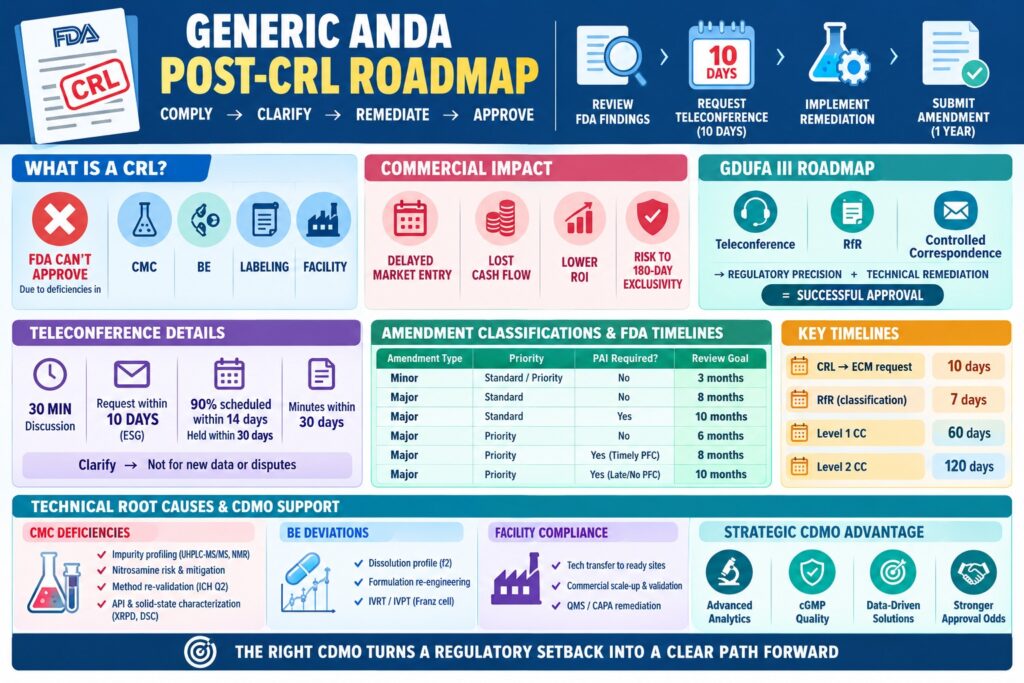
The post-CRL procedural roadmap under GDUFA III establishes structured administrative pathways—including post-CRL clarification teleconferences, requests for reconsideration, and controlled correspondence—that allow applicants to obtain clarification regarding FDA comments and better understand the agency’s remediation expectations. A clear understanding of these procedural mechanisms helps generic sponsors avoid compromising review goal dates or losing regulatory rights while addressing deficiencies and preparing the required remediation.
Post-CRL Clarification Teleconferences for a Generic ANDA
A post-CRL clarification teleconference is a 30-minute discussion between the FDA review team and the applicant that is intended to clarify particular deficiencies identified in a Complete Response Letter (CRL) for a Generic ANDA before the applicant submits a formal amendment. Under GDUFA III performance commitments, applicants are required to submit a written request through the Electronic Submissions Gateway (ESG) within 10 calendar days after the CRL is issued.
The central purpose of this teleconference is to resolve unclear reviewer comments or obtain additional understanding of the scope of the requested data. It is not intended to serve as a forum for disputing the scientific validity of FDA findings or presenting new data packages. The FDA commits to providing a scheduled date for 90% of qualifying requests within 14 calendar days after receipt and conducting the teleconference within 30 days of receipt. Following the teleconference, the agency provides official and finalized meeting minutes within 30 days, creating the authoritative record that can be used to develop the subsequent amendment strategy.
Requests for Reconsideration and Controlled Correspondence
Requests for Reconsideration and Controlled Correspondence represent separate formal regulatory mechanisms that allow ANDA applicants to address administrative classifications or obtain specific scientific and regulatory guidance after a CRL. These mechanisms can help prevent misunderstandings concerning submission categories and provide greater clarity regarding regulatory expectations before resubmission.
If an applicant believes that the FDA has incorrectly classified a CRL response amendment—for example, by categorizing a Minor Amendment as a Major Amendment—the applicant may submit a Request for Reconsideration (RfR) within seven calendar days of the FDA action date. A change in classification to a Minor Amendment can result in a shorter review goal date. In situations where clarification is required regarding broader regulatory matters or interpretations of specific guidance, applicants may use Controlled Correspondence. Under GDUFA III, Level 1 Controlled Correspondence has a 60-day FDA response goal, while Level 2 Controlled Correspondence, which involves complex multi-discipline review, has a 120-day response goal.
| Administrative Mechanism | Request Timeline | FDA Performance Goal Date | Primary Purpose |
|---|---|---|---|
| Post-CRL Clarification Teleconference | Within 10 calendar days of CRL issuance | Scheduled within 14 days; held within 30 days | Clarify ambiguous reviewer comments and deficiency scope |
| Request for Reconsideration (RfR) | Within 7 calendar days of FDA action | Priority internal agency evaluation | Dispute amendment classification or standard/priority status |
| Level 1 Controlled Correspondence | Post-action or during development | Response within 60 calendar days | General scientific or regulatory inquiries |
| Level 2 Controlled Correspondence | Post-action or during development | Response within 120 calendar days | Complex technical queries requiring inter-discipline review |
Understanding Amendment Classifications and FDA Review Timelines for a Complete Response Letter (CRL) for a Generic ANDA
A response submitted to a Complete Response Letter (CRL) for a Generic ANDA is categorized as either a Major Amendment or a Minor Amendment. This classification determines whether the FDA review clock corresponds to 3 months, 6 months, 8 months, or 10 months under GDUFA III performance goals.
The FDA determines the amendment category according to the scientific complexity of the proposed response and whether a Pre-Approval Inspection (PAI) of a manufacturing facility, testing facility, or API vendor site is necessary. Minor Amendments generally involve relatively straightforward changes, including labeling alignment, limited analytical method modifications, or basic administrative clarifications. The FDA has a commitment to review 90% of Minor Amendments within 3 months of submission.
Major Amendments, by comparison, involve more complex technical activities. These may include conducting new bioequivalence clinical studies, implementing substantial manufacturing process changes, performing batch scale-ups, or submitting extensive stability data packages. For standard Major Amendments that do not require a PAI, the FDA review goal date is 8 months. When a PAI is required, the review goal date extends to 10 months. Under priority review pathways, Major Amendments without a PAI have a 6-month goal date. Priority Major Amendments requiring a PAI have an 8-month goal date when a Pre-Facility Correspondence is submitted at least 60 days before the amendment, or a 10-month goal date when facility notifications are submitted late.
| Amendment Type | Priority Status | Pre-Approval Inspection (PAI) Required? | GDUFA III Review Goal Clock |
|---|---|---|---|
| Minor Amendment | Standard or Priority | No | 3 Months |
| Major Amendment | Standard | No | 8 Months |
| Major Amendment | Standard | Yes | 10 Months |
| Major Amendment | Priority | No | 6 Months |
| Major Amendment | Priority | Yes (With Timely PFC) | 8 Months |
| Major Amendment | Priority | Yes (Late/No PFC) | 10 Months |
Technical Root Causes and CDMO Support Options After a Complete Response Letter (CRL) for a Generic ANDA
Technical factors contributing to an ANDA CRL commonly include Chemistry, Manufacturing, and Controls (CMC) deficiencies, bioequivalence deviations, and facility inspection non-compliance. These issues can be systematically addressed through specialized CDMO support options. Contract Development and Manufacturing Organizations offer the technical infrastructure, analytical capabilities, manufacturing resources, and regulatory experience needed to investigate deficiencies and implement appropriate corrective measures.
Learn about the differences between peptide CDMO and CRO models when evaluating external technical and development support.
CMC Deficiencies and Advanced Impurity Profiling
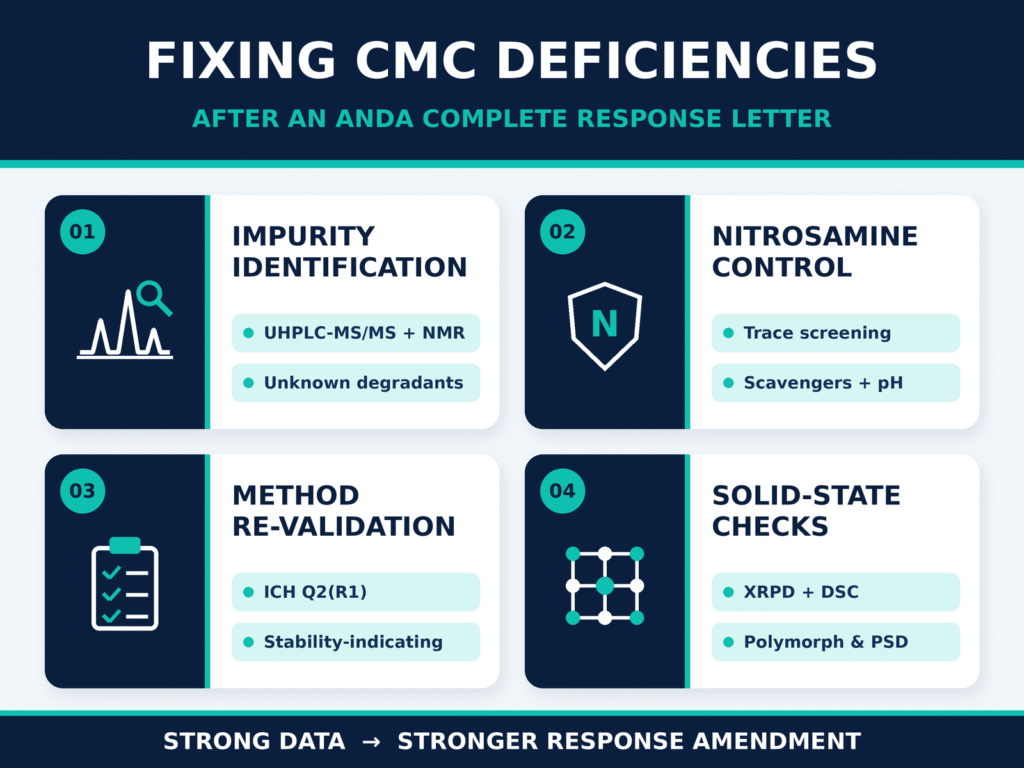
CMC deficiencies are among the primary scientific contributors to generic ANDA CRLs. Addressing these deficiencies may require CDMO support for advanced analytical characterization, nitrosamine risk evaluations, and re-validation of stability-indicating methods.
Explore peptide analytical characterization services for advanced approaches to identity, purity, impurity profiling, and structural characterization.
When an ANDA receives CMC-related objections, CDMOs can provide targeted analytical and formulation capabilities designed to address specific FDA requests:
- High-Resolution Impurity Elucidation: Using ultra-high-performance liquid chromatography coupled with tandem mass spectrometry (UHPLC-MS/MS) and nuclear magnetic resonance (NMR) spectroscopy to isolate, identify, and quantify unknown degradation products that exceed ICH Q3A/B identification thresholds.
- Nitrosamine Risk Assessment and Mitigation: Conducting forced degradation studies, trace-level screening, and confirmatory testing for N-nitrosamine impurities, followed by formulation modifications, such as the incorporation of scavengers or adjustment of micro-environmental pH, to reduce nitrosamine formation.
- Method Re-Validation: Re-validating stability-indicating analytical procedures in accordance with ICH Q2(R1) guidelines while establishing appropriate precision, linearity, range, and robustness under different operating conditions.
- API and Solid-State Characterization: Evaluating active pharmaceutical ingredient polymorph stability, particle size distribution (PSD), and surface morphology through analytical techniques such as X-ray powder diffraction (XRPD) and differential scanning calorimetry (DSC).
Bioequivalence Deviations and In Vitro Dissolution Enhancement
Remediation of bioequivalence failures depends on CDMO expertise in comparative f2 dissolution profile modeling, formulation re-engineering, and in vitro permeation testing (IVPT) to establish bio-sameness.
To address BE deficiencies identified in a CRL while potentially avoiding the substantial expense associated with multi-million-dollar clinical re-study programs, CDMOs can apply sophisticated in vitro predictive approaches:
- Dissolution Profile Optimization: Conducting comparative f2 dissolution profile testing using physiologically relevant media, including pH 1.2, 4.5, 6.8, and QC media, to bring the release kinetics of the test product into closer alignment with the Reference Listed Drug (RLD).
- Formulation Re-Engineering: Adjusting excipient ratios, disintegrant selection, or binder levels to address bio-inequivalence associated with delayed or incomplete drug release.
- In Vitro Release and Permeation Testing (IVRT/IVPT): Employing Franz diffusion cell apparatuses to conduct IVRT and IVPT for topical and complex dosage forms, generating bio-sameness data packages designed to meet FDA performance standards.
For specialized dosage-form development, review CDMO services for generic ophthalmic drug products and related analytical development capabilities.
Facility Compliance and Pre-Approval Inspection Remediation
Facility-related CRL deficiencies may be addressed by transferring manufacturing or testing activities to an audit-ready CDMO facility or by implementing comprehensive cGMP CAPA plans to address Official Action Indicated (OAI) inspection statuses.
When facility readiness problems or inspection findings interfere with ANDA approval, CDMOs can provide several operational solutions:
- Technology Transfer to Alternate Sites: Conducting rapid technology transfer of analytical methods or drug manufacturing processes to CDMO facilities with established FDA inspection histories, including No Action Indicated / Voluntary Action Indicated statuses.
- Commercial Batch Scale-Up and Validation: Producing full commercial-scale process validation batches under controlled cGMP conditions to replace non-compliant or sub-scale historical batches.
- Quality Management System Remediation: Strengthening laboratory data integrity frameworks, instrument qualification programs, and CAPA systems so that facility operations are aligned with current FDA expectations.
Learn more about peptide API scale-up and the technical considerations involved in moving from development-scale work toward larger-scale manufacturing.
Strategic Advantage of High-Capability CDMO Partnerships
Working with an advanced CDMO can support post-CRL remediation by replacing uncertain troubleshooting approaches with high-resolution empirical data, structured technical investigations, and comprehensive quality oversight.
Engaging a specialized contract laboratory or CDMO following receipt of a CRL can convert a reactive regulatory challenge into a more structured remediation strategy. Advanced analytical testing facilities, including ResolveMass Laboratories Inc., can support generic sponsors through specialized mass spectrometry, trace impurity quantitation, and comprehensive CMC capabilities. Through rigorous scientific methodologies and cGMP-compliant practices, technical partners can assist generic applicants in developing complete and scientifically supported response amendments designed to address FDA requirements under GDUFA III review standards.
Explore peptide CDMO scale-up services for development programs that require controlled transition from laboratory-scale work to larger manufacturing operations.
Conclusion
Successfully managing the post-issuance stage of a Complete Response Letter (CRL) for a Generic ANDA requires the coordinated application of regulatory compliance and scientifically robust remediation strategies. Conducting post-CRL clarification teleconferences, appropriately managing amendment classifications under GDUFA III, and utilizing CDMO capabilities to address CMC and BE-related technical deficiencies can help generic sponsors manage regulatory timelines and work toward final approval. Generic pharmaceutical applicants requiring high-resolution analytical remediation, impurity characterization, or comprehensive CMC resubmission support can consult technical specialists through the ResolveMass Contact Page.
Frequently Asked Questions (FAQs)
A Refuse-to-Receive (RTR) decision occurs during the initial filing review when an application does not meet required submission criteria or contains missing threshold information. A Complete Response Letter (CRL), in contrast, is issued after the FDA has completed its substantive review and identified deficiencies that prevent approval. An RTR resubmission may involve a new GDUFA user fee, whereas a CRL response is submitted as an amendment to the existing application.
A post-CRL clarification teleconference should be requested in writing through the Electronic Submissions Gateway within 10 calendar days after the CRL is issued. This discussion allows the applicant to clarify FDA comments and better understand the deficiencies that must be addressed. Requests submitted after the specified period may not receive the same GDUFA III performance commitment.
Under the stated GDUFA III performance goals, the FDA review goal for a Minor Amendment is 3 months from the date the amendment is submitted. This classification generally applies to responses involving relatively limited scientific, administrative, or labeling-related changes. The review goal does not change based on whether the original ANDA was under standard or priority status.
When a Pre-Approval Inspection (PAI) is required, the review timeline for a standard Major Amendment can increase from 8 months to 10 months from the amendment submission date. For a priority Major Amendment, the applicable goal can be 8 months when the required Pre-Facility Correspondence is submitted on time. Delayed or absent facility notification can result in a longer review goal.
An applicant that disagrees with the FDA’s amendment classification may submit a Request for Reconsideration (RfR) within seven calendar days of the relevant FDA action. The request can ask the agency to reassess whether the proposed response requires the level of review associated with a Major Amendment. The FDA then evaluates the request and determines whether the classification should remain unchanged or be revised.
Common CMC deficiencies can involve inadequate nitrosamine risk assessments, insufficient characterization of degradation impurities, stability concerns, and weaknesses in analytical method validation. Additional issues may include inadequate control of solid-state polymorphs, incomplete characterization, and container-closure integrity concerns. The specific deficiencies vary according to the product and FDA review findings.
A CDMO can support BE remediation through comparative f2 dissolution testing, formulation optimization, particle size distribution adjustments, and IVRT/IVPT studies where applicable. These activities help identify formulation or drug-release factors that may contribute to bioequivalence failure. The resulting data can support formulation refinement and help determine whether additional studies are necessary.
When a manufacturing facility receives an Official Action Indicated (OAI) inspection status, unresolved inspectional deficiencies can prevent the ANDA from receiving final approval. The applicant may need to implement appropriate remediation and demonstrate that the deficiencies have been adequately addressed. Depending on the circumstances, transferring manufacturing activities to another compliant facility may also be considered.
A response amendment submitted to address a Complete Response Letter (CRL) is generally not treated as a new ANDA filing that requires payment of a new ANDA application fee. The applicant submits the response within the existing application framework. However, applicable FDA fee requirements can depend on the specific submission and regulatory circumstances.
Reference:
- U.S. Food and Drug Administration. (2022). Post-complete response letter clarification teleconferences between FDA and ANDA applicants under GDUFA: Guidance for industry (Revision 1). U.S. Department of Health and Human Services, Center for Drug Evaluation and Research. FDA guidance PDF
- U.S. Food and Drug Administration. (2022). ANDA assessment program: GDUFA III performance goals and program enhancements. U.S. Department of Health and Human Services. FDA official page
- U.S. Food and Drug Administration. (n.d.). GDUFA III controlled correspondence enhancements. U.S. Department of Health and Human Services. FDA official page
- U.S. Food and Drug Administration. (2022). Generic drug user fee amendments: GDUFA III commitment letter. U.S. Department of Health and Human Services. FDA guidance PDF
- U.S. Food and Drug Administration. (2024, September). ANDA submissions: Amendments to abbreviated new drug applications under GDUFA: Guidance for industry. U.S. Department of Health and Human Services, Center for Drug Evaluation and Research. FDA official guidance page
Get In Touch With Us
About The Author


