

Introduction
Quantitative characterization of active pharmaceutical ingredients (APIs) requires accurate differentiation between total lyophilized mass and the true active drug payload. Net Peptide Content and Amino Acid Analysis testing services provide the foundational analytical framework required to establish active payload stoichiometry, satisfy cGMP release specifications, and prevent clinical dosing errors. In biopharmaceutical manufacturing, relying solely on chromatographic purity profiles introduces significant quality control risks because non-absorbing salts, volatile organic solvents, and bound water are completely omitted from UV absorbance chromatograms. Determining the absolute net active mass ensures precise formulation during drug product fill-finish operations, validates scale-up chemistry, and maintains compliance with global regulatory standards. Analytical characterization platforms, such as those provided by ResolveMass Laboratories Inc., employ validated quantitative workflows to evaluate peptide API batches, support lot release testing, and fulfill regulatory requirements.
Share via:
Quick Summary:
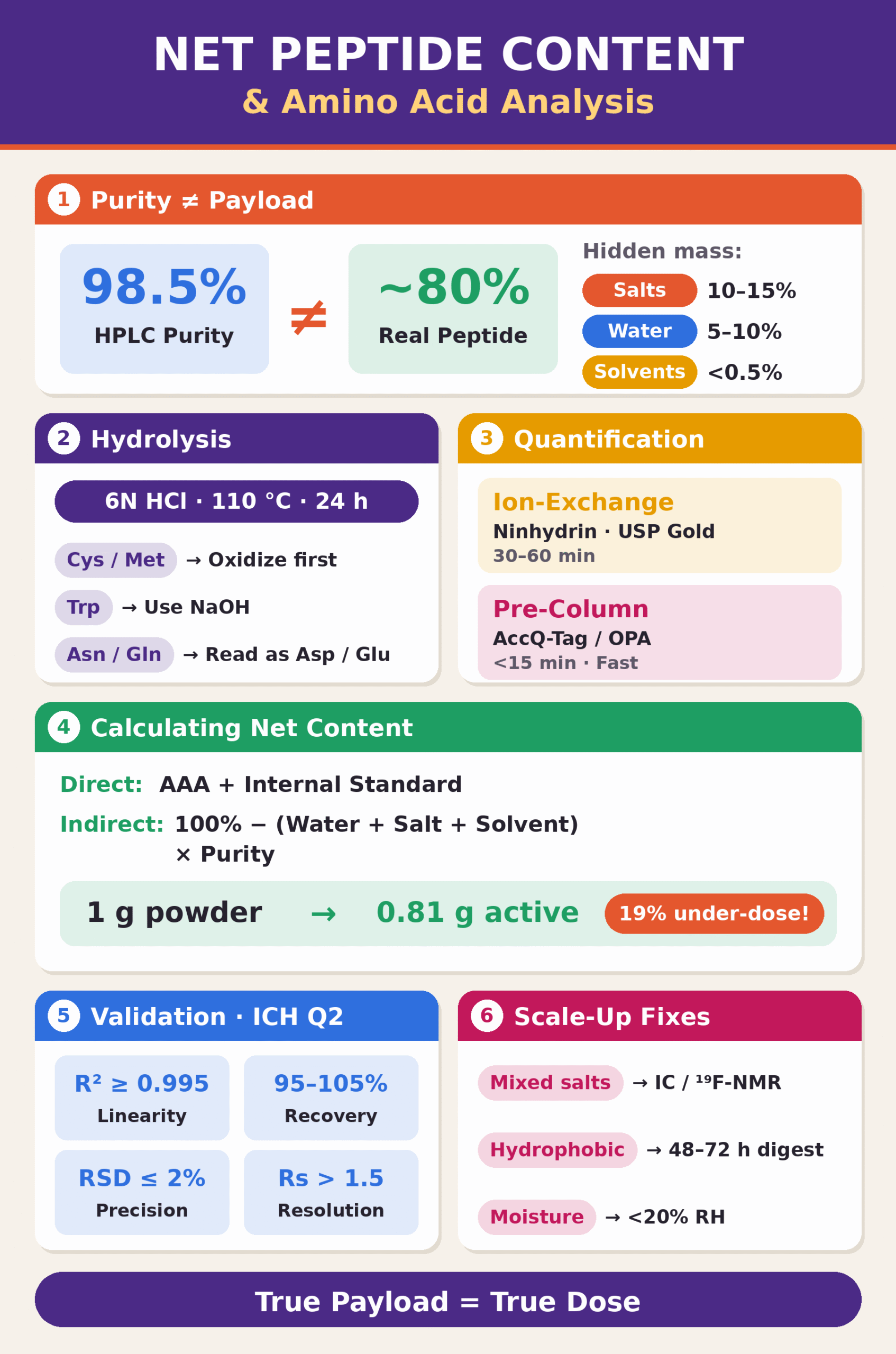
- Purity is not the same as payload: HPLC purity only compares the target peptide to other peptide impurities. It cannot see salts, water or solvents, so a batch that is 98.5% pure may contain only 75–80% real peptide by weight.
- Where the hidden mass comes from: Peptide synthesis leaves TFA counterions (often swapped for acetate or chloride) on basic residues, and the powder absorbs moisture. Together these add about 10–15% salts, 5–10% water and trace solvents.
- Hydrolysis is the first step: Standard digestion uses 6N HCl at 110 °C for 24 hours. Fragile residues need special handling: Cys/Met are oxidized first, Trp needs alkaline hydrolysis, and Asn/Gln are reported together with Asp/Glu.
- Two main ways to measure amino acids: Post-column ion-exchange with ninhydrin is the USP/EP reference method and resists matrix interference, but takes 30–60 minutes. Pre-column derivatization (AccQ-Tag, OPA, FMOC) is faster (under 15 minutes) and more sensitive.
- Two ways to calculate net content: The direct method sums the recovered amino acids, using an internal standard. The indirect mass balance method subtracts water, counterions and solvents, then multiplies by purity. In a GLP-1 example, 1 g of powder held only 0.81 g of active peptide, which would mean an 18.7% under-dosing error if uncorrected.
- Validation follows ICH Q2(R1) and USP/EP 2.2.56: Key criteria are linearity R² ≥ 0.995, recovery of 95–105%, RSD ≤ 2% and resolution Rs > 1.5.
- Scale-up challenges and fixes: Mixed salt forms are tracked by IC or ¹⁹F-NMR. Hard-to-cleave hydrophobic sequences need 48–72 hour or microwave digestion. Moisture uptake during weighing is controlled by handling samples below 20% relative humidity.
Distinguishing Chromatographic Purity from Net Peptide Content and Amino Acid Analysis
Chromatographic purity evaluates relative sequence integrity, whereas Net Peptide Content and Amino Acid Analysis quantify the absolute mass percentage of target peptide material within a bulk lyophilized drug substance. Reverse-Phase High-Performance Liquid Chromatography (RP-HPLC) coupled with UV detection at 214 nm or 220 nm measures the target peptide peak area relative to truncation sequences, deletion peptides, and diastereomers. However, RP-HPLC cannot detect non-chromophoric components, including counterions, residual water, or organic solvents.
During solid-phase peptide synthesis (SPPS), cleavage and deprotection steps utilize strong acids such as trifluoroacetic acid (TFA), leaving basic amino acid residues (Lysine, Arginine, Histidine) and the N-terminus as trifluoroacetate salts. Downstream purification protocols may retain TFA or exchange it for acetate or chloride salts. Furthermore, hydrophilic side chains attract atmospheric moisture, generating a bulk powder that contains significant non-peptide mass. Consequently, an API batch with a reported RP-HPLC purity of 98.5% may exhibit a Net Peptide Content of only 75% to 80% by weight, with the remaining mass consisting of counterions (10–15%), residual water (5–10%), and trace organic solvents (<0.5%). Utilizing raw lyophilisate weight rather than corrected net peptide payload can lead to significant under-dosing during preclinical bioassays and clinical trials.
| Specification Parameter | Primary Analytical Method | Target Measured Entity | Role in Drug Substance Release |
|---|---|---|---|
| Chromatographic Purity | RP-HPLC / UHPLC-UV (214/220 nm) | Target sequence relative to peptide impurities | Ensures chemical identity and limits related substances |
| Net Peptide Content (NPC) | Quantitative Amino Acid Analysis (AAA) / EA | Absolute mass fraction of active peptide payload | Establishes active substance potency for accurate dosing |
| Counterion Content | Ion Chromatography (IC) / 19F-NMR | Stoichiometric mass of TFA, acetate, or chloride | Validates salt-exchange efficiency and regulatory limits |
| Residual Moisture | Karl Fischer Titration (USP) | Percentage of bound and free water | Controls physical stability and prevents hydrolytic degradation |
| Residual Organic Solvents | Headspace Gas Chromatography (HS-GC) | Volatile solvents (e.g., DMF, ACN, Piperidine) | Confirms process solvent removal per ICH Q3C guidelines |
For a broader assessment of the physical and chemical attributes that contribute to peptide API quality, see our Peptide Physicochemical Characterization Services.
Methodological Framework for Net Peptide Content and Amino Acid Analysis Protocols
Quantitative Net Peptide Content and Amino Acid Analysis protocols require complete cleavage of the peptide backbone into free amino acids, followed by chromatographic separation and optical or mass spectrometric detection. Method execution depends on precise hydrolysis conditions tailored to specific residue stability profiles and regulatory requirements.
Hydrolysis Strategies and Residue Recovery Dynamics
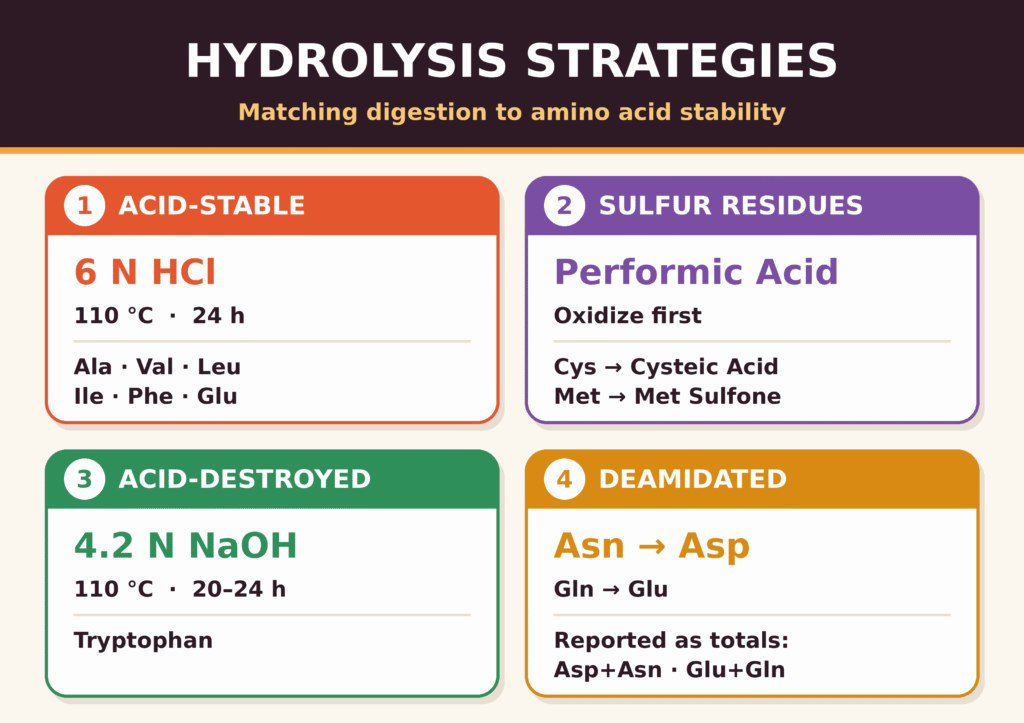
Acid hydrolysis serves as the standard preparation protocol for peptide APIs, typically utilizing 6 N HCl at 110 °C for 24 hours under an inert nitrogen or argon atmosphere to mitigate oxidative degradation. While this process quantitatively recovers acid-stable amino acids (such as Alanine, Valine, Leucine, Isoleucine, Phenylalanine, and Glutamic Acid), specialized pre-treatments or alternative hydrolysis chemistries are required for labile residues.
Acid-Stable Amino Acids: Standard 6 N HCl digestion yields quantitative release of non-polar Aliphatic, Aromatic, and acidic residues, providing reliable baseline metrics for total peptide mass calculations.
Sulfur-Containing Residues: Cysteine and Methionine undergo partial oxidation during standard acid hydrolysis. Performing performic acid oxidation prior to acid digestion quantitatively converts Cysteine to Cysteic Acid and Methionine to Methionine Sulfone, enabling accurate recovery analysis.
Acid-Destroyed Residues: Tryptophan undergoes rapid degradation under strong acid conditions. Quantitative recovery of Tryptophan requires alkaline hydrolysis utilizing 4.2 N NaOH at 110 °C for 20 to 24 hours.
Deamidated Residues: Asparagine and Glutamine undergo complete hydrolytic deamidation to Aspartic Acid and Glutamic Acid, respectively. Consequently, these residues are quantified as combined totals (Asp + Asn and Glu + Gln).
Chromatographic Quantification: Ion-Exchange vs. Pre-Column Derivatization
Following sample digestion, liberated amino acids are quantified through specialized liquid chromatography platforms. The two primary chromatographic methodologies used in cGMP testing environments differ in separation chemistry and derivatization timing.
Post-Column Ion-Exchange Chromatography (USP Method 1): Recognized as the pharmacopeial reference standard (USP, Ph. Eur. 2.2.56), this system separates non-derivatized amino acids on a cation-exchange column using a lithium or sodium citrate buffer gradient. Post-column reaction with ninhydrin reagent at 120 °C forms Ruhemann’s purple (measured at 570 nm) for primary amino acids and a yellow complex (measured at 440 nm) for secondary amino acids such as Proline. This technique is highly resistant to sample matrix interferences because unreacted species do not co-elute with target analytes.
Pre-Column Derivatization UHPLC Systems: Pre-column methodologies employ automated reagents—such as 6-aminoquinolyl-N-hydroxysuccinimidyl carbamate (AccQ-Tag), o-phthalaldehyde (OPA), or fluorenylmethyloxycarbonyl chloride (FMOC)—to form stable derivatives prior to reverse-phase UHPLC separation. Coupled with fluorescence or UV detection, pre-column derivatization provides rapid run times (<15 minutes) and picomole-level sensitivity, making it well-suited for high-throughput characterization.
| Operational Parameter | Post-Column Ion-Exchange (USP Method 1) | Pre-Column Derivatization UHPLC (AccQ-Tag / OPA) |
|---|---|---|
| Derivatization Stage | Post-column (following cation-exchange separation) | Pre-column (prior to reverse-phase separation) |
| Stationary Phase | Sulfonated polystyrene cation-exchange resin | Reverse-Phase C18 / Ethylene Bridged Hybrid (BEH) |
| Detection Mode | Vis Absorbance (570 nm primary, 440 nm secondary) | Fluorescence (Ex/Em) or UV Absorbance |
| Pharmacopeial Status | Standard gold reference method (USP / EP 2.2.56) | Validated alternative protocol (USP Method 2/5) |
| Matrix Susceptibility | Minimal; matrix components separate prior to reaction | Moderate; excess reagent artifacts require chromatographic control |
| Typical Run Duration | 30 to 60 minutes per sample | 10 to 18 minutes per sample |
Mathematical Determination and Mass Balance Equations for Net Peptide Content
Calculating Net Peptide Content requires applying validated mathematical models that transform raw chromatographic peak areas into absolute active drug substance mass. Laboratories utilize direct calculation via quantitative Amino Acid Analysis or indirect mass balance modeling.
Direct Calculation via Quantitative Amino Acid Analysis
Direct determination involves spiking the sample with a known concentration of an internal standard (e.g., Norleucine) prior to hydrolysis to correct for physical recovery losses. The absolute mass of the peptide payload is calculated using the molar concentrations of stable amino acids relative to their theoretical occurrence in the sequence.
Net Peptide Content (%) = (Σi=1k (Ci × MWresidue,i) / Msample) × 100
Where:
- Ci represents the experimentally measured molar quantity of stable amino acid i recovered from the hydrolyzed aliquot.
- MWresidue,i represents the molecular weight of amino acid residue i minus water (18.015 Da) lost during peptide bond formation.
- Msample represents the precise gross mass of bulk lyophilized powder weighed for analysis.
- k represents the total number of fully recovered, stable amino acids evaluated.
Indirect Mass Balance Calculation
The indirect mass balance methodology subtracts all non-peptide orthogonal impurities from total gross mass. This approach combines data from Karl Fischer titration (residual moisture), Ion Chromatography (counterions), and Headspace Gas Chromatography (residual organic solvents), scaled by the RP-HPLC chromatographic purity factor.
Net Peptide Content (%) = [100% − (% Moisture + % Counterions + % Residual Solvents)] × (% Chromatographic Purity / 100)
For analytical programs requiring additional structural confirmation beyond bulk peptide content measurements, complementary characterization strategies can provide orthogonal information about peptide structure and composition. See our 2D NMR for Peptide Characterization.
Representative GLP-1 API Batch Determination
Applying this orthogonal mass balance equation to a representative batch release dataset illustrates the relationship between raw powder weight and net payload:
- RP-HPLC Purity (220 nm): 98.40%
- Karl Fischer Water Content (USP): 5.80%
- TFA Counterion Content (Ion Chromatography): 11.20%
- Residual Organic Solvents (HS-GC): 0.40% (ACN and DMF)
Total Non-Peptide Impurities = 5.80% + 11.20% + 0.40% = 17.40%
Gross Peptide Component = 100.00% − 17.40% = 82.60%
Corrected Net Peptide Content = 82.60% × (98.40 / 100) = 81.28% (by weight)
In this scenario, 1.000 g of bulk lyophilized API contains exactly 0.8128 g of active target peptide. Formulating a drug product using gross weight without adjusting for this value would result in an 18.72% under-dosing error in finished dosage forms.
Regulatory Monographs and Validation Standards (USP and EP 2.2.56)
Regulatory standards for commercial peptide APIs mandate method validation in accordance with ICH Q2(R1) guidelines, alongside strict alignment with pharmacopeial monographs USP and EP 2.2.56. Compliance ensures that testing procedures yield reproducible results across clinical development and commercial manufacturing stages.
For additional context on regulatory expectations surrounding peptide analytical characterization, see our Regulatory Requirements for GLP-1 Peptide Characterization.
ICH Q2(R1) Validation Metrics for Quantitative Peptide API Testing
- Linearity: Calibration curves must achieve R2 ≥ 0.995 across 50%–150% target concentration range.
- Accuracy: Recovery across stable amino acids must fall within 95.0%–105.0% of theoretical values.
- Precision: Repeatability and intermediate precision must maintain RSD ≤ 2.0% for major peak areas.
- Specificity: Chromatographic resolution (Rs > 1.5) must be maintained between all adjacent residues.
Linearity and Dynamic Range: Analytical calibration curves generated using certified amino acid standard mixtures must demonstrate linearity (R2 ≥ 0.995) across 50% to 150% of nominal working concentrations.
Accuracy and Recovery: Method accuracy must be demonstrated through spike-recovery studies across standard reference materials, achieving mean recovery values between 95.0% and 105.0% for all stable amino acids.
System Precision: Assay repeatability and intermediate precision must yield a Relative Standard Deviation (RSD) of ≤ 2.0% across replicate injections.
Specificity and Resolution: Chromatographic conditions must maintain baseline separation (Resolution Rs > 1.5) for all primary amino acids, preventing co-elution with reagent artifacts or trace degradation products.
Quality Control Challenges and Mitigation Strategies in Peptide Scale-Up
Scaling peptide API production from laboratory development (1–10 grams) to commercial cGMP scales (1–100+ kilograms) introduces analytical challenges that directly impact Net Peptide Content and Amino Acid Analysis outcomes. Implementing appropriate mitigation strategies maintains analytical precision across expanding production volumes.
Counterion Heterogeneity and Salt Exchange Dynamics
Peptide APIs synthesized via solid-phase protocols initially retain trifluoroacetate counterions paired with basic side chains. Regulatory specifications often require converting TFA salts to acetate or chloride forms to minimize potential toxicity. Incomplete ion-exchange processing produces mixed-salt counterion profiles. Because trifluoroacetate (113 Da), acetate (59 Da), and chloride (35.5 Da) differ in formula weight, variable counterion ratios alter the overall mass balance of the API batch. Routine monitoring via Ion Chromatography or Fluorine-19 NMR quantifies counterion ratios to ensure accurate net payload calculations.
Detailed analytical considerations for peptide salt forms and related characterization can be reviewed through our Peptide Drug Substance vs. Drug Product Characterization.
Steric Resistance in Hydrophobic Sequences
Peptides containing contiguous hydrophobic amino acid sequences—such as Val-Val, Ile-Ile, or Leu-Val—exhibit steric hindrance that resists standard 6 N HCl digestion. Standard 24-hour hydrolysis may yield incomplete cleavage of these hydrophobic peptide bonds, leading to underestimated amino acid recoveries and inaccurate Net Peptide Content values. Validating extended hydrolysis durations (48 to 72 hours) or incorporating microwave-assisted acid digestion ensures complete cleavage of resistant hydrophobic domains.
Ambient Moisture Uptake During Micro-Weighing
Lyophilized peptide API powders with high proportions of charged or polar residues (such as Lysine, Arginine, Aspartic Acid, and Glutamic Acid) are highly hygroscopic. Exposure to ambient humidity during sample weighing causes rapid water absorption, artificially increasing the recorded powder weight (Msample) and skewing reported net content downward. Handling samples inside environmental chambers controlled to <20% relative humidity, utilizing desiccated balance enclosures, and purging sample vials with dry nitrogen or argon prevents moisture uptake during analytical handling.
For programs where aggregation and higher-order peptide species may also affect analytical assessment, see our Peptide Aggregation Analysis.
Strategic Value of Net Peptide Content and Amino Acid Analysis in API Release
Integrating Net Peptide Content and Amino Acid Analysis into cGMP release protocols establishes the quantitative foundation for accurate drug product potency assignment, compliant fill-finish operations, and successful regulatory submissions. Relying solely on chromatographic purity introduces financial and regulatory risks by misrepresenting active payload concentrations.
For a structured overview of the analytical documentation and outputs that should accompany peptide characterization work, see our Peptide Characterization CRO Deliverables Checklist.
Combining quantitative Amino Acid Analysis (USP / EP 2.2.56) with orthogonal techniques—such as Karl Fischer titration, Ion Chromatography, and Headspace Gas Chromatography—allows analytical laboratories to construct complete mass balances for complex peptide APIs. Characterization platforms provided by ResolveMass Laboratories Inc. deliver validated quantitative data that support therapeutic peptide programs from early-phase development through commercial scale-up.
When sequence confirmation is required alongside quantitative composition measurements, Peptide Sequencing of GLP-1 Peptides can provide complementary information for GLP-1 peptide characterization.
To request specialized testing services or discuss custom analytical validation strategies with scientific staff, submit inquiries through the ResolveMass Contact Page.
Frequently Asked Questions
RP-HPLC chromatographic purity primarily reflects the proportion of UV-detectable peptide-related components and does not quantify non-chromophoric materials. Salts, residual water, and certain organic solvents can therefore contribute to the bulk powder weight without appearing proportionally in the chromatogram. Using HPLC purity alone may consequently result in an inaccurate estimate of the actual active peptide quantity.
USP describes standardized approaches for Amino Acid Analysis based on chromatographic separation and detection principles. These include post-column ninhydrin derivatization after cation-exchange chromatography, as well as pre-column derivatization techniques using reagents such as AccQ-Tag, OPA, or FMOC. The selected approach depends on analytical requirements, sample characteristics, and validation considerations.
Direct Amino Acid Analysis determines peptide content from the measured quantities of individual amino acids released after hydrolysis and compares them with the expected peptide composition. Indirect mass balance instead accounts for non-peptide constituents such as moisture, counterions, and residual solvents. The remaining mass is then adjusted using the measured chromatographic purity to estimate Net Peptide Content.
Performic acid oxidation is used to convert Cysteine and Cystine into more stable oxidation products, particularly Cysteic Acid, before acid hydrolysis. This treatment helps minimize the degradation or incomplete recovery of sulfur-containing residues during subsequent digestion. Without appropriate pretreatment, the measured amino acid recovery may be lower than the actual amount present in the peptide.
Counterions such as trifluoroacetate can associate with basic residues and the N-terminus of peptide molecules during synthesis, cleavage, and purification. Because these ions contribute to the total mass of the isolated material but are not part of the peptide backbone, they reduce the percentage of actual peptide in the bulk powder. Changes in salt composition can therefore significantly influence the calculated Net Peptide Content.
Tryptophan is highly susceptible to degradation under conventional strong acid hydrolysis conditions. Quantitative recovery generally requires alkaline hydrolysis using 4.2 N NaOH at 110 °C for approximately 20 to 24 hours. Standard 6 N HCl hydrolysis can cause substantial destruction of Tryptophan and may therefore produce an underestimated recovery.
Many lyophilized peptide APIs are hygroscopic and can absorb water rapidly when exposed to atmospheric humidity. This increases the apparent sample mass during analytical weighing and can consequently lower the calculated Net Peptide Content. Controlled-humidity handling, rapid weighing, and appropriate storage conditions help minimize this source of analytical variation.
Elemental Analysis (EA), including CHN/S combustion analysis, can provide an orthogonal assessment of peptide content by measuring elemental composition, particularly nitrogen. It can be useful when the peptide is highly purified and its composition and salt form are well established. AAA provides more detailed residue-specific information and is generally more informative for complex peptide sequences or samples requiring compositional confirmation.
Net Peptide Content is used to determine the amount of bulk API required to provide the intended quantity of active peptide during formulation. The target active peptide mass is divided by the NPC expressed as a decimal fraction to calculate the corresponding gross API weight. This correction helps ensure accurate dosing and consistent potency throughout drug product manufacturing.
Reference:
- Parsamajd, M., Fazaeli, M., Majdinasab, M., & Golmakani, M.-T. (2025). Synergistic effects of hydrocolloid combinations on gluten-free batter and bread characteristics. Food Science & Nutrition, 13(10), e71107. https://doi.org/10.1002/fsn3.71107
- Prada, Y. A., Soler, M., Guzmán, F., et al. (2021). Design and characterization of high-affinity synthetic peptides as bioreceptors for diagnosis of cutaneous leishmaniasis. Analytical and Bioanalytical Chemistry, 413, 4545–4555. https://doi.org/10.1007/s00216-021-03424-2
- van de Weert, M., & Arvinte, T. (2013). Characterization of therapeutic peptides and proteins. In L. Hovgaard, S. Frokjaer, & M. van de Weert (Eds.), Pharmaceutical formulation development of peptides and proteins (2nd ed., pp. 49–78). CRC Press. ResearchGate
- Hayes, M., Naik, A., Mora, L., Iñarra, B., Ibarruri, J., Bald, C., Cariou, T., Reid, D., Gallagher, M., Dragøy, R., Galino, J., Deyà, A., Albrektsen, S., Thoresen, L., & Solstad, R. G. (2024). Generation, characterisation and identification of bioactive peptides from mesopelagic fish protein hydrolysates using in silico and in vitro approaches. Marine Drugs, 22(7), 297. PMC article
Get In Touch With Us
About The Author


